J
SSE
Journal of Social Science Education
Vol. 18, No. 4 (2019) DOI 10.4119/jsse-1011 pp. 102-122
Archaeology goes to high school
Practical approach to archaeology teaching in high school
Liia Vijand
University of Tartu
Keywords: Archaeology education, high school, empathy, teaching, interdisciplinary
- The recorder from the cesspit as an example how to structure archaeology lesson based on one object.
- Students are interested in archaeology and they see it benefits.
- Archaeology lessons in high school helps to develop various skills and students recognize it.
Purpose: The study investigated how various school subjects can be integrated into archaeology teaching and how this could lead students towards empathy and a more sustainable worldview.
Design/methodology/approach: To meet the purpose of this multiple-case study, optional archaeology course development (2011-2019) and students’ questionnaires and feedback group A (2018) and group B (2019) and various empirical material, was analysed in cross-case methods.
Findings: Archaeology interdisciplinarity and analysing long-term human behaviour supports an understanding of human nature, emphasizes empathy and tolerance, and encourages social cohesion.
Research limitations/implications: The study was carried out in Estonia as a multiple-case study and further research, especially in the empathy part, is needed for further conclusions. Practical implications: Archaeology is interdisciplinary and therefore as a school subject it links together various and sometimes abstract subjects. It gives an understanding of long-term human behaviour, which allows developing students’ empathy and tolerance.
1 INTRODUCTION
Archaeology is an interdisciplinary subject linking many different areas of knowledge, which makes it difficult to teach. Archaeology education has been an area of research in the United Kingdom and the USA at least since the 1960s (see, for example, Price, 1968; Selig & Higgins, 1986; Henson, Stone, & Corbishley, 2004, Henson, 2017) and has thus produced many useful outcomes like teacher guidebooks (e.g. by the English Heritage), websites (e.g. Archaeology in Europe Educational Resources; n.d.), and newsletters (e.g. Archaeology and Public Education Newsletter). Archaeology education, however, has not been incorporated into school curricula (for occasional exceptions see, for example, Jeppson & Brauer, 2007); it is usually project-based instead. Among 156 high schools in Estonia, only four have archaeology in their curriculum as an elective or compulsory subject.
In this article, the main idea is to show the value of archaeology teaching in high school, for that three main issues are addressed. Those themes may look like separate issues, but for a better understanding as a whole, it is essential to cover them all at once. Firstly, I will start with the general idea of archaeology as an interdisciplinary science and the value of teaching archaeology. Secondly, I take the idea of interdisciplinarity and apply it to practice and show how to integrate an optional archaeology course with other subjects in the national curriculum. I will demonstrate how theory and practice of archaeology interdisciplinarity work in the classroom and field trip, and how blending different methods may help to gain better results in students' interest for, and understanding of archaeology and in the same time developing various skills. Learning outcomes are influenced by attitudes towards the subject (Haydn, 2005) therefore deeper interest improves learning. Thirdly, I will focus on one specific skill, empathy, as an example.
It is the multiple-case study research carried out in Estonia. It is based on my own teaching experience in schools to test the theories and ideas for further in-depth research in archaeology education. The theoretical framework of action research (see, Elton-Chalcraft, Hansen & Twiselton, 2008; Hopkins, 2008) and multiple-case study research (see, Khan & VanWynsberghe, 2008; Yin, 2018) is discussed later in this article.
2 ARCHAEOLOGY IN SCHOOLS AS A FORM OF PUBLIC ENGAGEMENT
Archaeology in schools is a form of public engagement. Various authors claim that archaeology education has been studied very little (Nassaney, 2012; Cole, 2015). They are partially right, but at the same time, a lot of research has been done, projects have been implemented, educational tools and resources have been developed, etc. The roots of archaeology education go back to the 1960s and even earlier (see, Clark, 1943). Back then it was mainly about archaeologists wishing to present archaeological knowledge to the public (Jameson & Braugher, 2007), but today there is much more co-operation between archaeologists and non-archaeologists to enable a more meaningful discussion (Merriman, 2004). A good example is the North American higher education reform movement who combines community service with academic courses. The students provide research and activities for the community who defines the needs (Baugher, 2013). Similar cooperation between academia and local communities could easily be applied to archaeological practice (see, Nassaney, 2012).
There are various meaningful forms of archaeological outreach, but most of the cooperation is project-based (just like funding in science in general), and thus the long-term outcome is neither evaluated nor valued. The long-term results of these projects are rarely reported because of various reasons (see, Davis, 2005, 17) and even then, they mostly reflect some criticism towards not engaging the whole community or having just a short-term benefit (see, for example, Baugher, 2013). It thus seems that teaching archaeology in schools would be more sustainable than the project-based approach. Indeed, even though this means that only one age group would be educated in archaeology, it is the group that carries the acquired knowledge and attitude to the future.
Archaeological pedagogy, however, is even less researched than public archaeology. It could be argued that it is just a question of definitions – are they all not part of archaeology education? Thus, the most suitable term for teaching archaeology in schools could be archaeological pedagogy. Pedagogy is “the processes and relationships of learning and teaching” (Stierer & Antoniou, 2004, p. 277); archaeological pedagogy researches how the teaching and learning of archaeology are carried out. Even though this term is used more often to describe teaching in higher education (see Cobb & Croucher, 2014), it could also cover various school levels: starting with primary school and ending with higher education.
2.1 The Benefit of teaching archaeology
a) it is possible to teach ethics and values, such as tolerance and empathy, through archaeology; b) archaeology helps to develop various skills, such as abstract and critical thinking and
interpretation;
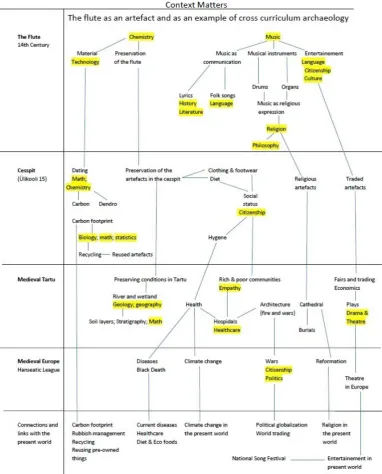
c) archaeology is a cross-curricula subject (see fig. 2) and thus links together different disciplines from arts to sciences; it brings abstract ideas to life;
d) archaeology helps to inform students about present-day issues, such as the impact of climate change on food availability and natural environment, in a historical context (Henson, 2017); e) archaeology gives knowledge of natural sciences and ancient technology as well as cultural evolution;
f) sustainable use of cultural heritage, in both public and private ownership, in the context of tourism, museums, media attention; an understanding that it is important to include different interest groups in decision-making; heightened awareness of social inclusion; ethical debate – who has the right and on what level to use the past?
Grahame Clark points out that human well-being should be the main goal of education and should be valued by its solidarity (Clark, 1943). In other words, he suggests an anthropocentric education. Kevin Bartoy (2012, p. 555) advocates teaching archaeology because it “emphasizes critical thinking and cultural relativism to serve as tools for social and cultural change”. Archaeology helps to explain how the past has shaped the present – for example, important prehistoric processes in religion, art, and agriculture influence the present world – and to understand our cultural identity and diversity, which in turn contributes to improving tolerance and empathy. As Clark (1943, p. 115) puts it “Between them anthropology and prehistory, functional and historical aspects of the same basic study, give a complete picture, both of man's place in nature and the emergence, development, and functioning of human society”.
3 THEORETICAL FRAMEWORK
Based on the previous researches and outreaches which are briefly discussed above, I find that it is problematic that archaeology outreach is mostly project-based and there are few evidence-based types of research of benefits of archaeology teaching in schools. I hypothesize that through archaeology, it is possible to link different school subjects and because of that, school subjects’ connections with everyday life come clearer; various aspects of human nature, such as empathy, can be enhanced through the study of a human being in the longer timeframe.
Knowledge gained in summer camps, weekend seminars, or even a one-week intense archaeology courses will be forgotten shortly afterwards. Perhaps longer courses would be useful, for spacing out the lessons over a longer period demands more effort in recalling relevant concepts, and more effectiveness is achieved (Brown, Roediger III, & McDaniel, 2014). As short-term workshops and practical activities do not require recalling previously learnt concepts as much, their main value lies in getting people interested in a topic, and not in developing long-term knowledge and skills. Based on the theory of Brown et al. (2014), I am trying to achieve imparting long-term knowledge and skills by dividing archaeology teaching into portion-sized bits administered over a longer period. One introductory course in the 10th grade; Estonian prehistory (part of the Estonian history course) in the 11th grade; and combined religion and material culture course in the 12th grade for those with a deeper interest in archaeology. Stretching archaeology teaching over a longer period, recalling previous courses, and improving their skills (such as critically evaluating various sources and interpretations) could lead students to long-term benefits they can use in real life.
(ibid.), history is constructed by historians and students’ can do it too (Bruner, 1996); b) recalling and long-term results (Brown, et. al, 2014).
One focus of archaeology teaching is empathy. Empathy is a complicated term that comes from the Greek word empatheia, which means physical affection or passion, ability to feel ‘with’ others. In psychology, there are as many as 17 different definitions for the term, and it is debated if there is a conceptual difference between archaeologists' and psychologists' understanding of empathy (Yilmaz, 2007). The term ‘historical empathy’ may be partly applied to archaeology as well, although archaeological material differs from written sources and thus the inception of the interpretation is not the same. There are several types of research about historical empathy and how to apply it to history teaching (see, De Leur, Van Boxtel & Wilschut, 2017), but it is less represented in archaeology education, even though it is sometimes mentioned (see, for example, Cole, 2015). Historical empathy is described as a “process of understanding people in the past by contextualizing their actions” (Hoepper, 2009) or “using the perspectives of people in the past to explain their actions” (Barton & Levstik, 2004, p. 208). Fallowing Hoepper (2009) and Barton & Levstik (2004) in this article, empathy is understood as the ability to grasp others’ situation, without having the same experiences and in historic context – perspectives of people in the past to explain their actions. I would not like to fall into a debate about the term, although empathy is being conflicted in a context of sympathy and empathy meaning. Some scholars have abandoned the term using instead perspective-taking, rational understanding, understanding people in the past (Barton, & Levstik, 2004). In this article, empathy is used since the term is more understandable for students than the ones mentioned above.
Estonian National Curriculum (2011) supports historical empathy teaching, ‘empathy, skill to put yourself into another person’s situation, considering the time period’. The question is how to measure the course impact on students’ behaviour and/ or beliefs? Based on at the beginning and at the end questionnaire it is possible to notice the change, but an in-depth understanding of how the study of the past influenced the students' empathic skills is impossible to say.
The theoretical frame of this article is multiple-case study research in Estonia where empirical material is researched in cross-case methods (Yin, 2018). In this case, two classes of archaeology and students’ questionnaires are compared in some questions. Field trips portfolios are analysed for understanding the students’ thoughts towards archaeology field trips. Group A forms the main bulk and group B is more like a set of appendices. Part of the study is based on action research theory. “Action research aims at changing three things: practitioners’ practices, their understandings of their practices, and the conditions in which they practice” (Kemmis, 2009, 463). Generally, it means that researches of social situations are researched by practitioners in purpose to improve a certain specific aspect of the activity (Hopkins, 2008). In this case, it would be archaeology teaching in Tartu Tamme Gymnasium. Action research researcher is foremost a practitioner who raises the level of professional development to improve teaching and concentrates on his/her school/ class/ subject context (Ryhammar, 1989). This research fits with this description partly, because one area of my research is my own designed archaeology course and teaching methods. But the higher purpose of this research is to question if archaeology teaching is beneficial in high school and what values it carries, do students understand and feel that too. It does have broader leverage than my school.
Theoretically, I try to fill the gap between the practitioners and theorists by having an academic background in archaeology and in education which gives me the knowledge in areas such as subject of matter, a human cognition, and instructional methods; and in the same time being a teacher in high school where I can apply theories into practice and analyse the practical value. Teacher expectations might influence the student choice, as might the time of day when the task was assigned (Davis, 2005). Subjective component stays, although I try to minimize it by collecting empirical data using different methods and sources.
4 METHODOLOGICAL ASPECTS
designed high school archaeology courses (since 2011), and student archaeology course questionnaires from 2018 (group A, 36 students; focus group in the survey) and results are compared for validity to next year (2018/19) course students (Group B, 35 students).
I taught twenty 75-minute lessons and had a three-hour field trip as a part of the spring practice with 10th-grade culture class (aged 15-16, group A). They had previously visited an archaeology lab and a storage room at the University of Tartu. Archaeology was an obligatory course for them. The various empirical material is analyzed, such as students’ course questionnaire, lesson feedback, practice portfolio and test; archaeology curriculum and lessons.
4.1 Design of archaeology course
In the Tartu Tamme Gymnasium homepage, there are all the current term syllabuses including archaeology and school curriculum. Lesson descriptions are seen for students and parents in an e-platform called Stuudium. Since the first archaeology course in 2011 (Põlva Co-Gymnasium) it has enhanced in theory and practice. It has been an elective or a compulsory course, an intense one week course in Võru Gymnasium and stretched over three years in Tartu Tamme Gymnasium.
Therefore, I rely on a cross-case analysis of different school institutions and managing various archaeology curricula that I have designed. That cross-cased knowledge can be put into service for broader purposes (see, Khan & VanWynsberghe, 2008). Tartu Tamme Gymnasium curricula were assessed by Innove (an educational competence Centre in Estonia) in 2019 and social sciences including archaeology were approved.
4.2 Students survey
Research methods are to a great extent determined by the questions being asked, but the idea is not to let a particular methodological approach limit what might be learned (Davis, 2005). To see the influence of archaeology course group A answered the questionnaire at the beginning of the archaeology course (6 March 2018), and at the end of the course (24 May 2018) they filled in a second modified questionnaire. For a cross-case analysis, group B did a similar questionnaire at the beginning (28 November 2018) and at the end of the course (14 February 2019). Course questionnaires measure immediate opinion, mind-set about archaeology. One course cannot make a conceptual change in students’ minds but may develop understanding, interest, and skills. It is considered that there might be other factors outside the course which may influence students’ opinion, but those are even harder to measure.
It is often the case that when a project is over, we get feedback, fill the report saying it was excellent, and apply for another grant. What happens to participants after the end of the project? Do they still use the gained knowledge or have they forgotten it all and moved on? Therefore, I try to avoid making final conclusions just from instant feedback. For further research, I have collated group A feedback with that gathered from the prehistory part of the Estonian history I course. To see longer-term results, I will do a similar questionnaire in 2020, just before the group A graduate high school.
Most of the questions were the same at the beginning and the end, but from the perspective of ‘did the course fulfils their expectations’ and ‘did it change their understanding of archaeology and the way of thinking of past and present’. From 22 questions four were close-ended and because of the qualitative research, the rest were open-ended so that participants have greater opportunity to express their knowledge/ opinion/ emotion. Students were allowed to use nicknames, so I could track the changes and improvements of a person during the course and evaluate their development and the usefulness of the course. At the same time, I get fair answers, because they can be honest and they do not have to worry about my opinion of them. Also, the test, which they did in the middle of the course, gave an idea of the knowledge that they gained in archaeology.
students to recall, integrate new knowledge and highlight what they thought was the most important. This conclusion gives an idea of student opinion, what they think they gained from the lesson including new knowledge and skills, but it does not apply to real knowledge and skills achieved in the lesson.
4.3 Field trips
The Estonian National Curriculum (2011) instructs teachers to make use of different learning environments such as museums, archives, exhibitions, and historical-cultural environments like sites, labs, different religious sacred places, and so forth. Schools must enable at least two field trips per year. Therefore, it is good if the field trips are cross-curricula and involve different subjects and teachers, so that students could put the knowledge gained in the classroom into practice.
Discussion in the field trip section is based on empirical data collected in the field observation, students’ practice portfolio (group A and B) and Instruction course for culture class portfolio (group B) and Võru Gymnasium students’ essays (2015). Those portfolios give an overview of students’ attitudes towards archaeology. In instruction course portfolios are described nine culture related field trips, such as Estonian Literary Museum, Viljandi Culture Academy, different University of Tartu departments. They had to follow the structure: date, location, lecture names, description of the lecture/practice, new knowledge gained and new terms and terms descriptions. Student’s practice portfolios are more like diaries - description of days and their tasks. It is important to note that those portfolios were presented for another teacher who led the course and they did not know that I will analyze them.
5 APPLYING THEORY INTO PRACTICE
Next, I will show how those theoretically debated advantages described above work in practice, for example how my designed archaeology curriculum works in the classroom and the field trips. History as a science has changed, it does not seek the ‘truth’ of the past, instead, it is focused on the dialogue with evidence and interpretation which is situated within the larger context of complex narratives of interpretations that draw their meaning from the present as much as the past (Sandwell, 2007). There is also paradigm change in schools – not only the subject itself but the subject integration with other subjects and links to everyday life matters. Therefore, history teaching including archaeology has transformed from lecture to dialogue, instead of telling the facts, you can interpret shreds of evidence together, use various methods that students could discuss with each other and discover the links with the past and the current world.
5.1 Archaeology as a cross-curriculum subject in Tartu Tamme Gymnasium
Clark (1943) claims that the major problem in education is that curricula are full of unlinked subjects that are “abstracted from their context in life, and bearing little or no relationship to one another” (p. 115, see also his links pp. 116-117). Partly based on these critics I designed archaeology course 2011 and have improved it ever since by analysing practical activities with students and their feedbacks and applying different theories and researches e.g. neuroscience, into practice. In the archaeology syllabus, I focus on cross-curricular thinking and produce a module of archaeology teaching to empower other teachers to create their curriculum based on their resources and co-operation opportunities with other teachers. The next paragraph describes how I have linked archaeology with different subjects.
importance of concentration. Secondly, parallels with prehistoric/past societies – they were complex and complicated worlds, but through time and different generations, information was lost and now we see a much-simplified version. The third topic was the importance of communication and if we cannot ask the source, then we have to interpret and sometimes add false information which influences the veracity of the result. In the group A feedback, 18 out of 33 mentioned the phone game in some context (and two mentioned the activity indirectly). Different skills were mentioned in the feedback, such as analysing, listening, concentration, paying attention, asking questions, discussing topics, and drawing, communicating, and understanding the value of the context. Most of the skills which they develop during the class are subliminal, but if you pay attention to it then students start to notice the progress and will see the wider use, not just archaeology.
Photo 1: The Recorder from the cesspit. Tartu City Museum. (TM A-141: 170) by Eero Heinloo
Photo 2: Tartu recorderís finding place – latrine made of logs. By Andres Tvauri
In the object analysis, I focus on only one object – a middle-age recorder made of maple (photo 1), found in a cesspit (photo 2) in Tartu (fig. 1) (Tvauri, Utt, 2005). That makes a great example of cross-curriculum study and understanding the importance of context (see the links with different themes and subjects fig. 2). The cesspit is a closed context that “contains a concentrated form of artefacts and comestibles, remnants of the behaviour of the people who used them” (Rathje & Cullen, 2001, p. 10). Students can interpret the rest of the cesspit findings and create the Medieval Tartu citizen profile – what they ate and how they lived, what music they listened and the clothes they wore, for furthermore I urge to research their beliefs (burials and Cathedral) and entertainment (fairs).
Recorder lesson links to the ‘Rubbish Bin’ method, which is widely used to teach archaeological stratigraphy. This method leads to two major intertwined outcomes. Firstly, the knowledge about soil types and layers is relevant because the preservation of items depends on the chemical composition of the soil (fig 2). Secondly, studying the contents of the rubbish bin shows us the carbon footprint of people today and in the past. As an assignment, one student will write up the contents of the rubbish bin and another has to portray the owner based on his/her rubbish. The next task is to show which materials will be preserved for 10, 100, 500, or 2000 years and how we can use that information to interpret data as time passes. This background allows us to analyse the contents of the cesspit and find out more about the lives of people in medieval Tartu. Studying the carbon footprint leads us to our garbage and its preservation (fig 2). The method presented by William L. Rathje & Murphy Cullen (2001) for analysing present-day rubbish using archaeological methods is a wonderful example for students to learn about the kinds of problems we are facing today and the importance of archaeology in understanding human behaviour. It is also worth discussing the importance of recycling today and in the past and whether the people of ancient times were more environmentally conscious, less wasteful, or there were simply fewer of them. Group B found this lesson interesting, 18 students from 26 mentioned rubbish and some of them expressed their surprise ‘archaeologists can make many conclusions and proper analysis based on rubbish’, ‘I would have never guessed that based on things that person throws away, you can make so many assumptions’. It put students to think about what kind of footstep they leave behind.
Another lesson is about chemistry and physics. The preservation of finds in the ground depends on the environment and how it has changed over time. In a waterlogged environment, such as a swamp, oxygen transfer is greatly reduced and the effects of sunlight are absent. Since the temperature varies only in the top layers, decomposition will be slowed down and organics, which otherwise would be destroyed, remain largely intact. Other good examples of natural conservators are ice, for example, Iceman Ötzi (Fowler, 2000), and hot desert sands, for example, textiles (Mannering, et al. 2013). Basic knowledge of chemistry is needed during digs when an archaeological finding needs to be removed from its burial environment. For instance, removing wood from a water-saturated environment insist immediate action to keep it wet, as it cracks when it dehydrates. When ceramics that are suffused with soluble salts dry out, the forming salt crystals can seriously disrupt the ceramics' structure and cause cracking and surface loss. Therefore, it is pivotal to know about the find's surrounding environment and act accordingly while excavating and extracting the find.
Archaeologists use many types of analysis, such as the isotope treatment, that ‘borrow’ from other disciplines. The analysis of bones allows students to discover the gender of the deceased, define their age from teeth, if they have suffered sword wounds, or if they have had invasive surgical treatment. This, however, means that it is also important to have basic knowledge of human anatomy and illnesses – a link with biology and health care. The carbon and nitrogen isotope analysis of keratin (an insoluble protein which is found in hair, skin, and nails) shows us what people ate a couple of months before dying.
There are various applications for Info Technology (IT) in archaeology as well which are introduced to students. For example, the use of Geographic Information System (GIS) is extensive in archaeological surveys, for it enables making 3D models of the finds and applying physical analysis techniques, such as the X-Ray Fluorescence Spectrometry (XRF) to learn the chemical composition of the find. This adds to new knowledge of ancient technology and conservation treatments.
Archaeology provides the broader context for new knowledge and links different disciplines which in turn supports a better understanding of archaeology. The examples from the archaeology curriculum given above show that archaeology provides a context in which students can see a practical application of other subjects that might otherwise remain abstract knowledge learnt in the classroom.
5.2 Field Trips as an example of cross-curriculum teaching
should ask a specialist to give a talk to the class, take the students to a lab, participate in museum workshops, etc. There are also some shortcomings with field trips. Trudie Cole (2015) brings out that in her case studies, workshops intended primarily for archaeological education were inspired by archaeology but led by an artist. This raises the question of whether the workshops deliver archaeological goals when they are led by non-archaeologists. How can the teacher know that some workshops are led by non-specialists?
One possibility is to visit universities where you can be sure that you get up-to-date data. For example, both A and B group visited the archaeology lab at the University of Tartu, students were shown different conservation techniques, climate conditions of the storage rooms, examples of finds under the microscope – everything that goes on in the lab and what ‘real archaeologists’ do. From group B, 25 of 31 students found that the most intriguing things were bones and that they could see and touch things at the lab. One student noted: ‘Researching bones and what you can ‘read’ from a skull. To see those bones and skulls and to ‘read’ this information, in reality, was totally different from the theoretical explanation in the classroom.’ Furthermore, they would have wanted to see archaeologists’ everyday life and work even more, because they already knew quite a lot of theoretical background of archaeology based on their portfolios. This shows that they need ‘real’ artefacts and people.
I will analyse the field trips to heritage sites with group A in spring 2018 and group B had a similar field trip in 2019. 2018 was the first time when archaeology had been included in the cultural class practical week. The main goal of the practical week was a hands-on approach to the local history of Seto and Võru Counties. History was linked with language, music, art, nature, and folklore. The aim was to give them a more sophisticated understanding of interdisciplinarity, culture and the past. Different methods were used, for example, students interviewed local people, put up plays based on medieval stories at Vasteliina castle, learnt about the language, danced local folk dances, and created music. After two and a half days, they arrived at Rõuge Iron Age Experiment Farm. I introduced the Rõuge hill fort and excavations which took place in the 1950s – this is the only hill fort whose courtyard area has been fully excavated. All this information was linked to the course materials and hints were given that they will need this knowledge for the Estonian History I course. The Rõuge experiment is also described in the Estonian History I textbook (Kriiska, et al 2014), which makes it perfect for recalling and linking it with the classroom activities. The A group students participated in different hands-on workshops, such as corn-grinding, fire-making with a flint, playing Viking Age games, and handled weapons. In student portfolios, they described it as an exciting and useful excursion where they could try different things.
I had an intense one-week archaeology course in Võru Gümnaasium with 16 students in 2015. To get their attention I first led a field trip to Võru County archaeological sites. The landscape has a great impact on our mind and imagination (Davis, 2005) therefore to grasp all the senses it is essential to go on the site and feel it. In the following two workdays of lecturing and discussions, I referred to the sites we visited and students had to recall and connect it with the bigger picture of archaeology. On the fourth day, we went to the Archaeology Lab and storage rooms at the University of Tartu. The final day was for feedback and writing an essay about archaeology. In their essays, students expressed their surprise how much archaeology is around them. It would be impossible to get that result in lectures and showing slides. Using local resources and people connects students with the community and shows archaeology from different perspectives. Even though archaeology is frequently associated with Ancient Egypt, it is as important to connect the so-called “big archaeology” with local history.
6 ARCHAEOLOGY COURSE STUDENT SURVEY
6.1 Students’ acceptance of archaeology
Terry Haydn (2005) points out that learning outcomes are influenced by attitudes to learning the subjects and referring to Lomas, who emphasized that commitment and interest are major factors. He claims that if students care about the past their learning about history improves. Neuroscience advocates that “a small amount of knowledge can pique curiosity and prime our hunger for knowledge” (Collins, 2016, 71). The NEARCH (2017) project shows that 90% of Europeans find archaeology useful, 54% find that archaeology is a field for which you can feel an attachment while 61% have wished to participate in archaeological excavations and 27% to become an archaeologist. That makes a good foundation for the argument of archaeology teaching in schools.
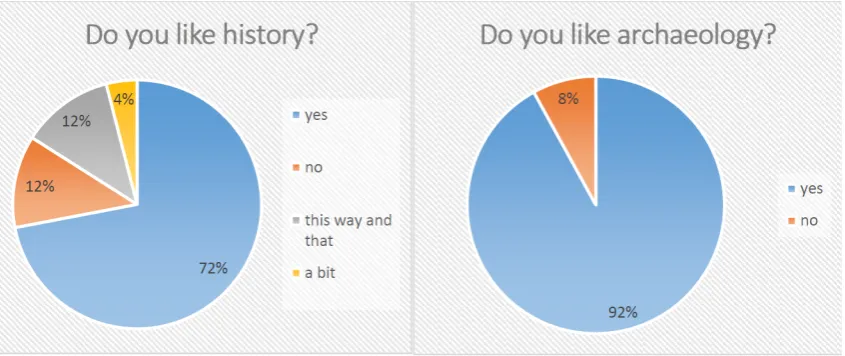
My research reflects similar results group A (see, fig. 3 and fig. 4). Twelve students were not sure if they liked archaeology at the beginning of the course because they were not exactly sure what archaeology is. Seven of them liked archaeology at the end of the course, and five were not present for the questionnaire during the last lesson. Several students commented that they started to like archaeology more when they found out what it was and what archaeologists do.
Figure 3:Group A feedback from the first lesson in the archaeology course. 33 out of 36
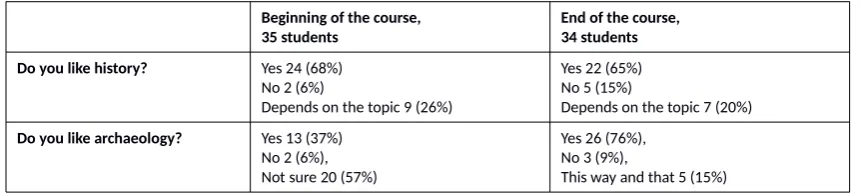
Group B (see, table 1) had similar trends, the more they got to know, the more they liked, for example ‘I did not know what to think about archaeology in the first place, but now I have only positive emotions’ or ‘Interest growth during the course’. On the other hand, one felt that the course was a disappointment ‘Archaeology seems much more boring than in the first place’. It may be influenced by television or films, such as Indiana Jones or Egypt mummies, that archaeology is hard work and everything does not shine.
Table 1:Group B feedback at the beginning and the end of the course
Beginning of the course, 35 students
End of the course, 34 students
Do you like history? Yes 24 (68%) No 2 (6%)
Depends on the topic 9 (26%)
Yes 22 (65%) No 5 (15%)
Depends on the topic 7 (20%)
Do you like archaeology? Yes 13 (37%) No 2 (6%), Not sure 20 (57%)
Yes 26 (76%), No 3 (9%),
This way and that 5 (15%)
Haydn’s (2005) theory was confirmed in this survey, group A - 92% liked archaeology and 72% liked history, this is reflected in the archaeology and history test results (Table 2). In archaeology tests, they achieved better grades. Compared with other year student test results (table 3) there is a similar tendency – archaeology test grades are better than World history ones. It is not about the teacher – 2015/16 schoolyear World history was taught by another teacher, but results were similar. Group A had Estonian prehistory and Contemporary history in 2019/20, see results in table 2. There might also be subjective reasons, such as Estonian prehistory was taught at the beginning of the year and the 20th-century test was just before Christmas, so maybe tiredness at the end of the year and other tests in the same time influenced it.
For a closer look, group A took a test on 17 April 2018. The maximum score was 60 + 5 extra points. The test consisted of different questions such as: what is archaeology; why is it necessary; evidence analysis; ethical questions such as what would you do if you found a treasure or what kind of dilemmas you might have if you excavated a burial ground; or compare the illicit and professional archaeology; discoveries and excavations, etc. The test results were good (see table 1) 94% were excellent or very good grades by giving the answers that reflected the understanding of archaeology meaning and analysing ethical dilemmas. The test results support the students’ questionnaire where they found archaeology reasonably beneficial and could explain why they thought so.
Similarly, they took an Ancient history test a week earlier, which was analogously designed, the maximum score was the same, 60 + 5 extra points. The test consisted of different questions, such as name an event or a person from Ancient Greece history that was the most important for Ancient Greece and today, explain it; describe your life as a Greek slave; if time-travelling was possible and you would find yourself in Ancient Rome, describe your sightseeing tour, what would you eat, drink and where would you spend the night; what means ‘crossing the Rubicon’?; who was Plato and why is he important nowadays? Or they had to compare the phenomenon’s in Greece and Rome. The test was built up to link the Ancient and present world, and develop historical empathy to understand past people's lives and living conditions.
Table 2: Culture class archaeology and history test in the spring term 2018, Estonian prehistory and 20th century in the autumn term 2018
Points 60-54p 53-43p 42-30p 19-12p 11-0p No of students
in the class
Test and year Grade 5 4 3 2 1
Archaeology 2017/18 No. of students 18 16 2 0 0 36
Percentage of students
50% 44% 6% 0 0
World history 2017/18 No. of students 9 17 9 1 0 36
Percentage of students
25% 47% 25% 3% 0
Estonian prehistory 2018/19 No. of students 12 16 3 1 0 32
Percentage of students
38% 50% 9% 3% 0
Contemporary history 2018/19
No. of students 3 5 15 7 2 32
Percentage of students
9% 16% 47% 22% 6%
Table 3: Archaeology and history test comparison with different classes in Tartu Tamme Gymnasium
Points 60-54p 53-43p 42-30p 19-12p 11-0p No. of
students in the class
Test and year Grade 5 4 3 2 1
Archaeology 2018/19 No. of students 12 18 4 1 0 35
Percentage of students 34% 52% 11% 3% 0
World history 2018/19 No. of students 5 16 12 1 1 35
Percentage of students 14% 46% 34% 3% 3%
Archaeology 2016/17 No. of students 13 9 3 0 0 25
Percentage of students 52% 36% 12% 0 0
World history 2016/17 No. of students 9 5 6 5 0 25
Percentage of students 36% 20% 24% 20% 0
Archaeology 2015/16 No. of students 12 10 5 0 0 27
Percentage of students 44% 37% 19% 0 0
World history 2015/16 No. of students 8 11 5 2 1 27
Percentage of students 30% 41% 19% 7% 3%
• You can find out a lot about yourself.
• You can dig things up and research them; excavation and discoveries; you can get so much information from one little thing.
• You can travel into the past with finds; knowledge of past people.
• Field trips; we can be the past’s myth-busters.
In answer to the question “Why is archaeology boring?” eight (24%) said it was not boring or did not answer the question.
Two main things mentioned were that archaeology is time-consuming (8) and that it is too theoretical (7). Here are some examples from the beginning of the course:
• Too much fact-based or mostly theoretical work.
• Time-consuming; long working hours; cleaning the finds and researching them takes too much time; sometimes you need a lot of patience.
• You find a lot of similar things; you rarely find new things.
• Soil could be very boring and you cannot dig in the winter; past things might be boring or all finds are not ‘cool’; pottery.
• You need to concentrate a lot and this might make you lose interest.
End of the course questionnaire answers, however, were more diverse. In contrast to the answers given at the beginning of the course, discoveries/finds are found interesting (10 out of 25), and knowledge about the past is also mentioned (3). Here are some examples:
• Excavations are a bit mysterious; amazing discoveries; new finds and new information is always interesting; you never know what you can find.
• It makes you think further; it is interesting and useful for life.
• So much information about the time when I did not exist; we can get a glimpse of human evolution because it is like a dialogue with past people.
• Practical; logical course; it links to other subjects if you take it as a school lesson; it differs from other school subjects.
And 8 of 25 (32%) found that archaeology is not boring at all, but there were several diverse answers and here are some examples what students think as a negative side of archaeology at the end of the course:
• Here you have to analyze and record; a lot of preparation; a lot of theory; making presentations.
• You have to be patient; maybe you dig in the wrong place and do not find anything. If some culture has not developed fast, it is boring.
• I wouldn´t want to participate in archaeological excavations, once I dug a house foundation and it was horrible.
• You cannot chew gum in the archaeology lesson.
At the end of the course, two students did not like archaeology, so I looked at their answers: one said ‘archaeology is cool because excavations are a little mysterious, but I found archaeology boring because there is too much paperwork’. Another said, ‘amazing discoveries are cool but the boring part is the pottery in the soil’. Even though not all of them liked archaeology, they saw its benefits. Interestingly, those who liked archaeology pointed out the boring aspects as well. This raises the question of how the students understand the concept of “like” and “dislike”? The answer to this question, in turn, determines how to interpret the students’ answers.
trend – 29%, 53%, and 69% correspondingly – in students perceiving history as useful (Haydn, 2005), which reflects public archaeology growth. It is easier to teach if students are interested in and are eager to learn, but for that, they have to know why it is useful for them. In Haydn’s (2005) survey, students were often unable to say exactly why history is useful.
In this case study both groups answered the question “why is archaeology beneficial?” at the beginning and the end of the course, some answers are grouped in table 4. Compared with other questions, such as “Do you like archaeology” – some did not like, but they still found archaeology useful. Therefore it reflects their opinion on the value of archaeology. Group B answers differed in one aspect – several students mentioned empathy at the end of the course. Otherwise, both groups reflected similar thoughts, although group A answers were a bit more sophisticated at the beginning, group B had more depth ideas at the end. The focus of the answers was look alike at the beginning and the end, but in the end, it was a deeper understanding of the subject and its relevance, seemed that they have understood why past matters. Answers indicated that students were able to see the usefulness of archaeology, which means that they did not just describe the past, but saw the possibilities to learn from it.
Table 4: Group A and B answers comparison ‘why archaeology is beneficial?’ at the beginning and the end of the course
Group A Group B
At the beginning of the course
To understand history better and to create a world-view of the past; it helps to understand where we came from and what life was like before we were born; helps to understand past societies, people’s mindset, and analyse their customs.
How people lived in the past and how they managed it.
Explains people’s nature, activities and practices in the past.
It gives knowledge which is useful in every person everyday life.
Got information about climate, how long some species have lived in Estonia, what was life like before.
If we do not know what happened in the past it is hard to predict future processes.
We get to know from where we originate and what we did before.
We get information previous generation.
At the end of the course
We can understand life around us better through archaeology (history etc.). Archaeology is important because you get information about history, and archaeology has cultural and national value as well.
It helps to see and understand the past, thus helps us to see the present too and in a way to predict the future; it forced us to think about the life in the past and present; because you start to understand what surrounds you and understand the past.
Researching how life was in the past and learning from it.
List: to understand the past, interpretation, research, making connections to the present; to understand, how people behaved in the past and how we have reached to the present-day.
To understand our old traditions better, but also other cultures’ dress, diet, customs etc.
To understand the past, know where the customs come from and understand the human being.
We can understand more about ourselves, where we come from, customs, traditions, and where they come from.
Archaeology is useful that we could get more information about ourselves and I think ourselves as a (human being) collective body; archaeology teaches how mankind, science and technology have reached so far.
Helps to understand the living conditions and history of different folks.
Develops empathy, makes us value our heritage more and a lot interesting facts; archaeology is useful because it teaches source criticism and empathy.
reliable sources; team-work, interpretation; improvement in the skills of analysis and listening, asking questions; I can differentiate male and female skeletons, and I developed my teamwork and attention skill. What to do when I find a treasure. Group A also mention illicit archaeology and group B mentioned empathy several times. One of the answers sums up the whole idea of archaeology: ‘I discovered how to learn about people just by looking at their things’. According to Corbishley (2015, p. 125), the value of the object is “what can be deduced from the object to help to understand peoples and events in the past”: an idea that surfaces several times in students’ archaeology course feedbacks.
7 EMPATHY AS A FOCUS
Empathy in archaeology especially in the archaeology pedagogic field has been studied very little, although it has been mentioned by several researchers (for example, Cole, 2015; Davis, 2005; Stone, 1994) and this section highlights the need for more in-depth research.
Archaeology offers many possibilities to practice empathy and teaches tolerance through people and the environment of the past. Teaching past cultural diversity helps to understand and manage it better in the present world. “Cultural relativism — or viewing cultures according to their terms and values — is essential to interpreting the past” (Arendt, 2013, p. 81) and it helps students to cope with the current world as well. Cole (2015, p. 129) gives an example of feedback from one of her case studies: “How they could walk around in such heavy clothes”, showing empathy towards people from the past. People are interested in people and this expands to the people from the past and their everyday lives as well. The Alexander Keiller Museum asked some students what they wanted to learn from the museum (Stone, 1994, p.p. 195, 205). The answers varied, but they all reflected daily life:
• About home: where did they go to the toilet, how did they wash and do make-up, what did they wear, what did their houses look like, what did they eat.
• Existence: about death, birthdays, parties, what did they think of the world.
• Childhood: games and toys, did they go to school.
There were also questions linking the past and the present, such as ‘are there physical difference between them and us?’ (Stone, 1994, p. 205). Fourth grade students’ perception and construction of the Pueblo people survey in the USA had similar results, such as how many enemies they had, what did they do for fun etc. (Davis, 2005, 72). They wanted to know about the lives of the past people, compare them with the present and learn from it. It is possible to apply this curiosity to teaching an understanding of others and their lives without bias or discrimination.
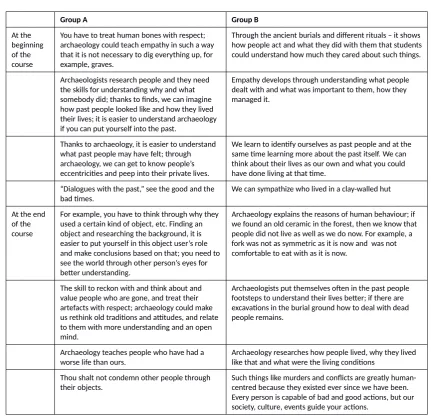
Table 5: Selection of group A and B answers of ‘how archaeology teaches empathy’ at the beginning and the end of the course
Group A Group B
At the beginning of the course
You have to treat human bones with respect; archaeology could teach empathy in such a way that it is not necessary to dig everything up, for example, graves.
Through the ancient burials and different rituals – it shows how people act and what they did with them that students could understand how much they cared about such things.
Archaeologists research people and they need the skills for understanding why and what somebody did; thanks to finds, we can imagine how past people looked like and how they lived their lives; it is easier to understand archaeology if you can put yourself into the past.
Empathy develops through understanding what people dealt with and what was important to them, how they managed it.
Thanks to archaeology, it is easier to understand what past people may have felt; through archaeology, we can get to know people’s eccentricities and peep into their private lives.
We learn to identify ourselves as past people and at the same time learning more about the past itself. We can think about their lives as our own and what you could have done living at that time.
“Dialogues with the past,” see the good and the bad times.
We can sympathize who lived in a clay-walled hut
At the end of the course
For example, you have to think through why they used a certain kind of object, etc. Finding an object and researching the background, it is easier to put yourself in this object user’s role and make conclusions based on that; you need to see the world through other person’s eyes for better understanding.
Archaeology explains the reasons of human behaviour; if we found an old ceramic in the forest, then we know that people did not live as well as we do now. For example, a fork was not as symmetric as it is now and was not comfortable to eat with as it is now.
The skill to reckon with and think about and value people who are gone, and treat their artefacts with respect; archaeology could make us rethink old traditions and attitudes, and relate to them with more understanding and an open mind.
Archaeologists put themselves often in the past people footsteps to understand their lives better; if there are excavations in the burial ground how to deal with dead people remains.
Archaeology teaches people who have had a worse life than ours.
Archaeology researches how people lived, why they lived like that and what were the living conditions
Thou shalt not condemn other people through their objects.
Such things like murders and conflicts are greatly human-centred because they existed ever since we have been. Every person is capable of bad and good actions, but our society, culture, events guide your actions.
At the end of the course, descriptions are more clear and precise; understanding has improved and group A mentions illicit archaeology several times.
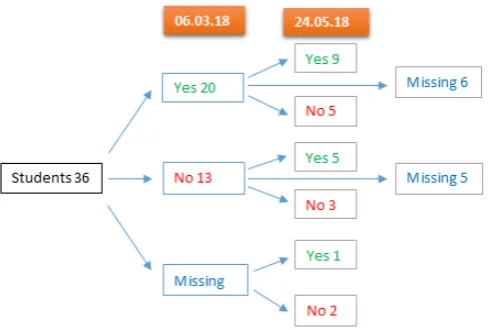
Figure 5: Group A feedback on whether archaeology teaches empathy before (06.03.2018) the archaeology course, and how it changed by the end of the course (24.05.2018)
Figure 5 demonstrates that some students gained a clearer idea about empathy during the course. At the same time, some still did not accept that archaeology could teach it. Students might have developed different understandings about past people and empathy, but one course is too short of a period to change people’s conceptions fully and two questions in the questionnaire were insufficient to give a complete idea of their ideology and understandings. Some answers were good reflections of the Keith C. Barton & Linda S. Levstik's (2004) definition of historical empathy. ‘In archaeology, it is important to understand what people thought and felt in the past’.
It is hard to say what is the value of archaeology because it is divided into tangible and intangible areas, and because many things cannot be measured – empathy being one of them. Therefore, it is easy to say archaeology increases empathy, tolerance, and identity, but difficult to measure it. Theoretically, it increases the emotional connection with the past, but it is impossible to say to what extent. You put your hand against a church and think about somebody else who has done the same thing centuries ago – it is like shaking hands with past people through the object (Henson, 2009) and students empathized with this as well: ‘Understanding people’s private life through finds’. Places are the same, the environment may have changed, but you can feel an echo from the past. Identity is about being aware of your own culture and heritage value and respecting other people’s cultures. Understanding that culture is a changing phenomenon. Of course, different perspectives in history do not immediately guarantee that they accept those differences in the present world, but it helps to create the conditions that might be possible (Barton, & Levstik, 2004).
8 CONCLUSION
Archaeology in schools is a form of public engagement that is beneficial in many ways. It links together different and sometimes abstract subjects and gives an understanding of long-term human behaviour, which allows developing students’ empathy and tolerance. In this case study, I demonstrated how those theoretical ideas work in practice describing various methods and field trips and analyzing students’ feedback.
Archaeology not only develops various skills but also helps to link different subjects (fig 1) to everyday life. The connection between past and present helps to elucidate environmental changes and how they have affected people’s lives. Besides, analyzing long-term human behaviour supports an understanding of human nature, emphasizes empathy and tolerance, and encourages social cohesion. The idea of archaeology education for the student is to experience the past and being human through artefacts and other archaeological data. And through field trips to sites and labs, it comes more feasible.
Archaeology education should not be project-based, i.e. with short-term goals, but instead an enhanced understanding of associated personal development. This case multi-case research shows that this field needs further research especially in the empathy part and also to see does archaeology helps to make better learners and is it true that it makes people interested in the world around them.
REFERENCES
Archaeology in Europe Educational Resources. (n.d.). Archeurope Educational Resources. Retrieved from http://archeurope.info/
Arendt, B. (2013). Making it Work: Using Archaeology to Build Job Skills for Careers Other Than Archaeology. Public Archaeology, 12(2), 79-100. DOI:10.1179/1465518713Z.00000000032
Barton, K. C. & Levstik, L. S. (2004). Teaching history for Common Good. New Jersey, London: Lawrence Erlbaum Associates.
Bartoy, M. K. (2012). Teaching through Rather than about. Education in the Context of Public Archaeology. In R. Skeates, C. McDavid, & J. Carman (Eds.), The Oxford Handbook of Public Archaeology. Oxford: Oxford University Press.
Baugher, S. (2013). Confirming Relevance: How American and Canadian Archaeologists Are Training Youth and Adults in Archaeology, Heritage Studies, and Community Partnership. In J. H. Jameson, J. Eogan (Eds.), Training and Practice for Modern Day Archaeologists. New York/NY: Springer.
Black, M. S. (2001). Maturing Gracefully? Curriculum Standards for History and Archaeology. The Social Studies, 92:3, 103-108. DOI:10.1080/00377990109603986
Brown, P. C., Roediger III, H. L., McDaniel, M. A. (2014). Make it stick. The Science of Successful Learning. London: The Belknap Press of Harvard University Press.
Bruner, J. (1996). The Culture of Education. Cambridge; Harvard University Press Clark, J. G. D. (1943). Education and the study of man. Antiquity 17(67), 113-121.
Cobb, H. & Croucher, K. (2014). Assembling archaeological pedagogy. A theoretical framework for valuing pedagogy in archaeological interpretation and practice. Archaeological Dialogues,21(2), 197-216. DOI:10.1017/S138020381400021X
Cole, T. (2015). Understanding and Assessing the Theories Behind Archaeological Education. Public Archaeology, 14(2), 115-136. DOI: 10.1080/14655187.2015.1112691
Collins, S. (2016). Neuroscience for learning and development. How to apply neuroscience & psychology for improved learning & training. Kogan Page Limited: London.
Corbishley, M. (2011). Pinning Down the Past. Archaeology, Heritage and Education Today. The Boydell Press, Woodbridge.
Corbishley, M. (2015). Object Lessons in Evidence-Based Learning. In C. J. Boulter, M. J. Reiss, & D. L. Sanders Darwin-Inspired Learning (New Directions in Mathematics and Science Education, 28. Rotterdam: Sense Publishers: 117-129. DOI.org/10.1007/978-94-6209-833-6_10
CLOtC (2018) = Council for Learning Outside the Classroom. (2018). Home page. Retrieved from: http://www.lotc.org.uk/why/
De Leur, T., Van Boxtel, C., & Wilschut, A. (2017). ‘I Saw Angry People and Broken Statues’: Historical Empathy in Secondary History Education. In British Journal of Educational Studies, 65:3, 331-352, DOI: 10.1080/00071005.2017.1291902
Elton-Chalcraft, S., Hansen, A. & Twiselton, S. (Eds.) (2008). Doing Classroom Research. A Step-by-step guide for student teachers. Glasgow: Open University Press
Estonian National Curriculum. (2011). Estonian Parlament 6. Jan. 2011 decrees no. 2 National Curriculum. Legal 17.01.2011. Retrieved from https://www.riigiteataja.ee/akt/129082014021 Fowler, B. (2000). Iceman: uncovering the life and times of a prehistoric man found in an alpine glacier.
New York: Random House.
Haydn, T. (2005). Pupil perceptions of history at Key Stage 3: Final Report, October 2005. Retrieved from https://archive.uea.ac.uk/~m242/historypgce/qcafinalreport.pdf
Henson, D., Stone, P. G., & Corbishley, M. (Eds.) (2004). Education and the historic environment. London: Routledge.
Henson, D. (2009). In my view: the true end of archaeology? Primary History, 51, 7-8.
Henson, D. (2017). The Meso-what? The public perception of the Mesolithic.PhD theses. York. Hoepper, B. (2009). Historical empathy. Retrieved from https://sites.google.com/site/
empathyahistoricalconcept/historical-empathy
Hopkins, D, (2008). A teacher’s guide to classroom research. Maidenhead; New York: McGraw-Hill/Open University Press.
Jameson, Jr., J. H. & Braugher, S. (2007). Public interpretation, outreach, partnering: An introduction. In J. H. Jr. Jameson & S. Braugher (Eds.) Past meets Present: Archaeologists partnering with museum curators, teachers, and community groups. New York: Spinger: 3-18.
Jeppson, P. L. & Brauer, G. (2007). Archaeology for Education Needs: An Archaeologist and an Educator Discuss Archaeology in the Baltimore Country Public Schools. In J. H. Jameson, Jr. & S. Baugher (Eds.)
Past Meets Present: Archaeologists partnering with museum curators, teachers, and community groups. New York: Spinger: 231-248.
Khan, S., VanWynsberghe, R. (2008). Cultivating the Under-Mined: Cross-Case Analysis as Knowledge Mobilization. Forum Qualitative Sozialforschung / Forum: Qualitative Social Research, 9 (1), http://nbn-resolving.de/urn:nbn:de:0114-fqs0801348
Kemmis, S. (2009). Action Research as a Practice based Practice. ‐based Practice. Educational Action Research 17 (3): 463–474. DOI: 10.1080/09650790903093284
Kriiska, A., Mäesalu, A., Selart, A., Põltsam-Jürjo, I. & Piirimäe, P. (2014). Eesti ajalugu I, Esiajast Rootsi aja alguseni. Avita, Tallinn.
Mannering, U., Andersson Strand E. B., Gleba, M., Harris, S., Christiansen C. A. (Eds.) (2013). Archaeological textiles review, no 55. Grafisk: University of Copenhagen.
Merriman, N. (2004). Introduction. Diversity and dissonance in public archaeology. In N. Merriman (Ed.)
Public archaeology. Routledge: London. 1-17.
Nassaney, M. S. (2012). Enhancing Public Archaeology through Community Service Learning. In R. Skeates, C. McDavid, & J. Carman The Oxford Handbook of Public Archaeology. Oxford: Oxford University Press. DOI:10.1093/oxfordhb/9780199237821.013.0022
NEARCH. (2017). New ways of Engaging audiences, Activating societal relations
and Renewing practices in Cultural Heritage Europeans and Archaeology. [Home page]. Retrieved from http://archaeologydataservice.ac.uk/archiveDS/archiveDownload?t=arch-2749-1/
dissemination/pdf/NEARCH_Europeans_and_Archaeology.pdf Price, M. (1968). History in Danger, History, Vol. 52: 342-7.
Rathje, W. L. & Cullen, M. (2001). Rubbish!: The Archaeology of Garbage. University of Arizona Press. Ryhammar, L. (1989). Pedagogiskt utvecklingsarbete och professionell lärarkompetens (Educational
Sandwell, R. (2007). The internal divide. Historians and their Teaching. In M. Gordon, T. V. O’Brien (Eds.)
Bridging Theory and Practice in Teacher Education. Rotterdam, The Netherlands: Sense Publishers: 17-29
Selig, R. O. & Higgins, P. J. (1986). Practicing anthropology in precollege education. In Selig, R. O. & Higgins, P. J. (Eds.) Practicing Anthropology 8 (3-4).
Stierer, B., & Antoniou, M. (2004). Are there distinctive methodologies for pedagogic research in higher education? Teaching in higher education, 9(3), 275–85. DOI: 10.1080/1356251042000216606 Stone, P. G. (1994). The re-display of the Alexander Keiller Museum, Avebury, and the National
Curriculum in England. In P. G. Stone & B. L. Molyneaux (Eds.) The presented past, London: Routledge: 190-205.
Tvauri, A., Utt, T-M. (2007). Medieval Recorder from Tartu, Estonia. Journal of Estonian Archaeology, 11 (2), 141-154.
Vijand, L. (2018). A critical look at archaeology teaching in Estonian High Schools. Journal of Estonian Archaeology, 22 (2), 119-148. DOI:org/10.3176/arch.2018.2.02
Vijand, L. (2016). Arheoloogia – (k)õige lõimitud(m) tund!? Retrieved from https://koolielu.ee/ainekuud/ readnews/497004/arheoloogia-%E2%80%93-koige-loimitudm-tund
Yilmaz, K. (2007). Historical Empathy and Its Implications for Classroom Practices in Schools. The History Teacher,40(3), 331-337. Retrieved from http://www.jstor.org/stable/30036827