246
A Study On Mobile Agent Based Collaborative Distance Learning System
Aye Aye Seint
University of Computer Studies, Hinthada , Myanmar
Abstract
Collaborative learning is achieved either between the student and the tutor or inside a group of learner interaction with the human tutor. It enables separated users to effectively facilitate remote access for distance learning. This paper present mobile agent approach for the development of collaborative learning supports by soft- ware agents. The proposed framework use mobile agent as a personal agents to assist the students and the human tutor. An artificial tutor agent tries to patricianly replace the human during student interaction and the information agent serves as to retrieve from the information database. In addition, a crucial factor for the success of distance education is need for distance evaluation. That present mobile agent based architecture for distance learning that supports the collaborative on line learning system for open and distance learning that tries to respond to the requirements of an efficient and motivating learning process. Therefore, this approach offers to establish mobile agent based collaborative distance framework to enhance student learning process.
Keywords: mobile agent, distance learning, personal agent, collaborative learning
1.
Introduction
Agents are one of the „hot‟ topics in the fields of information systems research and development at the moment. The last ten years have seen a marked interest in agent-oriented and a distinct trend has evolved to the research. This trend relates to the diversification in the types of agent being investigated and most popular types; include user interface agent, information agent, mobile agent and so on[9]. Over the past few years, the mobile agent paradigm has emerged as a new mechanism for structuring distributed application. It promises to alleviate many of the short coming of the client server approach [10].
Mobile agent is an autonomous piece of software that can be migrate between the various nodes to the network and can perform computation on behalf of the user. Some of the benefits provided by mobile agents
include reduction in network load, overcoming
network latency and disconnected operations.
Autonomous agents and multi-agent technology play a control role in network management and system management communities for several years. The ever increasing growth of mobile agent applications are encouraging research aimed at the wide spread communication infrastructure. Mobile agent often works on heterogeneous network and operating system environment.
Therefore, an intelligent logical interface to access physical structure via mobile agent application is becomes more and more important [4].This paper presents distributed mobile agent based architecture to support the activity of learning on distance learning system.
The remaining parts of this paper is organized as follows, section 2 present computer supported collaborative distance learning system, section 3 discuss about the motivation for using mobile agent, section 4 present mobile agent based collaborative distance learning system in detail discussion of the proposed design architecture, and the related work is discussed in section 5, finally, conclude the paper in section 6.
2.
Computer Supported Collaborative
Distance Learning System
The use of computers to support learning and education already has a long history. The first programs were written to facilitate many learning models that differed only slightly in the amount and nature of the computer‟s support. Examples of these learning models are: Computer Assisted Instruction,
Computer Assisted Learning, Computer Based
Learning, Distance Learning technologies are
important research and application issues of
multimedia computing and networking [14]. There is
much positive research on computer-supported
collaborative learning (CSCL) environments in
asynchronous distributed learning groups (DLGs). There is also research that shows that contemporary CSCL environments do not completely fulfill expectations on supporting interactive group learning,
shared understanding, social construction of
convinced many educators to believe CSCL environments to be the promising next generation of educational tools for distance education. Indeed, there is already a considerable body of research reporting positive over- all performances of DLGs using contemporary CSCL environments. Mobile agent based learning is an obvious next step in distance education.
3.
Motivation for using mobile agent
Over the past few years, the mobile agent paradigm has emerged as a new mechanism for structuring distributed application. Mobile agent is an autonomous piece of software that can between the various nodes to the network and can perform computation on behalf of the user.
Although it is possible to propose an alternative, based on an existing technology, to almost every mobile agent-based function (Chess et al., 1995) [2], in certain cases mobile agents have significant advantages over conventional approaches at the design, implementation and execution stages. The motivation for using mobile agents stems from following anticipated benefits [9]:
• Efficiency and reduction of network traffic:
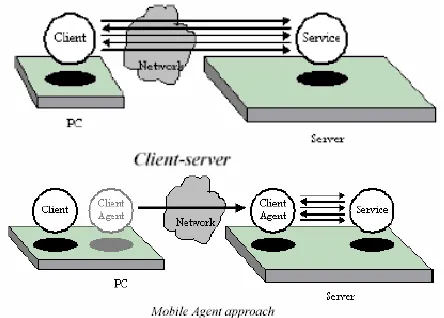
Mobile agents consume fewer network resources since they move the computation to the data rather than the data to the computation. Also mobile agents can package up a conversation and ship it to a destination host, where the interactions can take place locally, so network traffic is reduced in Figure (1).
• Asynchronous autonomous interaction:
Tasks can be encoded into mobile agents and then dispatched. The mobile agent can operate asynchronously and independent of the sending program.
• Interaction with real-time entities: Real-time entities require immediate responses to changes in their environment. Controlling these entities from across a potentially large network will incur significant latencies. Mobile agents offer an alternative to save network latency.
• Local processing of data: Dealing with vast volumes of data when the data is stored at remote locations, the processing of data over the network is inefficient. Mobile agents allow the processing to be performed locally, instead of transmitting the data over a network.
• Support for heterogeneous environments: Both the computers and networks on which a mobile agent system is built are heterogeneous in character. As mobile agent systems are generally computer and network independent, they support transparent operation.
• Convenient development paradigm: The design and construction of distributed systems can be made easier by the use of mobile agents. Mobile agents are inherently distributed in nature and hence are natural candidates for such systems.
Figure 1. Client-Server paradigm vs. Mobile Agent Approach.
4.
Proposed System Architecture
In this proposed system, Figure (2) presents proposed mobile agent based framework for a collaborative learning environment. The architecture of the system is a multi-agent, human and artificial agent together to achieve the learning task. Solid lines represent the learning and dash items represent the education. In learning system, the human tutor and others are learners. There are several agents in the system. Each learner has own personal agent, called the personal agent of learner. The tutor in the learning has own digital personal agent, called the tutor agent, which is similar to other personal agent. For retrieving information and filtering information, that can use information agent. The information agent is related to database and knowledge access. The filtering criteria may be specified by the learner and tutor and may be retrieved from learning materials provided by their own personal agent. Human tutor, tutor agent and personal agent of learner may access the information agent, which is responsible of retrieving and filtering information from specified sources that can range from learning materials. Learning materials will be stored courses materials.
Information retrieval
In learning time, connection between from each learner to learner, learner to tutor has always being in
synchronous mode. Human and agents are
collaborative together to achieve the learning goal. In evaluation time, the human tutor creates question agents (one per student) and dispatches them to each learner node. After the designated examination duration or when the learner finishes, each question agent returns to the human tutor with the learner‟s answers. The human tutor evaluate the answers, until the answers are evaluated, now creates result agent, which move to the each learner with learner‟s results.
According to Crook [3], collaborative learning
environments are electronic environments, that
support and mediate the cooperation work and leaning in a networks.
Learning Materials
Information Agent
This proposed system considers the portion of evaluation to evaluate the performance of each learner. Therefore, the proposed system, the human tutor prepares the questions and evaluates the answers by the help of mobile agent as shown in Figure (3).
The architecture of the system is divided into the following components: personal agent of learner, personal agent of teacher (tutor agent), information agent, question agent, result agent. The functionality of each agent is discussed in the next section.
4.1
Personal Agent of Learner
Personal agent of learner is responsible for
monitoring the learner‟s action. This agent
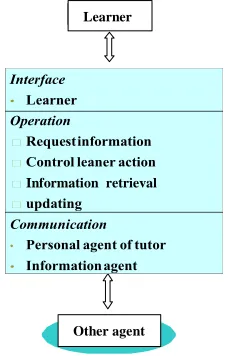
coordinates the work between other group members and observes the student behavior and acting on to complete the learning. This agent is cooperative with tutor agent and others learner‟s agent to exchange information about capabilities, commitment and learning goals of the learner. Moreover this personal agent is able to assume the role of its learner. The information may be retrieved from learning materials by the information agent. Figure (4) shows learner
agent‟s operations and commination
Personal Agent of leaner B
Request services
Personal Agent of Tutor
Personal agent of Leaner A
Request services
with other agent, such as tutor agent, other learner agents.
Leaner A Tutor Leaner B
Figure 2. Mobile agent based collaborative learning in the system
Question Agent Result Agent
Publish Results for each learner
Human Tutor
Evaluate Answers
Bring Question Answers and
Returned
Figure 4. Personal Agent of Learner
4.2 Tutor Agent
Learner 1 Learner 2 Learner 3
Each Leaner Get a Question Agent
Figure 3. Evaluation System
The second major agent in this system is the artificial tutor, named the tutor agent (Personal agent of tutor). This agent controls the course evolution of learning process. Learner‟s requests during the learning process or updating the learning materials agent. Tutor agent supply measure for the evaluation of personal performance, the team work style.
Interface
Tutor
Operation
Control course evolution Measure personal performance Built in capabilities of learning Access learning material
Communication
Personal Agent of learner Information Agent
Interface
Tutor
Operation
Move to learner with results.
Communication
learner The tutor agent is mainly built in but it has also
limited capabilities of learning from human tutor. Figure (5) shows the responsibilities of tutor agent.
Tutor
4.4. Question Agent
Question agents (one per student) are dispatched to each learner node. Each question agent carries the question to the student and waits until the specific du- ration has reached. After the duration time is over, it will move to the tutor with the student‟s answers. Figure (7) shows the operations of the questions agent.
Tutor
Other Agent
Figure 5. Tutor Agent
4.3. Information Agent
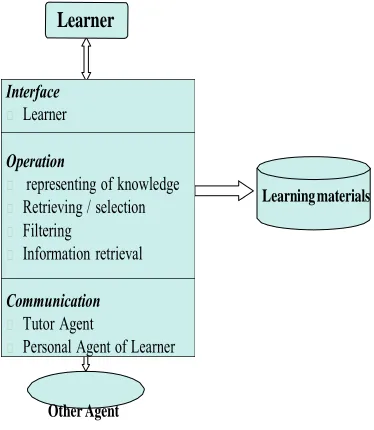
Information agent is an interface agent to access the database. It holds the representation of knowledge and maintains an interface to the data access. Both the personal agent of learner and tutor agent may access the database through the information agent. The information agent takes the responsible of retrieving and filtering information for user‟s specified request. Figure (6) shows the operation of information agent.
Learner
Figure 7. Question Agent
4.5. Result Agent
Human tutor evaluates the student‟s answers carried by the question agents. After evaluating the answers, result agent move to each learner with its result.
Learner
TutorLearning materials
Learner
Other Agent
Figure 6. Information Agent
Figure 8. Result Agent
5.
Related Work
various businesses are complex technical challenges when the application developers to develop and deploy agent application. The term mobile agent contains two distinct perceptions: agency and mobility [7].
Mobile agent is an agent encapsulates the program that receiving server is to execute, the data comprising the program‟s arguments and state. Software agents that transport themselves from a client computer to various servers for remote
procedure calls (RPCs) that are limited to
communicating data to a procedure to be executed on a remote server, mobile agent transport both the data and program acting on data within user‟s specification /configuration [4].
Many proposed Mobile Agent applications, such as the areas of e-commerce, information retrieval etc.[1] regard mobile agent mainly as a program that performs computations on behalf of the user. Mobile Agent approach need to this view and Mobile Agent s can be extremely useful as an application structuring mechanism.
The role of the software agents that supports distance education systems within virtual instruction and their specialized application in that context are mentioned in [8]. The primary purpose of the software agents in these environments is for retrieving information .
The Multiple Case-Based Approach to Generative Environment for Learning (MCBAGEL) of Georgia Institute of Technology in Atlanta is an environment for synchronous collaboration where students gather for brainstorming and planning activity and where a problem gets understood and broken into solvable pieces [17].
MCBAGEL is based on the problem solving learning method and is used with success in medical and business schools. Also from Georgia Tech is the Collaborative and Multimedia Learning Environment which supports asynchronous collaboration: students share resources found or invented while working separately. The environment is used in mechanism design classes [5].
In this paper, it considers several other qualitative features. Taking into account our teaching experience on undergraduate students, small groups of students will be conducted. Therefore, it will measure the performance comparing with traditional learning style with the proposed system. M obile agents may be particularly being suitable for structuring distributed application.
Mobile agent needs a programming language that lets users define the role of their agents as they travel across a network. So, this proposed system will be implement using java develop and Aglet. It plan to construct the courses for those students in this proposed system and conduct those cover to small
group of students to evaluate the efficiency of this proposed system. This approach aims toconstruct with the help of mobile agent among the distributed teams.
6.
Conclusion
This paper has presented a distributed on-line learning system for collaborative learning based on artificial agents. The system support synchronous and asynchronous cooperation among learners, cooperation being achieved either between the student and the tutor /expert or inside a group of learners, interacting or not with the tutor. Supporting mobile agent technology is enhanced with the emerging paradigm of intelligent human-computer interaction. The goal is to encourage distance learning student to work together, in order to promote both learning of collaboration. Collaboration means working together
on a common problem, communicating and
coordinating activities towards a shared goal . The architecture of the proposed system is multi-agent, human and artificial agent collaborating together to achieve the learning task based on mobile agent. The use of personal assistants and mobile agent based in distance learning programs can offer an interesting approach to meet education goal.
This study suggests a framework, which
contained both mobile agent communication network and mobile agent evolution states. This approaches aspired to provide to the distance learner. This is a strong case in favors of use of mobile agent in many network applications. Moreover, there is a clear evolutionary path that will take as from current technology to widespread use of mobile agents within the next few years.
Mobile agent technology will open a new interesting research area in the education, where traditional approaches are providing fruitless due to severe limitations imposed by the existing technology. Application driven in mobile agent actually improved for roaming students in distance learning environment. This study can be applied to future mobile-agent based distance learning environment.
References
[1] R. Chellappa, “An Electronic Infrastructure for a Virtual University”, Communication of the ACM, 1997.
[2] D. Chess, Harrison D. Kershenbaum,“Mobile Agents: Are they a good idea”, Technical Report, March, New York : IBM T.J. Watson Research Centre, 1995.
[4] L. Y. Deng, T.K. Shih, “Universal Access for Roaming User via Mobile Agent Technology”,
Tam- kang journal of Science and engineer- ing.Vol.5, No.3, pp. 175-185,2002.
[5] A.M. Florea, “An Agent-Based Collaborative Learning System”, published in Proceeding of
ICCE99, the 7th in ternational conference on com-
puter in education, Chiba, Japonia, 1999.
[6] J.M. Fonseca, A. Damas Mora, “Personal assistant autonomous agents for intelligent e-learning sys- tems”, International Conference WEB-Based EDUCATION.
[7] A.Frggetta, G.P. Picco, G. Vigna. “ Understanding Code Mobility ”, IEEE Transaction on Software
Engineeing,1998.
[8] Hilts S., B. Wellman, “Asynchronous Learning Networks as a Virtual Classroom”,
Communica-tion of the ACM, 1999.
[9] H. Hong, K. Xiaoqin, " Application of Mobile Agents in Web-based learning Environment. "Proceeding of EdMedia, 2001.
[10] V. Jamwal, S. Iyer,”Mobile Agent based real- izetion of a distance evaluation system”, Proceed-ing of the symposium on application and the
inter-net. IEEE Transaction paper, 2003.
[11] G. Kimovski, V. Trajkovic, D. Daveev, “Virtual Laboratory-Agent-based Resources Sharing Sys-
tem”, Faculty of Electrical Engineering and
Computer Science, 2000.
[12] K. Kreijns, P.A. Kirschner,W. Jochems,“ Sociability of computer Supported Learning Environment”, Educational Technology &
Society,2002.
[13] M. Rebollo, C. Carrascosa, V. Julian, V. Botti, “CALIOPE: An Agent-Based Personal Assistant for Learners and Teachers”, Agents in Learning
Workshop Autonomous Agents 2001.
[14] T.K. Shih, “Tutorial TS2 Methodologies and Software Systems for e-learning “, IEEE ICME,
Several other international conferences,2001.
[15] M. Thiry, S.K. Ricardo, M. Barcia, A.J. Martins, “ Intelligent Agent Based Approach for Distance Learning ”, 2001.
[16] M.F. Verdejo, B. Barros, “Supporting Distance Learner for Collaborative Problem Solving”, Pub-lished in ED_MEDIA & ED-TELECOM, AAACE,
Freiburg, 1998.