Influence of nuclear data parameters on integral
experi-ment assimilation using Cook’s distance
D.Kumar1,2,S. B.Alam1,H.Sjöstrand2,J. M.Palau1, andC.De Saint Jean1,∗
1CEA, DEN, Cadarache, F-13108 Saint Paul les Durance, France 2Department of Physics and Astronomy, Uppsala University, Sweden
Abstract.Nuclear data used in designing of various nuclear applications (e.g., core design of reactors) is improved by using integral experiments. To utilize the past critical experimental data to the reactor design work, a typical procedure for the nuclear data adjustment is based on the Bayesian theory (least-square technique or Monte-Carlo). In this method, the nuclear data parameters are optimized by the inclusion of the experimental information using a Bayesian inference. The selection of integral experiments is based on the availability of well-documented specifications and experimental data. Data points with large uncertainties or large residuals (outliers) may affect the accuracy of the adjust-ment. Hence, in the adjustment process, it is very important to study the influ-ence of experiments as well as of the prior nuclear data on the adjusted results. In this work, the influence of each individual reaction (related to nuclear data) is analyzed using the concept of Cook’s distance. First, JEZEBEL (Pu239, Pu240 and Pu241) integral experiment is considered for data assimilation and then the transposition of results on ASTRID fast reactor concept is discussed.
1 Introduction
Nuclear data contains all the nuclear physics needed for the mathematical modeling of a nu-clear application (e.g., for reactor design). Nunu-clear data is evaluated using nunu-clear reaction models in combination with differential data and is improved by using integral experiments [1, 2]. The improvement using integral experiments is called nuclear data adjustment which is typically based on the Bayesian theory, where the nuclear data parameters are optimized by the inclusion of experimental information using least square analysis or Monte-Carlo ap-proach [2]. Parameters in the context of nuclear data can refer to both, the underlying nuclear model parameters [3], or to the nuclear data itself. In the context of this paper, nuclear data parameters only refer to the multi-group values of the nuclear data defined by isotope, energy and nuclear observable (cross-section of a certain reaction, ¯ν, etc).
The so-called “adjusted data” has been used in the design of fast reactors such as Phenix and Super-Phenix in France [4, 5]. However, the adjustment process has raised several ques-tions about the physical meaning of the individual adjustment (i.e.by isotopes, reaction types and energy ranges). There is no clear definition of the application domain of the adjusted multi-group data. For a new reactor concept, it is difficult to say if a previously adjusted data can be used or a new adjustment will be needed with a different set of integral experiments.
How to choose a set of integral experiments for a particular reactor concept is also not obvi-ous. A detailed analysis is needed to estimate the influence of input data on the adjustment. These data points could be a given observation (integral experiment) or a given nuclear data parameter. The Cook’s distance is used to estimate the influence of a data point in performing the least square fit [6, 7]. In this work, the influence of input parameters on the Bayesian fit is analysed using the concept of Cook’s distance.
2 Nuclear data adjustment using Bayesian inference
The Bayesian inference is a mathematical framework that allows one to assimilate infor-mation from measurements (microscopic and integral) and from a prior knowledge of the parameters, in order to reduce the uncertainties of these parameters and modify their values if necessary.
2.1 General principle
The Bayes’ theorem gives the relationship between the probability densities of the posterior, prior knowledge and measurements. If~y=~yi(i=1,2, ....Ny) are some experimentally
mea-sured variables and~xare the parameters defining the modelM, which is used to simulate these variables, the probability of the adjusted parameters can be estimated using the Bayesian in-ference. Using the Bayes’ theorem, one can write the following relationship between the posterior, prior and the likelihood:
p(~x|M, ~y,U)=R p(~x|M,U).p(~y|~x,M,U)
d~x.p(~x|M,U).p(~y|~x,M,U) (1)
where the probability density of these parametersp(~x|M,U) is called a prior of the back-ground (the prior knowledgeU). p(~y|~x,M,U) is the likelihood of the measurements knowing ~xand p(~x|M, ~y,U) is the posterior probability density of the parameters. The denominator term in the above equation is a normalization constant.
This relation can therefore be understood as the advancing of the a prior knowledge by a likelihood function of new measurements,i.e.,
posteriorp(~x|~y,U)∝priorp(~x|U).likelihoodp(~y|~x,U) (2)
A fitting procedure can be used (e.g., generalized least square fit) to estimate the first two moments of the posterior or to obtain the posterior distribution of these parameters. In nuclear data field, this is a standard procedure for nuclear data adjustment [2]. In the context of this paper,xis the multi-group nuclear data,Mis a reactor model andyis the result of an integral experiment.
2.2 Analytical resolution
The above problem can be solved analytically by considering some necessary assumptions. In particular, the prior probability density and the likelihood are considered as Gaussian multi-parameterized distributions. Thus, if the prior data and its covariance matrix are respectively
~
xmandMx, and~yis a set of integral experiments withMythe covariance matrix, the posterior
posteriorp(~x|~y,U)∝e−(1/2)((~x−x~m)TM−x1(~x−x~m)+(~y−~t)TM−y1(~y−~t)) (3)
where~tis the theoretical model prediction (or result from computer simulation), which is functions of~x. For posterior distribution, the Laplace approximation is used for the determin-istic resolution of the least-square equation which consists in considering that this density is also of the Gaussian type is used.
Now, if the mean and the covariance matrix of the prior parameters, and the experimental covariance matrix are provided, the parameters after adjustment (and the posterior covariance matrix) can be estimated by looking for the minimum the following cost function:
χ2
GLS =(~x−x~m)TM−x1(~x−x~m)+(~y−~t)TMy−1(~y−~t) (4)
Using the least square fitting technique, the solution of this minimization gives the new adjusted values :
~
x−x~m=Mx.G(n)T(My+G(n).Mx.G(n)T)−1.(~y−t(x~m)) (5)
and the a posterior covariance matrix:
˜ Mx=
h
Mx−1+G(n)TMy−1G(n)i−1 (6)
whereGis the sensitivity matrix,i.e., a matrix of derivatives.nis associated with thenth iteration of the algorithm corresponding to a given numerical convergence. The entries of the sensitivity matrix are calculated as:
(G)i j=
∂ti
∂xj
!
(7)
withti the theoretical calculation corresponding to the experimental value. The coeffi
-cientsGi j are computed using sensitivity analysis (perturbation theory). For the adjustment
of multi-group nuclear data, the model parameters x and the covariance matrix Mx in the
above equations can be replaced by the nuclear data (σp) and its covariance matrix (Mσp)
respectively.
3 Effect of influential data using Cook’s distance
Cook’s distance provides an overall measurement of the change in all parameter esti-mates. The concept of Cook’s distance is a good measure of the influence of observation and is proportional to the sum of the squared differences between predictions made with all observations in the analysis and predictions made by removing the observation in question. A formula for the Cook’s Distance is provided in [6, 7]. In this work, the effect of the inputs is analysed using the concept of Cooks distance.
Ifσpis the original posterior nuclear data andσip is the adjusted posterior nuclear data
when theith parameter is discarded in the adjustment process, the Cook’s distance can be
calculated as (see [7]):
Di=(σip−σp)Mσ−1p(σ i
p−σp) (8)
whereMσPis the covariance matrix of the posterior parameters. TheMσPmatrix is not
re-estimated when a subset of data is removed in calculating the Cook’s distance. The covariance matrix is calculated using uncertainties (the standard deviation) of the nuclear data parameters and their correlation matrix. However, due to the high dimensional nuclear data used in the adjustment process, currently, several issues (such as singularity, negative definite) are encountered when inverting the covariance matrix. For those reasons, currently, a modified covariance matrix based on the nuclear data uncertainties is considered in calculating the Cook’s distance for this work.
4 Test case
For this study, the prior nuclear data uncertainties and their correlations are taken from CEA files COMAC-V1 in 33 energy groups [2]. The JEZEBEL experiment is considered as an integral experiment for the adjustment [8]. The JEZEBEL experiment was a small spherical assembly of plutonium alloyed with gallium (3.41% Ga, 91.95% Pu239, 4.35% Pu240 and 0.29% Pu241). Pu239 was the major component of the core in this experiment. It was used to determine the critical mass of spherical and homogeneous Pu-alloy. Using Cook’s distance, the influence of isotopes and nuclear reactions on the adjustment is investigated in this section.
4.1 Influence of Pu isotopes on the adjustment
To analyse the effect of Pu isotopes on the adjustment, Pu239, Pu240 and Pu241 isotopes are considered in the adjustment process. It means that the JEZEBEL (integral experiment) sensitivities ofke f f with respect to all Pu239, Pu240 and Pu241 nuclear reactions are provided
in the adjustment process. The Cook’s distance is plotted in Figure 1. The Cook’s distance for Pu239 is very large in comparison to Pu240 and Pu241 isotopes. It indicates that the major contribution on the adjustment is due to the ke f f sensitivities of the Pu239 isotope, which
is justified from the core composition of the JEZEBEL experiment. It is also important to investigate the effect of individual nuclear reaction cross-section of Pu239 isotope on the adjustment, which is analysed in the next section.
4.2 Influence of Pu239 nuclear reactions on the adjustment
Figure 1.Cook’s distance for Pu isotopes
Figure 2.Cook’s distance for Pu239 nuclear data (left) and Cook’s distance with increased uncertainty in the prior ¯ν(right)
It means that only the nuclear data related to Pu239 are adjusted here using the integral experiment.
The Cook’s distance for this case is plotted in Figure 2 (left). The Cook’s distance for the fission reaction is very large in comparison to the other nuclear reactions. It indicates that the major contribution on the adjustment is due to the ke f f sensitivities related to the
Pu239 fission cross-section. However, from theoretical aspect and from expert opinions, it is known that for JEZEBEL experiment, both fission and ¯νare very influential forke f f.
This contradiction may suggest that there is a possibility that the prior uncertainties are not evaluated properly (too low). Thus, when the prior uncertainty on Pu239 ¯νdata is increased by 1% and the adjustment process is repeated with JEZEBEL, the influence of Pu239 ¯νcan now be seen on Cook’s distance (see Figure 2 (right)). The Cook’s distance is plotted for the case where the prior uncertainty of ¯νis increased by 1%. Now, it can be seen that the Cook’s distance is larger for both (the fission and ¯ν) comparing to other nuclear reactions.
Further, in the Cook’s distance calculation, if Caseiis the case where theith parameter
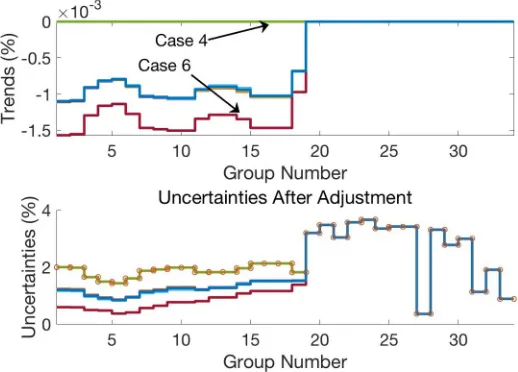
Capture cross-section is excluded from the adjustment. For Case 4 and Case 6, trends are very much different from the others. It indicates that the major difference is coming from fission and ¯νdata. Similarly, for Case 4 and Case 6, trends and uncertainties are plotted for Pu239 fission (in Figure 4) and for Pu239 ¯ν(in Figure 5) simultaneously. For these 2 cases also, the major contribution in the adjustment can be seen from the fission and ¯ν. Major differences in uncertainties for some cases can be seen but it is not discussed here since the uncertainties do not make a significant contribution to the Cook’s distance.
Figure 3.Adjusted Pu239 Capture data (trends and uncertainties) for all 7 sub-cases
Figure 5.Adjusted Pu239 ¯νdata (trends and uncertainties) for all 7 sub-cases
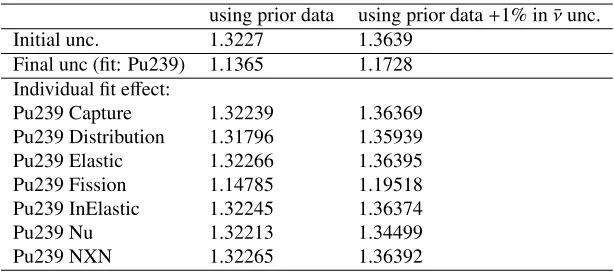
Table 1.ke f funcertainties for ASTRID
using prior data using prior data+1% in ¯νunc.
Initial unc. 1.3227 1.3639
Final unc (fit: Pu239) 1.1365 1.1728 Individual fit effect:
Pu239 Capture 1.32239 1.36369
Pu239 Distribution 1.31796 1.35939
Pu239 Elastic 1.32266 1.36395
Pu239 Fission 1.14785 1.19518
Pu239 InElastic 1.32245 1.36374
Pu239 Nu 1.32213 1.34499
Pu239 NXN 1.32265 1.36392
5 Transposition to ASTRID
Adjusted nuclear data using JEZEBEL integral experiment is used to compute theke f f
uncer-tainties of ASTRID GEN-IV concept reactor. A reduction in unceruncer-tainties can be seen when the posterior data is used (see Table 1). The initial uncertainty using the prior data is 1.3227% and the final uncertainty with the adjusted posterior data (when Pu239 all reaction parame-ters from JEZEBEL are used) is 1.1365%. It can also be seen from the Table 1 that the major reduction in the ASTRIDke f f uncertainty is due to the Pu239 fission reaction parameters.
6 Conclusions
In this work, the influence of isotopes and nuclear reactions on adjustment is investigated us-ing Cook’s distance. For this study, the prior nuclear data uncertainties and their correlations are taken from CEA files. The JEZEBEL experiment is used as an integral experiment for nuclear data adjustment. It is concluded that the major contribution on the adjustment is due to theke f f sensitivities related to the Pu239 isotope, more precisely due to Pu239 fission and
Pu239 ¯νreaction. The transposition of the results on ASTRID fast reactor concept is also discussed.
Acknowledgements
This study was performed in the framework of an on-going collaboration between Uppsala University and CEA. The first author gratefully acknowledges financial support from the Swedish Research Council.
References
[1] P. Leconte et al., Feedback on Pu239 and Pu240 nuclear data and associated covariances matrix through the CERES integral experiments, Journal of Nuclear Science and Technol-ogy, 52:7-8, 1044-1052, 2015.
[2] C. De Saint Jean et al., Evaluation of Neutron-induced Cross Sections and their Related Covariances with Physical Constraints, Nuclear Data Sheets, Volume 148, Pages 383-419, 2018.
[3] A. Koning, S. Hilaire, S. Goriely, User Manual, Talys-1.8, A Nuclear Reaction Program, 2015.
[4] G. Palmiotti et al., Integral Experiments Analysis for Validation and Improvement of Minor Actinide Data for Transmutation Needs, AIP Conference Proceedings 769, 1436, 2005.
[5] J. Tommasi et al., Analysis of Superphenix and Phenix neutron physics experiments with the ERANOS code and data system, Operational and decommissioning experience with fast reactors. Proceedings of a technical meeting, Cadarache, France, 2002.
[6] T. A. B. Snijders, and R. J. Bosker, Multilevel Analysis: An Introduction to Basic and Advanced Multilevel Modeling, second edition, Sage Publishers, ISBN 9781849202008, 2012.
[7] Methods and Issues for the Combined Use of Integral Experiments and Covariance data, A report by the working party of International Nuclear Data Evaluation Co-operation of NEA Nuclear Science Committee.