RESEARCH NOTE
ALLOCATION OF POSTS TO A
TELE-COMMUNICATION CENTER THROUGH
KAVOS
H. Taghizadeh Kakhki
Department of Mathematics, Ferdowsi Univ. of Mashhad Mashhad, Iran, [email protected]
M. Abdollahzadeh
Mashhad Carpet Company Mashhad, Iran
(Received: March 12, 2000 – Accepted in Final Form: October 10, 2000)
Abstract Every phone company customer in a given region receives phone services from a switching center through intermediate points called kavos. The problem addressed in this paper is where to locate this central facility and the kavos, how many of them and with what capacity, so that the total cable length is minimized. This problem can be formulated as a 0-1 mixed integer program; However, because of the scale of the problem, it is not possible to solve it in a reasonable amount of time with the existing software; Hence a solution procedure is developed which solves the problem very efficiently. In addition, to make the model more realistic, and to be able to take into account the decision maker’s preferences, an interactive program has been developed.
Key Words Two-Level Facility Location, Large-Scale Mixed Integer Programming, TelecommunicationNetworks
ﺪﻴﻜﭼ ﻩ ﺮﻫ
ﺍﺭﻦﻔﻠﺗﺕﺎﻣﺪﺧﻱﺮﺘﺸﻣ ﺍ
ﺯ
ﺪﻨﻛﻲﻣﺖﻓﺎﻳﺭﺩﺕﺍﺮﺑﺎﺨﻣ ﺰﻛﺮﻣﺯﺍﻮﻓﺎﻛ ﻡﺎﻧﻪﺑﻲﻧﺎﻴﻣﻁﺎﻘﻧﻖﻳﺮﻃ
.
ﻦﻳﺍ
ﻘﻧﻭﺰﻛﺮﻣﻦﻴﻴﻌﺗﻲﮕﻧﻮﮕﭼﻪﺑﻪﻟﺎﻘﻣ ﺎ
ﻁ ﻲﻧﺎﻴﻣ
)
ﻮﻓﺎﻛ
(
ﺩﺯﺍﺩﺮﭘﻲﻣﻲﻓﺮﺼﻣﻞﺑﺎﻛﻪﻨﻳﺰﻫﻞﻗﺍﺪﺣﺎﺑ
.
ﻲﻧﻮﻨﻛﻩﻮﺤﻧﺖﺴﺨﻧ
ﻪﻜﺒﺷﻱﻭﺭﻲﺤﻄﺳﻭﺩﻲﺑﺎﻳﻥﺎﻜﻣﻲﺿﺎﻳﺭﻝﺪﻣﻚﻳﺲﭙﺳﻭﻩﺪﺷﺪﻘﻧﺰﻛﺮﻣﻦﻳﺍﻦﻴﻴﻌﺗ
-ﺎﺳﻪﻨﻴﻬﺑﻝﺪﻣﻚﻳﻪﻛ ﻱﺯ
ﺑ
ﺖﺳﺍﻂﻠﺘﺨﻣﻚﻳﻭﺮﻔﺻﺢﻴﺤﺻﺩﺍﺪﻋﺍﺎ
ﺩﻮﺷﻲﻣﻪﺋﺍﺭﺍ
. ﻱﺍﺮﺑﻱﺭﺎﻜﺘﺑﺍﻲﺷﻭﺭ،ﻪﻟﺎﺴﻣﺩﺎﻌﺑﺍﻥﺩﻮﺑﮒﺭﺰﺑﻞﻴﻟﺩﻪﺑ
ﺩﻮﺷﻲﻣﺩﺎﻬﻨﺸﻴﭘﻪﻟﺎﺴﻣﻞﺣ
.
INTRODUCTION
Every phone company customer receives phone services from a switching center through intermediate points called kavos. In a particular region the locations of the customers (demand points) are known and their numbers are estimated for future developments. A certain number of demand points are connected to a kavo with a given capacity. They are then connected to a central facility as shown in Figure 1, below. The problem is where to
locate this central facility and the kavos, how many of them and with what capacity, and how to allocate the posts to the kavos, so that the total cable length is minimized. In this paper we consider this problem and present an MIP formulation for it. However, because of the scale of the problem, it is not possible to solve it in a reasonable amount of time with the existing software; hence a solution procedure is developed which solves the problem very efficiently.
that the model is more realistic and capable to take into consideration the decision maker’s preferences.
The input of the program is the location of the existing facilities (posts); the shortest distances between which are calculated using a known shortest path algorithm like Floyd’s algorithm. The outputs of the program are the location of the central facility, the number and the location of the kavos and how the posts are allocated to the kavos. The most important feature of the program is its flexibility in easy implementation of the modifications when - for any reason - the given solution is not acceptable or the location of a kavo or some kavos should be determined in advance. The program helps to reach a solution immediately.
Finally it should be noted that although in this paper we have addressed the problem in a communication setting, it could easily be extended to similar situations such as gas, electricity, and water networks.
CURRENT METHODOLOGY AND MATHEMATICAL FORMULATION OF
THE PROBLEM
Currently the location of a switching center in a region is determined as follows: First the number of current and future customers at different points are determined and marked on a map of the region. Then by drawing horizontal and vertical lines the map is divided into 100-meter sides squares. The rows and columns of the map are numbered from left to right and top to bottom. The total vertical distance of all customers to each column and the
total horizontal distance of all customers to each row are then calculated. The row and the column with the least total sum are selected as the location of the switching center. The location of the kavos are also determined empirically [1].
The phone company’s procedure for solving the problem is in fact an enumerative method for solving the Fermat’s problem with the rectilinear norm. To see this more clearly let the number of customers in column j be denoted by
w
j. Then if the center is placed in column k, the total cable needed will be:∑
=
−
+
=
n 1j j
k
|
k
j
1
|
w
S
(1)The optimal column is obtained by solving the following problem:
k k
S
min
(2)The optimal row is obtained in a similar manner. It is not difficult to see that this is the Fermat’s problem with rectilinear distances. Linearizing the objective and using the dual, it can be solved very easily, without any need for enumerating all possible combinations, as described earlier (see e.g. [2]).
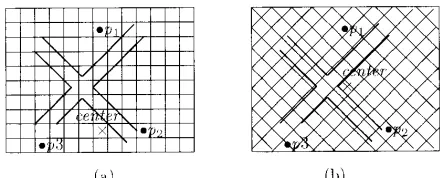
The main shortcoming of this procedure, aside from the way it is solved, is that the distances are assumed to be rectilinear. This is not a realistic assumption, because not only for the most part streets and cable canals in a city do not have such a configuration (except possibly in Manhattan!), but also the solution depends on the way the region is divided into squares. To see this more clearly consider the region given in Figure 2. If the lines are drawn parallel to the coordinate axes (Figure 2a). The center is at one point, while if Figure 1. The relation between posts, kavos and the center.
they are drawn making 45 degree angles with the axes (Figure 2b), then the center would be at another point.
THE PROPOSED MODEL
To overcome these shortcomings, we note that it would be more realistic to consider the problem as a capacitated two-level or two-echelon network location problem. Tcha and Lee [3] have studied an uncapacitated version of the multi-level problem. Gao and Robinson [4] have considered the 2-echelon uncapacitated facility location problem. They assume that a fixed cost is associated with each pair of echelon-1 and echelon-2 facilities that serves at least one customer. Barros and Labbe [5] present a general model for the 2-level case that includes an additional fixed cost for location of depots. Level-1 is considered to be the location of depots, and level-2 the location of distribution centers. Aardel, et. al. [6] also considered the 2-level uncapacitated facility location problem and investigated valid inequalities to improve the formulation. These models consider unlimited capacities for the facilities and assume that any fraction of the clients’ demands can be met by any facility at any level. Ronnqvist, et. al. [7] describe a new solution approach for the capacitated facility location problem but only for the case when each customer is served by a single facility.
More recently, Marin and Pelegrin [8] consider a family of two-stage location problems involving a system that provides a choice of depots and/or plants each with an associated location cost and a set of demand posts which must be supplied in such a way that the total cost is minimized. They use Lagrangian relaxation to obtain lower bounds and heuristic solutions. Finally, Chardaire, et. al., [9] consider a two-level concentrator access network where each terminal has to be connected to a first-level concentrator, which in turn must be connected to a second level concentrator. They develop a Lagrangian relaxation method to compute lower bounds on the optimal value of the linear programming formulations and feasible solutions of the integer-programmingmodel.
These models are in fact discrete location models, i.e., models in which facilities are selected
from among a given set of points. In our case, however, the underlying structure of the connecting lines is a network of streets. In addition, it requires any call to go through only one kavo. It cannot be divided between different kavos. These considerations led to view the problem as a two-level network location problem with the following model.
Let G=(V,E) be a network with nnodes (|V|=n), and marcs (|E|=m), and define:
=
,
0
,
1
Z
k Otherwise n ,..., 1 k , k at is center the If =Y
j=
1
0
,
,
Otherwise n ,..., 1 j ,j at placed is kavo a If = = , 0 , 1 ijk X Otherwise n ,..., k ,j , i ; j kavo to connected is i postIf =1
Assume, for the time being, that the number of kavos are known to be p, and that the capacity of the jth kavo is
j
C
. The distance between points iand j on G is denoted by
d
ij Then the problem can be formulated as:P1: min ijk
j k ij jk
i
X
)
d
d
(
∑ ∑
+
∑
(3)S.T.:
∑
=
k
k
1
Z
(4)∑
=
j
j
p
Y
(5)∑ ∑
=
∀
j k ijk
i
,
1
X
(6)∑ ∑
≤
∀
i k ijk j j
j
,
Y
C
X
(7)∑ ∑
=
∀
i j ijk k
k
,
Z
n
X
(8)k
,j
,
i
;
1
,
0
Z
,
Y
,
X
ijk j k=
∀
(9)the center. Constraint 4 guarantees that only one center is established, and Equation 5 allows the allocation of posts only to p kavos. Constraints 6 guarantee that each post is connected only to one kavo, and inequalities in (7) ensure that the capacity of each kavo is not exceeded. Finally Constraints 8 guarantees that all nodes are connected to the center.
It should be noted that the problem could be formulated in another form too. The one that has been presented here has a simpler form with NV = n3+2nvariables, and NC = 2+3n constraints.
SOLUTION METHODS
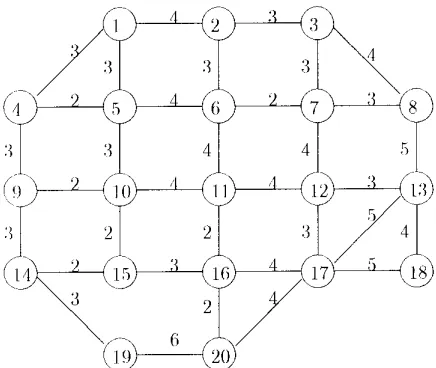
As mentioned earlier, this is a 0-1 ILP, which because of the large number of variables and constraints, even for medium size problems, is difficult to solve. For example, if only n=100, then the number of variables will exceed a million and the number of constraints will be more than 300. The solution of the problem on the network of Figure 3, below, with 20 posts and with only 3 kavos (p = 3) withCj = 8, using the computer package GAMS, took more than 7 hours.
For this reason a more efficient solution method is needed. Before presenting the following algorithm, note that if the center is fixed at a point, say k, then the foregoing problem reduces to a p-median-like problem, which is easier to solve than problem P1.
By solving the p-median problem n times, (∀k = 1, ..., n), after adjusting the distances each time, and comparing the results, the optimal solution to P1 can be obtained. Of course, if there are capacity limitations, then the corresponding constraints have to be added to the p-median model. Fortunately usually a set of particular locations are considered to be the candidate sites for the center. Hence the p-median problems need only be solved for this subset. However, the p-median problem itself as shown in [10] is NP-hard
.
On the other hand, note that since for any point k the sum of the distances from all other points to k through p intermediate points is greater than or equal to the sum of the direct distances from all these points to k; therefore, the 1-median of the
network provides a lower bound for P1.
For this reason in the following algorithm the l-median is selected as an initial center if no other point is chosen initially.
Now, if we construct a matrix of shortest distances from a point i to a fixed point k via an intermediate node j, and denote it by Dk = (
d
kij),the problem reduces to one of choosing p columns of Dk and assigning every other column, to a
unique column of these selected p columns. Note that the diagonal elements of this matrix are the same as the entries in its kth column, which is the
shortest distance from i to k in G.
By subtracting the diagonal entry of row i from all other entries of this row, another matrix is obtained whose entries in fact represent the additional cost incurred for deviation from the shortest path from i to k. We call this matrix the reduced matrix relative to k. and define
γ
, the deviational factor, as a measure of this additional cost.Hence we have the justification for the following algorithm, in which we also assume that each kavo has a minimum and maximum capacity of m and M units, respectively. This is in fact more general than the previous assumption of having p kavos.
THE ALGORITHM
Step 1
(Initial Step)
Given node k, calculatecolumns according to their decreasing (nonincreasing) distances from k; Set the deviational factor, γ, equal to zero;
Step 2 (Main Step)
Set S=∅ and do thefollowing for j=1,...,n Let
S
j=
{
δ
1j,...,
δ
tj}
be a setof t smallest elements of column j; Where t is the greatest number smaller than or equal to M
such
that
∑
=
δ
≤
γ
t
1
i ij
If
t
≥
m
, then set S=SUSj and drop thecorresponding rows from the reduced matrix;
Step 3 (Stopping Rule)
If |S|= n, stop;Otherwise, increase the deviational factor, γ, and go to step 2.
In the algorithm we initially set γ = 0, therefore if a solution to the problem is obtained with this value ofγ, then it would be the optimal solution. Otherwise, γ is incremented until a feasible assignment is obtained. Of course, a high value of
γ could guarantee attainment of an immediate solution, in fact an upper bound for P1. Thereafter, a procedure such as interval halving could be employed to reach the optimal solution. However, since the algorithm takes only a few seconds to solve even large problems, and since in our experience we have found the optimal solution to be close to the 1-median, we recommend increasing γ gradually until some optimality, or near optimality, condition is satisfied.
An Illustrative Example
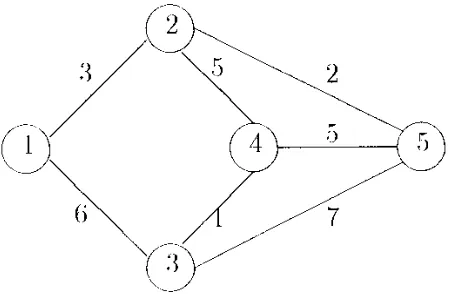
Consider the networkshown in Figure 4. We want to determine the location of a center and two Kavos each with a capacity of at least 2 and at most 3. For this network, the matrix of the shortest distances is given below:
−
−
−
−
−
3 6 7 5
3
6 5 2
6 6
1 6
7 5 1
5
5 2 6 5
Note that the 1-median is at node 2, so at step 1 we set k = 2 and calculate the distance matrix relative to this node as follows:
3
3 12 12 7
6
0 12 10 4
9
6
6
6
8
10 5
7
5
7
8
2 12 10 2
Calculating the reduced matrix and ordering its columns we obtain:
3 4 1 5 2
9
9
0 4 0
12 10 6 4 0
0
0
3 2 0
2
0
5 2 0
10
8
6 0 0
Set γ = 0 and go to step 2.
At step 2 we initially set S=∅. Since the first column of the ordered reduced matrix (the third column of the original matrix) has only one zero, i.e. t = 1
≥/
2 = m, therefore we consider the second column. The elements of the third and fourth rows of the second column of the ordered reduced matrix are zero. So we set S = SU
rows 1, 2, and 5 are assigned to column 2. Since S = S U{1,2,5} has |S| = n, the stopping criteria (step 3) is satisfied. Moreover, since this solution is obtained with γ=0 (it has the same value as the lower bound obtained for 1-median) it is the optimal solution to the problem and there is no need to consider any other node kas the center. Thus the optimal solution is to choose node 2 as the center, nodes 2 and 4 as kavos, and assign nodes 1, 2, and 5 to node 2; and nodes 3 and 4 to node 4 with the minimum cost of 16 units.
COMPUTATIONAL RESULTS
As an example of the application of the proposed method, we have tried to determine the location of a center and three kavos in a suburban area of Mashhad. Shahrak Mashhad Gholi. The map of the region was scanned and stored with a pcx format in a PC. 100 points were chosen on this map as potential posts, and their distances were measured. The shortest path matrix was then calculated using Floyd’s algorithm. The results indicated a 24% savings when compared to the current method of calculating the center. Other similar runs for different number of posts and kavos indicate a savings of 10 to 20% on the average.
ACKNOWLEDGEMENT
We would like to thank the referees for their helpful comments.
REFERENCES
1 Sedighzadeh, M. A., “Scientific and Practical Principles of Designing Urban Telephone Cable Networks”, Iran’s Telecommunication Company, (1977) (In Persian). 2 Francis, R. L., McGinnis, L. F. and White, J. A., “Facility
Layout and Location: An Analytical Approach”, Second Ed., Printice Hall, Englewoodcliffs, NJ (1992).
3 Tcha, D., and Lee, B., “A Branch and Bound Algorithm for the Multilevel Uncapacitated Facility Location Problem”, European Journal of Operational Research, Vol. 18, (1984), 35-43.
4 Gao, L. L., and Robinson, E. P., “A Dual Based Optimization Procedure for the Two-Echelon Uncapacitated Facility Location Problem”, Naval Research Logistics, Vol. 31, (1992), 191-212.
5 Barros, A. I., and Labbe, M., “A General Model for the Uncapacitated Facility and Depot Location Problem”,
Location Science, Vol. 2, No.3, (1994), 173-191.
6 Aardel, K., Labbe, M, Leung, J. and Queyranne, M., “On the Two-Level Uncapacitated Facility Location Problem”, Informs Journal on Computing, Vol. 8, (1996), 289-301.
7 Ronnqvist, M., Tragantalerngsak, S. and Holt, J. “A Repeated Matching Heuristic for the Single-Source Capacitated Facility Location Problem”, European Journal of Operational Research, Vol. 116, (1999), 51-68.
8 Marin, A., and Pelegrin, B., “Applying Lagrangian Relaxation to the Resolution of Two-Stage Location Problems”, Annals of Operations Research, Vol. 86, (1999), 179-198.
9 Chardaire, P., Lutton, J.-L., “A. Sutter, Upper and Lower Bounds for the Two-Level Simple Plant Location Problem”, Annals of Operations Research, Vol. 86, (1999), 117-140.