Fast Software Implementation of Binary Elliptic
Curve Cryptography
Manuel Bluhm1 and Shay Gueron2,3
1
Ruhr University Bochum, Germany
2 University of Haifa, Israel 3
Intel Corporation, Israel Development Center, Israel November 10, 2013
Abstract. This paper presents an efficient and side channel protected software implementation of point multiplication for the standard NIST and SECG binary elliptic curves. The enhanced performance is achieved by improving the L`opez-Dahab/Montgomery method at the algorithmic level, and by leveraging Intel’s AVX architecture and the pclmulqdq pro-cessor instruction at the coding level. The fast carry-less multiplication is further used to speed up the reduction on the newest Haswell platforms. For the five NIST curves overGF(2m) withm∈ {163,233,283,409,571}, the resulting point multiplication implementation is about 6 to 12 times faster than that of OpenSSL-1.0.1e, enhancing the ECDHE and ECDSA algorithms significantly.
Keywords:ECC, binary elliptic curves, point multiplication, pclmulqdq, AVX, ECDH, ECDSA, side channel protection, NIST, L`opez-Dahab.
1
Introduction
All SSL/TLS communications start with a client-server key establishment, based on a public key cryptosystem. The classical protocol uses the RSA algorithm for encryption/decryption of a session key, but it suffers from the following draw-back: the confidentiality of the sessions depends directly on the security of the server’s private RSA key. Especially motivated by recent disclosures, the current trends are to move to protocols providing(perfect) forward secrecy, such as the authenticated Diffie-Hellman Ephemeral (DHE) key exchange. One approach is to use Elliptic Curve Cryptography (ECC) to efficiently perform this kind of key exchange (ECDHE). Similarly, ECC based signature schemes (ECDSA) become attractive because of their relatively short keys. Thus, software implementations of ECC for the high end server platforms become a target for optimization.
Protocols such as TLS 1.x support elliptic curves over both prime and bi-nary fields, and the important cryptographic libraries include implementations for both types of ECC. For instance, the OpenSSL library that underlies the
1. INTRODUCTION
other key agreement protocols over binary and prime fields. It is interesting to note that from the hardware implementation cost, protocols using binary curves are cheaper to implement than prime field curves, which can be significant for low-end client devices. However, on the software implementation side, binary curves have been less efficient than their prime curves counterparts on high end processors. This was mainly caused by the fast integer multiplication units compared to slow carry-less multiplication. In OpenSSL-1.0.1e for example, the prime curvesecp256k1outperformes it’s binary counterpartsect283k1by sev-eral magnitudes.
This paper focuses on software optimization of point multiplication over
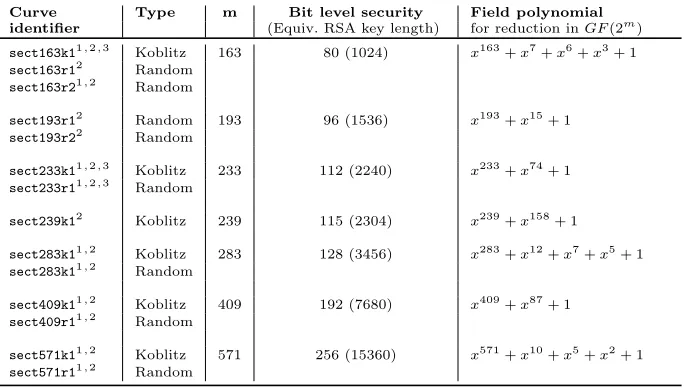
binary elliptic curves, leveraging the AVX instruction set and the newly op-timized carry-less multipliers on high end x86-64 platforms. Targeting perfor-mance and security by fast, side channel protected code, we built a library for the underlying binary field arithmetic for the common fields specified by NIST and SECG [17], covering security levels from 80 bits up to 256 bits. Table 1 shows the binary elliptic curves overGF(2m) (both random and Koblitz curves) that are optimized in this paper. It further displays their field representation and the equivalent bit level security, and (in parentheses) the corresponding RSA key length. On the left column, “1” indicates that the respective curve is
stan-dardized by NIST (the National Institute of Standards and Technology); “2”
indicates a curve standardized by SECG (Standards for Efficient Cryptography Group); “3” indicates that the curve is part of the Wireless Transport Layer
Security (WTLS).
Curve identifier
Type m Bit level security
(Equiv. RSA key length)
Field polynomial
for reduction inGF(2m) sect163k11,2,3 Koblitz 163 80 (1024) x163+x7+x6+x3+ 1 sect163r12 Random
sect163r21,2 Random
sect193r12 Random 193 96 (1536) x193+x15+ 1 sect193r22 Random
sect233k11,2,3 Koblitz 233 112 (2240) x233+x74+ 1 sect233r11,2,3 Random
sect239k12 Koblitz 239 115 (2304) x239+x158+ 1 sect283k11,2 Koblitz 283 128 (3456) x283+x12+x7+x5+ 1 sect283k11,2 Random
sect409k11,2 Koblitz 409 192 (7680) x409+x87+ 1 sect409r11,2 Random
sect571k11,2 Koblitz 571 256 (15360) x571+x10+x5+x2+ 1 sect571r11,2 Random
2. THE IMPROVED 2P ALGORITHM
2
The improved 2P algorithm
Given an elliptic curve E with |E|=|GE| · |HE| =n·h(here: h∈ {2,4}), the
essential operation of elliptic curve cryptosystems is multiplying a pointP ∈GE
on the curve, by a positive integerk∈[1, n], to obtain a new point
Q=k·P =P+P+...+P
| {z }
k-times =
k−1 X
i=0
P.
Montgomery [15] introduced a fast approach for this point multiplication. It uses the fact that the sum of two points whose difference is known, can be eval-uated with a procedure that involves only thex-coordinate of these points when performing one point doubling, and one point addition per iteration. L´opez and Dahab (LD hereafter) improved this algorithm for binary curves over GF(2m), by eliminating costly inversion operations in the field (when given in polynomial representation). In their so-called 2P-Algorithm [14], the pointP = (x, y) is represented in the LD-projective form P = (X/Z, Y /Z2). The x-coordinate of the sum P0+P1and of 2Piis the fractionX0/Z0, where
2Pi: P0+P1:
X0=X4
i +b·Zi4 X0=x·Z0+ (Z0·X1)·(Z1·X0)
Z0 =X2
i ·Zi2 Z0=
(Z0·X1) + (Z1·X0)
The computational cost of the resulting algorithm is dominated by the perfor-mance of the point addition(Madd) and point doubling(Mdouble), which are exe-cutedblog2(k)ctimes in a point multiplicationkP. Here, we speed up the point multiplication by reducing the amount of computations inMaddand Mdouble.
2.1 Improved Mdouble
By re-ordering the flow of the Mdouble, we first multiply Z2 with the precom-puted value c = √b, then add the result to X2, square this again and obtain the resultX ←(X2+c·Z2)2 =X4+b·Z4. This saves one squaring and one reduction operation per run. Algorithm 2 shows the improvedMdoubleflow.
For Koblitz curves, we haveb= 1 and therefore c =b2m−1 = 1, so another multiplication and reduction can be saved, as shown in Algorithm 3.
2.2 Improved Madd
3. SIDE CHANNEL PROTECTED POINT MULTIPLICATION
2.3 Estimating the impact of the improved Mdouble and Madd
Table 2 compares the number of the field operations in Algorithms 2, 3, and 4, compared to their original form. For simplicity, we count the reduction as a field operation here.
Field Operations
Mdouble Koblitz
Mdouble Random
Mdouble Original
Madd Improved
Madd Original #MUL 1blog2(k)c 2blog2(k)c 2blog2(k)c 4blog2(k)c 4blog2(k)c
#RED 4blog2(k)c 5blog2(k)c 6blog2(k)c 4blog2(k)c 5blog2(k)c
#SQR 3blog2(k)c 3blog2(k)c 4blog2(k)c blog2(k)c blog2(k)c
#ADD blog2(k)c blog2(k)c blog2(k)c 3blog2(k)c 2blog2(k)c
Table 2: The number of field operations for point multiplication, with the original and the improvedMdoubleandMaddalgorithms.
3
Side channel protected point multiplication
This section discusses the potential threat and countermeasures of software side channel attacks, where an adversary attempts to collect information about the secret keys that are being used. Today, it is known that software implementations of cryptographic primitives need to take such side channel attacks into account, and add appropriate countermeasures.
3.1 Protection requirements
As with other cryptographic schemes, implementations of ECC have been shown to be susceptible to software side channel attacks. Even the applicability of re-mote timing attacks on a ECC implementation has been demonstrated [7]. We concentrate here on protecting the software implementation of the LD/Mont-gomery point multiplication, without covering the higher implementation parts of the various protocols like ECDHE or ECDSA.
Timing attacks exploit the occurrence of variant execution times for different inputs. This kind of attack can be mounted whenever a correlation between the key and the execution time is found. Further, we take cache based timing attacks into account, where the adversary is assumed to be able to run an unprivileged process to measure instruction and data cache latencies. Thus, key dependent branches and table accesses should be avoided or masked.
To avoid timing attacks in the LD/Montgomery point multiplication one must ensure that
1. all inputs (k,P) to the point multiplication function are valid, meaning
◦ Integerkis in the interval [1, n] withn=|hPi| ◦ khas constant bit length (for the same group)
◦ P is a valid point on the curve.
3. SIDE CHANNEL PROTECTED POINT MULTIPLICATION
3.2 Protection strategy
The large variety of attacks makes it very difficult to protect an implementation against all possible side channel threats. In the following, we will show the mech-anisms to prevent the previously mentioned threats for server implementations.
Constant key length is a first step to assert a constant running time of the point multiplicationkP. Although, the input validation of the scalar kand the pointP should be performed prior to the point multiplication, we provide a bit length fix for allvalid k∈[1, n] withnorder of the large subgroupGE ofE. At
first, we always addnto k, so thatk0=k+nandkP =k0P. The bit length of
k0 is thenblog2(n)c ≤ log2(k0) ≤ blog2(n)c+ 1, since the result of an addition of two integersnandk≤nis not longer thanblog2(n)c+ 1 bits.
To make the bit length fixed for all cases ofk, one can repeat the addition of
n, if and only if the bit at positionblog2(n)c+ 1 is NOT set. To ensure that the implementation does not include any branches, one should create a mask in a similar way as suggested in Algorithm 1 and then add the masked value, which is either the order nor an equivalent sized number with zero value. Thereafter, the bit length of k0 is fixed to dlog2(n)e. One has to take into account that k
needs to be a valid input with k∈[1, n] in order to assert the fixed bit length, which is expected to be evaluated outside the point multiplication. Additionally, this countermeasure eventually adds vulnerability to Carry-based attacks [8], attacking not the point multiplication but this particular countermeasure itself. However, considering our attacker model this is no reasonable threat.
Constant memory access pattern and theelimination of key dependent branchesare the main countermeasure against cache based side channel attacks in our implementation. Since cache attacks are most likely with our attacker model, we want to assure not only a fixed memory access pattern but also avoid any key dependent branch. Therefore, we suggest algorithm 1 to veil the data access.
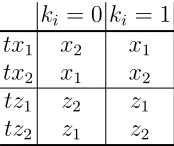
Lettx1,tx2,tz1 andtz2 be fixed size temporary variables for aGF(2m) and
ki the current bit at positioni. Table 3 shows the transition of the coordinates involved in the double/add process inside the LD/Montgomery point multipli-cation’s key evaluation loop.
For the proposed data veiling method, a masking wordt0is created with either all bits set to zero, or all bits set to one, depending on the value of
ki. This word is then used to create themaskfor field elements in step 2, which in turn is succes-sively applied with AND and NAND operations to the two possible values, satisfying the rules in Table 3. This transition is self-inverse and needs to be re-applied after the execution ofMaddand
Mdouble.
k
i= 0
k
i= 1
tx
1x
2x
1tx
2x
1x
2tz
1z
2z
1tz
2z
1z
24. EFFICIENT IMPLEMENTATION OF BINARY FIELD ARITHMETICS
Algorithm 1: Proposed data veiling method
Input: Keybitki, EC coordinatesx1,x2,z1,z2∈GF(2m)
Output: Temporary coordinatestx1,tx2,tz1,tz2∈GF(2m) 1 t0←( 0x00...0
| {z }
Wbit word
−ki);
2 for(j= 0; j <dm
We; j++)domask[j]←t0;
3 tx1←(mask∧x1)⊕(maskZx2); 4 tx2←(maskZx1)⊕(mask∧x2); 5 tz1←(mask∧z1)⊕(maskZz2); 6 tz2←(maskZz1)⊕(mask∧z2); 7 returntx1,tx2,tz1,tz2
In summary, the proposed technique requires 4 field XORs, NANDs and ANDs, and, neglectable in proportion, one 64 bit subtraction and one constant load each.
Constant function calls inside the key evaluation loop are naturally provided by the LD/Montgomery point multiplication. In addition, we must ensure that all called subfunctions are executed in constant time and thus not include data depending branches. However, due to the branches insideMxy, which is the final transformation to extract they-coordinate, the running time for the point mul-tiplication isnot constant if the result is invalid, the inverse−P of a pointP or the point at infinity (and thus the scalar ka multiple ofn).
Constant time implementation for binary field arithmetic is the neces-sary consequence from the previous point. If we want to ensure that the running time is constant, the binary field arithmetic must be totally data independent. This does not only mean that we cannot include any shortcuts for special values and data dependent branches at all, but it also biases the choice of algorithm, e.g., the inversion method.
4
Efficient implementation of binary field arithmetics
4. EFFICIENT IMPLEMENTATION OF BINARY FIELD ARITHMETICS
4.1 Binary field arithmetic
The square of a field elementa(x)∈GF(2m), rather than just multiplying a field element with itself, can be computed as follows:
a2(x) = m−1
X
i=0
aixi 2
= m−1
X
i=0
(aixi)2= m−1
X
i=0
aix2imodf(x)
This property makes squaring inGF(2m) a linear operation and therefore much faster than the conventional multiplication, and can be performed with small table lookups. This table can be stored in only one vector and is therefore naturally accessed in a fixed pattern. Expanding the element by successively inserting zeros, it can even be computed in parallel, using thepshufbinstruction. The use ofpshfubto implement lookup tables was originally proposed by Gueron and Kounavis [9] and first used by Aranha et al. in [4] for squaring inGF(2m).
The multiplication in GF(2m) was usually a very expensive operation. The 64 bit carry-less multiplier, which is now available on various x86 platforms, significantly accelerates the multiplication in binary fields. In this work we use both explicit and recursive versions of Karatsuba-Ofman for different sizes. We chose explicit forms for 2-, 3- and 5-term Karatsuba and recursive forms for 4-,7-and 9-terms, balancing performance gain against code size. For a comparison of Karatsuba implementations with vector extensions see [18] by Su and Fan.
For the inversion inGF(2m) we use the Itoh-Tsujii Algorithm(ITA)[11]. The ITA performs the inversion with exactly m−1 squares and blog2(m−1)c+
H(m−1)−1 multiplications with Hamming weight H. The general recursive formula to obtain the chain can be given as
1 + 2n+ 22n+...+ 2(k−2)n = (
(1 + 2n)×(1 + 22n+...+ 2(k−3)n), ifk−1≡0 mod 2 1 + 2n×(1 + 2n)×(1 + 22n+...+ 2(k−4)n
, ifk−1≡1 mod 2 The running time boundaries for this algorithm are mainly determined by squares and requires a serious amount of time. In this implementation, fortu-nately, the costly inversion is only required once per point multiplication.
4.2 Reduction
4. EFFICIENT IMPLEMENTATION OF BINARY FIELD ARITHMETICS
The reduction is basically a multiplication of the upper half of the double sized element with the reduction polynomial. Letf(x) =xm+r(x) with degree
deg(r) =kbe the reduction polynomial overGF(2m). We split the polynomial
c(x) =cH(x) +cL(x) with degreedeg(c) =m+tinto two parts where
cH(x) =Pti=mcixi and cL(x) =Pmi=0−1cixi. The reduction ofc(x) is then computed as
c0(x) =cL(x)⊕cH(x)·r(x).
The resulting polynomialc0(x) has degreed=deg(c0) =max(m−1, t+k). In case ofd≥m, the reduction is applied recursively.
“Left-to-Right In-Place Shift and Add” approach is the consequence. Since the multiplication of a word by one bit is a simple shift, this multiplica-tion can be applied as a series of shifts and adds. This makes especially sense, if we remember that the amount of bits inr(x) is very small (here either 2 or 4). In our experiments, this technique produced better results than other reduction schemes such as Barrett’s method [12][13].
The reduction fortrinomialsis very straightforward - we successively shift the top word by the components ofr(x) to the right and add the result to the remainder, while skipping multiples of 64 and 128 bit with memory alignments. In order to avoid duplication of work, one should execute the shift and add from the left to the right and adding the current word immediately to the remainder. Under the assumption that we are about to reduce a double quadword w by componentxk, we shiftwexactly (m−kmod 64) bits to the right and add it to the remainder while skippingl×128 bits, wherel=bm−k
128 c. If (m−kmod 128)≥ 64, however, we need to add the lower half ofwto the previous word.
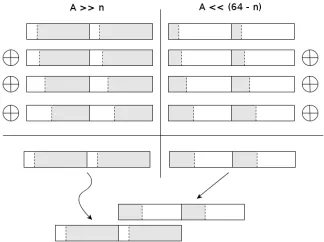
The strategy for pentanomi-als differs from the trinomial way in terms of recombination. Instead of directly adding each component to the remainder, we gather the results of left and right shifts of a vectorAin sep-arated vectors and recombine them by finally adding them to the remainder, which saves three alignments per 128 bit el-ement. Figure 1 shows the
4. EFFICIENT IMPLEMENTATION OF BINARY FIELD ARITHMETICS
Fast vector shifting uses the (faster) 128 bit shift instruction(pslldq/psrldq), which is feasible whenever the difference of two components in the polynomial is a multiple of 8. With the polynomials from 1, we can apply this trick for the polynomial f(x) =x163+x7+x6+x3+ 1 where 163−3 = 160. Additionally, we have the components x10 and x2 in the reduction polynomial for GF(2571) but here the fast shifting interferes with the recombination strategy, where the savings for the alignment pay off in comparison.
Special reduction schemes are possible inGF(2283) and necessary inGF(2239). A fast reduction in GF(2283) was proposed in [1] and uses the observation
f(x) =x283+x12+x7+x5+ 1 =x283+ (x7+ 1)·(x5+ 1).
The polynomialf(x) = x239+x158+ 1 is one of the two polynomials sug-gested in [17] for this field size and currently integrated in OpenSSL. For the implementation with vector extensions, this polynomial is suboptimal. This is caused by the small distance 239−158 = 81 < 128, which means that a 128 bit word of the remainder affects itself during the reduction, which makes shift and add reduction inefficient for this size. The GF(2239) reduction is therefore provided in 64 bit mode only. When using vector extensions, the polynomial
f(x) =x239+x36+ 1 (which has also been suggested by SECG) is much faster. Another approach would be to implement the reduction with a special version of Barrett’s method, which should increase the performance of this field signifi-cantly. Due to this issues we do not recommend the use of this field. Reduction in
GF(2233) is much faster and this particular curve has almost the same security level (see 1) with an only slightly shorter key. Anyhow, we added this curve to our implementation for convenience.
4.3 Mul&Add reduction
Thepclmulqdqinstruction can be utilized for reduction. Thus, each 64 bit word of the operand cH(x) must be multiplied with r(x) = P
k
i=0rixi and added to the remainder cL(x). Obviously, k must hold the condition k < 64 to ensure the lowest number of multiplications, which is exactlyt=dlog2(cH(x))
64 ethen. If
k >63, we must multiply each word more than once, particularlys=dk
64etimes per word and we therefore requiret·smultiplications overall.
5. RESULTS
cH(x) overlaps into an additional register, thus requiring t+ 1 multiplications. For example the reduction in GF(2163), the bits of cH(x) = P325
i=163cix i are spread over four 64 bit words. For our target curves, the operand shifting re-quires to much efforts compared to a single multiplication on Haswell, whereas on the Sandy/Ivy Bridge this shifting pays off. Obviously, the proposed tech-nique makes more sense the greater the hamming weight ofr(x) is, and if all the bits inr(x) are in one 64 bit word (s= 1). Fortunately, this is the case for the NIST curves over GF(2163),GF(2283) andGF(2571).
As a matter of fact, the performance of the pclmulqdqreduction strongly depends on the underlying architecture. This reduction scheme starts to pay off when the multiplier performs two multiplications faster than the according shifts and additions. Let the reduction polynomial be pentanomial with no spe-cial properties as fast shifts or other spespe-cial properties. For the “shift” step of the shift&add reduction, the required amount of operations for each 128 bit word is 4×2 SHIFT’s (psllq/psrlq) plus 3×2 XOR’s. Requiring the same amount of operations for the “add” step, the multiplier must be able to perform 2 mul-tiplications faster than this in order to beat the shift&add implementation for pentanomial reduction polynomials. On the Sandy/Ivy Bridge, this cannot be performed faster than 10 cycles (usually more), whereas one64 bit multiplica-tion has a latency of 14 cycles. This explains why this reducmultiplica-tion scheme does not pay off on these architectures.
On Haswell however, with a latency of 7 and a throughput of only 2 cycles, this can be performed in 9 cycles. In many cases, one can make advantage of the small throughput by fetching multiple multiplications at once to gain even better performance.
5
Results
5. RESULTS
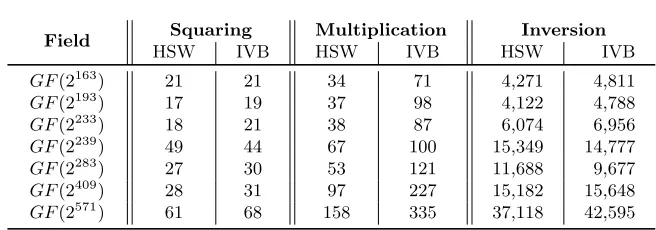
Binary field arithmetic costsare shown in Table 5. The results indicate the benefits of the fastpclmulqdqon Haswell and the performance difference of squaring and multiplication.
Reduction costs can be found in Table 6 on the different architectures. It shows the performance difference of trinomials and pentanomials as well as the performance loss due to the 64 bit mode in GF(2239). Furthermore, we see the mul&add reduction outperforming the shift&add reduction with factor 1.25 inGF(2163) and about 1.62 inGF(2283) and 1.61 inGF(2571) on Haswell. However, the shift&add implementation does not use AVX2 features, which could eventually allow improvements.
The computational costs for side channel protection by hiding the coordinates in order to assure a fixed memory access pattern per round are also not neclectable. A single data veiling requires twelve logical operations at the cost of an XOR. Additionally, one requires four temporary variables in order to hide the data processing for all four coordinates involved in the point multiplication. This has of course some performance impact to the point multiplication process, as this performance overhead applies for each loop execution.
The point multiplication’s importance has been pointed out several times by now. Table 7 shows the results fork·P in cycles. We find that the amount of cycles has been substantially diminished, up to a factor of almost 12. Also, we observe the impact of the improved code flow for the Koblitz rather than random curves, which is noticeable in both absolute numbers and the relative speedup. Hereby, we have to mention that the numbers for the unpatched OpenSSL-1.0.1e are not constant, since it is not a constant time implementation, especially the bit length of kis not fixed. Therefore, the speedup factor is also not consistent and will differ from run to run.
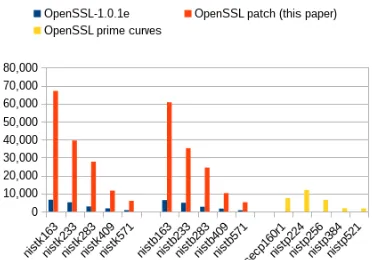
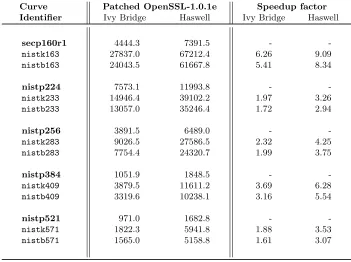
Elliptic curve Diffie-Hellman operations are presented in Table 11 and Figure 2, measured with the OpenSSL speed tool and therefore the curve iden-tifiers have been changed to nistk for Koblitz and
nistb for random curves. Since the ECDH is basi-cally a point multiplication, the speedup is very high. Prime curves are currently more frequently used in server implementations. As demonstrated in Table 8, our improvements to the point multiplication of the binary curves result in a big performance lead.
6. COMPARISON TO OTHER WORKS
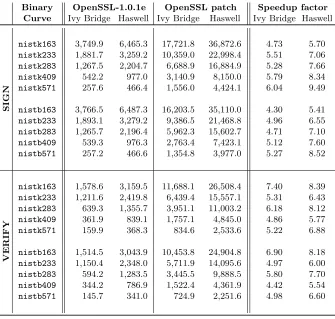
Elliptic curve signature and verificationalgorithms have considerably more overhead than the ECDH. However, as shown in Tables 9 and 10, we perceive an average speedup of factor 4.9 (sign) and 6.2 (verify) on Ivy Bridge as well as 4.5 and 6.3 on Haswell, respectively. Since the bit length for the ECDSA in OpenSSL has been fixedbefore the point multiplication in response to a timing attack [7], the resulting scalarkisnotin the interval [1, n] anymore and is either one or two bits longer (but constant for a specific field) than the original scalar (depending on the form of the corresponding curve ordern), which slightly increases the amount of cycles for the patched version.
6
Comparison to other works
Most works about the implementation of binary elliptic curves with the use of vector instructions are aiming to break speed records and thus often exploit al-gebraic properties. This work aims for provision of a generic point multiplication for the well known NIST/SECG curves over the binary field, without any com-promises in regard to security. This work doesnotuse precomputation schemes (such as wNAF, τNAF), point halving, special fields with beneficial properties (such asFq2), or other algebraic properties (e.g., Forbenius morphism).
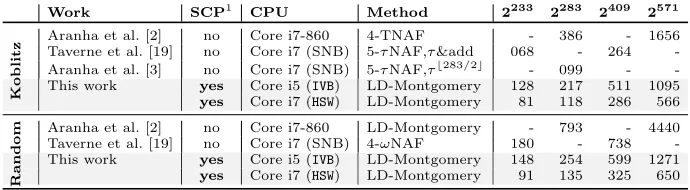
In Table 4 we show results for implementations of random point multiplica-tion for binary elliptic curves in NIST/SEC fields. All numbers are given in 103 cycles on a single core.
Work SCP1 CPU Method 2233 2283 2409 2571
Aranha et al. [2] no Core i7-860 4-TNAF - 386 - 1656 Taverne et al. [19] no Core i7 (SNB) 5-τNAF,τ&add 068 - 264 -Aranha et al. [3] no Core i7 (SNB) 5-τNAF,τb283/2c - 099 - -This work yes Core i5 (IVB) LD-Montgomery 128 217 511 1095
Koblitz yes Core i7 (HSW) LD-Montgomery 81 118 286 566
Aranha et al. [2] no Core i7-860 LD-Montgomery - 793 - 4440 Taverne et al. [19] no Core i7 (SNB) 4-ωNAF 180 - 738 -This work yes Core i5 (IVB) LD-Montgomery 148 254 599 1271
Random yes Core i7 (HSW) LD-Montgomery 91 135 325 650
Table 4: Unknown Point Multiplication over NIST Curves (Koblitz)
This work yields very good results for random curves and wins against all cur-rent state-of-the-art implementations over the NIST fields, even with the costly side channel countermeasures. Since all previous works have been implemented on the Sandy/Ivy Bridge, we compare with the Ivy Bridge implementation here. For the random curve over theGF(2233) NIST field, our implementation is about factor 1.22 (1.23 inGF(2409)) faster than [19] and even factor 3 (GF(2283)) and 3.5 (GF(2571)) faster than reported in [2] for a single core. Although our Ivy Bridge implementation for Koblitz curves beats the numbers presented in [2] by 1.77x and 1.51x, [19] achieve results which are factor 1.53 faster, whilst [3] is even as twice as fast.
7. CONCLUSION
For further comparison, we give the latest numbers of protected (as claimed by the authors) point multiplication implementations at the 128 bit security level, using curves with special algebraic properties. Bos et al.[6] report 117,000 cycles for a protected point multiplication on a Kummer surface with the Mont-gomery ladder and [16] reports 115,000 cycles on a GLS curve using 2-GLV (double&add) on a single core. At the same security level, this work achieves a point multiplication in 118,000 cycles with the OpenSSL patch [5] on the Haswell processor, without using special fields, exploiting algebraic properties or precom-putation techniques. At the 256 bit security level, this work achieves a EC point multiplication in about 566,000 (Koblitz) and 650,000 (random) cycles.
7
Conclusion
In this work, we proposed a fast, constant time implementation of the point multiplication on binary elliptic curves at a security level of 80 bits and greater, standardized by NIST and SECG.
We analyzed major implementation threats for server environments and se-cured the implementation by applying countermeasures against common and dangerous side channel threats such as cache and remote timing attacks. Over the last years, several publications have pointed out that these side channel at-tacks are more than a theoretical but a serious menace. To address this issue, we provide a constant time implementation of the elliptic curve point multipli-cation and binary field arithmetic, without key dependent branches and a fixed memory access pattern.
Additionally, we introduced an improved version for the well known LD/-Montgomery multiplication with enhancements on the arithmetic level, provided a patch for the OpenSSL library and showed its significant performance impact. This improvement is available on all 64 bit architectures implementing at least SSE4 (better: AVX) and the pclmulqdq instruction. The implementation has been contributed to OpenSSL as patch for version 1.0.1e and is available for download [5].
References
1. D. Aranha, A. Faz-Hernndez, J. Lpez, and F. Rodrguez-Henrquez,Faster implementation of scalar multiplication on koblitz curves, in Progress in Cryptology LATINCRYPT 2012, A. Hevia and G. Neven, eds., vol. 7533 of Lecture Notes in Computer Science, Springer Berlin Heidelberg, 2012, pp. 177–193.
2. D. Aranha, J. Lpez, and D. Hankerson, Efficient software implementation of binary field arithmetic using vector instruction sets, in Progress in Cryptology LATINCRYPT 2010, M. Abdalla and P. Barreto, eds., vol. 6212 of Lecture Notes in Computer Science, Springer Berlin Heidelberg, 2010, pp. 144–161.
3. D. F. Aranha, A. Faz-Hernndez, J. Lpez, and F. Rodrguez-Henrquez, Faster implementation of scalar multiplication on koblitz curves. Cryptology ePrint Archive, Report 2012/519, 2012. http://eprint.iacr.org/.
4. D. F. Aranha, J. L´opez, and D. Hankerson,Efficient Software Implementation of Binary Field Arithmetic Using Vector Instruction Sets, in The First Interna-tional Conference on Cryptology and Information Security (LATINCRYPT 2010), M. Abdalla and P. S. L. M. Barreto, eds., vol. 6212 of LNCS, 2010, pp. 144–161. 5. M. Bluhm and S. Gueron, A fast vectorized implementation of binary
ellip-tic curves on x86-64 processors, 2013. http://rt.openssl.org/Ticket/Display. html?id=3117.
6. J. W. Bos, C. Costello, H. Hisil, and K. Lauter,Fast cryptography in genus 2. Cryptology ePrint Archive, Report 2012/670, 2012. http://eprint.iacr.org/. 7. B. B. Brumley and N. Tuveri, Remote timing attacks are still practical, in Proceedings of the 16th European conference on Research in computer security, ESORICS’11, Berlin, Heidelberg, 2011, Springer-Verlag, pp. 355–371.
8. P.-A. Fouque, D. Ral, F. Valette, and M. Drissi,The carry leakage on the randomized exponent countermeasure, in Cryptographic Hardware and Embedded Systems CHES 2008, E. Oswald and P. Rohatgi, eds., vol. 5154 of Lecture Notes in Computer Science, Springer Berlin Heidelberg, 2008, pp. 198–213.
9. S. Gueron and M. Kounavis,Intel carry-less multiplication instruction and its usage for computing the gcm mode, April 2008. http://software.intel.com/ sites/default/files/article/165685/clmul-wp-rev-2.01-2012-09-21.pdf. 10. S. Gueron and V. Krasnov,Parallelizing message schedules to accelerate the
computations of hash functions, Journal of Cryptographic Engineering, 2 (2012), pp. 241–253.
11. T. Itoh and S. Tsujii,A fast algorithm for computing multiplicative inverses in gf(2m) using normal bases, Inf. Comput., 78 (1988), pp. 171–177.
12. M. Knezevic, K. Sakiyama, J. Fan, and I. Verbauwhede,Modular reduction in gf(2n) without pre-computational phase, in WAIFI, 2008, pp. 77–87.
13. A. O. Krzysztof Jankowski, Pierre Laurent,Intel polynomial multiplication instruction and its usage for elliptic curve cryptography, 2012.
14. J. Lpez and R. Dahab,Fast multiplication on elliptic curves over gf(2m) without precomputation, in Cryptographic Hardware and Embedded Systems, . Ko and C. Paar, eds., vol. 1717 of Lecture Notes in Computer Science, Springer Berlin Heidelberg, 1999, pp. 316–327.
15. P. L. Montgomery,Speeding the Pollard and Elliptic Curve Methods of Factor-ization, Mathematics of Computation, 48 (1987), pp. 243–264.
17. Standards for Efficient Cryptography Group, SEC 2: Recommended El-liptic Curve Domain Parameters, in Standards for Efficient Cryptography, 2000. 18. C. Su and H. Fan,Impact of intel’s new instruction sets on software
implemen-tation of gf(2)[x] multiplication, Inf. Process. Lett., 112 (2012), pp. 497–502. 19. J. Taverne, A. Faz-Hernndez, D. Aranha, F. Rodrguez-Henrquez, D.
Han-kerson, and J. Lpez, Speeding scalar multiplication over binary elliptic curves using the new carry-less multiplication instruction, Journal of Cryptographic En-gineering, 1 (2011), pp. 187–199.
20. E. VAMPIRE,Ecrypt benchmarking of cryptographic systems.http://bench.cr. yp.to/supercop.html, 2013.
21. D. Weber and T. Denny,The solution of mccurley’s discrete log challenge, in Advances in Cryptology CRYPTO ’98, H. Krawczyk, ed., vol. 1462 of Lecture Notes in Computer Science, Springer Berlin Heidelberg, 1998, pp. 458–471.
A.1 Speed results
Field Squaring Multiplication Inversion
HSW IVB HSW IVB HSW IVB
GF(2163) 21 21 34 71 4,271 4,811
GF(2193) 17 19 37 98 4,122 4,788
GF(2233) 18 21 38 87 6,074 6,956
GF(2239) 49 44 67 100 15,349 14,777
GF(2283) 27 30 53 121 11,688 9,677
GF(2409) 28 31 97 227 15,182 15,648 GF(2571) 61 68 158 335 37,118 42,595
Table 5: Cycles for arithmetic operations inGF(2m) (without addition)
Field Shift&Add (Haswell)
Mul&Add (Haswell)
Shift&Add (Ivy Bridge)
Mul&Add (Ivy Bridge)
GF(2163) 15 12 18 31
GF(2193) 11 - 13
-GF(2233) 12 - 15
-GF(2239) 42 - 41
-GF(2283) 21 13 25 57
GF(2409) 15 - 20
-GF(2571) 37 23 48 81
Binary Curve
OpenSSL-1.0.1e OpenSSL patch Speedup factor Ivy Bridge Haswell Ivy Bridge Haswell Ivy Bridge Haswell sect163k1 sect163r1 sect163r2 sect193r1 sect193r2 sect233k1 sect233r1 sect239k1 sect283k1 sect283r1 sect409k1 sect409r1 sect571k1 sect571r1 624,949 643,236 646,374 801,932 818,985 993,195 1,030,043 1,027,541 1,892,016 2,019,134 3,315,895 3,655,279 7,659,288 8,432,393 543,097 563,928 567,854 572,307 567,929 681,347 712,864 718,156 125,8711 1,341,366 1,984,879 2,142,064 4,764,870 5,222,559 66,378 76,534 77,238 121,127 121,163 128,474 148,230 185,629 217,192 254,163 510,787 599,002 1,094,765 1,270,666 45,642 49,869 50,127 73,296 73,442 81,133 91,372 144,816 118,120 134,571 286,090 325,279 566,257 659,528 9.42 8.40 8.37 6.62 6.76 7.73 6.95 5.54 8.71 7.94 6.49 6.10 7.00 6.64 11.90 11.31 11.33 7.81 7.73 8.40 7.80 4.96 10.66 9.97 6.94 6.59 8.41 7.92
Table 7: Point multiplication results in comparison to OpenSSL-1.0.1e in cycles
Curve Identifier
Patched OpenSSL-1.0.1e Speedup factor Ivy Bridge Haswell Ivy Bridge Haswell secp160r1 nistk163 nistb163 nistp224 nistk233 nistb233 nistp256 nistk283 nistb283 nistp384 nistk409 nistb409 nistp521 nistk571 nistb571 4444.3 27837.0 24043.5 7573.1 14946.4 13057.0 3891.5 9026.5 7754.4 1051.9 3879.5 3319.6 971.0 1822.3 1565.0 7391.5 67212.4 61667.8 11993.8 39102.2 35246.4 6489.0 27586.5 24320.7 1848.5 11611.2 10238.1 1682.8 5941.8 5158.8 -6.26 5.41 -1.97 1.72 -2.32 1.99 -3.69 3.16 -1.88 1.61 -9.09 8.34 -3.26 2.94 -4.25 3.75 -6.28 5.54 -3.53 3.07
Binary Curve OpenSSL-1.0.1e Patched OpenSSL Speedup Factor Sign Verify Sign Verify Sign Verify
Ivy Bridge sect163k1 sect163r1 sect163r2 sect193r1 sect193r2 sect233k1 sect233r1 sect239k1 sect283k1 sect283r1 sect409k1 sect409r1 sect571k1 sect571r1 929,081 1,667,026 955,187 1,743,232 959,119 1,734,078 1,004,362 1,806,773 1,007,317 1,816,476 1,161,852 2,125,398 1,197,683 2,226,927 1,194,324 2,210,181 2,097,257 4,006,091 2,227,001 4,241,617 3,505,242 6,801,755 3,776,632 7,322,093 8,018,930 15,635,228 8,745,813 17,133,137 181,832 215,389 190,778 238,232 193,299 236,150 248,191 335,012 248,683 334,215 262,615 362,315 289,039 405,330 321,347 482,566 366,470 557,568 404,091 628,606 702,767 1,181,176 793,073 1,359,816 1,365,881 2,461,485 1,542,300 2,816,402 5.11 7.74 5.01 7.32 4.96 7.34 4.05 5.39 4.05 5.44 4.42 5.87 4.14 5.49 3.72 4.58 5.72 7.18 5.51 6.75 4.99 5.76 4.76 5.38 5.87 6.35 5.67 6.08 Hasw ell sect163k1 sect163r1 sect163r2 sect193r1 sect193r2 sect233k1 sect233r1 sect239k1 sect283k1 sect283r1 sect409k1 sect409r1 sect571k1 sect571r1 680,085 1,215,819 698,430 1,256,375 702,585 1,246,757 730,894 1,302,676 732,172 1,306,010 841,066 1,530,004 875,737 1,585,333 869,989 1,582,703 1,440,771 2,724,199 1,517,952 2,882,340 2,201,747 4,230,856 2,353,768 4,524,217 5,091,193 9,885,973 5,478,258 10,727,383 157,761 173,166 160,901 180,300 163,610 182,937 198,160 234,577 197,911 236,197 213,628 264,756 223,396 285,478 278,374 402,386 266,409 355,636 283,443 386,729 480,983 738,817 524,003 822,021 833,567 1,384,070 914,464 1,552,640 4.31 7.02 4.34 6.97 4.29 6.82 3.69 5.55 3.70 5.53 3.94 5.78 3.92 5.55 3.13 3.93 5.41 7.66 5.36 7.45 4.58 5.73 4.49 5.50 6.11 7.14 5.99 6.91
Binary Curve
OpenSSL-1.0.1e OpenSSL patch Speedup factor Ivy Bridge Haswell Ivy Bridge Haswell Ivy Bridge Haswell
SIGN nistk163 nistk233 nistk283 nistk409 nistk571 nistb163 nistb233 nistb283 nistb409 nistb571 3,749.9 1,881.7 1,267.5 542.2 257.6 3,766.5 1,893.1 1,265.7 539.3 257.2 6,465.3 3,259.2 2,204.7 977.0 466.4 6,487.3 3,279.2 2,196.4 976.3 466.6 17,721.8 10,359.0 6,688.9 3,140.9 1,556.0 16,203.5 9,386.5 5,962.3 2,763.4 1,354.8 36,872.6 22,998.4 16,884.9 8,150.0 4,424.1 35,110.0 21,468.8 15,602.7 7,423.1 3,977.0 4.73 5.51 5.28 5.79 6.04 4.30 4.96 4.71 5.12 5.27 5.70 7.06 7.66 8.34 9.49 5.41 6.55 7.10 7.60 8.52 VERIFY nistk163 nistk233 nistk283 nistk409 nistk571 nistb163 nistb233 nistb283 nistb409 nistb571 1,578.6 1,211.6 639.3 361.9 159.9 1,514.5 1,150.4 594.2 344.2 145.7 3,159.5 2,419.8 1,355.7 839.1 368.3 3,043.9 2,348.0 1,283.5 786.9 341.0 11,688.1 6,439.4 3,951.1 1,757.1 834.6 10,453.8 5,711.9 3,445.5 1,522.4 724.9 26,508.4 15,557.1 11,003.2 4,845.0 2,533.6 24,904.8 14,095.6 9,888.5 4,361.9 2,251.6 7.40 5.31 6.18 4.86 5.22 6.90 4.97 5.80 4.42 4.98 8.39 6.43 8.12 5.77 6.88 8.18 6.00 7.70 5.54 6.60
Table 10: OpenSSL ECDSA sign and verification operations per second for the NIST curves on Ivy Bridge and Haswell
Binary Curve
OpenSSL-1.0.1e OpenSSL patch Speedup factor Ivy Bridge Haswell Ivy Bridge Haswell Ivy Bridge Haswell nistk163 nistk233 nistk283 nistk409 nistk571 nistb163 nistb233 nistb283 nistb409 nistb571 4,129.0 2,628.4 1,338.5 836.3 406.5 3,217.6 2,443.5 1,244.3 723.4 368.3 6,586.9 5,121.9 2,825.7 1,745.8 763.2 6,382.5 4,881.9 2,651.6 1,640.3 693.8 34,739.0 17,013.4 9,017.6 3,884.0 1,824.1 24,237.2 13,114.3 7,711.6 3,382.3 1,943.5 67,029.6 39,441.3 27,718.5 11,634.2 5,930.9 60,729.6 35,230.4 24,456.4 10,228.6 5,172.1 8.41 6.47 6.74 4.64 4.49 7.53 5.37 6.20 4.68 5.28 10.18 7.70 9.81 6.66 7.77 9.52 7.22 9.22 6.24 7.45
A.2 New 2P-Algorithm subfunctions
Algorithm 2: Point Doubling algorithm for random curves Input:c∈GF(2m) wherec2=b,x-coordinateX/Z for a pointP
Output:x-coordinateX/Z for the point 2P
1 t←c;
2 X←X2 modf(x); 3 Z←Z2 modf(x);
4 t←Z×tmodf(x);
5 Z←Z×X modf(x);
6 X←X+t;
7 X←X2 modf(x);
8 returnX,Z
Algorithm 3: Point Doubling algorithm for Koblitz curves Input:x-coordinateX/Z for a pointP
Output:x-coordinateX/Z for the point 2P
1 X←X2 modf(x); 2 Z←Z2 modf(x);
3 t←X+Z;
4 Z←Z×X modf(x);
5 X←t2modf(x);
6 returnX,Z
Algorithm 4: Algorithm for Point Addition
Input:x-coordinatesX/Zof the pointP(x, y), P0(X0, Z0), P1(X1, Z1)
Output:x-coordinateX1/Z1for the pointP0+P1 1 t0←X1;
2 X0←X0×Z0modf(x); 3 Z0←Z0×t0 modf(x);
4 t1←X0×Z0 ; // mult. w/o reduction, result double sized 5 Z0←Z0+X0;
6 Z0←Z02 modf(x); 7 t0←x;