Research Development Cell, Government College of Engineering, Jalagon (M. S), India
Review on Multiple Classifier System in
Pattern Recognition
Vaibhav V. Kamble
1, Rajendra D. Kokate
2Dept. of Electronics and Tele-communication, Dr. B.A.M.University, Aurangabad, Maharashtra, India
1Dept. of Instrumentation Engineering, Government College of Engineering Jalgaon, Maharashtra, India
2ABSTRACT
: Recently many researchers concentrate on Multiple Classifier System (MCS) in pattern recognition.
Pattern recognition system build in three steps i.e. database, feature extraction and classifier. MCS is Architect by
combining more than one classifier i.e. either same or different classifiers for different pattern recognition applications
such as emotion recognition, character recognition, face recognition etc. This review paper discuss on the designing
multiple classifier system is according to topological structure i.e. series or parallel. In MCS classifiers are combined
by combiner/fusion rule such as voting schemes, rank based method, Bayes approach, probability schemes etc. from
study it observed that MCS improves accuracy as compared to the output of any individual classifier.
KEYWORDS
: MCS, Feature extraction, Pattern Recognition, Fusion Schems, Voting schemes, Bayes Approach.
I.
I
NTRODUCTIONNaturally the concept of designing Pattern recognition system is according to database, features & classifier to make.
Recently researcher is increasingly attracting attention on implementing multiple classifier system (MCS) in the pattern
recognition field for better recognition rate. MCS is constructed by combination of more than one classifiers according
to fixed fusion rule into single system known as varies names like combining classifier, hybrid intelligent system,
fusion classifiers system and hierarchical classifier system etc. [6].
The execution process of a MCS can be alienated into three phases i.e. formation of ensemble of classifier algorithms,
the design of the combination function and system performance validation. The objective of MCS classifier is to
construct a set of like and unlike classifiers in the variety of Pattern recognition fields which includes Speech
recognition, emotion recognition, face recognition, printed word/character recognition etc. The fusion/ combination
rule is soul of the MCS. The final result of MCS method depends on the way of combining different classifier decision
in accordance with fusion rule. It is believed that to achieve high performance. [21]
One of challenge with determining the potential enhancement possible by doing collective use of multiple classifiers.
Another issue of substantial significance is the computational load implicit by the parallel use of multiple classifiers.
Given a huge set of potential classifiers (e.g., using different feature extraction methods, different modeling/similarity
scoring methods), using all of them in parallel may assure performance improvement but may not be feasible. Finally,
one should be attentive to understand theoretically whenand whya given set of classifiers, when combined, lead to
improved performance, while others do not. Loosely stated, the aforementioned objectives may only be achieved if it is
possible to quantify the potential of the combiner to improve the classification performance [28].
The advantages of MCS are as follows: Idealistically, the fusion rule take benefit of the individual classifiers, avoid
their weaknesses, and rise classification accuracy [19]. MCS performhealthy in the two extreme stages of data
availability: when we have very uncommon data base for learning and when we have a huge number of them at our
disposal. Combined classifier can outperform the best individual classifier under fuser rules; this improvement has been
proven analytically. MCS can be easily implemented in efficient computing environment such as parallel and
multithreaded computer architecture. Multi-Classifier Systems (MCS) emphasis on the combination of classifiers form
heterogeneous or homogeneous modeling environments to give the last conclusion. [1].
Research Development Cell, Government College of Engineering, Jalagon (M. S), India
II.
S
YSTEMF
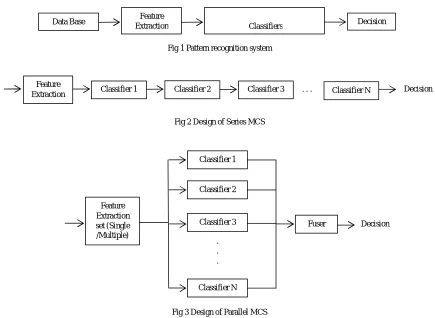
RAMEWORKGeneral Pattern recognition system is stated as database, feature extraction, classification and decision. Its structure is
illustrated in fig 1. MCS focused on the combining classifiers. These classifiers are heterogeneous or homogeneous
classifiers. The main two facts ponder in designing MCS are system topology and decision fuser rules. In MCS system
there are two approach of combining multiple classifiers: parallel combination and serial combination. The overview
of series and Parallel Combiner MCS is illustrated in fig 2 & fig 3 respectively.
Fig 1 Pattern recognition system
Fig 2 Design of Series MCS
Fig 3 Design of Parallel MCS
MCS system is build using more than one classifier and they are interconnected according to topological structure i.e.
parallel or series. For parallel combination classifiers are arranged in parallel and each classifier is nourishing with the
same input database. So that there outputs are combined and take final decision using fuser rule. For series combination
an individual classifiers integrated in sequence. When the prior classifier cannot be trusted to classify a given database,
then the features are given to next classifier. A primary classifier can be used. When it rejects a pattern, a secondary
classifier is used, and so on. In such a way final result would get using decision fuser rule [1].
There are different combination fuser scheme can be applied to take final decision of MCS. Some of the fusion rules
are probability schemes,voting schemes (maximum, minimum, median, Nash average and product), rank based method,
Bayes approach, Dempster-Shafer theory, fuzzy integral, fuzzy connectives, fuzzy template, applied information theory
(a measure of closeness, conditional entropy, and minimum mutual information) and combination by neural network.
By employing above strategy combines many classifier result to achieve better performance of MCS [4] [7] [21].
Data Base Extraction Feature Decision
Classifiers
Classifier 1
Classifier 2
Classifier 3
Classifier N . . .
Fuser Feature
Extraction set (Single /Multiple)
Decision
Classifier 1 Classifier 2 Classifier 3 . . . Classifier N
Feature
Research Development Cell, Government College of Engineering, Jalagon (M. S), India
III.
L
ITERATURE REVIEWNow a days many researchers works on MCS to improve their recognition rate in various applications such as face
recognition, iris recognition, speech recognition, speaker verification, emotion recognition and character recognition
etc.
Emotion Recognition
TL Pao et al. (2007) has work on“Combination of multiple classifiers for improving emotion recognition in
Mandarin speech”; for experiment author combines KNN, WKNN, WCAP, W-DKNN and SVM classifiers and
combining their output Majority Voting scheme. From the result author shows that combiner scheme is better than
single classifier in terms of overall accuracy with improvements ranging from 0.9%~6.5% [24]. Björn Schuller et al.
(2005), has worked on “Speaker Independent Emotion Recognition by Early Fusion of Acoustic and Linguistic
Features within Ensembles”; in this author used Berlin EMO database with SVM, K-NN, Naïve Bayes, C4.5, and ANN
classifiers and combines their output by Voting scheme. The overall performance upraised by 3.51% in total by their
combination [25][27]. Björn Schuller et al. (2005), has worked on “Meta-Classifiers in Acoustic and Linguistic feature
Fusion-Based Affect Recognition”;author work on unknown database to extract speaker dependent Acoustics features
and were analysed by combining MLR, NB, ND, SVM, C4.5c classifier and mean 94.8% Performancewereachieved
[26][27]. MCS designed author Enrique M. Albornoz et al. (2011) works on “Spoken emotion recognition using
hierarchical classifiers”; In this author achieved the identification rate 6.7% higher than any individual HME while the
rejection rate is of 2.2% [3].
Character recognition
Author Sandhya Arora et al.(2008) has applied “Combining Multiple Feature Extraction Techniques for Handwritten
Devnagari Character Recognition”; author got 92.80% overall recognition rate. Weighted majority voting technique
were used to fusionof classification decision obtained from four Multi-LayerPerceptron (MLP) based classifier.Author
matched this technique with other recent systems for Handwritten Devnagari Character Recognition and it has been
detected that this method has improved success rate than other methods [6].Researcher Anitha Mary M.O. Chackoa &
Dhanya P.M. (2015) has studied “Multiple Classifier System for Offline Malayalam Character Recognition”; and give
feature as fed to two feedforword neural netwoks. They combine the reults of these two neural networks by using four
different combination schemes: Max rule, Sum rule, Product rule and Borda count method. By using product rule
combination got the best result i.e. 81.82% [14].
Iris recognition
Md. Rabiul Islam (2014) had work on “Feature and Score Fusion Based Multiple Classifier Selection for Iris
Recognition”; Likelihood ratio score fusion based has been applied in iris recognition system proposal to combine the
classifier output non equally. The four different classifiers((i.e., unimodal left iris recognition classifier, unimodal right
iris recognition classifier, left-right iris feature fusion based classifier, and left-right iris likelihood ratio score fusion
based classifier)) outputs are combined with MCS based majority voting technique, and gives the highest recognition
rate than other existing approaches. By observing its ROC curves we understand the performance of the proposed
approach gives highest recognition rate [8].
Face recognition
Research Development Cell, Government College of Engineering, Jalagon (M. S), India
orientation-based classifiers for experiment 1 &2. Author brought an improvement of 5% and 10% compared to
individual classifiers from experiment 1 &2 respectively [29].
Homogeneous or heterogeneous classifiers are used with different strategies of fuser in different implicational area.
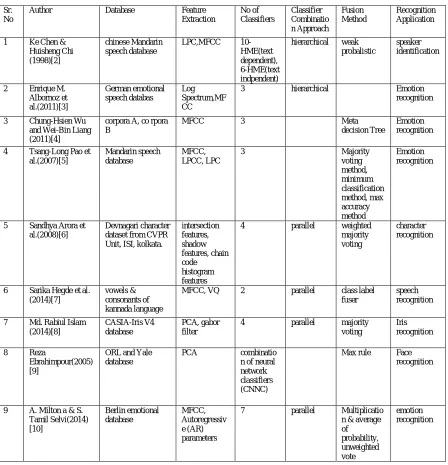
Review on MCS in different application shown in table 1.
Table 1: Review on MCS
Sr. No
Author Database Feature
Extraction No of Classifiers Classifier Combinatio n Approach Fusion Method Recognition Application
1 Ke Chen & Huisheng Chi (1998)[2]
chinese Mandarin speech database
LPC,MFCC
10-HME(text dependent), 6-HME(text indpendent)
hierarchical weak probalistic
speaker identification
2 Enrique M.
Albornoz et al.(2011)[3] German emotional speech databas Log Spectrum,MF CC
3 hierarchical Emotion
recognition
3 Chung-Hsien Wu
and Wei-Bin Liang (2011)[4]
corpora A, co rpora B
MFCC 3 Meta
decision Tree
Emotion recognition
4 Tsang-Long Pao et
al.(2007)[5]
Mandarin speech database
MFCC, LPCC, LPC
3 Majority
voting method, minimum classification method, max accuracy method Emotion recognition
5 Sandhya Arora et
al.(2008)[6]
Devnagari character dataset from CVPR Unit, ISI, kolkata.
intersection features, shadow features, chain code histogram features
4 parallel weighted
majority voting
character recognition
6 Sarika Hegde et al. (2014)[7]
vowels & consonants of kannada language
MFCC, VQ 2 parallel class label
fuser
speech recognition
7 Md. Rabiul Islam
(2014)[8]
CASIA-Iris V4 database
PCA, gabor filter
4 parallel majority
voting
Iris recognition
8 Reza
Ebrahimpour(2005) [9]
ORL and Yale database
PCA combinatio
n of neural network classifiers (CNNC)
Max rule Face
recognition
9 A. Milton a & S. Tamil Selvi(2014) [10] Berlin emotional database MFCC, Autoregressiv e (AR) parameters
7 parallel Multiplicatio
Research Development Cell, Government College of Engineering, Jalagon (M. S), India
10 Ramon
Lopez-Cozar et al.(2011)[11] telephone based dialogues between users(student of university) & shaplen system prosodic, acoustic, lexical dialog act
4 parallel Multiplicatio
n & average of probability, unweighted vote emotion recognition
11 Chul Min Lee et al.(2005)[12]
data obtained from real world call center dialog application
lexical, acoustic
3 parallel average
probability
emotion recognition
12 Donn Morrison et al. (2007)[13]
natural database collected from call center & emotional speech of mandarin & burmese speaker
prosodic 5 parallel unweighted
vote, stacked generalizatio n
emotion recognition
13 Anitha Mary M.O.
Chackoa & Dhanya P.M. (2015) [14]
handwritten Malayalam characters gradient and density based features
2 Max rule,
Sum rule, Product rule and Borda count method. Character Recognition
14 Utpal Garain, B. B. Chaudhuri, R. P. Ghosh (2004)[15] images containing displayed nad embedded expression fragements, both real and synthetic generated by TEX or Microsoft word
Stroke features
3 highest rank
method, the logistic regression and Borda count Recognition of Printed Mathematica l Symbols
15 F. KIMURA and
M. SHRIDHARt (1991)[16]
The numeral samples provided by a French company spatial features(chain codes, binary numeral image)
2 polling
(voting)strate gy
Handwritten Numerical Recognition
16 Yue Lu & Chew Lim Tan (2002) [17]
handwritten postal numerals were captured from live Chinese mail pieces at the site of Hangzhou Postal Mail Processing Center histogram features and gray-scale transformation features
5 parallel probabilistic
dictionary, Major voting, Bayes method postcode recognition
17 Shashi Kant Shukla & Akhilesh Pandey (2014) [18]
CPAR database Profile- simple profile, Contour based Triangular Area Representation (TAR)
3 parallel voting
scheme
hand written Devnagri numbers classification
18 Tin Kam
Ho,Jonathan J. Hull and Sargur N. Srihari(1994) [19]
images were collected from machine-printed addresses taken from live mail in a post office
polynomial discriminant, confidence-based contextual post processing,
segmentation-4 highest rank,
Research Development Cell, Government College of Engineering, Jalagon (M. S), India
values
19 Jie Sun and Hui Li (2009)[20]
Chinese listed companies real world data
discriminant analysis
3 series average
prediction
Financial distress prediction
20 Ekachai
Phaisangittisagul and H. Troy Nagle(2007)[21]
datasets were collected from an electronic nose prototype at the Biomedical Instrumentation Laboratory, North Carolina State University
discrete wavelet transform, principal component analysis
3 parallel measure of
closeness, conditional entropy, and minimum mutual information
odor classification systems
21 Moumita Roy,
Susmita Ghosh and Ashish
Ghosh(2014)[22]
remotely sensed images corresponding to the geographical areas of Mexico and Sardinia Island
state-of-the-art techniques
3 maximum change
detection of remotely sensed images
22 A. Zelaia, I. Alegria, O. Arregi and B.
Sierra(2011)[23]
Reuters-21578 dataset3
vector space model, singular value decomposition
30 k-NN single classifiers
Bayesian weighted voting
multiclass/m ultilabel document categorizatio n
IV.
C
ONCLUSIONIn this review we studied multiple classifier system in variety of applications. There has been various types of
Classifier fuser approaches generate more accuracy rate than each of the individual classifier. MCS system organised
using homogeneous or heterogeneous classifiers. The designing MCS is according to topological formation i.e. parallel
or series. From this study we observed Several combining schemes such as voting schemes, rank based method, Bayes
approach, Dempster-Shafer theory etc. are applied by authors to combine more than one classifiers output to get
improved recognition rate.
R
EFERENCES[1] Michał Woz´niak, Manuel Graña, Emilio Corchado. A survey of multiple classifier systems as hybrid systems. Information Fusion 16
(2014) Elsevier Publications, p. 3–17.
[2] Ke Chen, Huisheng Chi. A method of combining multiple probabilistic classifiers through soft competition on different feature sets. Neurocomputing 20 (1998) Elsevier Publications, P. 227-252.
[3] Enrique M. Albornoz, Diego H. Milone, Hugo L. Rufiner. Spoken emotion recognition using hierarchical classifiers. Computer Speech and Language 25 (2011) Elsevier Publications P. 556–570.
[4] Chung-Hsien Wu and Wei-Bin Liang. Emotion Recognition of Affective Speech Based on Multiple Classifiers Using Acoustic-Prosodic Information and Semantic Labels. IEEE Transactions on Affective Computing, Vol. 2, No. 1, January-March 2011 P. 10-21.
[5] Tsang-Long Pao, Charles S Chien, Yu-Te Chen, Jun-Heng Yeh, Yun-Maw Cheng and Wen-Yuan Liao. Combination of Multiple Classifiers for Improving Emotion Recognition in Mandarin Speech. IEEE Intelligent Information Hiding and Multimedia Signal Processing, 2007. Third International Conference, Volume: 1 P. 35-38.
[6] Sandhya Arora, Debotosh Bhattacharjee, Mita Nasipuri and Dipak Kumar Basu. Combining Multiple Feature Extraction Techniques for Handwritten Devnagari Character Recognition. IEEE the Third ICIIS 2008, Kharagpur, India December 8-10. P. 342/1-6.
Research Development Cell, Government College of Engineering, Jalagon (M. S), India
[8] Md. Rabiul Islam. Feature and Score Fusion Based Multiple Classifier Selection for Iris Recognition. Computational Intelligence and Neuroscience Volume 2014, Article ID 380585, Hindawi Publishing Corporation P. 1-11.
[9] Reza Ebrahimpour, Saeed Reza Ehteram and Ehsanollah Kabir. Face Recognition by Multiple Classifiers, a Divide-and-Conquer Approach. KES 2005, LNAI 3683, Springer-Verlag Berlin Heidelberg P. 225-232.
[10] A. Milton and S. Tamil Selvi. Class-specific multiple classifiers scheme to recognize emotions from speech signals. Computer Speech and Language 28 (2014) Elsevier Publications P. 727–742.
[11] Ramo´n Lo´pez-Co´zar, Jan Silovsky, Martin Kroul. Enhancement of emotion detection in spoken dialogue systems by combining several information sources. Speech Communication 53 (2011) Elsevier Publications P.1210–1228.
[12] Chul Min Lee and Shrikanth S. Narayanan. Toward Detecting Emotions in Spoken Dialogs. IEEE Transactions On Speech And Audio Processing, Vol. 13, No. 2, March 2005. P. 293-303.
[13] Donn Morrison, Ruili Wang and Liyanage C. De Silva. Ensemble methods for spoken emotion recognition in call-centres. Speech Communication 49 (2007) Elsevier Publications P. 98–112.
[14] Anitha Mary M.O. Chackoa and Dhanya P.M. Multiple Classifier System for Offline Malayalam Character Recognition. International Conference on Information and Communication Technologies (ICICT 2014). Procedia Computer Science 46, Elsevier Publications P. 86 – 92.
[15] Utpal Garain, B. B. Chaudhuri and R. P. Ghosh. A Multiple-Classifier System for Recognition of Printed Mathematical Symbols. IEEE 2004 0-7695-2128-2/04 $20.00.
[16] F. Kimura and M. Shridhart. Handwritten Numerical Recognition Based On Multiple Algorithms. Pattern Recognition 1991, Vol. 24, No. 10. P. 969-983.
[17] Yue Lu and Chew Lim Tan. Combination of multiple classifiers using probabilistic dictionary and its application to postcode recognition. Pattern Recognition 35 (2002) Elsevier Publications. P. 2823 – 2832.
[18] Shashi Kant Shukla and Akhilesh Pandey. Classification of Devnagari Numerals using Multiple Classifier. International Journal of Computer Trends and Technology (IJCTT) – volume 12 number 4 – Jun 2014 P. 196-200.
[19] Tin Kam Ho, Jonathan J. Hull and Sargur N. Srihari. Decision Combination in Multiple Classifier Systems. IEEE Transactions On Pattern Analysis And Machine Intelligence, VOL. 16. No. I . January 1994. P. 66-75.
[20] Jie Sun, Hui Li. Financial distress prediction based on serial combination of multiple classifiers. Expert Systems with Applications 36 (2009). Elsevier Publications. P. 8659–8666.
[21] Ekachai Phaisangittisagul, H. Troy Nagle. Enhancing multiple classifier system performance for machine olfaction using odor-type signatures. Sensors and Actuators B 125 (2007) Elsevier Publications P. 246–253.
[22] Moumita Roy, Susmita Ghosh, Ashish Ghosh. A novel approach for change detection of remotely sensed images using semi-supervised multiple classifier system. Information Sciences 269 (2014) Elsevier Publications P. 35–47.
[23] A. Zelaia, I. Alegria, O. Arregi, B. Sierra. A multiclass/multilabel document categorization system: Combining multiple classifiers in a reduced dimension. Applied Soft Computing 11 (2011) Elsevier Publications P.4981–4990.
[24] TL Pao, CS Chien, YT Chen, JH Yeh, YM Cheng, WY Liao; “Combination of Multiple Classifiers for Improving Emotion Recognition in Mandarin Speech”; Intelligent Information Hiding and Multimedia Signal Processing, 2007. IIHMSP 2007. Third International Conference on (Volume:1 )
[25] Björn Schuller, Raquel Jiménez Villar, Gerhard Rigoll, and Manfred Lang; “Speaker Independent Emotion Recognition By Early Fusion Of Acoustic And Linguistic Features Within Ensembles”; Interspeech 2005, September, 4-8, Lisbon, Portugal.
[26] Björn Schuller, Raquel Jiménez Villar, Gerhard Rigoll, and Manfred Lang; “Meta-Classifiers In Acoustic And Linguistic Feature Fusion-Based Affect Recognition”; ICASSP 2005; 0-7803-8874-7/05/$20.00 ©2005 IEEE.
[27] CN Anagnostopoulos, T Iliou, I Giannoukos; “Features and classifiers for emotion recognition from speech: a survey from 2000 to 2011” Artif Intell Rev ; Published buy Springer; DOI 10.1007/s10462-012-9368-5
[28] Afsar Saranlm*, MuK beccel Demirekler, “On output independence and complementariness in rank-based multiple classifier decision systems”; Pattern Recognition 34 (2001) 2319}2330; Elsevier Publications