A Survey on Intrusion Detection using Data
Mining Technique
D. Shona, A.Shobana
Assistant Professor, Dept. of Co mputer Sc ience, Sri Krishna Arts & Science Co llege, Coimbatore, India 1
M.Phil. Scholar, Dept. of Co mputer Sc ience, Sri Krishna Arts & Science College, Coimbatore, India2
ABSTRACT: Security and privacy of a system is co mpro mised, when an intrusion happens. Intrusion Detection System
(IDS) p lays vital ro le in network security as it detects various types of attacks in network. Imp le mentation of an IDS is
distinguishes between the traffic co ming fro m clients and the traffic o rig inated fro m the attackers or intruders, in an attempt to simultaneously mit igate the problems of throug hput, latency and security of the network. For th is reason this survey provides better approaches using data mining techniques. By applying Data Mining techniques on network traffic data is a promising solution that helps develop better intrusion detection systems. Therefore this paper provides Survey of various techniques of Intrusion detection system applied in the data mining. In this paper we present an Intrusion Detection System in data min ing with different techniques .
KEYWORDS: Intrusion Detection System, Security, Privacy, Data Mining and Survey.
I.INTRODUCTION
ven with today's advanced computer technologies (e. g., machine learn ing and data mining sys tems) e xt racting data is critica l one where data set are widely used in mach ine learn ing and data min ing (DM ) tasks. In Data Min ing, discovering
knowledge fro m data can still be fiendishly hard due to the characteristics of the computer generated data. Data mining is
one of the knowledge e xtraction process used to discover the knowledge fro m large datasets and convert it into useful informat ion. In large dataset data are represented in feature value. Size of dataset may be measured in no. of features and
no. of instance. As the number and size of the data were increased, these data were transferred through Netwo rk [1].
Through this method Internet traffic increase and the need for the intrusion detection grows in step to reduce the overhead required for the intrusion detection and diagnosis, it has made public servers increasingly vulnerable to unauthorized accesses and incursion of intrusions. In addition to ma intaining low latency and poor performance for the client, filtering unauthorized accesses has become one of the ma jor concerns of a server administrator. Hence imp le mentation of an Intrusion Detection System (IDS) distinguishes between the t raffic co ming fro m c lients and the traffic orig inated from the attackers or intruders, in an attempt to simultaneously mit igate the problems of throughput, latency and security of the network [2]. The e xponential growth of computer/network attacks is becoming more and mo re difficu lt to identify and the need for better and more e ffic ient intrusion detection systems increases in step. The ma in proble m with current intrusion detection systems is high rate of fa lse ala rms. As network-based computer systems have important roles in modern society, they have become the targets of intruders. There fore, we need to find the best possible ways to protect our systems. The security of a computer system is co mpro mised when an intrusion takes place.
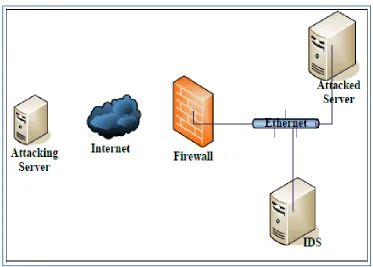
Fig 1: IDS Architecture
II.LITERATURE REVIEW
Huy Anh Nguyen and Deokja i Choi [5] evaluate that a network attacks have increased in nu mber and severity over the past few years, intrusion detection system (IDS) is increasingly beco ming a critica l co mponent to secure the network. Due to large volu mes of security audit data as well as co mple x and dyna mic properties of intrusion behaviors, optimizing performance of IDS becomes an important open proble m that is receiv ing more and more attention fro m the research community. The uncertainty to e xplo re if certain algorith ms perform better for certa in attack c lasses constitutes the motivation for the reported herein. In this paper, they evaluate performance of a co mprehensive set of classifie r algorith ms using KDD99 dataset. Based on evaluation results, best algorith ms for each attack category is chosen and two classifie r algorith m selection models are proposed. The simu lation result comparison indicates that noticeable performance improve ment and rea l-t ime intrusion detection can be achieved as they apply the proposed models to detect diffe rent kinds of network attacks.
Yeung and Chow [6] proposed a novelty detection approach using no parametic density estimation based on Parzen -window estimators with Gaussian kernels to build an intrusion detection system using normal data only. Th is novelty detection approach was employed to detect attack categories in the KDD dataset. The technique has surprisingly good reported results: 96.71% of DoS, 99.17% of Probe, 93.57% of U2R and 31.17% of R2L respectively. Ho wever, due to the fact that no FP was reported by the authors and a nearly impossible detection rate of 93.57% of U2R category, they really have to question the authentic of the reported numbers.
Fro m Krishna Kant et a l[7] In these days an increasing number of public and co mme rc ial services are used through the Internet, so that security of informat ion becomes more important issue in the society information Intrusion Detection System (IDS) used against attacks for protected to the Co mputer net -works. On another way, some data min ing techniques also contribute to intrusion detection. Some data mining techniques used for intrusion detection can be classified into two classes: misuse intrusion detection and anomaly intrusion detection. Misuse always refers to known at -tacks and harmfu l activities that explo it the known sensitivity of the system. Anomaly generally means a generally activity that is able to indicate an intrusion. In this paper, comparison made between 23 related papers of using data mining techniques for intrusion detection. Our wo rk provide an overvie w on data min ing and soft co mputing techniques such as Artific ia l Neura l Network (ANN), Support Vector Machine (SVM ) and Mult ivari-ate Adaptive Regression Spline (MARS), etc. In th is paper comparison shown between IDS data min ing techniques and tuples used for intrusion detection. In those 23 re lated papers, 7 research papers use ANN and 4 ones use SVM, because of ANN and SVM a re more reliable than other models and structures. In addition, 8 re -searches use the DARPA1998 tuples and 13 researches use the KDDCup1999, because the standard tuples are much more cred ible than others. There is no best intrusion detection model in prese nt time. However, future research directions for intrusion detection should be exp lored in this paper.
Fro m th is paper [8], they present an overview of our research in real time data mining -based intrusion detection systems (IDSs). They focus on issues related to deploying a data mining -based IDS in a rea l time environ ment. They describe our approaches to address three types of issues: accuracy, effic iency, and usability. To imp rove accuracy, data min ing progra ms are used to analyze audit data and extract features that can distinguish normal activ ities fro m intrusions; they use artific ia l anomalies along with norma l and/or intrusion data to produce more effective misuse and anomaly detection models. To improve efficiency, the co mputational costs of features are analy zed and a mu ltip le-model costbased approach is used to produce detection models with low cost and high accuracy. They also present a distributed architecture for evaluating cost -sensitive models in realt ime. To improve usability, adaptive learning a lgorith ms are used to facilitate model construction and incremental updates; unsupervised anomaly detection algorith ms are used to reduce the reliance on labeled data. They also present an architecture consisting of sensors, detectors , a data warehouse, and model generation components. This architecture facilitates the sharing and storage of audit data and the distribution of new or updated models. This architectu re also improves the effic iency and scalability of the IDS.
proposed in which it minimizes unnecessary recognition. Therefore , the purpose of traffic monitoring is two -folds; to reduce amount of data to be recognized and to avoid unnecessary recognition. For this Adaptive Neura l Fuzzy Inference System and Linear Genetic Progra mming to form ensemble classifie rs that shows a small improve ment using the ensemble approach for DoS and R2L classes (attacks).
S.A.Joshi et a l. [10] in paper has presented that with the tre mendous growth in information technology, network security is
one of the challenging issue and so as Intrusion Detection system (IDS). The traditional IDS a re unable to manage various newly a rising attacks. To overco me this type of proble m Data Min ing techniques, Feature Selection, Multiboosting were applied. With data min ing, it is easy to identify valid, useful and understandable pattern in large volume o f data. Features are selected using binary classifiers for mo re accuracy in each type of attack. Multiboosting is used to reduce both the variance and bias. Thus the effic iency and accuracy of Intrusion Detection system a re increased and security of network so is also enhanced.
III. INTRUS ION DET ECTION S YSTEM
An IDS is a co mbination of software and hardwa re which are used for detecting intrusion. It gathers and analyzes the network tra ffic & detects the ma lic ious patterns and finally a lert to the proper authority. The ma in function of IDS inc ludes :
Monitoring and analyzing the information gathered fro m both user and system activ ities.
Analyzing configurations of system and evaluating the file integrity and system integrity.
For static records, it finds out the abnormal pattern.
To recognize abnorma l pattern, it use static records and alert to system administrator.
According to techniques used for intrusion detection based on whether attack’s patterns are known or unknown, IDS classified into two categories
Misuse detection
Anomaly detection
Misuse detection:It is Signature based IDS where detection of intrusion is based on the behaviors of known attacks like antivirus software. Antivirus software compares the data with known code of virus. In Misuse detection, pattern of known ma licious activity is stored in the dataset and identify suspicious data by comparing new instances with the stored pattern of attacks.
Anomaly detection: It is diffe rent fro m M isuse detection. Here baseline of norma l data in network data in network load on network t raffic, protocol and packet size etc is defined by system ad ministrator and according to this baseline, Anoma ly detector monitors new instances. The new instances are co mpared with the baseline, if there is any deviation fro m baseline, data is notified as intrusion. For this reason, it is also called behavior based Intrusion detection system.
IV. IDS US ING DATA MINING TECHNIQUE
b. IDS US ING CLUS TERING ANALYS IS: Clustering assign objects (intrusions) to groups (clusters) on the basis of distance measurements made on the objects. As opposed to classification, clustering is an unsupervised learn ing process since no informat ion is available on the labels of the t rain ing data. In anoma ly detection, c lustering and outlier analysis can be used to drive the ID model. Distance or simila rity measure plays an important role in grouping observations in homogeneous clusters. It is important to formu late a metric to determine whether an event is dee med normal or ano malous using measures such as Jaccard simila rity measure, Cosine similarity measure, Euclidian d istance measure and longest common subsequence (LCS) measure [13]. Jacca rd similarity coeffic ient is a statistical measure of similarity between sample sets and can be defined as the degree of co mmonality between two sets . Cosine similarity is a co mmon vector based similarity measure and mostly used in text databases and it calculates the angle of d ifference in direction of t wo vectors, irrespective of their lengths. Euclidean distance is a wide ly used distance measure for vector spaces, for two vectors X and Y in a d imensional Euclidean space; Euclidean distance can be defined as the square root of the sum of diffe rences of the corresponding dimensions of the vectors [14].
c. IDS US ING ANN
Artificia l Neura l Netwo rk (A NN) is relative ly c rude electronic models based on the neural structure of the b rain. The bra in basically learns fro m h is e xperience. This is natural proof that some proble ms that are beyond the scope and range of current computers are indeed solvable by small energy effic ient packages. The brain modeling of a technical way to develop machine solutions is the new arrival approach to computing also provides a more g raceful degradation during system overload than its more habitual counter-parts [15]. A neural network is an interrelated group of artificia l neurons that uses a mathe matica l model or co mputational model for informat ion processing based on a connection a pproach to computation. A neural network could not contains do -main knowledge in the beginning, but it can be supervised to make decisions by mapping e xa mp le pa irs of input data into exa mp le output vectors, and estimat ing its we ights so that it maps each input exa mp le vector into the corresponding out-put exa mple vector appro x [16].
TECHNIQUE ADVANTAGE DISADVANTAGE
Ids using classification anal ysis High dimension space to find a hyper-plane
Slow in c lassifying and testing tuples
Ids using clustering anal ysis Grouping observations in homogeneous clusters
Require lot of t rain ing data
Ids using ANN Interrelated group of artific ia l neurons, highest detection rate
Cannot detect novel attacks an d variation of known attacks
Table 1 : A COMPARATIVE ANALYS IS OF IDS
V. CONCLUS ION
REFERENCES
[1] Ahmed Youssef and Ahmed Emam, “Network Intrusion Detection Using Data Mining And Network Behaviour Analysis”.
[2] Jian Pei, Shambhu J. Upadhyaya Faisal Farooq, Venugopal Govindaraju, “ Data Mining for Intrusion Detection– Techniques, Applications and Systems”
[3] Yogita B. Bhavsar1, Kalyani C.Waghmare Intrusion Detection System Using Data Mining Technique: Support Vector Machine [4] Sahilpreet Singh,Meenakshi Bansal, “A Survey on Intrusion Detection System in Data Mining”
[5] Huy Anh Nguyen and Deokjai Choi, “ Application of Data Mining to Network Intrusion Detection: Classifier Selection Model”
[6] Yeung, D.Y., Chow, C.: Prazen-window Network Intrusion Detectors. In: 16th International Conference on Pattern Recognition, Quebec, Canada, pp. 11–15 (August 2002)
[7] Krishna Kant Tiwari, Susheel Tiwari, Sriram Yadav, “ Intrusion Detection Using Data Mining T echniques” [8] Wenke Lee, Salvatore J. Stolfo , Philip K. Chan, “ Real Time Data Mining-based Intrusion Detection”.
[9] Anazida Zainal, Mohd Aizaini Maarof and Siti Mariyam Shamsuddin “Data Reduction and Ensemble Classifiers in Intrusion Det ection” in 2008 IEEE.
[10] S.A.Joshi, Varsha S.Pimprale “Network Intrusion Detection System (NIDS) based on Data Mining” International Journal of Engineering Science and Innovative Technology (IJESIT) Volum e 2, Issue 1, January 2013
[11] Abhaya, Kaushal Kumar, Ranjeeta Jha, Sumaiya Afroz, “Data Mining Techniques for Intrusion Detection: A Review”.
[12] Chunhua Gu and Xueqin Zhang,” A Rough Set and SVM Based Intrusion Detection Classifier”, Second International Workshop on Computer Science and Engineering, 2009.
[13] Steven Noel et al, “ Modern intrusion detection, data mining, and degrees of attack guilt”
[14] L. Pornoy. Intrusion detection with unlabeled data using clustering. In Undergraduate Thesis, Columbia University, Department of Computer Science, 2000.
[15] Joo, D., Hong, T., and Han, I. "The neural network models for IDS based on the asymmetric costs of false negative errors and false positive errors." Expert Sys-tems with Applications 25, 69–75 2000.