I
MPROVING
I
NTRUSION
D
ETECTION
S
YSTEMS
U
SING
D
ATA
M
INING
T
ECHNIQUES
By
Abdulrazaq Almutairi
A Doctoral Thesis submitted in partial fulfilment of the requirements for the award of Doctor of Philosophy of
Loughborough University
Improving Intrusion Detection Systems using Data Mining Techniques – Abdulrazaq Almutairi –Feb 2016
A
BSTRACT
Recent surveys and studies have shown that cyber-attacks have caused a lot of damage to organisations, governments, and individuals around the world. Although developments are constantly occurring in the computer security field, cyber-attacks still cause damage as they are developed and evolved by hackers. This research looked at some industrial challenges in the intrusion detection area. The research identified two main challenges; the first one is that signature-based intrusion detection systems such as SNORT lack the capability of detecting attacks with new signatures without human intervention. The other challenge is related to multi-stage attack detection, it has been found that signature-based is not efficient in this area. The novelty in this research is presented through developing methodologies tackling the mentioned challenges. The first challenge was handled by developing a multi-layer classification methodology. The first layer is based on decision tree, while the second layer is a hybrid module that uses two data mining techniques; neural network, and fuzzy logic. The second layer will try to detect new attacks in case the first one fails to detect. This system detects attacks with new signatures, and then updates the SNORT signature holder automatically, without any human intervention. The obtained results have shown that a high detection rate has been obtained with attacks having new signatures. However, it has been found that the false positive rate needs to be lowered. The second challenge was approached by evaluating IP information using fuzzy logic. This approach looks at the identity of participants in the traffic, rather than the sequence and contents of the traffic. The results have shown that this approach can help in predicting attacks at very early stages in some scenarios. However, it has been found that combining this approach with a different approach that looks at the sequence and contents of the traffic, such as event- correlation, will achieve a better performance than each approach individually.
K
EYWORDS
Intrusion detection; Multi-Stage attacks; IP Check; Data mining; Fuzzy Logic; Neural Network; Naïve base; Decision tree; SNORT
A
CKNOWLEDGEMENTS
First I would like to thank God who has been a source of blessing and making this project come through.
I would like this opportunity to thank my supervisors, Prof. David Parish and Dr. James Flint who have been very patient with me and have been relentlessly guiding me with their expert guidance.
I would also like to thank all of my colleagues in High Speed Network group for their support, help and for sharing their knowledge, Dr. Francisco Aparicio-Navarro, Dr. Konstantinos Kyriakopoulos and Gines Escudero-Andreu.
I would also like to thank family especially my wife Dr. Shaimaa Almutairi and friends who have helped with number of tasks in the PHd. I would also like to extend my gratitude to my sister – Huda, for whom I wish that she will wake up from coma and read this thesis. And I would like to thank my parents for their consistent support, without them I would not be where I am today.
Finally I would also thank my country Kuwait. And I would like to thank Prime Minister of the State of Kuwait Sheikh Jaber Mubarak Hamad Al-Sabah, And Sheikh Mohammad Abdullah Al-Mubarak Al-Al-Sabah, and Sheikh Khaled Mohammad al-Khaled Al-Sabah.
C
ONTENTS
CHAPTER 1 ... 1
INTRODUCTION ... 1
1.1 BACKGROUND... 1
1.2 MOTIVATIONS OF THE RESEARCH ... 5
1.3 RESEARCH AIM AND OBJECTIVES ... 6
1.4 THESIS ORIGINAL CONTRIBUTION ... 7
1.5 RESEARCH METHODOLOGY ... 7
1.6 THESIS OUTLINE ... 8
CHAPTER 2 ... 10
LITERATURE REVIEW ... 10
2.1 INTRODUCTION AND BACKGROUND ... 10
2.2 CLASSIFICATION OF HONEYPOTS ... 12 2.2.1 Low-Interaction Honeypots ... 12 2.2.2 High-Interaction Honeypots ... 14 2.3 PURPOSE OF HONEYPOT ... 15 2.3.1 Research Honeypot ... 15 2.3.2 Production Honeypots ... 15
2.4 MONITORING METHODS OF HONEYPOTS ... 17
2.5 MONITORING METHODS OF LOW-INTERACTION HONEYPOTS ... 17
2.5.1 Mwcollect (Malware Collection Tool) ... 17
2.5.2 Honeyd ... 18
2.6 MONITORING METHODS OF HIGH-INTERACTION HONEYPOTS ... 18
2.6.1 Sebek ... 18
2.6.2 Honeynets ... 20
2.6.3 Argos ... 22
2.7 ADVANTAGES AND DISADVANTAGES OF HONEYPOTS ... 23
2.8 INTRUSION DETECTION SYSTEMS ... 24
2.8.1 Overview ... 24
2.8.2 Detection methodologies ... 26
2.8.3 Limitations of Intrusion Detection Systems ... 27
2.8.7 Online Evaluation ... 34
2.9 DATA MINING ... 36
2.9.1 Overview ... 36
2.9.2 Data mining limitations ... 37
2.9.3 Genetic algorithms ... 37
2.9.4 Artificial Neural Network ... 38
2.9.5 Naive Bayes ... 39
2.9.6 Decision Tree ... 40
2.9.7 K Means ... 42
2.9.8 Related Research Works to the first contribution ... 44
2.9.9 Related Research Works to the Second Contribution ... 45
2.9.10 Weka data mining tool ... 47
2.10 FEATURE SELECTION ... 47
2.11 DISCUSSION ... 49
2.12 SUMMARY ... 51
CHAPTER 3 ... 53
MULTI-LAYER CLASSIFICATION SYSTEM ... 53
3.1 INTRODUCTION ... 53
3.2 CLASSIFICATION APPROACH ... 55
3.3 DATA SET –KDD’99 ... 57
3.3.1 Overview ... 57
1.3.2 Features of the Data Set ... 58
3.4 CLASSIFIER MODULE ... 59
3.4.1 Overview ... 59
3.4.2 Naïve Bayes ... 59
3.4.3 Decision Tree ... 60
3.4.4 Experiment Environment ... 61
3.4.5 All-Classes Based Model Creation Strategy ... 62
3.4.6 Two-Classes Based Model Creation Strategy ... 65
3.4.7 Chosen Model ... 67
3.5.5 Experiment Results ... 74
3.6 CONCLUSION ... 74
CHAPTER 4 ... 76
MULTI STAGE ATTACKS ... 76
4.1 INTRODUCTION ... 76
4.2 ANALYSIS APPROACH ... 78
4.3 SCENARIO A ... 78
4.3.1 Trace file ... 78
4.3.2 IP Involved in the Scenario ... 79
4.3.3 Stages of the attack ... 82
4.3.4 Summary of the Scenario ... 85
4.3.5 Analysis Outcome: ... 86
4.4 SCENARIO B ... 87
4.4.1 Social Engineering ... 87
4.4.2 Operation Shady Rat Attack ... 87
4.4.3 Analysis Outcome ... 90 4.5 SCENARIO C ... 91 4.5.1 CRLF Injection ... 91 4.5.2 Scenario C.1 ... 91 4.5.3 Scenario C.2 ... 93 4.5.4 Analysis Outcome ... 94 4.6 SCENARIO D ... 94 4.6.1 Vulnerable FTP Service ... 94 4.6.2 Scenario Description ... 94 4.6.3 Analysis Outcome ... 97 4.7 CONCLUSION ... 97 CHAPTER 5 ... 99
MULTI STAGE ATTACKS PREDICTION ... 99
5.1 INTRODUCTION ... 99
5.2 AN OVERVIEW OF THE PROPOSED SOLUTION ... 100
5.3 NETWORK SNIFFING MODULE ... 101
5.3.1 Choosing a sniffing tool ... 101
5.4.3 IP Rating ... 109
5.4.4 Implementation ... 109
5.5 THE REASONING MODULE ... 111
5.5.1 Data Mining Technique Selection ... 111
5.5.2 Pre-processing the inputs ... 112
5.5.3 Fuzzy logic ... 113
5.5.4 Implementation ... 116
5.5.5 Using Message Broker ... 118
5.6 SUMMARY ... 121 CHAPTER 6 ... 123 EVALUATION ... 123 6.1 INTRODUCTION ... 123 6.2 LOGISTICS EVALUATION ... 124 6.2.1 Distributed Management ... 124 6.2.2 Ease of Configuration ... 125
6.2.3 Ease of Policy Management ... 126
6.2.4 Outsource Solutions ... 126 6.2.5 Platform Requirements ... 127 6.2.6 Conclusion ... 127 6.3 DESIGN METRICS ... 128 6.3.1 Adjustable sensitivity ... 128 6.3.2 Data storage ... 129
6.3.3 Multi sensor support ... 129
6.3.4 Firewall Interaction ... 129
6.3.5 Incident logging and notifications ... 129
6.3.6 Packet Loss ... 130 6.3.7 System throughput ... 130 6.3.8 Conclusion ... 130 6.4 PERFORMANCE EVALUATION ... 131 6.4.1 Testing Data ... 131 6.4.2 First Phase ... 132
7.1 OVERVIEW ... 138
7.2 AUTOMATIC CREATION FOR SNORTRULES ... 139
7.3 MULTI-STAGE ATTACK PREDICTION ... 141
7.4 FUTURE WORK ... 145
7.5 PUBLICATIONS RELATED TO THIS THESIS ... 146
REFERENCES ... 147
APPENDIX A: PROJECT PLAN ... 164
A.1PROJECT MANAGEMENT METHODOLOGY ... 164
A.2PROJECT SCHEDULE ... 164
A.3RESOURCE PLAN ... 167
A.3COMMUNICATIONS PLAN ... 168
A.4RISK PLAN ... 168
APPENDIX B: NEURAL NETWORK TRAINING CODE ... 171
APPENDIX C: FUZZY RULES GENERATION CODE ... 172
APPENDIX D: HYBRID MODULE CODE ... 174
APPENDIX E: NETWORK SNIFFING MODULE CODE ... 179
APPENDIX F: IP INFORMATION FINDER MODULE ... 180
APPENDIX G: THE REASONING MODULE CODE ... 181
APPENDIX H: THE NETWORK SNIFFING MODULE CODE WITH A MESSAGE BROKER ... 183
APPENDIX I: THE IP INFORMATION MODULE CODE WITH A MESSAGE BROKER ... 185
APPENDIX J: THE TEST SCRIPT FOR MULTI-STAGE PREDICTION ... 187
L
IST OF
T
ABLES
TABLE 2.1:CLASSIFICATION OF HONEYPOTS ... 16 TABLE 2.2:ADVANTAGES AND DISADVANTAGES OF IDS METHODOLOGIES (LIAO ET
AL.2012) ... 27 TABLE 2.3:ATTACK TYPES IN EVALUATION DATA SET (SOURCE:(LIPPMANN ET AL.
2000)) ... 33 TABLE 2.4:TAXONOMY OF MACE EXPLOITS (SOURCE:(SOMMERS ET AL.,2005)) 35
TABLE 2.5: TRIDENT TOOLS DEVELOPED FOR NIDS PERFORMANCE EVALUATION
(SOURCE:(SOMMERS ET AL.2006)) ... 35
TABLE 2.6:ADVANTAGES AND DISADVANTAGES OF DATA MINING TECHNIQUES .... 44
TABLE 3.1: RESULTS FOR NAÏVE BAYES AND DECISION TREE USING AN ALL
-CLASSES MODEL CREATION STRATEGY ... 62
TABLE 3.2: ACCURACY / CLASS FOR NAÏVE BAYES AND DECISION TREE USING
ALL-CLASSES MODEL CREATION STRATEGY ... 64
TABLE 3.3:RESULTS FOR NAÏVE BAYES AND DECISION TREE USING TWO-CLASSES
MODEL CREATION STRATEGY ... 65 TABLE 3.4: ACCURACY / CLASS FOR NAÏVE BAYES AND DECISION TREE TWO -CLASSES MODEL CREATION STRATEGY ... 66 TABLE 3.5:RESULTS OF THE HYBRID MODEL USING NEURAL NETWORK AND FUZZY
LOGIC ... 74 TABLE 4.1:IP ADDRESSES PARTICIPATED IN THE FIRST SCENARIO AS SOURC ... 80 TABLE 4.2:IP ADDRESSES PARTICIPATED IN THE FIRST SCENARIO AS DESTINATIONS
... 81 TABLE 4.3: DNSQUERY ... 82 TABLE 4.4:DNSRESPONSE ... 82
TABLE 4.8: BOT NET COMMANDS USED BETWEEN THE COMPROMISED AND
TARGETED HOSTS ... 85
TABLE 5.1: A COMPARATIVE OVERVIEW OVER DIFFERENT SNIFFING TOOLS ... 103
TABLE 5.2:APIREQUEST FOR FINDING IP GEOGRAPHIC LOCATION (NEUTRINO API, 2013) ... 106
TABLE 5.3: API RESPONSE FOR FINDING IP GEOGRAPHIC LOCATION (NEUTRINO API,2013) ... 107
TABLE 5.4:APIREQUEST FOR FINDING IP GEOGRAPHIC LOCATION (NEUTRINO API, 2013) ... 108
TABLE 5.5: API RESPONSE FOR FINDING IP GEOGRAPHIC LOCATION (NEUTRINO API,2013) ... 108
TABLE 5.6:APIREQUEST FOR FINDING IP RATING (NEUTRINO API,2013) ... 109
TABLE 5.7:APIRESPONSE FOR FINDING IP RATING (NEUTRINO API,2013) ... 109
TABLE 5.8:THE REASONING MODULE INPUTS ... 112
TABLE 5.9:PRE-PROCESSING THE REASONING MODULE INPUTS ... 112
TABLE 5.10:IF THEN RULES USED IN THE REASONING MODULE ... 115
TABLE 6.1:LOGISTIC METRICS ... 128
TABLE 6.2:TEST ENVIRONMENT FOR MEASURING SYSTEM THROUGHPUT` ... 130
TABLE 6.3:DESIGN METRICS ... 131
TABLE 6.4:DIFFERENT CLASSES IN THE IP TEST LIST ... 132
TABLE 6.5:THE CONFUSION METRICS ... 134
TABLE 6.6:THE CONFUSION METRICS AFTER USING THE FRAUD LAB WEB SERVICE TO DETECT ANONYMOUS PROXY ... 134
TABLE 6.7: IP PARTICIPATED IN THE SQL ATTACK SCENARIO ... 135
TABLE 6.8:IP PARTICIPATED IN THE UDP SCAN SCENARIO ... 135
TABLE 6.9:IP PARTICIPATED IN THE CROSS SITE FORGERY SCENARIO ... 136
L
IST OF
F
IGURES
FIGURE 1.1:DISTRIBUTION OF COSTS FOR EXTERNAL CONSEQUENCES OF TARGETED CYBER-ATTACKS REPORTED BY STATISTIA (2015) ... 2
FIGURE 1.2:DISTRIBUTION OF COSTS FOR EXTERNAL CONSEQUENCES OF TARGETED CYBER-ATTACKS REPORTED BY PONEMON INSTITUTE (2014) ... 3
FIGURE 2.1:CONTROL PANEL FOR SPECTER TOOL SHOWING SERVICES THAT MAY BE EMULATED (SOURCE:(NETSEC,2012)) ... 13
FIGURE 2.2: HTTP SERVICE EMULATION SETUP USING KFSENSOR (SOURCE:
(KFSENSOR,2012)) ... 14
FIGURE 2.3: INSTANCE OF MODIFIED SYS_READ SYSTEM CALL AFTER LOADING OF
SEBEK ... 19
FIGURE 2.4: SEBEK BASED APPROACH IN HONEYPOT MONITORING IN CONTEXT OF
HTTP(SOURCE:(JIANG AND WANG,2007)) ... 20
FIGURE 2.5:HONEYWALL ARCHITECTURE (SOURCE:(PROJECT,2012))... 21
FIGURE 2.6:HIGH-LEVEL OVERVIEW OF ARGOS (SOURCE: (PORTOKALIDIS ET AL.,
2006)) ... 23 FIGURE 2.7:CONCEPTUAL VIEW OF DARPA EVALUATION TEST BED THAT CREATE
1000’S OF VIRTUAL HOSTS AND 100’S OF USERS TO SIMULATE A SMALL AIR
FORCE BASE SEPARATED BY ROUTER FROM THE INTERNET (SOURCE: (LIPPMANN ET AL.,2000)) ... 31 FIGURE 3.1:HIGH LEVEL VIEW OF RESEARCH PROCESS ... 55 FIGURE 3.2:ATTRIBUTES SELECTED UPON USING CFS EVALUATOR AND DEPTH FIRST
SEARCH ... 59 FIGURE 3.3: VARIANCE OF PREDICTED VS. EXPECTED CLASSES USING THE NAÏVE
BAYES ALL-CLASSES MODEL CREATION STRATEGY ... 63 FIGURE 3.4: VARIANCE OF PREDICTED VS. EXPECTED CLASSES USING DECISION
FIGURE 3.6: VARIANCE OF PREDICTED VS. EXPECTED CLASSES USING DECISION
TREE TWO-CLASSES MODEL CREATION STRATEGY ... 66
FIGURE 3.7:HYBRID MODEL OVERVIEW ... 68
FIGURE 3.8:FUZZY LOGIC COMPONENTS ... 70
FIGURE 3.9:MEMBERSHIP FUNCTION FOR THE SELECTED FEATURE (NOT INCLUDING THE ‘SERVICE’ FEATURE) ... 73
FIGURE 3.10:MEMBERSHIP FUNCTION FOR THE OUTPUT... 73
FIGURE 4.1: STAGES OF SCENARIO A ... 86
FIGURE 4.2: EXAMPLE OF HTML COMMENTS USED EMBEDDED IN HTML TO BE USED BY MALWARE ... 89
FIGURE 4.3:STAGES OF SCENARIO B... 90
FIGURE 4.4:CRLFINJECTION ON A PHP SCRIPT ... 92
FIGURE 4.5:STAGES OF SCENARIO C.1... 93
FIGURE 4.6:USING NMAP TOOL TO FIND AN OPEN PORT (PENTRATION TESTING LAB, 2012) ... 95
FIGURE 4.7: USING THE METASPLOIT TOOL TO FIND A VALID FTP LOGIN (PENTRATION TESTING LAB,2012) ... 96
FIGURE 4.8:STAGES OF SCENARIO D ... 97
FIGURE 5.1:AN OVERVIEW OF THE PROPOSED SOLUTION TO DETECT MULTI-STAGE ATTACKS ... 101
FIGURE 5.2:THE OUTPUT OF THE TCPDUMP COMMAND ... 104
FIGURE 5.3:THE FLOW CHART OF THE NETWORK SNIFFING MODULE ... 104
FIGURE 5.4:BLACK-LISTED COUNTRIES SELECTION ... 106
FIGURE 5.5:THE FLOW CHART OF THE IP INFO FINDER MODULE ... 110
FIGURE 5.6:A FUZZY LOGIC ELEMENTS ... 113
FIGURE 5.7: THE MEMBERSHIP FUNCTION SELECTED FOR THE INPUTS HAVING BOOLEAN VALUES ... 114
FIGURE 5.10:THE FLOW CHART OF THE REASONING MODULE ... 117 FIGURE 5.11:THE MODIFIED VERSION OF THE PROPOSED SOLUTION AFTER ADDING A
MESSAGE BROKER ... 118
FIGURE 5.12:NETWORK SNIFFING MODULE WHEN USING MESSAGE BROKER ... 119 FIGURE 5.13: THE FLOW CHART OF THE IP INFORMATION MODULE WHEN USING
MESSAGE BROKERS ... 120
G
LOSSARY OF TERMS
AD: Anomaly-based Detection. Anonymous Proxy: It is a server that acts as a middleman between a machine and the internet. It is used to hide a user’s identity when communicating with the internet.
Bot: is a program that is designed to carry out a number of tasks and normally waits for orders to be executed from a master computer.
Botnet: a group of machines that are infected by a bot controlled by the same master.
CFS: correlation-based feature selection.
Confusion matrix: representation of actual and predicted results for a classification. In this context, it is used to measure the performance of a classification system.
CPU: Computer Processing Unit.
CRLF: Carriage Return Line Feed.
Cross Site scripting: it is a vulnerability that allows attackers to inject client side code to a web page accessed by other users.
DDOS attacks: is a distributed denial of service. It is a denial of service that is carried out in a planned manner by multiple attackers targeting one victim.
Denial of Service: a denial of service is defined as an attempt by attackers to affect a machine in a way that it will not deliver a service for users having permissions of access. Affected machines become irresponsive in this case.
DNS: Domain Name System.
DNSBL: Domain Name System Block Lists.
False negative: In this context, false negative refers to alert not raised by a system while it is supposed to be raised. In this case, the system thinks it is a normal traffic while it is an attack.
False positive: In this context, false positive refers to alert raised by a system while it is not supposed to be raised. In this case, the system thinks it is an attack while it is normal traffic.
Firewall: It is a software or hardware system designed to check incoming traffic from outside the network (e.g. the Internet), and then decides either to pass the traffic or stop it based on the firewall settings (e.g. block unauthorized access).
Flood attacks: can be defined as any kind of attack that is carried out to target a system by overwhelming the system resources. It can be achieved by flooding the system with a large number of requests or responses.
FTTP: File Transfer Protocol.
GR: gain ratio.
Honeypot: Bandy (2015) defined it as a tool used to protect networks from unauthorized access, it does not contain data or applications that are critical to an organization but it has some data that hacker have an interest in. In other word, it is a computer in a network configured to interact with hackers in order to get some details about their attacks.
HTTP: Hyper Text Transfer Protocol.
ICMP: Internet Control Messaging Protocol.
IG: information gain.
Intrusion Detection Systems: An Intrusion Detection System is a
software or hardware system that monitors incoming and outgoing network traffic and raises an alert when detecting malicious activities in the traffic. More details about intrusion detection systems are included in chapter two.
Intrusion Prevention System: it is an Intrusion Detection System but able to take an action when detecting malicious traffic.
ISP: Internet Service Provider.
KDD: Knowledge Discovery and Data.
LAMP: it is a development framework that includes Linux as an operating system, APACHE as a web server, MYSQL as a database, and PHP as a programming language.
LARIAT: Lincoln Adaptable Real-time Information Assurance Testbed.
NMAP: Network Mapper.
NNTP: Network News Transfer Protocol.
PCAP: Packet Capture.
RAM: Random Access Memory.
SD: Signature-based Detection.
SNORT: is a signature based intrusion detection system.
SPA: Stateful Protocol Analysis.
SPAMS: this expression is used when referring to sending a large amount of unrequested emails.
Threats: the possibility of exploiting a vulnerability to carry out an attack targeting the system having the vulnerabilities.
Trace file: a file that contains activities belonging to a user or software. In this context, trace file contains network activities (outgoing and incoming packets).
True negative: In this context, true negative refers to the correct behaviour of a system when there is no attack. The system does not raise any alert in this case.
True positive: In this context, true positive refers to the correct behaviour of a system when there is an attack. The system raises any alert in this case.
URL: Uniform Resource Locator
Virus: a program that is developed with a malicious purpose to affect a system in a harmful way.
Vulnerabilities: A vulnerability can be defined as a weakness in a system design, implementation, or configuration that can be exploited by an attacker resulting in security breach, overcoming the system’s security policy, or leading to compromising a machine.
Worms: a worm is malicious software that can spread itself across networks without the need of any human intervention through emails and file sharing etc.
XSF: Cross Site Forgery.
XSS: Cross Site Scripting.
Zombies: A machine infected with a malicious program and set to be a part of a botnet.
NIDS: Network Based Intrusion Detection System.
C
HAPTER
1
_________________
I
NTRODUCTION
1.1
Background
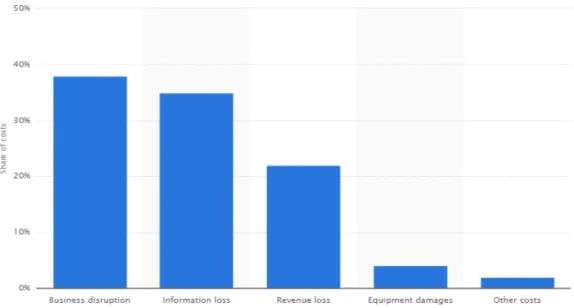
There is no doubt that the Internet plays an important role in different aspects of life these days. For example, it has been found that social networking such as Facebook, Twitter, and Linked-in have a remarkable impact in bringing people from different parts of the world together (Muila, 2010). Although it has changed the world, it has raised the possibility that malicious users gain illegal access to organizations to steal confidential information they are interested in or destroy it by injecting applications called malware. Those applications are created to give malicious users the ability to control organizations’ computers remotely. Malicious users get an illegal access to those organizations by exploiting weaknesses and vulnerabilities in organizations’ networks or web applications. The impact of attacks can lead to delaying delivering services in some organizations causing financial damages. A survey made by Statistia (2015) provides information on the distribution of costs for external consequences of targeted cyber-attacks on companies in global markets in 2014. Figure 1.1 shows the results obtained in that survey, it was found that 38 percent of participants pointed to business disruption as the most expensive consequence of a cyber-attack on their business.
Figure 1.1: Distribution of costs for external consequences of targeted cyber-attacks reported by Statistia (2015)
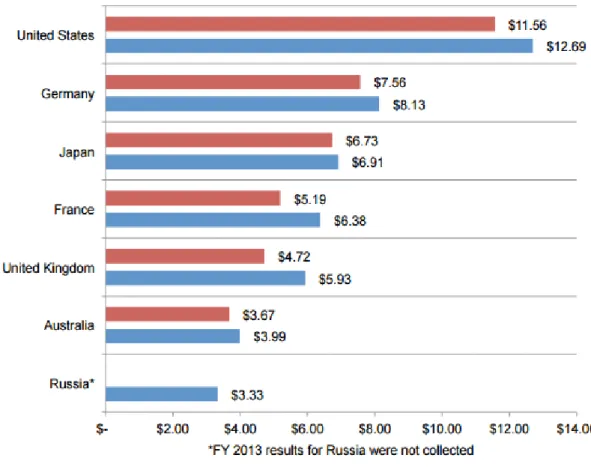
Williams (2014) reported that cyber-attacks were estimated to cost the global economy around $445 billion annually. She also reported that those attacks affected more than 800 million people in 2013. An annual study conducted by the Ponemon institute (2014) in seven countries including the United States, United Kingdom, Germany, Australia, Japan, France and the Russian Federation. The study involves a total benchmark sample of 257 organizations. Figure 1.2 presents the estimated average cost of cyber attacks for each country, it has been found that the US sample achieved the highest total average cost at $12.7 million while the Russian Federation sample got the lowest total average cost at $3.3 million. The figure also that the cost of cyber attacks went up in six countries during the past year compared to 2013 (apart of the Russian Federation), the highest increase was found in the United Kingdom (22.7%) while the lowest increase was found in Japan (2.7%). The study also reported that all industries are targeted by cyber-attacks, but with different levels. The study pointed out that organisation providing energy and financial services experience higher cyber-attack costs than organizations providing services in media, life sciences and healthcare.
Figure 1.2: Distribution of costs for external consequences of targeted cyber-attacks reported by Ponemon institute (2014)
An example of those attacks is a cyber-attack targeted the Dutch government’s main website for most of 10th February 2015, it was reported by Reuters (2015) about that incident the following:
“Cyber attackers crippled the Dutch government's main websites for most of Tuesday and back-up plans proved ineffective, exposing the vulnerability of critical infrastructure at a time of heightened concern about online security. The outage affected most of the central government's major websites, which provide information to the public and the media”
Another example of those attacks was against the online payment site PayPal in 2010. Rawlings (2013) reported that after WikiLeaks had issued a lot of classified material, PayPal decided to block WikiLeaks’ accounts in a way that stop anti-secrecy site from receiving online donations. That action pushed the anonymous group to launch an attack against PayPal, the aim of their efforts was to make the access to the
website impossible affecting all integrations between many of websites and paypal. The cost of this attack was estimated to be £3.5 million.
The impact of such attacks has made the internet security not only a matter related to businesses and organizations but extended to include national pushing governments to play an important role in that area (Statistia, 2015).
Detecting malicious activities occurring in a computers or networks can be achieved using IDS which is considered a security management system that monitor network traffic and raise an alert when capturing malicious activities. IDS have been widely employed in many organizations to detect attacks. The increase of their usage is down to availability of IDS as free of charge, and open source. In addition, there is a wide community of exports (Muila, 2010). Although the wide spread and usage of IDS over the world, there are many challenges that make detecting some attacks difficult. One of the main challenges is the ability to provide protection against new attacks. Cyber attacks can get more costly for an organization if not detected quickly (Ponemon, 2014).That challenge was described by SANS (2001) as following:
“The IDS technology is still reactive rather than proactive. The IDS technology works on attack signatures. Attack signatures are attack patterns of previous attacks. The signature database needs to be updated whenever a different kind of attack is detected and the fix for the same is available. The frequency of signature update varies from vendor to vendor.”
Another challenge is minimizing human intervention. Werlinger (2008) reported that IDS require a lot of human resources in the monitoring and analysis phases to investigate captured attacks and tune the system in order to reduce number of false alarms. Therefore, managing to minimize human intervention will lead to minimizing the operational cost of using IDS inside an organization.
One of IDS tools that is commonly used and has many researchers conducted to improve it is SNORT It is an example of signature based IDS. Many researches were conducted to evaluate the performance of this tool. There are also many efforts made by researchers to improve SNORT detection capabilities using data mining techniques such as genetic algorithm, and decision tree. In this research, a multi-layer
without the need of any human intervention. In addition, part of the solution proposed in this research also work in conjunction with SNORT to detect multi stage attacks that SNORT has limited capabilities to detect them.
1.2
Motivations of the research
The industrial challenges for improving intrusion detection systems are the motivation of this research project. As mentioned in the background section, minimizing the human intervention is one of those challenges. Although intrusion detection systems manage to reduce the time spent in capturing suspicious activities, other actions have been found dependant on human interventions. One of those actions is controlling the sensitivity to reduce the false positive rate. In addition, human intervention is required to update some intrusion detection systems with new rules to detect new attacks. Such actions are very time consuming, automating some of those actions will speed up the process of identifying intrusions and consequently will lead to a drop in the cost of attack response cycle (Hawrylkiw, 2002).
Detecting or predicting multi stage attacks is another challenge that is worth considering. Multistage attacks can evolve dramatically these days, causing much loss and damage to organisations. These attacks occur through multiple steps, each step looking legal and not violating any rules for some intrusion detection systems. Different solutions have been introduced to detect multi-stage attacks, some of those being event correlation-based. Event-correlation based solutions try to match network events with certain attack patterns. When a stream of network events matches a certain pattern, attacks can be stopped before progressing to the next stages. Many researchers claim the effectiveness of that approach in detecting multi-stage attacks However, this approach requires having up-to-date multi-stage attack patterns (sequences), which is not easy to achieve in a very short time, as discovering new complex attacks normally takes some time. The Shady Rat Operation attack is a good example of that; it started in 2006 and was only discovered in 2011 (Tal Global, 2011).
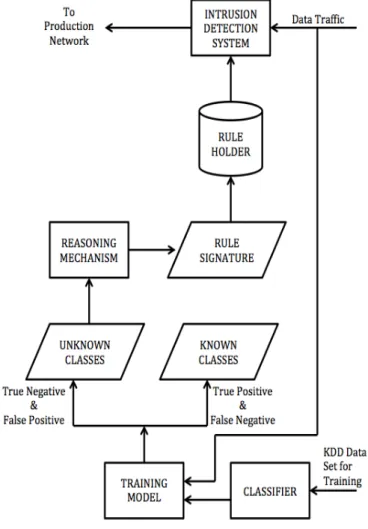
This thesis describes a solution that contributes in overcoming the mentioned challenges. The proposed solution has handled the first challenge by creating an intelligent system integrated with SNORT, this system uses data mining techniques to
detect new attacks not captured by SNORT then updates SNORT with the signature of those attacks automatically. The other challenge has been handled in this research by creating a system that follows IP information evaluation approach. This approach looks at the identity of the network traffic source rather than the sequence. In other words, it asks this question “who is communicating with us?” Rather than “what is being done in our environment?” The attackers usually try to hide their identities by using anonymous proxies. In addition, their traffic in many scenarios involves communications with IPs having bad reputation. Therefore, evaluating IP information (e.g. is the IP an anonymous proxy) can help in predicting potential attacks before their occurrence.
1.3
Research Aim and objectives
This research work aims to improve intrusion detection by proposing a new approach that will work in conjunction with SNORT; this approach will handle some of SNORT shortcomings. One of those shortcomings is the ability to detect recent attacks, the solution will be built in to detect those attacks then update SNORT with signatures of those attacks. Another shortcoming the proposed system will handle is its deficiency in detecting some multi stage attack scenarios; the other solution will not interact with SNORT. The proposed solution uses several data mining techniques in handling those shortcomings. In order to achieve the aim (using the approach), the following objectives would be met:
- Conducting a literature survey about intrusion detection systems by looking at different IDS tools and researches carried out using data mining techniques to improve them.
- Finding suitable data set for training and evaluation as the solution will use some machine learning algorithms.
- Building a classifier (first layer) based on machine learning algorithm that will be considered as the first defence line against new attacks.
- Building a reasoning module that will act as a second layer of classification module for traffic that the first layer will fail to classify.
- Building a solution that predicts multi stage attacks based on the analysis carried out on multi stage attack scenarios.
- Measuring the effectiveness of the system that detects multi stage attacks using metrics based approach.
1.4
Thesis original contribution
The contributions made in the thesis are as follows:
1. A methodology has been proposed that aims to improve the SNORT performance by automating adding the signature of recent attacks. The methodology involves two layers. The first layer is decision tree based while the second layers is a hybrid module that uses a neural network and the fuzzy logic. Using three different data mining techniques over the two layers reduces the chance of passing new attacks without detection. 2. A methodology has been introduced to predict/detect multi stage attacks
based on evaluating IP information using fuzzy log. The methodology involves using of three modules; network sniffing, IP information finder, and the reasoning module.
3. A validation approach has been used to evaluate the approach used to detect multi stage attacks. The validation approach is a modified version of a metrics-based approach introduced in a validation study.
1.5
Research Methodology
The research methodology followed in this research is a combination between qualitative and iterative experimental approach. The qualitative approach has been used to understand some concepts and systems behaviour while the iterative experimental approach is used when building the systems. In the iterative experimental approach, the system is initial implemented then tested. Based on the obtained results, the system implementation is modified until reaching to a point where obtained results are acceptable.
1.6
Thesis Outline
Chapter 2: The second chapter in this thesis provides a literature review. It provides a discussion various types of honeypots, the discussion includes detailing monitoring methods used by Honeypots. In addition, it enumerates advantages and shortcomings of Honeypots/Honeynet. The chapter also goes through IDS giving a quick overview then going through different intrusion detection methodologies, available IDS tools in the market detailing their cons and pros, and talking about limitations of IDS. This part of the thesis also walks through different data mining techniques and how they are employed in improving intrusion detection systems by some researchers and result obtained by that employment. Moreover, the chapter looks at feature selection algorithms showing how it can play a vital role in IDS.
Chapter 3: The third chapter in this research proposes a system that can be used to improve SNORT. The proposed system uses data mining techniques to detect malicious packets that SNORT is not able to capture then automatically updates SNORT signatures holder with a new one. The chapter provides a brief background overview over data mining techniques used in the proposed system (Decision tree, Naïve Base, Neural Network, Fuzzy logic). The chapter goes through the data set used for training and evaluation (KDD99) and which features from the data are selected in the proposed system. In addition, it shows how each module is trained and evaluated. This part of the thesis provides the evaluation results obtained from the proposed system in a form a confusion matrix showing how well the system is capable of performing its job.
Chapter 4: This chapter goes through four different multi-stage attack scenarios. The aim of this chapter is to understand the behaviour of multi-stage attacks and try to find a clue to predicting or detecting such kinds of attacks. In each scenario, the network traffic will be analysed highlighting all steps that have occurred and not been considered by many security systems. The outcome from analysing each scenario will be in the form of rules that will be used in building a solution that will predict multi-stage attacks before
Chapter 5: This chapter presents the proposed solution to detect multi stage attacks. It goes through the architecture of the solution detailing the interaction between different modules. In addition to this, it goes through each module individually showing different options for implementation and reasoning why one of them is preferred over others. The chapter includes some pieces of the codes that show the logic in each module.
Chapter 6: This chapter presents the evaluation for the solution proposed in chapter 5. The evaluation process involves following a metrics based approach then comparing the proposed solution with solutions proposed by other researchers. The metrics based approach evaluates the system from different perspectives; it includes logistics metrics, design metrics, and performance metrics.
Chapter 7: This chapter presents the conclusion and future work. It provides a critical review of the work done and pointing to areas than require some enhancement to achieve better results.
C
HAPTER
2
_________________
L
ITERATURE
R
EVIEW
2.1
Introduction and Background
Information security is becoming a primary concern in this age of information. The classical method of security that was more or less defensive is now being scaled to more aggressive defence format. Intrusion detection is a process of monitoring networks and machine within the network for unauthorised usage and or activity. Meijerink and Spellen (2006) define Intrusion Detection Systems (IDSs) as a system for detection of unwanted manipulation to system. This manipulation may be in form of attack by an attacker or simply by use of malicious script that changes the fingerprint of the system under attack (Kuwatly et al., 2004). Typically, an IDS is required for detection of all malicious traffic that cannot be detected by generally deployed tools such as firewall. IDSs are categorised into host-based (HIDS) – where data on individual computer system is examined and network-based (NIDS) – where analysis of data packets that transit over the
network attack on services and host attacks include unauthorised logins, setup of malware, access to files and changing of privileges.
Unlike common IDSs, honeypot technology tends to provide the attacker with important resources that are needed for a successful attack. Honeypot or honeynet based decoy system is implemented for the purpose of intrusion detection and protection. A honeypot is difficult to define as there are number of interpretations that have been understood from the literature which include domains of attack prevention, attack detection, data collection in context of security. It is distinctive as it is technology and not a solution or procedure / process to resolve a particular security issues. A honeypot is a trap set to detect, deflect or in some cases counteract the attempts of unauthorised usage of production systems. It appears to be part of a network but remains isolated and protected. Its value lies in being probed, attacked and compromised (Spitzner, 2003). Hence, honeypots has no production value and they should not work with any legitimate traffic or events. According to (Mokube and Adams, 2007), the purpose of honeypot or monitored honeynet networks include the following:
1. They form a defensive distraction system in order to direct an attacker towards machines containing no valuable information;
2. They serve the purpose of a early warning system that can inform about exploitation trends; and
3. They become a data collection store that can be used to examine the methods and processes of exploitation of a honeypot.
The interaction with honeypots is expected from attackers; hence the value of honeypot lies in unauthorised interaction conducted by abusers of the vulnerable honeypot.
Another term that is used regularly with honeypots is Honeynet that means a network that is formed of one or more honeypots (Gupta et al., 2012). Honeypots are classified based on level of interaction and purpose. Further details regarding the same are discussed in Section 2.
This chapter has been organised as follows: In Section 2, we discuss various types of honeypots. Section 3 goes through purpose of Honeypot followed by three sections (4, 5, and 6) where details regarding monitoring methods used by Honeypots are discussed in detail. Section 7 enumerates advantages and shortcomings of Honeypots / Honeynet. Section 8 discusses IDS giving a quick overview then going through different intrusion detection methodologies and finally talking about limitations of IDS. In section 9, data mining is briefly explained then some of techniques used in data mining are critically discussed. Section 10 talk about feature selection algorithm and how it can play a vital role in IDS. Section 11 provides a discussion about the chapter. Finally, Section 12 gives a summary of this chapter.
2.2
Classification of Honeypots
2.2.1
Low-Interaction Honeypots
A low-interaction honeypot simulates only limited services that cannot be exploited enough to gain total control of the honeypot (Sharma and Sran, 2011). The low level honeypot provides emulating services and operating system to the attacker, which makes it easier to deploy, and maintain. Example of emulated services include FTP service, listening on port 21 (Telnet), login to FTP server etc. The emulated services mitigate risk by containing the attacker’s activity. The interaction between this type of honeypot and production system is very limited. These type of honeypots can be compared to passive IDS as network traffic is not modified in any way and they do not interact with the attacker thus mitigating the risk associated with this category of honeypots (Mokube and Adams, 2007). Generally, low-interaction honeypots are used to analyse spammers and can
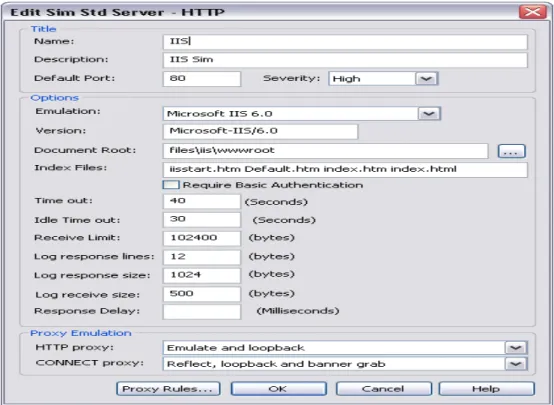
used to simulate a large network on a single network host. It is a framework for creating virtual honeypots using unused IP addresses of a network, which simulates various operating systems and services. Other low-interaction honeypot include Specter (Netsec, 2012) and KFSensor (KFSensor, 2012). Specter can monitor a total of 14 TCP ports and of these 14 monitored ports, 7 ports are called traps, and the other 7 are called services. Traps are port listeners: when the attacker makes a connection, the attempt is terminated, and then logged. Services are more advanced where there is interaction with the attacker, emulating the application (Netsec, 2012). The level of emulation depends on each service. For example, the HTTP service emulates a simple Web server with default static Web pages. Figure 2.1, shows the control panel for low-interaction honeypot tool – Specter and KFSensor simulates system services at the application layer (Kuwatly et al., 2004). Reference (KFSensor, 2012) explains the methods in which KFSensor can be used to setup new firewall rules. Figure 2.2, shows the HTTP service emulation within low interaction honeypot tool – KFSensor.
Figure 2.2: HTTP service emulation setup using KFSensor (Source: (KFSensor, 2012))
2.2.2
High-Interaction Honeypots
High interaction honeypots are complex solutions, which include deploying of a real operating systems and applications (Saini et al., 2011). As it involves real operating system, the level of risk is increased by many folds, but it is a trade-off in order to capture extensive amounts of information by allowing the attackers to interact with real systems (Singh and Joshi, 2011). This facilitates capturing / logging of full extent of attacker’s behaviour that can be analysed at later stage. According to (Singh and Joshi, 2011), as the attacker has more resources to exploit at his disposal, a high interaction honeypot should be regularly monitored to ensure that it does not become a security issue.
do something malicious the honeypot will shut down and makes dumps of memory and disk to get information about what the attacker was trying to do (Meijerink and Spellen, 2006). A greater detail regarding the high interaction monitoring methods is discussed in Section 6.
2.3
Purpose of Honeypot
2.3.1
Research Honeypot
A research honeypot is used to gain the information about the attacker’s community and does not add any direct value to the organisation (Sadasivam et al., 2005). The purpose of research honeypots is to gather intelligence regarding general threats that an organisation may face and hence allow organisation to protect itself in a better form against those analysed threats. The primary function is to study the method how attacker attacks, understand their objectives and behaviour (Saini et al., 2011). These type of honeypots are like high-interaction honeypots that are complex to deploy and difficult to maintain. They are generally used within research and commercial community in addition to military and defence organisations. According to (Mokube and Adams, 2007), they add tremendous value to research providing a platform to study cyber threats and attacks. They may also be suitable for aiding in development of analysis and forensic skills. (Spitzner, 2000) provides the instance where honeypot was used as a forensic analysis for domain name system (DNS) attack.
2.3.2
Production Honeypots
Production honeypots are used within the environment of a organisation to protect the information assets of the organisation and help in mitigation of risk (Sadasivam et al., 2005). Unlike research honeypots, they have direct values as they provide security to organisation’s production resources. As they do not require a large amount of functionality, they are not too complex to deploy or maintain and consequently, they are unable to
provide a large amount of information regarding the attackers. Their primary function is to mirror the production network of the organisation and invite attackers to interact with them, so that vulnerabilities of the network can be exposed. They are considered to add value to detection of attacks rather than prevention of attacks. One the examples of production honeypot is Nepenthes (Baecher et al., 2006).
Classification of Honeypot
Categories of
Honeypot Examples Brief Description
Level of Interaction Low Interaction Honeypot HoneyD, Specter, KFSensor, MWCollect A low-interaction honeypot simulates only limited services that cannot be exploited enough to gain
total control of the honeypot. High Interaction Honeypot Honeynet, Sebek, Argos
High interaction honeypots are complex solutions, which include deploying of real operating systems
and applications.
Purpose of Honeypot
Research
Honeypot Honeynets
A research honeypot is used to gain the information about the attacker’s community and does not add any
direct value to the organisation. Production
Honeypot Nepenthes
Production honeypots are used within the environment of an
organisation to protect the information assets of the organisation and help in mitigation
2.4
Monitoring Methods of Honeypots
Honeypot monitoring is a very important component of any honeypot deployment. There are two methods that used for monitoring of honeypots viz. external method (network-based) and internal method (host-based). In the network-based method, all packets that are sent to or received from the monitored honeypot are captured and traffic sniffing tools such as TCPDUMP (TCPDUMP, 2012) and Ethereal (Ethereal, 2012). In the host-based method, specialised sensors are deployed within the honeypot in order to monitor and record system events.
It should be noted that both approaches have their strengths and weakness. For instance, the network-based approach though being transparent and invisible to the attacker can sniff packets by being deployed outside the honeypot but it cannot capture internal system events on a vulnerable honeypot. Furthermore, it may be ineffective or perform at lower effectiveness, if the network data traffic is encrypted. On the other hand, the host-based method, if detected by the attacker can be tampered with, thus leaving it ineffective.
Data capture modules in high interaction honeypots deals with collection and recording of all the activities of Honeypot. It deceives the intruder by capturing all activity within honeypot without attacker knowing about any monitoring i.e. with introduction of decoy systems.
2.5
Monitoring Methods of Low-Interaction
Honeypots
2.5.1
Mwcollect (Malware Collection Tool)
Mwcollect (Swanson, 2008) is a low-interaction honeypot. This honeypot is installed on top of the operating system. The Mwcollect daemon is responsible to open well-known ports often used for purpose of attacking
by malware. Simulation of vulnerabilities of the open ports lures attackers who would then exploit these ports and send their malware shell codes to the Mwcollect daemon. The daemon is responsible for interpreting the shell code, parsing the exploited packets and take necessary action to download the malware which is then added to the repository for further analysis. Additional, shell codes can be written to extend the functionality offered by Mwcollect.
2.5.2
Honeyd
Honeyd (Provos, 2003) has been developed by the University of Michigan and is a daemon that can used to simulate a large network on a single network host. It is a framework for creating virtual honeypots using unused IP addresses of a network, which simulates various operating systems and services. Honeyd uses arpd tool to route all illegitimate traffic to an unused IP address and presumes the every connection made to this unused IP address is a candidate for an attack. The virtual hosts communicate with the attacker. According to (Provos, 2003), Honeyd is simulated at stack level, hence tool such as nmap cannot get fingerprint of the honeypot server. The creation of virtual hosts in a configuration file allows analyst to open TCP and UDP ports, bind scripts to those ports (if required) and bind IP address to a port. The facility to create customised scripts and binding them to ports to handle connections is very useful functionality for virtual hosts.
2.6
Monitoring Methods of High-Interaction
Honeypots
• Sebek installs as a loadable hidden kernel module that would capture all host activities. As a result of installation, Sebek, replaces a number of sensitive system calls in the original operating system. For instance, in the latest Sebek development for Linux 11 system calls have been replaced viz: sys_open, sys_read, sys_readv, sys_pread64, sys_write, sys_writev, sys_pwrite64, sys_fork, sys_vfork, sys_clone, sys_socketcall (Jiang and Wang, 2007). The hashtable for system calls is updated / hijacked by Sebek with its own system handlers as shown in Figure 2.3.
Figure 2.3: Instance of modified sys_read system call after loading of Sebek
• Upon successful replacement of system calls by Sebek, it would intercept any subsequent invocations of above mentioned system calls and capture the arguments as well as any context information such as PID. After capturing, Sebek invokes system call handlers and execute the system call together with passed arguments in order to complete requested service call.
• All collected information about invoked replaced system calls would be sent to remote Sebek server so that it can analysed in real time or saved for later analysis.
Figure 2.4, shows the Sebek based approach to honeypot monitoring. For the purpose of monitoring the malicious activity in the honeypot, the internal sensors like Sebek need to be transparent and tamper-resistant. However, as mentioned before, it case of comprise, attacker may introduce anomalies such as (Jiang and Wang, 2007):
• inconsistency in statistics transmitted by honeypot,
• Unsebek (Corey, 2003) of a honeypot system.
Figure 2.4: Sebek based approach in honeypot monitoring in context of HTTP (Source: (Jiang and Wang, 2007))
2.6.2
Honeynets
Honeynet is a high interaction honeypot developed by The Honeynet Project (Project, 2012) in order to capture information on the network. The primary purpose of the honeynet is to gather information on security issues. It acts as a gateway called Honeywall, by collecting data from and to the honeypots on the network.
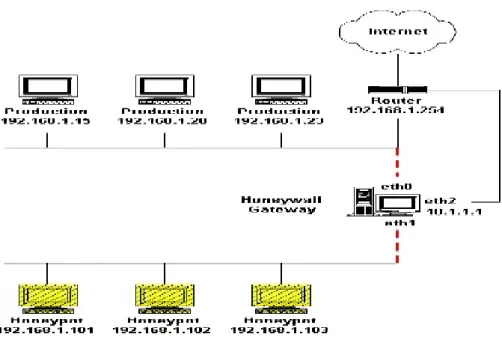
Figure 2.5: Honeywall architecture (Source: (Project, 2012))
Figure 2.5, shows the honeywall gateway that forms the main part of the Honeynet and work by capturing all the traffic entering or leaving the honeypot network. It separates the honeypots victims from rest of the network. According to (Meijerink and Spellen, 2006), it can be configured as layer 2 or layer 3 routing gateway, however layer 2 configuration is preferred as in bridge mode it is difficult to be detected by the attackers as the gateway would not have any IP address associated with itself. A highly controlled network where every packet entering or leaving is monitored, captured, and analysed consists of data control, data capture and data collection.
• Data Control: In a scenario where a honeypot deployed within honeynet is compromised, honeynet have to contain all the activities and ensure that production systems are not harmed in anyway. It should be ensured that all traffic can flow in and out of honeynet without attackers detecting control activities (Meijerink and Spellen, 2006).
• Data Capture: This part captures all activities within the honeynet and the data entering and leaving the honeynet without attacker knowing that they are being monitored. All the activities of the attacker are logged
and the captured data is analysed to understand vulnerabilities and motives of the attacker.
• Data Collection: All captured data is forwarded to a centralised data collection point. This facilitates captured data to be collected, analysed and archived at one location.
2.6.3
Argos
Argos (Portokalidis et al., 2006)is a high interaction honeypot that is based on Qemu (Bellard, 2005). Qemu is a fast machine emulator for various CPUs including x86, PowerPC, ARM and Sparc and on hosts including x86, PowerPC, ARM, Sparc, Alpha and MIPS (Bellard, 2005). Argos is known for fingerprinting zero-day attacks for instance worms and other malware without a requirement for any user input (Portokalidis et al., 2006).
As seen in Figure 2.6, all the incoming network traffic is logged into the network trace database and concurrently sent to an unmodified application running on top of the operating that is based on Qemu fast emulator. The emulator uses dynamic taint analysis to check a vulnerability that is being exploited in order to change control flow of the application. This is achieved by tagging all the data originating from unsafe source as tainted, track this tainted data during execution and prevent usage of tainted data in addition to its identification. All locations where the tainted data is copied i.e. memory or registers are also tagged as tainted locations. Argos can raise an alarm whenever instructions such as call, ret, jmp, longjmp etc. are invoked. Upon alarm, Argos starts by dumping all tainted blocks as well as information indicating all addresses that triggered violations into a log file. This step is known as signature creation process. In addition, extra information such as executable name, open files, used sockets, network
has Sweetbait – a system that correlates collected signatures that have been collected at various sites to create the final signature for a malware.
Figure 2.6: High-Level overview of Argos (Source: (Portokalidis et al., 2006))
2.7
Advantages and Disadvantages of Honeypots
Upon understanding about background and detection of honeypots, following distinct advantages have been realised as compared to other security systems (Project, 2012):
• Small Data Sets: Honeypots are always interested in the traffic that arrived to them rather than the traffic overload that is generally observed in production systems, where it is difficult and complex task to differentiate between legitimate and illegitimate packets. Overall, it collects small data sets of high value.
• Catch new attacks, false negatives: As honeypots capture everything arriving to them, they are capable of catching new tactics and attack
• Work in encrypted or IPv6 environments: Honeypots have been tested to work with encrypted traffic as well as have scaled to IPv6 environments. • Minimal Resources: As only limited data is captured, a high-end set of
resources is not required in case of honeypots. It is a simple concept that requires minimal resources.
Some of the disadvantages associated with honeypots as compared to other security system / approaches are as follows (Project, 2012):
• Limited field of View (Microscope): It is inherent to honeypots that the only activity or data captured by them is when the attacker directly interacts with them. Attacks happening on the other parts of honeypot network is unknown to a particular honeypot.
• Risk (mainly high-interaction honeypots): Though unlikely in low-interaction honeypots but in case high low-interaction honeypots, as the deployment of a real operating systems and applications is committed, in scenarios of compromise, parts of production network may be attacked that could be a major concern for an organisation.
2.8
Intrusion Detection Systems
2.8.1
Overview
Intrusion is described as an attack or attempt to sidestep security mechanisms of computer or networks, or compromising the confidentiality, integrity, or availability (CIA) (Bace and Mell, 2001). Weber (1998) categorized attacks into 5 classes: Denial-of-Service (DoS), Probing attacks, User to Root (U2R) attacks, Remote to Local (R2L) attacks, and Data attacks. In the first class, computing resources are overwhelmed by attackers in order to handle legitimate users’ requests (Labib, Vemuri, 2008). Probing is described by Paliwal and Gupta (2012) saying:
"an attack in which the hacker scans a machine or a networking device in order to determine weaknesses or vulnerabilities that may later be exploited so as to compromise the system"
U2R attack is defined as an attempt by hackers exploiting weaknesses in the system in order to obtain root user privileges. R2L attack is an attempt from a remote machine to get unauthorized local access. In the last class, malicious code is injected in data looking normal that passes firewalls to attack and destroy systems.
According to SANS Institute (2001), the intrusion detection process is involved in observing and analysing user and system activity, reviewing both system configurations and vulnerabilities, evaluating the stability of critical system and data file, reporting abnormal activities, and carrying out system audit. This process is carried out by a software application or hardware system. There are three components for intrusion detection systems; Network Intrusion Detection system, Network Node Intrusion detection system, and Host Intrusion Detection System. The first component (NIDS) is in charge of scanning traffic from and to all machines over the network (Bradley, 2014). The second component (NNIDS) is responsible for examining and analysing traffic directed from the network to a specific host (SANS, 2001). The last component (HIDS) checks incoming and outgoing packets from a host only and notifies users or administrator of suspicious activities (Bradley, 2014).
There is a common mistake that intrusion detection and prevention systems are considered as alternatives for a firewall. Although they are used in the context of network security, they are totally different. Both are used in conjunction to improve a network security. Hassan (2011) explained this difference in a very simple form saying:
"We can think a firewall as security personnel at the gate and an
A firewall is used to prevent intrusion between networks by restricting the access between them but it is not used to report or find attacks or threats inside networks. On the other hand, IDS is responsible for finding and reporting unwanted entries to the system.
2.8.2
Detection methodologies
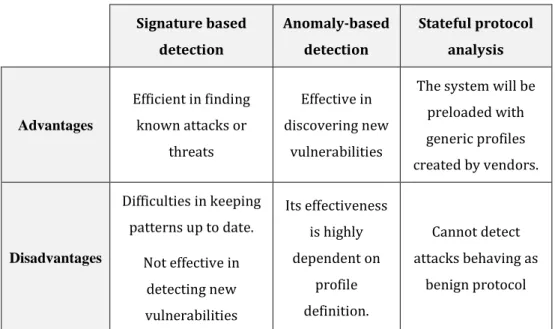
Intrusion detection methodologies are categorized into three types; signature based detection (SD), Anomaly-based detection (AD), and stateful protocol analysis (SPA). The first methodology (SD) defines a pattern that matches a particular attack. This methodology is very effective to find known attacks or threats. However, it is not easy to keep patterns up to date. In addition to this, this methodology is not effective in detecting unknown threats or attacks (Liao et al. 2012). On the other hand, the second type (AD) is very effective in finding new vulnerabilities. AD works on the basis of defining the network behaviour (profile). Then, the defined profile is compared with monitored events and activities to detect significant attacks. The main disadvantage of this methodology is its high dependency on profile definition, not well-defined profiles can lead to weak accuracy in detecting attacks or threats (Jyothsna et al. 2011). The third category (SPA) works similarly to AD but with generic profiles defined by vendors. Those preloaded profiles are related to specific protocols. Therefore, the system will be able to find unexpected sequences of commands like issuing a command repeatedly (Scarfone and Mell, 2007). However, it will not be able to cease attacks behaving as benign protocol (Liao et al. 2012). The table 2.2 summarizes advantages and disadvantages of each methodology.
By looking at pros and cons of the IDS methodologies mentioned above, we will find that providing more effective detection for attacks or threats can be achieved by using hybrid methodologies. For example, using
Signature based detection Anomaly-based detection Stateful protocol analysis Advantages Efficient in finding known attacks or threats Effective in discovering new vulnerabilities
The system will be preloaded with generic profiles created by vendors. Disadvantages Difficulties in keeping patterns up to date. Not effective in detecting new vulnerabilities Its effectiveness is highly dependent on profile definition. Cannot detect attacks behaving as benign protocol
Table 2.2: Advantages and disadvantages of IDS methodologies (Liao et al. 2012)
2.8.3
Limitations of Intrusion Detection Systems
IDS play an important role in finding possible attacks or threats and have a significant positive impact in security infrastructure. However, it is not an answer to all issues related to security as there are some limitations. One of those limitations is inability to trace and analyze all traffic on highly loaded or busy networks (SANS Institute, 2001). Therefore, the system may not be able to provide an instantaneous report for attacks or threats in such scenarios. It is also reported on the same paper (SANS, 2001) that IDS does not help if there is weakness in a network protocol, or in the absence of strong identification and authentication mechanism.
Another limitation addressed by Rebecca and Mell (2001) is lacking the capability of conducting investigation in the absence of human interaction. They also mentioned that it is not effective in dealing with
switched networks. A study conducted by Excamilla and Terry in 1998 reported a number of issues with IDS. One of those issues is that some IDS do not provide verification for the checksum field in the IP header. This shortcoming gives hackers a chance to manipulate this field. As a result, the system will record different information than what it should receive. Moreover, it was found that IDSs are not cheap solutions as it consumes different types of resources during both setup and monitoring phases. In addition, it demands high level of technical and organizational expertise. In spite of the requirements of a lot of resources and expertise, it is not simple to trace the improvement in security processes (Werlinger et al. 2008). A common complaint reported is that IDS can generate enormous number of alerts while the majority of those alerts are false positive (Ho, et al. 2012).
2.8.4
IDS Tools
SNORT tool is a widely used source network intrusion prevention and detection system built by Source fire. It is an example of signature based IDS. Numerous researchers have evaluated the performance of this tool. One example of such a study carried out by Rani and Singh (2014) concluded that SNORT managed to find 12 signatures one of them is ICMP PING attack having the max numbers of alerts reported by SNORT.
Another study (Salah et al. 2011) carried out to evaluate the performance of SNORT when using Windows 7 and Windows 2008 server, reported the following:
"Setting the scheduling priority to favour either kernel processing or user applications has little or no impact on SNORT’s performance under both normal and malicious traffic."
Although they obtained good results with SNORT, they reported that its performance is affected by heavy network traffic and this is one of
that need to be considering when selecting an IDS/IPS. One of those tools is Suricata which can run multi threads while SNORT can run a single thread, supporting multi-thread gives Suricata the advantage of using more than one CPU. Kachal and Shevade (2012) said about this advantage:
"Suricata has the advantage that it can grow to accommodate increased network traffic without requiring multiple instances. SNORT is lightweight and fast but limited in its ability to scale beyond 200-300 Mbps network bandwidth per instance"
Despite of having this advantage over SNORT, the multi-thread architecture consumes more memory and CPU usage as reported by Albin (2011) in his comparative analysis of SNORT and Suricata.
BRO is another IDS tool that is worth to be looked at. Mehra (2012) enumerated some advantages of BRO over SNORT in her brief study and comparison of SNORT and BRO. One of those advantages she mentioned is the ability of Bro to operate effectively on high-speed networks while SNORT does not work perfectly on high-speed networks. In addition to this advantage, it was reported in that study that the Bro signatures are more sophisticated than the signatures used in SNORT. On the other hand, it was found that BRO is difficult to deploy compared to SNORT. Moreover, BRO can run only in UNIX environment while SNORT can run in most popular operating systems.
2.8.5
Evaluation Metrics of IDSs
According to (Lazarevic et al., 2003, Zanero and Savaresi, 2004), anomaly detection rate and false alarm rate are the best measures that can be used for evaluation of IDSs. Clearly, the detection rate is equivalent to efficiency and the false alarm rate refers to effectiveness of IDSs. The anomaly detection rate is the ratio of number of detected intrusions to the total number of intrusions that were introduced into the network traffic as show in the equation below (Ertoz et al., 2004).
𝐸𝐸𝐸𝐸𝐸𝐸𝐸𝐸𝐸𝐸𝐸𝐸𝐸𝐸𝐸𝐸𝐸𝐸𝐸𝐸 = 𝑇𝑇𝑇𝑇𝑇𝑇𝐸𝐸𝐴𝐴𝐴𝐴𝐴𝐴𝑝𝑝𝑝𝑝𝑝𝑝𝑝𝑝𝑝𝑝𝑝𝑝𝑝𝑝𝑝𝑝𝑝𝑝
𝑎𝑎𝑎𝑎𝑎𝑎𝑎𝑎𝑎𝑎𝑝𝑝
Where
True Positive: Malicious traffic correctly classified by IDS.
False Negative: Malicious traffic incorrectly classified by IDS.
All Alarms: True positives plus false negatives.
It is clear from the equation that as the value of efficiency approaches 1 (more capable of detecting illegitimate traffic), IDS becomes more efficient. While, false alarm rate refers to the false-positive rate of IDSs i.e. number of legitimate network traffic that have been analysed by IDS as intrusions as shown in the equation below (Ertoz et al., 2004).
𝐸𝐸𝐸𝐸𝐸𝐸𝐸𝐸𝐸𝐸𝐸𝐸𝐸𝐸𝐸𝐸𝐸𝐸𝐸𝐸𝐸𝐸𝐸𝐸𝐸𝐸= 𝑇𝑇𝑎𝑎𝑇𝑇𝑝𝑝𝑝𝑝𝑝𝑝𝑝𝑝𝑝𝑝𝑝𝑝𝑝𝑝𝑝𝑝𝑝𝑝𝑝𝑝
𝐴𝐴𝑎𝑎𝑎𝑎𝑝𝑝𝑝𝑝𝑝𝑝𝑝𝑝𝑝𝑝𝑝𝑝𝑝𝑝𝑝𝑝𝑝𝑝
Where
True Positive: Malicious traffic correctly classified by IDS.
False Positive: Normal traffic incorrectly classified as malicious.
All Positives: True positives plus false positives.
This effectively refers to all anomalies that have not been detected by the IDS. In addition to, efficiency and effectiveness, (Sommers et al. 2004), further added two metrics viz. central processing unit (CPU) utilisation and packet loss. These measures are useful with regard to evaluation of IDS in terms of handling traffic load.
2.8.6
Offline Evaluation
According to (Lippmann et al., 2000, Mahoney and Chan, 2003), another method of evaluating IDSs is the method where datasets of network