A Data Nulling Superimposed Pilot based
Channel Estimator for MIMO-OFDM
Systems
Almas Fathima1, K.V. Prasad2
P.G. Student, Department of Electronics and Communication Engineering, Bangalore Institute of Technology,
V.V. Puram, Bengaluru, India1
Prof and Head, Department of Electronics and Communication Engineering, Bangalore Institute of Technology,
V.V. Puram, Bengaluru, India2
ABSTRACT: This paper proposes a channel estimation method based data nulling superimposed pilots for
MIMO-OFDM systems. An efficient estimation method in which the MIMO-OFDM data symbol is each transmit antenna is spread using the spreading matrix over all subcarriers then at certain subcarriers nulls are introduced between the data symbols and superimposed pilot. The nulls introduce cancel out the mutual interference. At the receiver, the superimposed pilots are removed from the received signal. Simple iterative data detection scheme is used to compensate the distortion which occurred in the data symbols. The simulation result shows the comparison between the different modulation techniques that improve the process channel estimation.The simulation results of the proposed algorithm show improvement in the estimation accuracy, bit error rate (BER) and computational complexity compared to that of the conventional superimposed pilot technique. The simulation results also show that the performance of the proposed technique approaches that of the frequency division multiplexed pilots technique while having higher data rate and increase in the receiver complexity.
.
KEYWORDS: Bit error rate, Superimposed Pilots, Iterative Data Detection .
I. INTRODUCTION
Wireless Communication system have been a far-fetching part in the field of Communication. High speed and reliable
wireless communication is of great demand.An attractive air-interface solution for next-generation wireless local area
networks is Multiple-input multiple-output (MIMO) wireless technology in combination with orthogonal frequency division multiplexing (MIMO-OFDM).
The quality of wireless communication depends upon the three parameters which are rate, range and reliability of transmission. These parameters are inter related with each other. Simultaneous improvement in all three parameters can be accomplished with the help of new technique called MIMO assisted OFDM system.
A really significant foundation on which to build the next and future generations of wireless networks is MIMO system
technology. The major challenge faced by future wireless communication systems is to provide high-data-rate wireless
propitious method for high data rate communications due to its simple implementation and robustness against frequency selective fading channelsThus, MIMO-OFDM systems, combining the OFDM technique with MIMO systems, can provide high-performance transmission
.
II. RELATEDWORK
A channel estimation scheme for multiple-input multiple-output (MIMO) orthogonal frequency division multiplexing (OFDM) systems based on pilot tones. to get the minimum MSE of the LS channel estimate, the pilot sequences should be equipowered, equispaced and phase shift orthogonal. Increasing the amount of transmit antenna needs additional pilot tones for training and, hence, decreases the spectral efficiency. This impact is lessened by estimating the channel parameters over multiple OFDM symbols once the channel is slowly time-varying.
Another attractive channel estimation approach for large capacity and high data rate is the blind techniques where no pilots are transmitted, and the estimation process is based on higher order statistics of the received signals. It establishes a sufficient condition for the channel to be identifiable which reduces the computational complexity. The main downside of this method is that the data sequence should be long enough so as to get an accurate channel estimation which, can be impractical particularly in fast varying channels.
Another engaging channel estimation technique which is presented in single-input-single output(SISO) systems is the channel estimation dependent on superimposed pilots, within which superimposed pilots sequence best known to the receiver is algebraically added to the data symbols and afterwards utilized for channel estimation which increases the spectral efficiency.Therefore, iterative methods are acquainted to mitigate the mutual interference between data symbols and the superimposed pilots. Hence, offer higher performance at the expense of increased receiver complexity.
III.PROBLEMSTATEMENT
MIMO-OFDM has proven to significantly increase in capacity through the use of transmitter and receiver diversity.These systems rely upon the knowledge of channel state information (CSI) at the receiver. The learning of the instantaneous CSI is required for the recovery of the source data at the destination and therefore helps in optimization and enhancement of the MIMO-OFDM. However, in practical MIMO-OFDM communication systems, the instantaneous CSI is not available at the node, and hence, it needs to be estimated. The channel estimation used for SISO-OFDM system termed as data nulling superimposed pilots showed a promising improvement in terms of channel estimation accuracy and bit error rate. Therefore, this channel estimation process can be implied on MIMO-OFDM system in order to obtain accurate channel estimation and hence increase the spectral efficiency compared to the conventional channel estimation schemes such as FDM based channel estimation scheme and conventional superimposed pilot scheme.
IV. IMPLEMENTATION
A baseband OFDM symbol can be generated in the digital domain before, modulating on a carrier for transmission. To generate a baseband OFDM symbol, a serial digitized data stream is first modulated using common modulation schemes such as the phase shift keying (PSK) or quadrature amplitude modulation (QAM).From the Fig.1, the binary data is first assembled and mapped according to the modulation in "signal mapeer". These data symbols are then converted to parallel streams before modulating subcarriers. Subsequent to embedding pilots either to all sub-bearers with a particular period or consistently between the data information arrangement, IDFT square is utilized to change the information grouping of length into time area signal.
Fig.1 : MIMO-OFDM Transmitter Block Diagram.
It is well known that IDFT can be implemented efficiently using inverse fast Fourier transform (IFFT). Therefore, in practice, the IFFT is performed on the data sequence at an OFDM transmitter for baseband modulation and the FFT is performed at an OFDM receiver for baseband demodulation. Size of FFT and IFFT is N, which is equal to the number of sub channels available for transmission, but all of the channels needs to be active. Following IDFT square, guard time, which is chosen to be larger than the expected delay spread, is inserted to prevent inter-symbol interference. The level of multipath robustness can be further increased by the addition of a guard period between transmitted symbols. This guard time incorporates the consistently expanded piece of OFDM symbol so as to eliminate the intersymbol interference. Finally, a baseband OFDM symbol is modulated by a carrier to become a bandpass signal and transmitted to the receiver. The transmitted sign x(n) will go through the frequency selective time varying fading channel with additive noise. The received signal is given by given as w(n) to which h(n), the Additive White Gaussian Noise (AWGN) is added. At the receiver, subsequent to passing to discrete domain through A/D and low pass filter, guard time is removed.
V. SIMULATIONRESULTS
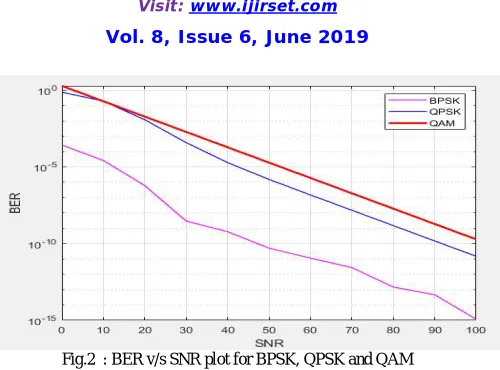
Fig.2 : BER v/s SNR plot for BPSK, QPSK and QAM
Fig 2 presents the BER plot for BPSK, QPSK, and 16-QAM in. From this we observe that in case of BPSK, QPSK and 16-QAM we are getting a SNR value less for SNR. As BPSK is having the minimum SNR value as compare to QPSK and 16-QAMSo it is preferable to use the BPSK modulation technique for transmission of the information data.
Fig.3 : BER plot for 4x4 MIMO-OFDM System
Fig. 3. Shows the BER of 4x4 MIMO system for the DNSP scheme at iteration=0, 1 and 2 the conventional superimposed pilot scheme at n iteration=0, 1 and FDM scheme. It is found that the BER of DNSP at all iterations are much lower than that of the conventional superimposed pilots and approaches that of the FDM scheme. Also, it is clear that most of the gain in data symbols detection is obtained in DNSP scheme.
Fig.4 : BER plot for 8x8 MIMO-OFDM System
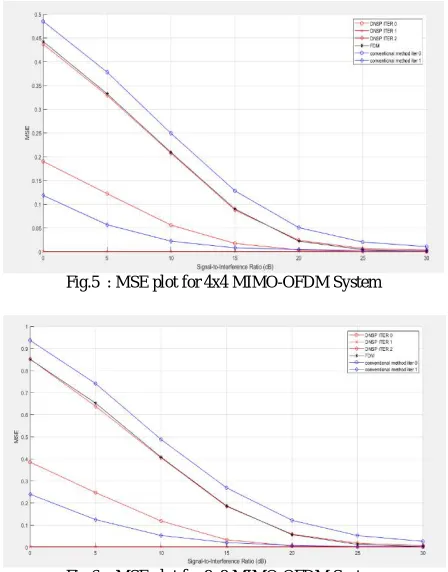
Fig. 5. And Fig.6. Shows the MSE of 4x4 MIMO and 8x8 MIMO system for the DNSP scheme for iteration= 0,1 and 2 conventional superimposed pilot scheme at iteration=0, 1 and 2 and FDM scheme. It is clear that the DNSP MSE is much better than the conventional superimposed pilots scheme even after 2 iterations and the MSE of DNSP is the same as that of FDM scheme although FDM scheme requires extra dedicated subcarriers for channel estimation process. This leads to better channel estimation accuracy.
Fig.5 : MSE plot for 4x4 MIMO-OFDM System
VI. CONCLUSION
MIMO-OFDM has become a popular method in high data rate wireless communications.A new channel estimation method is proposed for (MIMO-OFDM) system.This method depends on the usage of a special kind of superimposed pilots named data nulling superimposed pilots which cancels the mutual interference between the superimposed pilots and the data symbols by spreading data symbols on all subcarriers then introducing a distortion to the data symbols. This method can offer accurate channel estimation results as those of the methods that depend on FDM pilots but with higher spectral efficiency as there is no pilots symbol overhead but with some excess in the receiver complexity because an iterative detection algorithm is used to compensate the distortion occurred to data symbols.It was seen that AWGN channel is better over the Rayleigh channel and BPSK is better modulation scheme for low SNR requirement.This method offers much better performance in terms of channel estimation accuracy, BER performance and computational complexity compared to the conventional superimposed pilots methods that allow the mutual interference between superimposed pilots and data.
REFERENCES
[1] Barhumi, G. Leus, and M. Moonen, "Optimal training design for MIMO OFDM systems in mobile wireless channels", IEEE Transactions on Signal Processing, vol. 51, pp. 1615-1624, 2003.
[2] B. Hassibi, and B. M. Hochwald, "How much training is needed in multiple-antenna wireless links?", IEEE Transactions on Information Theory, vol. 49, pp. 951-963, 2003.
[3] C. Shin, R. W. Heath, and E. J. Powers, "Blind Channel Estimation for MIMO-OFDM Systems", IEEE Transactions on Vehicular Technology, vol. 56, pp. 670-685, 2007.
[4] Z. Yonghong , and N. Tung-Sang, "A semi-blind channel estimation method for multiuser multiantenna OFDM Eftychios A. Pnevmatikakis, Petros Maragos “An Inpainting System For Automatic Image Structure-Texture Restoration With Text Removal”, IEEE trans. 978-1-4244-1764, 2008 systems", IEEE Transactions on Signal Processing, vol. 52, pp. 1419-1429, 2004.
[5] A. G. Orozco-Lugo, M. M. Lara, and D. C. McLernon, "Channel estimation using implicit training", IEEE Transactions on Signal Processing, vol. 52, pp. 240-254, 2004.
[6] H. Zhang, X. Dai, and D. Li, "Semi-blind channel estimation for MIMO/OFDM systems using superimposed training", IET Conference on Wireless, Mobile and Sensor Networks (CCWMSN07), 2007, pp.873-876.
[7] C. W. R. Chiong, Y. Rong, and Y. Xiang, "Channel Estimation for Time-Varying MIMO Relay Systems", IEEE Transactions on Wireless Communications, vol. 14, pp. 6752-6762, 2015.
[8] G. Dou, C. He, C. Li, and J. Gao, "Channel estimation and symbol detection for OFDM systems using data-nulling superimposed pilots", Electronics Letters, vol. 50, pp. 179-180, 2014.
[9] R. Hunger, "Floating Point Operations in Matrix-Vector Calculus", No. TUM-LNS-TR-05-05, 2007.