T H E A SERIES OF ALLELOMORPHS I N RELATION TO PIGMENTATION I N MAIZE'
R. A. EMERSON
Cornel1 University, Ithaca, New York AND
E. G. ANDERSON
California Institute of Technology, Pasadena, California
Received March 10, 1932
TABLE O F CONTENTS
PAGE INTRODUCTION . . . . . . 503 The allelomorph A b . . . .
The allelomorph a p . . . . .
Dominance. ... . . . 508 SUMMARY.. . . 508 LITERATURE CITED. . . 509
ALEURONE COLOR
WITH CRPr
INTRODUCTION
The inheritance of anthocyanin, flavonol, and related pigments in maize is dependent upon a number of genetic factors. Descriptions of char- acters and their factorial interrelations have been presented in previous publications on aleurone color (EMERSON 1918), general plant color (EMERSON 192 1), silk color (ANDERSON 192 1), and pericarp color (ANDER-
SON and EMERSON 1923, ANDERSON 1924, MEYERS 1927). Some of the
more important factorial relations are shown in table 1.
TABLE 1
Factorial relations of plant, aleurone, pericarp, and silk colors.
SlLK COLOR PERlCARP COLOR WITH
-1
W l T H P S n z QENES PLANT COLOR
Purple Dilute purple Sun red Dilute sun red Brown Green Green Green
I I I
Purple Purple Purple Purple White White White White Red Red Red Red Brown Brown Brown Brown Cherry Cherry White White Brown Brown White White Salmon Salmon Salmon Salmon Green Green Green Green
*
These pericarp colors are absent with homozygous p . Other allelomorphs of P give varie-t
The cherry-brown pericarp colors do not appear even in the presence of Pi with any combi-Paper No. 186, Department of Plant Breeding, CORNELL UNIVERSITY, Ithaca, New York. gated red or brown Pvv, red or brown cob with white (colorless) pericarp Pw, etc.
nation of the allelomorphs of R lacking rch.
Other genetic factors also affect these pigments. The recessive gene b,
gives brown pericarp instead of red but does not affect aleurone or plant color (MEYERS 1927). A recessive gene found by Doctor M. T. JENKINS
resembles a in its effect on aleurone and plant color but apparently does not affect red pericarp color. The
P,
p ,
factor pair differentiates bluish purple from reddish color of anthocyanin, most noticeable in the aleurone. These genes are all independent of A .The pigments involved in chocolate pericarp (ANDERSON and EMERSON 1931) and in brown midrib (JORGENSON 1931, BURNHAM and BRINK 1932) seem to be unrelated to the anthocyanin, flavonol, and pericarp pigments dealt with in this paper.
THE ALLELOMORPH A I
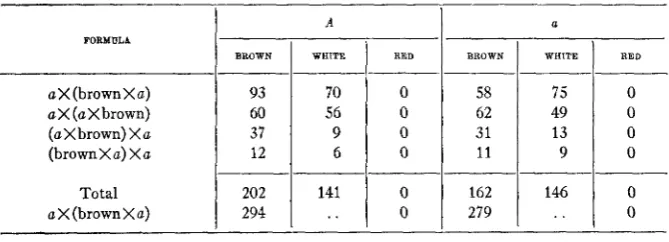
The source of the allelomorph A b was a maize with brown pericarp from Ecuador. This brown was found to be dominant to red pericarp and a note on its inheritance has been published (ANDERSON 1925). At that time tests of its re1atio.n to a had not been completed. Since then tests have been made showing the absence of any recombination between A a and the gene for dominant brown pericarp. The data are summarized in table 2.
TABLE 2
S u m m a r y of data o n the relation of dominant b r o w pericarp to the a factor.
The classification for A and a was made on aleurone color but was checked by plant color. The white pericarp in these cultures was due to the segregation of
p , and may be disregarded since
p
is independent of aPIGMENTATION I N MAIZE 505
Homozygous A b C
R
seeds have colored aleurone. Reciprocal crosses with recessive a also give colored aleurone, not distinguishable from the corresponding crosses of A with a. Homozygous A and heterozygous Ab a with the various combinations of B andPz
give typical purple, dilute purple, sun-red, and dilute sun-red plants. Thus A b appears to be identi- cal with A in its effect on aleurone and plant colors.From intercrosses of dominant brown pericarp with salmon silk red pericarp, backcrossed to salmon silk red pericarp plants, only three classes are obtained, as follows:
Brown pericarp green silks Red pericarp green silks Red pericarp salmon silks
Some of the brown pericarp plants when selfed give 25 percent of salmon silks; when crossed to salmon they give 50 percent of salmon. In these cultures all salmon silk plants have red pericarp, and all green silk plants have brown pericarp. These are homozygous sm s,, the salmon silk color being suppressed by A b . This is to be expected if the salmon silk color is due to an extension of the red pericarp pigment into the silks. A small amount of brown pigment in the silks would be entirely masked by the chlorophyll and carotinoid pigments present.
Thus A b may be described as the equivalent of the normal A in its effect on the anthocyanin pigmentation of the plant; but it converts the red pericarp pigment into a corresponding brown pigment. In the latter effect it is dominant to A .
A dominant brown pericarp similar to that discussed here has been isolated from maize (C. I. 501) collected by RICHEY and EMERSON at Huancayo, Peru, in 1924.
THE ALLELOMORPH U P
Another dominant brown pericarp came from the maize collection made in 1924 by RICHEY and EMERSON. An ear with cherry pericarp and purple aleurone (C. I. 499-2) was obtained at Huancayo, Peru. An indi- vidual grown at Ithaca, New York in 1925 from seed of this ear had purple plant color (apparently A B
Pz)
but produced no ear. Pollen from this plant crossed onto an individual of an inbred strain of Onondaga White Dent, a type with dilute sun-red plant color and white pericarp, A bp z p ,
produced an FI progeny of 25 purple plants with cherry pericarp (ap- parently A B
P L
r c h ) and 28 sun-red plants (like A Bp l ) .
But all plants of both color types had brown mosaic pericarp (in addition to cherry inALEURONE COLOR
F,
STRONG PALE CRO8JED
WITB
PURPLE PURPLE
~ _ _ _ _ _ _ _ _ . _ _ _ _ _ _ _
883 . .
. . 892
AP 121 . . . .
A P 282 . . . . d R P ( . . . ’
case of A B P z plants) as if the genotype were a PmO. Moreover, in Fz and later generations of this cross, brown and green plants appeared as if the genotype were a B P L or a b
p,.
When such green plants, however, were crossed with A-testers, a C R , the resulting aleurone color was pale purple rather than white as expected from a a or strong purple as ex- pected from A a or Ab a.Evidently the Peruvian plant used in this cross carried some gene like a
with respect to plant color, like A b with respect to pericarp color, and intermediate between A or A b and a with respect to aleurone color. A gene up allelomorphic to A , A b and a with characteristics noted above provides a ready interpretation of all the results obtained with this ma- terial.
That Pmo was present in the original Peruvian plant is sufficiently indi- cated by the appearance of brown mosaic pericarp in F1 of crosses with white pericarp, and only mosaic and white segregates in Fz. Crosses of brown mosaic with red self-colored pericarp gave brown self color in
F1
and brown and red self and brown and red mosaic in Fz.
Peruvian type green plants with brown pericarp apP crossed with green, white pericarp A-testers a b
p z p ,
and with brown plants with or without pericarp color, a B P z P orp ,
the Fl’s being recrossed with a C Rp
or with Ap ,
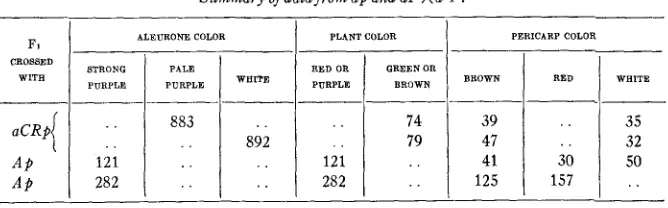
gave the results summarized in table 3. These data show that a C Rp
TABLE 3
Summary of d a t a f r o m a p and aP XaPP.
PLANT COLOR PERICARP COLOR
RED OR GREEN on
RED WHITE PURPLE BROWN
I__-p
. . 74 39 . . 35
. . 79 47 . . 32
121 . . 41 30 50
282 . . 125 157 . .
X ( a
p
Xgreen plant brown pericarp) gave approximately equal numbers of pale purple and of white and no strong purple aleurone, and that both aleurone color types produced only green plants with approximately equal numbers of brown and of white and no red pericarp. Also A p X ( ap
PIGMENTATION I N MAIZE 507
FI
Selfed
Selfed
X a C R p
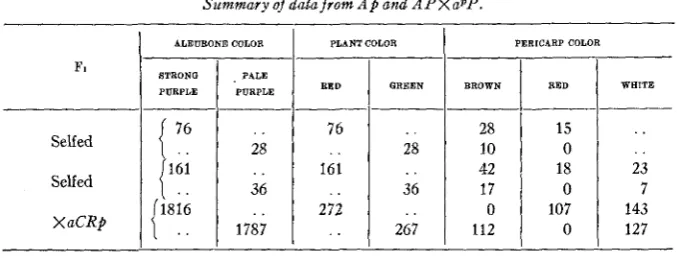
Green plants with brown pericarp of the Peruvian stock, a p
P
crossed with Ap
and AP
gave the results shown in table 4. As shown in this table, selfed Fl’s gave approximately the expected frequency of strong purple and pale purple but no white aleurone. The pale purple seeds pro- duced only green plants with brown (or brown and white) pericarp while the strong purple seeds gave only red plants some with brown and some with red pericarp (and some white when Pp ) .
The Fl’sXa C Rp
gave some strong purple aleurone, red plants, and red or white pericarp, and about an equal number of pale purple aleurone, green plants, and brown or white pericarp. These results establish the independence of brown andP
and the allelomorphism of brown and A .TABLE 4
Summary of data from A p and APXaPP.
STRONQ , PALE
PURPLE PURPLE RED GREEN BROWN RED WAITE
-_______________
-_
76 . . 76 . . 28 15 . .
28 . . 28 10 0 . .
161 . . 42 18 23
36 . . 36 17 0 7
. . 272 . . 0 107 143
. . 267 112 0 127
I
ALEURONBCOLOR1
PLANTCOLORI
PERICARP COLORThe relation of a p to salmon silk colors,
P
s m , has not been determined. Its relation to the cherry-brown pericarp colors is apparently the same as that of a. Some of the plants of the cross of the original Peruvian plant,a p B
P I
P m o R, with Onondaga White Dent, A bp z
p
y C h , were purple andthe pericarp of all these was brown mosaic on a background of cherry. This indicates that U P either has the same effect as A or is recessive to it as regards cherry pericarp. A reddish brown plant, a p B
P1,
which ap- peared in a later generation of this cross, crossed with a purple plant having cherry pericarp and known to be A a B PZ y c h , produced a small F1 culture consisting of purple and of reddish brown plants. All the purple plants had cherry pericarp, A a p BPl
rch, and the brown plants had brown pericarp,a p a B
PZ
y c h . It is certain, therefore, that, withPI
and reh, A a p givescherry and a p a gives brown pericarp. Since the allelomorphs A and a are
related to cherry brown pericarp colors exactly as they are to plant colors, A giving purple plants and cherry pericarp and a a green or brown plants and brown pericarp and since u p a P gives green or brown plants, it is pre- sumable that it would also give brown pericarp with
PI
y c h .The allelomorph u p resembles A b only in its effect on the pericarp pig-
ment. Like A b it produces brown pericarp color and is dominant to the red pericarp color produced by A . With C and
R
it gives a pale purple aleurone color instead of the deep color of A and A b or the absence of color with a. I n its effect on plant color it resembles the recessive a except that the brown color in combination with B andPI
is a reddish brown.DOMINANCE
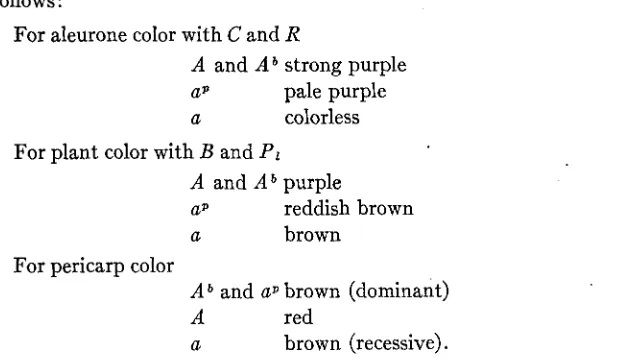
These four allelomorphs of A do not form a simple series in their domi- nance relationships. The sequences from dominant to recessive are as follows :
For aleurone color with C and R
A and A b strong purple
U P pale purple
a colorless For plant color with B and
P L
A and A b purple
U P reddish brown
a brown
Ab and a= brown (dominant)
A red
U brown (recessive).
For pericarp color
The interactions of the several allelomorphs of A with various other aleurone, plant, pericarp and silk color genes are summarized in table 5 . Combinations which have not been tested directly are given in paren- theses.
SUMMARY
Two new allelomorphs of the A factor for aleurone, plant and pericarp color are described.
A b resembles the normal A in its effect on the anthocyanin pigmentation of the plant; but it converts the red pericarp pigment into a corresponding brown pigment. It is dominant to A in this respect.
The allelomorph u p resembles Ab in its dominant effect on pericarp color. But it gives pale aleurone color with C and R and it is almost like the recessive a in its effect on plant color.
PIGMENTATION I N MAZIE 509
PLANT COLOR PERICARP COLOR
ALEURONE COLOR WITH
CRP, WITR BPI WITH Bp1 W I T H P l t C h WITH P
Strong Purple Sunred Cherry Red
Strong Purple Sunred Cherry Red
Strong Purple Sun red (Cherry) Brown
Strong Purple Sun red Cherry Brown
Strong Purple Sun red (Cherry) Brown
(Strong (Purple) (Sun red) (Cherry) (Brown)
Strong Purple Sun red (Cherry) Brown
Pale Reddish Green Brown Brown
Pale purple Reddish Green Brown Brown
White Brown Green Brown Brown
purple
purple
purple
purple
purple
purple)
purple
brown
brown
ALLBLO- YORPAS OF A
BILK COLOR WITH PSm
Salmon
Salmon
Green
(Green)
Green
(Green?)
(Green?)
(Green?)
(Green?)
Green
A A A a A A b Aap A b A b A bap Aba apap @a aa
LITERATURE CITED
ANDERSON, E. G., 1921 The inheritance of salmon silk color in maize. Cornell Agric. Expt. Sta.
1924 Pericarp studies in maize. 11. The allelomorphism of a series of factors for pericarp Mem. 48: 539-554.
colors. Genetics 9: 442453.
1925 A dominant brown pericarp color in maize. Michigan Acad. Sci., Arts and Letters 5: 73-75.
ANDERSON, E. G., and EMERSON, R. A., 1923 Pericarp studies in maize. I. The inheritance of
1931 Inheritance and linkage relations of chocolate pericarp color in maize. Amer. Nat. 65:
BURNHAY, C. R., and BRINK, R. A., 1932 Linkage relations of a second brown midrib factor in
EMERSON, R. A., 1918 A B t h pair of factors A a, for aleurone color in maize, and its relation to 1921 The genetic relations of plant colors in maize. Cornell Agric. Expt. Sta. Mem. 39: 1-156.
JORGENSON, L. R., 1931 Brown midrib in maize and its linkage relations. J. Amer. Soc. Agron. 23:
MEYERS, MARION T., 1927 A second recessive factor for brown pericarp in maize. Ohio J. Sci. pericarp colors. Genetics 8: 466476.
253-257.
maize. (Manuscript.)
the C c and R r pairs. Cornell Agric. Expt. Sta. Mem. 16: 225-289.
549-557.
27: 295-300.