ISSN(Online): 2319-8753 ISSN (Print): 2347-6710
I
nternational
J
ournal of
I
nnovative
R
esearch in
S
cience,
E
ngineering and
T
echnology
(A High Impact Factor, Monthly, Peer Reviewed Journal)
Visit: www.ijirset.com
Vol. 7, Special Issue 4, April 2018
Smart Toll Payment Using QR Technology
Abilash C1, Ezhilraj R2, Krithikaa Venket V S3 Department of IT, KCG College of Technology, Chennai, India1,2,3.
ABSTRACT: The transportation is the backbone of any country’s economy. Improvement in transportation systems result into the good lifestyle in which we achieve extraordinary freedom for movement, immense trade in manufactured goods and services, as well as higher rate of employment levels and social mobility. There are many problems caused due to increasing number of vehicles ,which results into problems such as congestion, accident , air pollution. By using Android Smart phone, select toll area, time and pay. This, in combination with reduced fuel consumption has positive effect on environment. By introducing this technology, this system makes automatic and easier and also user can pay the money at anywhere.
KEYWORDS: Toll plaza, QR code, Transaction, Smart Phone, E-payment.
1. INTRODUCTION
A user- friendly and apt mobile payment solution is using QR technology. In present day many of country use RFID (Radio Frequency Identification) technology for toll-gate payment. There are many disadvantages using
RFID. It can be easily interrupted, RFID Tag Collision, Security privacy, Low cost, There are many problems in many cities by using RFID technology. Therefore by using QR technology, all the problems stated above will be solved. QR codes can be scanned and read by a camera armed Smartphone. QR code on an item scans it with your Smartphone and directly has access to a lot of information electronically.
E- payment by doing this pre-banking Tollgate transaction processing the drivers will have QRcode as a proof in the smart phone and move to the concern location without any waiting time tollgates.
To use QR technology have many advantages they are, Very recognizable, Easier and cheaper to get QR codes out here, RFID requires dedicated equipment, QR codes are web oriented and more flexible and Securable.
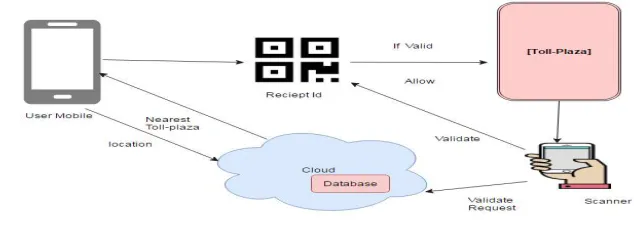
Fig 1: Architecture Diagram
The architecture diagram of the toll collection system gives the complete explanation about the process and how the information is fetched from the database.
ISSN(Online): 2319-8753 ISSN (Print): 2347-6710
I
nternational
J
ournal of
I
nnovative
R
esearch in
S
cience,
E
ngineering and
T
echnology
(A High Impact Factor, Monthly, Peer Reviewed Journal)
Visit: www.ijirset.com
Vol. 7, Special Issue 4, April 2018
unique code order will be placed. The communication between user and toll gate is with the help of mobile application. To do the payment process between the toll-gate operators, they send and store data’s to the database, then the database generate the QR code and it send to the toll-gate operator and the toll-gate operator pass the QR code to user. The user after receive the QR code the payment process is completed, when a users cross the toll-gate user must to show the QR code in to the QR code reader. After read the QR code the toll-gate open and easily cross the toll-gate without any time delay.
II. OBJECTIVE
Here are some objectives about the ETC based on android system which tells us about the purpose behind selecting this topic & the requirement of this type of project in our day to day life. To avoid the fuel loss. To save the time in collecting toll at toll plaza. To avoid financial loss. To control the traffic. According to the survey of Government, in Sept.2012 they have proposed to get the annual toll collection about 25000 million/year .But in the present situation they are able to collect only 900 corers of the toll value. Means there is loss of 600 cores due to human errors. So, in this situation we have to control this leakage.
III. MATERIALS AND RELATED WORKS RELATED WORKS
The toll payment collection is the
one of the major source for the Government and road maintenance. In the tax payment system will be an advantage for the government and this system will be mainly used for to pay the proper toll amount for a vehicle that been used in the system. In existing system traffic will be occurred due to the toll manual process. So to avoid such problems, a technology called RFID has been implemented. In use of RFID tag on vehicles’ for read the data using RFID tag reader. There are many disadvantages by using RFID technology such as, RFID systems can be easily disrupted, RFID Tag Collision, Security privacy, much cost, Ethics Problems with RFID,
various size of RFID tag are used to difficulty and also damage easily. These are the problems which will be come by using RFID technology. So we can use QR technology instead of RFID technology. QR code has easily read and writes the data with high secure. It communicates between users and toll-gate operators. We use two types of application web application for pc and mobile application. To make E- payment for toll-gate using unique code for every tollgate has specific number to identification. By payment, the user can able to have their QR code which been generated automatically. Then the user has to show their QR code to the toll, then toll validate whether the QR code is valid or not. The user will be allowed, when the QR code is valid, otherwise the user cannot able to cross the toll plaza.
IV. SECURITY REQUIREMENTS
Authentication: Authentication is the process of identifying or verifying the user.
Availability: Availability give the complete information about the toll plaza and give the availability of toll plaza.
Payment : Payment gateway introduced to the mode of money transaction to toll authorities.
Privacy: User identification and payment have higher security between toll and user.
V. EXISTING SYSTEM
ISSN(Online): 2319-8753 ISSN (Print): 2347-6710
I
nternational
J
ournal of
I
nnovative
R
esearch in
S
cience,
E
ngineering and
T
echnology
(A High Impact Factor, Monthly, Peer Reviewed Journal)
Visit: www.ijirset.com
Vol. 7, Special Issue 4, April 2018
bar code technology.
VI. PROPOSED SYSTEM
The proposed system uses the new technology called QR technology. The message can be delivered to the user once the user finishes his/her transaction to the system. All the transaction information will be given to the user through messaging. Now QR technology been used for this type of transaction. QR can be scanned and get read by the camera. By using QR code all the
information can be scanned faster. It is an new technology for automatic toll collection solution. In this , the modules and working flow of the system is described and data information is also easily exchanged between the person and toll authorities, thereby enabling a more efficient toll collection by reducing traffic and eliminating possible human errors.
VII. IMPLEMENTATION PROCESS& METHODOLOGIES
Following modules involves
7.1 MODULES
Registration & Verification Data-Base Creation Toll Booking QR code generation Receipt Scanning
7.2 MODULE DESCRIPTION Registration & Verification
In this module, Android used xml to develop
classical screens in our application. The modules describe register page contains mobile number and user name details should be stored in database. After that one time password should be sent to register mobile number for
verification and based on user input if otp is matched, then user allow in the app otherwise it gave an alert and also it have option to request to
send the One time password again.
Database Creation
Mobile Number,name,OTPhave been stored after registration. Android used php function to store the data in mysql database and fetching user application details.
Toll Booking
In this Module, user give all the details about the vehicle like vehicle type, vehicle number and trip mode and trip type and mode of paymentand tollbooth id ,date and time. In our process, validate all the above things and if it is authenticated, then it should be forwarded to the payment gateway.
QR Code Generation
In the QR code generation module, after processing the bill payment, it generate QR code for Receipt id, and vehicle details using QR code technology.
Receipt Scanning
ISSN(Online): 2319-8753 ISSN (Print): 2347-6710
I
nternational
J
ournal of
I
nnovative
R
esearch in
S
cience,
E
ngineering and
T
echnology
(A High Impact Factor, Monthly, Peer Reviewed Journal)
Visit: www.ijirset.com
Vol. 7, Special Issue 4, April 2018
7.3 FLOW DIAGRAM
First vehicle owner needs to download the application and has to register by giving basic details such as username, vehicle details and then registering an account . During the registration, the owner needs to deposit a certain amount in his account. The registration provides QR code to the vehicle. The second module is toll management. As the vehicle meets the gate, QR code reader captures the QR code authenticates and the amount will be deducted from owner account. Using this application can reduce the number of traffic in the toll road.
ISSN(Online): 2319-8753 ISSN (Print): 2347-6710
I
nternational
J
ournal of
I
nnovative
R
esearch in
S
cience,
E
ngineering and
T
echnology
(A High Impact Factor, Monthly, Peer Reviewed Journal)
Visit: www.ijirset.com
Vol. 7, Special Issue 4, April 2018
Toll Booking
QR Code Generation
Receipt Scanning
VIII. RESULTS AND CONCLUSION
The payment for Toll Gate processing using QR technology of toll gate can have the best solution over money loss at toll gate by reducing the manpower required for collection of money and also to reduce the traffic indirectly resulting in reduction of time at the toll gate. The QR code technology has high securable and low amount of spend cost and easy steps to pay. Toll collection
ISSN(Online): 2319-8753 ISSN (Print): 2347-6710
I
nternational
J
ournal of
I
nnovative
R
esearch in
S
cience,
E
ngineering and
T
echnology
(A High Impact Factor, Monthly, Peer Reviewed Journal)
Visit: www.ijirset.com
Vol. 7, Special Issue 4, April 2018
IX. FUTURE SCOPE
For the future the QR code technology will be the global market for any access. User can able to pay the toll amount at anywhere and any vehicle.
REFERENCES
[1]. G. Mujtaba, “Adaptive Automated Teller Machine Part-II”,International Conference on Information and Communication Technologies, pp.1 – 6, 2011.
[2]. G. Mujtaba, “Adaptive Automated Teller Machine Part-I”,International Conference on Information and
Communication Technologies,2010.
[3]. A.S. Adams, and K. A. Thieben, “Automatic teller machinesand the older population”, Applied Ergonomics, Vol. 22, pp.85 -90, 11991. [4]. A. B. El-Haddad, and M. A. Almahmeed, “ATM banking behaviour in Kuwait: a consumer survey”, International Journal of Bank Marketing, Vol. 10, pp. 25 - 32, 1992.
[5]. A Basic Study on Automated Teller Machine (ATM Machines).Available(Online):http://en.wikipedia.or
g/wiki/Automated_teller_machine/Teller .
[6]. S. Sridharan, “New Generation ATM Terminal Services,” in Proceedings of the 2013 (IEEE) International Conference on Computing, Cybernetics and IntelligentInformationSystems (CCIIS'13).
[7] Wei-Hsun Lee , Shian-Shyong Tseng , and Ching-Hung Wang, “design and implement of electronic toll collection system based on vehicle positioning system techniques,”vol. 31, 2008,pp.2925–2933.
[8] L.Jerry, C.Barbara "Shrouds of Time: TheHistory of RFID", AIMPublication, ver. 1.0, 2001.
[9] M. Ayoub Khan, S. Manoj and R. B. Prahbu "A Survey of RFID Tags", International Journal of Recents Trends in Engineering, vol 1, no 4, May 2009