Comparative Study on Composite Stub
Column
P. Princy Prema Rani 1, Dr. T. Bhagavathi Pushpa 2
P.G. Scholar, Department of Structural Engineering, Anna University Regional Campus Madurai, TN, India1
Assistant Professor, Department of Civil Engineering, University College of Engineering Ramanathapuram, TN, India2
ABSTRACT: - The structural behavior of Concrete Filled Steel Tube (CFST) stub columns has been investigated by the experimental study which system has many advantages. In this paper, the comparison was discussed and analyzed on the stainless steel tube, mild steel tube, PVC tube and reinforced composite member for M30 concrete. The slenderness ratio was taken as less than 12. The taken size of the column includes 150 mm diameter, 300 mm height. Experiments were undertaken to examine the interaction between the stainless steel tube, mild steel tube, PVC tube and rebar. Finally the strength of the stainless steel tube stub column increased by 25% compared to normal rebar composite stub column. At the end results demonstrated that there was an improvement in the behavior and the load carrying capacity of CFST stub column by strengthening those externally using other composites stub columns.
KEYWORDS: Axial compressive load, CFST stub columns, composite column.
I. INTRODUCTION
A column is designed to combine two different materials or two different grades of material to form a structural member. A structural steel shape of column may be filled with concrete, or a structural steel member for reinforcing may be encased in concrete. The composite structural elements are increasingly used in tall buildings, bridges and other type of structures [6]. A steel-concrete composite column is a compression member, comprising either a concrete encased hot-rolled steel section or a concrete filled tubular section of hot-rolled steel and is generally used as a load-bearing member in a composite framed structure. In a composite column both the steel and concrete would resist the external loading by interacting together by bond and friction. Supplementary reinforcement in the concrete encasement prevents excessive spalling of concrete both under normal load and fire conditions [6].
1.1 Stub column
A stub column is a column whose length is sufficiently small to prevent failure as a column, but long enough to contain the same residual stress pattern that exists in the column itself. Stub column is one which does not having footing and pedestal support, which is rises from beams or slabs for upper levels. In such places stub columns are used to minimize the construction cost .
1.2 CONCRETE FILLED STEEL TUBE COLUMN
The use of concrete filled tubular columns provides large saving in cost by increasing the floor area by a reduction in the required cross-section size. Concrete filled tubular columns can provide an excellent monotonic and seismic resistance in two orthogonal directions. There exist applications in Japan and Europe, where CFTs are also used as bridge piers. Moreover, CFTs may be utilized for retrofitting purposes for strengthening concrete columns in earthquake zones .
Fig.1: Composite column
II. RELATEDWORK
1. C.P.Indumathi et al., 2016, The reinforcement in concrete plays a vital role in increasing its self – weight. In order to reduce that weight the reinforcement is replaced by hollow steel pipe filled with rubber cement mortar. The hollow steel pipe is taken of required dimension according to the structure. The scrap tyres are used as rubber crumbs. The replaced composite reinforcement is used in normal conventional concrete of M25 grade and tested for its strength. In order to find a replacement for reinforcement we done this project and got successful result. The strength of composite reinforced concrete increased by 30% compared to ordinary reinforced concrete column. Hence the project is successful. Good bond to the concrete, irrespective of pH, moisture, and similar factors Thermal compatibility, not causing unacceptable stresses in response to changing temperatures.
2. Tohid Ghanbari Ghazijahani et al., 2015, A new composite element comprising rectangular steel tubular sections filled with timber and confined with car- bon fiber reinforced polymer (CFRP) was investigated in this study. Several tests were conducted on different specimens with varying geometrical conditions and the impact of each material was studied on the structural behavior of these members under axial compression. The timber infill was found to significantly improve the capacity by preventing local inward buckling. This effect was further enhanced when the short columns were confined with sufficient layers of CFRP to prevent local outward buckling. In both cases the strength increase (up to 75%) was substantially greater than the corresponding weight increase (up to 44%).A new composite element comprising rectangular steel tubular sections filled with timber and confined with CFRP was undertaken in this study. Several tests were conducted on different specimens with varying geometrical conditions and the impact of each material was studied on the structural behaviour of these structures.
buckling load of above said columns and tests were conducted under Monotonic loading.
III.EXPERIMENTALDETAILS
Cement:
Cement is a binder that sets and hardens and can bind other materials together. Ordinary Portland Cement (OPC) 53 grade was used. The grade number i.e., 53 indicates the compressive strength of cement sand mortar in N/mm2 at 28 days. The specific gravity of ordinary Portland cement was computed as 3.
Fine aggregate:
Aggregate which passed through 4.75 mm IS sieve and retained on 75 micron IS sieve is termed as fine aggregate. Fine aggregate is added to concrete to assist workability and to bring uniformity in mixture. The natural river sand was used as fine aggregate and its specific gravity was recorded as 2.6.
Coarse aggregate:
The coarse aggregate should be as river gravel or crushed stone. Angular shape aggregate which passes through 20 mm sieve and retain on 10mm can be used as coarse aggregate. The specific gravity of coarse aggregate was determined as 2.74. The grading of coarse aggregate should be as per specifications of IS 383-1970.
Mild steel:
The diameter of the hollow pipe is 6 mm rod. It is less brittle than stainless steel. It is alloyed with chromium, nickel, molybdenum and other elements to improve its mechanical and chemical properties. Mild steels are steels with carbon content up to 2.1 % by weight. The specified minimum for copper does not exceed 0.4 %. Carbon percentage content rises; steel has the ability to become harder and stronger.
Stainless steel:
Mechanical properties specified for flat rolled products are normally tensile strength, yield stress (or proof stress), elongation and Brinell’s or Rockwell hardness. Property requirements for pipe typically state tensile strength and yield stress. Then no need for painting or other protective coating. All stainless steels are iron based alloys but contain a minimum of around 10.5 % of chromium. Steel alloy has minimum of 11 % chromium. It is not corrode or rust as easily as ordinary steel.
Polyvinyl Chloride (PVC):
Density of PVC pipe is 1.3 to 1.45 g/cm3 and thermal conductivity of rigid PVC pipe is 0.14 to 0.28 W/(m·K). Yield strength is 4500 to 8700 psi and young’s modulus is 490000 psi.
Rebar:
Rebar also called reinforcing steel and reinforcement steel. Used as a tension device in reinforced concrete and reinforced masonry structures to strengthen and hold the concrete in tension. Better bond with the concrete.
Casting:
Water (lit/m3)
Cement (kg/m3)
Fine aggregate
(kg/m3)
Coarse aggregate
(kg/m3)
197.16 438.13 778.6 984.25
0.45 1 1.7 2.2
Table -1: Mix ratio
Testing methods:
For determining the strength of concrete generally compression test of concrete cubes are done. Initially to determine the workability of concrete the slump value was determined. By the results, the value of slump was achieved for the conventional concrete is 100mm.
The various slump values indicate the workability and consistency of concrete. They are, slump value of 0-25 mm (very dry mixes) are used in road making, having slump 10-40 mm (low workability mixes) are used for foundations with light reinforcement, 50-90 mm (medium workability mixes) for normal reinforced concrete placed with vibration, high workability concrete is greater than 100 mm.
Compression Test:
The compressive strength of concrete is given in terms of the characteristic compressive strength of 150 mm size
cubes tested at 28 days (fck). The characteristic strength is defined as the strength of the concrete below which is not more than 5% of the test results are expected to fall. The prepared specimens were tested by compression testing machine after 7 days of curing or 28 days curing. The compressive strength of M30 grade concrete was found to be 30.5 MPa after 28 days of curing.
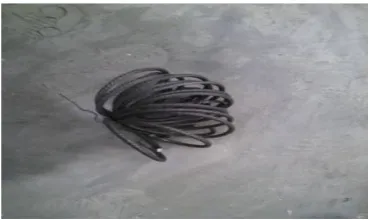
The size of stub column includes 150 mm diameter, 300 mm height with using 3 circular strips and 6 steel tubes. The diameter of the steel tube taken as 6 mm with spacing of each rod was 75 mm. The compressive strength achieved for ordinary reinforced concrete column was 30.7 MPa whereas for composite reinforced column was 34.98 Mpa.
Fig -2: Circular stirrups
IV.EXPERIMENTAL RESULTS
.
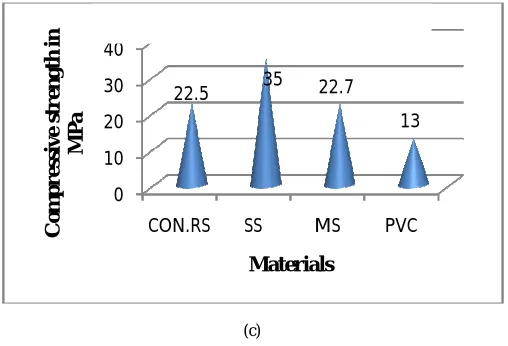
This graph represents the compressive strength of concrete for 28 days from various steel like reinforcement steel, stainless steel, mild steel, pvc tube. Compare the compressive strength of mild steel, stainless steel, reinforcement steel. Stainless steel has the highest value of strength.
(c)
Fig. 3. (a) : Initial crack (b) After failure by compression test (c) Comparison of various stub columns
From the test results, it can be observed that,
o Rebar stub column reached the compressive strength of 22.5 MPa.
o Compressive strength of stainless steel stub column was recorded as 35 MPa which is 12.5 % higher than normal stub column. From the result, it is evident that, stainless steel stub column gives higher compressive strength than that control stub column, because stainless steel has higher load carrying capacity.And then it is more resistant to corrosion.
o Compressive strength of mild Steel stub column was observed as 22.7 MPa which is 0.2 % higher than normal stub column. Mild steel is less resistant to corrosion. So it has less brittle compared to rebar.
o Compressive strength of PVC stub column was 13 MPa which is 9.5 % lesser than normal stub column. PVC pipe is in light weight compared to other materials, so it has very low load carrying capacity
0 10 20 30 40
CON.RS SS MS PVC
22.5 35 22.7
13
C
o
m
p
r
e
ss
iv
e
s
tr
e
n
gth
i
n
M
P
a
Materials
V. CONCLUSION
In order to find a replacement for reinforcement, the various materials have been attempted. From the results, the strength of stainless steel stub column was increased by 12.5% compared to ordinary reinforced stub column. According to the materials used for replacement, the mild steel achieved the result nearer to the normal stub column and the PVC gave lesser value. Finally, the results indicate that, the stainless steel stub column was performed well compared to the other materials used and with the normal stub column.
REFERENCES
[1] Ali A.Aliabdo, AbdElmoaty M.AbdElmoaty, Mostafa M.AbElbaset, “Utilization of waste Rubber in non structural applications”, construction and building materials, 91, pp.195-207, 2015.
[2] Haolin Su,jian Yang,Tung-Chai Ling, Gurmel S. Ghataora, Samir Dirar, “Properties of concrete prepared with waste tyre rubber particles of uniform and varying sizes” Journal of cleaner production, 91, PP 288-296, 2015.
[3] Knowles, R B, Park,R, “Strength of Concrete filled Steel column” Journal of the structural division,95, pp. 2565-2587,1969.
[4] Jing Lv , Tianhua Zhou, Qiang Du, Hanheng Wu, “Effects of rubber particles on mechanical properties of lightweight aggregate concrete”, Construction and Building Materials, 91, pp. 145–149, 2015.
[5] TaekHee Han, Ki Yong Yoon, Young Jong Kang, “Compressive strength of circular hollow reinforced concrete confined by an internal steel tube”, Construction and Building Materials, 24, pp. 1690–1699, 2010.
[6] C.P.Indumathi and K.L.Ravi Shankar ”Experimental behavior of composite reinforced column by axial loading”, International research journal of engineering and technology, Vol 3,pp.1974-1975,2015.
[7] Michel Sabri Samaan, “An analytical and experimental investigation of concrete-filled fiber reinforced plastics (FRP) tubes” PhD thesis, University of Central Florida, Orlando, Florida, 1997.
[8] Saafi, M., Toutanji, H. and Li, Z. “Behavior of concrete columns confined with fiber reinforced polymer tubes”, ACI Materials Journal, 96(4), pp. 500–509, 1999.
[9] M. Marzouck and K. Sennah, “Concrete-filled PVC tubes as compression members: Composite Materials in Concrete Construction”, Proceedings of the international congress“ challenges of concrete construction”, pp. 31-38, 2002.