Mediation
After
Case
Evaluation
A
Caseflow
Study
of
Mediating
Cases
Evaluated
Under
$25,000
State Court Administrative Office
Office of Dispute Resolution
Michelle Hilliker
Financial and Statistical Management Analyst
Executive Summary
Mediation, formalized through a series of court rules adopted in 2000, has been considered to be one tool courts could use to help parties resolve their case earlier and without adjudication by the court. The purpose of this study was to assess the impact to the circuit court docket of ordering mediation following case evaluation in cases evaluated under $25,000.
This study examined the effect of ordering mediation in select civil cases where case evaluation awards have been rejected. Ninety-three randomly selected cases from the circuit courts in Kent, Macomb, and Oakland counties were included in the study. The cases met the following criteria: (1) the case evaluation award was under $25,000; (2) the award was rejected by one or all of the parties; (3) parties were ordered to mediation either with a private mediator or with a Community Dispute Resolution Program (CDRP) center; (4) the case was ordered to mediation under the pilot; and (5) the case was disposed between March 1, 2007, and September 17, 2009. Seventy-seven (83 percent) of the cases settled prior to trial, 9 (10 percent) were disposed by summary disposition or default judgment, and the remaining 7 (7 percent) were disposed by trial. On average, cases were 340 days old when ordered to mediation. Forty percent of the cases were disposed within an average of 66 days from the order to mediate. After mediation was conducted and an agreement was reached at the table, an additional 30 cases were disposed; thus 67 cases (72 percent) were disposed within an average of 78 days from the order to mediate. An additional 15 (88 percent) cases settled after a settlement conference or mediation; an average of 99 days after the order to mediate.
Cases settling either premediation or through the mediation event were disposed on average within 93 days of the order to mediate; cases not settled were disposed on average 178 days after the order to mediate. Settlement rates at mediation were higher when all summary disposition motions were decided prior to mediation than when a summary disposition motion was pending. Cases with trial dates scheduled early did not have higher settlement rates than cases without a trial date scheduled early. Further, nearly one-half of the cases with early scheduling of trial dates were ultimately rescheduled between one and three times. Taken together, the study suggests that the practice of early scheduling of trial dates should be reassessed for its efficacy in promoting settlement.
Mediation took place in 55 percent (51 cases) of cases. In these cases, 71 percent were disposed by settlement.
Future studies should examine whether mediation dispositions vary by case type and whether higher levels and earlier dispositions would result from ordering mediation to occur prior to case evaluation.
Acknowledgments
I would like to acknowledge the contributions of the following persons who assisted in developing, administering, and evaluating this pilot project.
6th Judicial Circuit Court of Oakland County: The Judges of the 6th Judicial Circuit Court; Kevin Oeffner, Court Administrator; Diane Kratz,
Caseflow/Alternative Dispute Resolution Supervisor
16th Judicial Circuit Court of Macomb County: The Judges of the 16th Judicial Circuit; Keith Beasley, Court Administrator
17th Judicial Circuit Court of Kent County: The Judges of the 17th Judicial Circuit Court; Jack Roedema, Court Administrator; David Drain, Deputy Court
Administrator
Dispute Resolution Center of West Michigan: Jonathan Wilmot, Executive Director; Alan Ryder, Case Manager
Oakland Mediation Center: Bonnie Hanes, Executive Director; Camelia Ureche, General Manager
The Resolution Center: Craig Pappas, Executive Director; Jennifer Clein, Program Coordinator
I would also like to recognize the following State Court Administrative Office staff for their assistance with this project: Laura Hutzel, Statistical Research Director; Douglas A. Van Epps, Office of Dispute Resolution Director; Frances Goff, Administrative Specialist; Jill Booth, Management Analyst III; and Kevin Bartley, Administrative Assistant.
i
Table of Contents
Table and Figure Index ... ii
I. Background ...1
II. Methodology ...1
III. Mediation Service Providers Profile ...2
IV. Data Analysis ...4
A. Final Dispositions After the Order to Mediate ...4
B. Impact of Summary Disposition Motions on Settlement ...7
C. Scheduling and Rescheduling Trial Dates ...8
1. Scheduling the Original Trial Date ... 8
2. Rescheduling Trial Dates ... 9
D. Settlement by Case Type ...10
E. Mediations Conducted ...11
V. Summary, Conclusions, and Recommendations ...12
ii
Table and Figure Index
Table 1: Disposition Statistics by Provider ... 3
Table 2: Case Disposition by Event ... 7
Table 3: Event Type After Summary Disposition Motion Decision ... 7
Table 4: Summary Disposition Motion Pending Prior to Mediation ... 8
Table 5: Trial Date Scheduled ... 9
Table 6: Cases in Which Trial Date was Rescheduled ... 9
Table 7: Case Type of Cases Settled ... 11
Table 8: Case Type of Cases Settled Where Last Monitored Activity was Mediation ... 12
Figure 1: Dispositions by Provider ... 3
I. Background
The purpose of this study was to assess the effect on the circuit court docket of ordering mediation following case evaluation in cases evaluated under $25,000. The potential for
mediation to be effective in reaching disposition was suggested by the relatively high settlement rates typically reported by private mediators and Community Dispute Resolution Program (CDRP) centers in the decade since court rules were adopted authorizing judges to order parties to attempt resolution of their dispute through mediation. The State Court Administrative Office (SCAO) created a pilot project to study if these centers may be able to assist parties in reaching earlier resolutions of their matters in select circuit court matters, thereby resulting in earlier removal of cases from court dockets.
To test this hypothesis, SCAO’s Office of Dispute Resolution contacted three of the largest circuit courts in Michigan and the CDRP centers in their jurisdictions to determine whether they would be interested in piloting the referral of case-evaluated matters to CDRP centers or private mediators.
All six entities agreed to participate in the study. The three pilot courts and their partnering CDRP agencies consisted of: the 6th Judicial Circuit of Oakland County and the Oakland Mediation Center, the 16th Judicial Circuit of Macomb County and the Resolution Center, and the 17th Judicial Circuit of Kent County and the Dispute Resolution Center of West Michigan. The pilot projects began in late 2006.
For purposes of this study, “case evaluation” refers to the dispute resolution process outlined in MCR 2.403, in which a panel of attorneys, following a brief presentation of the case by the attorneys, renders an award that parties may then accept or reject.
“Mediation” is defined as appears in MCR 2.411(A)(2):
Mediation is a process in which a neutral third party facilitates communication between parties, assists in identifying issues, and helps explore solutions to promote a mutually acceptable settlement.
II. Methodology
All cases in this study were first evaluated under MCR 2.403 and subsequently ordered to mediation under MCR 2.411 with SCAO-approved Local Administrative Orders authorizing referral of cases to CDRP centers.
Under the Local Administrative Orders, once the 28-day period following case evaluation expired without an acceptance of the award, parties were ordered to participate in mediation. The orders permitted parties to select their own mediator within 14 days or to otherwise have the mediation managed by the local CDRP center.
Mediation After Case Evaluation – Page 2
Circuit court administrators at each of the three pilot sites were asked to provide the SCAO with 40 randomly-selected cases that met the following criteria: (1) the case evaluation award was under $25,000; (2) the award was rejected by one or all parties; (3) the case was ordered to mediation under the pilot directing parties to select their own mediator or to have mediation managed by the local CDRP center; and (4) the case was disposed between March 1, 2007, and September 17, 2009. The SCAO’s goal was to have a total of 90 cases, with each court
contributing 30 cases.
III.
Mediation Service Providers Profile
The Local Administrative Orders approving the trial court pilot projects required that parties be offered an opportunity to select their own mediator. Absent that selection, the default service provider would be the local CDRP center. Although all parties had an opportunity to select their own mediator, the case data showed that parties utilized the services of the local CDRP center in 91 percent of the cases.
The three CDRP centers participating in this study are independent non-profit organizations that are financially supported, in part, by the SCAO to provide mediation services "as an alternative to the judicial process." [260 PA 1988; MCL 691.1551]. The centers use a facilitative mediation process that includes the following elements: (1) introduction and ground rules; (2) opening statements by the parties; (3) identifying the issues requiring resolution; (4) generating options for resolving each issue; (5) identifying the best option for resolving each issue; and (6) committing the series of agreements to writing. The mediators are volunteers who have completed a minimum 40-hour training program approved by the SCAO and a supervised internship. The mediators participating in the pilot had substantial mediation experience, and on occasion, co-mediated with a newer mediator for training purposes. The centers reported
modifying the basic mediation process to the cases in this study by more frequently assigning an attorney as the mediator and at the parties’ request, increasing the use of caucus.
Figure 1 on the next page displays for each provider how the cases ordered to mediation were disposed. Table 1 reflects the number of cases ordered to the providers and the number of
mediations attempted and settled. The bottom section of Table 1 displays the percentage of cases referred to the pilot which were disposed through mediation, disposed by the parties’ settlement without mediation, or disposed by a subsequent court event.
Mediation After Case Evaluation – Page 3 Figure 1: Dispositions by Provider
Table 1: Disposition Statistics by Provider
Dispute Resolution Center of West Michigan (Kent) The Resolution Center (Macomb) Oakland Mediation Center (Oakland) Private
Mediators Pilot Total Number of cases ordered 28 29 28 8 93 Number of mediations conducted 16 19 10 6 51 Number of mediations settled 12 13 7 4 36 Percentage settled through mediation 42.8% 44.8% 25.0% 50.0% Percentage settled by parties without mediation 28.6% 20.7% 57.1% 25.0% Percentage disposed by the court (through summary disposition, default judgment, settlement conference, trial) 28.6% 34.5% 17.9% 25.0% Total Percentage 100% 100% 100% 100% 0 2 4 6 8 10 12 14 16
Kent Macomb Oakland Private
mediators Number of Cases Disposed
Dispositions
by
Provider
Summary disposition prior to mediationSettlement prior to mediation Mediation agreement at table Settlement conference
Mediation settlement later with no court
intervention
Default judgment
Summary disposition after mediation
attempted Trial
Mediation After Case Evaluation – Page 4
IV. Data
Analysis
The SCAO staff compiled case data by reviewing the register of action and/or case file of each case and entering the relevant data into a database. Cases were removed from the study if a motion to remove the case from mediation had been granted, an order had been entered
remanding the case to district court; or, the case evaluation award had been accepted beyond the 28th day provided for acceptance or rejection, but prior to the court’s sending the order to
mediate to the CDRP center. The court with the smallest number of cases that could be included in the study had 31 cases; therefore, the first 31 eligible cases were included for the remaining two courts.
A. Final Dispositions After the Order to Mediate
The principal purpose of this study was to determine the impact on the docket of ordering mediation shortly after the rejection of case evaluation awards and if mediation resulted in pretrial dispositions or settlement.
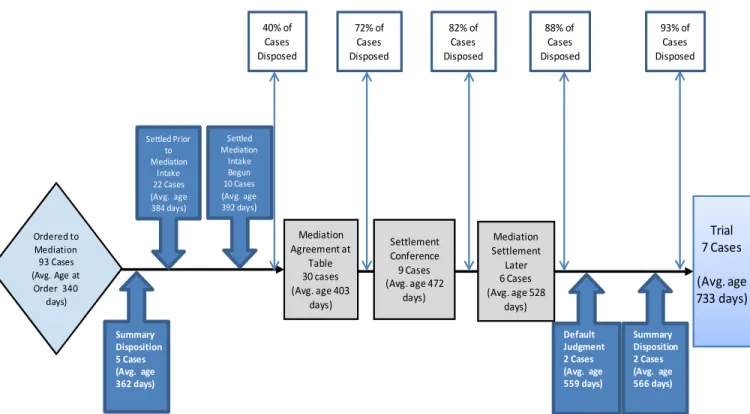
Figure 2 reflects a caseflow analysis of the 93 cases in this study. In practice, a complete caseflow analysis incorporates the entire lifecycle of a case from the moment of filing to final disposition. For purposes of this study, however, the caseflow analysis focuses exclusively on the period of time ranging from the post-case evaluation mediation order to final disposition. By way of explanation, the far left of the continuum on Figure 2 reflects the cases that were ordered to mediation after case evaluation was rejected. The average age of the cases at the time of the order to mediation was 340 days. The far right of Figure 2 reflects the cases that were disposed by trial. The average age of these cases at disposition was 733 days.
Mediation After Case Evaluation – Page 5
Between the event on the far left and the event on the far right fall the various disposition points, which include summary disposition motions, settled cases,1 mediation,2 settlement conferences, and default judgments. The uppermost boxes reflect the cumulative percentage of cases that are disposed as court events continue to take place, such that by the trial event, 93 percent of the cases in the study were disposed. The boxes on the line reflect the last monitored event prior to disposition.3
1
The distinction between the two boxes captioned “Settled Prior to Mediation Intake” and “Settled Mediation Intake Begun” is that the first box includes cases in that an order to mediate was forwarded to the partnering CDRP center or private mediator and a case file was created, but upon contacting the parties, mediators discovered the case had been settled after the order to mediate had been issued. This contrasts with the cases that were removed from the study in which the order was never forwarded to a CDRP center or mediator, most often because the case evaluation award was accepted by all parties later than 28 days. “Settled Mediation Intake Begun” includes cases in which the order to mediate was received by a CDRP center or mediator and contact with parties was made, but before the mediation was conducted, the parties arrived at their own settlement of the case.
2
The difference between “Mediation Agreement at the Table” and “Mediation Settlement Later” is that “Mediation Agreement at the Table” includes cases in which an agreement was reached during a face-to-face mediation session and disposed the case. “Mediation Settlement Later” includes cases in which a mediated agreement was not reached at the face-to-face mediation session, but no further monitored court activities were required before settlement of the case.
3
Each box includes the type of event, the number of cases that were studied, and the average case age in days (defined as the number of days from case filing to disposition) for all cases that met the event criteria.
Mediation Agreement at Table 30 cases (Avg. age 403 days) Ordered to Mediation 93 Cases (Avg. Age at Order 340 days) Trial 7 Cases (Avg. age 733 days) Settled Prior to Mediation Intake 22 Cases (Avg. age 384 days) 40% of Cases Disposed 93% of Cases Disposed 72% of Cases Disposed 82% of Cases Disposed 88% of Cases Disposed Settlement Conference 9 Cases (Avg. age 472 days) Summary Disposition 5 Cases (Avg. age 362 days) Default Judgment 2 Cases (Avg. age 559 days) Summary Disposition 2 Cases (Avg. age 566 days) Settled Mediation Intake Begun 10 Cases (Avg. age 392 days) Mediation Settlement Later 6 Cases (Avg. age 528 days)
Mediation After Case Evaluation – Page 6
A number of findings are noteworthy here. First, 40 percent of the cases were disposed prior to mediation taking place, on average 66 days from the order to mediate. Second, with 32 percent of the cases settling and disposed at mediation, 72 percent of the study cases were disposed between the order to mediate and the conclusion of the scheduled mediation event, on average 78 days from the order to mediate. The remaining 28 percent of the cases had protracted case ages, ranging from an average age of 472 days for cases disposed by settlement conference to 733 days,4 for cases that were ultimately tried.
As expected, the vast majority of cases settled without formal adjudication. Of the 93 cases studied, 77 (83 percent) settled prior to trial. An additional 9 cases (10 percent) were disposed through summary motions, and 7 (7 percent) of the cases were tried.5
As to the timing of the settlements in relationship to mediation taking place, as noted above, of the cases that settled, 32 cases (34 percent) settled prior to mediation taking place, meaning that between the date of the order to mediation and mediation taking place, counsel were able to reach settlement on their own in a significant number of cases.
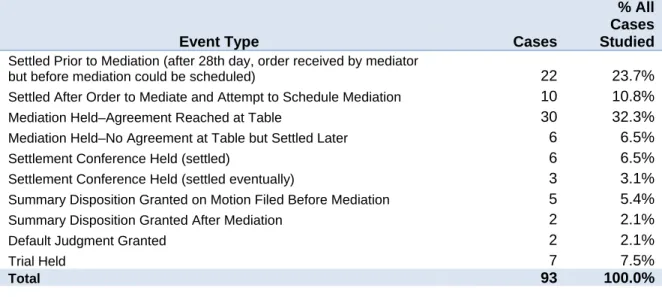
Of the cases settled prior to trial, mediation resulted in 36 (39 percent) settling either at or within weeks of the mediation event. Notably, of the ten types of events tracked, mediation events resulted in the highest number of dispositions, followed closely by settlements that occurred after issuance of the order to mediate. See Table 2.
When mediation took place, 30 cases (59 percent) resulted in agreement “at the table.” This agreement rate is not inconsistent with agreement rates reported by circuit courts in
administering mediation services under MCR 2.411, however, it is lower than the average agreement rate for all cases mediated or conciliated by all CDRP centers, reported as 68 percent in 2009.6 Although the study did not assess differences that may result in settlement rates, the fact that the mediations were conducted in very late stages of litigation rather than in earlier stages, where mediation is generally thought to be more productive, may explain the modest decrease in settlement rates. Another consideration, however, is that six more cases in the study could be attributed to mediation in the weeks after the event in that even though they did not settle “at the table,” no further monitored schedule events took place, and the cases were disposed. Including these cases, the settlement rate for mediated cases would increase to 71 percent.
4
One outlying case was disposed by jury trial after 1,882 days. 5
The statewide trial rate for all circuit court nonfamily civil dispositions in 2009 was 1.5 percent. The higher trial disposition rate reported here chiefly reflects that the sample size included only cases in the late stages of litigation, and thus does not incorporate cases that would have settled prior to or during case evaluation. Source: Michigan Supreme Court Annual Report 2009.
6
When conciliations (non-face-to-face agreements) and mediations (face-to-face meetings) were combined, the agreement rate (resolution rate) was 68 percent in cases when parties agreed to use a CDRP center’s services. Source: Community Dispute Resolution Annual Report 2009.
Mediation After Case Evaluation – Page 7
The remaining 9 cases (11 percent) were settled as a result of a subsequent settlement conference.
The data supports the following conclusions: (a) that nearly three-quarters of cases ordered to mediation were disposed either by premediation or mediation-related settlement activities; (b) that a significant number of post-case evaluation events, e.g., settlement conferences and trials, were avoided; and (c) that the majority of mediation-related settlement activities resulted in far more expeditious dispositions than matters requiring other post-mediation events; e.g., settlement conferences and trial.
B. Impact of Summary Disposition Motions on Settlement
Another question of this study was the extent to which the existence of a summary disposition motion affected mediation events.
Over one-third (n=34) of the cases in the study included a motion for summary
disposition (MSD). In 24 cases, these MSDs were decided prior to mediation and in 10 cases, these MSDs were pending at mediation. Of the 24 cases (see Table 3) in which an MSD had been filed and disposed prior to conducting the mediation, 5 cases were
immediately closed because the motions were granted after the order to mediate but prior to mediation. In one case, an MSD was denied prior to mediation intake, mediation was deemed inappropriate and the MSD was re-filed and granted later. An additional case was settled by the parties prior to mediation. The remaining 17 cases were mediated, and of those, 11 (65 percent) settled at mediation. Three (17.5 percent) additional cases mediated without agreement, but
Table 2: Case Disposition by Event
Event Type Cases
% All Cases Studied
Settled Prior to Mediation (after 28th day, order received by mediator
but before mediation could be scheduled) 22 23.7%
Settled After Order to Mediate and Attempt to Schedule Mediation 10 10.8%
Mediation Held–Agreement Reached at Table 30 32.3%
Mediation Held–No Agreement at Table but Settled Later 6 6.5%
Settlement Conference Held (settled) 6 6.5%
Settlement Conference Held (settled eventually) 3 3.1%
Summary Disposition Granted on Motion Filed Before Mediation 5 5.4%
Summary Disposition Granted After Mediation 2 2.1%
Default Judgment Granted 2 2.1%
Trial Held 7 7.5%
Total 93 100.0%
Table 3: Event Type After Summary Disposition Motion Decision
Event Type Cases
Case Dismissed by Party or Settled Prior 1
Mediated w/ Agreement 11
Mediated w/out Agreement 6
Motion Granted 6
Mediation After Case Evaluation – Page 8
settled prior to the next scheduled court event. The remaining 3 cases (17.5 percent) settled after settlement conference.
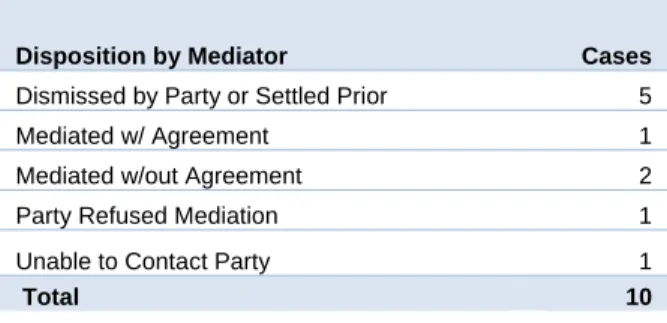
Throughout the pilot period, mediation center staff had reported that parties frequently have either refused to mediate, or if mediated, failed to reach agreement because an MSD was pending hearing or decision by the court. Only 10 cases involving pending MSDs appeared in the study, however. Table 4 reflects that of these cases, five were dismissed or settled prior to mediation and only three reached the mediation table. The remaining two cases eventually settled either through settlement conference or party agreement.
With the caveat that the sample sizes are quite small, the findings do suggest that pending summary disposition motions negatively affect mediation. The findings also support the recommendation of the National Center for State Courts that one event should be concluded before another event is begun.7 In this study, 65 percent of the cases reached agreement in mediation where an MSD had been decided, but only 10 percent of the mediated cases reached agreement where an MSD remained undecided at the time of mediation.
C. Scheduling and Rescheduling Trial Dates
Additional study questions examined the extent to which a scheduled trial date affected case settlement and the influence a trial date had on case disposition.
1. Scheduling the Original Trial Date
Scheduled trial dates appeared in 43 cases (46 percent) of the 93 cases studied, meaning that the trial date may have been scheduled at any point from early in the litigation to the final settlement conference. Put differently, in over 50 percent of the study cases, a trial date was never
scheduled.
Of the cases that did have scheduled trial dates, 35 (81 percent) had established trial dates at the time of the order to mediate. It should be noted, however, that the majority of these instances reflect one court that assigned trial dates early in the case life. In that court, the trial dates were scheduled within 68 to 76 days of the filing date. The remaining two courts scheduled trial dates much later in the case life, generally after mediation events that did not result in settlement.
7
Judicial disposition of pending motions seems to be a key element of a successful mediation. “Whenever possible, the court should rule on pretrial motions, especially motions that may be dispositive, such as suppression motions in criminal cases or summary judgment motions in civil cases before cases are set for trial. Moreover, the court should make every pretrial court event meaningful as an opportunity for disposition or for progress to disposition by trial or other means” (Steelman, Goerdt, & McMillan, 2000, p. 7). “Meaningful” is defined as “[court events] that they will contribute substantially to progress toward disposition…” Ibid., p. 6.
Table 4: Summary Disposition Motion Pending Prior to Mediation
Disposition by Mediator Cases
Dismissed by Party or Settled Prior 5
Mediated w/ Agreement 1
Mediated w/out Agreement 2
Party Refused Mediation 1
Unable to Contact Party 1
Mediation After Case Evaluation – Page 9
Table 5 displays case age information regarding the 43 cases in which a trial date had been scheduled.
While there is a moderate correlation between scheduling early trial dates and the age of the cases at settlement, only 42.6 percent of the variance in the case age at settlement could be explained by the case age when the trial date was scheduled.8 This would suggest that the early setting of trial dates was only one relatively minor factor in the case age at settlement, because 57.4 percent of the variance still remained unexplained and not influenced by the case age when the trial date was set.
As a result, this study was unable to conclude that the inclusion of trial dates in premediation orders affected mediation-related settlements.
2. Rescheduling Trial Dates
Of the 43 cases that established trial dates at some point in the life of the cases, 21 (49 percent) rescheduled the trial date 1 to 3 times either because of motions filed by parties or because of court scheduling conflicts. Fifteen of the 21
cases in which a trial date had been reset were cases in which the original trial date was set early in the case life, within 76 days of filing. “The certainty of trial and implementation of a realistic setting policy can be enhanced if the court sets the actual trial date only after settlement
possibilities have been exhausted…” (Steelman, Goerdt, & McMillan, 2000, p. 29). Table 6 provides information regarding the cases that were scheduled for trial and the cases in which more than one trial date was
scheduled.
A high positive correlation existed between the age of the case at the time trial was scheduled and the age of the case at the time of disposition when all alternative dispute resolution processes
8
The coefficient of determination indicated that 42.6 percent of the total variation in the settlement date can be explained by the variation in the dates when trial dates were set.
Table 5: Trial Date Scheduled
Case Age Minimum Case Age in Days Median Case Age Maximum Case Age Number of Cases
Early (99 days or less) 68 72 76 31
Middle (100-400 days) 110 232 343 5
End (more than 400 days) 505 560 1,274 7
Total 43
Table 6: Cases in Which Trial Date was Rescheduled
Case Age Trial Date Scheduled Number of Cases Number of Cases with Trial Date Reset Percent Early (99 days or less) 31 15 Middle (100-400 days) 5 2
End (more than
400 days) 7 4
Mediation After Case Evaluation – Page 10
had been attempted and the trial date was set.9 Therefore the age of the case when the trial date was set (after all alternative dispute processes had been completed) was related to the disposition age. This implies that setting a trial date was important in reaching disposition.
The practice of scheduling a firm trial date after all earlier activities have been completed has also been supported by the NCSC. The establishment of the expectation that events will occur as scheduled and trial dates will begin on the day calendared show counsel and parties their
disposition date is firm (Steelman, Goerdt, & McMillan, 2000). NCSC researchers stated, “National research shows that a court’s ability to provide firm trial dates is associated with shorter times to disposition in civil and felony cases in urban trial courts” (Steelman, Goerdt, & McMillan, 2000, p. 7).
In summation, the trial date scheduling data indicates that the early scheduling of trial dates does not appear to strongly influence the early settlement of the case. In fact, scheduling trial dates early (less than 100 days from case filing) led to the rescheduling of the trial date (up to three times beyond the original date) in 49 percent of the cases that were scheduled for trial. Rescheduling trial dates incurs the use of valuable court resources that may not have been
necessary if a firm trial date had been scheduled.10 In addition, the case age when the trial date is set strongly correlates with the date of case disposition if all alternative dispute resolution
processes are complete. Taken together, these two findings reflect that while scheduling a trial date is important, it is likely most effective for a court to schedule the date after all other
alternative dispute resolution processes have been attempted and determined to be unsuccessful, which in turn leads to realistic firm trial date.
D. Settlement by Case Type
The study also questioned whether settlement rates varied by case type.
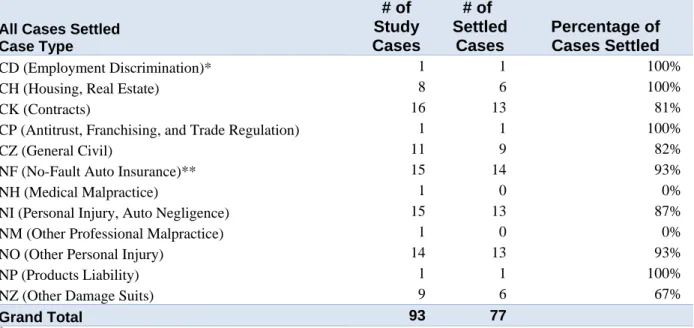
Under MCR 2.403(A)(2), case evaluation of tort cases filed in circuit court is mandatory. Case evaluation of other civil actions in which the relief sought is primarily money damages or division of property is optional under MCR 2.403(A)(1). In this study, 60 percent of the cases were tort claims, thus were required to be case evaluated; almost 40 percent of the cases in the study were commercial cases and were not required by statute to be case evaluated. The most frequently referred case types found in the study were: Contracts (CK), No-Fault Auto Insurance (NF), Personal Injury, Auto Negligence (NI) and Other Personal Injury (NO). Table 7 displays the case types of the cases reviewed in this study and the percentage of cases that settled. Because such a high percentage of the cases in the study eventually settled, and because there were only one or a very small number of cases in a number of case types, this study was unable to determine any case specific settlement characteristics.
9
The coefficient of determination regression equation indicated 88.6 percent of the variance in the age of the case at disposition could be explained by the age of the case when the trial was set.
10
Caseflow management experts recommend that as many cases as possible be disposed prior to setting the trial date. Researchers theorize that reasonably firm trial dates and the expectation that events will occur as scheduled assist lawyers and litigants in making progress toward disposition (Steelman, Goerdt, & McMillan, 2000).
Mediation After Case Evaluation – Page 11
Contract and tort cases were almost equally likely to settle. Of the 37 contract cases, 30 (81.8 percent) settled. Forty-seven of the 56 (83.9 percent) tort cases settled.
To test settlement variations by case type, a future study should incorporate a larger number of cases by individual case type to ensure that a statistically significant result could be determined.
E. Mediations Conducted
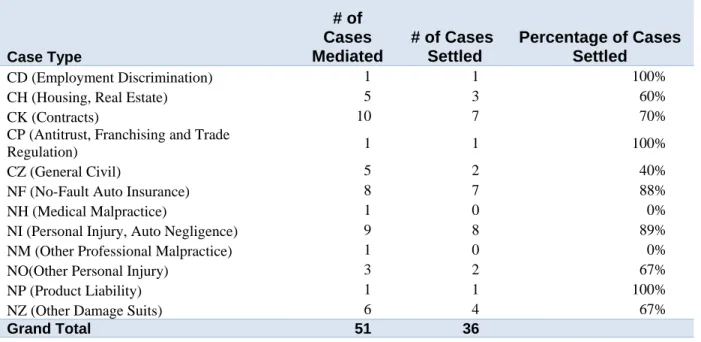
The study attempted to identify whether mediation settlement rates varied by case type. Fifty-one of the 93 cases (55 percent) studied were mediated. Thirty-six (71 percent) of the mediated cases were disposed with a settlement (Table 8). The case types that were most frequently mediated were Contract (CK), Personal Injury and Auto Negligence (NI), and No-Fault Auto (NF).
Similar to the previous question regarding case type and settlement, not enough data by case type existed in the settlement of mediated cases to determine a statistically significant result. A future study should incorporate a larger number of cases by individual case type to ensure a statistically significant result could be determined.
Table 7: Case Type of Cases Settled
All Cases Settled Case Type # of Study Cases # of Settled Cases Percentage of Cases Settled CD (Employment Discrimination)* 1 1 100%
CH (Housing, Real Estate) 8 6 100%
CK (Contracts) 16 13 81%
CP (Antitrust, Franchising, and Trade Regulation) 1 1 100%
CZ (General Civil) 11 9 82%
NF (No-Fault Auto Insurance)** 15 14 93%
NH (Medical Malpractice) 1 0 0%
NI (Personal Injury, Auto Negligence) 15 13 87%
NM (Other Professional Malpractice) 1 0 0%
NO (Other Personal Injury) 14 13 93%
NP (Products Liability) 1 1 100%
NZ (Other Damage Suits) 9 6 67%
Grand Total 93 77
*
Case types beginning with C (e.g., CD) denote contract cases.
**
Case types beginning with N (e.g., NF) denote tort cases.
Mediation After Case Evaluation – Page 12
An additional question was whether contract type cases, which are not required to be case evaluated, were more likely to settle in mediation than tort cases, which are required to be case evaluated. Of the 51 cases that were mediated, 14 of 22 (63.6 percent) contract cases settled, while 22 of 29 (75.9 percent) of tort cases settled.
V. Summary,
Conclusions, and Recommendations
This study examined the effect of ordering mediation immediately after one or more parties rejected a case evaluation award of under $25,000. Thirty-one randomly selected civil cases were submitted by each of the three participating circuit courts for inclusion in the study. Ninety-three civil cases filed in circuit courts were reviewed and key aspects of the cases were compiled and analyzed, including dates of significant events such as: filing, disposition, orders to case evaluation and mediation, and scheduling of trials and settlement conferences.
The data supports the following conclusions in cases that were evaluated below $25,000 that were sent to mediation:
1. Nearly three-quarters of cases referred were disposed either by premediation or mediation-related settlement activities within an average of 78 days from the order to mediation thereby a significant number of post-case evaluation events, e.g., settlement conferences and trials, were avoided; and the majority of mediation-related settlement activities resulted in far more expeditious dispositions than matters requiring post-mediation events, e.g., settlement conferences and trial.
Table 8: Case Type of Cases Settled Where Last Monitored Activity was Mediation
Case Type # of Cases Mediated # of Cases Settled Percentage of Cases Settled CD (Employment Discrimination) 1 1 100%
CH (Housing, Real Estate) 5 3 60%
CK (Contracts) 10 7 70%
CP (Antitrust, Franchising and Trade
Regulation) 1 1 100%
CZ (General Civil) 5 2 40%
NF (No-Fault Auto Insurance) 8 7 88%
NH (Medical Malpractice) 1 0 0%
NI (Personal Injury, Auto Negligence) 9 8 89%
NM (Other Professional Malpractice) 1 0 0%
NO(Other Personal Injury) 3 2 67%
NP (Product Liability) 1 1 100%
NZ (Other Damage Suits) 6 4 67%
Mediation After Case Evaluation – Page 13
2. Higher settlement rates were achieved when motions for summary disposition were decided prior to mediation taking place.
3. Disposition times can be reduced by restricting or eliminating the practice of
rescheduling trial dates. Courts should also consider scheduling firm trial dates after all alternative dispute resolution processes have concluded.
4. Contract and tort cases were almost equally likely to settle, and mediation appears equally successful in both types of cases.
Considerations for future pilot projects assessing the efficacy of case evaluation and mediation might include the following:
1. Placing mediation before case evaluation. The data suggests that by simply ordering a case to mediation, a significant number of cases will settle. An additional significant number could be expected to settle “at the table,” resulting in significant savings to a court in reducing the amount of time and resources expended in scheduling subsequent events; e.g., case evaluation, settlement conferences, and trial.
2. Postponing scheduling the trial until dispute resolution processes are concluded. If, as in this study, it is presumed that a number of the cases could be disposed without setting a trial date, the trial docket calendar could be substantially cleared and used for scheduling only those cases that have a far higher probability of actually going to trial.
Mediation After Case Evaluation – Page 14
VI. Works Cited
Michigan Supreme Court. (2010). Community Dispute Resolution Program 2009 Annual
Report. Retrieved from
http://courts.michigan.gov/scao/resources/publications/reports/summaries.htm#arss Michigan Supreme Court (2010). 2009 Annual Report. Retrieved from
http://courts.michigan.gov/scao/resources/publications/reports/summaries.htm#annual Steelman, D. C., Goerdt, J. A., & McMillan, J.E. (2000). Caseflow Management: The heart of
court management in the new millennium. Williamsburg, VA: The National Center for