VOLUME 16 ISSUE 2 (2018), Page 21 - 29
METALS IN RESPIRABLE AND INHALABLE DUST AT EDUCATIONAL INSTITUTIONS
Shamzani Affendy Mohd Din1, Nik Nurul-Hidayah Nik Yahya2 &
Rashidi Othman3
1,3Kulliyyah of Architecture and Environmental Design
INTERNATIONAL ISLAMIC UNIVERSITY MALAYSIA
2
Faculty of Engineering and Green Technology UNIVERSITI TUNKU ABDUL RAHMAN, MALAYSIA
Abstract
Haze episode has always becomes the one of the common reasons for emergency closing of school. Unique approach had been used to collect and examine the toxic metal of the respirable and inhalable dust by combining the latest personal cyclone and seven-hole head sampler together with the latest spectrometer of inductively coupled plasma-mass spectrometry (ICP-MS) in a single framework. Iron is found significantly different with the highest concentration at 107.895 ng m-3. The mean ranges of metal in respirable dust found in educational institutions are between 0.005 and 78.629 ng m-3. The findings of this research seen the amount of respirable dust exceeds more than 21.13 per cent than inhalable dust. Analysed metals found are not exceeding the ambient air exposure limit established by Department of Environment Malaysia. Hence, it is understood that the outdoor atmospheric environments of Malaysian educational institutions are non-hazardous for both visitors and occupiers (students and personnel). The high level of iron signify that it is safe for the crossing of children to have a traffic light in front of the school, but the idling of motor vehicles emitted more pollutant that risks health of the school children, teachers and officers. These suggest that when there are schools, there shall be constructed of flyover crossing for long term solution or with certain distance to traffic sources.
INTRODUCTION
Assessments of heavy metals (Cr, Cu, Fe, Mn, Ni, Pb, V and Zn) were determined on particle concentrations at Gombak, Selangor. For the purpose of this study, a public college and a boarding school were selected. The two selected educational institutions are the Sekolah Integrasi Gombak (SIG) and Kolej Vokasional Gombak (KVG). The assessment of this type of built environment is significant as the precondition of education is a healthy educational institution microenvironment. However, several studies show that the classrooms and its surrounding area are hazardous.
This research aims at assessing the metal content of airborne particulates from outdoor of the educational institutions and its effect towards human health. Its objectives are to determine metal concentration contributed by the multi-sources surrounding the educational institutions and to compare the respirable and inhalable dust, metal concentration, and effects of airborne particulates towards human health.
AIRBORNE PARTICULATES IN EDUCATIONAL INSTITUTIONS The average age of children attending these educational institutions is from 13 to 18 years old, which could be classified under a risky group of people. Moreover, it is also found that in general views, Malaysian latest growth rate for the age between 0 and 14 years old and 15 and 64 years old are approximately at 7.799 and 20.501, respectively (Malaysia Statistical Department, 2015). Thus, indicating that the amounts of school children are increasing at a huge amount each year and most of the population are the school age children. As found by previous studies, the amount of time spend with the children in a school are approximately 30% and from 80 to 90% per day (Tofful & Perrino, 2015; Che, Frey, & Lau, 2015). The personal sampling against outdoor sampling also had been done through several studies (Branis, Rezacova, & Domasova, 2005; Che et al., 2015; Roosebroeck et al., 2007; Zhu, Hinds, Kim, & Sioutas, 2011; Janssen, Hoek, Brunekreef, & Harssema, 1999; Zhang et al., 2014).In comparison with other types of sampling, the results show high result in dust collected with personal sampler at the higher range of multiple concentrations.
peak hours, high capacities of vehicles are also believed to increase the iron (Fe) (Wahid et al., 2014), Ni and Cr(Kulshrestha et al., 2014) through the process of fuel combustion. These factors also largely contributed by the fuel type, vehicle type, utilization parameters and operating modes(Zhu et al., 2011).
The potential sources found in and surrounding the educational institutions based on previous research are crustal dust, indoor organic, movement of student, school personnel and paperwork, vehicle exhaust, traffic sources, industrial source, secondary inorganic components, the infiltration of outdoor air, inadequate construction characteristic of building, absence of automated air filtration system, building construction, inappropriate ventilation, use of cleaning products and procedures, resuspension of dust deposited indoors, soil-earth crust erosion, secondary reactions in atmosphere, high no. of person, high activity, ventilation system and location in the city (Branis et al., 2011; Tofful & Perrino, 2015; Zhang et al., 2014; Stridh et al., 2002). Moreover, the association between the teaching organisation that traffic-related sources and the level of health of its occupant had been explored by several researchers. This is for the respirable dusts and inhalable dusts (Janssen et al., 1999), are widely exposed towards the children. Human health also can be affected due to the metal found in particlesand (Janssen et al., 1999).
MATERIALS AND METHOD
Personal outdoor concentrations were collected for this study on the behaviour of the children, such as playing outdoors and hand-to-mouth contact contribute to exposure towards heavy metal pollution. This is also agreed by Branis(2005) that the empty classroom at night and during weekend found the PM10 concentrations were double than the indoor. Thus, indicating that outdoor personal exposure of an educational institution is significant to be monitored and assessed. Therefore, this research applied personal sampler in order to measure an individual personal exposure to airborne particles. There are two types of sampling head being used that are the cyclone and 7 hole sampling head. Both represent the respirable and inhalable dust accordingly.
These factors of time–weighted concentration at various micro environment that people spend their time show the exposure of the individual towards the inhalable and respirable dusts. However, for the purpose of this study, in order to standardize the exposure time between this built environment, the normal global working hours at 8-hours personal exposure were collected. This is also based on the standard of sampling hours as recommended by Deparment of Safety and Health Malaysia (DOSH).
inorganic elements analysed in this research are Ba, Cr, Cu, Fe, Mn, Ni, Pb, V, and Zn. The metal concentrations are measured in SI unit of mg/m3. The sampling was done at the outdoor ambient of SIG and KVG that located 720.39m in distance to each other.
RESULTS
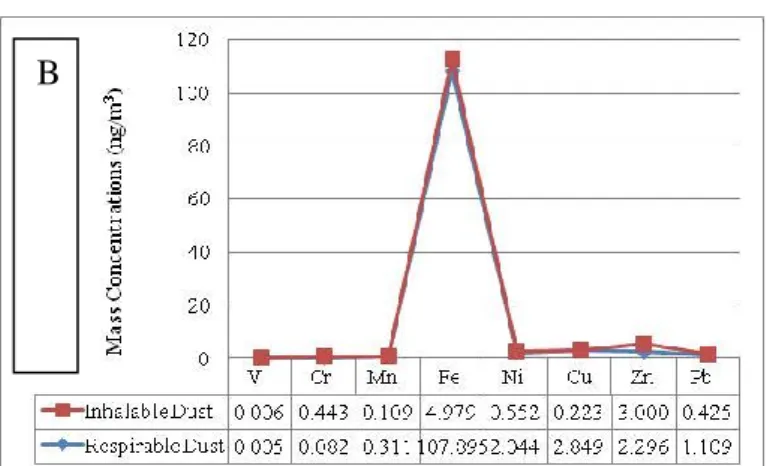
The following graphs are illustrated based on the means and standard deviation found from the samples collected from the two educational institutions at Gombak, Selangor. The concentrations of V, Cr, Mn, Fe, Ni, Cu, Zn, and Pb value recorded dust at Sekolah Integrasi Gombak (SIG) and Kolej Vokasional Gombak (KVG) in Gombak, Selangor were illustrated in graphs as in the Figure 1.
Iron that was collected from the inhalable dust at the KVG had the highest concentrations in all samples from the teaching organization. In addition, this analysis also demonstrated that the KVG inhalable dust were found highest in Mn, Fe, Cu and Pb. The respirable result showed highest concentrations amount of V, Cr and Zn. The inhalable dusts at SIG were found highest in Ni and Ba. These data are highlighted in blue, below.
These analyses also discovered that no significant metals were higher and lower than each other between the respirable and inhalable dust. The mean ranges of respirable dust found in educational institutions were between 0.005 and 78.629 ng m-3. The averages in inhalable dust were at 0.006 and 37.749 ng m-3. Thus, sum up to an overall average for all metal concentrations at 0.005 and 89.207 ng m-3, for respirable and inhalable dust, accordingly. The dominant metal for all sampling locations at educational institutions was Fe. The highest was iron for both inhalable dust and respirable dust at 70.520 and 107.895 ng m-3, correspondingly. Thus, suggesting the amount of exceeded respirable dust towards the inhalable dust were at 21.13 per cent.
Figure 1: Heavy metal content in respirable and inhalable particulate matter at educational institutions in Gombak, Selangor.
Notes: A- SIG. B – KVG
Observed Sources at the Educational Institutions
The area that surround the sampling sites are acknowledged as its locality. Through the locality observation, several sources from nature and manmade activities were found. These are listed in the following Table 1.
Table 1: The primary and secondary reactions found in SIG and KVG locality.
Primary Natural Sources
Both SIG and KVG exposed to the greenery conserved forest, limestone caves and hilly area, acid intrusive, lithosols types of soils and shallow latosols are found on steep hilly land.
Secondary Mandmade Activities
SIG
This included the roadway pavement; railing; concrete kerbs; roof tiles, concrete and steel from the bus stop; roadway painting; steel and painting of the signage; concrete, roof tiles and paint from the nearby structure of post guard; concrete wall; paint; school concrete and steel gate; the steel and removable canopies from the stall and motor vehicles materials that are parked at temporal period.
KVG
roadway pavement; railing; roadway painting; concrete kerbs; roof tiles; concrete wall; paint; steel, concrete, electrical components and plastic wears from the traffic light; steel, concrete, roof tiles, paint and plastic wear from the nearby structure of post guards and shop lots; the steel and removable
canopies from stall and motor vehicles materials that are parked at temporal period nearby the KVG and educational schools.
This street is a busy way that lead to the nearby freeway. There are traffic lights in front of the schools and nearby the T-junctions. Thus, many vehicles have stopped in idling and waiting mode for a few minutes at the said traffic lights. Thus, indicates that this urban located educational institution contained a high concentration level of heavy metals as it was located nearby traffic lights (t-junctions and crossroads). In a perspective, it was safe for the crossing of children to have traffic light, but the idling mode by motor vehicles emitted more pollutant that risked health of the school children, teachers and officers. These suggested that when there are schools, there shall be construction of flyover crossing rather than the traffic light as the long term solution. It is to be highlighted that this layout of school was typical to the other schools in Malaysia.
The results suggested that the amount of idling motor vehicles is high in daily schools as the parents send and pick up their children at schools every morning, afternoon and evening. Thus, the children are exposed to traffic sources during most rush traffic hours in school. The human activities that occurred at both outdoor educational institutions were the movement of people to the nearby stall and shops. The cooking and smoking at the restaurants. People were transporting through these local streets nearby the teaching organisations from the universities surrounding houses area to the main road to city. In parallel with the above discussion,(Branis et al., 2005) stated that human activities are the changing agent of the undisturbed soils. In this case, the heterogeneous dust was formed and became road dust. For Malaysia, a hot and humid country, the earth crust is believed to dry (Ghosh, 2014). Hence resuspension of airborne particles occurs due to the human activities, mainly transportations in these sites.
Respirable & Inhalable Dust at Educational Institutions
In addition, iron metal elements contributed by both coarse and fine particles in soil (Che et al., 2015; Salam, Hossain, Siddique, & Shafiqul Alam, 2008) were believed to occur both in respirable and inhalable dust fraction. Even though different types of particles were dominant by different chemical elements, the results shows a similar trend between both. Thus, suggested that both results were from similar sources. The above summaries of results showed that the metal contents found in respirable and inhalable dusts were varying. It was found that the mean concentrations ranged of respirable dust value were lower than the inhalable dust. The natural environment of lithosols type of soil and acid intrusive rocks, supporting this finding in Fe high concentration level that was found as a large contributor to the natural airborne particles. This is in agreement by previous researcher (Che et al., 2015; Wahid et al., 2014; Tahir, Suratman, Foo, Hamzah, & Latif, 2013).
Iron Dominant the Respirable and Inhalable Dust
Both of the teaching organisations were located in the urban background, hence the high concentration value was relevant to the urban area as found by Tahir in Salam et al.(2008). Traffic emissions and soil entrainment that contributed to the formation of road dust at site were the potential sources of iron contamination in the dust samples. Therefore, the findings were supported by many scientists,that the Fe was found highest due to the industrial and traffic activities. Additionally, traffic emissions are further defined by Wahid et al. (2014), and Abbasi, Tufail and Chaudhry (2013), as the vehicular exhaust emission, non-engine combustion sources due to engine abrasion and clutch, break and tyres wear), and road infrastructure (corrosion of galvanized steel crash barriers, pavement wear). In this case, industrial source is to be omitted due to residential, commercials and educational institutions are the surrounding built environment of the area.
Furthermore, for ambient air in Malaysia, there are allowable exposure limit for lead, zinc and copper at 0.025 mg m3, 0.1 mg m3 and 0.1 mg m3, respectively. From the above results, the percentage of exceeding limit had been calculated. These data summarised that none of them exceeded the limits.
CONCLUSION
In conclusion, it is safer for the children crossing to have traffic light in front of the school. However the idling motor vehicles emitted pollutant that risked health of the school children, teachers and officers. Hence suggesting that there should be flyover crossing for long term solution or with certain distance to traffic sources.
ACKNOWLEDGEMENT
The author would like to acknowledge the FRGS grant by Ministry of Higher Education and the International Islamic University Malaysia for facility supports to make this research possible.
REFERENCES
Abbasi, M. N., Tufail, M. A., & Chaudhry, M. M. (2013). Assessment of heavy elements in suspended dust along the Murree Highway near capital city of Pakistan. World Applied Science Journal, 21(9), 1266-1275.
Branis, M., Rezacova, P., & Domasova, M. (2005). The effect of outdoor air and indoor human activity on mass concentrations of PM10, PM2.5, and PM1 in a classroom. Environmental Research, 99(2), 143-149.
Che, W. W., Frey, H. C., & Lau, A. K. H. (2015). Comparison of sources of variability in school age children exposure to ambient PM2.5. Environmental Science& Technology, 49(3), 1511-1520.
Ghosh, M. K. (2014). An analysis of roadside dust fall in Bhilai-3 of Durg District Chhattisgarh, Central India and its impact on human health. International Journal of Research in Environmental Science and Technology, 4(2), 54-60. Janssen, N. A., Hoek, G., Brunekreef, B., & Harssema, H. (1999). Mass concentration
and elemental composition of PM10 in classrooms. Occupational and Environmental Medicine, 56(7), 482-487.
Kulshrestha, A., Massey, D. Masih, J., & Taneja, A. (2014). Source characterization of trace elements in indoor environments at urban, rural and roadside sites in a semi-arid region of India. Aerosol and Air Quality Research, 14, 1738-1751. Laden, F., Neas, L. M., Dockery, D. W., & Schwartz, J. (2000). Association of Fine PM
from different source with daily mortality in 6 US cities. Environmental Health Perspectives, 108(10), 941-947.
Talib, Latif, M. T., Othman, M. R., & Johnny, Z. (2006). Kajian Kualiti Udara di Bandar Kajang, Selangor. The Malaysian Journal of Analytical Sciences, 10(2), 275-284.
Malaysia Statistical Department (2015). Population Statistics - Population ('000) by Age Group, 1891 – 2013.
children attending schools located near busy roads, a validation study. Atmospheric Environment, 41(16), 3381-3394.
Salam, A., Hossain, T., Siddique, M. N. A., & Shafiqul Alam, A. M. (2008). Characteristics of atmospheric trace gases, particulate matter, and heavy metal pollution in Dhaka, Bangladesh. Air Quality Atmospheric Health, 1, 101-109. Stridh, G., Andersson, H., Linder, B., Oscarsson, J., & Bang, C. S. (2002). Total dust
exposure and size distribution of airborne particles in day-care centres. In Proceedings ofIndoor Air 2002:Schools And Offices (pp. 97-102).
Tahir, N. M., Suratman, S., Foo, T. F., Hamzah, M. S., & Latif, M. T. (2013). Temporal distribution and chemical characterization of atmospheric particulate matter in the eastern coast of Peninsular Malaysia. Aerosol and Air Quality Research, 13(2), 584-595.
Tofful, L., & Perrino, C. (2015). Chemical composition of indoor and outdoor PM2.5 in three schools in the City of Rome. Atmosphere, 6(10), 1422-1443.
Ibrahim, W. H. W., & Ramli, N. A. (2009). Human settlement development: A case study of mitigating air pollution emissions at traffic light junctions. In S. Sassen (Ed.), Human settlement development (Vol. 2) (pp. 35-55). Oxford: Eolss Co.
Wahid, N. B. A., Latif, M. T., Suan, L. S., Domminick, D., Sahani, M., Jaafar, S. A., & Mohd Tahir, N. (2014). Source identification of PM in semi-urban area of Malaysia using multi-variate techniques. Bulletin of Environmental Contamination and Toxicology, 92(3), 317-322.
Zhu, Y., Hinds, W. C., Kim, S., & Sioutas, C. (2011). Concentration and size distribution of ultrafine particles near a major highway. Journal of the Air & Waste
management Association, 52(9), 1032-1042.
https://doi.org/10.1080/10473289.2002.10470842
Zhang, N., Han, B., He, F., Xu, J., Niu, C., Zhou, J.,…& Xu H. (2014). Characterization, health risk of heavy metals, and source apportionment of atmospheric
PM2.5 to children in summer and winter: an exposure panel study in Tianjin, China. Air