Saakshi Kapoor, Vishal Gupta and Rohit Kumar
Department of Computer Science and Engineering, UIET, Panjab University, Chandigarh, India
An Obfuscated Attack Detection
Approach for Collaborative
Recommender Systems
In the recent times, we have loads and loads of infor-mation available over the Internet. It has become very cumbersome to extract relevant information out of this huge amount of available information. So to avoid this problem, recommender systems came into play, which can predict outcomes according to user's interests. Al-though recommender systems are very effective and useful for users, the most used type of recommender system, i.e. collaborative filtering recommender sys-tem, suffers from shilling/profile injection attacks in which fake profiles are inserted into the database in order to bias its output. With this problem in mind,we propose an approach to detect attacks on recommender systems using Random Forest Classifier and find that, when tested at 10% attack, our approach outperformed earlier proposed approaches.
ACM CCS (2012) Classification: Computing Method-ologies → Machine Learning → Machine Learning approaches → Classification and Regression Trees Human-centered computing → Collaborative and So-cial Computing → Collaborative and Social Comput-ing theory, concepts and paradigms → Collaborative filtering
Keywords: collaborative recommender systems, ob-fuscated attack, random forest classifier, SVM
1. Introduction
We are living in an era of information overload wherein information is being incessantly bom-barded and people are breathlessly embracing the wide array of information available to them vis-à-vis varied sources. The backlash against the information overload is getting stronger than ever and is assuming gigantic proportions. Thus,
one tool which has been developed to tackle such problems is recommender system [1]. Recommender systems [2], [5] can filter out the information required by the user from the vast amount of information available using certain characteristics and thus this concept is very helpful in overcoming the problem of in-formation overload. Recommender systems can broadly be categorized as content-based [22], collaborative [4], [18], [23], [24] and Hybrid [3] recommender systems. In this paper, we will be focusing on collaborative recommender systems [2] because these are the ones which are widely used in today's era because of their abilities to give output to users according to their own needs. It recommends items based on similarity measures between users and items and recommends items to users that were liked by other users who have exhibited similar tastes. Thus it can easily handle even unusual requests by users which were not possible with content-based recommender systems. Although collaborative recommender systems are quite helpful in many ways, they are still prone to a shilling or profile injection attacks due to their natural openness. In these attacks, malicious users are inserted into existing dataset in order to influence the result of recommender systems. Mostly these attacks are generated by product sellers or developers who aim to promote their own product or demote their competitor's prod-uct.
stan-dard [4] or obfuscated [26] attacks. Although previous research is effective in detecting stan-dard attacks, it is not as effective as it should be for obfuscated attacks.
Thus, how can we effectively identify and resist profile injection attacks [14], [29] has become an urgent problem that needs to be solved for the better development and extensive applica-tion of collaborative recommender systems. In this paper, we propose a technique to detect profile injection attacks using Random Forest Classifier and conduct experiments on the Mov-ieLens dataset [25] ‒ 1M to verify the effective-ness of the proposed approach by comparing it with different classifier techniques. The paper is organized as follows: Section 2 describes the related work, in Section 3 we discuss details about our proposed approach, Section 4 deals with the experiments performed and their anal-ysis and finally in Section 5 we conclude the paper along with the possible future scope.
2. Related Work
Shilling or Profile Injection Attacks pose a seri-ous threat to recommender systems and collab-orative filtering recommender systems which are highly vulnerable to these attacks. The term "shill" means posing as a fake user so as to de-coy others. There have been researches regard-ing detection of these attacks and reducregard-ing their effects on recommender systems. Since most of the fake profiles appear similar to genuine pro-files it is quite difficult to identify them. The main work carried out in this field falls into two categories: techniques to increase the robust-ness of recommender systems and techniques for detecting biased profiles, a technique which we will be focusing on in our work. In this sec-tion, we will be discussing some of the previous research work that has been carried out in the field of detecting shilling attacks.
Zhou et al. (2012) [7] proposed a hybrid un-supervised detection approach based on signal processing theory and designed a high pass fil-ter to filfil-ter out the signal of attack profiles. The main advantage of this model was that it could detect attacks even if the number of attack pro-files was unknown. Zhang et al. (2012) [8] pro-posed Meta-learning based approach to detect
shilling attacks and also proposed an algorithm to create diverse base level training sets through a flexible combination of various attack types. They generated a Meta level classifier by com-bining various base level classifiers. Zhang et al. (2014) [9] proposed a spectral clustering method to make recommender systems resis-tant to shilling attacks in the cases when the attack profiles are highly correlated with each other. To estimate the highly correlated group they worked by first translating the matrix into a graph and then applying a spectral clustering algorithm to find the min-cut solution which will be used to estimate highly correlated group. Williams et al. (2008) [11] focused on Probabilistic Latent Semantic Analysis (PLSA) based technique that might be used to reduce the impact of segment attack and also examined their robustness against traditional attack mod-els by using a model based on PLSA that aims to offer significant improvements in stability and robustness against all identified attack pro-files. Zhou et al. (2014) [12] proposed and eval-uated an algorithm for detecting average and random attacks first by using a rough detection model that will be used to divide the profiles into genuine and potential attack profiles. Then the attack profiles set will be analysed, based on which genuine profiles will be further removed from the target item set. Yang et al. (2015) [13] proposed an unsupervised method to detect shilling attacks first by filtering out genuine us-ers, using suspected target items as far as pos-sible so as to reduce time consumption. Then they developed a new similarity metric by com-bining traditional similarity metric and linkage information between users to improve accuracy of similarity of users. Q. Zhou (2016) [15] pro-posed a supervised approach to detect obfus-cated attacks, especially Average over Popular (AoP) attack by using the theory of term fre-quency-inverse document frequency (TFIDF) to extract the features of attack and then used SVM (Support Vector Machine) to generate a SVM based classifier. Finally, they used the generated classifier to detect AoP attack. Zhang
et al. (2014(a)) [16] proposed an ensemble de-tection model by introducing Back Propogation (BP) neural network and ensemble learning technique. They created Ensemble Detection Model (EDM) through the combination of various attack types, created base training sets which included samples of attack profiles and
detection, but how a biased user can affect re-sults of a recommender system can be explained with the help of an example which is presented below.
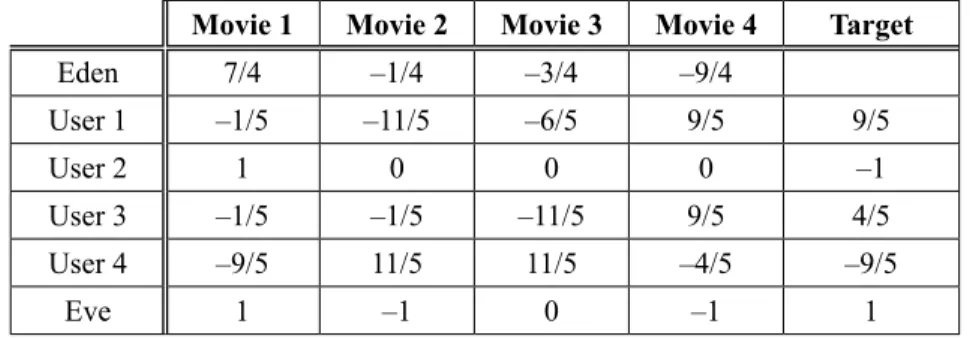
Consider, for example, a recommender system that identifies movies a user might like to watch, using a user-based collaborative algorithm. A user profile in this hypothetical system con-sists of the user's ratings of various movies on a scale of 1‒5 with 1 being the lowest. Table 1 shows Eden's profile (genuine user) along with that of four genuine users. An attacker, Eve, has inserted attack profiles into the system. Eve's attack profiles may be closely related to the profiles of one or more existing users or they may be based on average or expected ratings of items across all users.
Suppose the system is using a simplified us-er-based collaborative filtering approach where the predicted ratings for Eden on target will be obtained by finding the closest neighbour to Eden based on Pearson similarity. Without the attack profile the most similar user to Eden would be User 2, but after the attack the most similar user to Eden will be Eve. So in this ex-ample the attack will be successful and Eden will get a recommendation according to the at-tack and not according to a genuine user. Thus we can clearly see that even a single attack pro-file can affect the result of recommender sys-tem to a great extent and that these attacks can be identified with the help of some detection attributes.
Here, if Eve was not added as an authentic user, then User 2 would have been similar to Eden, but after the addition of attacker Eve, Eve is go-ing to be most similar to Eden.
Thus it shows that how addition of an attacker can affect the results.
Here, the Pearson similarity is calculated as shown in the expression below. Similarly, r (Eden, Eve) = 0.72.
had great diversities with each other. Then they created base training sets to train BP neural net-works to generate diverse base classifiers and finally selected parts of base classifiers which had the highest precision on validation data-set and integrated them using voting strategy. Zhang et al. (2014(b)) [17] proposed a method to detect profile injection attacks by combining Hilbert Huang Transform (HHT) and SVM and making them work incrementally. They worked by constructing rating series for each user pro-file based on novelty and popularity of items. Then they used Empirical Mode Decomposi-tion (EMD) to decompose each rating series and extract Hilbert spectrum based features for characterizing profile injection attacks. Finally, they used SVM to detect profile injection at-tacks based on the proposed features. As dis-cussed above in [8], Bhebe et al. (2015) [19] also proposed a combiner strategy that com-bined multiple classifiers to detect shilling at-tacks in which KNN, SVM and Bayesian net-works acted as initial base classifiers and Naïve Bayes was used as meta-classifier. Chung et al. (2013) [21] proposed Beta Protection (βP) to alleviate recommender systems and make them resistant to shilling attacks. βP was based on βeta distribution to detect and remove fake user profiles.
Sutter et al. (2008) [34] proposed a generic method to utilize tags as a supplementary source to predict item recommendations. Verbert et al. (2011) [35] presented datasets that can capture learner interactions with tools and resources and can be used for learning analytics research. Manouselis et al. (2011) [36] discussed how Technology Enhanced Learning (TEL) can de-sign, test and develop socio-economic innova-tions so as to practice them in real life scenarios as well. Konstan et al. (2012) [37] presented a review about how recommender algorithms can be applied to real life scenarios so as to predict better recommendations.
Above, we discussed different research work that has been carried out in the field of attack
(
)
2 2 2 2 2 2 2 2 27 1 1 11 3 6 9 9
4 5 4 5 4 5 4 5
r Eden, User 1 0.45
7 1 3 9 1 11 6 9 9
4 4 4 4 5 5 5 5 5
− + − − + − + −
= = −
+ − + + − − + − + − + +
dard [4] or obfuscated [26] attacks. Although previous research is effective in detecting stan-dard attacks, it is not as effective as it should be for obfuscated attacks.
Thus, how can we effectively identify and resist profile injection attacks [14], [29] has become an urgent problem that needs to be solved for the better development and extensive applica-tion of collaborative recommender systems. In this paper, we propose a technique to detect profile injection attacks using Random Forest Classifier and conduct experiments on the Mov-ieLens dataset [25] ‒ 1M to verify the effective-ness of the proposed approach by comparing it with different classifier techniques. The paper is organized as follows: Section 2 describes the related work, in Section 3 we discuss details about our proposed approach, Section 4 deals with the experiments performed and their anal-ysis and finally in Section 5 we conclude the paper along with the possible future scope.
2. Related Work
Shilling or Profile Injection Attacks pose a seri-ous threat to recommender systems and collab-orative filtering recommender systems which are highly vulnerable to these attacks. The term "shill" means posing as a fake user so as to de-coy others. There have been researches regard-ing detection of these attacks and reducregard-ing their effects on recommender systems. Since most of the fake profiles appear similar to genuine pro-files it is quite difficult to identify them. The main work carried out in this field falls into two categories: techniques to increase the robust-ness of recommender systems and techniques for detecting biased profiles, a technique which we will be focusing on in our work. In this sec-tion, we will be discussing some of the previous research work that has been carried out in the field of detecting shilling attacks.
Zhou et al. (2012) [7] proposed a hybrid un-supervised detection approach based on signal processing theory and designed a high pass fil-ter to filfil-ter out the signal of attack profiles. The main advantage of this model was that it could detect attacks even if the number of attack pro-files was unknown. Zhang et al. (2012) [8] pro-posed Meta-learning based approach to detect
shilling attacks and also proposed an algorithm to create diverse base level training sets through a flexible combination of various attack types. They generated a Meta level classifier by com-bining various base level classifiers. Zhang et al. (2014) [9] proposed a spectral clustering method to make recommender systems resis-tant to shilling attacks in the cases when the attack profiles are highly correlated with each other. To estimate the highly correlated group they worked by first translating the matrix into a graph and then applying a spectral clustering algorithm to find the min-cut solution which will be used to estimate highly correlated group. Williams et al. (2008) [11] focused on Probabilistic Latent Semantic Analysis (PLSA) based technique that might be used to reduce the impact of segment attack and also examined their robustness against traditional attack mod-els by using a model based on PLSA that aims to offer significant improvements in stability and robustness against all identified attack pro-files. Zhou et al. (2014) [12] proposed and eval-uated an algorithm for detecting average and random attacks first by using a rough detection model that will be used to divide the profiles into genuine and potential attack profiles. Then the attack profiles set will be analysed, based on which genuine profiles will be further removed from the target item set. Yang et al. (2015) [13] proposed an unsupervised method to detect shilling attacks first by filtering out genuine us-ers, using suspected target items as far as pos-sible so as to reduce time consumption. Then they developed a new similarity metric by com-bining traditional similarity metric and linkage information between users to improve accuracy of similarity of users. Q. Zhou (2016) [15] pro-posed a supervised approach to detect obfus-cated attacks, especially Average over Popular (AoP) attack by using the theory of term fre-quency-inverse document frequency (TFIDF) to extract the features of attack and then used SVM (Support Vector Machine) to generate a SVM based classifier. Finally, they used the generated classifier to detect AoP attack. Zhang
et al. (2014(a)) [16] proposed an ensemble de-tection model by introducing Back Propogation (BP) neural network and ensemble learning technique. They created Ensemble Detection Model (EDM) through the combination of various attack types, created base training sets which included samples of attack profiles and
detection, but how a biased user can affect re-sults of a recommender system can be explained with the help of an example which is presented below.
Consider, for example, a recommender system that identifies movies a user might like to watch, using a user-based collaborative algorithm. A user profile in this hypothetical system con-sists of the user's ratings of various movies on a scale of 1‒5 with 1 being the lowest. Table 1 shows Eden's profile (genuine user) along with that of four genuine users. An attacker, Eve, has inserted attack profiles into the system. Eve's attack profiles may be closely related to the profiles of one or more existing users or they may be based on average or expected ratings of items across all users.
Suppose the system is using a simplified us-er-based collaborative filtering approach where the predicted ratings for Eden on target will be obtained by finding the closest neighbour to Eden based on Pearson similarity. Without the attack profile the most similar user to Eden would be User 2, but after the attack the most similar user to Eden will be Eve. So in this ex-ample the attack will be successful and Eden will get a recommendation according to the at-tack and not according to a genuine user. Thus we can clearly see that even a single attack pro-file can affect the result of recommender sys-tem to a great extent and that these attacks can be identified with the help of some detection attributes.
Here, if Eve was not added as an authentic user, then User 2 would have been similar to Eden, but after the addition of attacker Eve, Eve is go-ing to be most similar to Eden.
Thus it shows that how addition of an attacker can affect the results.
Here, the Pearson similarity is calculated as shown in the expression below. Similarly, r (Eden, Eve) = 0.72.
had great diversities with each other. Then they created base training sets to train BP neural net-works to generate diverse base classifiers and finally selected parts of base classifiers which had the highest precision on validation data-set and integrated them using voting strategy. Zhang et al. (2014(b)) [17] proposed a method to detect profile injection attacks by combining Hilbert Huang Transform (HHT) and SVM and making them work incrementally. They worked by constructing rating series for each user pro-file based on novelty and popularity of items. Then they used Empirical Mode Decomposi-tion (EMD) to decompose each rating series and extract Hilbert spectrum based features for characterizing profile injection attacks. Finally, they used SVM to detect profile injection at-tacks based on the proposed features. As dis-cussed above in [8], Bhebe et al. (2015) [19] also proposed a combiner strategy that com-bined multiple classifiers to detect shilling at-tacks in which KNN, SVM and Bayesian net-works acted as initial base classifiers and Naïve Bayes was used as meta-classifier. Chung et al. (2013) [21] proposed Beta Protection (βP) to alleviate recommender systems and make them resistant to shilling attacks. βP was based on βeta distribution to detect and remove fake user profiles.
Sutter et al. (2008) [34] proposed a generic method to utilize tags as a supplementary source to predict item recommendations. Verbert et al. (2011) [35] presented datasets that can capture learner interactions with tools and resources and can be used for learning analytics research. Manouselis et al. (2011) [36] discussed how Technology Enhanced Learning (TEL) can de-sign, test and develop socio-economic innova-tions so as to practice them in real life scenarios as well. Konstan et al. (2012) [37] presented a review about how recommender algorithms can be applied to real life scenarios so as to predict better recommendations.
Above, we discussed different research work that has been carried out in the field of attack
(
)
2 2 2 2 2 2 2 2 27 1 1 11 3 6 9 9
4 5 4 5 4 5 4 5
r Eden, User 1 0.45
7 1 3 9 1 11 6 9 9
4 4 4 4 5 5 5 5 5
− + − − + − + −
= = −
+ − + + − − + − + − + +
3. Proposed Detection Method
The proposed detection model is based on the idea that a user might be an attacker and might be wishing to alter the results of the recom-mender system. The basic goal of our approach is the identification of such users. Figure 1 de-scribes the framework of our proposed detec-tion approach for detecting attacks. Our frame-work consists of three stages.
In the first stage, certain attributes are com-puted on ratings assigned by users in the data-set. Next, training and testing sets are used to generate Classifier for the purpose of shilling attack detection. In the final stage of detection, the proposed Classifier is used to detect the re-sults.
3.1. Phase 1: Attribute Extraction
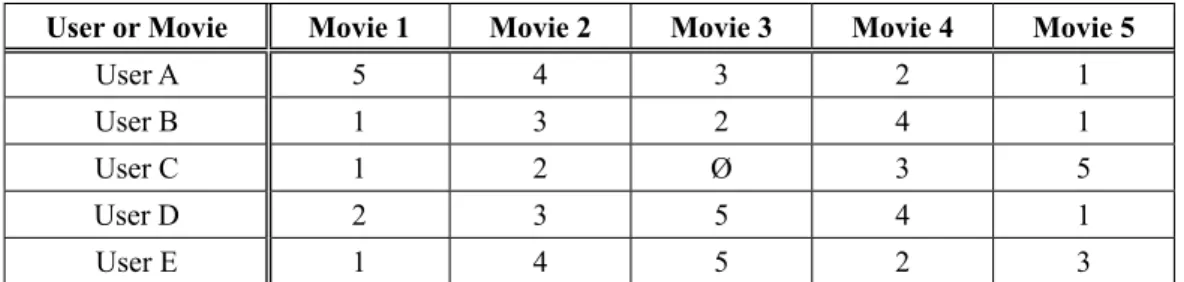
Attribute extraction forms a key factor in de-termining the performance of shilling attack detection. Some of the attributes which will be used are RDMA (Rating Deviation from Mean Agreement), WDA (Weighted Degree of Agree-ment), Similarity (cosine and Pearson similar-ity), LenVar (Length Variance), and along with that, we will be using TF-IDF (Term Frequen-cy-Inverse Document Frequency) [15] as well as a few combinations of the said attributes. With the help of a matrix example (Table 4), we will explain how these attributes are calculated. 1. Rating Deviation from Mean Agreement (RDMA): RDMA [19] can identify attackers by analysing the profile's average deviation per
item or user. It is defined as:
,
, 0 RDMA
u
T x i i
x i x
x
x
r r
R N =
−
=
∑
where Tu is the number of items user x rated, rx,i
is the rating given by the user x to item i, ri is the average rating of item i, Rx,i is the number of ratings provided for item i by all users and Nx is the number of users. For instance, the RDMA value for User A is computed as shown below:
User A
5 2 4 3.2
5 5
RDMA 5 5
3 3.4 2 3 1 2.2
5 5 5
5 5 5
− −
= + +
− − −
+ + +
Here, for the example, we have taken Rx,i = 5. 2. Weighted Degree of Agreement (WDA): WDA [6] can be calculated as the numerator of RDMA.
,
0 ,
WDAx Tu x i i x x i
r r
R =
− =
∑
where Tu is the number of items user x rated, rx,i is the rating given by the user x to item i, ri is the average rating of item i, and Rx,i is the num-ber of ratings provided for item i by all users.
User B 1 2 3 3.2 2 3.4
WDA 5 5 5
4 3 1 2.2
5 5
− − −
= + + +
− −
+ +
Here, for the example, we have taken Rx,i = 5
3. Length Variance (LengthVar): LengthVar [6] is used to capture how much the length of a given profile varies from the average length in the dataset. It is particularly effective in detect-ing attacks with large filler sizes.
(
)
20
# #
LenghtVar
# #
j N
i i
score score
score score
=
− =
−
∑
where #scorej is the average length of a profile in the rating database and N is the total number of users in the system.
( )
(
) (
) (
) (
) (
)
User
2 2 2 2 2
LenghtVar
5 3
5 3 5 3 5 3 5 3 5 3
for a =
− =
− + − + − + − + −
Here, for the example, we have taken the aver-age profile length of the user as 3.
4. The Degree of Similarity with Top Neigh-bours (DegSim): DegSim [12] is used to cap-ture the average similarity of a profile's k near-est neighbours
, 1 DegSim x i j
i= Z
=
∑
where Zi,j is the Pearson correlation between
users i and j, and x is the number of neighbours.
Z1,2 = 0.122 (Pearson correlation as discussed
in Section 2)
DegSim = 0.122
As we have calculated DegSim for User 1, therefore, number of neighbours = 1.
5. To use the theory of TF-IDF [15], to extract the features for an attack, we first converted the rating dataset to a 0, 1 format by converting
rat-Table 1. An example of how an attack can affect the results.
Movie 1 Movie 2 Movie 3 Movie 4 Target Pearson Similarity [1]
Eden 5 3 4 1 ?
User 1 3 1 2 5 5 ‒0.45
User 2 4 3 3 3 2 0.41
User 3 3 3 1 5 4 ‒0.68
User 4 1 5 5 2 1 ‒0.02
Eve 5 3 4 3 5 0.72
Table 2. Modification of Table 1 by taking an average of rows.
Movie 1 Movie 2 Movie 3 Movie 4 Target Average
Eden 5 3 4 1 ? 13/4
User 1 3 1 2 5 5 16/5
User 2 4 3 3 3 2 3
User 3 3 3 1 5 4 16/5
User 4 1 5 5 2 1 14/5
Eve 5 3 4 3 5 4
Table 3. Modification of Table 3 by subtracting an average from each rating element.
Movie 1 Movie 2 Movie 3 Movie 4 Target
Eden 7/4 ‒1/4 ‒3/4 ‒9/4
User 1 ‒1/5 ‒11/5 ‒6/5 9/5 9/5
User 2 1 0 0 0 ‒1
User 3 ‒1/5 ‒1/5 ‒11/5 9/5 4/5
User 4 ‒9/5 11/5 11/5 ‒4/5 ‒9/5
Eve 1 ‒1 0 ‒1 1
Table 4. Ratings assigned for a movie by a user.
User or Movie Movie 1 Movie 2 Movie 3 Movie 4 Movie 5
User A 5 4 3 2 1
User B 1 3 2 4 1
User C 1 2 2 3 5
User D 2 3 5 4 1
3. Proposed Detection Method
The proposed detection model is based on the idea that a user might be an attacker and might be wishing to alter the results of the recom-mender system. The basic goal of our approach is the identification of such users. Figure 1 de-scribes the framework of our proposed detec-tion approach for detecting attacks. Our frame-work consists of three stages.
In the first stage, certain attributes are com-puted on ratings assigned by users in the data-set. Next, training and testing sets are used to generate Classifier for the purpose of shilling attack detection. In the final stage of detection, the proposed Classifier is used to detect the re-sults.
3.1. Phase 1: Attribute Extraction
Attribute extraction forms a key factor in de-termining the performance of shilling attack detection. Some of the attributes which will be used are RDMA (Rating Deviation from Mean Agreement), WDA (Weighted Degree of Agree-ment), Similarity (cosine and Pearson similar-ity), LenVar (Length Variance), and along with that, we will be using TF-IDF (Term Frequen-cy-Inverse Document Frequency) [15] as well as a few combinations of the said attributes. With the help of a matrix example (Table 4), we will explain how these attributes are calculated. 1. Rating Deviation from Mean Agreement (RDMA): RDMA [19] can identify attackers by analysing the profile's average deviation per
item or user. It is defined as:
,
, 0 RDMA
u
T x i i
x i x
x
x
r r
R N =
−
=
∑
where Tu is the number of items user x rated, rx,i
is the rating given by the user x to item i, ri is the average rating of item i, Rx,i is the number of ratings provided for item i by all users and Nx is the number of users. For instance, the RDMA value for User A is computed as shown below:
User A
5 2 4 3.2
5 5
RDMA 5 5
3 3.4 2 3 1 2.2
5 5 5
5 5 5
− −
= + +
− − −
+ + +
Here, for the example, we have taken Rx,i = 5. 2. Weighted Degree of Agreement (WDA): WDA [6] can be calculated as the numerator of RDMA.
,
0 ,
WDAx Tu x i i x x i
r r
R =
− =
∑
where Tu is the number of items user x rated, rx,i is the rating given by the user x to item i, ri is the average rating of item i, and Rx,i is the num-ber of ratings provided for item i by all users.
User B 1 2 3 3.2 2 3.4
WDA 5 5 5
4 3 1 2.2
5 5
− − −
= + + +
− −
+ +
Here, for the example, we have taken Rx,i = 5
3. Length Variance (LengthVar): LengthVar [6] is used to capture how much the length of a given profile varies from the average length in the dataset. It is particularly effective in detect-ing attacks with large filler sizes.
(
)
20
# #
LenghtVar
# #
j N
i i
score score
score score
=
− =
−
∑
where #scorej is the average length of a profile in the rating database and N is the total number of users in the system.
( )
(
) (
) (
) (
) (
)
User
2 2 2 2 2
LenghtVar
5 3
5 3 5 3 5 3 5 3 5 3
for a =
− =
− + − + − + − + −
Here, for the example, we have taken the aver-age profile length of the user as 3.
4. The Degree of Similarity with Top Neigh-bours (DegSim): DegSim [12] is used to cap-ture the average similarity of a profile's k near-est neighbours
, 1 DegSim x i j
i= Z
=
∑
where Zi,j is the Pearson correlation between
users i and j, and x is the number of neighbours.
Z1,2 = 0.122 (Pearson correlation as discussed
in Section 2)
DegSim = 0.122
As we have calculated DegSim for User 1, therefore, number of neighbours = 1.
5. To use the theory of TF-IDF [15], to extract the features for an attack, we first converted the rating dataset to a 0, 1 format by converting
rat-Table 1. An example of how an attack can affect the results.
Movie 1 Movie 2 Movie 3 Movie 4 Target Pearson Similarity [1]
Eden 5 3 4 1 ?
User 1 3 1 2 5 5 ‒0.45
User 2 4 3 3 3 2 0.41
User 3 3 3 1 5 4 ‒0.68
User 4 1 5 5 2 1 ‒0.02
Eve 5 3 4 3 5 0.72
Table 2. Modification of Table 1 by taking an average of rows.
Movie 1 Movie 2 Movie 3 Movie 4 Target Average
Eden 5 3 4 1 ? 13/4
User 1 3 1 2 5 5 16/5
User 2 4 3 3 3 2 3
User 3 3 3 1 5 4 16/5
User 4 1 5 5 2 1 14/5
Eve 5 3 4 3 5 4
Table 3. Modification of Table 3 by subtracting an average from each rating element.
Movie 1 Movie 2 Movie 3 Movie 4 Target
Eden 7/4 ‒1/4 ‒3/4 ‒9/4
User 1 ‒1/5 ‒11/5 ‒6/5 9/5 9/5
User 2 1 0 0 0 ‒1
User 3 ‒1/5 ‒1/5 ‒11/5 9/5 4/5
User 4 ‒9/5 11/5 11/5 ‒4/5 ‒9/5
Eve 1 ‒1 0 ‒1 1
Table 4. Ratings assigned for a movie by a user.
User or Movie Movie 1 Movie 2 Movie 3 Movie 4 Movie 5
User A 5 4 3 2 1
User B 1 3 2 4 1
User C 1 2 2 3 5
User D 2 3 5 4 1
ings. Numbers here denote the value of the rat-ings and ∅ denotes the user that does not rate the item. Here, Table 5 acts as a rating database and in Table 6, ratings are converted to 1 and ∅
is converted to 0. We used TF-IDF as described below:
TFIDF(u,m) = TF(u,m) × IDF(m) TF(u,m) = 0 if rating = 0 else TF(u,m) = 1/number of ratings rated by a user. IDF(m) = log(genuine users/nu), where nu is the number of users who have not given rating 0 to movie
m and belong to genuine users. TF(u, m) is the term frequency for user u and movie m and IDF(m) is the inverse document frequency for movie m.
(
)
1TF User A, Movie 1 =5
(
)
5IDF Movie 1 log 4=
(
)
1 5TF-IDF User A, Movie 1 5 log 4
1 0.223145 0.044628
= ∗ =
= ×
=
3.2. Phase 2: Shilling Detection Algorithm We propose an approach for the detection of shilling attacks by examining various classi-fier models like SVM [20], [31], Random for-est [32] and MLP (multilayer perceptron) [33], etc. and then select the classifier model which outperform other models on the basis of certain evaluation metrics like precision and recall. The proposed attack detection algorithm is de-scribed below:
After various experiments, it was found out that Random Forest Classifier outperforms other classifiers while taking care of different attack types and various attributes. It performed much better than other classifiers except in a few cases. Random Forests are basically based on the concept of Decision Trees but here instead of just using a single Decision Tree, Random Forests take up many Decision Trees. For ex-ample, for our approach we have taken a De-cision Tree count of 100. Furthermore, as dis-cussed above, Random Forest is based on the basic structural principle of Decision Trees, but it works by constructing a multitude of Deci-sion Trees at training time and outputting the class that is the mean or mode of the individual trees. In this way, it forms an ensemble learning method. It can easily classify large amounts of data with accuracy.
3.3. Phase 3: Detection
We used the generated classifier to detect re-sults for shilling attack by using certain evalua-tion metrics such as precision and recall.
4. Experiments and Evaluation
In this section, we present the overall perfor-mance comparison of our approach with some other techniques and classifiers.
4.1. Dataset
In our experiments, we have used the publicly available MovieLens 1M dataset [25]. This dataset consists of 1,000,209 ratings by 6040 MovieLens users of approximately 3900 mov-ies, which contains all genuine users. All ratings were integer values between 1 and 5, 1 being the lowest (disliked) and 5 the highest (liked). For our experiments, we chose 100 random us-ers from the dataset.
For non-genuine users, we designed a dataset containing only malicious users. We used dif-ferent attack models to create difdif-ferent attack profiles. Thus we designed attack dataset (con-taining attack ratings for different malicious us-ers) for different attacks according to the said attacks. For AoP attack [15], [26], [30], the set of attacked items consists of movies which fall into the category of most 5% rated movies by users. For User Shifting attack [26], [30], we selected some of the ratings from each profile and lowered their ratings by one. For Noise In-jection attack [26], [30], we were required to calculate standard normal distribution on the dataset and multiply that by ratings and that came out to be 0.4. To create the test set, at-tack profiles were injected individually into the dataset. In this paper, we only detect push attacks but this approach will be applicable to nuke attacks as well.
Rating dataset
Attribute extraction
Attributes Used: 1. RDMA 2. WDA 3. TFIDF 4. Length Variance 5. Similarity 6. RDMA_ Similarity (RDMA feature+ Similarity feature) 7. RDMA_ Length Variance (RDMA feature + Length Variance feature) 8. TFIDF_ RDMA (TFIDF feature+ RDMA feature)
Training set
Testing set
Use classifier to detect results
Detection results
Phase 1: Attribute
extraction Phase 2: Classifier
Generation
Phase 3: Detection Classifier
Classifier generation
Figure 1. Framework of the proposed approach.
Table 5. Example of rating dataset.
User or Movie Movie 1 Movie 2 Movie 3 Movie 4 Movie 5
User A 5 4 3 2 1
User B 1 3 2 4 1
User C 1 2 Ø 3 5
User D 2 3 5 4 1
User E 1 4 5 2 3
Table 6. Converting table 7 for TF-IDF calculation.
User or Movie Movie 1 Movie 2 Movie 3 Movie 4 Movie 5
User A 1 1 1 1 1
User B 1 1 1 1 1
User C 1 1 0 1 1
User D 1 1 1 1 1
User E 1 1 1 1 1
Algorithm 1. The proposed attack detection.
Input: ratings Output: result
For i = 0 to length (ratings) do
Calculate selected attributes i.e. RDMA, WDA, Length Variance, etc.
end for
For all attributes ε selected attributes do
Classifier ← train using one of the selected
attributes and repeat for all other attributes result ← ∅
result ← result ∅ {classifier detection result} end for
ings. Numbers here denote the value of the rat-ings and ∅ denotes the user that does not rate the item. Here, Table 5 acts as a rating database and in Table 6, ratings are converted to 1 and ∅
is converted to 0. We used TF-IDF as described below:
TFIDF(u,m) = TF(u,m) × IDF(m) TF(u,m) = 0 if rating = 0 else TF(u,m) = 1/number of ratings rated by a user. IDF(m) = log(genuine users/nu), where nu is the number of users who have not given rating 0 to movie
m and belong to genuine users. TF(u, m) is the term frequency for user u and movie m and IDF(m) is the inverse document frequency for movie m.
(
)
1TF User A, Movie 1 =5
(
)
5IDF Movie 1 log 4=
(
)
1 5TF-IDF User A, Movie 1 5 log 4
1 0.223145 0.044628
= ∗ =
= ×
=
3.2. Phase 2: Shilling Detection Algorithm We propose an approach for the detection of shilling attacks by examining various classi-fier models like SVM [20], [31], Random for-est [32] and MLP (multilayer perceptron) [33], etc. and then select the classifier model which outperform other models on the basis of certain evaluation metrics like precision and recall. The proposed attack detection algorithm is de-scribed below:
After various experiments, it was found out that Random Forest Classifier outperforms other classifiers while taking care of different attack types and various attributes. It performed much better than other classifiers except in a few cases. Random Forests are basically based on the concept of Decision Trees but here instead of just using a single Decision Tree, Random Forests take up many Decision Trees. For ex-ample, for our approach we have taken a De-cision Tree count of 100. Furthermore, as dis-cussed above, Random Forest is based on the basic structural principle of Decision Trees, but it works by constructing a multitude of Deci-sion Trees at training time and outputting the class that is the mean or mode of the individual trees. In this way, it forms an ensemble learning method. It can easily classify large amounts of data with accuracy.
3.3. Phase 3: Detection
We used the generated classifier to detect re-sults for shilling attack by using certain evalua-tion metrics such as precision and recall.
4. Experiments and Evaluation
In this section, we present the overall perfor-mance comparison of our approach with some other techniques and classifiers.
4.1. Dataset
In our experiments, we have used the publicly available MovieLens 1M dataset [25]. This dataset consists of 1,000,209 ratings by 6040 MovieLens users of approximately 3900 mov-ies, which contains all genuine users. All ratings were integer values between 1 and 5, 1 being the lowest (disliked) and 5 the highest (liked). For our experiments, we chose 100 random us-ers from the dataset.
For non-genuine users, we designed a dataset containing only malicious users. We used dif-ferent attack models to create difdif-ferent attack profiles. Thus we designed attack dataset (con-taining attack ratings for different malicious us-ers) for different attacks according to the said attacks. For AoP attack [15], [26], [30], the set of attacked items consists of movies which fall into the category of most 5% rated movies by users. For User Shifting attack [26], [30], we selected some of the ratings from each profile and lowered their ratings by one. For Noise In-jection attack [26], [30], we were required to calculate standard normal distribution on the dataset and multiply that by ratings and that came out to be 0.4. To create the test set, at-tack profiles were injected individually into the dataset. In this paper, we only detect push attacks but this approach will be applicable to nuke attacks as well.
Rating dataset
Attribute extraction
Attributes Used: 1. RDMA 2. WDA 3. TFIDF 4. Length Variance 5. Similarity 6. RDMA_ Similarity (RDMA feature+ Similarity feature) 7. RDMA_ Length Variance (RDMA feature + Length Variance feature) 8. TFIDF_ RDMA (TFIDF feature+ RDMA feature)
Training set
Testing set
Use classifier to detect results
Detection results
Phase 1: Attribute
extraction Phase 2: Classifier
Generation
Phase 3: Detection Classifier
Classifier generation
Figure 1. Framework of the proposed approach.
Table 5. Example of rating dataset.
User or Movie Movie 1 Movie 2 Movie 3 Movie 4 Movie 5
User A 5 4 3 2 1
User B 1 3 2 4 1
User C 1 2 Ø 3 5
User D 2 3 5 4 1
User E 1 4 5 2 3
Table 6. Converting table 7 for TF-IDF calculation.
User or Movie Movie 1 Movie 2 Movie 3 Movie 4 Movie 5
User A 1 1 1 1 1
User B 1 1 1 1 1
User C 1 1 0 1 1
User D 1 1 1 1 1
User E 1 1 1 1 1
Algorithm 1. The proposed attack detection.
Input: ratings Output: result
For i = 0 to length (ratings) do
Calculate selected attributes i.e. RDMA, WDA, Length Variance, etc.
end for
For all attributes ε selected attributes do
Classifier ← train using one of the selected
attributes and repeat for all other attributes result ← ∅
result ← result ∅ {classifier detection result} end for
4.2. Evaluation Metrics
In the context of attack detection, our goal was to provide insight into how accurately the algo-rithm identifies attack profiles. For measuring detection performance, we used precision [17], recall [10] as our evaluation metrics which are defined below:
Precision =
Correctly
Correctlyidentified attackers Wrong identified attacidentified attackers kers
= +
identified attackers identified attackersTrue
Recall Tru= e +Missed attacke sr
4.3. Experimental Results and Analysis
4.3.1. Comparison of Recall and Precision
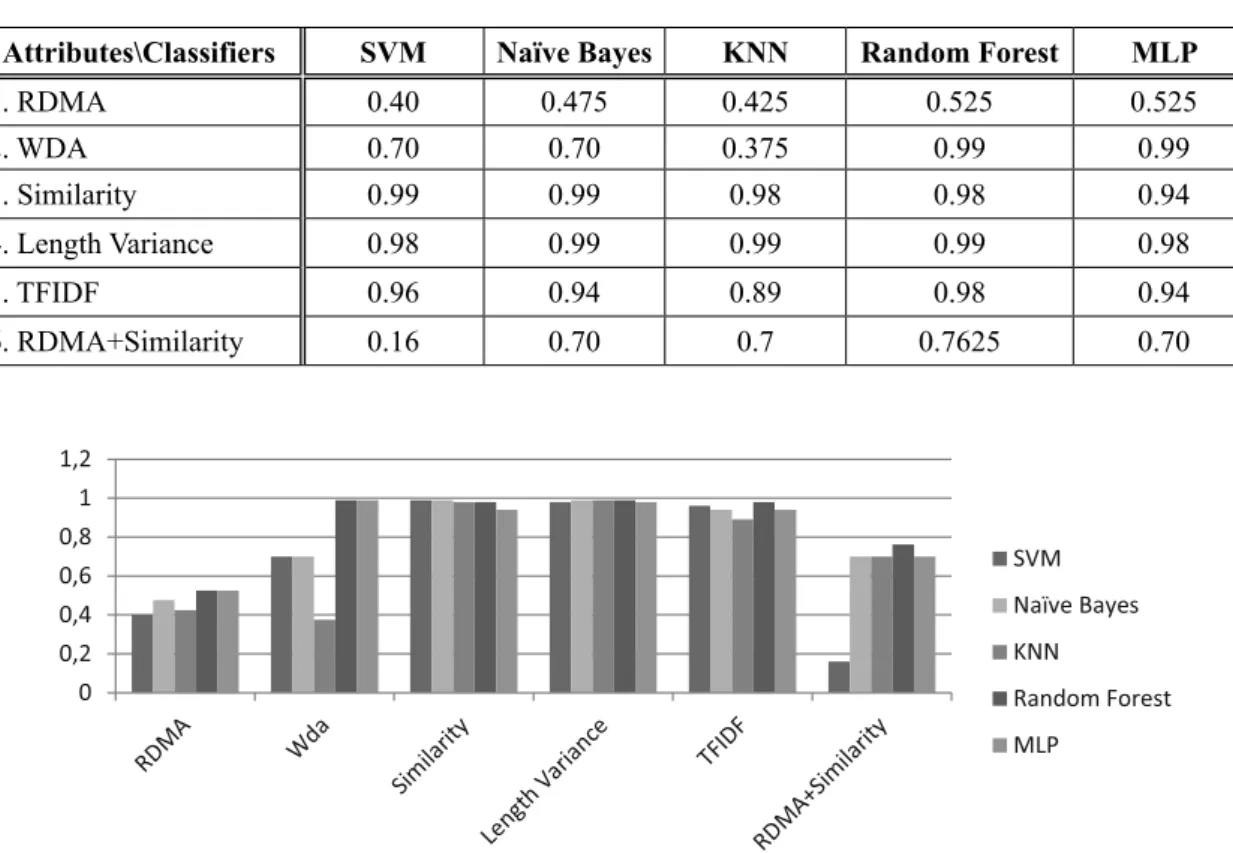
We conducted several experiments and com-pared the performance of the proposed algo-rithm with different classifiers as well as with
different existing techniques. Tables 7, 8, 9 and figures 2, 3, 4 give a comparative performance of different classifiers we used for detecting the best classifier amongst them all for our problem and Table 10 and Figure 2 give a comparison between different techniques available for AoP attack detection on the basis of precision and recall.
4.3.2. Complexity of the Proposed Method
The average space complexity of the proposed algorithm is 0 (5n).
5. Conclusion and Future Work
The issue of Shilling attacks is a major con-cern in the field of recommender systems. To maintain its trustworthiness, we need to either design recommender systems in such a way that they are resistant to such attacks or design algorithms which can detect attacks easily and
Table 7. Precision comparison of different classifiers at 10% AoP Attack.
Attributes\Classifiers SVM Naïve Bayes KNN Random Forest MLP
1. RDMA 0.47 0.275 0.35 0.40 0.325
2. WDA 0.80 0.70 0.85 0.98 0.85
3. Similarity 0.92 0.94 0.95 0.99 0.97
4. Length Variance 0.96 0.99 0.90 0.97 0.99
5. TFIDF 0.98 0.94 0.96 0.99 0.98
6. RDMA + Similarity 0.14 0.6375 0.6625 0.65 0.6375
Table 8. Precision comparison of different classifiers at 10% Noise Injection Attack.
Attributes\Classifiers SVM Naïve Bayes KNN Random Forest MLP
1. RDMA 0.40 0.475 0.425 0.525 0.525
2. WDA 0.70 0.70 0.375 0.99 0.99
3. Similarity 0.99 0.99 0.98 0.98 0.94
4. Length Variance 0.98 0.99 0.99 0.99 0.98
5. TFIDF 0.96 0.94 0.89 0.98 0.94
6. RDMA+Similarity 0.16 0.70 0.7 0.7625 0.70
0 0,2 0,4 0,6 0,8 1 1,2
SVM Naïve Bayes KNN
Random Forest MLP
Figure 2. Precision comparison of different classifiers at 10% AoP Attack.
0 0,2 0,4 0,6 0,8 1 1,2
SVM Naïve Bayes KNN
Random Forest MLP
Figure 3. Precision comparison of different classifiers at 10% Noise Injection Attack.
Table 9. Precision comparison of different classifiers at 10% User Shifting Attack.
Attributes\Classifiers SVM Naïve Bayes KNN Random Forest MLP
1. RDMA 0.23 0.275 0.35 0.35 0.325
2. WDA 0.70 0.85 0.85 0.96 0.93
3. Similarity 0.97 0.94 0.94 0.98 0.97
4. Length Variance 0.99 0.97 0.96 0.99 0.98
5. TFIDF 0.96 0.96 0.96 0.99 0.98
6. RDMA+Similarity 0.21 0.6375 0.6625 0.65 0.6375
0 0,2 0,4 0,6 0,8 1 1,2
SVM Naïve Bayes KNN
Random Forest MLP
4.2. Evaluation Metrics
In the context of attack detection, our goal was to provide insight into how accurately the algo-rithm identifies attack profiles. For measuring detection performance, we used precision [17], recall [10] as our evaluation metrics which are defined below:
Precision =
Correctly
Correctlyidentified attackers Wrong identified attacidentified attackers kers
= +
identified attackers identified attackersTrue
Recall Tru= e +Missed attacke sr
4.3. Experimental Results and Analysis
4.3.1. Comparison of Recall and Precision
We conducted several experiments and com-pared the performance of the proposed algo-rithm with different classifiers as well as with
different existing techniques. Tables 7, 8, 9 and figures 2, 3, 4 give a comparative performance of different classifiers we used for detecting the best classifier amongst them all for our problem and Table 10 and Figure 2 give a comparison between different techniques available for AoP attack detection on the basis of precision and recall.
4.3.2. Complexity of the Proposed Method
The average space complexity of the proposed algorithm is 0 (5n).
5. Conclusion and Future Work
The issue of Shilling attacks is a major con-cern in the field of recommender systems. To maintain its trustworthiness, we need to either design recommender systems in such a way that they are resistant to such attacks or design algorithms which can detect attacks easily and
Table 7. Precision comparison of different classifiers at 10% AoP Attack.
Attributes\Classifiers SVM Naïve Bayes KNN Random Forest MLP
1. RDMA 0.47 0.275 0.35 0.40 0.325
2. WDA 0.80 0.70 0.85 0.98 0.85
3. Similarity 0.92 0.94 0.95 0.99 0.97
4. Length Variance 0.96 0.99 0.90 0.97 0.99
5. TFIDF 0.98 0.94 0.96 0.99 0.98
6. RDMA + Similarity 0.14 0.6375 0.6625 0.65 0.6375
Table 8. Precision comparison of different classifiers at 10% Noise Injection Attack.
Attributes\Classifiers SVM Naïve Bayes KNN Random Forest MLP
1. RDMA 0.40 0.475 0.425 0.525 0.525
2. WDA 0.70 0.70 0.375 0.99 0.99
3. Similarity 0.99 0.99 0.98 0.98 0.94
4. Length Variance 0.98 0.99 0.99 0.99 0.98
5. TFIDF 0.96 0.94 0.89 0.98 0.94
6. RDMA+Similarity 0.16 0.70 0.7 0.7625 0.70
0 0,2 0,4 0,6 0,8 1 1,2
SVM Naïve Bayes KNN
Random Forest MLP
Figure 2. Precision comparison of different classifiers at 10% AoP Attack.
0 0,2 0,4 0,6 0,8 1 1,2
SVM Naïve Bayes KNN
Random Forest MLP
Figure 3. Precision comparison of different classifiers at 10% Noise Injection Attack.
Table 9. Precision comparison of different classifiers at 10% User Shifting Attack.
Attributes\Classifiers SVM Naïve Bayes KNN Random Forest MLP
1. RDMA 0.23 0.275 0.35 0.35 0.325
2. WDA 0.70 0.85 0.85 0.96 0.93
3. Similarity 0.97 0.94 0.94 0.98 0.97
4. Length Variance 0.99 0.97 0.96 0.99 0.98
5. TFIDF 0.96 0.96 0.96 0.99 0.98
6. RDMA+Similarity 0.21 0.6375 0.6625 0.65 0.6375
0 0,2 0,4 0,6 0,8 1 1,2
SVM Naïve Bayes KNN
Random Forest MLP
effectively. Our proposed approach is carried out for this purpose only i.e. designing of an algorithm for easy and effective detection of at-tacks. For this purpose, our paper demonstrates an attack detection model based on Random Forest Classifier and we conducted several ex-periments on 1M MovieLens dataset. In our future work, we intend to extend and improve attack detection by
1. Working on more types of attacks i.e. stan-dard and obfuscated attacks.
2. Working on different features and attrib-utes for attack detection.
3. Trying to improve results and reduce com-putation time by using most influential us-ers instead of the whole dataset.
Although our proposed approach is quite ef-fective, it will be hard to see if it can perform successfully in real life scenarios as well or not.
References
[1] A. Dhoha et al., "A Survey Paper on Recom-mender Systems", arXiv preprint: 1006.5278, 2010.
[2] P. Melville and V. Sindhwani, "Recommender Systems", in Encyclopedia of Machine Learning,
pp. 829‒838, Springer US, 2011.
http://dx.doi.org/10.1007/978-1-4899-7687-1_964 [3] R. Burke, "Hybrid Recommender Systems: Sur-vey and Experiments", User Modeling and User-adapted Interaction, vol. 12, no. 4, pp. 331‒370,
2002.
[4] B. Mobasher et al., "Attacks and Remedies in Collaborative Recommendation", IEEE Intelli-gent Systems, vol. 22, no. 3, 2007.
http://dx.doi.org/10.1109/MIS.2007.45
[5] F. O. Isinkaye et al., "Recommendation Systems: Principles, Methods and Evaluation", Egyptian Informatics Journal, vol. 16, no. 3, pp. 261‒273,
2015.
http://dx.doi.org/10.1016/j.eij.2015.06.005 [6] Z. Yang, and Z. Cai, "Detecting Abnormal
Pro-files in Collaborative Filtering Recommender Systems", Journal of Intelligent Information Sys-tems, pp. 1‒20, 2016.
http://dx.doi.org/10.1007/s10844-016-0424-5 [7] Q. Zhou and F. Zhang, "A Hybrid Unsupervised
Approach for Detecting Profile Injection Attacks Table 10. Comparison of different techniques at 10%
AoP attack.
Technique Recall Precision
1. Zhang et al. (2014) [9] 0.92 0.93
2. Q.Zhou (2016) [15] 0.375 0.7
3. Williams et al. (2007) [29] 0.35 0.6
4. Mehta et al. (2007) [33] ‒ 0.4
5. Proposed
(with Random Forest) 0.9825 0.9825
in Collaborative Recommender Systems", Jour-nal of Information and ComputatioJour-nal Science,
vol. 9, no. 3, pp. 687‒694, 2012.
[8] F. Zhang and Q. Zhou, "A Meta-Learning-Based Approach for Detecting Profile Injection Attacks in Collaborative Recommender Systems," Jour-nal of Computers, vol. 7, no. 1, pp. 226‒234,
2012.
http://dx.doi.org/10.4304/jcp.7.1.226-234
[9] Z. Zhang and S. R. Kulkarni, "Detection of Shilling Attacks in Recommender Systems via Spectral Clustering", in Information Fusion (FU-SION), 17th International Conference on Infor-mation Fusion, IEEE, 2014, pp. 1‒8.
[10] Z. Zhang and S. R. Kulkarni, "Graph-based De-tection of Shilling Attacks in Recommender Sys-tems", in Machine Learning for Signal Process-ing (MLSP), International Workshop on Machine Learning for Signal Processing, IEEE, 2013, pp.
1‒6.
http://dx.doi.org/10.1109/MLSP.2013.6661953 [11] C. Williams et al., "Evaluation of Profile
Injec-tion Attacks in Collaborative Recommender Sys-tems", Technical report. Available from:
http://facweb.cti.depaul.edu/research/techreports/ TR06-006.pdf
[12] W. Zhou et al., "Attack Detection in Recom-mender Systems based on Target Item Analysis", in Neural Networks (IJCNN), International Joint Conference on Neural Networks, IEEE, 2014, pp.
332‒339.
http://dx.doi.org/10.1109/IJCNN.2014.6889419 [13] Z. Yang, "Defending Suspected Users by
Exploit-ing Specific Distance Metric in Collaborative Fil-tering Recommender Systems", in Data Mining Workshop (ICDMW), International Conference on Data Mining Workshops, IEEE, 2015, pp.
1001‒1006.
http://dx.doi.org/10.1109/ICDMW.2015.89 [14] P. Chakraborty and S. Karforma, "Detection of
Profile-injection Attacks in Recommender Sys-tems Using Outlier Analysis", International Con-ference on Computational Intelligence: Modeling Techniques and Applications (CIMTA), Procedia Technology, vol. 10, pp. 963‒969, 2013.
http://dx.doi.org/10.1016/j.protcy.2013.12.444 [15] Q. Zhou, "Supervised Approach for Detecting
Average over Popular Items Attack in Collabo-rative Recommender Systems", IET Information Security, vol. 10, no. 3, pp. 134‒141, 2016.
http://dx.doi.org/10.1049/iet-ifs.2015.0067 [16] F. Zhang and Q. Zhou, "Ensemble Detection
Model for Profile Injection Attacks in Collabora-tive Recommender Systems based on BP Neural Network", IET Information Security, vol. 9, no. 1,
pp. 24‒31, 2014.
http://dx.doi.org/10.1049/iet-ifs.2013.0145 Figure 5. Recall and Precision comparison of different available techniques at 10% AoP Attack.
0 0,2 0,4 0,6 0,8 1 1,2
ZRK[9] ZQ[15] CMR[29] MTP[33] Proposed approach
Recall Precision
[17] F. Zhang and Q. Zhou, "HHT–SVM: An Online Method for Detecting Profile Injection Attacks in Collaborative Recommender Systems", Knowl-edge-based Systems, vol. 65, pp. 96-105, 2014. [18] Z.-J. Deng et al., "Shilling Attack Detection in
Collaborative Filtering Recommender System by PCA Detection and Perturbation", in Wavelet Analysis and Pattern Recognition (ICWAPR), In-ternational Conference on Wavelet Analysis and Pattern Recognition, IEEE, 2016, pp. 213‒218.
http://dx.doi.org/10.1109/ICWAPR.2016.7731644 [19] W. Bhebe and O. P. Kogeda, "Shilling Attack De-tection in Collaborative Recommender Systems using a Meta Learning strategy", in Emerging Trends in Networks and Computer Communi-cations (ETNCC), International Conference on Emerging Trends in Networks and Computer Communications, IEEE, 2015, pp. 56‒61.
http://dx.doi.org/10.1109/ETNCC.2015.7184808 [20] W. Zhou et al., "SVM-TIA a Shilling Attack De-tection Method based on SVM and Target Item Analysis in Recommender Systems", Neurocom-puting, vol. 210, pp. 197‒205, 2016.
http://dx.doi.org/10.1016/j.neucom.2015.12.137 [21] C.-Y. Chung et al., "βP: A novel Approach to Fil
-ter Out Malicious Rating Profiles from Recom-mender Systems", Decision Support Systems, vol.
55, no. 1, pp. 314‒325, 2013.
http://dx.doi.org/10.1016/j.dss.2013.01.020 [22] G. Adomavicius and A. Tuzhilin, "Toward the
next Generation of Recommender Systems: A Survey of the State-of-the-Art and Possible Ex-tensions", IEEE Transactions on Knowledge and Data Engineering, vol. 17, no. 6, pp. 734‒749,
2005.
http://dx.doi.org/10.1109/TKDE.2005.99
[23] D. Almazro et al., "A Survey Paper on Recom-mender Systems", arXiv preprint: 1006.5278, 2010.
[24] X. Su and T. M. Khoshgoftaar, "A Survey of Col-laborative Filtering Techniques", Advances in Ar-tificial Intelligence, pp. 4, 2009.
http://dx.doi.org/10.1155/2009/421425
[25] F. M. Harper and J. A. Konstan, "The Movielens Datasets: History and Context", ACM Transac-tions on Interactive Intelligent Systems (TiiS), vol. 5, no. 4, pp. 19, 2016.
http://dx.doi.org/10.1145/2827872
[26] R. Bhaumik et al., "A Clustering Approach to Unsupervised Attack Detection in Collaborative Recommender Systems", in Proceedings of the 7th IEEE International Conference on Data Min-ing, 2011, Las Vegas, NV, USA, pp. 181‒187. [27] F. Zhang, "A Survey of Shilling Attacks in
Col-laborative Filtering Recommender Systems", in Computational Intelligence and Software Engi-neering, International Conference on Compu-tational Intelligence and Software Engineering, IEEE, 2009, pp. 1‒4.
effectively. Our proposed approach is carried out for this purpose only i.e. designing of an algorithm for easy and effective detection of at-tacks. For this purpose, our paper demonstrates an attack detection model based on Random Forest Classifier and we conducted several ex-periments on 1M MovieLens dataset. In our future work, we intend to extend and improve attack detection by
1. Working on more types of attacks i.e. stan-dard and obfuscated attacks.
2. Working on different features and attrib-utes for attack detection.
3. Trying to improve results and reduce com-putation time by using most influential us-ers instead of the whole dataset.
Although our proposed approach is quite ef-fective, it will be hard to see if it can perform successfully in real life scenarios as well or not.
References
[1] A. Dhoha et al., "A Survey Paper on Recom-mender Systems", arXiv preprint: 1006.5278, 2010.
[2] P. Melville and V. Sindhwani, "Recommender Systems", in Encyclopedia of Machine Learning,
pp. 829‒838, Springer US, 2011.
http://dx.doi.org/10.1007/978-1-4899-7687-1_964 [3] R. Burke, "Hybrid Recommender Systems: Sur-vey and Experiments", User Modeling and User-adapted Interaction, vol. 12, no. 4, pp. 331‒370,
2002.
[4] B. Mobasher et al., "Attacks and Remedies in Collaborative Recommendation", IEEE Intelli-gent Systems, vol. 22, no. 3, 2007.
http://dx.doi.org/10.1109/MIS.2007.45
[5] F. O. Isinkaye et al., "Recommendation Systems: Principles, Methods and Evaluation", Egyptian Informatics Journal, vol. 16, no. 3, pp. 261‒273,
2015.
http://dx.doi.org/10.1016/j.eij.2015.06.005 [6] Z. Yang, and Z. Cai, "Detecting Abnormal
Pro-files in Collaborative Filtering Recommender Systems", Journal of Intelligent Information Sys-tems, pp. 1‒20, 2016.
http://dx.doi.org/10.1007/s10844-016-0424-5 [7] Q. Zhou and F. Zhang, "A Hybrid Unsupervised
Approach for Detecting Profile Injection Attacks Table 10. Comparison of different techniques at 10%
AoP attack.
Technique Recall Precision
1. Zhang et al. (2014) [9] 0.92 0.93
2. Q.Zhou (2016) [15] 0.375 0.7
3. Williams et al. (2007) [29] 0.35 0.6
4. Mehta et al. (2007) [33] ‒ 0.4
5. Proposed
(with Random Forest) 0.9825 0.9825
in Collaborative Recommender Systems", Jour-nal of Information and ComputatioJour-nal Science,
vol. 9, no. 3, pp. 687‒694, 2012.
[8] F. Zhang and Q. Zhou, "A Meta-Learning-Based Approach for Detecting Profile Injection Attacks in Collaborative Recommender Systems," Jour-nal of Computers, vol. 7, no. 1, pp. 226‒234,
2012.
http://dx.doi.org/10.4304/jcp.7.1.226-234
[9] Z. Zhang and S. R. Kulkarni, "Detection of Shilling Attacks in Recommender Systems via Spectral Clustering", in Information Fusion (FU-SION), 17th International Conference on Infor-mation Fusion, IEEE, 2014, pp. 1‒8.
[10] Z. Zhang and S. R. Kulkarni, "Graph-based De-tection of Shilling Attacks in Recommender Sys-tems", in Machine Learning for Signal Process-ing (MLSP), International Workshop on Machine Learning for Signal Processing, IEEE, 2013, pp.
1‒6.
http://dx.doi.org/10.1109/MLSP.2013.6661953 [11] C. Williams et al., "Evaluation of Profile
Injec-tion Attacks in Collaborative Recommender Sys-tems", Technical report. Available from:
http://facweb.cti.depaul.edu/research/techreports/ TR06-006.pdf
[12] W. Zhou et al., "Attack Detection in Recom-mender Systems based on Target Item Analysis", in Neural Networks (IJCNN), International Joint Conference on Neural Networks, IEEE, 2014, pp.
332‒339.
http://dx.doi.org/10.1109/IJCNN.2014.6889419 [13] Z. Yang, "Defending Suspected Users by
Exploit-ing Specific Distance Metric in Collaborative Fil-tering Recommender Systems", in Data Mining Workshop (ICDMW), International Conference on Data Mining Workshops, IEEE, 2015, pp.
1001‒1006.
http://dx.doi.org/10.1109/ICDMW.2015.89 [14] P. Chakraborty and S. Karforma, "Detection of
Profile-injection Attacks in Recommender Sys-tems Using Outlier Analysis", International Con-ference on Computational Intelligence: Modeling Techniques and Applications (CIMTA), Procedia Technology, vol. 10, pp. 963‒969, 2013.
http://dx.doi.org/10.1016/j.protcy.2013.12.444 [15] Q. Zhou, "Supervised Approach for Detecting
Average over Popular Items Attack in Collabo-rative Recommender Systems", IET Information Security, vol. 10, no. 3, pp. 134‒141, 2016.
http://dx.doi.org/10.1049/iet-ifs.2015.0067 [16] F. Zhang and Q. Zhou, "Ensemble Detection
Model for Profile Injection Attacks in Collabora-tive Recommender Systems based on BP Neural Network", IET Information Security, vol. 9, no. 1,
pp. 24‒31, 2014.
http://dx.doi.org/10.1049/iet-ifs.2013.0145 Figure 5. Recall and Precision comparison of different available techniques at 10% AoP Attack.
0 0,2 0,4 0,6 0,8 1 1,2
ZRK[9] ZQ[15] CMR[29] MTP[33] Proposed approach
Recall Precision
[17] F. Zhang and Q. Zhou, "HHT–SVM: An Online Method for Detecting Profile Injection Attacks in Collaborative Recommender Systems", Knowl-edge-based Systems, vol. 65, pp. 96-105, 2014. [18] Z.-J. Deng et al., "Shilling Attack Detection in
Collaborative Filtering Recommender System by PCA Detection and Perturbation", in Wavelet Analysis and Pattern Recognition (ICWAPR), In-ternational Conference on Wavelet Analysis and Pattern Recognition, IEEE, 2016, pp. 213‒218.
http://dx.doi.org/10.1109/ICWAPR.2016.7731644 [19] W. Bhebe and O. P. Kogeda, "Shilling Attack De-tection in Collaborative Recommender Systems using a Meta Learning strategy", in Emerging Trends in Networks and Computer Communi-cations (ETNCC), International Conference on Emerging Trends in Networks and Computer Communications, IEEE, 2015, pp. 56‒61.
http://dx.doi.org/10.1109/ETNCC.2015.7184808 [20] W. Zhou et al., "SVM-TIA a Shilling Attack De-tection Method based on SVM and Target Item Analysis in Recommender Systems", Neurocom-puting, vol. 210, pp. 197‒205, 2016.
http://dx.doi.org/10.1016/j.neucom.2015.12.137 [21] C.-Y. Chung et al., "βP: A novel Approach to Fil
-ter Out Malicious Rating Profiles from Recom-mender Systems", Decision Support Systems, vol.
55, no. 1, pp. 314‒325, 2013.
http://dx.doi.org/10.1016/j.dss.2013.01.020 [22] G. Adomavicius and A. Tuzhilin, "Toward the
next Generation of Recommender Systems: A Survey of the State-of-the-Art and Possible Ex-tensions", IEEE Transactions on Knowledge and Data Engineering, vol. 17, no. 6, pp. 734‒749,
2005.
http://dx.doi.org/10.1109/TKDE.2005.99
[23] D. Almazro et al., "A Survey Paper on Recom-mender Systems", arXiv preprint: 1006.5278, 2010.
[24] X. Su and T. M. Khoshgoftaar, "A Survey of Col-laborative Filtering Techniques", Advances in Ar-tificial Intelligence, pp. 4, 2009.
http://dx.doi.org/10.1155/2009/421425
[25] F. M. Harper and J. A. Konstan, "The Movielens Datasets: History and Context", ACM Transac-tions on Interactive Intelligent Systems (TiiS), vol. 5, no. 4, pp. 19, 2016.
http://dx.doi.org/10.1145/2827872
[26] R. Bhaumik et al., "A Clustering Approach to Unsupervised Attack Detection in Collaborative Recommender Systems", in Proceedings of the 7th IEEE International Conference on Data Min-ing, 2011, Las Vegas, NV, USA, pp. 181‒187. [27] F. Zhang, "A Survey of Shilling Attacks in
Col-laborative Filtering Recommender Systems", in Computational Intelligence and Software Engi-neering, International Conference on Compu-tational Intelligence and Software Engineering, IEEE, 2009, pp. 1‒4.
[28] I. Gunes et al., "Shilling Attacks against Recom-mender Systems: a Comprehensive Survey", Ar-tificial Intelligence Review, pp. 1‒33, 2014.
http://dx.doi.org/10.1007/s10462-012-9364-9 [29] C. A. Williams et al., "Defending Recommender
Systems: Detection of Profile Injection Attacks", Service Oriented Computing and Applications,
vol. 1, no. 3, pp. 157‒170, 2007.
http://dx.doi.org/10.1007/s11761-007-0013-0 [30] C.-W. Hsu et al., "A Practical Guide to Support
Vector Classification", pp. 1‒16, 2003.
[31] L. Breiman, "Random forests", Machine learn-ing, vol. 45, no. 1, pp. 5‒32, 2001.
[32] D. W. Ruck et al., "Feature Selection using a Multilayer Perception", Journal of Neural Net-work Computing, vol. 2, no. 2, pp. 40‒48, 1990.
[33] B. Mehta et al., "Lies and Propaganda: Detecting Spam users in Collaborative Filtering", in Pro-ceedings of the 12th International Conference on Intelligent user Interfaces, ACM, 2007, pp.
14‒21.
http://dx.doi.org/10.1145/1216295.1216307 [34] T. Sutter et al., "Tag-Aware Recommender
Sys-tems by Fusion of Collaborative Filtering Algo-rithms", in Proceedings of the 2008 ACM Sym-posium on Applied Computing, ACM, 2008, pp.
1995‒1999.
[35] K. Verbert et al., "Dataset-Driven Research for Improving Recommender Systems for Learn-ing", in Proceedings of the 1st International Con-ference on Learning Analytics and Knowledge, ACM, 2011, pp. 44‒53.
[36] N. Manouselis et al., "Recommender Systems in Technology Enhanced Learning", in Recom-mender Systems Handbook, Springer, Boston,
MA, 2011, pp. 387‒415.
[37] J. A. Konstan and J. Riedl, "Recommender Sys-tems: from Algorithms to user Experience", User Modeling and User-Adapted Interaction, vol. 22,
pp. 101‒123, 2012.
http://dx.doi.org/10.1007/s11257-011-9112-x
Received: December 2017
Revised: May 2018
Accepted: June 2018
Contact addresses: Saakshi Kapoor Department of Computer Science and Engineering UIET, Panjab University Chandigarh, India e-mail: [email protected] Vishal Gupta Department of Computer Science and Engineering UIET, Panjab University Chandigarh, India e-mail: [email protected] Rohit Kumar Department of Computer Science and Engineering UIET, Panjab University Chandigarh, India e-mail: [email protected]
SaakShi kapooris currently pursuing her master's thesis under the
guidance of Dr. Vishal Gupta and Mr. Rohit Kumar from UIET, Panjab University, Chandigarh, India. She has completed her BE in Computer Science from Chitkara University, Baddi Campus, Himachal Pradesh, India.
ViShal Guptais currently working as a Senior Assistant Professor at
UIET, Panjab University, Chandigarh, India. He joined UIET in 2006. He has completed his BE, ME and PhD degrees in Computer Science and Engineering. He received the Young Scientist Award in Engineer-ing & Technology from Punjab Academy of Sciences for 2013. He has published a number of research papers. His major research interest lies in the areas of natural language processing and text mining.
rohit kumaris currently working as an Assistant Professor at UIET,