A Novel Modi
fi
ed Secant Method
for Computing the Fair Share Rate
Dong Wei and Nirwan Ansari
Advanced Networking Laboratory, Department of Electrical and Computer Engineering, New Jersey Institute of Technology, Newark, USA
In this paper, we propose a novel modified secant method to compute the flow fair share rate within the framework of the core-stateless fair queueing 1]. The geometric
explanation and numerical results demonstrate that the proposed method possesses better performance in terms of accuracy and convergence than that proposed in 1].
Keywords: core-stateless, fair queueing, fair share rate.
1. Introduction
Most scheduling schemes for quality of services
(QoS)provisioning require all routers to
man-age per flow states and perform per flow opera-tions2]3]. Such a stateful architecture is less
scalable and less robust than the stateless archi-tectures, such as the original IP and the DiffServ framework4].
In1], a framework of core-stateless fair
queue-ing (CSFQ), which does not require per flow
management or operation at core routers, was proposed. It is able to provide high quality of services while maintaining a high level of robustness, simplicity and scalability. In this framework, one key element is the calculation of the fair share rate, which is briefly reviewed in the next section. The accuracy and effectiveness of the scheme for computing the fair share rate affects the effectiveness of the core-stateless fair queueing scheme. A more effective method for computing the fair share rate is thus proposed in this paper.
The rest of the paper is organized as follows. In Section 2, we review the core-stateless fair queueing and the original method for comput-ing the fair share rate. We present the proposed
method in Section 3, and compare performance between the proposed method and the original one by geometric reasoning in Section 4. Simu-lation results are shown in Section 5. In Section 6, we discuss the applications of the proposed method in other scenarios. Finally, concluding remarks are presented in Section 7.
2. Background
2.1. The Core-stateless Fair Queueing
In a contiguous region of a network, routers are classified as edge routers and core routers. Edge routers maintain per flow state and es-timate the incoming rate of each flow; based on this estimation, each packet is labeled when it departs from the edge router. Core routers do not maintain per flow state; they just use a
FIFOqueue and a probabilistic dropping algo-rithm that uses the packet labels and an estimate of the aggregate traffic at the router. Since no per flow state is maintained in the core routers and packets are served based on “first come first served” policy, the implementation complexity of the core routers isO(1).
Denote xi as the arrival rate of flow i and f as
the fair share rate, respectively, whereasxi 0
and f 0. Then, each incoming packet of
flow i is dropped with probability pi, where
pi=max 0 1;
f xi
Thus, the throughput of this link can be written as:
C =C(f)=
N
X
i=1
min(xi f): (1)
Note thatCis a continuous non-decreasing con-cave and piecewise-linear function of f. If the
link is congested, i.e., PN
i=1
xi > L, there is a
unique solution of f to PN
i=1
min(xi f)=L; if
the link is not congested, i.e., PN
i=1
xi L, we
define f = max
i=1 2:::N
(xi). Clearly, if allxi’s are
known, f can be computed. However, this re-quires maintenance of per flow information. To avoid maintaining per flow state, we can use the measurement ofCto compute f.
2.2. The Computation of the Fair Share Rate
If per flow state information is not maintained, allxi’s are unknown. In this case, f can be
esti-mated based on both the measurement and the properties of the function ofC. The estimation off can be formulated as a root finding problem of a nonlinear equation as follows:
ψ(f)=
N
X
i=1
min(xi f);L =0: (2)
Denote the exact fair share rate by f , i.e., C(f ) = L. The effectiveness of the CSFQ
scheme depends on the effectiveness of the method for computing f. Denote the kth
ite-ration of the f estimation and the measured throughput by f(k) and C(k), respectively. The
original fair share rate estimation method pro-posed in1], which is referred to as theFSRCSFQ
method in this paper, is written as:
f(k+1) = f
(k)
L C(k)
:
It can be rewritten as:
f(k+1) = f
(k) ;
f(k)
C(k) (C
(k)
;L): (3)
3. The Modified Secant Method
3.1. The Regula Falsi Method and the Secant Method
For the nonlinear equation Eq.(2), we know the
root must be in the interval 0 L]. The regula
falsi method 5], a closed domain method, can
be expressed as follows:
f(k+1) =
8 > > > > > > > < > > > > > > > :
f(k) ;
f(k) ; f
(k;1)
C(k) ;C
(k;1) (C
(k) ;L)
when (C
(k)
;L)(C (k;1)
;L)<0
f(k) ;
f(k) ; f
(k;2)
C(k) ;C
(k;2) (C
(k) ;L)
otherwise
(4)
whereas f(0) =0 f
(1) =L.
The secant method is a numerical method for solving a nonlinear equation 5], such as Eq. (2), when the derivative
@C (k) @f
is unavailable. It can be written as:
f(k+1) = f
(k) ;
f(k) ; f
(k;1)
C(k) ;C
(k;1) (C
(k)
;L) (5)
A secant to a curve is a straight line which passes through two points on the curve. Two initial ap-proximations, f(0) and f(1), are required. It is
claimed that the secant method converges much faster than the regula falsi method5].
3.2. The Modified Secant Method
We modify the secant method for the following two reasons: 1) f may change when the traffic
pattern changes. For example, after a period of stable status, i.e., when f(k)
= f
(k;1), if there is
a change of the throughput, i.e., the arrival pat-tern changes, we need to adjust the estimation of f. In this case, since f(k)
; f (k;1)
= 0, Eq. (5)cannot be used; however, we know that the
origin must be on the curve of Eq.(1).
There-fore, in this case, we usef(k;1)
=0,C (k;1)
=0
to compute f(k+1); 2
)as shown in the next
sec-tion, when f decreases, by Eq.(5), f
(k+1) may
be less than 0, which cannot be used. Therefore, we let f(k;1)
scheme can be written as a pseudo code as in Fig. 1.
Initialization Procedure
f(0) 0;
C(0) 0;
f(1)
δ L;
C(1)
Measure Throughput; Update Fair Share Rate Procedure
kk+1;
C(k)
Measure Throughput; if(C
(k)
;L)(C (k;1)
;L)<0
f(k;1) 0;
C(k;1) 0;
f(k+1) f
(k) ;
f(k) ;f
(k;1)
C(k) ;C
(k;1) (C
(k) ;L) if f(k+1)
<0
f(k+1) f
(k)
L C(k)
;
Fig. 1.The modified secant method.
When the scheduler starts to transmit packets, to avoid buffer overflow, we first attempt a fair share rate f(1)
= δ L, which is small enough
that the throughput is not greater thanL. With the measurement of C(1), the modified secant
method is initiated. The update fair share rate procedure is called upon a packet arrival. The explanation of this procedure is presented in the next section.
4. Performance Analysis
In this section, we compare the performance in terms of convergence between the method pro-posed in 1] and our modified secant method.
We demonstrate that, with our proposed secant
method, f can be reached whereas, with the
FSRCSFQmethod,f can only be approximated,
but may not be reached. We consider two sce-narios: 1) when f increases, and 2) when f
decreases.
Since the throughput C is a continuous, non-decreasing, concave, and piecewise-linear func-tion of f, the following inequalities must hold,
80< f (a)
< f (b)
<L.
C(f (a)
)C(f (b)
): (6)
@C(f (b)
) @f
@C(f
(a) ) @f
: (7)
C(f (b)
)
f(b)
C(f (a)
)
f(a)
: (8)
@C(f (b)
) @f
C(f (b)
)
f(b)
: (9)
Ineq.(6)demonstrates the non-decreasing
prop-erty, and Ineqs.(7),(8)and(9)demonstrate the
concave property. By the above inequalities and the fact that the origin is on the curve ofC(f),
Ineq.(10)can be readily derived.
@C(f (b)
) @f
C(f (b)
);C(f (a)
)
f(b) ;f
(a)
@C(f (a)
) @f
(10)
4.1. Case 1: The Fair Share Rate Increases
Denote the estimation of f of the kth iteration,
by using theFSRCSFQmethod and by using the
proposed method, as f(k)
CSFQand f
(k)
Secant,
respec-tively. Let 0 < f (k;1)
Secant < f (k)
Secant < f , and
f(k)
CSFQ= f (k)
Secant.
By Ineq.(8), we have
C(f (k)
Secant)
f(k)
Secant
C(f (k;1)
Secant)
f(k;1)
Secant
.
Then,C(f (k)
Secant) f (k;1)
Secant C(f (k;1)
Secant) f (k)
Secant.
Thus,C(f (k)
Secant) f (k)
Secant;C(f (k)
Secant)f (k;1)
Secant
C(f (k)
Secant) f (k)
Secant;C(f (k;1)
Secant) f (k)
Secant.
Therefore,C(f (k)
Secant)
f(k)
Secant
C(f (k)
Secant);C(f (k;1)
Secant)
f(k)
Secant; f (k;1)
Secant
* f (k)
Secant f by Ineq.(6),C(f (k)
Secant)L,
) f (k)
Secant;
f(k)
Secant
C(f (k)
Secant) (C(f
(k)
Secant);L)
f (k)
Secant;
f(k)
Secant;f (k;1)
Secant
C(f (k)
Secant);C(f (k;1)
Secant) (C(f
(k)
Secant);L): * f
(k)
CSFQ= f (k)
Secant,
) f (k)
CSFQ;
f(k)
CSFQ
C(f (k)
CSFQ) (C(f
(k)
CSFQ);L)
f (k)
Secant;
f(k)
Secant; f (k;1)
Secant
C(f (k)
Secant);C(f (k;1)
Secant) (C(f
(k)
Secant);L):
By Eqs.(3)and(5),f (k+1)
CSFQ f (k+1)
Secant.
By Ineq.(10),
C(f (k)
Secant);C(f (k;1)
Secant)
f(k)
Secant; f (k;1)
Secant
@C(f
(k) ) @f
C(f );C(f (k)
Secant)
f ; f (k)
Secant
.
* C(f (k)
Secant)L
) f (k)
Secant;
f(k)
Secant; f (k;1)
Secant
C(f (k)
Secant);C(f (k;1)
Secant) (C(f
(k)
Secant);L) f
(k)
Secant;
f ; f (k)
Secant
C(f );C(f (k)
Secant) (C(f
(k)
Secant);L): * C(f )=L
) f (k)
Secant;
f(k)
Secant; f (k;1)
Secant
C(f (k)
Secant);C(f (k;1)
Secant) (C(f
(k)
Secant);L) f :
Thus, by Eq.(5),f (k)
Secant < f (k+1)
Secant < f .
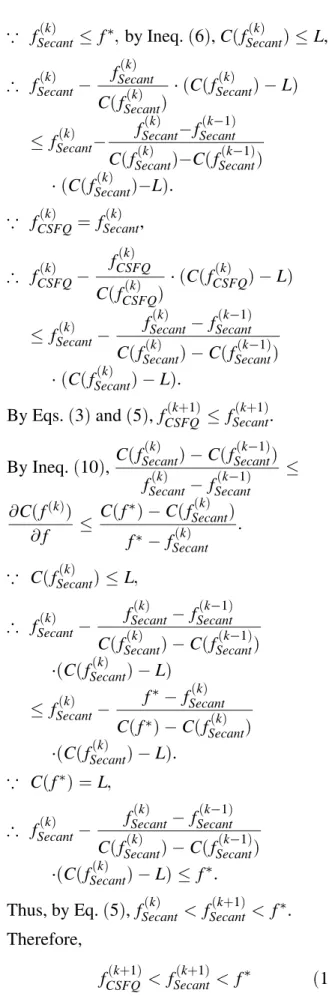
Therefore,
f(k+1)
CSFQ < f (k+1)
Secant < f (11)
Ineq.(11)demonstrates that the secant method
can approximate the exact value of the fair share
rate f better than the FSRCSFQmethod, when
the fair share rate increases.
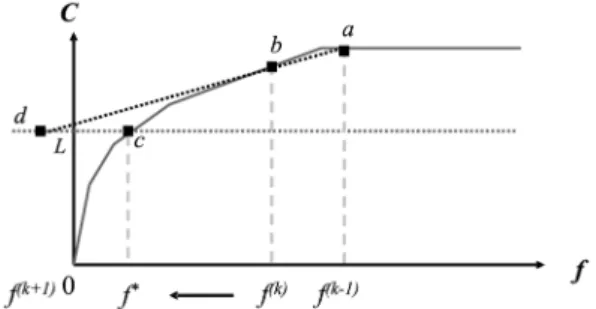
As shown in Fig. 2, the function of C vs f
can be depicted as the solid line, which passes through the origin. a, b, c, d, and e are points on the curve with Cartesian coordinates
(f (k;1)
Secant C(f (k;1)
Secant)),(f (k)
Secant C(f (k)
Secant)),(f L), (f
(k+1)
CSFQ C(f (k+1)
CSFQ))and(f (k+1)
Secant C(f (k+1)
Secant)),
re-spectively. d,band the origin are on the same line, which is used to compute(f
(k+1)
CSFQ C(f (k+1)
CSFQ)).
a,bandeare on the same line, which is used to compute f(k+1)
Secant. Since 0 < f (k;1)
Secant < f (k)
Secant <
f and f(k)
CSFQ = f (k)
Secant, the slope of the dotted
lineab,C(f (k)
Secant);C(f (k;1)
Secant)
f(k)
Secant;f (k;1)
Secant
, must be greater
than the slope of the dotted linebd, C(f (k)
CSFQ)
f(k)
CSFQ
.
The ideal slope is the slope of the dotted linebc, which passes the point with the exact fair share rate, f . Therefore, with the slope used by our modified secant method, it approximates point cbetter than that by theFSRCSFQmethod.
Fig. 2.The geometric explanation of the fair share rate computation when it increases.
Note that, 1) if there is only one line segment
between pointcand the origin, both methods are able to computef ; 2)if there are more than one
line segment between pointcand the origin, the FSRCSFQmethod may only approximate pointc
4.2. Case 2: The Fair Share Rate Decreases
In this section, we first show that, when f de-creases, the FSRCSFQ method is equivalent to
the regula falsi method. Since it is claimed, in 5], that the secant method converges much
more rapidly than the regula falsi method, our proposed method possesses better performance in terms of convergence than theFSRCSFQ
me-thod. Finally, we explain the reason why, in this case, the secant method cannot be directly deployed.
Let f < f (k)
CSFQ < f (k;1)
CSFQ. Thus, by Eq. (6),
L<C(f (k)
CSFQ).
Then, by Eq.(3), 0 < f (k+1)
CSFQ < f (k)
CSFQ,
imply-ing that the computed fair share rate approxi-mates the exact rate from the right hand side, as shown in Fig. 3. a, b, and c are points on the curve with Cartesian coordinates, (f
(k;1)
CSFQ
C(f (k;1)
CSFQ)),(f (k)
CSFQ C(f (k)
CSFQ))and(f L),
re-spectively. TheFSRCSFQmethod uses the
ori-Fig. 3.The geometric explanation of the fair share rate computation, when it decreases, using theFSRCSFQ
method.
Fig. 4.The geometric explanation of the fair share rate computation, when it decreases, using the modified
secant method.
gin and pointbto compute f(k+1)
CSFQ. It is,
mathe-matically, equivalent to finding the root of Eq.
(2), by using Eq. (4), whereas f (k;2)
= 0.
Again, if there is only one line segment between pointc and the origin, theFSRCSFQ method is able to compute the exact fair share rate, f ; otherwise, the FSRCSFQ method may only ap-proximate pointc closely, but can never reach it.
When the secant method is deployed, C
(k) ;L
C(k;1) ;L
may be less than f
(k)
f(k;1)
, and thus by Eq. (5),
f(k+1)
< 0, as shown in Fig. 4. a,b, c, and d
are points on the curve with Cartesian coordi-nates (f
(k;1)
Secant C(f (k;1)
Secant)), (f (k)
Secant C(f (k)
Secant)), (f L) and (f
(k+1)
Secant C(f (k+1)
Secant)), respectively.
The fair share rate f cannot be set to a value less than 0. Thus, in this sense, the original se-cant method cannot be used without modifica-tion. Therefore, when f(k+1)
<0, we compute
f(k+1) by Eq.
(3). That is, if f (k+1)
< 0, the
FSRCSFQmethod is used again in this iteration.
Note that, 1) if there is only one line
seg-ment between point a and the origin, in Fig. 3, both methods are able to compute the exact fair share rate, f ; 2)if there are more than one
line segment between point a and the origin, theFSRCSFQmethod may approximate pointc
closely, but can never reach it, mathematically. However, the proposed method can still reach point c, if, with enough iterations, point b is on the line which passes through point c; 3)
theoretically, using the method proposed in1],
when the fair share rate decreases, the computed fair share rate is always greater than the exact value, i:e:, f < f
(k)
CSFQ, and thus the expected
5. Simulation Results
In the previous section, we demonstrate, ge-ometrically, that the secant method converges faster than theFSRCSFQmethod. The following
examples show that the proposed scheme con-verges to f faster than theFSRCSFQmethod.
5.1. Example 1: The Fair Share Rate Increases
Suppose 20 flows share one link with a capacity of 10. Assume, starting from time 0, the arrival rates of the first five flows are 1, 2, 3, 4, and 5, respectively, and the remaining 15 flows are 1. Assume, beforetK;2, the fair share rate reaches
the exact rate and remains stable tilltK;1, i.e.,
by Eq. 2, f(K;2) = f
(K;1)
= 0:5. Starting
from tK, only the first five flows remain the
same and the remaining 15 flows become idle, and therefore, the function of aggregate rateC vsthe fair share rate f can be written as:
C= 8 > > > > < > > > > :
5 f when 0 f <1
4 f +1 when 1 f <2
3 f +3 when 2 f <3
2 f +6 when 3 f <4
f +10 when 4 f <5
15 when 5 f
(12)
whereas the root of the equation
ψ(f)=
N
X
i=1
min(xi f);L =0
is f =2:333333. The relative error is defined
as:
e(k) =
f(k) ; f
f
100% (13)
Denote the relative error by using theFSRCSFQ
method and our proposed modified secant me-thod by e(k)
CSFQ and e
(k)
Secant, respectively. Note
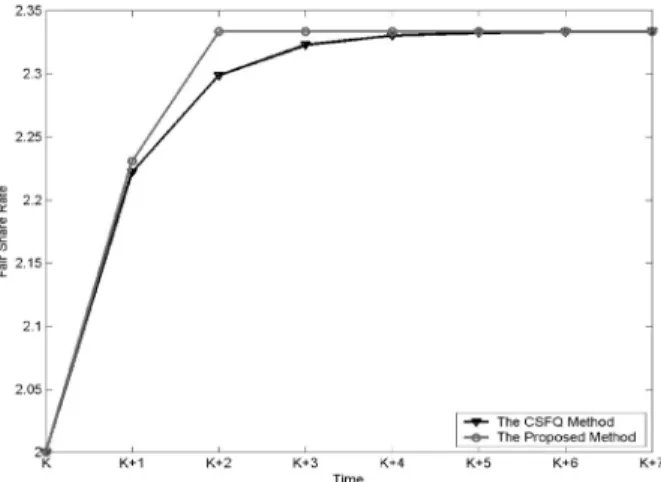
that, in the computation, we only keep four dig-its after the decimal point. Fig. 5 and 6 show the comparison of the iterative computation of the FSRCSFQ method and the modified secant
method. We see that, with 2 iterations, by
us-ing the proposed method, f can be reached,
whereas the relative error of theFSRCSFQ
me-thod is still 1.47%.
Fig. 5.Computation of the fair share rate using the FSRCSFQmethod and the modified secant method in
Example 1.
Fig. 6.The computed relative error of the fair share rate using theFSRCSFQmethod and the modified secant
method in Example 1.
5.2. Example 2: The Fair Share Rate Decreases
Suppose 5 flows share the same link as in Ex-ample 1. Assume, starting from time 0, the arrival rate of the first four flows are 1, 2, 3, and 4, respectively, and the last flow is idle. Before tK;2, the fair share rate reaches the
exact rate and remains stable till tK;1, i :e:,
f(K;2) = f
(K;1)
= 4. Starting from tK, only
the last flow becomes active and the arrival rate is 5, while the remaining flows remain the same as before. Then, Eq. (12) still holds,
and f = 2:333333. Fig. 7 and 8 show the
Fig. 7.Computation of the fair share rate using the FSRCSFQmethod and the modified secant method in
Example 2.
Fig. 8.The computed relative error of the fair share rate using theFSRCSFQmethod and the modified secant
method in Example 2.
FSRCSFQ method and our proposed modified
secant method. We can see that, with 2 iter-ations, by using the proposed method, f can be reached, whereas the relative error of the FSRCSFQ method is 1.68%. This result is very
similar to that in Example 1.
With these examples, we can see that the modi-fied secant method converges much more rapidly than the method proposed in1].
6. Discussion
In this paper, we have proposed a novel modi-fied secant method for computing the fair share
rate on a link shared by multiple flows. The CSFQ scheduling scheme is a min-max scheme per se 1]; the proposed method, which only
improves the performance to calculate the fair share rate, does not change this property. In the examples from the previous section, all flows are treated equally,i:e:, each flow has the same
weight. However, the proposed method can be readily extended to a weighted CSFQ schedul-ing scheme too, by deployschedul-ing and calculatschedul-ing nominal fair share rate f using Eq.(14)instead
of the fair share rate f using Eq.(1),
C =C(f)=
N
X
i=1
(xi wiLf) (14)
wherewiis the weight of flowiand N
P
i=1
wi=1.
In some applications, there are two parts in each flow - guaranteed rate (like voice and video,
etc.) and best effort rate (such as data). The
guaranteed rate must be satisfied and best ef-fort rate is computed based on the fair share. The proposed method can be extended to these applications by using Eq.(15),
C=C(f)=
N
X
i=1
(xi gi+wiLf) (15)
wheregiis the guaranteed rate of flowi. N
P
i=1
gi
L, andL=L;
N
P
i=1
gi.
Note that, in these two scenarios,Cis a still con-tinuous non-decreasing concave and piecewise-linear function of f. Therefore, the proposed method can be employed to calculate the nomi-nal fair share rate f instead of f.
7. Conclusions
method, and can finally reach f . The numeri-cal results also show that the proposed method performs better in terms of accuracy and con-vergence than the original method proposed in
1].
Acknowledgement
This work has been supported in part by the New Jersey Commission on Science and Technology via the NJWINS, and the New Jersey Commis-sion on Higher Education via the NJ I-TOWER project.
References
1] STOICA, I., SHENKER, S. ANDHUIZHANG,
Core-stateless fair queueing: a scalable architecture to approximate fair bandwidth allocations in high-speed networks, IEEE/ACM Transactions on Net-working, Volume: 11, Issue: 1, Feb. 2003, pp. 33–46.
2] PAREKH, A.K.ANDGALLAGER, R.G, A generalized
processor sharing approach to flow control in in-tegrated services networks: the single-node case, IEEE/ACM Transactions on Networking, Volume: 1, Issue: 3, June 1993, pp. 344–357.
3] M. SHREEDHAR ANDG. VARGHESE, Efficient fair
queueing using deficit round robin, ACM/IEEE Transactions on Networking, Volume: 4, Issue: 3, June 1996, pp. 375–385.
4] S. BLAKE, D. BLACK, M. CARLSON, E. DAVIES, Z.
WANG, ANDW. WEISS, An Architecture for Dif-ferentiated Services, IETF RFC 2475, December 1998.
5] J. HOFFMAN,Numerical Methods for Engineers and
Scientists, Second Edition – Revised and Expanded, Marcel Dekker Inc., 2001.
Received:January, 2005 Accepted:May, 2005
Contact address: Dong Wei and Nirwan Ansari Advanced Networking Laboratory, Department of Electrical and Computer Engineering New Jersey Institute of Technology Newark, NJ 07102, USA e-mail:[email protected]
DONGWEIgraduated from Tsinghua University with a BSEE degree. He received the MSEE and Ph.D. degrees from NJIT in 2001 and 2004, respectively. He worked in Siemens Ltd., China, as a system engineer for 4 years. He is currently a member of technical staff in Siemens Corporate Research.
NIRWANANSARIstarted schooling at the age of 10 in Hong Kong, pro-ceeded to acquire his B.S.(summa cum laude), M.S., and Ph.D. degrees, all in electrical engineering, from NJIT, University of Michigan, and Purdue University in 1982, 1983, and 1988, respectively.
He joined the Department of Electrical and Computer Engineering at the New Jersey Institute of Technology as an Assistant Professor in 1988, and was promoted to a full professor in 1997. He authored with E.S.H. Hou Computational Intelligence for Optimization(Kluwer, 1997, trans-lated into Chinese in 2000), and edited with B. Yuhas Neural Networks in Telecommunications(Kluwer, 1994). He is a technical editor of the IEEE Communications Magazine, Computer Communications, the ETRI Journal, as well as the Journal of Computing and Information Technology. His current research focuses on various aspects of broad-band networks and multimedia communications. His research has been supported by various federal and state agencies, and private industries. He has also contributed over 80 refereed journal articles plus numerous conference papers and book chapters.