MODIFIED COCOMO MODEL FOR MAINTENANCE COST
ESTIMATION OF REAL TIME SYSTEM SOFTWARE
Sheo Kumar*
Sugandha Chakraverti** Dr. S.C. Agarwal***
Ashish Kumar Chakraverti****
ABSTRACT
Accurate cost estimation of software projects is one of the most desired capabilities in
software development Process. Accurate cost estimates not only help the customer make
successful investments but also assist the software project manager in coming up with
appropriate plans for the project and making reasonable decisions during the project
execution. Although there have been reports that software maintenance accounts for
the majority of the software total cost, the software estimation research has focused
considerably on new development and much less on maintenance. Now if we talk about real
time software system(RTSS) development cost estimation and maintenance cost estimation is
not much differ from simple software but some critical factor are considered for RTSS
development and maintenance like response time of software for input and processing time to
give correct output. As like simple software maintenance cost estimation existing models (i.e.
Modified COCOMO-II) can be used but after inclusion of some critical parameters related to
RTSS.
A Hypothetical Expert input and an industry data set of eighty completed software
maintenance projects were used to build the model for RTSS maintenance cost. The full
model, which was derived through the Bayesian analysis, yields effort estimates within
30% of the actual 51% of the time,outperforming the original COCOMO II model
when it was used to estimate theseprojects by 34%. Further performance improvement
was obtained when calibrating the full model to each individual program, generating
effort estimates within 30% of the actual 80% of the time.
Keywords: COCOMO-II, RTSS, Bayesian analysis, Efforts Estimation.
1. INTRODUCTION
Software maintenance is an important activity in software engineering. Over the decades, software maintenance costs have been continually reported to account for a large majority of software costs [Zelkowitz 1979, Boehm 1981, McKee 1984, Boehm
1988, Erlikh 2000]. This fact is not surprising. On the one hand, software environments and requirements are constantly changing, which lead to new software system upgrades to keep pace with the changes. On the other hand, the economic benefits of software reuse have encouraged the software industry to reuse and enhance the existing systems rather than to build new ones [Boehm 1981, 1999]. Thus, it is crucial for project managers to estimate and manage the software maintenance costs effectively.
1.1The Problem
COCOMO is the most popular non-proprietary software estimation model in literature as well as in industry. The model was built using historical data and assumptions of software (ab initio) development projects. With a few exceptions, the model’s properties (e.g., forms, cost factors and constants) are supposed to be applicable to estimating the cost of software maintenance. However, inherent differences exist between software development and maintenance. For example, software maintenance depends on quality and complexity of the existing architecture, design, source code, and supporting documentation. The problem is that these differences make the model’s properties less relevant in the software maintenance context, resulting in low estimation accuracies achieved. Unfortunately, there is a lack of empirical studies that evaluate and extend COCOMO or other models, in order to better estimate the cost of software maintenance.
1.2 A Solution
Instead of using the COCOMO model that was designed for new development, what if we build an extension that takes into account characteristics of software maintenance. Thus, my work is on Improved COCOMO models that allow estimators to better determine the equivalent size of maintained software and estimate maintenance
effort can improve the accuracy of effort estimation of software maintenance.
involved in deleting code. Using the industry dataset that I have collected, I will also evaluate the differences in the effects of the COCOMO cost drivers on the project's effort between new development and maintenance projects. Finally, COCOMO models for software maintenance will be introduced and validated using industry data sets.
Hypothesis 1: The measure of the SLOC deleted from the modified modules is not a
significant size metric for estimating the effort of software maintenance projects.
Hypothesis 2: The productivity ranges of the cost drivers in the COCOMO II model for
maintenance are different from those of the cost drivers in the COCOMO II.2000 model.
Hypothesis 3: The COCOMO II model for maintenance outperforms the COCOMO II.
2000 model when estimating the effort of software maintenance projects.
Hypothesis 4: The COCOMO II model for maintenance outperforms the simple linear
regression model and the productivity index estimation method.
2. RELATED WORKS
Software cost estimation has attracted tremendous attention from the software engineering research community. A number of studies have been published to address cost estimation related problems, such as software sizing, software productivity factors, cost estimation models for software development and maintenance.
2.1 SOFTWARE SIZING
Size is one of the most important attributes of a software product. It is a key indicator of software cost and time; it is also a base unit to derive other metrics for software project measurements, such as productivity and defect density. This section describes the most popular sizing metrics and techniques that have been proposed and applied in practice. These techniques can be categorized into code-based sizing metrics and functional size measurements.
2.2 MAJOR COST ESTIMATION MODELS
estimation for a broad range of software development and maintenance activities, covering a number of phases of software lifecycles such as requirements, architecture, implementation, testing, and maintenance.
2.3 MAINTENANCE COST ESTIMATION MODELS
Although the area of software maintenance estimation has received less attention as compared to that of new development, given the importance of software maintenance, a number of models have been introduced and applied to estimating the maintenance costs. These models address diverse sets of software maintenance work, covering, for instance, error corrections, functional enhancements, technical renovations, and reengineering. They can be roughly classified into three types based on the granularity level of the
estimation focus: phase-, release-, and task-level maintenance estimation models.
3. THE RESEARCH APPROACH
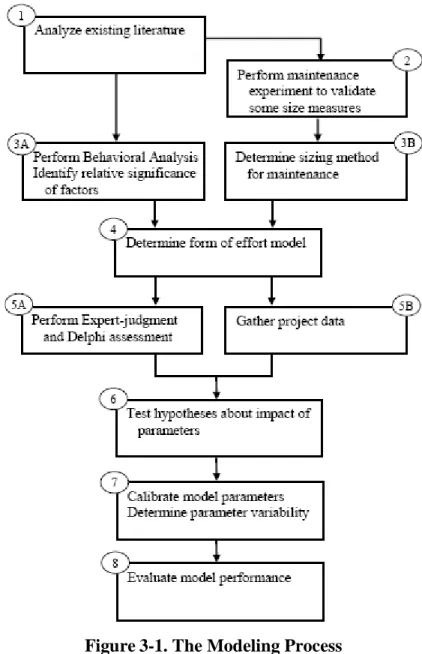
This part presents our research approach and framework to derive the extended COCOMO II size and effort models for software maintenance. Section 3.1 details the 8- step modeling process that is based on the generic COCOMO II modeling methodology discussed in [Boehm 2000b]. The techniques used to calibrate the proposed COCOMO II effort model for software maintenance are discussed in Section 3.2. And Section 3.3 presents the strategies used to validate and compare the performance of estimation models.
3.1 THE MODELING METHODOLOGY
Figure 3-1. The Modeling Process
3.2 THE CALIBRATION TECHNIQUES
This section describes three calibration techniques, namely ordinary least squares regression, Bayesian analysis, and constrained regression technique, which are applied to calibrating the cost drivers of the model.
3.2.1 ORDINARY LEAST SQUARES REGRESSION
3.2.2 THE BAYESIAN ANALYSIS
The Bayesian approach relies on Bayes’ theorem to combine the a priori
knowledge and the sample information in order to produce an a posteriori model. In the COCOMO context, the a priori knowledge is the expert-judgment estimates and variances of parameter values; the sample information is the data collected from completed projects. To compute the posterior mean and variance of the coefficients, we need to determine the mean and variance of the expert-judgment estimates and the sampling information. Steps 5A and 5B in the modeling process Figure 3-1 are followed to obtain these data.
4. THE COCOMO II® MODEL FOR REAL TIME SYSTEM
SOFTWARE MAINTENANCE
4.1 SOFTWARE MAINTENANCE SIZING METHODS
Size is the most significant and essential factor for the cost estimation model, inclusion of software maintenance cost (see Section 2.3). Thus, we must provide methods to measure the size of work effectively.
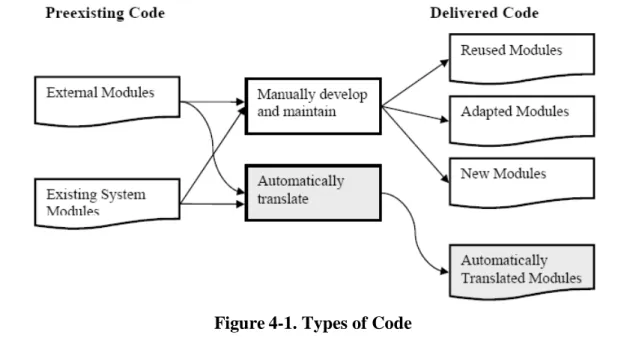
Unlike the new development, where the code for core capabilities does not exist, the software maintenance relies on the preexisting code. As a result, the maintenance sizing method must take into account different types of code and other factors, such as the effects of understanding the preexisting code and the quality and quantity of the preexisting code.
Figure 4-1 shows preexisting code as source inputs and delivered code as outputs of the development and maintenance activities.
4.2 COCOMO II® EFFORT MODEL FOR REAL TIME SYSTEM SOFTWARE
MAINTENANCE
We first assume that the cost of software maintenance follows the same form of the COCOMO II model. In other words, the model is nonlinear and consists of additive, multiplicative, and exponential components [Boehm and Valerdi 2008]. Furthermore, the cost drivers’ definitions and rating levels remain the same except that the Developed for Reusability (RUSE) and Required Development Schedule (SCED) cost drivers were eliminated, and rating levels for the Required Software Reliability (RELY), Applications Experience (APEX), Platform Experience (PLEX), and Language and Tool Experience (LTEX) were adjusted. Details of the changes and rationale for the changes are given as follows.
Elimination of SCED and RUSE
As compared with the COCOMO II model, the Developed for Reusability (RUSE) and
Required Development Schedule (SCED) cost drivers were excluded from the effort model for software maintenance, and the initial rating scales of the Required Software Reliability
(RELY) cost driver were adjusted to reflect the characteristics of software maintenance projects. As defined in COCOMO II, the RUSE cost driver “accounts for additional effort needed to develop components intended for reuse on current or future projects.” This additional effort is spent on requirements, design, documentation, and testing activities to ensure the software components are reusable. In software maintenance, the maintain team usually adapts, reuses, or modifies the existing reusable components, and thus, this additional effort is less relevant as it is in development. Additionally, the sizing method already accounts for additional effort needed for integrating and testing the reused components through the IM parameter.
5. RESEARCH RESULTS
5.1 THE CONTROLLED EXPERIMENT RESULTS
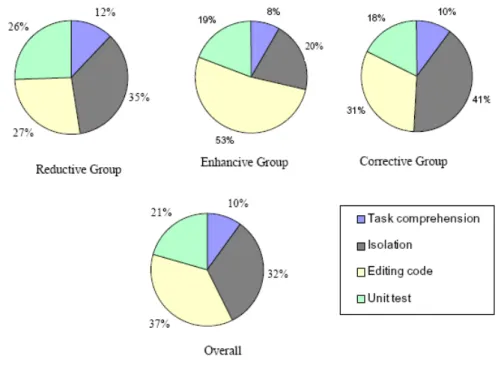
We performed a controlled experiment of student programmers performing maintenance tasks on a small C++ program [Nguyen 2009, Nguyen 2010]. The purpose of the study was to assess size and effort implications and labor distributions of three different maintenance types and to describe estimation models to predict the programmer’s effort on maintenance tasks.
5.1.1 EXPERIMENT RESULTS
Figure 5-1. Effort Distribution
6. FUTURE WORK
REFERENCES
1. Abrahamsson P., Moser R., Pedrycz W., Sillitti A., Succi G. (2007), "Effort Prediction in Iterative Software Development Processes -- Incremental Versus Global Prediction Models", Proceedings of the First International Symposium on Empirical Software Engineering and Measurement (ESEM)
2. Abran A. and Maya M. (1995), "A Sizing Measure for Adaptive Maintenance Work Products," Proceedings of the 11th International Conference on Software Maintenance (ICSM), pp.286-294
3. Abran A., St-Pierre D., Maya M., Desharnais J.M. (1998), "Full function points for embedded and real-time software", Proceedings of the UKSMA Fall Conference, London, UK, 14.
4. Abran A., Silva I., Primera L. (2002), "Field studies using functional size measurement in building estimation models for software maintenance", Journal of Software Maintenance and Evolution, Vol 14, part 1, pp. 31-64
5. Albrecht A.J. (1979), “Measuring Application Development Productivity,” Proc. IBM Applications Development Symp., SHARE-Guide, pp. 83-92.
6. Albrecht A.J. and Gaffney J. E. (1983) "Software Function, Source Lines of Code, and Development Effort Prediction: A Software Science Validation," IEEE Transactions on Software Engineering, vol. SE-9, no. 6, November.
7. Banker R., Kauffman R., and Kumar R. (1994), “An Empirical Test of Object-Based Output Measurement Metrics in a Computer Aided Software Engineering (CASE) Environment,” Journal of Management Information System.
8. Basili V.R., (1990) "Viewing Maintenance as Reuse-Oriented Software Development," IEEE Software, vol. 7, no. 1, pp. 19-25, Jan.
9. Basili V.R., Briand L., Condon S., Kim Y.M., Melo W.L., Valett J.D. (1996), “Understanding and predicting the process of software maintenance releases,” Proceedings of International Conference on Software Engineering, Berlin, Germany, pp. 464–474.