Evolutionary Timetabling Using
Biased Genetic Operators
Daniel Danciu
CS Department, Babes-Bolyai University, Cluj Napoca, Romania
Evolutionary Algorithms have proved to be a flexible and effective technique for addressing various instances of the timetabling problem. This article describes an investigation and its results on an evolutionary ap-proach to solving a particular class of highly constrained timetabling problems. The convergence speed of the evolution program has been significantly improved with the usage of biased operators, which generate offspring by preserving the building blocks of the parents. We also describe two metrics for measuring the efficiency of the genetic operators and how convergence speed has been improved by applying these metrics to fine-tune the probability of the genetic operators. Computational experiments over real test problems showed promising results.
Keywords: timetabling problem, biased operators, pres-ence quotient, improvement rate.
1. Introduction
The timetabling problem is a particular opti-mization problem, and consists of arranging a sequence of meetings between teachers and stu-dents in a period of time, subject to constraints of several types. In this paper we consider a particular instance of the timetabling problem, calledschool timetabling, which consists of cre-ating the daily schedule for all the classes of a high school, according to a predefined curricu-lum. Our main goal was to provide adminis-trative staff of public high schools in Romania an alternative solution for the handmade timeta-bles, which would both decrease the time spent in elaborating the timetable and produce better results. The particular characteristics observed for Romanian high schools are:
1)Each class of pupils is preassigned to a certain
room. There are some exceptions to this rule,
when a certain subject is to be held at a predeter-mined room or group of rooms(e.g. computer
science is taught in labs, sports in the sports room etc.); in this case care should be taken
that the number of subjects held simultaneously does not exceed the number of available rooms; 2)There are some subjects for which the class
of pupils is divided into two subgroups, each subgroup being tutored by a different teacher
(e.g. foreign languages);
3) Teaching starts at a predefined time for all
classes and breaks are not allowed in the pupils’ schedule. The number of hours per day varies between a predefined minimum and maximum; 4)Some of the subjects have to be grouped
to-gether in a continuous block.
The central problem in applying genetic algo-rithms to optimization problems is that of con-straints - and the timetabling problem incor-porates many nontrivial constraints of various kinds, which have been studied and categorized according to various criteria 5, 1]. Our
ap-proach of handling constraints is based on the principles of evolutionary programming6]:
ad-equate data structures and specialized genetic operators will take care that the potential solu-tions will satisfy the most important problem constraints. The remaining constraints are en-forced via penalties, and have been grouped in the following categories:
—teacher clashes: the most prominent overall constraint(central to all timetabling problems)
is that there should be no clashes 8]; that is,
— organizational constraints (e.g. having no
more than two sports classes at the same time);
— didactic constraints(e.g. having more
dif-ficult subjects distributed in the first part of the day);
— personal costs (e.g. all teachers prefer to
have their lectures for a day scheduled continu-ously, without breaks).
The convergence speed of the evolutionary al-gorithm is improved with the usage of biased genetic operators, which take into consideration information regarding violation of the penalties, calculated at the evaluation step. Biasing is ap-plied to both the mutation and the crossover operators. The role of mutation in genetic algo-rithms using non-binary encodings of the solu-tions goes beyond recovering desirable genes that have been accidentally deleted from the population9, 4]. In evolutionary programming,
the mutation operator plays an important role as an exploratory tool as well, seeking to iden-tify new desirable genetic structures. The bi-ased mutation operators described in this paper are devised as an enhanced exploratory tool, which replaces "blind", random alterations of the chromosomes with changes that preserve building blocks and are more likely to produce better offspring. The role of crossover in ge-netic algorithms is to combine features in the mating parents to produce, hopefully, better off-spring. Driven by this idea, there have been many efforts to improve the crossover opera-tors for the timetabling problem, which often resulted in better, but more complex and com-putationally intensive operators 10, 11]. The
biased crossover operator defined in section 2.4 has the advantage that it is both computationally efficient and clearly outperforms the unbiased version.
We measure the efficiency of the proposed ge-netic operators using two metrics: improvement rate and presence quotient. Even though de-fined in the timetabling context, the two metrics can be used to measure the effectiveness of the genetic operators of any evolutionary algorithm. The paper is divided as follows: Section 2 de-scribes the particular elements of the evolu-tionary algorithm that solves the high school timetabling problem: the solution encoding, the objective function, the genetic operators, and the initial population. Section 3 presents
the operator efficiency metrics, the experimen-tal setup and the results. Section 4 provides a concluding discussion and pinpoints some di-rections for further work.
2. The Problem
There are many versions of the timetabling problem, and most of the efficient approaches are tailored to a particular version. In our case, we have a list of teachersT1 T2 ::: Tm, a list
of classesC1 C2 ::: Cn, a list of one hour time
intervalsH1 H2 ::: Hp(partitioned intoq
sub-sets corresponding to the working days of the week), we have to find an optimal timetable,
i.e. a timetable that satisfies the constraints de-scribed in Section 1.
2.1. Solution Encoding
The most natural (but, surprisingly, not used)
data structure for the chromosome representa-tion of a potential solurepresenta-tion is the matrix rep-resentation in which the rows are the classes, the columns are the hours of the day, and the cells contain the teacher(s)lecturing a
particu-lar class at a given time, plus some additional information as described below.
Colorni et al. use in 1] a similar matrix
rep-resentation, except that the rows in their case represent the list of teachers and the cells con-tain the classes. Gyori et al. 5] have
intro-duced the notion ofset, which consists of any number of teachers, classes and rooms, and al-lows class merging and splitting in a very flexi-ble way, with the cost of imposing supplemen-tary constraints(which were otherwise handled
by the matrix representation)via penalties. In
our approach, splitting of classes is handled by encoding supplementary information inside the cells of the matrix. An elementxijof the
chro-mosome matrix consists of a tuple(t1 t2 c p).
The first two components of the tuple contain the teachers that lectureCiat timeHj(a value of
0 means “no teacher”). The third component,
be taught simultaneously, due to some limited resources(computer science labs, sports rooms
etc.). Since these rules are problem specific,
they are imposed via the evaluation function. The forth component, p, encodes special prop-erties of the lecture, which need to be considered by the genetic operators and/or the evaluation
function:
—Immutable: The lecture cannot be moved by the genetic operator — it is required to remain as it was set up initially.
—Block: The lecture is part of a block (
com-puter science labs are scheduled in blocks of two, three or four hours); genetic operators are
allowed to move blocks, but are not allowed to split blocks.
—Difficult: The subject has an increased level of difficulty, and thus it would be desirable to schedule it at the beginning of the day; this property represents a didactic constraint and is handled via the evaluation function.
2.2. Objective Function
The representation of the solution described in the previous paragraph handles most of the im-portant constraints. Thus, the initial population is generated so that the curriculum for each class is respected and there are no breaks in the stu-dents’ schedule; genetic operators do not alter these constraints. The representation does not allow class clashes. The rest of the constraints are enforced via the selection pressure driven by the objective function.
The objective function measures a generalized cost, which represents the distance between a perfect timetable, respecting all constraints, in-cluding the organizational, didactic and per-sonal requirements. Due to the contradictory nature of the constraints, in most of the cases the value of the objective function is positive for all timetable instances. The objective function for a timetable matrixXis defined as:
f(X)=α c+β b+γ o(X)+δ d(x)+ p(X)
wherec is the number of clashes inX,b is the number of undesired breaks for teachers, o(X)
is the cost of unsatisfied organizational costs for
X,d(X)is the cost of unsatisfied didactic costs
for X, and pis the cost of unsatisfied personal
costs. The organizational, didactic and personal costs differ from one school to another, and thus
o,dandpare defined ad-hoc for each particular instance. By choosingα β ' γ δ ' ,
we induce ahierarchical structurein the objec-tive function 1], so that we are able to drive
the evolutionary process towards solving a par-ticular category of constraints at each evolution stage.
The objective function represents the basis for the computation of the fitness function, which has the role of environmental feedback in the evolutionary process. The need to distinguish between the objective and the fitness function is given by the need of making the selection pro-cess more effective6]. We have used F(X) =
1=(1+ f(x))as the fitness function, combined
with alinear dynamicfitness scaling6, 1]
pro-cedure. Due to the nature of the objective func-tion, it is essential to use the fitness scaling method, as otherwise the algorithm reduces to a blind search in the solution space.
2.3. Initial Population
Unlike other approaches 3, 1], which used
the available handmade timetables as the ini-tial population, we have used as a starting point a randomly generated population optimized us-ing a simple heuristic approach, to reduce the number of clashes. We have also tested the al-gorithm with completely random populations; this made the evolutionary process somewhat longer, but did not significantly influence the final outcome. In both cases the initialization process was constructed so that all individuals respect the constraints that can be maintained via the solution encoding, as described in the previous paragraph.
2.4. Biased Operators
The genetic operators used in the algorithm, are the classical matrix genetic operators, as de-scribed in1, 2]. We managed to improve the
convergence speed of the algorithm by altering the above operators to act in a biased way in-stead of a uniform way. The idea is that both the crossover and the mutation operators randomly pick some lines(classes)and columns(time
in most evolutionary approaches the nature of the solution encoding does not allow localizing the genes that are the cause of the constraint violations, in our matrix representation this is quite straightforward to do.
When evaluating an individual, the evaluation algorithm counts, for each row and each col-umn, the number of cells that are causing con-straint violations(clashes, breaks in the
teach-ers’ schedule etc.) and calculates a weighted
sum of these infeasibilities, in a similar man-ner as for the hierarchical objective function. This sum represents a violation score that can be used to infer which classes and time inter-vals are more problematic in the timetable rep-resented by the current individual. We put this information to use in two ways: direct the mu-tation operators towards problematic genes and preserve building blocks in crossover operators. Most of the matrix mutation operators basically reduce to exchanging two groups of cells, ran-domly selected. We can use the violation score for each row and column to direct the action of the mutation operators in a very simple way. The idea is to move away the cells that are causing constraint violations into zones with-out or with less constraint violations. Thus, when selecting the first group of cells, we assign each row and column a probability of selection, which is directly proportional to the violation score. We can then use any of the standard evo-lutionary selection schemes to select the rows and columns that belong to the first group of cells. We have chosen to use the straightforward roulette wheel method for this. A good reason for this choice is simplicity. For example, we can easily select a column by generating a ran-dom number between 0 and the total violation score for all columns. After that, we traverse the columns, decreasing the random number with the column’s violation score, until it becomes negative. The column where we stopped is se-lected for mutation. Rows can be sese-lected in a similar manner.
The idea of using violation-directed mutation operators is not new. Ross et al. 7], have
de-vised and studied an improved mutation opera-tor, called directed mutation, which exchanges two genes selected using constraint violation in-formation in a similar way. The differences are that Ross et al. also consider constraint viola-tion informaviola-tion for choosing the allele where
the first group is going to be placed, whereas in our case the second group of cells is randomly selected, and Ross et al. only consider sin-gle gene mutations, while the matrix encoding used in this paper naturally allows biasing for all mutation operators(for example, day-swap
mu-tation, which exchanges two blocks of genes).
The reason for randomly selecting the second group of cells is that calculating the constraint violation score for each possible allele position is computationally expensive and seems more adequate for a genetic repair algorithm(2, 1])
than for a mutation operator.
The violation score can also be used for devising efficient crossover operators, which tend to pre-serve building blocks. It is known that crossover is the main source of exploration in the evolu-tionary process. The problem in crossover is to find the proper tradeoff between preservation of schemata(and thus, of the building blocks)and
the effective recombination. In other words, we need to find a balance between the extent to which good solutions obtained at a certain phase are preserved and the extent to which new regions of the search space are explored. By bi-asing the crossover operator we address exactly this problem.
Our algorithm uses two crossover operators:
section crossoverandline-swap crossover. Sec-tion crossover takes two parents and generates two offspring by horizontally cutting the par-ent matrices(at a random line)and exchanging
the lines below the cut. Similarly, line-swap crossover takes two parents and generates two offspring by selecting several lines from each parent that are going to be replaced with lines from the other parent. Line-swap crossover can be easily enhanced by making use of the vio-lation score. Instead of randomly selecting the lines that are going to be swapped, we bias the probability of selection, so that lines having a larger violation score have more chances to be selected for being replaced. Thus, the resulting operator will tend to keep the building blocks
(solved subproblems)of the parents and pass it
3. Efficiency Measurement of the Genetic Operators
Given the matrix representation of the timetable, it is very easy to devise several mutation and crossover operators 2]: cell-swap mutation,
day-swap mutation, day-permutation mutation, column-swap mutation, section crossover, line crossover etc.
The list could go on with several other opera-tors, but the question is how much does each of these operators improve the convergence speed of the evolutionary algorithm? One could ex-periment with assigning different probabilities to each of the operators and see how the qual-ity of the results is affected over several test runs. However, this method does not always give conclusive results and does not offer con-crete comparison criteria between the genetic operators. We have devised two simple metrics which characterize the efficiency of the genetic operators: improvement rateandpresence quo-tient.
The improvement rate is defined as the num-ber of times the operator actually brings an im-provement on the individual divided by the total number of times it is applied. Thepresence quo-tient’s calculation is slightly more complex. For each individual in the population, we store the sequence of operators that has lead to its ge-neration. We call this sequenceoperator chain. Then, we count how many times a specified operator appears in the operator chain and di-vide this number with the expected number of appearances, obtaining thepresence quotient. If operators would be equally efficient, the pres-ence quotientshould be approximately equal to 1. However, practice has proven that this is not the case. Naturally, we are interested in the presence quotient of the best individuals in the population, as this gives a good hint upon how much each operator has contributed to obtaining the solution of the problem.
In order to test the performance of our evolu-tion program, we implemented it in Java(source
code available at http://www.danciu.ro/tt),
and tested it using concrete inputs. The input data contained m = 54 teachers and n = 23
classes. We considered q = 5 working days,
each day having at most 7 hours; the number of time intervals is p = 35. The total
num-ber of hours to be taught is 739, out of which
123 are taught in subgroups (two teachers at
the same time), which gives an average of 16
hours per teacher and a coverage of 91% of the available time. The generated timetables were better in terms of cost than the handmade ones: they contained no clashes, no undesired breaks in the teachers’ schedules and managed to fulfill most of the organizational, didactic and personal goals.
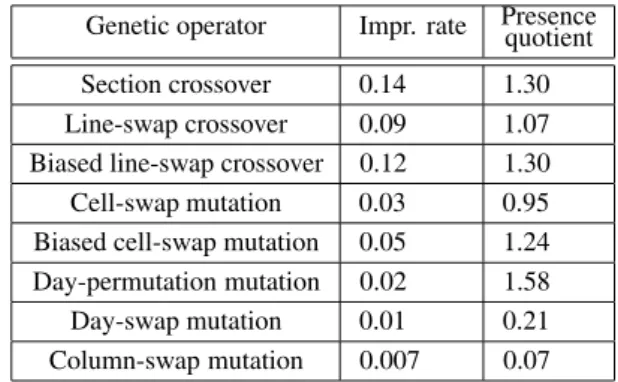
Table 1 summarizes the average values for the improvement rate and presence quotient of the six genetic operators enumerated above plus the biased versions of cell-swap mutation and line-swap crossover operators. The superiority of the biased operators over their unbiased coun-terparts is clearly proved by both a higher im-provement rate and a higher presence quotient.
Genetic operator Impr. rate Presencequotient Section crossover 0.14 1.30 Line-swap crossover 0.09 1.07 Biased line-swap crossover 0.12 1.30 Cell-swap mutation 0.03 0.95 Biased cell-swap mutation 0.05 1.24 Day-permutation mutation 0.02 1.58 Day-swap mutation 0.01 0.21 Column-swap mutation 0.007 0.07
Table 1.Average values of the efficiency metrics for the genetic operators over ten test runs.
By analyzing the values in Table 1 we came to the following conclusions:
genetic algorithms theoretical point view: an algorithm with a mutation rate higher than the crossover rate clearly outperformed the classi-cal algorithm with low mutation rates;
— day-swap and column-swap mutation opera-tors bring little contribution to the convergence speed and their probability can be reduced; — since the values of the improvement rate and of the presence quotient are consistent (lower
improvement rate corresponds to lower pres-ence quotient and vice versa)we can conclude
that the two metrics are a valuable tool for em-pirically measuring the relative efficiency of the genetic operators.
It is interesting to note that higher values of the improvement rate for the operators over two distinct configurations of the evolutionary al-gorithm do not necessarily imply a better con-vergence rate. On the contrary, by introduc-ing inefficient genetic operators, which tend to slow down the evolutionary process, the im-provement rates for the rest of the operators get higher, but this is only because the new opera-tors increase the diversity of the population and thus give more chances for the other operators to repair below-average individuals.
Fig. 1.Best individual fitness over 1000 generations for the initial and the fine-tuned probabilities; repeated runs
give very similar results.
4. Conclusion
We have shown that concrete timetabling prob-lems can be effectively addressed by an evo-lutionary algorithm which uses a direct matrix representation and well-selected genetic oper-ators. The biased genetic operators have been proposed as an alternative to the classic matrix operators. The operator efficiency metrics mea-sure the effectiveness of the genetic operators
from two points of view. The presence quotient shows how much each operator has contributed to creating the best individual, while the im-provement rate measures how much each oper-ator has contributed to improving or repairing the individuals in the population. The expe-riments performed have shown that these two metrics are consistent and can be reliably used to compare the relative efficiency of the genetic operators defined for an evolution program. The proposed algorithm will be experimentally used in the next year at the Computer Science high school in Bra¸sov.
References
1] COLORNI A., DORIGO M., MANIEZZO V., Meta-heuristics For High-School Timetabling, Compu-tational Optimization and Applications1997; 9(3): pp. 277–298.
2] DANCIU D., SASU L.M., Solving The Timetable Problem With Multiple Constraints Using Genetic Algorithms, in: Orman G., editor, Proceedings of the 2nd International Conference on Symmetry and Antisymmetry; 2000 Jun 29–30; Brasov, Ro-mania. Transilvania University, Brasov; 2000., pp. 137–145.
3] FILHOR.G., LORENAL.A.N., A Constructive Evolu-tionary Approach to School Timetabling, in: Boers EJW et al. editors, Applications of Evolutionary Computing: Proceedings of EvoWorkshops, 2001, Apr 18–20; Como, Italy, 2001, pp. 130–139. 4] GOLDBERGD.E.,Genetic Algorithms in Search,
Op-timization and Machine Learning, MA: Addison-Wesley; 1989.
5] GYORIS., PETRESZ., VARKONYI-KOCZYA.R., Ge-netic Algorithms in Timetabling. A New Approach, MFT Periodika2001.www.mft.hu/hallg/ 200107.pdf 02/15/2003].
6] MICHALEWICZ Z., Genetic Algorithms + Data Structures = Evolution Programs, New York: Springer-Verlag; 1994.
7] ROSSP.M., CORNED., FANGH.L., Improving Evo-lutionary Timetabling with Delta Evaluation and Directed Mutation, in: Davidor Y., Schwefel H.P., Manner R., editors,Proceedings of PPSN III; 1994 Oct 9–14; Jerusalem, Israel, pp. 556–565.
8] ROSSP.M., CORNED., FANGH.L., Successful Lec-ture Timetabling with Evolutionary Algorithms, in: Eiben A.E., Manderick B. and Ruttkay Zs., editors, Proceedings of the ECAI 94 Workshop on Applica-tions of EAs; 1994 Aug 9; Amsterdam, Netherlands. ECCAI; 1995, pp. 23–34.
10] TERASHIMA-MARINH., ROSSP.M., VALENZUELA -RENDONM., Clique-Based Crossover For Solving
the Timetabling Problem with GAs, in: Schoe-nauer M. et al., editors, Proceedings of CEC 99 Conference; 1999 Jul 6–9; Washington, USA, pp. 1200–1206.
11] YAMADAT., NAKANO R., Scheduling by Genetic Local Search with Multi-Step Crossover, in: Voigt H-M. et al., editors,Proceedings of PPSN IV; 1996 Sep 22–26; Berlin, Germany, pp. 960–969.
Received:June, 2003 Accepted:September, 2003
Contact address: Daniel Danciu CS Department Babes-Bolyai University M. Kogalniceanu 1˘ RO-3400 Cluj Napoca Romania e-mail:[email protected]