Analysis of an Immune Algorithm for Protein Structure Prediction
Andrew J. Bennett, Roy L. Johnston, and Eleanor Turpin University of Birmingham, Birmingham, United Kingdom E-mail: [email protected]
Jun Q. He
Aberystwyth University, Aberystwyth, United Kingdom
Keywords:HP lattice bead model, immune algorithm, population diversity tracking, protein modelling
Received:June 23, 2008
The aim of a protein folding simulation is to determine the native state of a protein from its amino acid sequence. In this paper we describe the development and application of an Immune Algorithm (IA) to find the lowest energy conformations for the 2D (square) HP lattice bead protein model. Here we intro-duce a modified chain growth constructor to prointro-duce the initial population, where intermediate infeasible structures are recorded, thereby reducing the risk of attempting to perform wasteful point mutations during the mutation phase. We also investigate various approaches for population diversity tracking, ultimately allowing a greater understanding of the progress of the optimization.
Povzetek: V ˇclanku je opisan razvoj in izvedba imunskega algoritma (IA) za iskanje najnižje energijske strukture za 2D (kvadratne) HP mrežno nanizanega modela proteina.
1 Introduction
Predicting the 3-dimensional secondary and tertiary struc-ture of a protein molecule from its (primary strucstruc-ture) amino acid sequence alone is an important problem in chemical biology [1]. Under certain physiological condi-tions, the amino acid chain will reliably fold into a specific native state (biologically active conformation). The pro-tein folding problem is the search for this native state for a given sequence of amino acid residues. The reliability of protein folding is said to be dominated by the presence of a “folding funnel” on the folding energy landscape since sys-tematic or random searching is clearly infeasible for large numbers of amino acids [2]. Therefore, discovering the na-ture of the folding energy landscape is necessary to develop a better understanding of the folding dynamics [3].
Many protein models have been developed, ranging from simple, minimalist models such as the HP lattice bead model [4], to more complicated and computationally ex-pensive models such as off-lattice interpretations. The most common lattice structures are 2D square and 3D cu-bic. More computationally intense models include the dy-namical lattice and all-atom models, both introducing more complicated fitness functions.
In this work, the standard HP lattice bead model has been incorporated into an immune algorithm. Despite the min-imalistic approach employed by this model, it has been shown to belong to the “NP-Hard” set of problems [5]. Monte Carlo [6], chain growth algorithms [4], simulated annealing [7], genetic algorithms [5, 8, 9], ant colony op-timization [10] and more recently immune algorithms [11]
have been developed by many researchers as heuristic and approximate solutions for this and other computationally hard problems.
2 Methodology
2.1 The HP lattice bead model
In this work, the standard HP lattice bead model is embed-ded in a 2-dimensional square lattice, restricting bond an-gles to only a few discrete values [4]. Interactions are only counted between topological neighbours, that is between beads (representing amino acids) that lie adjacent to each other on the lattice, but which are not sequence neighbours [3]. The energies corresponding to the possible topological interactions are as follows:
²HH =−1.0 ²HP = 0.0 ²P P = 0.0 (1)
By summing over these local interactions, the energy of the model protein can be obtained:
E=X
i<j
²ij∆ij (2)
where
∆ij =
1 if i and j are topological neighbours, but are not sequence neighbours; 0 otherwise.
HP-20b 20 -9 HP HP2H2P HP2HP H2P2HP H HP-24 24 -9 H2P2(HP2)6H2
HP-25 25 -8 P2HP2(H2P4)3H2
HP-36 36 -14 P3H2P2H2P5H7P2H2P4H2P2HP2 HP-48 48 -23 P2H(P2H2)2P5H10P6(H2P2)2HP2H5
HP-50 50 -21 H2(P H)3P H4P(HP3)3P(HP3)2HP H4(P H)4H
Table 1: Benchmark HP sequences used in the present study [12]. The lowest energies that have been found for these sequences are indicated byE∗.
many native structures protecting the hydrophobic core with polar residues, resulting in a compact arrangement [11]. This idea reflects the repulsive nature of the interac-tions between the hydrophobic residues and the surround-ing water molecules [3].
2.2 The coordinate system
A previous study has illustrated how a local coordinate sys-tem offers better performance than a global one for study-ing protein foldstudy-ing [2]. In this work, alocal coordinate sys-temis used to define the folding conformation of the model proteins, that is the position of beadjis defined relative to beads(j−1)and(j−2). As the energy is identical for ro-tationally related structures, the bond between the first two beads lies along thex-axis, with these beads having coor-dinates (0,0) and (1,0) respectively. As a result, the search spaced is halved. The bond joining the(j−1)thandjth beads can be left, right or straight ahead relative to the bond joining the(j−2)thand(j−1)thbead, corresponding to an integer representation of 0, 1 and 2 respectively. The pro-tein conformation is therefore expressed as aconformation vector, containing a list of 0’s, 1’s and 2’s.
For this study, a set of well investigated protein bench-mark sequences have been considered: the tortilla HP benchmark sequences [12]. They range in length from eighteen to fifty beads and are listed in Table 1. The table also includes the energy, E∗, of the putative global
mini-mum (or conformations, since all of these structures have degenerate global minima) for each sequence.
3 The immune algorithm
An immune algorithm [13] is inspired by the clonal selec-tion principle employed by the human immune system. In this process, when an antigen enters the body, B and T lym-phocytes are able to clone upon recognition and bind to it [13]. Many clones are produced in response and undergo many rounds of somatic hypermutation. The higher the fit-ness of a B cell to the available antigens, the greater the chance of cloning. Cells have a certain life expectancy,
al-lowing a higher specific responsiveness for future antigenic attack [11].
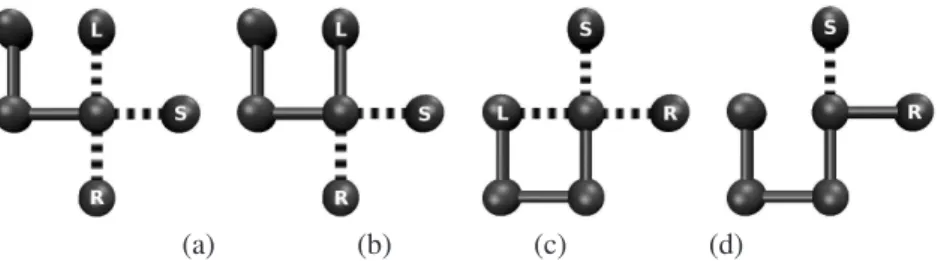
The IA presented here includes the aging, cloning and selection operators used in a previous study by Cutelloet al. [11], with modified constructor and mutation opera-tors. The constructor employs a backtracking algorithm that records some of the possible mutations by testing bead placement during chain growth. These possibilities are ex-ploited and updated during the mutation process, prevent-ing an infeasible conformation from occurrprevent-ing based on the preceding self-avoiding structure for a particular point in the model protein chain. In retaining this information, infeasible mutations are not explored, allowing a greater number of constructive mutations to be investigated. Fig-ure 1 illustrates the stages involved in placing two consec-utive beads during the chain growth phase. Before com-mitting a bead to the lattice, all possible directions are ex-plored, 1(a), and from the valid options available, a random choice is made, 1(b). Again all possible choices are inves-tigated, marking any infeasible options (note that choosing left will not result in a self avoiding conformation), 1(c), and a valid choice is selected from the remaining options, 1(d). Any remaining valid choices are left unmarked for use in the first mutation phase after the initial chain growth. Once a valid mutation has been made, the entire structure is reconstructed as before marking any infeasible directions as a result of the new conformation vector.
popu-(a) (b) (c) (d)
Figure 1: Stages of the chain growth algorithm investigating left (L), right (R) and straight (S) availability (a), random selection from all available directions (b), at the next locus investigation of L, R and S availability (c) and random selection from remaining available S and R directions (d).
lation size of 10. All results quoted are averaged over 30 independent runs.
4 Results
4.1 Algorithm comparison
With CPU time being hardware dependent, the number of fitness evaluations (together with the percentage success rate) have been used to assess the efficiency of the algo-rithm, as shown in Table 2 for the benchmark sequences.
It is apparent from Table 2 that, although the use of mem-ory B-Cells [11] hinders the discovery of global minima for some of the smaller sequences, it enhances the search for the larger, more difficult to find sequences. The memory ability allows mid to high fitness conformations to remain in the population for a longer number of generations. For larger sequences, this allows a more detailed exploration in certain areas of the potential energy surface, permitting the memory B-Cells to converge towards the global solution much sooner. In contrast, for smaller sequences the mid to high fitness range is much smaller, thereby preventing a rapid exploration of the potential energy surface by retain-ing unfavourable segments of local structure for a larger number of generations. Generally, the use of memory B-Cells allows a more diverse inspection of the potential en-ergy surface, due to a greater number of the degenerate conformations being found. This is achieved as favourable fragments of local structure are not rapidly disposed of dur-ing the retirement process, hinderdur-ing efficiency as a conse-quence.
The algorithm presented here shows promising results, being comparable to the work of Cutelloet al.[11]. While our success rates for the larger sequences (e.g. HP-48) are a little lower, in some cases our number of fitness evaluations show an improvement.
4.2 Analysis of global minima
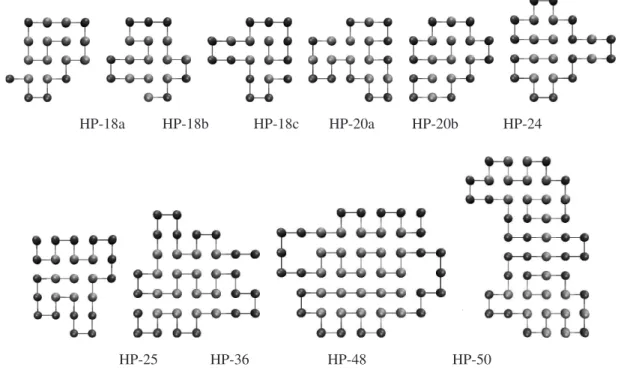
The compact structural arrangement present in all global minima (GMs) is apparent from the example GMs shown in Fig. 2. With the driving force being the hydrophobic topological contact, it can be seen that compact hydropho-bic cores give rise to high fitness conformations. Inspection
of the HP-48 global minimum (i) allows us to understand the poor success rate for this sequence. The 5×5 hydropho-bic core presents a problem to the IA (or other optimization algorithms [3]) in achieving convergence, as a single mis-placed hydrophobic bead will result in only a metastable conformation. The problem does not exist for the HP-50 sequence (j), due to the presence of two small hydropho-bic cores coupled by a chain of hydrophohydropho-bic beads, which explains the higher success rate and fewer average struc-ture evaluations necessary for 50, compared with HP-48 and (when using memory B-cells) even the much shorter HP-36 sequence [3]. The work of Cutelloet al. supports this idea [11], as similar magnitudes of the number of fit-ness evaluations for these problematic sequences can be seen, with a much lower success rate for HP-48 than for any other instance.
4.3 Tracking population diversity
The much larger populations required to ensure popula-tion diversity can be problematic for both GAs and IAs. In this section, a single run, with population size 200 for sequence HP-20a has been analyzed. The global minimum was found in generation 28, at which point the algorithm was terminated due to meeting the search criteria. In order to help us understand the progress of the optimization and ultimately to improve the methodology, monitoring popu-lation diversity and the progress of the algorithm is benefi-cial.
HP-20a 100 26,207 100 312,405
HP-20b 100 15,221 100 30,414
HP-24 100 26,580 100 49,616
HP-25 100 79,042 100 95,123
HP-36 63 4,867,993 90 3,082,014
HP-48 3 6,318,721 3 4,195,086
HP-50 50 4,904,031 96 853,706
Table 2: Comparison of the percentage success and average number of structure evaluations with and without using memory B-Cells
HP-18a HP-18b HP-18c HP-20a HP-20b HP-24
HP-25 HP-36 HP-48 HP-50
Figure 2: Examples of GM structures for the benchmark sequences.
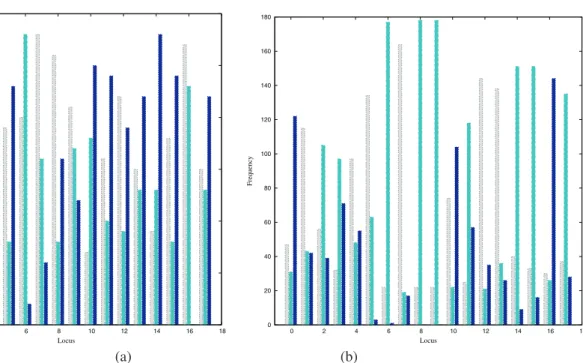
Figure 4 shows a graphical representation of the initial and final populations of the calculation. By plotting the conformation vector for each population member, the pop-ulation can be quickly compared for diversity. Poppop-ulation members are ordered by descending fitness and the colour scheme is similar to the allele frequency distribution shown in Fig. 3, but with white replacing grey for the left choice. It is clear that initially the population has high diversity (in agreement with the allele frequency plot shown above), with the algorithm preserving favourable regions of local structure (corresponding to schemata in a GA sense) as the calculation converges. More detailed analysis of the final population shows that there are often correlations (or anti-correlations) between directions at specific loci, with cer-tain combinations giving rise to favourable energies or in-feasible structures, respectively.
For simple protein models such as the HP lattice bead
(a) (b)
Figure 3: The frequency of alleles at each locus along the model protein chain for the initial population (a) and the final population (b), left (light grey), right (dark grey) and straight ahead (black).
(a) (b)
(a) (b)
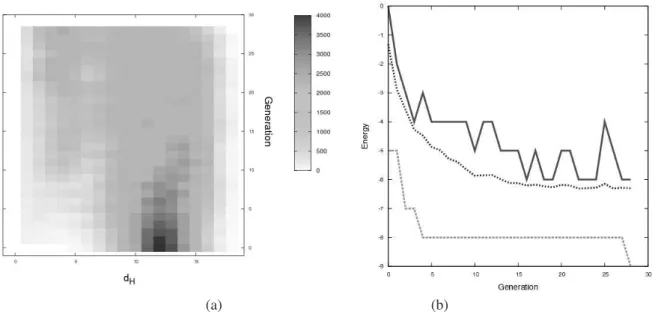
Figure 5: (a) The density of pairwise Hamming distances,dH, between population members throughout the calculation.
(b) The change in energy throughout the calculation, showing the best (dashed), worst (solid) and average (doted) energies in each generation.
population diversity drastically decreases during the final stages of the calculation, not just in the final generation. This confirms that the calculation has not discovered the global minimum by chance, but a directed search strategy has been employed.
5 Conclusions
Although implementation of a modified constructor for use in the mutation phase of the IA has not always given greater success rates (especially for more challenging sequences), it has allowed for a more efficient search to be performed in some cases, showing a descrease in the number of fit-ness evaluation performed. The use of population diversity tracking allows a greater understanding of the algorithm’s ability to explore areas of the potential energy surface of these simple model proteins. Areas of favourable local structure along the chain can be assessed, illustrating the important allele combinations that give rise to the determi-nation of global minima. We are currently applying these approaches to more realistic protein models.
Acknowledgements
AJB thanks Dr Benjamin Curley for programming assis-tance and the University of Birmingham for PhD funding. Calculations were performed on the University of Birming-ham’s BlueBEAR 1500+ processor cluster, funded by the EPSRC (under SRIF3) and the University of Birmingham.
References
[1] K.M. Merz (ed.).The Protein Folding problem and Structure Prediction. Birkhauser, 1994.
[2] N. Krasnogor, W.E. Hart, J. Smith, and D. Pelta. Protein Structure Prediction with Evolutionary Algo-rithms. InProc. 1999 International Genetic and Evo-lutionary Computation Conference (GECCO99), Or-lando, Florida, USA, 1999, pages 1569–1601.
[3] G.A. Cox and R.L. Johnston. Analyzing Energy Landscapes for Folding Model Proteins. J. Chem. Phys., 124(20):204714, 2006.
[4] T. Beutler and K. Dill. A Fast Conformational Search Strategy for Finding Low Energy Structures of Model Proteins.Protein Sci.5(10):2037–2043, 1996.
[5] R. Unger and J. Moult. Genetic Algorithms for Pro-tein Folding Simulations. J. Mol. Biol., 231:75–81, 1993.
[6] R. Ramakrishnan, B. Ramachandran, and J.F. Pekny. A Dynamic Monte Carlo Algorithm for Exploration of Dense Conformational Spaces in Heteropolymers.
J. Chem. Phys., 106(6):2418–2425, 1997.
[7] S. Kirkpatrick and C.D. Gellat. Optimization by Simulated Annealing. Science, 220(4598):671–680, 1983.
[8] W. Liu and B. Schmidt. Mapping of Genetic Algo-rithms for Protein Folding onto Computational Grids.
[9] J. Song, J. Cheng, T. Zeng, and J. Mau. A Novel Genetic Algorithm for HP Model Protein Folding. In
Proc. Sixth International Conference on Parallel and Distributed Computing Applications and Technolo-gies (PDCAT’05), Dalian, China, 2005, pages 935– 937.
[10] A. Shmygelska and H.H. Hoos. An Improved Ant Colony Optimization Algorithm for the 2D HP Pro-tein Folding Problem. Lect. Notes Comput. Sci., 2671:400–412, 2003.
[11] V. Cutello, G. Niscosia, M. Pavone, and J. Tim-mis. An Immune Algorithm for Protein Structure Pre-diction on Lattice Models. IEEE T. Evol. Comput., 11(1):101–117, 2007.
[12] W.E. Hart, S. Istrail. HP Benchmarks. www.cs. sandia.gov/tech_reports/compbio/ tortilla-hp-benchmarks.html.
![Table 1: Benchmark HP sequences used in the present study [12]. The lowest energies that have been found for these sequences are indicated by E ∗ .](https://thumb-us.123doks.com/thumbv2/123dok_us/8045815.2130489/2.892.209.708.124.326/table-benchmark-sequences-present-lowest-energies-sequences-indicated.webp)