An Approach to Validation of Fuzzy
Qualitative Temporal Relations
Slobodan Ribari´c, Bojana Dalbelo Ba
si´c and Lada Male
ˇ
s
ˇ
1Faculty of Electrical Engineering and Computing, University of Zagreb, Croatia 1Faculty of Natural Science, Mathematics and Education, Split, Croatia
A geometrical approach to validation of fuzzy temporal relations between fuzzy time primitives, based on the possibility and necessity measures are proposed. Fuzzy temporal relations between fuzzy time points and fuzzy time point and fuzzy time interval are considered. The same approach can be used for evaluation of relation between two fuzzy intervals. An example of validation of temporal relations between a fuzzy time point and fuzzy time interval is given.
Keywords: fuzzy temporal knowledge, fuzzy temporal relations, necessity and possibility measures.
1. Introduction
Research interest in modelling and implement-ing a technical system that can exhibit some as-pects of human intelligence has led to develop-ing various kinds of knowledge representations and reasoning schemes.
As the notion of time is one of the most im-portant aspects of human intelligence, an ef-fort to formalize temporal reasoning process has gained much attention of the artificial intelli-gence community from the very beginning. It is out of the scope of this paper to give an exten-sive overview of the proposed temporal models but here are some of them, given in chronolog-ical order, that are also relevant for this paper. The time specialist 6], interval-based temporal logic 1], formal logic of plans 7], time maps 3], temporal constraint networks 4], Petri nets with time concepts 8], 12], 15], etc. The fact that human knowledge about time is usually in-complete, pervaded with uncertainty and vague-ness and expressed by vague linguistic terms, has made various kinds of representation and
reasoning schemes necessary for dealing with vague, incomplete temporal information. The fuzzy set theory 13]and the possibility the-ory 14] established by Zadeh represent a very convenient framework for dealing with fuzzy temporal knowledge and are applied in 2], 5],
10]and 11].
Following the idea of building a model capa-ble of effectively reasoning about time in vague environment, just as humans successfully do in every day life, we focus our research interest on the following issues:
representational capabilities of the model have to include vague linguistic term con-cerning both, fuzzy time point and fuzzy time interval(e.g. “about five o’clock”, “ap-proximately between six and eight o’clock”), and
the reasoning process has to include qualita-tive temporal relations between time points and time intervals (e.g. “before the begin-ning of the meeting”, “during the meeting”, “after the meeting” etc.).
In order to fulfill the above demands we have proposed geometrical approach for validation of fuzzy qualitative temporal relations 1], based on the possibility and necessity measures 5],
16].
The paper is organized as follows. In Section 2 basic definitions, a description of fuzzy tem-poral relations and a geometrical approach to validation of possibility and necessity measures are given.
points, and fuzzy time point and fuzzy time interval. An example of validation process is given in Section 4.
2. Reasoning with Fuzzy Temporal Knowledge
2.1. Basic Definitions
In this section some basic fuzzy set theory def-initions 13], 14], used in this paper, are given. The fuzzy set A on the universal set U is the function µA : U ! 0 1], so that µA(x) rep-resents the degree of membership of the
ele-ment x 2 U to the fuzzy set A. The height
ofA is hgt(A) = supx 2UµA
(x). It is said that a fuzzy set is normal iff hgt(A) = 1. Sup-port and core of A are crisp sets, defined by supp(A)=fx 2UjµA(x)>0gand core(A)= fx 2UjµA(x) =1g, respectively. IfAis trian-gular normal fuzzy set the cardinality of core(A) is 1.
The time point(or time instant)is a time prim-itive and it describes an event, the beginning or end of some action/state. The fuzzy time point will be denoted bya,b,c, etc. The know-ledge about the time pointais presented in the form of a possibility distribution function πa 5]. The possibility distribution is a function
πa : T ! 0 1], so that8t 2 T,πa(t) 2 0 1] is a numerical estimate of the possibility that the time pointais preciselyt. Possibility distribu-tion is associated with the fuzzy setA(more or less possible values ofa)andπa(t)is by defini-tion equal toµa(t) 14]. In this paper fuzzy time points are represented by triangular possibility distributions.
The duration of an action or a state is described by fuzzy time interval. Dubois and Prade 5] have described fuzzy interval as a pair of fuzzy sets: ]A B and A B]. The set]A B is a set of time points that are more or less certainly be-tweenaandb, and the set A B]is a set of time points possible betweenaandb. These sets are given by:
µA B]
(t)= sup
sts 0
min(πa(s) πb(s 0
))=
= A +1)\(;1 B]
µA B]
(t)=min(µ ]A+1)
(t) µ
(;1B
(t))=
= ;1 A]
C
\ B +1)
C
2.2. Fuzzy Temporal Relations
In this paper fuzzy temporal relations between two fuzzy time points, fuzzy time point and fuzzy time interval and two fuzzy time intervals are estimated. Relations between fuzzy time points are: before, after and equal. There are five temporal relations between the fuzzy time point and the fuzzy time interval 9]: before, after, during, start and finish. For two fuzzy time intervals there are thirteen possible ways in which they can be related: before, during, start, finish, overlap, equal and their inversion
(except to the relation equal) 1]. The fuzzified version of relations between two fuzzy intervals is given by Dubois and Prade 5]. Fuzzy tem-poral relations are described by possibility and necessity measures.
2.3. Possibility and Necessity Computation
The fuzzy set A B]is obtained as the intersec-tion of fuzzy sets A 1)and(;1 B].
A 1)is a fuzzy set of time points that are pos-sible after the pointa, and (;1 B]is a fuzzy set of time points that are possible before the pointb.
Using those definitions Zhou et al. 16] have proposed geometrical approach to the possibil-ity computation of elementary temporal relation ab:
Π(ab)=
Area( A B])\πa Area(πa)
(1)
We have used measure Π(a b) as a
prim-itive for the estimation of all fuzzy temporal relations.
Evaluation process for Π(a b) depends on the relative position of πa and πb on the time
scale.
In order to reduce computational time, existence of the intersection between supports ofπa and
πbhas to be determined.
If supp(πa)\supp(πb) 6= , then 0<Π(ab)
If supp(πa)\supp(πb) = then Π(a < b)is equal 0 or 1.
The computation process of Eq. (1) when
core(A) > core(B), and supp(πa)\supp(πb)
6= is illustrated in Fig. 1.
Π(ab)=
Area(triangleABC\πa) Area(πa)
=
Area(triangleABC) Area(πa)
Fig. 1.An illustration of the computation process of the Eq.(1).
For the complete information about temporal re-lationab, besides the possibility measureΠ, the necessity measure N has to be introduced. Due to the duality between possibility and ne-cessity measures, the nene-cessity measure 5] is defined by N(ab)=1;Π(b<a).
Values of possibility and necessity measures for different positions ofπaandπbon time scale are
shown on Fig. 2.
Fig. 2.Values of possibility and necessity measures for different positions ofπaandπb.
3. Temporal Relations Between Fuzzy Time Primitives
3.1. Temporal Relations Between Fuzzy Time Points
Let a and b denote two fuzzy time points de-scribed by possibility distributionsπa and πb.
Possible temporal relations between them are: abeforeb,aafterbandaequalsb.
3.1.1. Temporal Relations: abefore/afterb
In order to validate temporal relations a be-fore/after b, the intersection between supports ofπaandπbis evaluated and two cases are
con-sidered:
(i)supp(πa)\supp(πb)= , and
(ii)supp(πa)\supp(πb)6= .
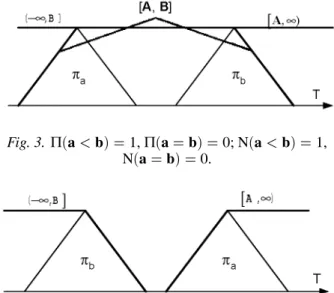
In the case(i)there are two options(see Fig.2): 1)Π(a<b)=1 and N(a<b)=1(see Fig. 3), 2)Π(a<b)=0 and N(a<b)=0(see Fig. 4). In the case(ii) there are also two options(see Fig. 2):
1)Π(ab)=1 and 0<N(a<b)1(see Fig. 5), 2)0<Π(ab)1 and N(ab)=0(see Fig. 6).
Fig. 3.Π(a<b)=1,Π(a=b)=0; N(a<b)=1,
N(a=b)=0.
Fig. 4.Π(a<b)=0,Π(a=b)=0; N(a<b)=0,
Π(ab)=
Area(trapezoidABCD\πa) Area(πa)
=
=
Area(πa) Area(πa)
=1
Π(ab)=1;Π(a<b)=
=1;
Area(triangleEFG\πb) Area(πb)
=
=1;
Area(triangleEFG) Area(πb)
Fig. 5. Π(a b)=1; 0<N(a b) 1.
Π(ab)=
Area(triangleEFG\πa) Area(πa)
=
=
Area(triangleEFG) Area(πa) N(ab)=1;Π(a<b)=
=1;
Area(trapezoidABCD\πb) Area(πb)
=
=1;
Area(trapezoidABCD) Area(πb)
=1;1=0
Fig. 6. 0<Π(a b) 1; N(a b)=0.
The process of validation for the case (ii), op-tion 1 and opop-tion 2 are depicted in Fig. 5 and Fig. 6, respectively.
3.1.2. Temporal Relation aequalsb
If supp(πa)\supp(πb)= , thenΠ(a=b)=0 and N(a=b)=0.
If supp(πa) \supp(πb) 6= , then Π(a = b)
=minfΠ(ab) Π(ba)g.
3.2. Temporal Relations Between Fuzzy Time Point and Fuzzy Time Interval
Let ab,ae]denote the fuzzy interval A, where ab and ae are triangular fuzzy numbers ab =
(ab1 ab2 ab3)and ae = (ae1 ae2 ae3) that de-scribe the beginning and the end of fuzzy in-terval respectively(see Fig. 7). Let tpdenote fuzzy time point(see Fig. 8). Possibility distri-butionsπb a and πe a are of the beginning and
the end of the intervalA. As we have already mentioned, there are five temporal relations be-tween the fuzzy time pointtpand the fuzzy time intervalA.
We can estimate the degrees of possibility and necessity for temporal relations between fuzzy time point and the fuzzy time interval.
Fig. 7.Fuzzy numbersabandae.
3.2.1. Before
Π(tpbeforeA)=Π(tp<ab)and N(tpbeforeA)=N(tp<ab). If supp(πtp)\supp(πb a)= then
Π(tp<ab)= 8 > > < > > :
1 8t 2 tp1 tp3]less than8t 2 ab1 ab3] 0 8t 2 tp1 tp3]greater
than8t 2 ab1 ab3] and
N(tp<ab)= 8 > > < > > :
1 8t2 tp1 tp3]less than8t 2 ab1 ab3] 0 8t2 tp1 tp3]greater
than8t 2 ab1 ab3] If supp(πtp)\supp(πb a)6= then 0<Π(tp ab) 1 and 0 N(tp ab) < 1(see Fig. 5. and Fig. 6.).
3.2.2. After
Π(tpafterA)=Π(ae <tp)and N(tpafterA)=N(ae tp). If supp(πtp)\supp(πe a)= then
Π(ae<tp)= 8 > > < > > :
1 8t 2 ae1 ae3]less than8t 2 tp1 tp3] 0 8t 2 ae1 ae3]greater
than8t 2 tp1 tp3] and
N(ae <tp)= 8 > > < > > :
1 8t 2 ae1 ae3]less than8t 2 tp1 tp3] 0 8t 2 ae1 ae3]greater
than8t 2 tp1 tp3] If supp(πtp)\supp(πe a)6= then 0<Π(ae tp) 1 and 0 N(ae tp) < 1 (see Fig. 5. and Fig. 6.).
3.2.3. During
Π(tpduringA)=minfΠ(ab<tp) Π(tp<ae)g and
N(tpduringA)=minfN(abtp) N(tpae)g.
If supp(πtp)\supp(πb a)= then
Π(ab <tp)= 8 > > < > > :
1 8t 2 ab1 ab3]less than8t2 tp1 tp3] 0 8t 2 ab1 ab3]greater
than8t2 tp1 tp3] and
N(ab<tp)= 8 > > < > > :
1 8t2 ab1 ab3]less than8t 2 tp1 tp3] 0 8t2 ab1 ab3]greater
than8t 2 tp1 tp3] If supp(πtp)\supp(πb a)6= then 0<Π(ab tp) 1 and 0 N(ab tp) < 1(see Fig. 5. and Fig. 6.).
If supp(πtp)\supp(πe a)= then
Π(tp<ae) = 8 > > < > > :
1 8t 2 tp1 tp3]less than8t 2 ae1 ae3] 0 8t 2 tp1 tp3]greater
than8t 2 ae1 ae3] and
N(tp<ae)= 8 > > < > > :
1 8t 2 tp1 tp3]less than8t 2 ae1 ae3] 0 8t 2 tp1 tp3]greater
than8t 2 ae1 ae3] If supp(πtp)\supp(πe a)6= then 0<Π(tp ae) 1 and 0 N(tpb ae) <1(see Fig. 5. and Fig. 6.).
3.2.4. Starts
Π(tpstartsA)=Π(tp=ab)and N(tpstartsA)=N(tp=ab).
If supp(πtp)\supp(πb a)= then
Π(tp=ab)=0 and N(tp=ab) =0. If supp(πtp)\supp(πb a)6= then
0<Π(tpab)1 and 0 N(tp ab)< 1
3.2.5. Finishes
Π(tpfinishesA)=Π(tp=ae)and N(tpfinishesA)=N(tp=ae).
If supp(πtp) \ supp(πe a) = then Π(tp = ae)=0 and N(tp=ae)=0.
If supp(πtp)\supp(πe a)6= then 0<Π(tp ae) 1 and 0 N(tp ae) < 1 (see Fig. 5. and Fig. 6.).
4. Example
Based on the discussion in the previous sec-tions we give a simple example of the validation process of all temporal relations between fuzzy time point and fuzzy time interval.
John’s meeting starts at about 10 o’clock and
finishes about 12 o’clock. He expects an impor-tant telephone call that is announced at about 10.15.
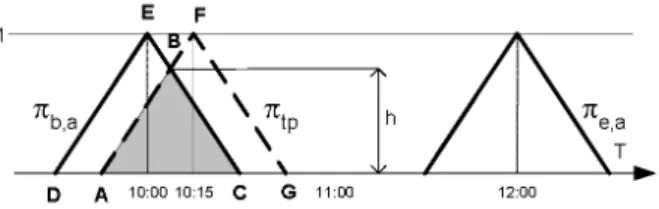
The knowledge about John’s meeting is defined by two possibility distributionsπb aandπe a
rep-resenting the possible starting and ending times of John’s meeting, respectively. Possibility dis-tributionsπb a = (9 : 30 10 : 00 10 : 30)and
πe a= (11 : 30 12 : 00 12 : 30)are depicted in Fig. 9. The knowledge about the time point representing the possible time of an important telephone call, about 10.15, is given by the pos-sibility distributionπtp=(9 : 45 10 : 15 10 : 45)(see Fig. 9).
In this example we want to compute possibility and necessity measures for five temporal rela-tions between fuzzy time point(time of an
im-portant telephone call)and fuzzy time interval (duration of John’s meeting).
The intersections between possibility distribu-tions supports are examined first.
Because supp(πtp)\supp(πe a)= , possibility and necessity measures are:
Π(tp=ae)=0 and N(tp=ae)=0,
Π(tp<ae)=1 and N(tp<ae)=1 and for the inverse relations:
Π(ae<tp)=0 and N(ae <tp)= 0.
Fig. 9.Possibility distributionsπb aandπe a (representing the start and the end of fuzzy interval)and
πtp(representing the time point).
Since supp(πa)\supp(πb)6= measuresΠ(tp ab),Π(ab tp), N(tp ab) and N(ab tp) are computed as follows:
Π(tpab)=
Area(triangleABC\πtp) Area(πtp)
=
=
Area(triangleABC) Area(πtp)
= 45h
2 601
2 =
= 3 4h=
3 4
3
4 =
9
16 =0:5625
(wherehrepresents the height of the triangleABC).
Π(abtp)=
Area(trapezoidDEFG\πb a) Area(πb a)
=
=
Area(πb a) Area(πb a)
=1
N(tpab)=1;Π(abtp)=1;1=0 N(ab tp)=1;Π(tpab)=
=1;0:5625=0:4375
These measures are used to estimate the degree of possibility and necessity for all temporal re-lations between the time of telephone call and the time of meeting:
Π(tpbeforeA)=Π(tpab)=0:5625, N(tpbeforeA)=N(tpab)=0,
Π(tpafterA)=Π(ae<tp)=0,
N(tpafterA)=N(ae <tp)=0,
Π(tpduringA)=minfΠ(abtp) Π(tp<ae)g=1, N(tpduringA)=minfN(abtp), N(tp<ae)g=
=minf0:4375 1g=0:4375,
Π(tpfinishesA)=Π(tp=ae)=0, N(tpfinishesA)=N(tp=ae)=0.
According to these results it is completely pos-sible that the telephone call occurs during the meeting. The necessity for relation during is 0.4375. Also, it is possible that the telephone call occurs before or at the beginning of the meeting with the possibility 0.5625, but these temporal relations are not certain. All other relations are not possible.
5. Conclusion
In this paper we have introduced geometrical approach to validation of the possibility and ne-cessity measures for temporal relations between two fuzzy time points and a fuzzy time point and a fuzzy time interval. Measures are based on proportions of areas given by Eq. 1. In order to simplify the validation process all temporal relations are represented by triangular and/or trapezoidal fuzzy numbers. The possibility and necessity measures for temporal relations be-tween fuzzy time intervals can be computed in the same way.
Fuzzy temporal reasoning introduced in this pa-per represents a base for building adequate mod-els for temporal knowledge representation and reasoning in environments where time is de-scribed as fuzzy, unprecize and vague.
References
1] ALLEN JF. Maintaining knowledge about
tem-poral intervals. Communications of ACM 1983; 26(11):832–843.
2] BARROS., MARINR., MIRAJ., PATONAR. Model
and Language for the Fuzzy Representation and handling of Time. Fuzzy Sets and System 1994; 61(2):153–175.
3] DEANTL., MCDERMOTTDV. Temporal Data Base
Management.Artificial Intelligence1991; 32:1–55.
4] DECHTERR., MEIRI I., PEARL J. Temporal
Con-straint.Artificial Intelligence1991; 49:61–95.
5] DUBOISD., PRADEH. Processing Fuzzy Temporal
Knowledge.IEEE Transaction on System, Man and Cybernetics1989; 19(4):729–744.
6] KAHN K., GORRY GA. Mechanizing Temporal
Knowledge,Artificial Intelligence1977; 9:87–108.
7] PELAVINR., ALLENJF. A Formal Logic of Plants in
Temporally Rich Domains.Proceeding of the IEEE
1986; 74(10):1364–1382.
8] RIBARIC´ S., DALBELO BASIˇC´ B. Temporal
Knowl-edge Representation and Reasoning Model Based on Petri Nets with Time Tokens. In: Proceedings of the IEEE 8th Mediterranean Electrotechnical Conference, Industrial Applications in Power Sys-tems, Computer Science and Telecommunications, MELECON’96; Bari, Italy, May 13–16, 1996. p. 131–135.
9] RIBARIC´ S., DALBELO BASIˇC´ B. Modelling Crisp
and Fuzzy Qualitative Temporal Relations, In: The Proceedings of the 12th International Conference on Information and Intelligent Systems — IIS 2001, September 26–28; 2001, Varazdin, Croatia, p. 218– 226.
10] RIBARIC´S., DALBELOBASIˇC´B., TOMACD.
Object-Oriented Implementation of a Model for Fuzzy Temporal Reasoning, Technologies for Construct-ing Intelligent Systems, Eds. B. Bouchon-Meunier, J. Gutierrez-Rios, L. Magdalena and R.R. Yager, Springer-Verlag, 2002.
11] VIRANTJ., ZIMICN. Attention to Time in Fuzzy
Logic.Fuzzy Sets and Systems(1996), 82: 59–77. 12] YAOY. A Petri Net Model for Temporal Knowledge
Representation and Reasoning. IEEE Transaction on System, Man and Cybernetics1994; 24(9):1374–
1382.
13] ZADEH LA. Fuzzy sets. Information and Control
1965; 8(4):338–353.
14] ZADEH LA. Fuzzy sets as a Basis for Theory of
Possibility.Fuzzy Sets and Systems1978; 1:3–28.
15] ZAIDIAK. On Temporal Logic Programming Using
Petri Nets.IEEE Transaction on System, Man and Cybernetics1999; 29(3):245–254.
16] ZHOUY., MURATAT., DEFANTITA. Modeling and
Performance Analysis Using Extended Fuzzy-Timing Petri Nets for Networked Virtual Envi-ronements.IEEE Transaction on System, Man and Cybernetics2000; 30(5):737–756.
Received:June, 2002
Accepted:September, 2002
Contact address:
Slobodan Ribari´c, Bojana Dalbelo Basi´cˇ
Faculty of Electrical Engineering and Computing University of Zagreb Unska 3, 10000 Zagreb, Croatia e-mail:fslobodan.ribaric|[email protected]
SLOBODANRIBARIC´received his B.S. degree in electronics, the M.S.
degree in automatics and the PhD. degree in electrical engineering from the Faculty of Electrical Engineering, Ljubljana, Slovenia, in 1974, 1976, and 1982, respectively. He is currently a Full Professor at the Department of Electronics, Microelectronics, Computer and Intelligent Systems, Faculty of Electrical Engineering and Computing, University of Zagreb, Croatia. His research interests include pattern recognition, artificial intelligence, computer architecture and robot vision. He has published more than one hundred and twenty papers on these topics, and he is author of four books(Microprocessor Architecture, The Fifth
Computer Generation Architecture, Advanced Microprocessor Archi-tectures, CISC and RISC Computer Architecture)and co-author of one
(An Introduction to Pattern Recognition). Dr. Ribari´c is a member of the IEEE and IAPR.
BOJANADALBELOBASIˇC´received her B.S. degree in mathematics from the Faculty of Sciences, University of Zagreb, in 1982 and the M.S. and PhD. degrees in computer science from the Faculty of Electrical Engineering and Computing, University of Zagreb, in 1993 and 1997, respectively. In 2000 she received a DAAD grant. She has published forty papers, mostly concerning applied multivariate statistics, fuzzy temporal reasoning and intelligent systems. Currently, she is Assis-tant Professor at the Faculty of Electrical Engineering and Computing, University of Zagreb. Her current research interests include machine learning, especially kernel based methods.
LADAMALESˇreceived her B.S. degree in electronics from the Faculty of Electrical Engineering, Mechanical Engineering and Naval Archi-tecture, University of Split, in 1996 and the M.S. degree in computer science from the Faculty of Electrical Engineering and Computing, University of Zagreb, in 2002. Currently, she is an assistant at the Department of Informatics, Faculty of Natural Science, Mathematics and Education, University of Split. Her research interests include fuzzy temporal reasoning and intelligent systems. Lada Males is a memberˇ