A Simple Method for Dynamic
Scheduling in a Heterogeneous
Computing System
Janez Brest and Viljem
Zumer
ˇ
Faculty of Electrical Engineering and Computer Science, University of Maribor, Slovenia
A simple method for the dynamic scheduling on a het-erogeneous computing system is proposed in this paper. It was implemented to minimize the parallel program execution time. The proposed method decomposes the program workload into computationally homogeneous subtasks, which may be of the different size, depending on the current load of each machine in a heterogeneous computing system.
Keywords: heterogeneous computing, task scheduling, optimization, heuristic algorithm.
1. Introduction
A computer system of PCs, workstations, mini-computers etc., connected together in a local area network or wide area network represents a large pool of computational power 19].
Research in the field of heterogeneous comput-ing began in the mid 1980s; since then it has grown tremendously 8]. From the scientific
community to the federal government, hetero-geneous computing has become an important area of research and interest.
Heterogeneous computing includes both paral-lel and distributed processing 9, 13]. The
vir-tual heterogeneous associative machine concept makes the distributed machines appear as one single machine. By exploiting the different fea-tures and capabilities of a heterogeneous envi-ronment, higher levels of performance can be attained.
In general, the goal of heterogeneous comput-ing is to assign each subtask to one of the ma-chines in the system so that the total execution
time(computation time and inter-machine
com-munication time)of the application program is
minimized 23, 12, 7, 11, 16, 18, 24]. Mapping
can be specified statically or determined at run-time by load balancing algorithms. In hetero-geneous computing the structure of a problem may be known, but the structure of the system can change dynamically.
In a heterogeneous system that consists of PCs or workstations, individual subtasks can be matched to the best-suited processor. During the design/synthesis of a heterogeneous
sys-tem, the designer must 8]:
consider all relevant factors, costs, constraints, and objectives during the design;
decide on the number and type of processors to be included in the system;
decide on the interconnection between the selected processors;
determine the effective use of the designed heterogeneous system to perform the given application task;
map and schedule the subtasks for execution on the processors.
The dynamic scheduling strategies fall under different models, which include the schemes based on predicting the future from the past loads, the task queue model, and the diffusion model 26].
and provides case studies for two computation-ally intensive tasks. An improved load balanc-ing strategy in master-slave structures, where the size of task to be assigned to a slave is determined by the last two packets and their execution time, is presented.
The rest of the paper is organized as follows. In Section 2 a brief overview of the heteroge-neous computing is given. In Section 3 the task scheduling and the load balancing are described. A simple task scheduling scheme and the algo-rithm for dynamic scheduling on heterogeneous computing system are presented. The results of the implemented algorithm on two classes of op-timization problems are presented in Section 4. In Section 5 the conclusion remarks are given.
2. Heterogeneous Computing
High performance networks of workstations are becoming increasingly popular as a parallel computing platform 14]. Both message
pass-ing and software distributed shared memory paradigms have been developed on such dis-tributed platforms. An important performance bottleneck in these systems is network latency, which is poorer than that in high-speed parallel computer interconnection networks.
A heterogeneous computing(HC)system
con-sists of a number of autonomous and indepen-dently scheduled heterogeneous computers. A primary objective in many research projects
dealing with heterogeneous computing is the minimization of the job completion time 3, 4].
The network layer can provide interconnectivity between computing sites. Communication tools suitable for HC are a message passing interface
(MPI) 5, 8], a parallel virtual machine(PVM),
portable programs for parallel processors(P4),
etc.
Local Area Multicomputer (LAM) 5, 6] is a
parallel environment development system of independent computers. It features the MPI programming standard, supported by extensive monitoring and debugging tools.
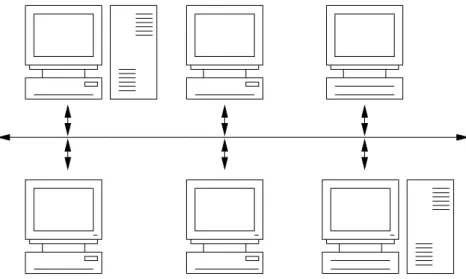
Figure 1 shows a part of the heterogeneous com-puting system that has been used in our ex-periments. There are many different operating systems (Solaris, Linux, etc.) on computers
connected in a local-area network. We used LAM/MPI tool as parallel environment.
3. Task Scheduling and Load Balancing
The problem of load partitioning and schedul-ing in a multiple-processor system has been the area of active and sustained research over the past two decades 8, 25].
The most critical aspect of a task-scheduling al-gorithm is the strategy used to allocate problems to slaves. Generally, the chosen strategy will represent a compromise between the conflict-ing requirements for independent operation(to
reduce communication costs)and global
know-ledge of computation state(to improve load
bal-ance).
3.1. Master/Slave
Figure 2 illustrates a simple task scheduling scheme that is nevertheless effective in mod-erating a number of processors 9].
... master
slave slave ... slave
Fig. 2.A master/slave scheme.
In the so-called embarrassingly parallel prob-lem, computation consists of a number of tasks that can be executed more or less independently, without communication 9]. These problems
are usually easy to adapt for parallel execution. The same computation must be performed us-ing a range of different input parameters. The parameter values are read from an input file, and after parallel program execution, the differ-ent computation results are written to an output file.
3.2. Arbitrarily Divisible Jobs
The problem of heterogeneous load balancing and task scheduling is examined for two prac-tical workload paradigms 10]: indivisible-task
jobs and arbitrarily divisible jobs.
This paper deals with load balancing and task scheduling in the context of arbitrarily divisible jobs. The arbitrarily divisible load model can be used in an application where the load consists of a large number of small elements with iden-tical processing requirements. Examples can be found in the application for image and signal processing, and also in iterative algorithms 14].
If the execution time per task is constant and each processor has the same computational power, then it is a good idea to decompose the available
problems into equal-sized sets and allocate one such set to each processor. In other situations, each slave task repeatedly requests parameter values from the input task, computes using these values, and sends results to the output task. The execution time can vary. The input and the out-put task cannot expect to receive messages from various slaves in any particular order. This non-determinism affects only the allocation of prob-lems to slaves and the ordering of results in the input file, but not the actual results computed.
3.3. Our Method
We have modeled the computing performance of each computer with a single parameter: its response time needed for the execution of the task.
At time t +2 the new task size sp(t +2) for
processorpis a function of two previous values of response timesτp(t+1) τp(t)and task sizes
sp(t+1) sp(t):
sp(t+2)= f(sp(t+1) τp(t+1) sp(t) τp(t))
t=0 1 2 ::: (1)
This single parameter includes more aspects of heterogeneity of each computer during the given operating conditions. The task size(chunk size)
should be smaller than number of processorsnumber of total size.
3.4. Algorithm
The algorithm for dynamic scheduling on a he-terogeneous computing system is presented in this section.
There is one node that representsmasteror man-ager, all other nodes areslavesorworkers(see
Fig. 2). The master does not compute, but it
collects global status information of the sys-tem,
performs the dynamic scheduling algorithm that also distributes tasks and/or parameter
values,
collects the results.
Slaves do not have information about the global status of the heterogeneous system such as sys-tem load, program execution progress. Each slave has to do only two jobs: to make a com-putation in order to find the solution, i.e. task execution, and make time measurements, i.e. lo-cal information. Lolo-cal information is sent from slaves to the master that has an overview of all activities in the heterogeneous computing sys-tem. The master uses the function (1) to
cal-culate the new task size. The master can store all valuess(t)andτ(t), but because of the time
locality and space assumption for storing those values, we used only the last two values. Given a parameter > 0, the function f is defined as
follows.
Let
k=
s(t+1)
τ(t+1) s(t)
τ(t)
(2)
If
1. k<1;: the new task size can be increased
by factor 2(the load execution time will be
better if the new task size is greater than the current task size),
2. k>1+: the new task size can be decreased
by factor 2,
3. 1; k 1+: task size does not need
to be changed.
Parametershould not be too small or too large.
In the former case, the function for calculating
MASTERandSLAVEalgorithms in pseudo-code:
Module MASTER begin
/* performs task scheduling and load balancing */
Read data from input files
Use simple heuristic method to compute an initial solution Send input data to slaves
Send to slaves:
the initial solution size of subtask
while(program application not finished)do begin
Receive temporary solution from any slave
ifthis solution is currently the best onethen begin
Receive all data from the slave with the best solution Store this temporary best solution and other data
end
Receive measurements from the slave
Use current and previous measurements to compute new size of the next subtask Send the new subtask to the slave
end
Print the best solution, results,:::
end master
Module SLAVE/* worker */ begin
/* Slave computes and sends measured data to the master */
Receive input data from master
while(something to do)do begin
Receive the initial or temporary solution and a size of subtask Compute to find solution
Send the local best solution and time measurements to the master
end
the new task size is too sensitive to all small changes in the system load. In the latter case, the dynamic scheduling strategy is rigid. In both cases lower levels of performance were observed. Of course, there are lower and up-per limits of minimum and maximum task size. We have obtained the highest performance for 0:05 0:1. We have decided to use factor
2 because of the following reasons: increasing
(dividing) the task size is a simple operation,
the increase of the sequence 1, 2, 4, 8,::: is
rather high. The disadvantage of using factor 2 is that the sequence contains some values only.
4. Results
We have evaluated proposed dynamic schedul-ing strategy on two classes of optimization prob-lems, where heuristic search algorithms were used. Both of the optimization problems belong to NP-hard problems, and therefore we used dy-namic scheduling on computers connected in a local area network to solve the problem faster and/or better.
The first one was the problem of continuous speech recognition. We have implemented an algorithm for bigram word clustering 17, 22]on
a heterogeneous computing system. The corpus consisted of approximately 750.000 words and the vocabulary size was 20.000. We used mas-ter and slave algorithms, described in previous
section, and 10 PCs and workstations(one slave
per computer) connected into a local area
net-work, and LAM/MPI tool.
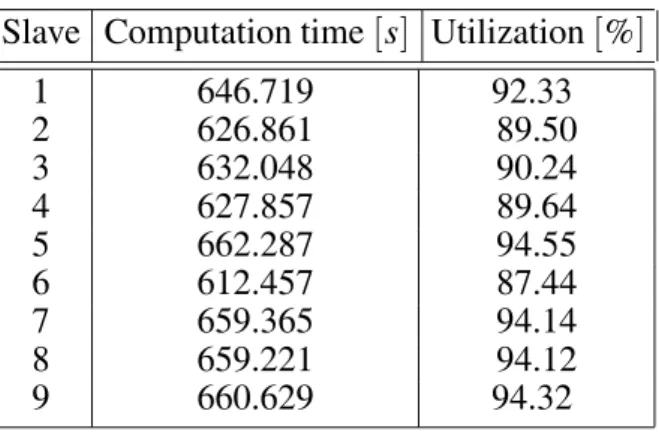
The total execution time of parallel program is the sum of communication time and compu-tation time. Utilization can be defined as the ratio between the computation time and the to-tal execution time. Table 1 shows utilizations of slaves, which were about 0:9(the total
exe-cution time of parallel program was 700:437s).
The parallel version of the algorithm for bigram word clustering found a better final solution(
ap-proximately 10%) than the sequential version,
if the execution times of both algorithms were equal. Note that obtained 10% better final solu-tion in the bigram word clustering is very good.
Slave Computation time s] Utilization %]
1 646.719 92.33
2 626.861 89.50
3 632.048 90.24
4 627.857 89.64
5 662.287 94.55
6 612.457 87.44
7 659.365 94.14
8 659.221 94.12
9 660.629 94.32
Table 1.Utilization.
0 0.2 0.4 0.6 0.8 1
0 100 200 300 400 500 600 700
solution
time [s]
sequential parallel
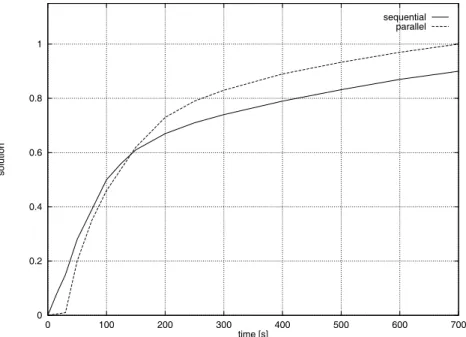
Fig. 4. Solutions obtained by parallel and sequential algorithms vs. time.
Figure 4 shows normalized solutions obtained by parallel and sequential algorithm for bigram word clustering, respectively. Timeτ indicates the point, where the solution obtained by the parallel version of the program is equal to the solution obtained by the sequential version. At the beginning of the program execution, parallel version needs some time for an initialization of the computing system and data transfer. There-fore, before the timeτ, which is not known a pri-ori, the solution obtained by the sequential ver-sion is better than the solution obtained by the parallel version. In our experiment we wanted to determine the value of the timeτ, when both solutions were close to each other. The value of the timeτ is obtained by the averages of 20 independent runs of both parallel and sequential program versions: 130s<τ <160s.
If computers are heterogeneous, they have pro-cessors of different power, so it is difficult to measure the speedup of the parallel computa-tion, since it is not clear which computer to use as a reference of the sequential computation. Figure 3 shows the comparison of our method
(initially, the is set to the chunk size of the
task) with scheduling algorithm when there is
no change of the chunk size. It can be no-ticed that the simple method gives better re-sults in terms of the execution time(up to 10%)
compared to the scheduling algorithm with no change in chunk size. The disadvantage of
dy-namic scheduling with no change in chunk size is that the execution time is increased when the chunk size is too small or when the chunk size is too big. The obtained results show that our dynamic scheduling algorithms perform better when the initial chunk size is small.
The second class of optimization problem used to evaluate presented dynamic scheduling me-thod was asymmetric traveling salesman prob-lem(ATSP) 15, 20, 1]. In this experiment we
used a homogeneous computing system, which consists of 41 computers (one processor per
computer)connected using ATM network.
Re-sults of the execution time and speedup for two ATSP instances with 358 and 443 nodes, respec-tively, are presented in Table 2. Other problem instances are smaller thanrbg443(currently the
largest problem in TSPLIB library with 443 nodes)and therefore speedup values were lower
than those obtained byrbg443.
Problem T1 s] T41 s] Speedup T1
T41
rbg358 1359.21 48.08 28.87
rbg443 3591.50 112.80 31.84
Table 2.Speedup.
Problem Optimum min % avg %
rbg358 1163 1166 99.74 1170.85 99.33
rbg443 2720 2720 100.00 2720.70 99.97
Table 3.Results for the asymmetric TSP instances.
the ATSP instances and the number of cities. The shortest tours are known for all of them and are shown in the second column. The optimal solution values can be found in TSPLIB library
(http://softlib.rice.edu/softli b/tsp lib/ )
20, 21]. For each of the problem instances,
30 independent runs were performed. In the last two columns the best tour solutions and the averages of the runs are shown. The results(tour
lengths)of other problem instances are similar
to the results obtained by sequential algorithms
(see 1], 2], page 247). We have done many
experiments on heterogeneous system consist-ing of different processors, operation systems
(HP-UX, Linux, Solaris, etc.) and the obtained
results of the tour lengths were similar to the re-sults presented in Table 3. Recall that the time needed by parallel algorithms was smaller(see
Table 2.)
The proposed method is simple, but the results are comparable to other approaches described in the literature.
5. Conclusion
This paper presents dynamic scheduling on a heterogeneous computing system. Our method decomposes the program workload into compu-tationally homogeneous subtasks, which may be of different size, depending on the current load of each machine in the heterogeneous com-puting system. Experimental results of two practical applications are presented to evaluate the described dynamic scheduling.
In future research, we intend to apply the power of the proposed method to a wider range of practical problems.
References
1] J. BREST, J.ZˇEROVNIK, An approximation algorithm
for the asymmetric traveling salesman problem, Ricerca Operativa,28, pages 59–67, 1999.
2] J. BREST, J.ZˇEROVNIK, An approximation algorithm
for the asymmetric traveling salesman problem, in N. Callaos, M. Bennamoun, and J. Aguilar, editors, World Multiconference on System, Cybernetics and Informatics, volume 3, pages 244–249, July 1997.
3] J. BREST, V.ZˇUMER ANDM. OJSTERSEKˇ , Dynamic
scheduling on a network heterogeneous computer system,Lecture Notes in Computer Science,1557, pages 584–585, 1999.
4] J. BREST, V. ZˇUMER, M. OJSTERSEKˇ , Dynamic
Scheduling on a PC Cluster, in J. Carrol and H. Haddad, editors, ACM Symposium on Applied Computing, SAC’99, pages 496–500, 1999.
5] G. D. BURNS, R. B. DAOUD, J. R. VAIGL, LAM:
An Open Cluster Environment for MPI, in Super-computing Symposium ’94, Toronto, Canada, June 1994.
6] G. D. BURNS, The Local Area Multicomputer,
in Proceedings of the Fourth Conference on Hy-percube Concurrent Computers and Applications, ACM Press, March, 1989.
7] M. CERMELE, M. COLAJANNI, G. NECCI, Dynamic
load balancing of distributed spmd computations with explicit message-passing,Proceedings: Sixth Heterogeneous Computing Workshop (HCW’97), pages 2–16, April 1997.
8] M. M. ESHAGIAN, editor, Heterogeneous
Comput-ing, Artech House, Inc., Norwood, MA 02062, ISBN 0-89006-552-7, 1996.
9] I. FOSTER, Designing and Building Parallel
Pro-grams, Addison-Wesley, ISBN 0-201-57594-9, 1995.
10] E. HADDAN, Load Balancing and Scheduling in
Network Heterogeneous Computing, in M. M. Es-hagian, editor, Heterogeneous Computing, pages 224–276, Norwood, MA 02062, ISBN 0-89006-552-7, 1996. Artech House, Inc.
11] D. HENSGEN, editor, Proceedings: Sixth
Hetero-geneous Computing Workshop (HCW’97), IEEE Computer Society Press, Los Alamitos, CA, April 1997.
12] H. HLAVACS, C. W. UEBRHUBER, Simulating load
balancing on heterogenous workstation clusters, Lecture Notes in Computer Science, 1557, pages 533–540, 1999.
13] K. HWANG, Z. XU, Advanced Computer
14] P. H. JOSEPH, S. VAJAPEYAM, Program-Level
Con-trol of Network Delay for Parallel Asynchronous Iterative Applications. In 3rd International Con-ference on High Performance Computing, pages 88–93, Trivandrum, India, December 1996. IEEE Computer Society Press.
15] E. L. LAWLER,ET AL., editors.The Traveling
Sales-man Problem, John Wiley & Sons Ltd., 1985.
16] W. M. LIN, W. XIE, Minimizing Communication
Conflicts with Load-Skewing Task Assignment Techniques on Network of Workstations. INFOR-MATICA: An International Journal of Computing and Informatics,23, pages 57–66, 1999.
17] S. MARTIN, J. LIERMANN, H. NEY, Algorithms
for bigram and trigram word clustering. EU-ROSPEECH’95. 4th European Conference on Speech Communication and Technology,pages 203– 213, September 1995.
18] B. MONIEN,ET AL., Efficient use of parallel and
dis-tributed systems: From theory to practice.Lecture Notes in Computer Science, 1000, pages 62–77, 1995.
19] B. RAYKUMAR, editor, High Performance Cluster
Computing: Architectures and Systems. Prentice Hall - PTR, NJ, USA, 1999.
20] G. REINELT, TSPLIB — A traveling salesman
prob-lem library, Technical Report 250, Universit¨at Augs-burg, Institut f¨ur Mathematik, AugsAugs-burg, 1990.
21] G. REINELT, TSPLIB — A traveling salesman
prob-lem library,ORSA Journal on Computing, 3(No.
4), pages 376–384, 1991.
22] M. SEPESY MAUCECˇ , Statistical language
model-ing based on automatic classification of words. In Advances in speech technology, pages 173–180, 1998.
23] M. TAN, et al., Minimizing the Application
Exe-cution time Through Scheduling of Subtasks and Communication Traffic in a Heterogeneous Com-puting System.IEEE Transaction on Parallel and Distributed Systems, 8 (No. 8) 173–186, August,
1997.
24] B. WILKINSON, M. ALLEN,Parallel Programming:
Techniques and Applications Using Networked Workstations and Parallel Computers, Prentice-Hall, Englewood Cliffs, NJ 07632, USA, 1998.
25] M. Y. WU, On Runtime Parallel Scheduling for
Processor Load Balancing, IEEE Transaction on Parallel and distributed systems 8(No. 2), pages
173–186, February, 1997.
26] M. J. ZAKI, S. PARTASARATHY, W. LI, Customized
dynamic load balancing, in B. Raykumar, editor, High Performance Cluster Computing: Architec-tures and Systems, Prentice Hall – PTR, NJ, USA, 1999.
Received:January, 2000 Revised:July, 2001 Accepted:December, 2001
Contact address:
Janez Brest, ViljemZumerˇ
University of Maribor Faculty of Electrical Engineering and Computer Science Smetanova 17, 2000 Maribor, Slovenia
Phone:++386-62-220-7452
Fax:++386-62-211-178
e-mail:[email protected]
PROF. DR. VILJEMZˇUMERis head of Institute of Computer Science on Faculty of Electrical Engineering and Computer Science, University of
Maribor, Slovenia. Prof.Zumer is a member of the IEEE Computerˇ
Society.
JANEZBRESTis a PhD candidate in the Department of Computer
![Figure 2 illustrates a simple task scheduling scheme that is nevertheless effective in mod-erating a number of processors 9 ] .](https://thumb-us.123doks.com/thumbv2/123dok_us/8046540.2130691/3.892.148.404.330.470/figure-illustrates-simple-scheduling-scheme-effective-erating-processors.webp)