Hungarian Association of Agricultural Informatics European Federation for Information Technology in Agriculture, Food and the Environment
Journal of Agricultural Informatics. Vol. 9, No. 2 journal.magisz.org
Significance of food industry trademarks and product traceability from a
customer perspective
István Füzesi1, Péter Lengyel2, János Felföldi3
I N F O
Received 2 Mar 2018 Accepted 7 May 2018 Available on-line 18 Jun 2018 Responsible Editor: M. Herdon
Keywords:
product trademark, food safety, traceability, food marketing.
A B S T R A C T
Food quality and safety related scandals have received considerable media coverage and have improved consumer awareness in Hungary and Europe. Consequently, the existence or lack of food safety may become a significant limiting factor which affects global trade. The number of consumers who require additional information on the origin of food products is becoming increasingly widespread. Our research seeks to provide an answer to the question whether confidence in the product manufacturer, some certificate (trademark) or detailed traceability information might well increase the acceptance and sales of a particular product. Moreover, the paper investigates what level of traceability information detail Hungarian consumers need, whether they intend to pay a higher price for traceability data beyond legislative requirements. Results show that consumers are mostly unaware of product traceability notions and they have limited insight into the product chain. As a result, they frequently identify product traceability with food safety; furthermore, the majority of consumers question the reliability of the information provided. The development, establishment and operation of a complex information system to provide adequate data for consumers require considerable investments and improvements, which are difficult - if not impossible - to realise from the approximately 10% additional charge considered as acceptable by consumers. In conclusion, such service can succeed if it has other, extra functionality as well.
1. Introduction
Food safety and the origin of food products raise an increasing number of various doubts among customers. Scandals related to food safety and the origin of food products sometimes overreacted by the media have shaken the confidence of customers in commercial food products in recent years (Lakner, Szabó & Hajdúné 2005). To some extent, as a consequence of this, new principles have been laid down in EU food regulations, where consumer health protection has become one of the essential principles. At present, the majority of food products are produced on a large scale, and due to globalisation, they reach a large number of consumers fast. Production, distribution and foodstuffs trade represent exceptionally complex business activities. Therefore the development of new procedures and methodologies are needed to safeguard food quality. However, as consumers have no overview of the circumstances of food production and applied technologies, confidence in manufacturers may provide indications in the selection of a specific product. Today, emphasis will be put on the issue of food safety in all sectors of the food industry (Ding, Xu, Li & Xie 2017). Over the past years, the average customer may have heard a lot about problems (many times in an extreme form) related to food products, different microbiological infections, physical and chemical contaminations. In an attempt to deal with emergency situations more efficiently and to promote consumer confidence in the credibility of products, these risk factors have resulted in the formulation
1 István Füzesi
University of Debrecen [email protected]
2 Péter Lengyel
University of Debrecen
3 János Felföldi
University of Debrecen
of stricter regulations and measures (Cebeci, Guney & Alemdar 2008). Problems that can arise might be solved by compliance with the legislation (or by their enforcement) in this field, by the introduction of quality management systems, the traceability and identifiability of products beyond reasonable doubt (Loureiro & Umberger 2007). According to the definition of ISO 8402:1994: “traceability is the ability to trace the history, application or location of an entity using recorded identifications“. Its primary objective is to distinguish and precisely identify the source of potential contamination, to efficiently recall the product and to remove them from the market. It is also essential that it can help avoid particular additives or ingredients of foodstuffs at the time of purchase, giving more excellent choices for customers among products. Therefore, movements among every unit are to be recorded for the participants of the food supply chain (Felföldi, Botos, Péntek, Szilágyi & Várallyai 2017), just like in the case of food production processes. The spread of problems due to the lack of food safety cannot be exclusively traced back to the increasing rate of world trade. Population density growth linked to urbanization, changes in lifestyle, modifications in consumption habits, increasing environmental pollution, the lengthening of the chain between food production and consumption, the fact that food production is becoming large-scale, the application of new, hazardous technologies, the increasing number of consumers in sensitive groups (e.g. elderly people) are all key factors (Farkas 2002; Bánáti 2004). The number of disturbing cases receiving considerable media coverage has improved consumer awareness. Therefore the existence or lack of food safety have become significant obstacles restricting global trade (Golan, Krissof & Kuchler 2004).
2. Literature review
The whole food chain should ensure compliance with the most restrictive quality standards and safety regulations. In all phases of the food chain from the purchase of raw materials through manufacturing, distribution and sales, quality requirements related to the given products, processes or methods of treatment should be met by retailers or supply units. Previously used, traditional methods are no longer satisfactory to solve these issues. Recently, as a result of various efforts (Szilágyi & Herdon 2013), the correlations of general quality issues aiming at enhancing the significance of food safety have become increasingly apparent than before. Consequently, progressing rules, regulations and production techniques are drawn up to produce safe food products (Schiefer 1997).
main point of traceability. The majority of consumers are unable to bring a concrete decision as to the guarantee or functional quality nature of traceability, and they connect it primarily with food safety. The identification of the so-called Traceable Resource Unit (Kim, Fox & Gruninger 1995), i.e. TRU is pivotal in the determination of the depth of traceability in the case of certain products on the producer side. TRU is an illustrative unit that enables segregated tracking in the supply chain. The determination of an optimal TRU size is a complex task to fulfil the criteria of keeping quantities of products at risk of potential removal, economic damage and image destruction to a minimum. Based on this approach, TRU should be as low as possible; however, the lower the core entity subject to tracking, the higher the number of units for segregated classification and data storage, making the solution even more costly. The identification of the level of tracking requires the examination of potential risk factors and their potential occurrence. It means the determination of an optimum point to meet market demands that causes the lowest possible damage if and when products are recalled, suits the capacities of the related business and the applied technology, feasible regarding organisation and technicality, and will prove to be the most economical solution. The importance of food safety is different for all food chain participants (Füzesi, Lengyel, Szilágyi & Ráthonyi 2016). As customers are the first to be interested in food safety, their expectation of traceability system is to ensure safety and trust (Lakner, Bánáti, Szabó & Kasza 2003). Traceability systems offer the following benefits for customers: protection of food safety by effective product recalls in emergency situations; the system provides options for allergy and food intolerance sufferers or those who struggle with their lifestyles’ debilitating effects to avoid certain food ingredients by offering actual choices from food products derived from a variety of production methods (Herdon, Pető, Botos & Várallyai 2014). Full traceability of products can be achieved by using numerical and barcode systems as well as electronic and biological marking systems and a combination of appropriate levels. Identification requirements ensure continuity of tracking and reliability between independent partners (common language and information interoperability). In order to keep the tracking from the producer to the consumer, in each intermediate step, information about the product must be provided without modification, along with other related additional information. The most critical point of food traceability is the potential loss of comprehensive traceability. It may result from the loss or damage of identification labels, the interconnection of product cycles, the use of more than one identifier and the differences in the chain levels.
3. Methodology
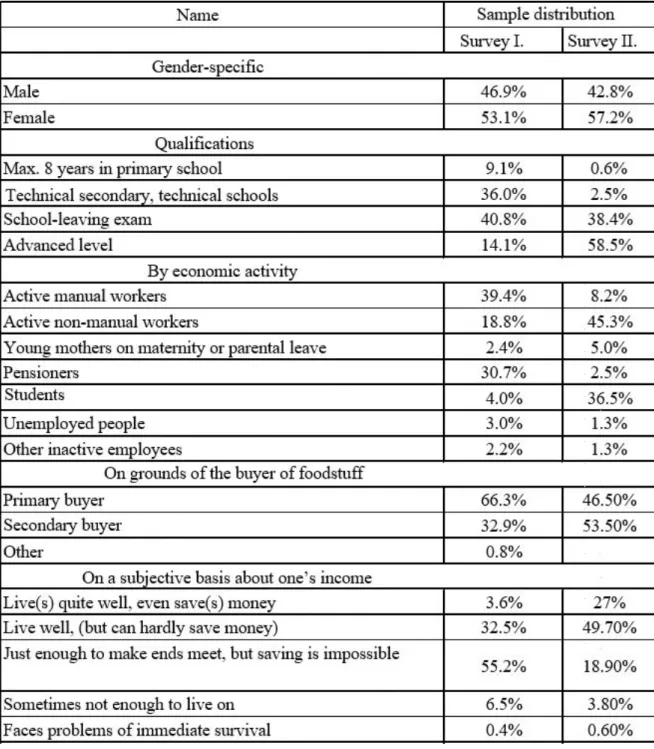
To answer the questions, we used two sets of questionnaire data where the results were evaluated separately. However, they were used in one study and proved to be particularly useful for drawing conclusions relevant to our subject (Table 1) The first survey on the shopping habits of Hungarian consumers was carried out in 2016. This representative survey examined the information-gathering habits of Hungarian customers regarding food products (Csapóné & Péntek 2014). It was followed by another online questionnaire from 1 June to 15 July 2017, which investigated the relation between young (most likely under 40) Hungarian consumers representing massive customer demand (80% of respondents represent this age group) and product traceability information beyond legislative requirements.
Table 1. Distribution of samples regarding critical background variables (NI=505, NII=159)
Source: Author’s development, 2017
4. Results
In the early stages of our research, we investigated where customers could obtain their information on food products. It was required to enable the estimation of the efficiency of initiatives promoting the sharing of traceability data with customers. It is clear, however, that consumers tend to be curious about prices and ingredients. It is because the rate of “conscious” customers is steadily increasing today, similarly to the rate of food allergy and intolerance sufferers. The findings suggest that the number of information sources in addition to data specified by legislation is very limited. Consumers look mostly for data that they can collect directly, the conditions of production, the life-cycle of products will not be listed among factors to guide them in their choices. Customers could receive information by various identification numbers, barcodes or manufacturers’ websites, but according to our survey findings, these are very rarely used (below 10%). It is based on some reasons. Our findings also indicate that relatively few products are labelled to provide additional information for customers. Therefore they can rarely collect information through these channels. Naturally, demand for extra information depends heavily on the type of food products, so it would be wrong to deal with all product cycles and their complexity on the same footing.
Our survey addressed the significance of processing conditions for the production of food products purchased by customers and also end-to-end traceability during their sales process. The answers were measured on a scale of 1-5, where 1 represented the lowest approval rating and 5 the highest one. Our research investigated the milk, meat, vegetable and fruit product cycles separately, but our findings showed no significant differences among the product groups. The proportion of consumers who strongly agreed was determined by adding 4 and 5. The proportion of these respondents was above 60% in the case of all the three product groups. Personal interviews, however, highlighted the lack of awareness of customers about the meaning of “from fork to table” related to food traceability. First, their awareness should be improved about the mandatory nature of the registration of traceability data, and feasibility of effective product recalls in the framework of European Union and Hungarian legislation. Among others, the General Food Law Regulation 178/2002/EC of the European Parliament and Council make provision for this issue; however, it does not exclusively cover the obligation to make these data available for customers. Second, TRUs of different volumes are used for traceability data collection, which means that only information related to the potential sources of food products can be registered instead of the exact list of sources they include. Spearman’s rank correlation calculation revealed a significant correlation (p<0.05) between consumers’ demand for traceability data, their level of health-consciousness and monthly income. Notably, a similarly strong correlation exists between the two explanatory variables, i.e. those with high incomes are willing to spend more money on healthier food products.
Demand for food trademarks is even higher. 87% of consumers replied that trademarks certifying the origin of liquid milk (fresh, not long-life), fresh poultry meat, fresh pork, fruits and vegetables would be necessary. Trademarks identify the product origin thus it gains a certain degree of specificity, and raises the opportunity for customers to differentiate between specific products; hence trademarks play a key role in food marketing. Consequently, the primary considerations in product selection will be previous shopping experience, confidence in manufacturers and certified trademarks. Interestingly, customers who think they are health-conscious, do not consider the use of trademarks certifying the origin of food products necessary; the obtained data failed to reveal any correlations. On the contrary, a low, but detectable correlation emerges between household incomes and demand for trademarks: the higher the standard of living, the increased the interest in them.
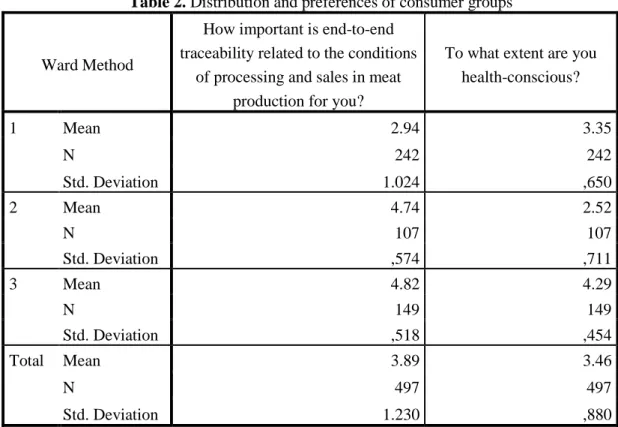
Table 2. Distribution and preferences of consumer groups
Ward Method
How important is end-to-end traceability related to the conditions
of processing and sales in meat production for you?
To what extent are you health-conscious?
1 Mean 2.94 3.35
N 242 242
Std. Deviation 1.024 ,650
2 Mean 4.74 2.52
N 107 107
Std. Deviation ,574 ,711
3 Mean 4.82 4.29
N 149 149
Std. Deviation ,518 ,454
Total Mean 3.89 3.46
N 497 497
Std. Deviation 1.230 ,880
Source: Author’s development, 2017
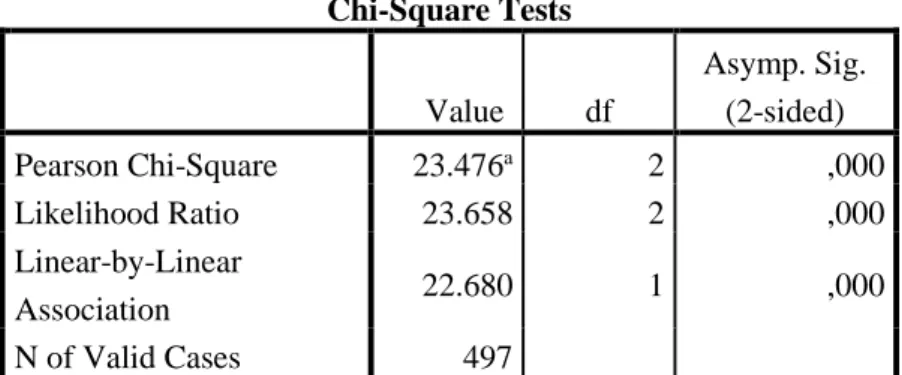
Of the investigations on the correlations of information capture regarding the clusters and food products, correlations of trademarks and markings (Table 3) were the most relevant in our research topic. Analysis on the relationship of clusters and trademarks suggests that consumer groups correlate demonstrably with demand for trademarks. The first group consisting of the majority of customers showed little interest in trademarks on food products.
Table 3. Relationship between consumer groups and trademarks
If you want to get information on food products, what sources do you use? Trademark, marking on the label * Ward Method Crosstabulation
Ward Method
Total
1 2 3
If you want to get information on food products, what sources do you use?
Trademark, marking on the label
Yes Count 74 50 81 205
% within Ward
Method 30.6% 47.2% 54.4% 41.2%
Adjusted Residual -4.7 1.4 3.9
No Count 168 56 68 292
% within Ward
Method 69.4% 52.8% 45.6% 58.8%
Adjusted Residual 4.7 -1.4 -3.9
Total Count 242 106 149 497
% within Ward
Chi-Square Tests
Value df
Asymp. Sig. (2-sided)
Pearson Chi-Square 23.476a 2 ,000
Likelihood Ratio 23.658 2 ,000
Linear-by-Linear
Association 22.680 1 ,000
N of Valid Cases 497
a. 0 cells (,0%) have expected count is less than 5. The minimum expected count is 43.72.
Symmetric Measures
Value
Approx. Sig.
Nominal by Nominal Phi ,217 ,000
Cramer's V ,217 ,000
Contingency
Coefficient ,212 ,000
N of Valid Cases 497
Source: Author’s development, 2017
We examined the correlations of consumers classified in specific clusters and demographic properties (age group, gender, qualifications, marital status, number of dependents, residence, region, and income, the primary buyer of food products, environmental awareness, and preference of Hungarian products). We drew the conclusion that inclusion in certain clusters was affected by the gender of customers, their health-consciousness, commitment to Hungarian products and the person who was the primary buyer of food products in households. These findings enabled the characterisation of particular groups (Table 4). The analysis did not cover the criteria of environmental awareness, as it was closely linked to the quality criteria of health consciousness.
Table 4. Characterization of consumers divided into clusters
Cluster 1. Cluster 2. Cluster 3.
Variables in cluster processes
Demand for traceability
data Neutral Yes Yes
Health consciousness Neutral No Yes
Variables included exclusively in characterisation
No In equal number In equal number Women
Primary buyers of food
products Mostly yes Mostly yes Yes
Commitment to
Hungarian products Mostly yes No Yes
Name
Neutral Interested
Careful housewives
Source: Author’s development, 2017
conscious consumers. The third cluster indicates those female buyers who care about their families and place a high emphasis on safety and health (>81%). Responses to our questionnaire questions about food safety reveal that Hungarian consumers regard the level of food safety in Hungary appropriate (82.4% of them gave medium and good ratings). We also investigated whether authority control or product traceability guaranteed better food safety to customers. On the basis of the findings, it can be concluded that both factors influence the feeling of security significantly (p<0.05), and Hungarian consumers have confidence in the work of Hungarian authorities and food traceability.
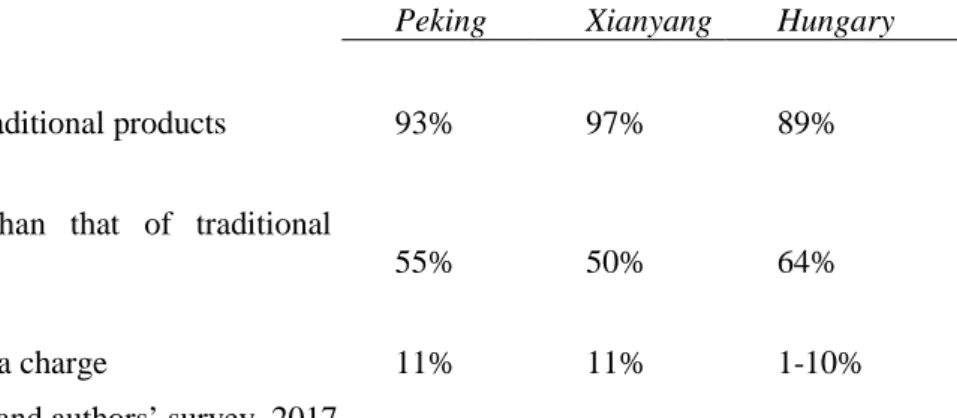
The next part of our research attempted to answer questions about customers’ considerations regarding those products with traceability data providing information in addition to legislative requirements; furthermore, whether extra traceability exerts an influence on product price and quality. Our results demonstrate that in the opinion of consumers, food traceability affects quality and food safety the same way. Therefore, they claim that products that contain these data are sold at higher prices than “traditional products”. The proportion of the potential customers of products that contain traceability data beyond legislative requirements was compared to data from the Chinese study mentioned in the literature survey (Table 5). Not surprisingly, it can be seen that the majority of consumers would purchase products that contain traceability data beyond legislative requirements at a sale price equal to traditional products. It is especially interesting why the remaining percentage of customers would bring a different decision as no harm came to them if they received additional information.
Table 5. The proportion of customers purchasing products containing data beyond legislative requirements.
Peking Xianyang Hungary
At the same price as traditional products 93% 97% 89%
At a price higher than that of traditional
products 55% 50% 64%
Rate of acceptable extra charge 11% 11% 1-10%
Source: Zhao et al. 2010 and authors’ survey, 2017
However, just over half of customers would choose traceable products at prices higher than traditional products; according to the survey, this proportion is higher in Hungary (64%). On the contrary, if the rate of the acceptable extra charge is lower, customer demand will only accept 1% -10%. Our investigations explored a precise correspondence between the demand for extra traceability data and the level of household income and health-conscious behaviour (p<0.05). Our study has found that the implementation of the development, improvement and operation of a traceability system mentioned in the introduction, at such an extra charge seems to be very doubtful. An additional criterion provides that customers should demand these data in the long-term regularly and should pay for it; however, our survey suggests that merely a low percentage of customers would be willing to act accordingly.
4. Conclusion
recalls, investment in such projects is worthwhile if extra costs are financed by customers. Then our research attempted to find out in what conditions customers would be willing to pay these costs. However, the implementation of these information services is doubtful in various aspects. First, several investigations have proved that most customers are not aware of the essential nature of traceability in all cases, and their overview of the product chain is limited. As a result, they frequently identify product traceability with food safety. Furthermore, the majority of consumers doubt the reliability of the information provided; their demand for these data should be continuous and regular to meet an additional critical criterion. However, there is little chance for average consumers to query about data of the same product type permanently.The rate of an acceptable extra charge is also questionable, if interpretable, as more than half of our respondents would never find the consequent price rise acceptable. The development, establishment and operation of a complex information system to provide consumers with adequate data would require massive investments, which are very difficult or impossible to implement from the 10% extra charge acceptable for customers. In conclusion, such service can succeed if they provide additional functionality as well (organic, traditionally produced food product, etc.) Our research shows that trademarks and confidence in producers are of greater importance than the accurate and continuous availability of traceability data.
References
Bánáti, D 2004, ‘Élelmiszer-biztonság az élelmiszeriparban.’ (Food safety in the food industry.) Kopint-Datorg, Budapest, pp. 1-46.
Balogh, P, Bai, A, Popp, J, Huzsvai, L, & Jobbágy, P 2015, ’Internet-orientated Hungarian car drivers' knowledge and attitudes towards biofuels’ Renewable & Sustainable Energy Reviews 48: pp. 17-26.
https://doi.org/10.1016/j.rser.2015.03.045
Cebeci, Z, Guney, I, & Alemdar, T 2008, ‘Designing a Conceptual Production Focused and Learning Oriented Food Traceability System.’ In Proceedings of the 4th International Conference on Information and Communication Technologies in Bio and Earth Sciences, (Ed. T. Tsiligiridis), 18-20 Sep 2008,Agric. Univ. Of Athens, Greece. pp. 206-213.
Csapóné Riskó, T, & Péntek, Á 2014, ’A tudatos fogyasztás megjelenési formái.’ (Forms of Conscious Consumption.) Táplálkozásmarketing 1:(1-2) X. pp. 73-80.
Cunningham, P 2008, ‘Using DNA Traceability to Track Meat and Ensure Safety.’ Genetic Engineering & Biotechnology News, Vol. 28, No. 8,
Dickinson, D, L, & Bailey, D 2005, ‘Experimental Evidence on Willingness to Pay for Red Meat Traceability in the United States, Canada, the United Kingdom, and Japan.’ Journal Of Agricultural & Applied Economics 37/3 pp. 537-548.
Ding, J, Xu, H, Li, P, & Xie, R 2017, ‘Design and implementation of food safety traceability system based on RFID technology.’ Advances in Intelligent Systems and Computing, Volume 611, pp. 657-666.
https://doi.org/10.1007/978-3-319-61566-0_61
Farkas, J 2002, ‘Élelmiszer-biztonság: globális gondok – javítási törekvések.’ (Food security: global concerns - improvement aspirations.) Magyar Tudomány 2002/12. Budapest, 1608. p.
Felföldi, J, Botos, Sz, Péntek, Á, Szilágyi, R, & Várallyai, L 2017, ’Studying the ict management of agrifood sector on supply chain level – the first stage: analysis of agricultural ict usage’ In: Anastasios Karasavvoglou, Persefoni Polychronidou (ed.) Agricultural Sector Issues in the European Periphery: Productivity, Export and Development Challenges. Wilmington (DE): Vernon Press, 2017. pp. 35-50.
Füzesi, I, Lengyel, P, Szilágyi, R, & Ráthonyi, G 2016, ’Application of EDI Technologies in the Food Supply Chains’, Journal of Ecoagrotourism 12:(1 (32)) pp. 69-77.
Golan, E, Krissof, B, & Kuchler, F 2004, ‘Food Traceability: One Ingredient in a Safe and Efficient Food Supply’. Amber Waves April, 2004. Economic Research Service/USDA
Kim, H.M, Fox, M,S & Gruninger M 1995, ‘An Ontology of Quality for Enterpise Modeling, Enabling Technologies’ Infrastructure for Collaborative Enterprises, 1995., Proceedings of the Fourth Workshop Berkeley Springs, WV, pp. 105-116.
Lakner, Z, Bánáti, D, Szabó, E, & Kasza, Gy 2003, ‘A magyar fogyasztó és az élelmiszerek biztonsága.’ (The Hungarian consumer and the safety of food.) A Hús, 2003/1. 49-55. pp.
Lakner, Z, Szabó, E, & Hajdú, I.-né 2005 ‘The 2004 paprika scandal: anatomy of a food safety problem.’ Studies in Agricultural Economies. Budapest, Agricultural Economics Research Institute, pp. 67-82.
Loureiro, M, L, & Umberger, W, J 2007, ‘A choice experiment model for beef: What US consumer responses tell us about relative preferences for food safety, country-of-origin labeling and traceability.’ Food Policy 32 (2007) pp. 496–514. https://doi.org/10.1016/j.foodpol.2006.11.006
Oláh, J, Karmazin, Gy, Pető, K & Popp, J 2018, ‘Information technology developments of logistics service providers in Hungary’ International Journal of Logistics Research and Applications 21:(3) pp. 332-344 https://doi.org/10.1080/13675567.2017.1393506
Popp, J, & Bánáti, D 2006, ‘Élelmiszer-biztonság a nemzetközi kereskedelem tükrében.’ (Food safety in the light of international trade.) Agrárgazdasági Kutató Intézet, Budapest, 141. p.
Schiefer, G 1997, ‘Quality Management and Process Improvement – The Challenge’, In: Schiefer G., Helbing R. (eds.), Quality Management and Process Improvement for Competitive Advantage in Agriculture and Food (Volume I.), Dept. of Agricultural Economics, University of Bonn, 509. p.
Simon, J 2006, ‘A klaszterelemzés alkalmazási lehetőségei a marketingkutatásban.’ (Application possibilities for cluster analysis in marketing research.) Statisztikai Szemle 84. évfolyam 7. szám pp. 627-651.
Stranieri, S, Cavaliere, A, & Banterle, A 2017, ‘Do motivations affect different voluntary traceability schemes? An empirical analysis among food manufacturers.’ Food Control Volume 80, 1 October 2017, pp. 187-196.
https://doi.org/10.1016/j.foodcont.2017.04.047
Szakály, Z, Pető, K, Popp, J, & Jasák, H. 2015, ‘A fenntartható fogyasztás iránt elkötelezett fogyasztói csoport, a
LOHAS szegmens jellemzői.’ (A consumer group dedicated to sustainable consumption, characteristics of the
LOHAS segment.) Táplálkozásmarketing 2:(1) pp. 3-9.
Szakály, Z, Soós, M, Kovács, S, & Polereczki, Zs 2016, ‘A felárfizetési hajlandóságot befolyásoló tényezők elemzése funkcionális élelmiszereknél.’ (Analysis of factors influencing the willingness to pay on functional food.) Gazdálkodás 60:(4) pp. 305-321.
Szilágyi, R, & Herdon, M 2013, ‘Augmented Reality (AR) Applications in Agriculture.’, In: Zacharoula Andreopoulou, Vagis Samathrakis, Soulla Louca, Maro Vlachopoulou (ed.) E-Innovation for Sustainable Development of Rural Resources During Global Economic Crisis. Hershey (PA): IGI Global, Information Science Reference, 2013. pp. 65-79.
Zhaoa, R, Qiaoa, J, & Chena, Y 2010, ‘Influencing factors of consumer willingness-to-buy traceable foods: An analysis of survey data from two Chinese cities.’ Agriculture and Agricultural Science Procedia 1 pp. 334–343.