Multiple Attribute Decision Making Method Based on the Trapezoid
Fuzzy Linguistic Hybrid Harmonic Averaging Operator
Peide Liu and Yu Su
School of Management Science and Engineering, Shandong University of Finance and Economics No.7366 Erhuandong Road, Lixia District, Ji’nan 250014, Shandong Province, P.R. China E-mail1:[email protected]
Keywords: the trapezoid fuzzy linguistic variables (
TFL
Vs
), theTFLHHA
operator, multiple attribute decision making (MADM)Received: October 18, 2010
A new method is proposed to solve the multiple attribute decision making (MADM) problems with the trapezoid fuzzy linguistic variables (
TFL
Vs
) based on the trapezoid fuzzy linguistic hybrid harmonic averaging (TFLHHA
) operator. To begin with, this paper reviews the concept and operational rules of theTFL
Vs
, the calculation method of the possibility degree withTFL
Vs
, and the comparison method ofTFL
Vs
. Then, some operators are proposed, in order to aggregate theTFL
Vs
, such as the trapezoid fuzzy linguistic weighted harmonic averaging (TFLWHA
) operator, the trapezoid fuzzy linguistic ordered weighted harmonic averaging (TFLOWHA
) operator, and the trapezoid fuzzy linguistic hybrid harmonic averaging(
TFLHHA
)
operator. Furthermore, based on theTFLHHA
operator, a new method solving the MADM problems with theTFL
Vs
is proposed. Finally, an illustrative example is given to show the decision making steps, and it verifies the effectiveness of the developed method.Povzetek: Članek opisuje metodo za podporo odločanju, ki uporablja mehko logiko.
1
Introduction
In the process of the multiple attribute decision making (MADM), the decision making information, given by the decision makers, often takes the form of the linguistic variables, because of the complexity and uncertainty of the objective things, and the ambiguity of human thinking. Therefore, the MADM under the linguistic context is an interesting research topic which has been receiving more and more attention in recent years [1-4]. Some operators were widely used to aggregate the decision making information in the process of the MADM. Bordogna et al. [5] developed a model within fuzzy set theory by the linguistic ordered weighted average (
LOWA
) operators for the group decision making in the linguistic context. Xu [6] proposed an approach to solve the multiple attribute group decision making problems with the uncertain linguistic information, based on the uncertain linguistic ordered weighted averaging (ULOWA
) operator and the uncertain linguistic hybrid aggregation (ULHA
) operator. Wu and Chen [7] introduced the linguistic weighted arithmetic averaging (LWAA
) operator to aggregate the decision making information which took the form of the linguistic variables. Xu [8] developed some operators for aggregating the triangular fuzzy linguistic variables, such as the fuzzy linguistic averaging (FLA
) operator, the fuzzy linguistic weightedaveraging (
FLWA
) operator, the fuzzy linguistic ordered weighted averaging (FLOWA
) operator, and the inducedFLOWA
(IFLOWA
) operator.But in the real situation, the decision-makers sometimes can only provide the decision making information in the form of the trapezoid fuzzy linguistic variables (
TFL
Vs
). The trapezoid fuzzy linguistic variable (TFL
V
) generalizes the linguistic variable, the uncertain linguistic variable and the triangular fuzzy linguistic variable. So the research on the MADM problems with theTFL
Vs
is very significant. But therelated decision making methods based on
the
TFL
Vs
are less. Xu [9] proposed the trapezoid fuzzy linguistic weighted averaging (TFLWA
) operator to aggregate all the decision making information corresponding to each alternative, and he used the similarity measure to rank the decision alternatives and then the most desirable one is selected. Liang and Chen [10] proposed the trapezoid fuzzy linguistic weighted averaging (TFLWA) operator to aggregate the decision making information, and then all the alternatives were ranked by comparing the possibility degree of theV
TFL
.Based on these, this paper extends the
to deal with the MADM problems with the trapezoid fuzzy linguistic information, such as the trapezoid fuzzy linguistic weighted harmonic averaging (
TFLWHA
) operator, and the trapezoid fuzzy linguistic ordered weighted harmonic averaging (TFLOWHA
) operator. TheTFLWHA
operator only focuses on the attribute weight itself, but it ignores the position weight with respect to the attribute value; and theTFLOWHA
operator focuses on the position weight with respect to the attribute value, but it ignores the weight of the attribute value itself. The two operators are one-sided. So in order to avoid the disadvantage of the two operators, the trapezoid fuzzy linguistic hybrid harmonic averaging (
TFLHHA
) operator is proposed to aggregate the attribute values which take the form of theTFL
Vs
. According to theTFLHHA
operator, the new method is proposed, which can solve MADM problems with theVs
TFL
directly.To do so, the remainder of this paper is structured as follows: In section 2, this paper reviews the concept and the operational rules of the
TFL
Vs
, and introduces the comparison method of theTFL
Vs
, in which the calculation method of the possibility degree with theTFL
Vs
is reviewed. In section 3, three operators are proposed in order to aggregate theTFL
Vs
, such as theTFLWHA
operator, theTFLOWHA
operator, and theTFLHHA
operator. In section 4, the decision making steps of the new method is proposed based on theTFLHHA
operator. In section 5, an illustrative example is given to show the decision making steps, and it verifies the effectiveness of the developed method. The section 6 concludes this paper.2
The Trapezoid Fuzzy Linguistic
Variables
2.1
The definition of the trapezoid fuzzy
linguistic variables
Let
S
s
i|
i
1
,
2
,
,
t
be a linguistic term set with odd cardinality, any labels
i represents a possible value of the linguistic variable. Especially,s
1ands
trepresent the lower and the upper values of the linguistic terms, respectively. For example, a linguistic term setS
could be given as follows:S
= {s
1=extremely poor,s
2=very poor,s
3=poor,4
s
=slightly poor,s
5=fair,s
6=slightly good,s
7=good,8
s
=very good,s
9=extremely good}Usually, in these cases,
s
iands
jmust satisfy the following additional characteristics [13]:(1) The set
S
is ordered:s
iis worse thans
j, ifi
j
;(2) Maximum operator:
max(
s
i,
s
j)
s
i, ifs
i
s
j; (3) Minimum operator:min(
s
i,
s
j)
s
j, ifs
i
s
j.Some calculation results, however, may not exactly match any linguistic labels in
S
in the calculation process. To preserve all the given information, the discrete term setS
is extended to a continuous term setS
{ |
s s
i 0
s
is i
q,
[0, ]}
q
, wheres
i meets all the characteristics above andq q
(
t
)
is a sufficient large positive integer. Ifs
i
S
, then we calls
i the original term, otherwise, we calls
i the virtual term. In general, the decision makers use the original linguistic terms to evaluate the alternatives, and the virtual linguistic terms can only appear in the process of the operation and ranking [13].Definition 2.1[8]: Let
s s
,
S
, then we defined the distance betweens
ands
as:
,
)
(
s
s
d
(1)Definition 2.2[8]: Let
s
[
s s s s
,
,
,
]
S
, wheres s s s
,
,
,
S
, and the subscripts
,
,
,
are non-decreasing numbers, ands
ands
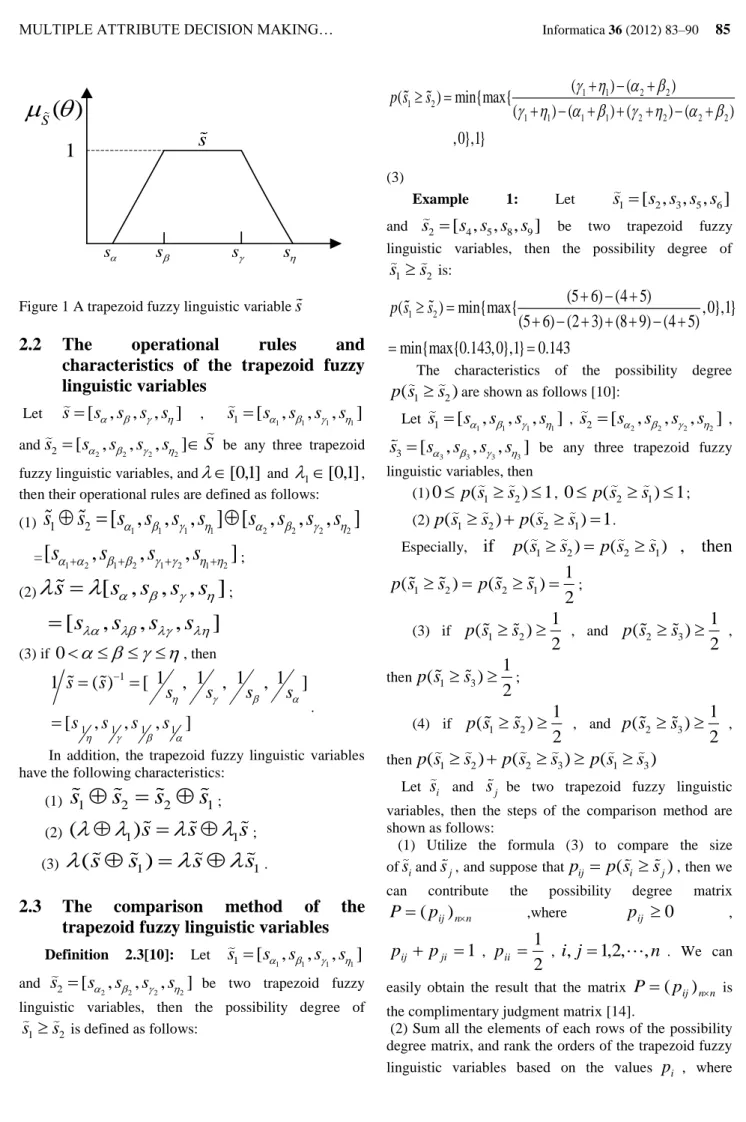
indicate the interval in which the membership value is 1, withs
ands
indicating the lower and upper values ofs
, respectively, thens
is called the trapezoid fuzzy linguistic variable (TFL
V
), which is characterized by the following membership function (see Figure 1):0
0
(
,
)
(
,
)
1
(
,
)
( ,
)
0
s
q
s
s
s
d s s
s
s
s
d s
s
s
s
s
d s s
s
s
s
d s s
s
s
s
( )
(2)where
S
is the set of all the trapezoid fuzzy linguistic variables. Especially, if any two of
1
( )
S
s
s
s
s
s
Figure 1 A trapezoid fuzzy linguistic variable
s
2.2
The
operational
rules
and
characteristics of the trapezoid fuzzy
linguistic variables
Let
s
[
s s s s
,
,
,
]
,1 1 1 1 1
[
,
,
,
]
s
s
s
s
s
and
2 2 2 2 2
[
,
,
,
]
s
s
s
s
s
S
be any three trapezoid fuzzy linguistic variables, and
[
0
,
1
]
and
1
[
0
,
1
]
,then their operational rules are defined as follows: (1)
1 1 1 1 2 2 2 2
1 2
[
,
,
,
] [
,
,
,
]
s
s
s s s s
s
s
s s
=
1 2 1 2 1 2 1 2
[
s
,
s
,
s
,
s
]
;(2)
s
[
s
,
s
,
s s
,
]
;[
s
,
s
,
s
,
s
]
(3) if
0
, then1
1 1 1 1
1
1
1
1
1
( )
[
,
,
,
]
[
,
,
,
]
s
s
s
s
s
s
s
s
s
s
.In addition, the trapezoid fuzzy linguistic variables have the following characteristics:
(1)
s
1
s
2s
2s
1; (2)(
1)
s
s
1s
; (3)
(
s
s
1)
s
s
1.2.3
The
comparison
method
of
the
trapezoid fuzzy linguistic variables
Definition 2.3[10]: Let
1 1 1 1 1
[
,
,
,
]
s
s
s
s
s
and
2 2 2 2 2
[
,
,
,
]
s
s
s
s
s
be two trapezoid fuzzy linguistic variables, then the possibility degree of1 2
s
s
is defined as follows:1 1 2 2 1 2
1 1 1 1 2 2 2 2
(
) (
)
(
) min{max{
(
) (
) (
) (
)
,0},1}
p s
s
(3)
Example 1: Let
s
1
[ , , ,
s s s s
2 3 5 6]
and
s
2
[ , , ,
s s s s
4 5 8 9]
be two trapezoid fuzzy linguistic variables, then the possibility degree of1 2
s
s
is:1 2
(5 6) (4 5)
(
) min{max{
,0},1}
(5 6) (2 3) (8 9) (4 5)
min{max{0.143,0},1} 0.143
p s
s
The characteristics of the possibility degree
1 2
(
)
p s
s
are shown as follows [10]: Let1 1 1 1 1
[
,
,
,
]
s
s
s
s
s
,2 2 2 2 2
[
,
,
,
]
s
s
s
s
s
,3 3 3 3 3
[
,
,
,
]
s
s
s
s
s
be any three trapezoid fuzzy linguistic variables, then(1)
0
p s
(
1
s
2) 1
,0
p s
(
2
s
1) 1
; (2)p s
(
1
s
2)
p s
(
2
s
1) 1
.Especially,
if
p s
(
1
s
2)
p s
(
2
s
1)
, then
1 2 2 1
1
(
)
(
)
2
p s
s
p s
s
;(3) if
(
1 2)
1
2
p s
s
, and(
2 3)
1
2
p s
s
,then
(
1 3)
1
2
p s
s
;(4) if
(
1 2)
1
2
p s
s
, and(
2 3)
1
2
p s
s
, thenp s
(
1
s
2)
p s
(
2
s
3)
p s
(
1
s
3)
Let
s
i ands
j be two trapezoid fuzzy linguistic variables, then the steps of the comparison method are shown as follows:(1) Utilize the formula (3) to compare the size of
s
iands
j, and suppose thatp
ij
p s
(
i
s
j)
, then we can contribute the possibility degree matrixn n ij
p
P
(
)
,wherep
ij
0
,1
jiij
p
p
,2
1
ii
p
,i
,
j
1
,
2
,
,
n
. We can easily obtain the result that the matrixP
(
p
ij)
nn is the complimentary judgment matrix [14].
nj ij
i
p
p
1
(
i
1, 2,
,
n
). The larger the value ofi
p
is, the larger the trapezoid fuzzy linguistic variables
iis.
Example 2: Let
s
1
[ , , ,
s s s s
2 3 5 6]
and
s
2
[ , , ,
s s s s
4 5 8 9]
be two trapezoid fuzzy linguistic variables, then we can compare the size of1
s
withs
2:(1) The possibility degree of
s
1
s
2 is:1 2
(5 6) (4 5)
(
) min{max{
,0},1}
(5 6) (2 3) (8 9) (4 5)
min{max{0.143,0},1} 0.143
p s
s
and the possibility degree of
s
2
s
1 is:2 1
(8 9) (2 3)
(
) min{max{
,0},1}
(8 9) (4 5) (5 6) (2 3)
min{max{0.857,0},1} 0.857
p s
s
Then we can contribute the possibility degree matrix:
2 2
0.5
0.143
(
)
0.857
0.5
ij
P
p
(2)
2
1 1
1
0.5 0.143
0.643
j j
p
p
,
2
2 2
1
0.875 0.5 1.375
j j
p
p
,so
p
1
p
2.Then, we can get that:
s
1
s
2(s
1is worse thans
2).3
Some Harmonic Operators with
the Trapezoid Fuzzy Linguistic
Variables
Definition 3.1: Let
TFLWHA S
:
n
S
, if1 1 2
1
( ,
,
,
)
(
)
n j
w n
j j
w
TFLWHA s s
s
s
(4)where
S
is the set of all trapezoid fuzzy linguistic variables, ands
j
S
(j
1
,
2
,
,
n
) is the trapezoid fuzzy linguistic variable.w
(
w
1,
w
2,
,
w
n)
is theweight vector, and
w
i is the weight ofs
i , where0
i
w
,i
1
,
2
,
,
n
,1
1
n
i i
w
, thenTFLWHA
is called the trapezoid fuzzy linguistic weighted harmonic averaging (TFLWHA
)operator.Example 3: If
s
1
[ , , ,
s s s s
2 3 5 6]
s
2
[ , , ,
s s s s
4 5 8 9]
3
[ , ,
5 6 7,
9]
s
s s s s
ands
4
[ ,
s s s s
3 4, ,
5 7]
S
arefour trapezoid fuzzy linguistic variables, and
(0.3, 0.2, 0.1, 0.4)
w
is the weight vector, then4 1 1 2 3 4
1
( ,
, ,
)
(
j)
w
j j
w
TFLWHA s s s s
s
1 2 3 5 6 4 5 8 9 5 6 7 9 3 4 5 7
0.3
0.2
0.1
0.4
(
)
[ , , , ] [ , , , ] [ , , , ] [ , , , ]
s s s s
s s s s
s s s s
s s s s
0.05 0.06 0.1 0.15 0.022 0.025 0.04 0.05
1 0.011 0.014 0.017 0.02 0.057 0.08 0.1 0.133
([
,
,
,
)
(
,
,
,
]
[
,
,
,
]
[
,
,
,
])
s
s
s
s
s
s
s
s
s
s
s
s
s
s
s
s
1
0.14 0.179 0.257 0.353 2.833 3.891 5.587 7.143
[
s
,
s
,
s
,
s
]
[
s
,
s
,
s
,
s
]
Definition 3.2: Let
TFLOWHA S
:
n
S
, if1 1 2
1
( ,
,
,
)
(
)
n j n
j j
TFLOWHA s s
s
r
(5)where
S
is the set of all trapezoid fuzzy linguistic variables , ands
j ,r
j
S
(j
1
,
2
,
,
n
) are the trapezoid fuzzy linguistic variables.r
jis thej
th largest ofs
i(i
1
,
2
,
,
n
), and
(
1,
2,
,
n)
is the position weight vector withTFLOWHA
, where0
j
,j
1
,
2
,
,
n
,1
1
n
j j
, thenTFLOWHA
is called the trapezoid fuzzy linguistic ordered weighted harmonic averaging (TFLOWHA
)operator.The characteristic of the
TFLOWHA
operator is: Firstly, The order of the trapezoid fuzzy linguistic variables is ranked, then the position weights are aggregated with them, but there is no relationship between
jands
j, and
jis only associated with theth
j
position in the aggregation process, so)
,
,
,
(
1
2
n
is called the position weight vector.According to the real situation, the position weight vector
(
1,
2,
,
n)
is determined. In this paper, the position weight is determined by the method which proposed in literature [15]. The formula is shown as follows:1
1 1
,
0,1,
,
1
2
i n
i n
C
i
n
(6) Example 4: Lets
1
[ , , ,
s s s s
2 3 5 6]
and
s
2
[ , , ,
s s s s
4 5 8 9]
be two trapezoid fuzzy linguistic variables, and we already know that1 2
s
s
(the calculation steps are shown in Example 1), then the position weight vector is0 1 2-1 2-1 2-1 2-1
C
C
(
,
)=(0.5, 0.5)
2
2
1 1 2
2 3 5 6 4 5 8 9 1
2 3 5 6 4 5 8 9
0.5
0.5
( , )
(
)
[ , , , ]
[ , , , ]
0.5
0.5
(
)
[ , , , ]
[ , , , ]
TFLOWHA s s
s s s s
s s s s
s s s s
s s s s
1 0.083 0.1 0.167 0.25 0.056 0.0625 0.1 0.125
1 0.139 0.1625 0.267 0.375
([
,
,
,
]
[
,
,
,
])
[
,
,
,
]
s
s
s
s
s
s
s
s
s
s
s
s
2.667 3.745 6.154 7.217
[
s
,
s
,
s
,
s
]
The
TFLWHA
operator only focuses on the weight of the attribute value itself, but it ignores the position weight with respect to the attribute value; and theTFLOWHA
operator focuses on the position weight with respect to the attribute value, but it ignores the weight of the attribute value itself. The two operators are one-sided. If the decision makers use these operators to aggregate the decision making information, some information may be lost. So in order to avoid the disadvantage of the two operators, the trapezoid fuzzy linguistic hybrid harmonic averaging (TFLHHA
) operator is defined as follows:Definition 3.3: Let
TFLHHA S
:
n
S
, if1 , 1 2
1
( ,
,
,
)
(
)
n j
w n
j j
TFLHHA
s s
s
r
(7)where
S
is the set of all trapezoid fuzzy linguistic variables , ands
i ,r
j
S
(i
,
j
1
,
2
,
,
n
) are the trapezoid fuzzy linguistic variables.r
jis thej
th largest of ii
s
nw
(i
1
,
2
,
,
n
), where 1 2(
,
,
,
n)
w
w w
w
is the weight vector, andw
iis theweight of
s
i,w
i
0
(i
1
,
2
,
,
n
),1
1
n
i i
w
, andn
is the balancing coefficient.
(
1,
2,
,
n)
is the position weight vector withTFLHHA
, where0
j
(j
1
,
2
,
,
n
),1
1
n
j j
, thenTFLHHA
is called the trapezoid fuzzy linguistic hybrid harmonic averaging (
TFLHHA
) operator.Example 5: Let
s
1
[ , , ,
s s s s
2 3 5 6]
and
s
2
[ , , ,
s s s s
4 5 8 9]
be two trapezoid fuzzy linguistic variables. We already know that the position weight vector is
(0.5, 0.5)
(the calculation steps are shown in Example 4), and the weight vector is(0.3,0.7)
w
, given by the decision makers, then based on the method shown in section 2.2, we cancalculate that: 1
1 3.333 5 8.333 10 1
[
, ,
,
]
2
s
r
s
s s
s
w
, and2
2 2.857 3.571 5.714 6.429 2
[
,
,
,
]
2
s
r
s
s
s
s
w
,Then,
1 , 1 2
1
1 3.333 5 8.333 10 2.857 3.571 5.714 6.429
( ,
,
,
)
(
)
ˆ
0.5
0.5
(
)
[
, ,
,
]
[
,
,
,
]
n j
w n
j j
TFLHHA
s s
s
r
s
s s
s
s
s
s
s
1 0.05 0.06 0.1 0.15 0.0778 0.0875 0.14 0.175
1 0.1278 0.1475 0.24 0.325
([
,
,
,
]
[
,
,
,
])
(
,
,
,
)
s
s
s
s
s
s
s
s
s
s
s
s
3.077 4.167 6.780 7.826
(
s
,
s
,
s
,
s
)
Especially, if
(
1
,
1
,
,
1
)
n
n
n
w
, thenTFLHHA
operator is reduced toTFLOWHA
operator; if
(
1
,
1
,
,
1
)
n
n
n
, thenTFLHHA
operator is reduced to the
TFLWHA
operator. Obviously,TFLOWHA
operator andTFLWHA
operator are extended from theTFLHHA
operator. The
TFLHHA
operator focuses on not only the importance of the weight of the trapezoid fuzzy linguistic variables itself, but also the importance of the position weight of the trapezoid fuzzy linguistic variables. So this operator is better than the previous ones.4
Multiple Attribute Decision
Making Method Based on the
Trapezoid Fuzzy Linguistic
Variables
A multiple attribute decision making problem under the fuzzy linguistic environment is represented as follows:
Let
X
{
x
1,
x
2,
,
x
n}
be the set of thealternatives, and
U
{
u
1,
u
2,
,
u
m}
be the set of theattributes. Let
w
(
w
1,
w
2,
,
w
m)
T be the weight vector of the attributes, andw
jbe the weight value of theth
j
attribute, wherew
j
0
(j
1
,
2
,
,
m
),
m
j j
w
1
1
, given by the decision makers directly.Suppose that
A
(
a
ij n m)
is the fuzzy linguistic decision matrixm
u
u
11 12 1 1
21 22 2 2
1 2
m m
n
n n nm
a
a
a
x
a
a
a
x
A
x
a
a
a
where
a
ij
[
a
ij( ),
a
ij( ),
a
ij( ),
a
ij( )]
S
is the attribute value which takes the form of the trapezoid fuzzy linguistic variables, given by the decision makers, for the alternativex
i
X
(i
1
,
2
,
,
n
) with respect to the attributeu
j
U
(j
1
,
2
,
,
m
). Let1 2
[
,
,
,
]
i i i im
a
a a
a
be the vector of the attribute values under the alternativex
i(i
1
,
2
,
,
n
).Then the decision making steps are shown as follows
Step 1: Construct the weighted linguistic matrix
A
'
(
a
ij n m')
' ' '
11 12 1
' ' '
' 21 22 2 '
' ' '
1 2
(
)
m m
ij n m
n n nm
a
a
a
a
a
a
A
a
a
a
a
where ij' ij j
a
a
nw
,w
(
w w
1,
2,
,
w
m)
is theweight vector of the attributes,
w
j
0
(
j
1, 2,
,
m
),1
1
m j j
w
,n
is the balancing coefficient.Step 2: Utilize the formula (3) to construct the possibility degree matrixes
( ) ( ) ' '
(
i)
(
i(
))
i jk m m jk ij ik m m
P
p
p
a
a
with respect to the alternativex
i (i
1
,
2
,
,
n
) , and sum all the elements of each rows of the possibility degree matrixP
i , then get the ranking vectors( ) ( ) ( ) ( ) 1 2
(
,
,
,
)
i i i i
j
p
p
p
p
, (j
1
,
2
,
,
m
), where( ) ( ) 1
m
i i
j jk
k
p
p
. Finally, rank the orders of attributevalues
a
ij' (j
1
,
2
,
,
m
) with respect to the alternativex
i based on the valuesp
( )ji (j
1
,
2
,
,
m
).Step 3: Utilize the formula (6) to calculate the position weight vector
(
1,
2,
,
m)
ofTFLHHA
operator.Step 4: Utilize the formula (7) to calculate the combined attribute values
1 , 1 2
1
( ,
,
,
)
(
)
m j
i w m
j j
z
TFLHHA
s s
s
r
where
i
1
,
2
,
,
n
.Step 5: Utilize the formula (3) to construct the possibility degree matrix
P
(
p
ij)
nn, based on the combined attribute valuesz
i of each alternative, then sum all the elements of each rows of the possibility degree matrix, where
nj ij
i
p
p
1
(
i
1
,
2
,
,
n
). Rank all the combined attribute values of each alternative and select the best alternative based on the valuesp
i.5
Illustrative Examples
In this section, a decision making problem of evaluating cars for buying (adapted from literature [1, 9]) is used to illustrate the new method.
A decision maker intends to buy a car. Four types of cars
x
i(i
1
,
2
,
3
,
4
) are available. He takes into account four attributes to decide which car he should buy: 1)G
1: economy, 2)G
2: comfort, 3)G
3: design, and 4)G
4: safety. The decision maker evaluates these four types of carsx
i (i
1
,
2
,
3
,
4
) under the attributesj
G
(j
1
,
2
,
3
,
4
), where the weight vector isw
(0.3, 0.2, 0.1, 0.4)
given by the decision makers. He uses the linguistic term set:S
={s
1=extremely poor,s
2=very poor,s
3=poor,4
s
=slightly poor,s
5=fair,s
6=slightly good,s
7=good,8
s
=very good,s
9=extremely good} and provides the linguistic decision making matrixA
(
a
ij)
4 4 :2 3 5 6 4 5 8 9 5 6 7 9 3 4 5 7
3 5 6 7 5 6 7 8 4 5 8 9 4 5 7 8 4 6 8 9 4 5 6 7 6 7 8 9 3 4 5 6
5 6 7 9 4 7 8 9 3 5 6 7
[ , , , ][ , , , ][ , , , ][ , , , ]
[ , , , ][ , , , ][ , , , ][ , , , ]
[ , , , ][ , , , ][ , , , ][ , , , ]
[ , , , ][ , , , ][ , , , ][
s s s s
s s s s
s s s s
s s s s
s s s s
s s s s
s s s s
s s s s
A
s s s s
s s s s
s s s s
s s s s
s s s s
s s s s
s s s s
s
6
, , , ]
s s s
7 8 9
Step 1: Construct the weighted linguistic matrix
A
'
(
a
ij')
4 4 , where' ij ij
j
a
a
nw
(j
1
,
2
,
3
,
4
).1.67 2.5 4.17 5 5 6.25 10 11.25
2.5 4.17 5 5.83 6.25 7.5 8.75 10 '
3.33 5 6.67 7.5 3.33 4.17 5 5.83
4.17 5 5.83 7.5 5 8.75 10 11.25
[
,
,
, ][ ,
,
,
]
[
,
, ,
][
,
,
,
]
[
, ,
,
][
,
, ,
]
[
, ,
,
][ ,
,
,
]
s
s
s
s
s s
s
s
s
s
s s
s
s
s
s
A
s
s s
s
s
s
s s
s
s s
s
s s
s
s
12.5 15 17.5 22.5 1.875 2.5 3.125 4.375
10 12.5 20 22.5 2.5 3.125 4.375 5
15 17.5 20 22.5 1.875 2.5 3.125 3.75 7.5 12.5 15 17.5 3.75 4.375 5 5.625
[
,
,
,
][
,
,
,
]
[ ,
,
,
] [
,
,
, ]
[ ,
,
,
] [
,
,
,
]
[
,
,
,
] [
,
, ,
]
s
s s
s
s
s
s
s
s s
s s
s
s
s
s
s s
s s
s
s
s
s
s
s
s s
s
s
s s
Step 2: Utilize the formula (3) to construct the possibility degree matrixes
( ) ( ) ' '
4 4 4 4
(
i)
(
i(
))
i jk jk ij ik
P
p
p
a
a
with respect to each alternativex
i (i
1, 2,3, 4
), and sum all the elements of each rows of the possibility degree matrixP
i , then get the ranking vectorsp
( )i
(
p
1( )i,
p
2( )i,
,
p
( )ji)
, (j
1, 2,3, 4
),where 4 ( ) ( ) 1 i i j jk k
p
p
. Finally, rank the orders ofattribute values
a
ij' (j
1, 2,3, 4
) with respect to the alternativex
ibased on the valuesp
( )ji (j
1, 2,3, 4
).
5
.
0
0
0
41
.
0
1
5
.
0
1
1
1
0
5
.
0
1
59
.
0
0
0
5
.
0
1p
(1) (1) (1) (1) (1) 1 2 3 4
(
,
,
,
)
(1.09, 2.5,3.5, 0.91)
p
p
p
p
p
' ' ' '
13 12 11 14
a
a
a
a
.
5
.
0
0
0
34
.
0
1
5
.
0
1
1
1
0
5
.
0
1
66
.
0
0
0
5
.
0
2p
p
(2)
(
1
.
16
,
2
.
5
,
3
.
5
,
0
.
84
)
' ' ' '
23 22 21 24
a
a
a
a
3
0.5
0.73
0
1
0.27
0.5
0
1
1
1
0.5
1
0
0
0
0.5
p
(3)(2.23,1.77,3.5, 0.5)
p
' ' ' '33 31 32 34
a
a
a
a
.
5
.
0
0
0
22
.
0
1
5
.
0
9375
.
0
1
1
0625
.
0
5
.
0
1
78
.
0
0
0
5
.
0
4p
)
72
.
0
,
4375
.
3
,
5625
.
2
,
28
.
1
(
) 4 (
p
' ' ' '43 42 41 44
a
a
a
a
.Step 3: utilize the formula (6) to calculate the position vector of
TFLHHA
operator:(0.125, 0.375, 0.375, 0.125)
.Step 4: utilize the formula (7) to calculate the combined attribute values:
1
(
2.65,
3.73,
5.73,
7.02)
z
s
s
s
s
,2
(
3.67,
5.27,
6.55,
7.55)
z
s
s
s
s
,3
(
3.33,
4.5,
5.63,
6.53)
z
s
s
s
s
,4
(
4.65,
6.39,
7.39,
8.87)
z
s
s
s
s
Step 5: utilize the formula (3) to construct the possibility degree matrix, based on
z
i:0.5
0.33 0.46
0.15
0.67
0.5
0.66
0.29
0.54
0.34
0.5
0.12
0.85
0.71 0.88
0.5
P
then sum all the elements of each row of the possibility degree matrix, we can get
1
1.44
p
p
2
2.12
p
3
1.5
p
4
2.94
. Based on the valuesp
i, rank all combined attribute values of each alternative and select the best alternative, then we can getx
4
x
2
x
3
x
1, so the best alternative isx
4.In order to verify the effective of this method, we utilized the method shown in literature [9] to solve this illustrate example.
Step1: From the linguistic decision making matrix
A
(
a
ij n m)
, we can get the vector of the ideal point of the attribute values corresponding to the alternativex
i(i
1
,
2
,
3
,
4
):I=(I ,I ,I ,I )
1 2 3 4 , and1 5 6 8 9 2 5 7 8 9
3 6 7 8 9 4 6 7 8 9
I
( , , ,
),I
( ,
, ,
),
I
( ,
, ,
),I
( ,
, ,
)
s s s s
s s s s
s s s s
s s s s
Step2: Utilize the
TFLWA
operator to derive the overall valuesz
i (i
1, 2,3, 4
)of the alternativei
x
(i
1
,
2
,
3
,
4
) andz
of the ideal pointI
1 3.1 4.1 5.8 7.3 2 3.9 5.2 6.8 7.8 3 3.8 5.1 6.4 7.4 4 5 6.5 7.5 8.8
5.5 6.7 8 9
z
(
,
,
,
), z
(
,
,
,
),
z
(
,
,
,
), z
( ,
,
,
)
z
(
,
, ,
)
s
s
s
s
s
s
s
s
s
s
s
s
s s
s
s
s
s
s s
Step3: We get the similarity degree
s(z,z )
i betweenz
andz
i(i
1
,
2
,
3
,
4
) based on the similarity degree formula1
s(z,z )
0.876
,s(z,z )
2
0.924
,3
s(z,z )
0.910
,s(z,z )
4
0.981
Step 4: Rank the order of
s(z,z )
i (i
1
,
2
,
3
,
4
), then we can get:x
4
x
2
x
3
x
1.Analysis:
6
Conclusions
This paper proposed a new method of the MADM problems based on the
TFLHHA
operator. The new method can deal with the MADM problems where the decision making information takes the form of theTFL
Vs
directly, and makes the computation process of theTFL
Vs
easily without the loss of the information. This method is easy to use and understand, and it enriched and developed the theory and method of the MADM, This method can solve these MADM problems where the attribute values take the form of the fuzzy linguistic variables, such as fuzzy linguistic variables, the uncertain fuzzy linguistic variables, the triangular fuzzy linguistic variables, the trapezoid fuzzy linguistic variables, and the mixed fuzzy linguistic variables, if we can transform these fuzzy linguistic variables into the trapezoid fuzzy linguistic variables. But this method can only solve the MADM problem under the linguistic context. So it is the limitation of this paper. In the future, we will apply this method to solve the real-life MADM problems in the linguistic context, and we will continued working in the decision making method of the MADM problems with theTFL
V
.Acknowledgment
This paper is supported by the Humanities and Social Sciences Research Project of Ministry of Education of China (No.10YJA630073 and No.09YJA630088), the Natural Science Foundation of Shandong Province (No. ZR2011FM036), the Social Science Planning Project Fund of Shandong Province (09BSHJ03), the Soft Science Project Fund of Shandong Province (2009RKA376), and the Doctor Foundation of Shandong Economic University. The authors also would like to express appreciation to the anonymous reviewers for their very helpful comments on improving the paper.
References
[1] Herrera, F., Martínez, L.(2000). An Approach for Combining Numerical and Linguistic Information Based on the 2-Tuple Fuzzy Linguistic Representation Model in Decision Making, International Journal of Uncertainty, Fuzziness and Knowledge -Based Systems, 8, pp. 539-562. [2] Li, D.F., Yang, J.B.(2004). Fuzzy Linear
Programming Technique for Multi-attribute Group Decision Making in Fuzzy Environments, Information Sciences, 158, pp. 263-275.
[3] Herrera, F., Martínez L. (2000). A 2-tuple fuzzy linguistic representation model for computing with words, IEEE Transactions on fuzzy systems, 8, pp. 746–752.
[4] Xu, Z.S. (2004).Uncertain Multiple Attribute Decision Making: Methods and Applications, Tsinghua University Press, Beijing.
[5] Bordogna, G., Fedrizzi, M., Pasi, G. (1997).A Linguistic Modeling of Consensus in Group Decision Making Based on OWA Operators, IEEE
Transactions on Systems, Man, and Cybernetics-Part A ,27(1), pp.126-132.
[6] Xu, Z.S. (2004). Uncertain Linguistic Aggregation Operators Based Approach to Multiple Attribute Group Decision Making under Uncertain Linguistic Environment, Information Sciences, 168, pp.171-184.
[7] Wu, Z.B., Chen, Y.H. (2007). The maximizing deviation method for group multiple attribute decision making under linguistic environment, Fuzzy Sets and Systems, 158, pp. 1608-1617. [8] Xu, Z.S.(2007). Group decision making with
triangular fuzzy linguistic variables, Springer Berlin / Heidelberg. pp.17-26.
[9] Xu, Z.S.(2005). An approach based on similarity measure to multiple attribute decision making with trapezoid fuzzy linguistic variables, Fuzzy Systems and Knowledge Discovery 3613, pp. 110-117. [10] Liang, X.C., Chen, S.F.(2008). Multiple attribute
decision making method based on trapezoid fuzzy linguistic variables, Journal of Southeast University (English Edition), 24(4), pp.478-481.
[11] Chen, H.Y., Liu, C.L., Sheng Z.H.(2004). Induced Ordered Weighted Harmonic Averaging (IOWHA) Operator and Its Application to Combination
Forecasting Method, Chinese Journal of
Management Science, 12(5), pp. 35-40.
[12] Liu, J.P., Chen, H.Y.(2007). Uncertain combined weighting harmonic averaging operators and its application, Operations Research and Management Science, 16(3), pp.36-40.
[13] Wei, G.W.(2007). Fuzzy Linguistic Hybrid
Geometric Aggregation Operator and Its
Application to Group Decision Making, Science paper online. www.paper.edu.cn/ .
[14] Xu, Z.S. (2010). The least variance priority method (LVM) for fuzzy complementary judgment matrix, System engineering theory& practice, 21(10), pp.93-96.