Decision-Making in Determining the Level of Knowledge of Students
in the Learning Process under Uncertainty
Shahnaz N. Shahbazova
Department of Information Technology and Programming Azerbaijan Technical University
25 H.Javid Ave., Baku, AZ1073 Azerbaijan E-mail: [email protected]
Keywords: intellectual learning and testing system, algorithm of decision-making, fuzzy logic, knowledge base,
control the student's knowledge
Received:August 22, 2012
In this paper, intellectual technology is applied with the device of fuzzy logic as the basis of a developed system of learning and testing. This system is used to automate the process of teaching and control of knowledge of students in higher education institutions. The quality of the intellectual learn learning system directly depends on the accuracy of the definition of the student’s current level of knowledge, as well as the choice of a learning strategy. It can be a transition to teaching new material, review of old material, or the learning completion.
Povzetek:Predstavljena je metoda za določanje znanj študentov v verjetnostih domenah .
1
Introduction
Application of modern intellectual information systems creates the new environment into which modern methods of teaching are easily integrated, as well as flexibility and individuality that were unachievable in traditional methods of learning.
An advantage to nontraditional ways of teaching is that the application of network technologies can simultaneously train a considerable quantity of students while maintaining an individualized educational process and testing. It allows superior mastery of course material in comparison with a traditional method of learning because it can determine the real level of knowledge of teaching materials of each given student.
Another advantage is the flexibility of the system. The student can choose from a collection of materials reflecting the experience and talent of the best teachers from every corner of the world. This system allows the student to choose from various learning courses the method and intensity of learning according to the student’s own preferences and abilities.
Each modern higher education institution must create and integrate educational information systems into complex intellectual, information learning system network; it must develop universal automated methods of information control as well as an individualized approach to student learning [12].
As a practical realization of the intellectual information system, we solve the following problems:
The problem of creating a unified system of storage methods of distributed informational materials in networks of complex configurations.
The problem of creating a flexible system of learning and testing with universal quality monitoring of knowledge of students.
For each of these tasks, we propose solutions that have proven themselves in practice. The proposed model of structuring informational materials combines flexibility and efficiency and can be applied to any system of governance. Another problem solved in this article is the use of the algorithmic modeling decision-making system to control the student's knowledge; it is an original mechanism for simulating the techniques of the teacher in an individual test of the student. Analytical study of the teacher’s teaching techniques makes it possible to find several main principles; these are used to increase the effectiveness of control procedures in the automated system of knowledge. It is used to develop a more detailed analysis of each incorrect answer given in a test to define not only the current assessment that the student has earned, but also to estimate the total knowledge the student possesses. This algorithm is an essential element developed for an automated system with minimal learning from an instructor.
2
Intellectual information system of
learning and testing (IISLT)
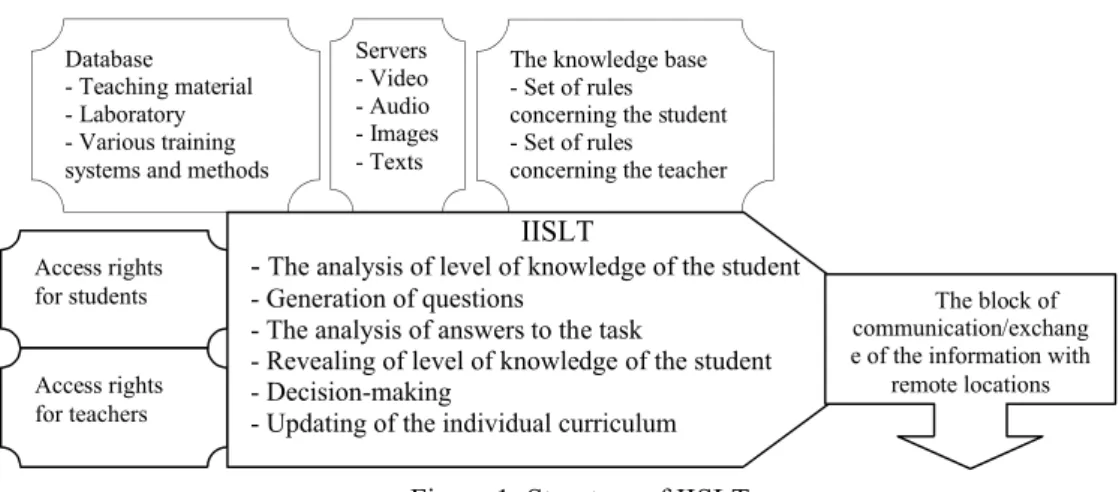
Figure 1: Structure of IISLT. material, programs, teaching material, and details of the
students.
Informational material can be presented in the form of electronic resources, for example, video and audio collections, laboratories of text materials, and unabridged editions of various dictionaries and encyclopedias. This large quantity of information is on different system servers and there is the possibility of the addition of new systems or edits of existing material.
Multimedia courses and search programs require multiple system resources and plays of files of various formats (video, audio, and images). The data can also be used for test and training programs.
The teaching material can be divided into three groups according to functional value:
Preparatory material – contains a considerable quantity of varied teaching material on different themes of all areas of knowledge.
Pedagogical materials – consist of courses of lectures, abstracts, and various questionnaires prepared by teachers for the practice. This material can be more purposeful and structured, reflecting different methods of teaching.
Training material – is intended for intermediate or definitive testing of knowledge of the student. Various testing methods, for the purpose of definition of level of knowledge and abilities of the student, are in this category.
Information system resources are increased through cross-referencing; in this way, the new material is easily integrated into the information environment.
This method uses accompanying keywords as index elements. Keywords enable easy guidance in extensive information resources of a similar orientation and subjects, without limiting teachers to additional conventions required in registering learning materials.
Resources of the intellectual system are increased by addition or improvement of algorithms of decision-making and also expansion of the library of rules of the knowledge base realized on a mathematical apparatus of the fuzzy logic and neural networks.
One of the main system resources is the information folder of the student, which stores all data on the student’s abilities, the schedule for training and testing,
the statistic, and so on. In addition to this data, comments and remarks of teachers are stored in this folder.
3
The algorithm of decision-making
This mechanism of decision-making features the choice of level of question complexity set for the student on the basis of the result of the answer to the previous question [6,8].
The resolution of this problem depends on a considerable quantity of parameters, the majority of which are not known to the intellectual system (owing to complexity); however, a fairly accurate answer can be found by means of the mathematical apparatus of fuzzy logic [1,2].
The algorithm of decision-making is based on the results of the decisions to the following problems: 1. The preliminary analysis of knowledge of the
student – is used for an estimation of level of student knowledge for decision-making of a choice of the first question (to the unprepared student a simple question is asked whereas the prepared student receives a more difficult question )[7];
Figure 2: Strategy of a choice of the first question. 2. The student has answered the previous question
correctly – in this case, the student is asked a question of increased difficulty
Q = (Max (A +) + (Max or Max (A-))) / 2 ± 2 % (1)
Servers - Video - Audio - Images - Texts Database
- Teaching material - Laboratory - Various training systems and methods
The knowledge base - Set of rules concerning the student - Set of rules concerning the teacher
Access rights for students
Access rights for teachers
IISLT
-The analysis of level of knowledge of the student - Generation of questions
- The analysis of answers to the task
- Revealing of level of knowledge of the student - Decision-making
- Updating of the individual curriculum
The block of communication/exchang e of the information with
where Q = the following question, (A +) = a right answer, (A-) = the wrong answer, and ±2 % are the limits for the following question.
Figure 3: Strategy of a choice of a question resulting from a right answer.
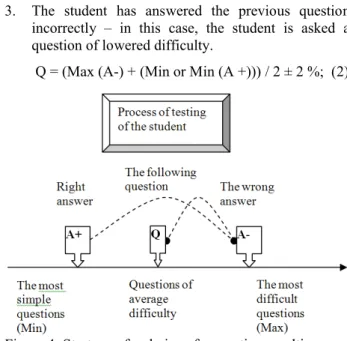
3. The student has answered the previous question incorrectly – in this case, the student is asked a question of lowered difficulty.
Q = (Max (A-) + (Min or Min (A +))) / 2 ± 2 %; (2)
Figure 4: Strategy of a choice of a question resulting from a wrong answer.
4. Processing of results and decision-making on a definitive estimation or testing continuation – quantity of right answers multiplied by their complexity in relation to errors; the set of correct and wrong answers are input to the decision-making subroutine for estimation results. If there is a high probability of uncertainty, testing proceeds [11]
{Z, P} = f (∑ (A +) × (V +), ∑ (A-) × (V-), (A0 +), (A1 +)..., (A0-), (A1-)...) (3)
where Z = an estimation, P = uncertainty, f = the subroutine of decision-making,
(Ai +) = set of right answers, (Ai-) = set of wrong answers, (V +) = weight of right answers, and (V-) = weight of wrong answers.
The most simple questions (Min)
The difficult questions (Max) The testing
termination
Questions of average difficulty
+ +
+ + - + -
-+ - +++ ++- - - +
Figure 5: An example of distribution of answers upon termination of testing.
One of the functions of the decision-making block is a choice of the following question which, most likely, corresponds to the level of knowledge of the student [9]. Upon an incorrect answer, the data about the student is reevaluated and a less complicated question is chosen (2). Upon a right answer, the program chooses a more complicated question (1, 13).
As was previously mentioned, because of the considerable quantity of external parameters, these decisions are analyzed and executed by means of a mathematical apparatus of fuzzy logic. The question choice is carried out by performance of several calculations of a set of the fuzzy expressions [3,4]; the ultimate goal is transfer of the results to a decision-making subsystem.
This decision-making process enables the sequence of question choices to be individualized and at test termination to yield the most exact estimation of knowledge of the student [10].
Based on the previous results of the student (3) in the given subject, the system analyzes the test results and takes out an estimation which is brought in the private affair of the student. This estimate of overall test performance is presented in digital form (Figure 6).
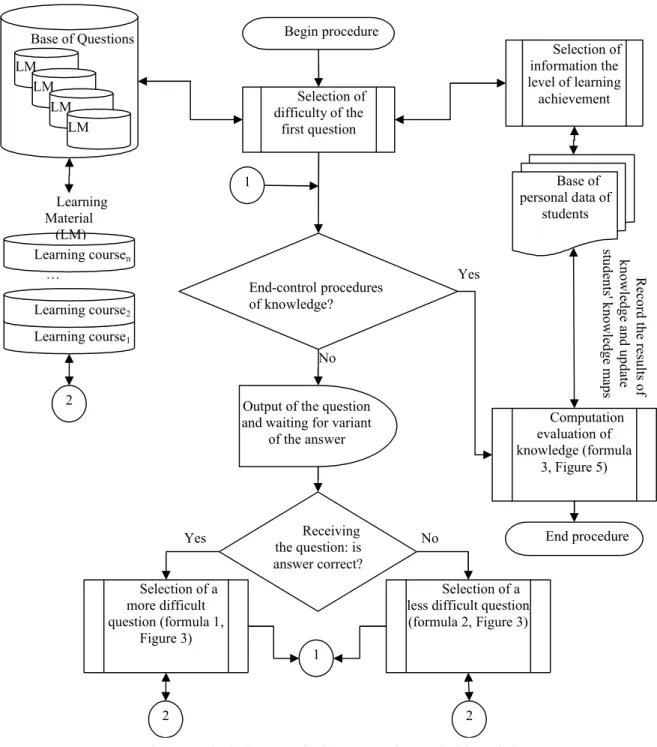
The mechanism of selection of questions described above during the testing procedure can be represented as an algorithm displayed in the block diagram shown in Figure 7.
The implementation of this algorithm is extremely simple and is based on applying a set of rules of fuzzy logic, which are logical structures that control the process of control of knowledge.
....
2 2 1 1Y
f
THEN
X
f
IF
Y
f
THEN
X
f
IF
output input output input (4)where the incoming data according to X characterizing the coming of the student survey results, select the appropriate response of the current situation of systems
which Y represents one of the four analyzed above, the answers of module knowledge control [14].
The decision of an appropriate question for the estimation for the executed test can be based on both the program and the teacher or their joint decision. The given algorithm of decision-making enables training or testing at any level of complexity, from the individual test to the graduation examination.
In the process, the students can not only determine their level of knowledge but also learn to analyze their own mistakes, which can affect the curriculum. By achieving sustainable results in the test on a particular subject, the student can go to the next section of the course.
Participating in the training will give the necessary time to complete assimilation and retention of the Base of Questions
LM LM LM LM Begin procedure End procedure Base of personal data of
students Selection of information the level of learning achievement Selection of
difficulty of the first question
Learning course1
Learning course2
Learning coursen
…
Learning Material
(LM)
Output of the question and waiting for variant
of the answer End-control procedures of knowledge?
No
Receiving the question: is answer correct?
Yes
Selection of a more difficult question (formula 1,
Figure 3)
Selection of a less difficult question
(formula 2, Figure 3)
Computation evaluation of knowledge (formula
3, Figure 5)
R ec or d t he re su lts o f kn ow le dg e a nd u pd ate stu de nts ' k no w le dg e m ap s 1 1 2 2 2 Yes No
material and then transition to new, more complex material. Each transition is accompanied by a small test evaluating retention of the content of the previous course.
4
Conclusion
This article discusses the mechanism for an intelligent method for the control of students' knowledge. This paper describes the intellectual system in which the advantages of the test system and the algorithm of performance of the teacher are combined to determine the knowledge of the trainee.
This developed algorithm of decision-making can test the knowledge level of the student using a minimal number of questions with a high level of reliability in comparison to a traditional testing method, the spent teacher or at the sample test task.
References
[1] M.Nikravesh, F.Aminzadeh, L.A.Zadeh, Soft Computing and Intelligent data analysis in oil exploration, 2003, Elsevier.
[2] M.Nikravesh, L.A.Zadeh, J.Kacprzyk, Soft Computing for Information Processing and Analysis, 2005, Springer.
[3] A.B.Barsky, Neural networks: recognition, management, decision-making, 2004, Moscow, «Finance and statistics».
[4] N.G.Jarushkina, Bases of the theory of fuzzy and hybrid systems, 2004, Moscow, «Finance and statistics».
[5] Shahbazova Sh., Freisleben B., A Network-Based Intellectual Information System for Learning and Testing, Fourth International Conference on Application of Fuzzy Systems and Soft Computing, Siegen, Germany, 2000, pp.308-313.
[6] Shahbazova Sh., Zeynalova S., Decision-Making In Definition Of Knowledge In The Conditions Of Uncertainty Of Educational Process, PCI-2010, Volume I, "Elm", 2010, pp.305-310.
[7] Zadeh L.A., Klir G.J., Yuan B., Fuzzy Sets, Fuzzy Logic, and Fuzzy Systems: Selected Papers by Lotfi A. Zadeh, 1996, pp.60-69.
[8] Zadeh L.A., The new approach to the analysis of difficulty systems and decision processes, Mathematics Today, Knowledge, 1974, pp. 23-37 [9] Zadeh L.A., A new approach to the analysis of
difficulty systems and decision processes, Mathematics Today, Knowledge, 1974, pp. 23-37 [10] Bernshteyn L.S., Bojenyuk A.V., Fuzzy models of
decision making: deduction, induction, analogy. Taganrog, Univ Tsure, 2001. pp. 78-99.
[11] Bouchon-Meunier B., Yager R.R., Fuzzy Logic and Soft Computing (Advances in Fuzzy Systems: Application and Theory), World Scientific, 1995, pp.84-93, 103-119.
[12] Gorbunova L.G., On the realization of the rating system in pedagogical high schools, Proceedings of 2 International Technical Conference "University Education", Penza, 1998, Part 1. – pp.105-106.
[13] Shahnaz N.Shahbazova, Application of Fuzzy Sets for Control of Student Knowledge, ISSN 1683-3511, Applied and Computational Mathematics, An International Journal, Volume 10, N 1, 2011. Special Issue on Fuzzy Set Theory and Applications, pp.195-208.