Oligomeric state of the ZIKV E protein de
fi
nes
protective immune responses
Stefan W. Metz
1
*, Ashlie Thomas
1
, Alex Brackbill
2
, John Forsberg
2
, Michael J. Miley
2
, Cesar A. Lopez
1
,
Helen M. Lazear
1
, Shaomin Tian
1
& Aravinda M. de Silva
1
*
The current leading Zika vaccine candidates in clinical testing are based on live or killed virus
platforms, which have safety issues, especially in pregnant women. Zika subunit vaccines,
however, have shown poor performance in preclinical studies, most likely because the
antigens tested do not display critical quaternary structure epitopes present on Zika E protein
homodimers that cover the surface of the virus. Here, we produce stable recombinant E
protein homodimers that are recognized by strongly neutralizing Zika speci
fi
c monoclonal
antibodies. In mice, the dimeric antigen stimulate strongly neutralizing antibodies that target
epitopes that are similar to epitopes recognized by human antibodies following natural Zika
virus infection. The monomer antigen stimulates low levels of E-domain III targeting
neu-tralizing antibodies. In a Zika challenge model, only E dimer antigen stimulates protective
antibodies, not the monomer. These results highlight the importance of mimicking the highly
structured
fl
avivirus surface when designing subunit vaccines.
https://doi.org/10.1038/s41467-019-12677-6
Z
ika virus (ZIKV) is an enveloped single stranded RNA
virus that is transmitted by mosquito vectors. As a member
of the
fl
avivirus genus, ZIKV shares many structural
fea-tures with other medically important
fl
aviviruses such as Wes
Nile virus, yellow fever virus, and dengue virus (DENV). The
fl
avivirus envelope (E) protein is a major target of neutralizing
and protective human antibodies. E oligomers form complex
quaternary structure epitopes on the viral surface which are of
particular importance as protective human antibodies bind to
these higher order protein structures
1.
ZIKV infection during pregnancy can result in
neurodevelop-mental defects (congenital Zika syndrome). This has stimulated
work on subunit vaccines, as live attenuated and other replicating
virus vaccines are contraindicated during pregnancy. However,
for
fl
aviviruses subunit vaccines based on recombinant E proteins
(rE) have performed poorly in preclinical studies compared with
virus or virus-like particle (VLP) vaccines
2–6. In aqueous solution,
fl
avivirus rE proteins are in a dynamic equilibrium that favors the
monomer over the dimer at physiological temperature, which
likely explains poor binding by potently neutralizing human
antibodies targeting quaternary epitopes and the overall poor
immunogenicity of these antigens in preclinical studies
2,7,8.
Here, we investigate if ZIKV rE dimers are better subunit
vaccine antigens than monomers. Unlike the E monomer, the
dimer is recognized by strongly neutralizing mAbs isolated from
ZIKV patients and the dimer, not the monomer, stimulates
strongly neutralizing and protective antibodies that targeted
epitopes that were similar to epitopes recognized by human
antibodies following natural Zika virus infection. These results
highlight the importance of mimicking the highly structured
fl
avivirus surface when designing subunit vaccines. The
fl
avivirus
fi
eld has a long history of using E monomers as vaccine antigens
with limited success. These results highlight the importance of
mimicking the highly structured
fl
avivirus surface when
design-ing subunit vaccines, and are applicable to developdesign-ing second
generation subunit vaccines against Zika as well as other
medi-cally important
fl
aviviruses like dengue and yellow fever.
Results
Expression of ZIKV rE monomers and homodimers
. Here, to
investigate if ZIKV rE dimers are better subunit vaccine antigens
than monomers, we expressed ZIKV rE variants (aa1
–
402) that are
monomers (rE
M) or stable dimers (rE
D) under physiological
conditions. We generated stable ZIKV rE
Dproteins as previously
described for DENV E protein by introducing a disul
fi
de bridge
(A264C)
in
the
E-domain
II
interactive
region
of
the
homodimer
9,10(Fig.
1
a). The oligomeric state of the puri
fi
ed rE
Mand rE
Dproteins were con
fi
rmed by protein gel electrophoresis
(Fig.
1
b). The stable rE
D, but not the rE
M, was ef
fi
ciently recognized
by neutralizing mAbs that have dimer-dependent quaternary
footprints, such as ZIKV-speci
fi
c mAbs A9E, G9E, and ZKA-230
and
fl
avivirus cross-reactive mAbs C8 and C10 (Fig.
1
c).
ZIKV rE
D, but not rE
M, induces neutralizing antibodies
. After
con
fi
rming that rE
Dwas a dimer displaying native quaternary
epitopes, we immunized C57BL/6 mice with 5 µg rE
M, 5 µg rE
D,
5 µg rE
M+
alum, or 5 µg rE
D+
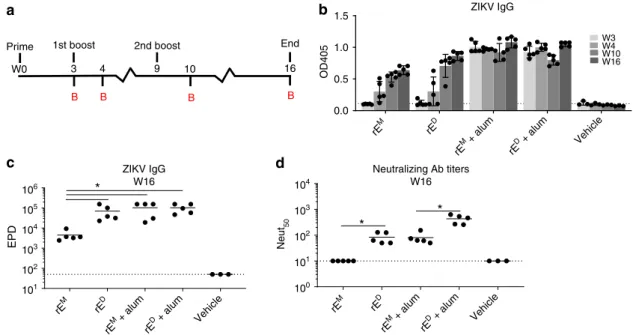
alum and analyzed ZIKV-speci
fi
c
IgG and neutralizing antibody titers over time (Fig.
2
a). In the
absence of alum, rE
Mand rE
Dinduced minimal IgG titers after
the initial immunization, but this response increased upon
boosting (Fig.
2
b, c). In the alum adjuvanted groups, high IgG
titers were observed even after the prime alone, with minimal
change upon boosting (Fig.
2
b). Although rE
Melicited
ZIKV-binding antibodies in the absence of alumn, these antibodies
failed to neutralize ZIKV (Fig.
2
d). In contrast, non-adjuvanted
rE
Delicited ZIKV-neutralizing antibodies (Fig.
2
d). The addition
of alum adjuvant elevated neutralizing antibody levels in both
groups, but neutralizing titers were signi
fi
cantly higher after rE
Dimmunization compared with rE
M. Our results demonstrate that,
while both antigens stimulated ZIKV-speci
fi
c IgG, the rE
Dsti-mulated antibodies that are more potently neutralizing compared
with the rE
Mstimulated antibodies.
ZIKV rE
Dstimulates antibodies that target complex epitopes
.
We next performed experiments to determine if antibodies
stimu-lated by rE
Mand rE
Dantigens recognized different epitopes on the
ZIKV E protein. Many
fl
avivirus type-speci
fi
c antibodies recognize
relatively simple epitopes on domain III of the E protein (EDIII),
whereas other type-speci
fi
c antibodies recognize more complex
quaternary structure epitopes displayed on E protein homodimers
or higher order structures that cover the viral surface. Most
EDIII-speci
fi
c neutralizing antibodies have been isolated from mice
immunized with inactivated
fl
avivirus antigens
11–13. In contrast,
most quaternary epitope directed neutralizing antibodies have been
isolated from people infected with wild-type
fl
aviviruses
7,14–17. In
fact, recent studies demonstrate that neutralizing antibodies in
a
b
c
Engineered disulfide
1.0
Epitope confimation
rEM rED
0.5
A405
0.0
4G2 1M7 C8
Q
C10
Q
A9E
Q
G9E
Q
ZKA-230
Q
2D22
38 49 62 98 (kDa) Mar
k
er
rE
M
rE
D
people exposed to
fl
avivirus infections or effective live attenuated
vaccines predominantly recognize quaternary epitopes, with simple
EDIII epitopes accounting for only a minor fraction of neutralizing
antibodies
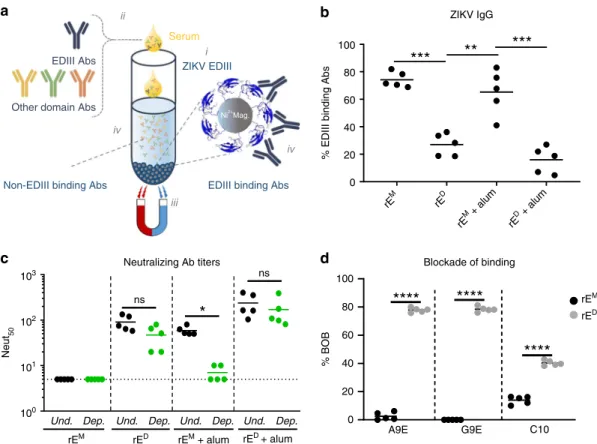
18–22. To compare levels of EDIII directed antibodies in
animals immunized with rE
Mor rE
D, we used recombinant
ZIKV-EDIII conjugated to magnetic beads to deplete mouse immune sera
of EDIII-binding antibodies (Fig.
3
a). We tested control-depleted
and EDIII antibody depleted immune sera to estimate the levels of
binding (Fig.
3
b) and neutralizing antibodies (Fig.
3
c) in each
sample targeting epitopes on EDIII. In mice immunized with rE
M,
~70% (rE
Mgroup) and ~60% (rE
M+
alum group) of total
ZIKV-speci
fi
c IgG recognized epitopes on EDIII (Fig.
3
b). On the other
hand, signi
fi
cantly less EDIII-speci
fi
c antibodies were induced after
immunization with rE
D(~30% for rE
Dand ~20% for rE
D+
alum).
The antibody binding patterns were also re
fl
ected in the ZIKV
neutralization assays. The majority of neutralizing antibodies in the
rE
M+
alum group were lost following depletion with EDIII antigen
(Fig.
3
c). In contrast, no loss of neutralization was observed in the
animals immunized with rE
Dor rE
D+
alum after the removal of
EDIII-binding antibodies (Fig.
3
c). We conclude that the rE
Mantigen induces an EDIII focused antibody response that is poorly
neutralizing, whereas rE
Dantigens stimulate robust neutralizing
antibody responses that target epitopes distinct from simple EDIII
epitopes.
We recently isolated two ZIKV-speci
fi
c strongly neutralizing
human mAbs (A9E and G9E) from a person who was infected
with ZIKV in 2016
23. These antibodies map to complex epitopes
on domain I (A9E) and domain II (G9E) of ZIKV E protein
23.
Moreover, antibody blockade assays using these mAbs and
human immune sera indicated that the epitopes targeted by these
mAbs also are targeted by antibodies in immune serum from Zika
patients but not dengue patients
23. We used a blockade of binding
(BOB) assay to test if mice immunized with rE
Mor rE
Ddeveloped antibodies that recognize A9E or G9E epitopes on
ZIKV. We also tested if rE
Mor rE
Dantigens stimulated
antibodies that targeted the epitope of human mAb EDE C10
17which binds to a E dimer-dependent epitope that is conserved
between DENV and ZIKV. Sera from mice immunized with rE
Mdid not block binding of A9E, G9E, and C10 mAbs to ZIKV
(Fig.
3
d). In contrast, sera from mice immunized with rE
Dantigen ef
fi
ciently blocked binding of A9E and G9E (~80%) and
partially blocked binding of EDE C10 (~35%) to ZIKV. These
results demonstrate that the rE
Dantigen and natural ZIKV
infections stimulate antibodies that target similar complex
epitopes on the virion. The rE
Mfails to induce similar antibodies
and directs the antibody response to simple epitopes on
ZIKV EDIII.
ZIKV rE
Dinduces protective antibodies in mice
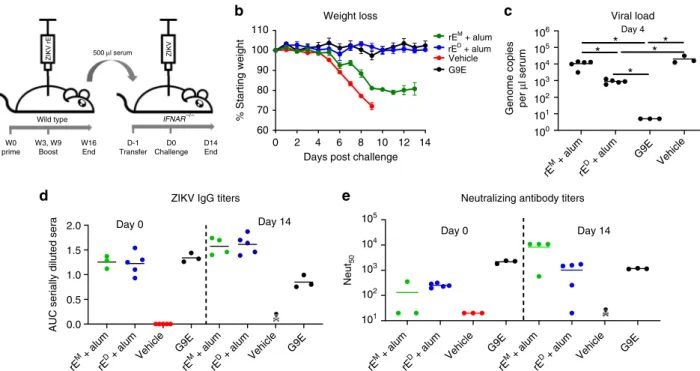
. Next, we
investigated if the immune sera of mice vaccinated with rE
M+
alum and rE
D+
alum could protect mice from lethal ZIKV
challenge. We immunized wild-type mice as previously
descri-bed (Fig.
2
), and transferred heat-inactivated immune sera to
Ifnar1
−/−mice which are highly susceptible to ZIKV. Ifnar1
−/−mice were challenged with 1000 FFU of ZIKV H/PF/2013, 1 day
post serum transfer. Mice were monitored for weight loss and
ZIKV induced disease, and mice were bled at days 0 (before
virus challenge), 4, and 14 (Fig.
4
a). The potently neutralizing
mAb G9E was used as a positive control for protection against
ZIKV infection
23. Mice that received G9E or serum from rE
D+
alum immunization were completely protected against weight
loss and disease signs. In contrast, mice receiving rE
M+
alum
serum exhibited signi
fi
cant weight loss and hindlimb paralysis
(Fig.
4
b). At 4 days post challenge, viremia levels in the rE
D+
alum group were signi
fi
cantly reduced compared with the rE
M+
alum and vehicle groups (Fig.
4
c), and all groups cleared
viremia at day 14. We also measured ZIKV-speci
fi
c IgG titers
(Fig.
4
d) and neutralizing antibody titers (Fig.
4
e) at days 0 and
14. Mice receiving rE
M+
alum and rE
D+
alum immune sera
showed similar ZIKV-speci
fi
c IgG titers at day 0, which were
OD405
rE
M
rE
D
rE
M + alum
rE
D + alum Vehicle
rE
M
rE
D
rE
M + alum
rE
D + alum Vehicle
Neut
50
Prime 1st boost 2nd boost
3 9 16
End
B B B B
W0 4 10
a
b
c
d
100 101 102
103
104
0.0 0.5 1.0 1.5
W3 W4 W10 W16
Neutralizing Ab titers W16
ZIKV IgG
EPD
rE
M
rE
D
rE
M + alum
rE
D + alum Vehicle
101
102
103
104
105
106
ZIKV IgG W16
*
*
*
marginally higher for both groups at day 14. On the other hand,
neutralizing antibody titers were higher at day 14 in the rE
M+
alum group, likely caused by an endogenous immune response
elicited against replicating virus in these animals (Fig.
4
c).
Discussion
The magnitude, sudden onset and severe clinical manifestations
of ZIKV epidemics highlight the need for safe and effective
vaccines for key patient populations including pregnant women.
While effective live attenuated vaccines have been developed for
several
fl
aviviruses, they are contraindicated in pregnant women.
Live vaccines typically are ineffective during the
fi
rst year of life
because maternal antibodies interfere with vaccine replication. It
has been dif
fi
cult to formulate tetravalent live attenuated DENV
vaccines that stimulate balanced and effective responses to each
serotype because of differential replication of vaccine virus
components. Subunit vaccines may address some of these
chal-lenges, but progress has been slow and subunit vaccines have not
performed well in non-human primate models
24. Our studies
offer a potential explanation for the poor performance of subunit
vaccines and a strategy for developing more effective
fl
avivirus
vaccines. Our results demonstrate that a critical aspect of rE
antigen design is to develop E proteins that display complex
quaternary epitopes that recapitulate antigen presentation on the
surface of infectious virus particles. Here we demonstrate that
ZIKV rE
Mand rE
Dsubunit antigens induce antibody responses
that differ in functionality and domain focus. ZIKV rE monomers
stimulated an EDIII biased, poorly neutralizing IgG response. In
contrast, ZIKV rE dimers induced strongly neutralizing and
protective antibodies that also blocked the binding of strongly
neutralizing human mAbs to quaternary epitopes on ZIKV.
While
fi
ner mapping studies are required to comprehensively
map the speci
fi
city of rE
Dstimulated antibodies, our studies
suggest that by designing the E protein to be a stable homodimer,
it is possible to induce strongly neutralizing and protective
anti-bodies that mimic properties of protective antianti-bodies induced by
natural infection. It is possible that inactivated whole virus or
virus-like particle (VLP) vaccines will also stimulate antibodies to
quaternary structure epitopes. An advantage to using rE
D-protein
subunits over inactivated virion or VLP vaccines is the absence or
prM protein in subunit vaccine but not virus or VLP vaccines.
PrM antibodies are non-neutralizing and some studies suggest
that enhance the replication of
fl
aviviruses
25. Additional studies
are needed to compare the immunogenicity, ef
fi
cacy and safety of
ZIKV rE-dimer, inactivated virus and VLP vaccines. The strategy
we describe here for ZIKV E protein may also be applicable for
developing subunit vaccines against other medically signi
fi
cant
fl
aviviruses.
Methods
Cells and viruses. Vero-81 cells (ATCC CCL-81) were maintained in DMEM medium (Gibco)+1% non-essential amino acids, 5% fetal bovine serum, strep-tomycin (100 µg per ml), and penicillin (100 U per ml) at 37 °C with 5% CO2. i
ii
iv iv
iii
EDIII binding Abs Non-EDIII binding Abs
Other domain Abs EDIII Abs
ZIKV EDIII
Serum
Ni2+Mag.
a
rE
M
rE
D
rE
M + alum
rE
D + alum
0 20 40 60 80 100
100 101
102
103
0 20 40 60 80 100
ZIKV IgG
Blockade of binding
A9E G9E C10 Neutralizing Ab titers
**
***
****
****
****
***
rEM rED
ns
ns
*
rED + alum
rEM + alum
Und. Dep. Und. Dep. Und. Dep. Und. Dep.
b
c
d
% BOB
% EDIII binding Abs
Neut
50
rEM
rED
Suspension adapted EXPI293 cells (ThermoFisher) were cultured in EXPI293 expression medium (Life Technologies). ZIKV strain H/PF/2013 was grown in Vero cells and titered by focus-forming assay usingflavivirus mAb E6026,27.
Production of ZIKV rE antigens. The recombinant ZIKV E (H/PF/2013; aa1–404) monomers (rEM) and stable E dimers (rED) were expressed in the EXPI293
transient expression system (ThermoFisher) following supplied protocols. The rED
was created by an A264C substitution in E-domain II and all proteins were equipped with a C-terminal 6 × His-tag. Recombinant proteins were purified as previously described28. In short, cell supernatants were concentrated by tangential
filtration and proteins were affinity purified using Ni2+-chromatography columns. Pooled elution fractions were subjected to size exclusion chromatography and purified protein samples wereflash frozen and stored at−80 °C.
Production of ZIKV EDIII proteins. ZIKA virus EDIII (H/PF/2013, aa302–403) was expressed as an N-terminal MBP fusion protein equipped with a C-terminal 6 × His-tag in BL21–E. coli. Cells were transformed with a pET21-MBP/ZIKVEDIII expression plasmid and expanded overnight to 100 ml cultures (LB-growth med-ium, supplemented with 100 µg per ml ampicillin). Overnight cultures were transferred to 1L LB-growth medium and grown to and OD600=0.6 at 37 °C, shaking at 225 rpm. ZIKV EDIII expression was stimulated by adding 50 mM IPTG and cells were grown overnight at 16 °C with shaking at 225 rpm. Next, cells were pelleted and lysed by high pressure homogenization. ZIKV EDIII proteins were purified from the lysate by Ni2+-affinity chromatography. Eluted fractions (50 mM Tris, 10 mM NaCl, 10% glycerol, 10% sucrose, pH 7.0) were pooled and dialyzed overnight at 4 °C in 20 mM Tris, 50 mM NaCl, pH 7.0 and stored at
−80 °C.
Protein analysis. The oligomeric state of purified rEMand rEDproteins was
characterized by ELISA and SDS-PAGE followed by Coomassie Brilliant Blue (CBB) staining. For SDS-PAGE, 1 µg of rEMand rEDwere incubated in denaturing
gel loading buffer for 10 min at 95 °C. After centrifugation, proteins were separated by SDS-PAGE and gels (original gel in Source Data File) were incubated with CBB stain (0.1% coomassie blue, 10% acetic acid, 50% methanol). Protein
con-firmations were analyzed by antigen-capture ELISA. ZIKV rEMand rEDwere
captured on Ni2+-coated ELISA plates and subjected to binding of ZIKV-specific 2 ng per µl mAbs (A9E, G9E, and ZKA-230)23andflavivirus cross-reactive mAbs (4G2 and 1M7)16,29.
Mouse immunizations and challenge. Female C57BL/6 mice were purchased from Jackson Laboratory and used for immunizations at 6–12 weeks of age. Female A129 (B6.129S2-Ifnar1tm1Agt/Mmjax) mice were purchased from
MMRRC (Mutant Mouse Resource & Research centers supported by NIH) and used in challenge experiments at 7 weeks of age. All mouse experiments were performed under protocols approved by the University of North Carolina Institutional Animal Care and Use Committee, in compliance with ethical and federal regulations (the Public Health Service Policy on Humane Care and Use of Laboratory Animals, Animal Welfare Act, and the Guide for the Care and Use of Laboratory Animals).
For evaluation of ZIKV rE immunogenicity, mice were immunized
subcutaneously in theflank with 5 µg soluble rEM(n=5), 5 µg rEM+500 µg alum
(Alhydrogel, Invivogen) (n=5), 5 µg rED(n=5), 5 µg rED+500 µg alum (n=5),
or PBS (n=3). All groups received three immunizations (day 0, 21, and 63), and serum samples were collected on day 21, 28, 70, 77, 84, 91, 98, 105, and 112 by submandibular bleed.
To evaluate the protective activity of rE-induced antibodies, heat-inactivated immune sera were passively transferred to ZIKV susceptible A129 mice. Serum samples (days 70 through 112) of mice immunized with rEM+alum and rED+
alum (days 70–112) were pooled and 500 µl of immune sera (per mouse,n=5), or vehicle control serum (n=3) was injected into A129 mice, via intraperitoneal route 1 day prior to ZIKV challenge. The ZIKV-neutralizing mAb G9E23was used as a positive control (200 µg/mouse,n=3). Mice were challenged with 1000 FFU of ZIKV (H/PF/2013) by subcutaneous footpad inoculation. Mice were weighed daily for 14 days and monitored for clinical disease signs. Mice losing 30% of their starting weight were humanely euthanized.
ZIKV rE-induced antibody evaluation. ZIKV-specific IgG responses were mea-sured by antigen-capture ELISA. Briefly, ZIKV was captured on 1M7 (2 ng per µl)-coated ELISA plates and incubated with 1:50 or serially diluted mouse sera 3, 4, 10, and 16 weeks post immunization. Next, plates were incubated with alkaline phosphatase conjugated anti-mouse IgG (1:2500; Sigma A9044) diluted anti-mouse IgG for 1 h at 37 °C. Wells were developed using alkaline phosphatase substrate and adsorbance was measured at 405 nm. Endpoint dilution (EPD) titers where mice sera signals reached background (vehicle control) levels was determined using GraphPad Prism software.
Evaluation of neutralizing antibody responses. Neutralizing antibody titers were determined using aflow cytometry based assay. Vero-81 cells were seeded (25,000 cells per well) and incubated at 37 °C overnight. Immunized mice sera was serially
a
b
c
% Starting weight 101
100 102 103 104 105 106
Days post challenge 0 60 70 80 90 100 110
500 µl serum
ZIKV rE ZIKV
Wild type W0 prime W3, W9 Boost W16 End D-1 Transfer D0 Challenge D14 End IFNAR–/–
2 4 6 8 10 12 14
rE
M + alum
rE
D + alum G9E Vehicle
Weight loss
rEM + alum rED + alum Vehicle G9E
Viral load
Genome copies per
µ l serum Day 4
*
*
*
*
*
e
101 102 103 104 105Neutralizing antibody titers
Day 0 Neut 50 Day 14
d
rEM + alum
rE
D + alum Vehicle G9E
rE
M + alum
rE
D + alum Vehicle G9E
rE
M + alum
rE
D + alum Vehicle G9E
rE
M + alum
rE
D + alum Vehicle G9E
0.0 0.5 1.0 1.5 2.0
ZIKV IgG titers
AUC serially diluted sera
Day 0 Day 14
diluted in OptiMEM (Gibco) supplemented with 2% FBS and incubated for 45 min at 37 °C with the amount of ZIKV previously determined to infect ~15% of the cells. Cells were subsequently washed with OptiMEM and overlaid with the diluted sera/virus mix for 2 h at 37 °C. Next, the cells were washed with growth medium and incubated overnight in growth medium at 37 °C. The next day, cells were washed with PBS and detached from the plate by trypsin (Gibco). Cells were subsequentlyfixed in 4% paraformaldehyde and washed in permeabilization buffer and blocked with 1% normal mouse serum in perm buffer for 30 min at room temperature. Following incubation, infected cells were detected by staining with Alexa-488 conjugated 1M7 mAb (5 µg per µl) for 1 h at 37 °C. Next, cells were washed in perm buffer and resuspended in 200 µl FACS buffer. The percentage of infected cells were determined using the Guava Flow Cytometer (EMD Millipore) and the neutralizing capacity was expressed as neut50(the dilution where 50% of the virus is neutralized), calculated by GraphPad Prism software.
Depletion of EDIII-binding IgG from mouse serum. Bacterially expressed ZIKV EDIII proteins (C-terminal 6 × His-tag) were conjugated to Ni-NTA Magnetic beads (Thermo Scientific) following manufacturers protocol. In short, 1 mg of Ni-NTA beads were washed in equilibration buffer and incubated on a rotator with 60 µg of ZIKV-EDIII or MBP-His (control depletions) for 1 h at 37 °C. Next, the beads were washed in equilibration buffer and divided in two tubes for two rounds of depletions. Mouse immune serum was diluted 1:20 in PBS and incubated with magnetic beads for 1 h at 37 °C on a rotator. Following incu-bation, the depleted serum was separated from the beads and stored at 4 °C for subsequent IgG ELISA and neutralization assays. The percentage of ZIKV EDIII-binding antibodies was calculated by dividing the EDIII-depleted IgG titers by the control-depleted IgG titers. The percentage of ZIKV EDIII neutralizing antibodies was calculated by dividing the EDIII-depleted neut50by the control-depleted neut50.
Human mAb blockade of binding (BOB) assay. High-binding ELISA plates were coated with 2 ng per µl 1M7 human mAb in PBS for 1 h at 37 °C. Next, plates were blocked with 3% skim milk in PBS+0.05% Tween for 30 min at 37 °C. After blocking, plates were washed in PBS+0.2% Tween and incubated with ZIKV H/PF/2013 for 1 h at 37 °C. The plates were washed and incubated with serially diluted immunized mouse sera for 1 h at 37 °C. Next, the plates were washed and incubated with alkaline phosphatase (AP)-conjugated A9E, G9E or C10 human mAb at 2 ng per µl for 1 h at 37 °C. Following incubation, the plates were washed and developed with AP-substrate and absorbance was measured at 405 nm.
ZIKV RNA qRT-PCR analysis. Viral RNA was isolated from 30 µl of mouse sera using the QIAmp Viral RNA Mini Kit (Qiagen) following manufacturer’s protocol. RNA was eluted in RNase free MilliQ water and stored at−80 °C. For qRT-PCR, 2 µl of RNA was added to 18 µl of PCR mastermix (10 µl of iTaq universal probes mix+0.5 µl of iScript advanced reverse transcriptase+2 µl of forward primer (10 µM; CATGATACTGCTGATTGC)+2 µl of reverse primer (10 µM; CCTTCCA-CAAAGTCCCTATTGC)+0.4 µl of probe (IDT; 10 µM; FAM-CGGCATACA-ZEN-GCATCAGGTGCATAGGAG-IBFQ)+6.5 µl of nuclease-free H2O). Next, samples were analyzed in a Bio-Rad CFX96 Thermocycler according to the fol-lowing program: 10 min at 50 °C, 2 min at 95 °C (10 s at 95 °C, 20 s at 60 °C) × 40 cycles. RNA was isolated from a known quantity of ZIKV H/PF/2013 to generate a standard curve.
Reporting summary. Further information on research design is available in the Nature Research Reporting Summary linked to this article.
Data availability
The authors declare that all data supporting thefindings of this study are available within the paper. The source data underlying thefigures are provided as a Source Datafile.
Received: 10 June 2019; Accepted: 25 September 2019;
References
1. Gallichotte, E. N., Baric, R. S. & de Silva, A. M. The molecular specificity of the human antibody response to dengue virus infections.Adv. Exp. Med. Biol.
1062, 63–76 (2018).
2. Larocca, R. A. et al. Vaccine protection against Zika virus from Brazil.Nature
536, 474–478 (2016).
3. Block, O. K. et al. A tetravalent recombinant dengue domain III protein vaccine stimulates neutralizing and enhancing antibodies in mice.Vaccine28, 8085–8094 (2010).
4. Midgley, C. M. et al. An in-depth analysis of original antigenic sin in dengue virus infection.J. Virol.85, 410–421 (2011).
5. Williams, K. L., Wahala, W. M., Orozco, S., de Silva, A. M. & Harris, E. Antibodies targeting dengue virus envelope domain III are not required for serotype-specific protection or prevention of enhancement in vivo.Virology
429, 12–20 (2012).
6. Liu, Y., Liu, J. & Cheng, G. Vaccines and immunization strategies for dengue prevention.Emerg. Microbes Infect.5, 77–83 (2016).
7. de Alwis, R. et al. Identification of human neutralizing antibodies that bind to complex epitopes on dengue virions.Proc. Natl Acad. Sci. USA109, 7439–7444 (2012).
8. Allison, S. L., Stadler, K., Mandl, C. W., Kunz, C. & Heinz, F. X. Synthesis and secretion of recombinant tick-borne encephalitis virus protein E in soluble and particulate form.J. Virol.69, 5816–5820 (1995).
9. Slon Campos, J. L. et al. Temperature-dependent folding allows stable dimerization of secretory and virus-associated E proteins of Dengue and Zika viruses in mammalian cells.Sci. Rep.7, 966 (2017).
10. Rouvinski, A. et al. Covalently linked dengue virus envelope glycoprotein dimers reduce exposure of the immunodominant fusion loop epitope.Nat. Commun.8, 15411 (2017).
11. Wahala, W. M. et al. Natural strain variation and antibody neutralization of dengue serotype 3 viruses.PLoS Pathog.6, e1000821 (2010).
12. Pitcher, T. J. et al. Functional analysis of dengue virus (DENV) type 2 envelope protein domain 3 type-specific and DENV complex-reactive critical epitope residues.J. Gen. Virol.96, 288–293 (2015).
13. Zhou, Y. et al. The mechanism of differential neutralization of dengue serotype 3 strains by monoclonal antibody 8A1.Virology439, 57–64 (2013). 14. Fibriansah, G. et al. DENGUE VIRUS. Cryo-EM structure of an antibody that
neutralizes dengue virus type 2 by locking E protein dimers.Science349, 88–91 (2015).
15. Swanstrom, J. A. et al. Dengue virus envelope dimer epitope monoclonal antibodies isolated from dengue patients are protective against Zika virus. mBio7, 1123–1131 (2016).
16. Fibriansah, G. et al. A potent anti-dengue human antibody preferentially recognizes the conformation of E protein monomers assembled on the virus surface.EMBO Mol. Med.6, 358–371 (2014).
17. Rouvinski, A. et al. Recognition determinants of broadly neutralizing human antibodies against dengue viruses.Nature520, 109–113 (2015).
18. Fahimi, H., Mohammadipour, M., Haddad Kashani, H., Parvini, F. & Sadeghizadeh, M. Dengue viruses and promising envelope protein domain III-based vaccines.Appl. Micro. Biot.102, 2977–2996 (2018).
19. Guzman, M. G., Hermida, L., Bernardo, L., Ramirez, R. & Guillen, G. Domain III of the envelope protein as a dengue vaccine target.Expert Rev. Vaccines9, 137–147 (2010).
20. Qu, P. et al. Insect cell-produced recombinant protein subunit vaccines protect against Zika virus infection.Antivir. Res.154, 97–103 (2018).
21. Yang, M., Dent, M., Lai, H., Sun, H. & Chen, Q. Immunization of Zika virus envelope protein domain III induces specific and neutralizing immune responses against Zika virus.Vaccine35, 4287–4294 (2017).
22. Flipse, J. & Smit, J. M. The complexity of a dengue vaccine: a review of the human antibody response.PLoS Negl. Trop. Dis.9, 3749–3767 (2015). 23. Collins, M. H. et al. Human antibody response to Zika targets type-specific
quaternary structure epitopes.JCI Insight4https://doi.org/10.1172/jci. insight.124588(2019).
24. Martin, J. & Hermida, L. Dengue vaccine: an update on recombinant subunit strategies.Acta virologica60, 3–14 (2016).
25. Luo, Y. Y. et al. Identification of a novel infection-enhancing epitope on dengue prM using a dengue cross-reacting monoclonal antibody.BMC Microbiol.13, 194 (2013).
26. Baronti, C. et al. Complete coding sequence of zika virus from a French polynesia outbreak in 2013.Genome Announc.2https://doi.org/10.1128/ genomeA.00500-14(2014).
27. Brien, J. D., Lazear, H. M. & Diamond, M. S. Propagation, quantification, detection, and storage of West Nile virus.Curr. Protoc. Microbiol.31, 15D 13 11–15D 13 18 (2013).
28. Metz, S. W. et al. In vitro assembly and stabilization of dengue and Zika virus envelope protein homo-dimers.Sci. Rep.7, 4524 (2017).
29. Henchal, E. A., McCown, J. M., Burke, D. S., Seguin, M. C. & Brandt, W. E. Epitopic analysis of antigenic determinants on the surface of dengue-2 virions using monoclonal antibodies.Am. J. Trop. Med. Hyg.34, 162–169 (1985).
Acknowledgements
This work was supported by grants from the NIH-NIAID grants 1-R01-AI107331-01 (PI A. de Silva), U19 AI109784-01 PI J.Ting), US Department of Defense grant W81-XWH-18-2-0035 (PI A. de Silva) and the European Union Zika Plan Research Consortium.
Author contributions
animal experiments, S.W.M., S.T., and A.M.dS. designed the study. S.W.M. wrote the paper and all authors reviewed the paper.
Competing interests
The authors declare no competing interests.
Additional information
Supplementary informationis available for this paper at https://doi.org/10.1038/s41467-019-12677-6.
Correspondenceand requests for materials should be addressed to S.W.M. or A.M.d.S.
Peer review informationNature Communicationsthanks the anonymous reviewers for their contribution to the peer review of this work. Peer reviewer reports are available.
Reprints and permission informationis available athttp://www.nature.com/reprints
Publisher’s noteSpringer Nature remains neutral with regard to jurisdictional claims in published maps and institutional affiliations.
Open AccessThis article is licensed under a Creative Commons Attri-bution 4.0 International License, which permits use, sharing, adaptation, distribution and reproduction in any medium or format, as long as you give appropriate credit to the original author(s) and the source, provide a link to the Creative Commons license, and indicate if changes were made. The images or other third party material in this article are included in the article’s Creative Commons license, unless indicated otherwise in a credit line to the material. If material is not included in the article’s Creative Commons license and your intended use is not permitted by statutory regulation or exceeds the permitted use, you will need to obtain permission directly from the copyright holder. To view a copy of this license, visithttp://creativecommons.org/licenses/by/4.0/.