International Educational Applied Research Journal
Volume: 2 | Issue: 4 | April 2018
1
INTERNATIONAL EDUCATIONAL APPLIED RESEARCH JOURNAL
QUANTUM MECHANICAL CALCULATIONS for REACTION PATH of O-R BOND
RUPTURE in SOME CEFPODOXIME PRODRUGS
Rehab Majed Kubba
11
Department of Chemistry, College of Science, University of Baghdad, Jadiriya, Baghdad, Iraq.
_____________________________________________________________________________________________________________________________________________
Abstract -
This work is unrestricted Hartree Fock (UHF) quantum mechanical calculations of proton transfer (PT)
and reaction path of (O-R) bond rupture energies in nine cefpodoxime ester prodrugs derivatives, at their equilibrium
geometries, in addition to some physical properties such as heat of formation, total energy, dipole moment and the
energy difference of EHOMO and ELUMO (ΔEHOMO-LUMO) energy levels, using Gaussian-09 program. Comparisons
were done between the total energies of the reactants, end products, activation energies and transition states. The
calculations are reported in the vacuum phase. The results showed that some substituted organic groups can be used as
carrier linkages for the acidic cefpodoxime drug, and others can't be.
Keywords :
Cefpodoxime proxetil ester derivatives, O-R bond rupture.
___________________________________________________________________________________________________________________________________________
Introduction
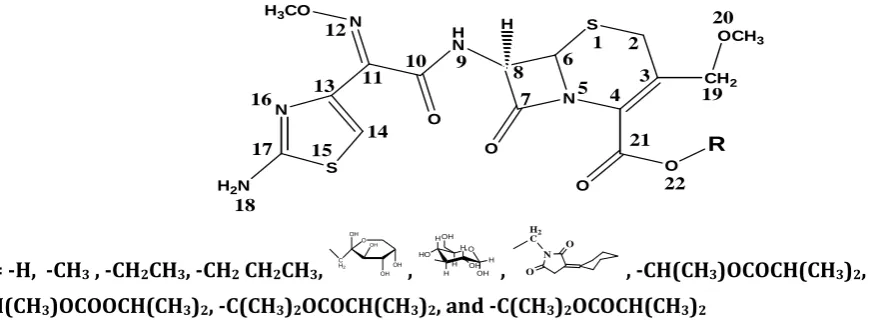
The term ‘Prodrug’ or ‘Proagent’ was first introduced by Albert (1958) [1] to describe any compound that undergoes biotransformation prior to the exhibition of its pharmacological effect. The term ‘Prodrug’ signifies a pharmacologically inactive chemical derivative that could be used to alter the physicochemical properties of drugs in a temporary manner to increase their usefulness and/or to decrease associated toxicity. Prodrug is also called as ‘Proagent’, ‘Bioreversible derivative’ or ‘Latentiated drug’, but prodrug is the most commonly accepted term. The prodrug design approach is also referred to as “Drug Latentiation” [2]. The chemical modification of a biologically active compound forms a new compound that, upon in vivo enzymatic attack will liberate the parent compound. Prodrug can be defined as pharmacologically inert chemical derivatives that can be enzymatically or non-enzymatically converted in vivo to the active drug molecule to exert a therapeutic effect. According to IUPAC (International Union of pure and applied chemistry): Prodrug is defined as any compound that undergoes biotransformation before exhibiting its pharmacological effects [3]. Depending upon the constitution, lipophilicity, method of deactivation and the catalyst involved in bio activation, prodrugs are classified into two categories- carrier linked prodrug and bio precursor [4]. In recent years numerous prodrugs have been designed and developed to overcome barriers to drug utilization such as low oral absorption properties, lack of site specificity, chemical instability, toxicity, bad taste, bad odor and pain at application site [5, 6]. Cefpodoxime proxetil CPD (R= -CH(CH3)OCOOCH(CH3)2) Figure 1 is chemically [6R-[6α ,7β (z)]]-7-[[(2-amino-4-thiozolyl) (methoxyimino) acetyl] amino]-3-(methoxymethyl)-8-oxo -5- this
International Educational Applied Research Journal
Volume: 2 | Issue: 4 | April 2018
2
INTERNATIONAL EDUCATIONAL APPLIED RESEARCH JOURNAL
knowledge, there is not any report of computational studies on the proton transfer PT reaction of O-R bond rupture of cefpodoxime ester prodrugs, so these theoretical calculations will provide a useful, preliminary explanation of the data about cefpodoxime prodrugs in the literature.
Computational methods
All the quantum chemical calculations were performed with complete geometry optimizations using Gaussian-09 software package [15]. The geometry optimization was carried out for cefpodoxime acid and ten cefpodoxime ester prodrugs, Pro. D(1–10), Figure 1, by ab initio open shell Unrestricted Hartree Fock (UHF/STO-3G level [14]. The calculations were performed in the vacuum phase only for expecting (IPT) to be almost the same as in solution [16-17].
An energy minimum (a stable compound or a reactive intermediate) has no negative vibrational force constant
[18].
Results and discussion
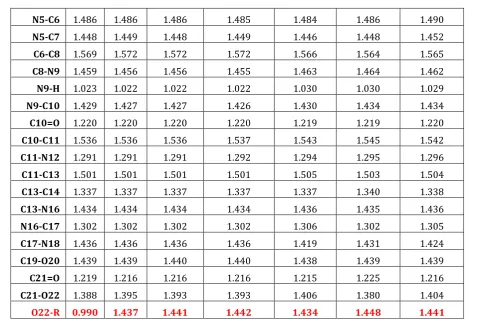
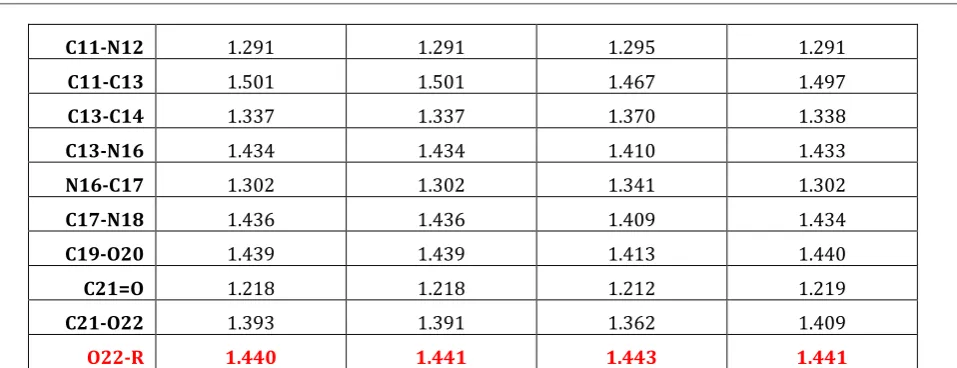
Table 1shows the UHF calculations of the structures (bond lengths A°) for calculated cefpodoxime acid (R= -H) and
cefpodoximate derivatives Pro. D1–10 at the equilibrium geometry. It was found that the difference for a specified bond was slightly shorter or slightly longer, referring to the convergence of their force constants. Extensive studies were concentrated on the bond length of O-R. This bond is linking drug with carrier. The length ranging value for O-R bond of Pro. D(1–10) were (1.434-1.448 Å) calculated by UHF/STO-3G Table 1. The shorter O-R bond length was referred to the primary (10) prodrug derivative (Pro. D4 (R= 1-Frectosyl)),
while the longer O-R bond length was belonged to the largest carrier linkage Pro. D5 (R= -3-Glycosyl). There is a presence of increasing in bond length on going from Pro. D1(10) to
Pro. D3(10) due to the inductive effect of increasing (–CH2)
groups. The same reason (–CH3) for increasing in the O-R
bond length of Pro. D10(20) than Pro. D9(10). Generally all
R bonds length of the prodrug derivatives are longer than O-H bond length of cefpodoxime acid (0.990), so it is expected to be of the larger energy of cracking purpose. Table 1shows the UHF calculations of the structures (bond lengths A°) for calculated cefpodoxime acid (R= -H) and cefpodoximate derivatives Pro. D(1–10) at the equilibrium geometry.
N
S
H N
N S
CH2 OCH3
O H2N
O N
O
O H3CO
R
1 2
3 4 5 6
7 8 9 10 11 12
13
14 15
H
16
17
18
19 20
21
22
-R= -H, -CH
3, -CH
2CH
3, -CH
2CH
2CH
3,
O OH C H2
OH OH
OH
,
O H HOH H
OH OH
H H
OH
,
NO
O
H2 C
, -CH(CH
3)OCOCH(CH
3)
2,
-CH(CH
3)OCOOCH(CH
3)
2, -C(CH
3)
2OCOCH(CH
3)
2, and -C(CH
3)
2OCOCH(CH
3)
2Figure 1-
Structures and numbering of the calculating cefpodoxime acid (-R= -H) and ester-prodrug derivatives
Pro. D(1–10)
as applied in the present work.
Table 1-
UHF calculations for the bond lengths (A°) of cefpodoxime acid (R= -H) and for the calculated
cefpodoximate derivatives at their equilibrium geometries.
Bond descripti on
-R
-H -CH3 -CH2CH3 -CH2CH2CH3
O OH
C H2
OH OH OH
O H HO
H H
OH OH H H OH
N O
O
H2 C
S1-C2 1.804 1.803 1.805 1.804 1.804 1.802 1.805
S1-C6 1.803 1.803 1.803 1.803 1.804 1.803 1.803
C2-C3 1.534 1.533 1.534 1.534 1.534 1.534 1.533
C3-C4 1.327 1.325 1.325 1.326 1.325 1.328 1.325
C3-C19 1.531 1.532 1.531 1.531 1.533 1.533 1.537
C4-N5 1.438 1.440 1.439 1.440 1.436 1.438 1.439
International Educational Applied Research Journal
Volume: 2 | Issue: 4 | April 2018
3
INTERNATIONAL EDUCATIONAL APPLIED RESEARCH JOURNAL
Table 1:
continue.
N5-C6 1.486 1.486 1.486 1.485 1.484 1.486 1.490
N5-C7 1.448 1.449 1.448 1.449 1.446 1.448 1.452
C6-C8 1.569 1.572 1.572 1.572 1.566 1.564 1.565
C8-N9 1.459 1.456 1.456 1.455 1.463 1.464 1.462
N9-H 1.023 1.022 1.022 1.022 1.030 1.030 1.029
N9-C10 1.429 1.427 1.427 1.426 1.430 1.434 1.434
C10=O 1.220 1.220 1.220 1.220 1.219 1.219 1.220
C10-C11 1.536 1.536 1.536 1.537 1.543 1.545 1.542
C11-N12 1.291 1.291 1.291 1.292 1.294 1.295 1.296
C11-C13 1.501 1.501 1.501 1.501 1.505 1.503 1.504
C13-C14 1.337 1.337 1.337 1.337 1.337 1.340 1.338
C13-N16 1.434 1.434 1.434 1.434 1.436 1.435 1.436
N16-C17 1.302 1.302 1.302 1.302 1.306 1.302 1.305
C17-N18 1.436 1.436 1.436 1.436 1.419 1.431 1.424
C19-O20 1.439 1.439 1.440 1.440 1.438 1.439 1.439
C21=O 1.219 1.216 1.216 1.216 1.215 1.225 1.216
C21-O22 1.388 1.395 1.393 1.393 1.406 1.380 1.404
O22-R 0.990 1.437 1.441 1.442 1.434 1.448 1.441
Bond description
-R
-CHOCOCH(CH3)2 CH3
-CHOCOOCH(CH3)2
CH3
-CCH3OCOCH(CH3)2
CH3
-CCH3OCOOCH(CH3)2
CH3
S1-C2 1.803 1.804 1.820 1.806
S1-C6 1.803 1.803 1.822 1.805
C2-C3 1.535 1.534 1.487 1.535
C3-C4 1.329 1.327 1.351 1.329
C3-C19 1.537 1.537 1.510 1.531
C4-N5 1.441 1.439 1.425 1.428
C4-C21 1.529 1.527 1.504 1.535
N5-C6 1.485 1.486 1.514 1.479
N5-C7 1.449 1.450 1.480 1.443
C6-C8 1.570 1.572 1.568 1.573
C8-N9 1.455 1.455 1.463 1.464
N9-H 1.022 1.022 1.000 1.034
N9-C10 1.427 1.427 1.432 1.437
C10=O 1.220 1.220 1.216 1.219
International Educational Applied Research Journal
Volume: 2 | Issue: 4 | April 2018
4
INTERNATIONAL EDUCATIONAL APPLIED RESEARCH JOURNAL
Examination of the geometrical optimization
structures for Pro. D(1-10)
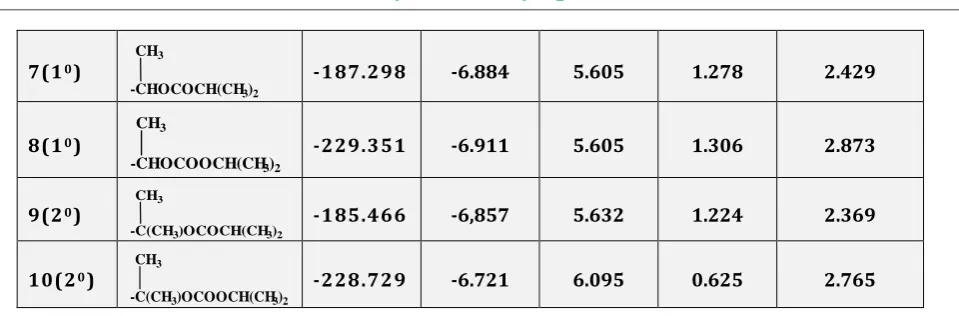
Pro D(1, 2, 3) possess the higher heat of formation, higher total energy, in the order of Pro. D(1< 2< 3), dipole moment in the order of Pro. D(3> 2> 1) because of the inductive effect of increasing CH2 group. Pro D(4,5,6) possess the lower total
energy in the order of Pro. D(6< 5< 4), higher dipole moment in the order of Pro. D(6> 4> 5). Pro D(7-10) possess the mid values of the heat of formation, total energy and dipole moment, Tables 2, 3.
For comparison the results of the primary (10) and
secondary derivatives (20). The results of the two isomers
derivative 1-Fructosyl 4(10) and 3-Glycosyl 5(20) shows that
there is an increase in O-R bond length with decreasing in ΔHf, (meaning 5(20) is more stable than 4(10)). Also
decreasing in ELUMO, and ΔEHOMO-LUMO, with increasing in µ.
Generally it can be seen that cefpodoxime derivatives 8(10)
and 10(20) including (-OCOO) group have a shorter O-R bond
length, larger dipole moment and lower ∆H0f, in comparison with the corresponding derivatives 7(10) and 9(20) which
include (OCO) group, so they are probably more stable and more viable to be used as a carrier-linkage for cefpodoxime drug than others. The physical properties for the global minimum structures of cefpodoxime acid and Pro. D(1–10), such as bond lengths, dipole moment, standard heat of formation, EHOMO (Energy of the Highest Occupied Molecular
Orbital), and ELUMO (Energy of the Lowest Unoccupied
Molecular Orbital) at their equilibrium geometries as calculated by (UHF/STO-3G) method are illustrated in Tables 2.
Table 2
- UHF calculations for some physical properties of the cefpodoximic acid and esters derivatives at the
minimize equilibrium geometries.
C11-N12 1.291 1.291 1.295 1.291
C11-C13 1.501 1.501 1.467 1.497
C13-C14 1.337 1.337 1.370 1.338
C13-N16 1.434 1.434 1.410 1.433
N16-C17 1.302 1.302 1.341 1.302
C17-N18 1.436 1.436 1.409 1.434
C19-O20 1.439 1.439 1.413 1.440
C21=O 1.218 1.218 1.212 1.219
C21-O22 1.393 1.391 1.362 1.409
O22-R 1.440 1.441 1.443 1.441
Dipole moment (Debye) ΔE
HOMO-LUMO (kcal/ mol) ELUMO
(kcal/ mol) EHOMO
(kcal/ mol) ΔH0f
(kcal/ mol) -R
Cefpo Pro. D No.
2.394 1.279
5.605 -6.884
-91.661
-H
3.213 1.197
5.660 -6.857
-85.283
-CH3
1(10)
3.250 1.252
5.632 -6.884
-90.254
-CH2CH3
2(10)
5.337 1.252
5.632 -6.884
-97.741
-CH2CH2CH3
3(20)
6.694 1.115
5.768 -6.884
-301.957
O
OH
CH2 OH
OH OH 4(10)
5.260 1.386
5.524 -6.911
-301.080
O H
HO
H H
OH OH
H H
OH
5(20)
8.924 1.142
5.660 -6.803
-169.411
N O
O H2
C
International Educational Applied Research Journal
Volume: 2 | Issue: 4 | April 2018
5
INTERNATIONAL EDUCATIONAL APPLIED RESEARCH JOURNAL
10: primary ester, 20: secondary ester.
Results of calculations for O-R bond rupture energy
The “reaction coordinate method” [19] was used to calculate the activation energy in the cefpodoxime acid and Pro. D(1– 10). Only O17-R19 bond length is constrained for the
appropriate degree of freedom while all other variables are freely optimized. The activation energy values for the proton transfer reactions were calculated from the difference in energies of the global minimum structures and the derived transition states (t.s).The transition state structures were verified by their only one negative frequency. The activation energies obtained from Unrestricted Hartree Fock (UHF/STO-3G level of theory for cefpodoximic acid and Pro. D(1–10) were calculated without the inclusion of any solvent. In a former study it was shown that the UHF/STO-3G yields for the O-R bond rupture a reaction path of a peculiar shape in which a sudden decline of the total molecular energy is calculated after the transition state (t.s) [11-13]. The calculated reaction energy agreed well with the experimentally measured values. It was important to inspect the shape of the reaction curve and extend the treatment to
different prodrugs. The treatment should show the change in molecular energy along the reaction path and the structures of the transition states as well as the reaction products. The distance between C17 and O19 increases during the cracking
purposes. The calculated reaction path of cracking processes for Pro. D(1–10) was shown in Figure 2. This figure shows the energy curve for the O-R bond rupture of cefpodoxime ester derivatives calculated by UHF/STO-3G method. There is obvious increase in the total energy (Etotal) and dipole
moment () of the molecule with increasing the bond distance of (O....R) towards transition state (t.s) [20]. Studying energy curves showing that the O-R bond ruptures reactions of cefpodoxime ester prodrugs of Pro. D(1–3) are reversible, of high energy barrier, high activation energy (Ea#), very low heat of cracking (Hc), beyond the transition
state produces σ radical structure and giving free radicals end products. Meaning, sense, these prodrugs do not given cefpodoxime drug as a result of O-R bond breakage as shown in Figure 3, Table 3. This results correspond to the experimental literature [21].
Table 3-
UHF calculations for some physical properties of the cefpodoxime acid and ester derivatives at the
minimize equilibrium geometries.
2.429 1.278
5.605 -6.884
-187.298
-CHOCOCH(CH3)2
CH3 7(10)
2.873 1.306
5.605 -6.911
-229.351
-CHOCOOCH(CH3)2
CH3
8(10)
2.369 1.224
5.632 -6,857
-185.466
-C(CH3)OCOCH(CH3)2 CH3
9(20)
2.765 0.625
6.095 -6.721
-228.729
-C(CH3)OCOOCH(CH3)2
CH3
10(20)
Ea* (kcal/m ol)
∆Hc (kcal/m ol) Etotal (product)
kcal/mol Etotal (reactant)
kcal/mol -R
Cefpo . D. no.
167.265 1.190
-1322542.144 -1322540.954
-CH3
1(10)
135.469 1.782
-1346643.057 -1559741.275
-CH2CH3
2(10)
164.276 1.223
-1370959.198 -1370960.421
-CH2CH2CH3
3(20)
135.311 93.508
-1674434.753 -1674528.261
O
OH
CH2 OH
OH
OH
4(10)
118.502 5.197
-1674524.361 -1674529.558
O H
HO
H H
OH OH
H H
OH
5(20)
137.606 54.418
-1687669.079 -1687723.497
N O
O
H2 C
International Educational Applied Research Journal
Volume: 2 | Issue: 4 | April 2018
6
INTERNATIONAL EDUCATIONAL APPLIED RESEARCH JOURNAL
Pro. D1 (R= CH
3)Pro. D3 (R= -CH
2CH2CH3)
Pro. D4 (R= -
OOH
CH2 OH
OH
OH
).
Pro. D5 (R
=-O H HO
H H
OH OH
H H
OH
).
Pro. D6
(R= NO O
H2
C
)
Pro. D7 (R= -C(CH
3)2OCOCH(CH3)2)
93.734 78.051
-1535454.007 -1535532.058
-CHOCOCH(CH3)2
CH3
7(10)
123.895 84.735
-1581790.295 -1581875.030
-CHOCOOCH(CH3)2
CH3
8(10)
102.279 54.900
-1559686.375 -1559741.275
-C(CH3)OCOCH(CH3)2
CH3
9(20)
96.363 51.909
-1606020.703 -1606072.612
-C(CH3)OCOOCH(CH3)2
CH3
International Educational Applied Research Journal
Volume: 2 | Issue: 4 | April 2018
7
INTERNATIONAL EDUCATIONAL APPLIED RESEARCH JOURNAL
Pro. D10 (R= -C(CH
3)2OCOOCH(CH3)2).
Pro. D8 (R=
-CH(CH3)OCOOCH(CH3)2)
Figure 2.
The calculated reaction path of O-R bond ruptures reaction for some cefpodoxime prodrugs of
different (R) according to the ab initio UHF method.
N
S
H N
N S
CH2
OCH3
O H2N
O N
O O H3CO
R
N
S
H N
N S
CH2 OCH3
O
.
H2NO N
O O H3CO
+
.
RPro. D(1-3)
.
R=
.
CH3 ,.
CH2CH3 ,
.
CH2CH2CH3
-R
Figure 3.
The products of the calculated O-R bond rupture reaction in cefpodoxime ester prodrugs.
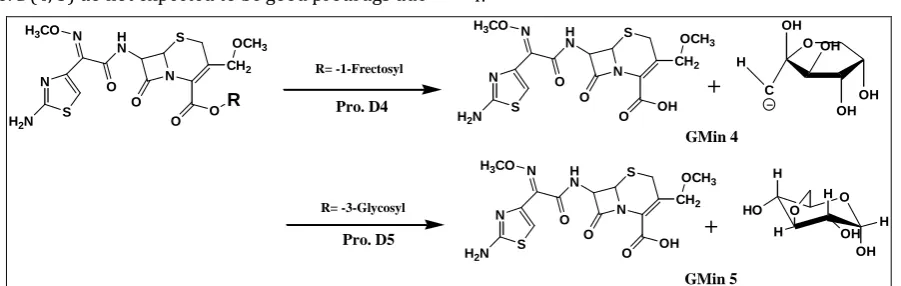
The end products of the O-R bond ruptures reactions in Pro. D(4, 5) given cefpodoxime acid with unstable anion and [2,6-Dioxa-bicyclo[3.2.1]octane-3,4,8-triol] respectively, GMin (4, 5). So Pro. D(4, 5) do not expected to be good prodrugs due
to high ∆Hc (93.508 kcal/ mol), high activation energy Ea#
(135.311 kcal/ mol) of Pro. D(4), and for very low heat of cracking Hc (5.197 kcal/ mol), of Pro. D(5), Table 3, Figure 4.
N
S H N
N S
CH2 OCH3
O H2N
O N
O O H3CO
R
N
S H N
N S
CH2 OCH3
OH H2N
O N
O O H3CO
N
S H N
N S
CH2 OCH3
OH H2N
O N
O O H3CO
+
+
Pro. D4
R= -3-Glycosyl
Pro. D5
GMin 4
GMin 5 R= -1-Frectosyl
O
OH OH OH
OH
C H
O H
HO
H
OH OH H O
H
Figure 4.
The end products for the calculated O-R bond rupture reaction in cefpodoxime ester prodrugs (Pro.
D4 and Pro. D5).
The reaction for O-R bond rupture in Pro. D(6) [R= 1-Ethyl-3-methylene-pyrrolidine-2,5-dione] was irreversible, possessing high energy of activation Ea# (137.606 kcal/
mol), wasn't showing proton transfer at the transition state and wasn't given cefpodoxime medicine as a final product. Instead, the end product was [(E)-(3-cyclohexylidene -2, 5-
International Educational Applied Research Journal
Volume: 2 | Issue: 4 | April 2018
8
INTERNATIONAL EDUCATIONAL APPLIED RESEARCH JOURNAL
N O O H2 C N S H N N S CH2 OCH3 O H2N
O N
O O H3CO
Pro. D6 C C H2 C C O N CH2 N S H N N S CH2 OCH3 O H2N
O N
O O H3CO
R
-R=
(Optimization), O-R= 1.441 A0
N S H N N S CH2 OCH3 O H2N
O N
O O H3CO
N O O
H2C
O N S H N N S CH2 OCH3 O H2N
O N
O O H3CO
N O O
H2C
(Transition state), O-R= 2.241 A0
GMin 6 (Product), O-R= 2.641 A0
Figure 5.
The products of the calculated O-R bond rupture reaction in Pro. D(6) [R=
1-Ethyl-3-methylene-pyrrolidine-2,5-dione]; as a result of breakage O-R bond.
The reactions process for O-R bond ruptures of Pro. D(7,8,9,10) were all given cefpodoxime acid with alkenes as a result of O-R bond rupture as shown in Figure 6, including cefpodoxime proxital (Pro. D8) which its calculated values were taken as standard. In these reactions, the O-R bond breakage was at about 1.6 A° leading to form cation and anion fragment. The transition state was at the range of (2.2-2.3) A°. Beyond the transition state the (O22) anion and the H
proton unite leading to form the end products of
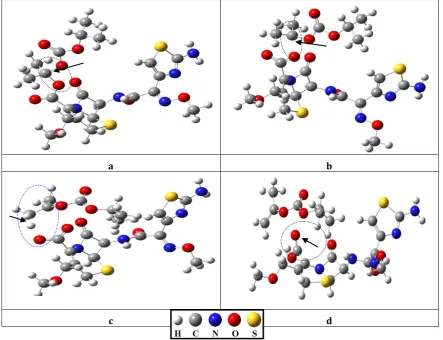
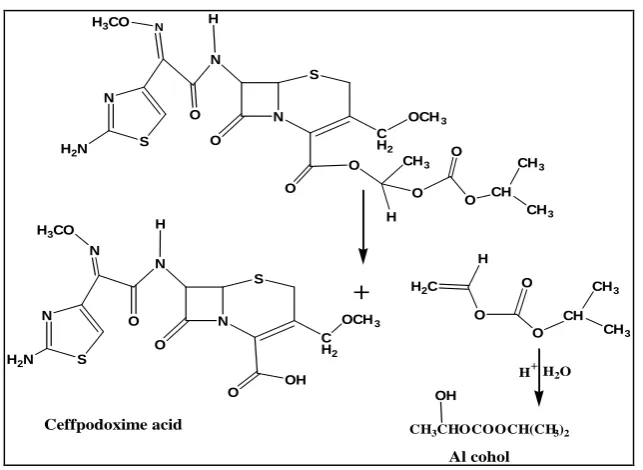
cefpodoxime acid and alkenes as a result of the final geometrical minimization, GMin (7-10) [12-14]. The proton transfer activation energy is largely depended on the property of the linker carriers [22-25]. The proton transfer from the ethyl ester group into the neighboring carboxylic oxygen at the transition state was illustrated in Figures 7a, 7b. Alkenes in acidic media are supposed to turn into acid and alcohol, Figure 7c.
+
N S H N N S CH2 OCH3 O H2NO N
O O H3CO
R N S H N N S CH2 OCH3 OH H2N
O N
O O H3CO
N S H N N S CH2 OCH3 OH H2N
O N
O O H3CO
N S H N N S CH2 OCH3 OH H2N
O N
O O H3CO
+
R= -CH(CH3)OCOCH(CH3)2
+
Pro. D7 N S H N N S CH2 OCH3 OH H2NO N
O O H3CO
+
R= -CH(CH3)OCOOCH(CH3)2
Pro. D8
R= -C(CH3)2OCOOCH(CH3)2
Pro. D10
R= -C(CH3)2OCOCH(CH3)2
Pro. D9 H2C=C(CH3)OCOCH(CH3)2
CH2=CHOCOOCH(CH3 )2
CH2=CHOCOCH(CH3)2
H2C=C(CH3)OCOOCH(CH3)2
GMin 7
GMin 8
GMin 9
GMin 10
International Educational Applied Research Journal
Volume: 2 | Issue: 4 | April 2018
9
INTERNATIONAL EDUCATIONAL APPLIED RESEARCH JOURNAL
Figure 7a.
Geometrical structures for cefpodoxime proxital at: a) Equilibrium geometry (O-R= 1.441 A°), b) O-R
breakage bond (O....R= 1.541 A°), c) Transition state (the proton transfer (O....R= 2.341 A°), d) The end product
for the O-R rupture (O....R= 2.441 A°).
C O
O
C C H H H
OCOOCH(CH3)2 C
C H H
OCOOCH(CH3)2
H
C O
O HC
C H H
OCOOCH(CH3)2
H
C C H H H
OCOOCH(CH3)2
H
C O
O
C O
O
Acid Alkene proton transfer
H H
Figure 7b.
Mechanism of the proton transfer in the OR bond rupture processes in cefpodoxime proxital (R=
-CH(CH
3)OCOOCH(CH
3)
2).
a b
International Educational Applied Research Journal
Volume: 2 | Issue: 4 | April 2018
10
INTERNATIONAL EDUCATIONAL APPLIED RESEARCH JOURNAL
NS
C H2
OCH3
O
O N
O
N H
CH3
H O
O
O CH CH3
CH3 O
N
S H2N
H3CO
N S
C H2
OCH3
OH O N
O N
H
O H3CO
N
S H2N
O O
O CH
CH3
CH3 H2C
H
H2O
CH3CHOCOOCH(CH3)2
OH
H+
+
Ceffpodoxime acid
Al cohol
Figure 7c.
The reaction processes of the O-R bond rupture in cefpodoxime proxital.
Conclusion
- In this research, unrestricted Hartree Fock (UHF) quantum mechanical methods were used to confirm the possibility of using theoretical calculations as an initial estimation for different organic groups to be used as carriers for the pharmaceutical compound (cefpodoxime proxital) by calculating the reaction path for the breakage of R-O bond in the pharmacological part. The energy of the reactant, product, activation energy, the nature and stability of the bond breakage products were studied.
- For choosing derivative as a prodrug, it is important to take in account, it is of low dipole moment (for the unpolarity characteristic of the living cellularuar wall), the O-R bond rupture reaction is irreversible, endothermic (the prodrugs are more stable than their cracking products and not decomposed until reach their side of action). For activation energy it mustn't too high nor two low for the same reason, the larger values of Ea# for prodrugs cracking means
possessing unfavorable carrier group (in spite of the stability of the products), the reverse are for the prodrugs possessing favorable carrier group.
. These properties were been found in Pro. D(7, 8, 9, and 10) derivatives, so their carriers - linked had the priority to be chosen.
- Results of calculation confirm a good possibility of applying quantum mechanics calculation to specify groups that may be substitute d in drug derivatives as carrier groups of medicine pro-drugs type carrier-linked and to be applied as curing drug.
- Quantum mechanical calculation can be used to show the incipient assumption of release probability of the required medicine part as one of cracking results for these groups
after O-R cracking, which is the principle aim for studying this cracking.
- The theoretical study gave the possibility of specifying the safest and less toxicity groups might be applied, by identify their cracking results (regardless of the physical properties of the carriers group added to the drug part).
![Figure 5. The products of the calculated O-R bond rupture reaction in Pro. D(6) [R= 1-Ethyl-3-methylene-pyrrolidine-2,5-dione]; as a result of breakage O-R bond](https://thumb-us.123doks.com/thumbv2/123dok_us/8727071.1745498/8.595.74.527.420.694/figure-products-calculated-rupture-reaction-methylene-pyrrolidine-breakage.webp)