Unit 1
The World of
Marketing
Unit 1
The World of
Marketing
Chapter 1
Marketing Is All
Around Us
Chapter 1
Marketing Is All Around Us
Chapter 1
Marketing Is All Around Us
•
Section 1.1 Marketing and the Marketing Concept
•
Section 1.2 The Importance of Marketing
•
Section 1.3 Fundamentals of Marketing
•
Section 1.1 Marketing and the Marketing Concept
•
Section 1.2 The Importance of Marketing
Marketing and the Marketing
Concept
Objectives
•
Define marketing
•
List the seven marketing core functions
•
Understand the marketing concept
Key Terms marketing goods services marketing concept
Marketing and the Marketing
Concept
Graphic Organizer
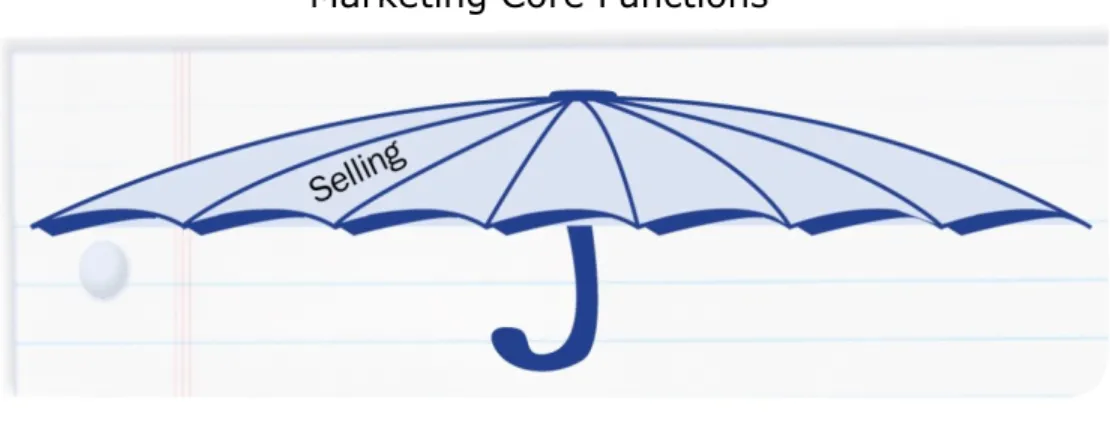
Draw an umbrella shape to organize the marketing concepts you will learn about in this section.
Marketing Essentials Chapter 1, Section 1.1
The Scope of Marketing
You have already participated in the marketing X
process as a consumer. Now you need to think like a marketer and keep up with:
· Trends
· Consumer attitudes · Customer relationships
marketing
The process of planning, pricing, promoting, selling, and distributing products to satisfy customers’ needs and wants.
Marketing promotes ideas, goods, and services, such as:
• A candidate’s political platform • A public service initiative
Ideas, Goods, and Services
This ad promotes a healthy diet that includes dairy products
Examples of marketed goods X include: · Cars
· Electronics
· Home furnishings · Foods
goods
Tangible items of monetary value that satisfy
needs and wants.
Marketing Essentials Chapter 1, Section 1.1
Examples of services X that may be marketed are:
· Automotive repair · Hair styling
· Legal aid
· Financial consulting
services
Intangible items of monetary
value that satisfy needs and wants.
Marketing Essentials Chapter 1, Section 1.1
The marketplace is the commercial environment in which buying and selling take place, including:
· Shops
· Internet stores
· Financial institutions
Marketing Essentials Chapter 1, Section 1.1
Seven Marketing Core Functions
1. Channel Management getting goods to customers
2. Market Planning understanding concepts and strategies to develop and target
marketing strategies to a specific market
continued
Seven Marketing Core Functions
3. Marketing information management researching customers, trends, and
competitors
4. Pricing charging for goods and services to make a profit
continued
Seven Marketing Core Functions
5. Product/service management obtaining, developing, maintaining, and improving a product or service
6. Promotion informing, persuading, and reminding customers about a product or service
continued
Seven Marketing Core Functions
7. Selling providing customers with goods and services
The move toward same-day fulfillment is gaining speed across the Internet as e-tailers compete for customers.
The Marketing Concept
The marketing concept X focuses on satisfying the needs and wants of customers. For a business to be successful, all employees must:
· Understand the marketing concept
· Provide the best possible service to customers
marketing concept
Businesses should satisfy customers’ needs and wants while making a profit.
The Marketing Concept
Customer relationship management (CRM) combines:
· Customer information
· Marketing communications
The goal is to establish long-term relationships.
The Importance of Marketing
Objectives
· Analyze the benefits of marketing · Apply the concept of utility
Key Terms
utility
The Importance of Marketing
Note the benefits of marketing and list the five utilities on lines jutting out from one of the ovals.
Key Terms
utility
Economic Benefits of Marketing
Marketing’s benefits to the economy and consumers are:
· New and improved products · Lower prices
· Added value
New and Improved Products
Marketing generates competition. Some examples: · Food manufacturers know that parents want
children to start the day with healthy foods. So Quaker created Fruit & Oatmeal Toastables® and Breakfast Squares®.
New and Improved Products
· Dutch Boy Paints won an award for its new container design that makes the
container easy to hold and open as paint is poured.
This ad promotes Dutch Boy Paints’ innovative paint container.
Lower Prices
Marketing increases demand. When demand is high: · Products can be produced in larger quantities
· The fixed cost per unit is lower
Lower Prices
As a result, a company can:
1. Charge a lower price per unit
2. Sell more units
3. Make more money
Lower Prices
In addition, when demand for products increases: · More companies enter the marketplace
· Companies must lower prices to remain competitive
Added Value and Utility
The value that marketing adds to a product or service is called utility X. Five utilities contribute to making a product or service capable of satisfying customers’ wants and needs:
· Form putting parts together to make a product consumers want
utility
An attribute of a product or
service that
makes it capable of satisfying
consumers’
wants and needs.
Added Value and Utility
· Place offering a product where consumers can buy it (e.g. retail store, catalog, Web site)
· Time offering a product at a convenient time of day or year for consumers
Added Value and Utility
· Possession allowing consumers to take legal ownership of a product
· Information communicating information about a product (e.g. through labeling, advertising, or an owners’ manual)
SECTION 1.2 REVIEW
-Fundamentals of Marketing
Objectives
· Describe the concept of market
· Differentiate consumer and industrial markets
· Describe market share
· Define target market
· List the components of the marketing mix
Key Terms market consumer market industrial market market share target market customer profile marketing mix
Fundamentals of Marketing
Graphic Organizer
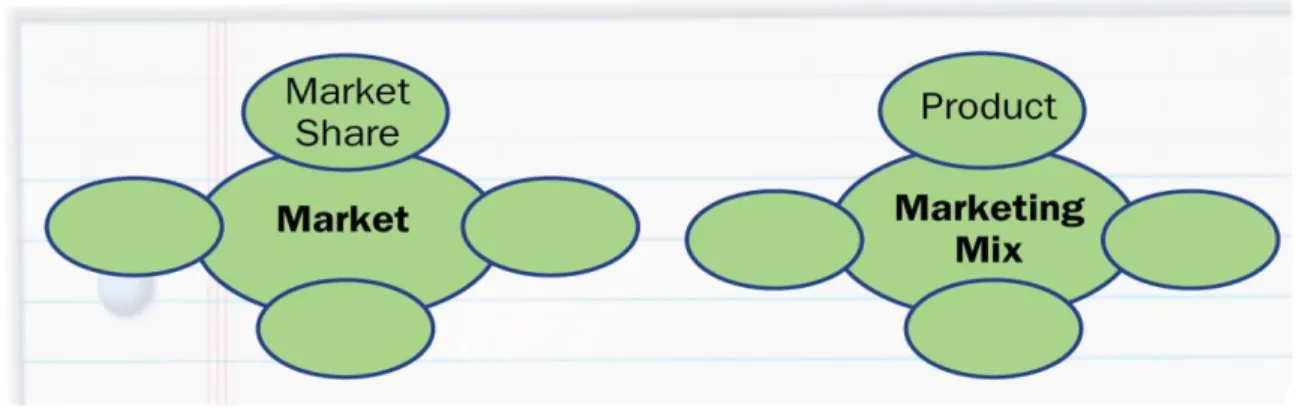
Draw these two diagrams to record four terms about the concept of market and the four Ps of the
marketing mix.
Market and Market Identification
Memorize the terms in this section. The first
important term is market X, which refers to people who:
· Share similar needs and wants
· Have the ability to purchase a product
market
People who share similar needs and wants and are capable of buying products.
Consumer Versus Industrial Markets
The consumer market X wants products and services that:
· Save money · Make life easier
· Improve appearance · Create status
consumer market All consumers who purchase goods and services for personal use.
Consumer Versus Industrial Markets
The industrial market X, or business-to-business (B-to-B) market, wants products and services that:
· Improve productivity · Improve efficiency · Increase sales
· Decrease expenses
industrial market
Businesses that buy products to use in their
operations; also called the
business-to-business market (this can be
abbreviated as B-to-B or B2B).
Perdue advertises its chicken and turkey products:
· On television and in newspapers, to reach consumers
· In Supermarket News, to reach
professionals in the supermarket industry
Marketing Essentials Chapter 1, Section 1.3
Market Share
A company’s market share X is its percentage of
total sales in a given market, such as the video game market. Market share changes as:
· New competitors enter the market
· The market’s volume increases or decreases
market share
A company’s percentage of total sales volume
generated by all competition in a given market.
Target Market and Market
Segmentation
Identifying a product’s target market X is a key to success. A single product may have these two target markets:
· Consumers · Customers
target market
A group of
people identified as those most likely to become customers.
Target Market and Market
Segmentation
A nutritious breakfast food would be targeted at: · Children who will request it and eat it, the
consumers
· Parents who will approve and buy it, the customers
To develop a clear picture of its target market, a business may create a customer profile X, which lists information such as:
· Age
· Income level
· Ethnic background
customer profile
A list of information about a target market, such as age, income level, ethnicity, occupation, attitudes, lifestyle, and geographic residence.
Marketing Essentials Chapter 1, Section 1.3
Customer profile lists may also include: · Occupation
· Attitudes · Lifestyle
· Geographic residence
Marketing Essentials Chapter 1, Section 1.3
Marketing Mix
The marketing mix X includes four basic marketing
strategies, or tools, called the four Ps: · product
· place · price
· promotion
marketing mix
The four basic marketing
strategies, called the four Ps:
product, place, price, and
promotion.
Product
A company must choose what products to develop, update, and improve.
Place
A company must decide where to sell and distribute a product.
Price
A company must determine what price it will charge for a product.
Promotion
A company must decide how to advertise, promote, and publicize a product.
CHAPTER 1 REVIEW
-Section 1.1
• Marketing is defined as the process of planning
and executing the conception, pricing, promotion, and distribution of ideas, goods, and services to create exchanges that satisfy individual and
organizational objectives.
Section 1.1
• There are seven functions of marketing. The
marketing concept is a focus on customers’ needs and wants while generating a profit.
Section 1.2
• Three benefits of marketing are new and improved
products, lower prices, and added value (utility). Five economic utilities are form, place, time,
possession, and information.
Section 1.3
•
A market is defined as all people who share
similar needs and wants and who have the
ability to purchase given products.
•
Market share is a firm’s percentage of total
sales of all competitors in a given market.
Section 1.3
• The four Ps of the marketing mix are product,
This chapter has helped prepare you to meet the following DECA performance indicators:
· Describe marketing functions and related activities.
· Explain the nature of marketing plans. · Select a target market.