1 Programme Title and Cohort: BA (Hons) in Business and Management, 5
Module Code and Title: NX0320 Dissertation
Forename: Canistan
Surname: Anthony
Student ID number: w11040268
2 Name:- Anthony Canistan
Degree:- BA (Hons) in Business and management
Superviser:- Aubrey Smith
3 DECLARATION
I declare the following:-
(1) That the material contained in this dissertation is the end result of my own work and that due acknowledgement has been given in the bibliography and references to ALL sources be they printed, electronic or personal.
(2) The Word Count of this Dissertation is – 10, 976 words
(3) That unless this dissertation has been confirmed as confidential, I agree to an entire electronic copy or sections of the dissertation to being placed on Blackboard, if deemed appropriate, to allow future students the opportunity to see examples of past dissertations. I understand that if displayed on Blackboard it would be made available for no longer than five years and that students would be able to print off copies or download. The authorship would remain anonymous.
(4) I agree to my dissertation being submitted to a plagiarism detection service, where it will be stored in a database and compared against work submitted from this or any other School or from other institutions using the service.
In the event of the service detecting a high degree of similarity between content within the service this will be reported back to my supervisor and second marker, who may decide to undertake further investigation which may ultimately lead to disciplinary actions, should instances of plagiarism be detected.
(5) I have read the University Policy Statement on Ethics in Research and Consultancy and the Policy for Informed Consent in Research and Consultancy and I declare that ethical issues have been considered and taken into account in this research.
4 Executive Summary
As the nature of competitive environment grows rapidly in educational atmosphere the roles of marketers must be developed meaningfully (Nazari and Elahi, 2012). One of the major roles of marketing is, understanding the consumer preferences in the process of delivering the service (Moorman and Rust, 1999). Hence, educational organisation must understand how to offer a satisfying learning experience to students in order to retain them.
Many studies have examined about customer satisfaction in higher education industry. However the studies conducted in Sri Lanka about customer satisfaction are not sufficient to suggest robust recommendations to mangers to generate customer satisfaction .The problem of the current study is the difficulties of Sri Lankan institutes with retaining their students despite the high spending on delivering quality service. In the literatures about students’ satisfaction it is stated that, Higher the level of student satisfaction emphasizes the higher level of student retention (Aldridge and Rowley, 1998; Andreassen and Lindestad, 1998). Hence in order to fill the gap, the author decided to undertake a systematic investigation on factors affecting customer satisfaction in higher education. To narrow down the scope of examination due to word and time limit, he has limited his research among business management students specially referring to Colombo district.
The literature review of the current study mainly focuses on the terms customer satisfaction, customer retention and higher education and it has identified the factors which affect customer satisfaction in the industry of higher education.
5 supported by several theories on customer satisfaction, hence the author has discussed about few important customer satisfaction theories in the literature review.
In the context of relationship marketing customer satisfaction is seen as the essence of retaining customers (Arnett, German, and Hunt, 2003). Therefore there is need for educational organisation in establishing a deeper understanding of customer satisfaction in order to develop the linkage between customer satisfaction and customer retention. The attempt of past literatures to understand the term customer satisfaction exposes that, customer satisfaction is an emotion which occurs based on the evaluation of difference between prior expectation and perceived performance of the service (Tse and Wilton, 1988). It is further stated that, to produce a positive result from the evaluation, organisations must equal or exceed the expectation created towards the service. Educational organisations generally attempt to match the perceived expectation despite the toughness of the challenge in order to gain the benefits of customer satisfaction (Thurau, 2004)
Therefore the literature review of the current study also analyses the benefits of customer satisfaction for an organisation. Analysis of the benefits of customer satisfaction exposes that, customer satisfaction affects several components of an organisation positively and stimulate an emotion among customers that keeps them closer to the organisation (Hatfield, 2008). Hence educational organisations are increasingly concentrating about the factors which affect customer satisfaction to deliver a service which is highly valid by customers in order to imply the benfefits of customer satisfaction in their organisation.
6 Methodology part of the current study exposes the strategy, approach, methods, sample approach, techniques, ethical consideration and the limitations of the survey conducted in order to evaluate the influence level of the factors which were identified in the literature review. Furthermore it elaborates the techniques of the evaluation of managerial interest on customer satisfaction.
Quantitative strategy is utilized in order to conduct the evaluation on influential level of factors that affect students’ learning experience and qualitative strategy is adopted to analyze the managerial interest on customer satisfaction. Thus the current study will be conducted as a mixed research in order to achieve the objectives in the best possible way. To conduct quantitative analysis a questionnaire is delivered to 60 Business Management students in 3 various institutes asking them to rate the factors affecting their learning experience in a 5 point scale. Descriptive analysis is used to convert the factors into measurable elements in order apply the quantitative strategy. On the other hand qualitative strategy is applied to analyze the interviews conducted. Author decided to present the qualitative analysis in a table format given that it is a very brief section. Based on the results of the survey and interviews, findings and analysis are presented in the chapter 4. By calculating the mean value of each factor author has compared and contrasted the influential levels of factors which affect the learning experience of the students. Each findings are supported by the literature, in fact few findings exposes different views from the literature. Furthermore, the table of analysis of the interviews exposes how customer satisfaction is interpreted and approached in the higher education institutes in Sri Lanka.
7 Overall the current study implies that retaining students has become important as attracting them, and customer satisfaction plays a major role in retaining customers. Several factors influence student satisfaction through affecting their learning experience and the influential level varies from a factor to another factor.
8 Acknowledgement
Firstly I express my sincere gratitude to my parents and brother who supported me financially and none financially to complete my degree in BA (Hons) in business and management. They encouraged me in different ways in difficult situations.
I thank my University supervisors who provided me initial feedback for my research proposal and local supervisor who guided me by providing constant feedbacks. I’m grateful to my manager who helped to gain practical experience which I applied in the assignments.
9
Contents
1. Introduction ... 14
1.1 Project topic ... 14
1. 2 Introduction/Rationale ... 14
1.3 Current Situation ... 15
1.4 Objectives ... 16
1.5 Overview of Literature Review ... 17
1.6 Outlined Methodology ... 18
2. Literature Review ... 19
2.1 An Introduction to Customer satisfaction (CS) ... 19
2.2 Formation of CS ... 19
2.3 Theories on CS ... 22
2.3.1 Assimilation Theory ... 22
2.3.2 Assimilation Contrast Theory ... 23
2.3.3 Negative Theory ... 25
2.3.4 Hypothesis Testing Theory ... 25
2.3 impact of CS ... 25
2.3.1 Relationship between CS and CR ... 27
2.4 CS in service industry ... 28
2.4.1 Role of marketing in service industry to generate CS ... 30
2.5 The Industry of Higher Education ... 31
2.5.1 CS in higher education ... 33
2.5.2 Generating CS in Higher Education ... 34
2.5.2.1 Building expectation for educational service ... 34
10
2.6 Summary ... 38
3. Methodology ... 40
3.1 Defining Research ... 40
3.2 Research Strategy ... 41
3.3 Research Approach ... 43
3.4 Research Methods ... 44
3.5 Sample approach ... 45
3.6 Data collection ... 45
3.7 Pilot Survey... 46
3.8 Data analysis ... 46
3.9 Ethical Research ... 47
3.10 Limitation of the research ... 47
4. Findings and analysis ... 49
4.1 Introduction ... 49
4.2 Analysis of the questions ... 50
4.3 Major finding: - Influence level of the major factors on student satisfaction ... 58
4.3 Analysis of Interviews ... 59
5. Conclusion ... 62
5.1 Review of the objectives ... 62
5.1.1 Key themes of Literature Review ... 63
5.1.2 Key themes of Finding and Analysis ... 63
5.2 Future research ... 64
6. Recommendations ... 66
Appendix 1: reflective statement ... 68
12
List of tables
Tables Pages
Table 1.1:- introduction to the institutes selected as sample clusters 15
Table 2.1:- Factors affecting Customer satisfaction 36
Table 3.1:- Stages of research according to Kolias (2005) 40 Table 4.1:- Values of rating points for the answers of questionnaire 49 Table 4.2:- Mean value of the factors under design of the course 52 Table 4.3:- Mean values of the factors under teaching personal 53 Table 4.4:- Mean values of the factors under physical evidence 54 Table 4.5:- Mean values of the factors under administrative support 55 Table 4.6:- Mean values of the factors under Students’ social life 56 Table 4. 7:- Mean values of the factors under reputation 57 Table 4.8:- Mean values of the major factors on student satisfaction 58
Table: - 4. 9 Analysis of interview of questions 59
Table 5.1:- Opportunities for the future research 64
13
List of Figures
Figures Pages
Figure 2.1:- Formation of CS 20
Figure 2.2:- factors affecting consumer expectation and product’s performance 22
Figure 2.3:- Assimilation contrast theory 24
Figure 2.4:- The Conceptual Model 30
Figure 4.1:- Sample range 50
14 1. Introduction
1.1 Project topic
An investigation into the factors influencing CS among students of Business Management; Survey on private institutes of higher education in Colombo District, Sri Lanka
1. 2 Introduction/Rationale
The education market has become a “dynamic environment”, and significantly globalised (Abubakar, Shanka and Muuka, , 2010, p.49). Indeed, the dynamic change in the higher educational market has led the institutes to develop massively (Skuza, Sojkin and Bartkowiak, (2012). Furthermore, Helgesen (2008) states that, in the developed higher educational market, retaining students has become equally important as attracting them. Fang, Chiu, and Wang (2011) suggest that, customer satisfaction (CS) is particularly important for retaining customers for a product or a service.
15 (Ranaweera, and Prabhu 2003, p.82) .Meanwhile the students shifting behavior is increasing in the industry of private higher education in Colombo city (J.Mendis, D.samarathunge, personal communication). The dropout rate of business degree in an institution named ICBT is around 20% (D.samragunaratne, personal communication). The dropout rates in other institutes are also generally high (J.mendis, personal communication). Hence the institutes which provide business management degree programs are finding difficult in sustaining their customers. Therefore, the main objective of this study will be to identify the most important factors which affect CS in order to avoid the students’ dropouts and shift to another institute in the private higher education industry especially relating to the stream of business management.
1.3 Current Situation
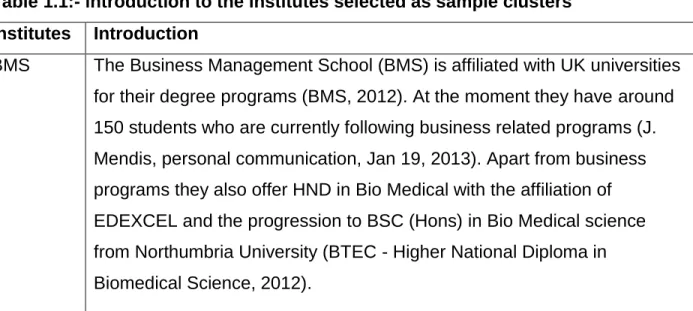
When it comes to business management studies in Sri Lanka there are many organisations which provide different qualifications in business management. This survey will only be focused on the university studies which are related to business Management. The other programs such as diplomas and certificate qualification will be omitted due to cost limitation. The survey will be conducted through the main 3 institutes in Colombo which provide degrees in business management related areas with the affiliations of foreign universities. Brief information about the institutes are given in table 1.1.
Table 1.1:- introduction to the institutes selected as sample clusters Institutes Introduction
16 ANC ANC is also known as American education centre limited (AECL), It
provides privet higher education with the affiliations of USA, UK and Australian Universities (ANC global education program: transfer and degree completion option and spanning the globe, 2010). Currently ANC has around 100 students who follow Business Related Programs
(Samarathunge, personal communication, Jan 11, 2013).
ICBT International College of business and technology (ICBT) provide degree programs with the affiliations of UK Universities (Welcome to international college of business & technology ltd, 2011). There are around 100
students following business related programs in ICBT (D.Samarathunge, personal communication, Jan 11th 2013).
The above institutes are monitored by Sri Lankan government based on University grant commission standards (Wijetunge, 2002).
The researcher works as a Student Relations Executive in one of the leading private institutes and therefore willing to research on this area with the view of gaining further understanding on the behavior of this vibrant market.
1.4 Objectives
1. To critically analyze literature over the concepts of CS, CR and higher education via secondary research.
2. To identify the factors influencing CS in the industry of higher education via secondary research.
3. To undertake primary research via distributing questionnaire to students, in order to evaluate the influential level of each factor on CS
17 4. To outline strategic activities for private institutes in Colombo city in order to enhance CS especially relating to business management degree programs.
1.5 Overview of Literature Review
There has been an important position given for CS in marketing theories (Dobrovski, 2007). Based on those theories the managerial interest on CS is rapidly growing (Anderson and Sullivan, 1993). Most of the managers concentrate on CS for customer retention (CR) and to tempt customers to repurchase (Taylor and Baker, 1994). As a result managers expect the revenue to be increased and the transaction cost to be reduced (Fornel 1992; Reichheld and Sasser 1990; Rust et al 1994 as cited in Anderson, Fornell and Rust 1997). Ultimately organisations try to achieve CL through satisfying customers (Ranaweera and Prabhu, 2003). Bloomer and Kasper (1994) argue that the CS doesn’t always generate customer loyalty (CL). However studies have identified, that the CS will have a major impact on CL. For an example scholars have justified, that the relationship between CS and CL is significantly positive (Anderson et al, 1993; Rust and Zahorick; Taylor and Baker, 1994; Thurau and Klee, 1992).
On the other hand it is essential to identify the actions which will lead to “an optimal level of CS” (Anderson and Sulivan, 1993, p.125). Since the customer perceptions vary
in different scenarios (Munteanu et al, 2010) an irrelative strategy for an industry targeting CS can be in veined and even harmful to the organisation (Anderson and Sulivan, 1993). CS in higher education mainly depends on the learning experience of students (Aldridge and Rowley 1998; Munteanu et al, 2010). Indeed the expectation on a higher education institute can be created by several factors ( Zenithal et al, 1990 as cited in Mai, 2005 ). As the expectation influences on the CS it is important to identify the factors and which determine the level of customer expectation (Mai, 2005).
18 students and also it is important to identify the priorities given to those factors by students (Aldridge and Rowley,1998).
1.6 Outlined Methodology
The research will be conducted as a pluralistic study, therefore the researcher will be able to gain advantages and counter the disadvantages of the both quantitative and qualitative strategies (Azorin, Gamero, Moliner, Ortega, and Guillo, 2012). However, this research will be more inclined towards the direction of quantitative strategy which will enable the researcher to statistically evaluate the priorities given to the factors which determine CS (Koilias, 2005). The research will be approached as a survey since it will be focused on an industry, and the type would be exploratory. Thus it will be easier to define the population and design the sample for this particular research.
The population of this research would be all the Business Management students and the marketing managers of 3 leading private higher education institutes in Colombo district. Using cluster sampling techniques BMS, ICBT and ANC will be selected as the population of the study. As the second step, 20 students of business management studies and a manager will be picked from each institute as subjects using simple random sampling. A structured questionnaire will be issued for the selected 60 students and the results will be statistically evaluated. Mai (2010) states, that gaining CS involves dealing with the emotions and the feelings of the customers. Hence, in order to gain better clarity of the outcomes of the study, interviewing the selected managers would be appropriate. Journal articles, books and other academic sources will be used as secondary resources.
19 2. Literature Review
This chapter aims to carry out a detailed critical review focusing on different literatures related to CS in general and more specifically in higher education. Moreover the factors determining CS will be also identified by reviewing the literature.
2.1 An Introduction to Customer satisfaction (CS)
The category of CS always has a major position in marketing theories (Cronin, Brady and Hult, 2000). Hence the interest of researching on consumer satisfaction has been hugely increased in past decades (Fornell, Johnson and Anderson, 1996). The majority of CS studies encompass four elements that are expectation, performance, disconfirmation and confirmation (Caruana, 2002; Yang and Peterson 2004). According to Athanassopoulos, Gounaris and Stathakopoulos (2001) the four elements of CS are developed based on the comparison between consumer preference and the performance of the product or service. Eventually disconfirmation and confirmation of the performance of the product expected to generate dissatisfaction or satisfaction among customers (Johnson and Fornell, 1991). Reflecting the four aspects covered in the CS studies, Tse and Wilton (1988, p.204) explain the term CS as “the consumer’s response to the evaluation of the perceived discrepancy between prior expectation and actual performance perceived after its consumption.” Moreover Kristensen, Martensen
and Gronholdt (1999) state that, the formation of CS is based on discrepancy between customer expectation and product’s performance.
2.2 Formation of CS
Churchill and Surprenant (1982) raise the question, what differentiates the formation of satisfaction and dissatisfaction? Yi (1990) was able to answer this question stating that, satisfaction arises when the anticipated performance matches the standards of the product or service, whereas dissatisfaction is the result of mismatch. This is further supported by Oliver (1993), by mentioning that, expectations of product/service coupled with performance of product/service lead to CS or dissatisfaction.
20 Figure 2.2:- Formation of CS
Source: - Anderson and Sullivan (1993), The antecedents and consequences of CS for firms. Marketing science
The above framework is similar to the paradigm of confirmation and disconfirmation discussed by Yi (1990). As shown in the figure 2.1, if the received performance from the product/service meets negative feedback compared with customer expectation the result will lead to dissatisfaction. Satisfaction would be the result when feedback of product’s performance is positive compared with customer expectation.
22 Figure 2.2:- factors affecting consumer expectation and product’s performance
Source: - Hill (1986), Satisfaction and consumer services
Based on the discussions above, many theories been developed. Those theories show how the CS is formulated in an organised manner.
2.3 Theories on CS
Numerous theories have been developed on the basis of formation of CS (Fornell, Johnson, Anderson, and Bryant, 1996). Most of them demonstrate similar concept in different ways.
2.3.1 Assimilation Theory
23 customers will also try to minimize the relative significance of product or service to avoid any tension formed by the difference between their expectation and product’s performance (Johnson and Fornell, 1991).
Peyton, Pitts and Kamery (2003) criticizing this theory argue that, the theory proposes that the relationship between satisfaction and expectation, however it fails to demonstrate how negative feedback of the expectation level generates dissatisfaction or satisfaction. They further argued that, according to the assimilation theory dissatisfaction will not occur unless a product or service forms negative expectation. 2.3.2 Assimilation Contrast Theory
24 Figure 2.3:- Assimilation contrast theory
Source: - Anderson (1973), Consumer dissatisfaction: the effect of disconfirmed expectancy on perceived product performance
25 2.3.3 Negative Theory
Carlsmith and Aronson (1963) developed this theory and suggested that, occasionally aggressive marketing generate expectations in high level. In these cases, dissatisfaction will be the result even the performance of the product equals the prior expectation. Ilgen (1971) states that this situation is possible when an organisation miss communicate the need or want of the product.
2.3.4 Hypothesis Testing Theory
Deighton (1984) suggested two steps to generate satisfaction among customers towards a product or service through this theory. He states that, advertising and own pre purchase information or the information gathered from others play a significant role in stimulating expectation. He continued to state that, consumer satisfaction will take place after consumer testing their experience relating to the prior expectations. According Deighton, Henderson and Neslin (1994) customers will always try their best to accept the product’s performance in line with their expectation rather than rejecting. Deighton (1984) claims this as the second step of hypothesis testing theory on CS. Discussions and theories on forming CS show that, developing a product or service which matches or exceeds the expectations of customers is not easy (Sivadas and Baker-Prewitt, 2000). The significance of forming CS is also justified by many articles (Fornell,1992; Smith, Bolton and Wanger; McDougall and Levesque, 2000). Hennig-Thurau (2004) argues that, the level importance given to CS is because of its impact on an organisation’s performance.
2.3 impact of CS
26 organisation. Hence it is a conceptual view that, CS influences various components of an oraganisation to be successful in an industry.
However “there is considerable disagreement between CS and productivity of the organisation (Huff, Fornell, and Anderson, 1996 as cited in Anderson, fornell, and Rust
1997, p. 131). Supporting this, Terziovski (2006) states that, an organisation may increase it productivity through cost cutting in short term, but in the future, as result of lower CS level the profitability would decrease. To counter the criticism on the relationship between CS and productivity, Boulding (1990) states that in the context of CS, an organisation should concentrate on overall performance of the company rather than worrying about a single component. Additionally Homburg, Koschate and Hoyer (2005) state that, considering the benefits of the CS brings to an organisation, a company must always concentrate on satisfying customers despite any side effects that can happen to the company.
Mostly highlighted theory on CS is the positive relationship between CS and CL and its influence on the profitability of an organisation (Hallowell, 1996). This is further supported in studies such as Andreassen and Lindestad (1998); Gronholdt, Martensen and Kristensen. The studies have researched about the links between CS and different elements that drive an organisation to success (Homburg et al, 2005). Initiatively Lee, Lee and Feick (2001) demonstrate the relationship between CS and CL is significantly positive. Nonetheless, the process of generating CL through CS is long and challenging (Storbacka, Strandvik and Gronroos, 1994).
27 eventually affect the marketing cost, sales, operational cost and ultimately the profitability of the company (Bowen and Chen, 2001). Hennig‐Thurau and Klee (1997) argue that, the cost reduction and increase in the sales is the result of CR through CL. The literatures also proved that CL which arrives from CS always has a major impact on CR (Srinivasan, Anderson, and Ponnavolu, 2002).
2.3.1 Relationship between CS and CR
According to Sheth and Parvatiyar (1995), from 1990s the term CS has been obtaining an interest towards relationship marketing (RM). Indeed consumer satisfaction has become a source for controlling and supervising organisational activities in RM (Morgan and Hunt, 1994). Hennig‐Thurau and Klee (1997) state that, in RM the term consumer satisfaction is often applied as a source of CR. Numerous researches have proved that, satisfaction is the basic to retain customers (Ravald and Gronroos, 1996). This is further supported by Tax, Brown and Chandrashekaran (1998) as they state that, the link between CR and CS is formulated by many marketing scholars, most of them treated CS as the starting point of CR.
However few researchers question the extent of the relationship between CS and retention, they doubt that the relationship is “weak or even nonexistent” (Henning -Thurau and Klee, 1997, p, 737). On the other hand Garbarino and Johnson (1999) argue the criticism on the relationship between CS and CR occurred in 1980s, and the increase in the interest of researching in CS in RE has overcome the criticism based on the link between CS and CR.
28 generally retain customers and increase the market share. Blundell, Griffith and Van Reenen (1999) argue that, the ultimate aim of organisational objectives would be to increase the profitability through increasing market share. Hence it is a conceptual view that, CS retains customers of an organisation and retention of customers will have a positive effect on market share that will lead the organisation to achieve the vital goal (Rust and Zahorik, 1993).
However according to Andreassen and Lindestad (1998), the impact of CS can vary based on the nature of product or service and even there can be difference of the affect of CS between goods and service industries.
2.4 CS in service industry
“It is likely that there will be tradeoffs between CS and productivity when a standardization quality is important than customization quality in” generating “CS” (Anderson, Fornell and Rust, 1997, p135). Vargo and Lusch (2004) argue that, generally standardization quality is relatively more important than customization quality in forming CS in the industries which manufacture goods. Conversely in service industries customized quality plays the major role in generating CS (Reeves and Bednar, 1995). This is further supported by Lai, Liang and Ku (2003) as they justify that, many services are successful because of personal intentions on customers and customized delivery. Moreover CS is a longer process in the service industry compared to an industry which sells goods (Roos, 1999). Chen and Popovich (2003) justify the view of Roos (1999) as they explain that, the process of catering the needs and wants in the service industry is much longer than manufacturing a product which fulfil the consumer’s need or want.
29 variables enable the marketers to understand the interrelationship between the variables with each other (Vargo and Lusch, 2004). Moreover the researches mainly refer to the impact of these variables on customer’s buying intentions (Patterson and Spreng, 1997). Reflectively Parasuraman and Grewal (2000) mention that, there is no doubt that the development in value, service and satisfaction will direct an organisation for positive results.
According to Johnson and Anderson (1996, p. 9), in service industry CS is determined by two factors which are “perceived quality”/service quality and “perceived value”/service value., Hallowell (1996, p.96) as quoted in Cronin, Brady and Hult (2000)
clarifying the view of Johnson and Anderson (1996) states that, in service industry CS occurs based on the “perceived value where the value equals or exceeds perceived service quality in relation to price.
Perceived quality is “consumer’s judgment about an overall excellence or superiority” of a service” (Zeithaml, 1988 as quoted in Andreassen and Lindestad 1998, p.9). Anderson, Fornell and Lehmann (1994) states that, judgment of the customer on perceived quality depends on the gap between perceived and expected delivery of service. “Perceived value takes into account the price of the service in addition to the quality” (Zeithaml et al, 1988 as quoted in Cronin, Brady and Hult, 2000). Therefore as
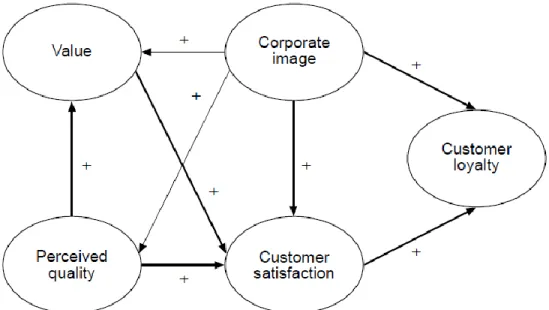
30 corporate image of the company will generate CL which influence the consumer behavior to choose an organisation to receive the service. Based on this argument they have created the conceptual model as shown in the Figure 2.4.
Figure 2.4:- The Conceptual Model
Source: - Andreassen and Lindestad (1998), The impact of corporate image on quality, CS and loyalty for customers with varying degrees of service expertise.
As shown in the figure 2.4, corporate image of an organisation will act as a filter in the perception of the variables which influence CS in order to simplify the consumer buying behavior of choosing an organisation for purchasing the service (Andreassen and Lindestad,1998). Moreover, the corporate image of an organisation plays a significant role in creating expectation of the service provided (Nguyen and Leblanc, 2001). Supporting this view, Gray and Balmer (1998) suggest that, having a very good corporate image helps the marketers to build a strong expectation towards the service. 2.4.1 Role of marketing in service industry to generate CS
31 customer relation of service firms” (Gronroos, 1984, p. 36). On the other hand
Parasuraman (1990) argues the main role of marketers in service industry is creating a strong expectation about the service offered. However he agrees before creating the expectation they should make sure the need of customers is clearly understood and the delivered service will balance the created expectation. The consequences of Parasuraman’s (1990) argument are reflected in the negative theory which was discussed in the section 2.3.3. Conversely to the argument of Parasuraman (1990), Harrison (2001) suggests that, it’s not the prior expectation which brings business for services, it’s the prior satisfied experiences that brings new customers and hold customers for service oriented organisation. As a whole marketing not only plays a big role in selling the service, but also in generating CS (Hennig‐Thurau and Klee, 1997). Generally marketing is an organisational activity which creates, communicate and deliver the product/service to customers in order to benefit the organisation and its stakeholders (Rafiq and Ahmed). However service industry has moved towards RM from the traditional way of marketing (Tax, Brown and Chandrashekaran). Still RM is not a completely new concept (Nevin, 1995). Supportively Morgan and Hunt (1994, p. 22) state that, RM concentrates on developing “relational exchanges” with customers which was established in the later stages of traditional marketing methods. They further continued to state that, the interest in RM is growing in a rapid pace since implementing RM in service industries such as healthcare and higher education has been highly successful.
2.5 The Industry of Higher Education
32 (Alam, 2009). Hence the role of higher education industry for the society becomes more significant (Rizzo and Ehrenberg 2004).
Universities and institutes are facing strong expectations and demand from all type of stakeholders (Marginson, 2006). Thus, the organisations in the industry of higher education must concentrate on satisfying a range of different individuals and groups apart from trying to achieve their general goals (Wagner, Hassanein and Head, 2008). Supporting this view, Cortese (2003) briefly explain that, universities and higher education institutes play a sufficient role in the developments of a nation; the support to the government to develop the country arrives in many ways from the industry of higher education. Reflectively Glass (2008) quoted in Gibbs and Murphy (2009) states that, “higher education’s contribution to the economic success of both developed and developing nations and of individuals has been widely recognized”. Glyphis (2001), however argues that, only few institutes and universities have established a reliable educational design and practice to contribute for sustainable individual’s and nation’s future.
33 2.5.1 CS in higher education
Institutes and universities have accepted that, “higher education is a service industry” (DeShields, Kara and Kaynak, 2005, p.129). As the literature have proved, in service industries “high CS ratings are widely believed to be the best indicator of company’s profit” (Kotler, 1991, p.19). Accordingly the firms which operate in the industry of higher
34 industry, students are considered as the major customer and satisfying them will aid the organisation to gain almost all the potential benefits of CS.
One of the major benefits of CS is retaining customers in the higher education industry, and retaining customers has become important as attracting them (Helgesen, 2008). Thus, the ideas of marketing and operation in an educational institute must be very clear on achieving CS to retain their customers(Aldridge and Rowely, 1998). Moxley, Najor-Durack and Dumbrigue (2001) also argue that, the best way to control the increasing dropout rates of students would be satisfying them in all possible ways. To do this task successfully an organisation should develop efficient strategies that generate CS in the process of delivering the service. (Hanif, Hafeez, and Riaz, 2010). 2.5.2 Generating CS in Higher Education
Identifying the factors “affecting CS is worth of importance in order to know the reasons which are responsible to create satisfaction among customers” (Hanif, Hafeez, and Riaz, 2010). The factors which affect CS vary from service to another service (McDougall and Levesque, 2000). Hence precisely identifying the influential factors of CS becomes more significant and challenging. Fornell (1992) suggests that, organisations have to act very efficiently from the very basic of the process of generating CS. According to Hennig-Thurau (2004), the foundation of CS is building expectation towards the service provided.
2.5.2.1 Building expectation for educational service
35 service compared to the competitors (Chacko, 1996). Merila and Crnokrak (2001) argue that, specialization or differentiation helps an orgnisation to build a very strong expectation towards the product or service.
Most of the managers of educational organisation believe that, positive word of mouth is the essence of building a strong reputation (Hill, 1995). Maxham (2001) proposes that, an organisation must entertain its customers with high quality service to generate positive word of mouth. Basically, “the higher the level of CS” emphasizes “the higher the level of positive word of mouth” (Ranaweera and Prabh, 2003, p.83). On the other
hand Van (2008), states that ranking of the universities is also an influential aspect on the reputation of educational organisations. However Hemsley and Oplatka (2006) argue that, since generating positive word of mouth relies on CS how it can generate the initial expectation for the service provided? They further argue that, even achieving high ranking is a long term process; therefore an educational organisation must also be aggressive in advertising to generate expectation among potential customers. Moreover Anctil (2008) elaborates that, clearly communicating the variety of courses provided through marketing activities an educational organisation can develop expectation and demand among the customers. It can be concluded, based on the reputation and marketing activities of the organisation customers assume the quality of learning experience can be gained from the institute/university.
Fornell (1992) elaborates that, Learning experience of a student contains all the possible activities which student will be engaged in the process of learning. Biggs and Tang (2011) Mention that, the quality of the learning experience determine the level of student satisfaction. Hence adding value to a student’s learning experience requires increasing the efficiency of the factors which affect CS.
2.5.2.2 Factors affecting CS in higher education
36 income and life style for example will influence the purchasing decision of the consumer (Baumeister, 2002). According to Akintoye, Hardcastle, Beck, Chinyio and Asenova (2003), after making the purchasing, generally consumers believe that, they will gain the best value in the process of fulfilling their need. Hence it is highly essential for an educational organisation to identify the factors which affect the learning experience of the student to offer the best value of the service (Elliott and Healy, 2001).
Researchers have categorized the factors which affect the learning experience and ultimately students’ satisfaction. Design of the course, teaching personal, tangibles, administrative support, and social life are the most common categories identified by the studies (see for: Aldridge and Rowley, 1998; Anton, 2010; DeShields, Kara and Kaynak, 2005; Koilias, 2005; LeBlanc and Nguyen 1997; Mai, 2005;; Munteanu, Ceobanu, Bobalca, 2010). Furthermore LeBlanc and Nguyen (1997) argue, certain activities of an educational organisation justify the developed reputation of the organisation. They further state that, justification of the reputation will always acts as an instrument to increase the level of CS. Accordingly Walsh, Dinnie and Wiedmann (2006) emphasizes that, reputation is not only a tool to build expectation; it can be a major input to achieve an optimal level of CS. Hence including reputation, generally there are six categories of factors which affect CS in higher education industry.
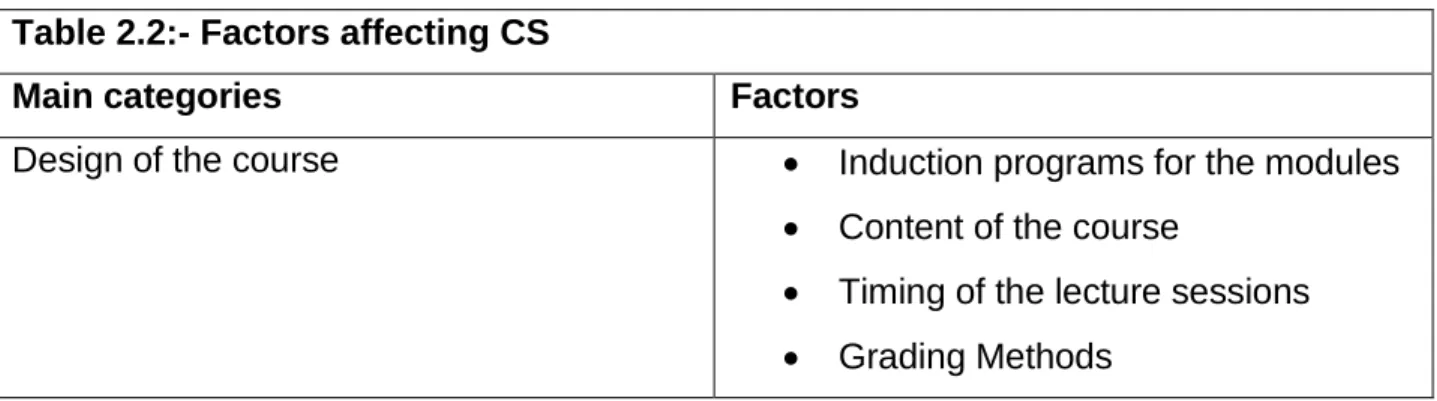
Various researchers have included different factors under the six categories discussed above. However the factors quoted by LeBlanc and Nguyen (1997) are the most common factors discussed by the researchers. Table 2.1 exposes the factors which affect CS under six main categories.
Table 2.2:- Factors affecting CS
Main categories Factors
Design of the course Induction programs for the modules Content of the course
37 Assessment Methods
Progression of the course
Teaching personal Lecturer’s appearance
Lecturer’s friendliness Punctuality of lecturers Teaching style and method
Availability of the lecturers apart from the lecture hours
Students involvement during
lecturers
Working in groups Tangibles and physical evidence Classroom layout
Classroom lighting Building’s appearance
Facilities of Information Technology
(IT)
Library services Parking availability Washroom facilities
Cleanliness of the building
Administrative support Appearance of the staffs Availability of the staffs Friendliness of the staffs
Response of the staffs for student’s issues
Speed of the response
Staffs’ willingness to provide assistance
Social life Activities of student council
38 Involvement in extracurricular
activities
Rewarding system of the
achievements
Reputation Culture, believes of the organisation
Institute’s involvement with the community
Updated curriculum
The above table was based on several studies which evaluated CS in higher education (see for: see for: Aldridge and Rowley, 1998; Anton, 2010; DeShields, Kara and Kaynak, 2005; Koilias, 2005; LeBlanc and Nguyen 1997; Mai, 2005; Munteanu, Ceobanu, Bobalca, 2010). The most common factors discussed in the studies are mentioned in table 2.1. Course variety is another common factor discussed under the category design of the course. However it is omitted in the table 2.1 since current study will be only focusing only on business management courses.
Researchers have identified the importance of the above categories by evaluating the students’ priorities for each category. They have proved that, the teaching personal contains the most important factors which affect student satisfaction (Aldridge and Rowley, 1998; LeBlanc and Nguyen 1997). Thus the relationship between lecturers and students becomes an essential part of student’s learning experience (Aldridge and Rowley, 1998). However it is justified, that the other factors also play a dominant role in student satisfaction. Especially administrative support and design of the course appeared to be equally important as teaching personal (DeShields, Kara and Kaynak, 2005). Furthermore they have compared the importance of all the factors with each other; it will be discussed in the chapter 4 along with the findings of the current study. 2.6 Summary
40 3. Methodology
This section of the study justifies the approach, strategy, and method of the research conducted. The limitations of the current study and the ethical consideration also will be demonstrated in this section. Overall the section methodology specifies the procedures from collecting information to presenting data (Noor, 2008).
3.1 Defining Research
Generally research is believed to be a scientific approach of gathering knowledge on specific concepts (McMillan and Schumacher, 2006). Kuhn (1996) elaborates scientific approach as a systematic examination of information on specific subject to enhance the facts and to derive new judgments. Maxwell (2004) argues that, establishment of facts and new judgments considered as tools to solve problems. Hence, research is a process of “defining and redefining problems” (Clifford, 1927, p. 172). Adding to that research collects and presents data, makes conclusion and tests the conclusion to suggest solutions to the defined problems (Clifford, 1927).
According to Kolias (2005, p. 364-365) research includes four major stages. The author of the current study adopted those four stages to conduct the research.
Table 3.1:- Stages of research according to Kolias (2005)
Stages Application
“Preliminary Stage” In this stage, the author identified the problem of Sri Lankan educational
institutes with retaining students. In-depth review of the literature exposed that student satisfaction determines the
retention in higher education. An extensive review of literatures demonstrated the factors affecting student satisfaction.
“Development of Questionnaire and gallop poll”
41 of identified factors which affect student satisfaction and to understand the
managerial interest on CS of educational institutes. Furthermore the pattern of the research was determined which will be explained throughout chapter 3.
“Analysis” This stage of the study includes
processing the data gathered through questionnaire. The processed data was analyzed using appropriate tools to statistically evaluate the impact of the identified factors in CS. Moreover the data gathered from the interviews with the managers also presented in an appropriate manner.
“Results” Finally the major findings of the study were evaluated and the author suggested
necessary recommendations for
educational organisation to retain students Source: - Adopted from Kolias (2005,p. 364-365), Evaluating Students satisfaction: The case of informatics department of TEI Athens.
3.2 Research Strategy
42 Quantitative research statistically analyzes and presents data to make and draw conclusion (McMillan and Schumacher, 2006). Bryman (2006) suggested that, statistical analyses are appropriate to investigate individual’s thinking and behavior. Supportively Pickard and Childs (2007) state that, questionnaires will be provided in the form of multiple choices in quantitative research thus the participants can easily choose the best option according to his/her own thinking and behavior. This type of research is ideal to analyze the relationship between variables, and discover specific solution for an issue (Bryman, 2006).
Qualitative research produces a detailed description of an issue or situation (Merriam, 1998). Generally it will be an attempt to expose the significance of human believes and emotions (Patton, 2005). Therefore in qualitative research questions are not only asked to choose options but to allow the respondent to expose the impact of the emotions related to the subject (Bryman, 2006). Relatively Berg (2004) states that, this type of research is utilized to explain emotions, motivation, beliefs and hypothesis.
The author used both quantitative and qualitative strategy to conduct the current study. Approaching this study as mixed research enabled the author to take advantage of the strengths and counterbalance the weaknesses of qualitative and quantitative strategies (Bryman, 2006).
43 The managers of the educational organisation believe that, CS is feeling or an emotion of student towards the organisation (Aldridge and Rowley, 1998). As qualitative research investigates the richness of emotion and feelings (Patton, 2005) the author has used this strategy to evaluate how managers deal with CS. Moreover qualitative strategy enabled the author to obtain managers’ own opinions on the influential factors of CS rather than restricting their response by giving options. Merriam (1998) argues that, in qualitative research, data can be easily generalized. However the use of quantitative strategy will extract the generalized information in this study (Bryman , 2006) .
3.3 Research Approach
According to Orlikowski and Baroudi, (1991) a research can be approached in five ways that are survey, case study, experimental study, history, and archival analysis. However commonly used approaches has been only two that are survey and case study (Berg, 2004).
Case study approach involves an in-depth investigation of dynamic situation or problem within a single setting (Stake, 1005). Relatively Sauer (1993) also states that, case study approach caries out a study on an organisation, community, social group or an event.
The current study will be approached as a survey since it focuses on an issue faced by an entire industry. This is supported by Weisberg (2009) as he states that, survey focuses on a larger population compared to case study, it evaluates a common problem faced by different individuals or groups. Survey approach and quantitative strategy delivers an ideal combination to statistically analyze a large number of information collected from questionnaire (Robson, 2002). Furthermore this approach aids the author to seek the level of influential factors in the study settings and enhance the results in graphical manner in order to achieve the objectives of the study.
44 study settings and suggest efficient recommendations through the verbal survey conducted. However author also faced some difficulties in conducting this survey. The major disadvantage of the survey approach has been, the author was unable to adjust the data collection process when needed. Reflectively Larsson (1993) states that, the systematic approach of survey leads to many benefits however it can be inflexible to modify according to new findings.
3.4 Research Methods
As the current study involves quantitative strategy, the author distributed a questionnaire where the participants are guided to choose the given options. Basically respondents were supposed to answer questions which have multiple choices and five point likert scale options.
The unit of the study is individual as questionnaire is completed by one person. The questionnaire was distributed to 60 individuals in the form of personal delivery. Personal delivery method was undertaken by the author because, Peyrot and Rubin (2005) suggested that, to assure high rate of respondents and assist responders with the problems occur during the process of completing the questionnaire, the researcher must personally deliver the questionnaire. They further stated that, systemic technique of questionnaire leads the respondents to provide positive and comprehensive feedback in a quick pace. However respondents must have faced “difficulties in assessing their own behavior or have poor recall of the circumstances surrounding their behavior”
(Glasow, 2005, p.2).
The author conducted interviews with three marketing managers of different institutes to support the qualitative part of the study. This is mainly to understand the strategies of educational management for dealing with student’s emotions as it is believed that student satisfaction is an emotion towards the organisation.
45 3.5 Sample approach
The population of this study will be the students who follow business related higher education programs conducted by private institutes in Sri Lanka and the marketing managers of the private educational organisation. As it is impossible to evaluate the every element of the population, the author decided to use cluster sampling and selected three institutes which are BMS, ICBT and ANC. This approach of the author is justified by Krebs (1999) as they define cluster sampling stating that, the samples will be selected from homogeneous groups which represents the population, it is generally used when it is impractical to observe complete list of elements of the targeted population.
After selecting the three clusters the author used stratified sampling to choose the students who follow business related programs. This was done with the help of management of the related institutes. 20 questionnaire sheets were distributed in the each institute to the student of business related programs. Moreover marketing managers of the same institutes were selected as the interviewees of the current study. 60 sample units appear to be a small sample size compared with the population. However quantitative strategy has the ability of making inferences about large groups using smaller group of people (Bryman, 2006). Furthermore cluster sampling aided the author to select sample unites at specific locations. Hence the sampling process was done in a quick pace and in cheap and easy manner.
3.6 Data collection
The collected data act as empirical evidences to support and reject theories (Chay and Hyslop, 1998). Hence the process of collecting data becomes an essential part of the research. Generally data can be collected in two forms that are, primary data and secondary data (Chay and Hyslop, 1998).
46 Generally interviews can be categorized into three forms that are structured interview, unstructured interview and semi structured interviews (Roboson, 2002). The author used the structured interview as he wanted to ask similar question from all the managers to analyze and compare the responses.
3.7 Pilot Survey
Pilot survey aids the author to encounter the problems may occur by the respondents and modify the questionnaire to solve the problem (Antony, 2004). This is further supported by Carruthers and Smith (1979) as they state that, pilot survey evaluates the level of accuracy of the questionnaire.
3 individuals were selected to do the pilot survey. The individuals were author’s cricket team mates who are obtaining their higher education in private institutes. Initially the questions on influential factors were prepared in future tense; however confusions occurred since the respondents are current students. One of the respondents of the pilot survey thought, the questions were asked about the efficiency level of influential factors in his institute since questionnaire was prepared in future tense. Hence the author adjusted the related question into present tense and clearly mentioned that the questions were asked based on the importance of the factors and not based on the efficiency level of the institutes.
3.8 Data analysis
In research data will be gathered in various forms (Roboson, 2002). Gathered data must be evaluated using appropriate methods and tools to achieve the objectives of study (Merriam, 1988). This job is done in the part of data analysis during the research process.
47 the mean for each factors affecting CS to evaluate the students’ proprieties given towards those factors. Since the current study has an element of qualitative strategy, the author adopted the constant data analysis method. Using this method, the author has recorded and presented the date obtained from interviews in an organized manner. 3.9 Ethical Research
Ethical consideration in research is not a new concept (Munhall, 1998) however the unethical behaviors of several researchers increase the influence of ethics in educational programs (Roboson, 2002). Thus, ethical consideration during the process of conducting research becomes even more important. Moreover the ethical consideration of the research plays a part in determining the value of research (Munhall, 1988).
Ethics in research referred to one’s own effort to set regulations to maintain a form of conduct which prevents him/her affecting an individual or society in a negative manner (Roboson, 2002). Since the current study is carried at educational institutes the author made sure he doesn’t disturb any lecture sessions by distributing the questionnaire in break times. Adding to that, he also assured the work of managers is not interrupted by the interviews conducted to the purpose of this study. Furthermore the secondary data obtained in this study is credited using APA referencing method.
3.10 Limitation of the research
The major limitation of this research was lack of money and time. Due to the time limitation and unavailability of human resource the samples were only selected in Colombo and 3 institutes where the population is spread all over Sri Lanka in more than 200 institutes. This limits the sample size up to 60.
49 4. Findings and analysis
4.1 Introduction
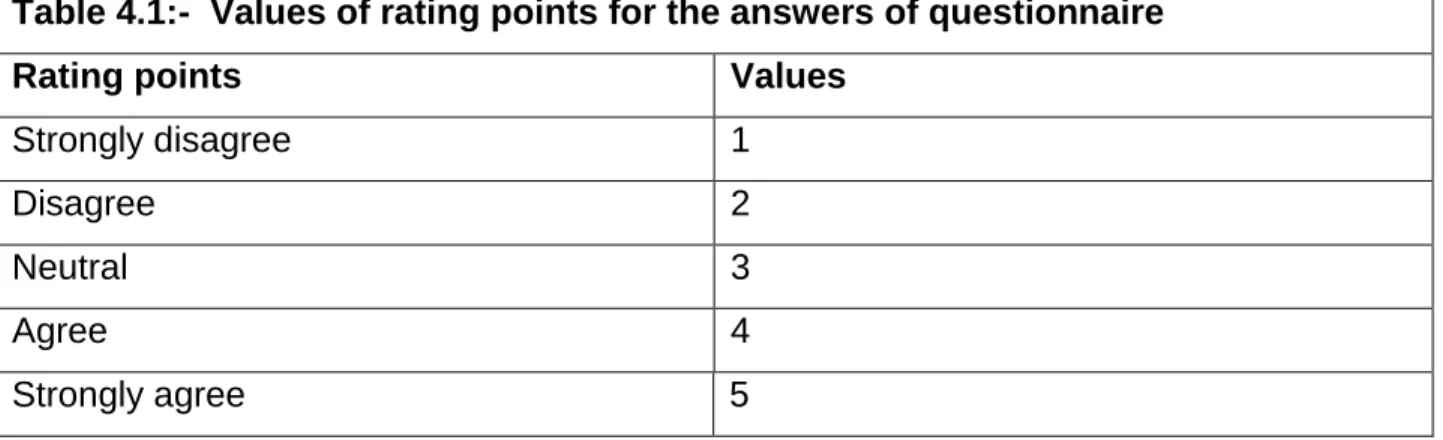
This section will be focusing on evaluating the influential level of factors which affect CS in order to achieve the 3rd objective of the current study. In the questionnaire, respondents were asked to rate the importance of factors affecting their learning experience in a five point scale. Author has given value for each rating point to convert the factors into measurable elements as shown in the table 4.2.
Table 4.1:- Values of rating points for the answers of questionnaire
Rating points Values
Strongly disagree 1
Disagree 2
Neutral 3
Agree 4
Strongly agree 5
50 4.2 Analysis of the questions
Question 1
The figure 4.1exposes the source and the number of sample unites Figure 4.1:- Sample range
The above chart is developed through Microsoft Excel, because SPSS doesn’t allow showing 3 variables in one chart.
As shown in the above figure respondents were from three various institutes. The author was able to receive 100% response rate due to personal delivery. Total number of respondents (N) is 60 in this current study (N=60).
0 5 10 15 20 25
BMS ANC ICBT
51 Question 2:- Factors which generate expectation towards educational organisation
Figure 4.2:- factors affecting student expectation towards educational services
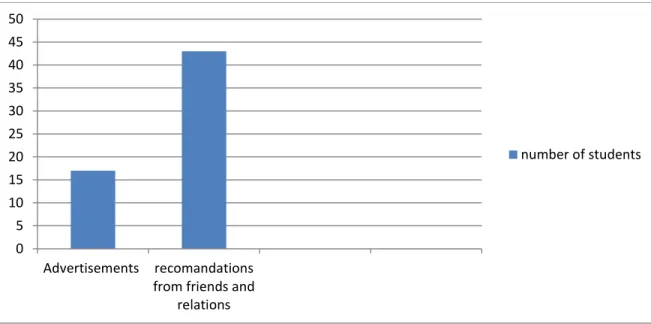
In the past studies on CS, researchers have argued about the factors which generate expectation towards educational organisation. As discussed in the literature review advertisements and word of mouth have been the influential factors on customer expectation (Webb, 2002). However according to the finding of current study it can be implied that, word of mouth has been playing the major role in generating expectation as 43 respondents have said that, they have selected their institute based on recommendations where only 17 respondents have selected through advertisements. Maxham (2001) argues that, positive recommendations are developed through the pleasant perceived experience of the past and present customers. Hence this particular finding justifies the view of Harrison (2001) as he states that, it’s the past satisfied experience of the customer which creates strong expectation among potential customers where as advertisements play the role of creating awareness about the organisation. He further elaborates that; positive word of mouth will uplift the reputation of the institute/University and ultimately assist the organisation to build a strong demand for their services.
0 5 10 15 20 25 30 35 40 45 50 Advertisements recomandations from friends and
relations
52 Question 3-8:- influence of factors under design of the course
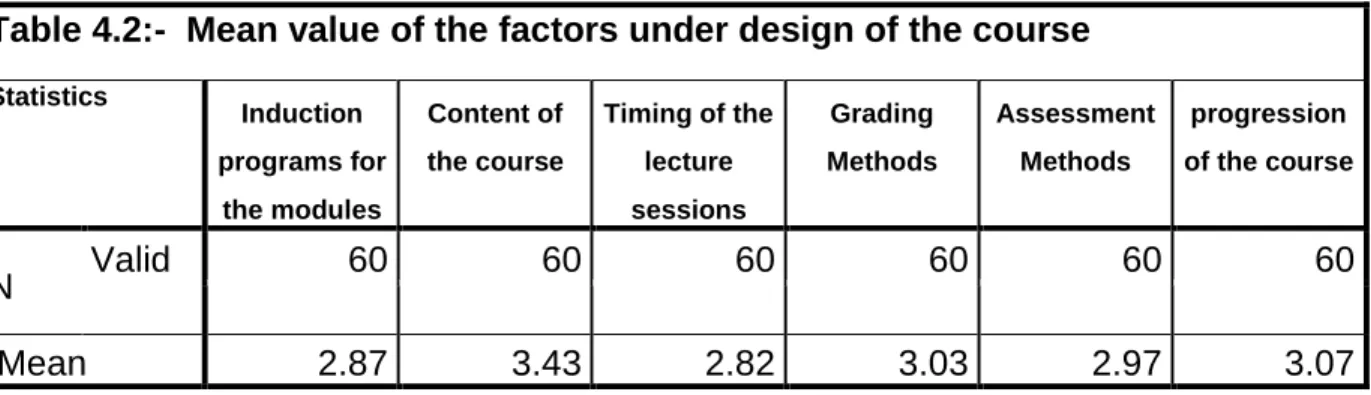
Table 4.2:- Mean value of the factors under design of the course Statistics
Induction
programs for
the modules
Content of
the course
Timing of the
lecture
sessions
Grading
Methods
Assessment
Methods
progression
of the course
N Valid 60 60 60 60 60 60
Mean 2.87 3.43 2.82 3.03 2.97 3.07
53 Question 8 - 15:- Influence of Factors under Teaching personal
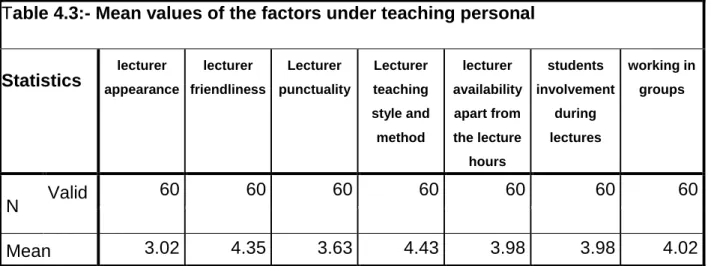
Lecturer’s teaching style and method obtaining the highest mean value, is a proof of Anton’s (2010) argument. He justified that, clear communication and dynamic delivery are the most needed attribute of the professors. Conversely Mai (2005) has identified Lecturer’s friendliness as the most important factor in determining the perceived teaching personal, as he states that, friendly expression of the lecturers has been treated as the most important factor since it helps an institute/University to gain the benefits of RM. Supportively, Elliott and Healy (2001) state that, lecturers have direct communication with the customers in higher education industry; therefore they play the major role of developing relational exchanges through RM. However they didn’t specify any criteria as the important factor. It can be viewed as; every single factor mentioned in the table 4.3 plays significant roles of teaching personal in establishing a well designed learning experience through developing RM as they have achieved the mean value of more than 3. Nevertheless high priorities must be given to lecturer’s teaching style and friendliness as those factors have obtained the highest mean values of 4.43 and 4.35 in the current study and other studies have argued about the importance of the same factors.
Table 4.3:- Mean values of the factors under teaching personal
Statistics lecturer appearance lecturer friendliness Lecturer punctuality Lecturer teaching style and method lecturer availability apart from the lecture hours students involvement during lectures working in groups
N Valid 60 60 60 60 60 60 60
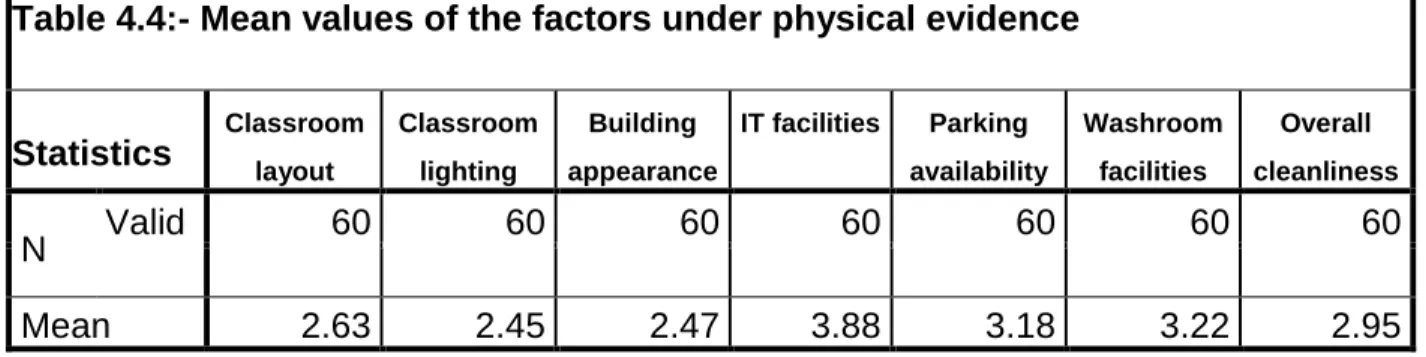
54 Question 16 - 22:- influence of the factors under physical evidence
Table 4.4:- Mean values of the factors under physical evidence
Statistics
Classroom
layout
Classroom
lighting
Building
appearance
IT facilities Parking
availability
Washroom
facilities
Overall
cleanliness
N Valid 60 60 60 60 60 60 60
Mean 2.63 2.45 2.47 3.88 3.18 3.22 2.95
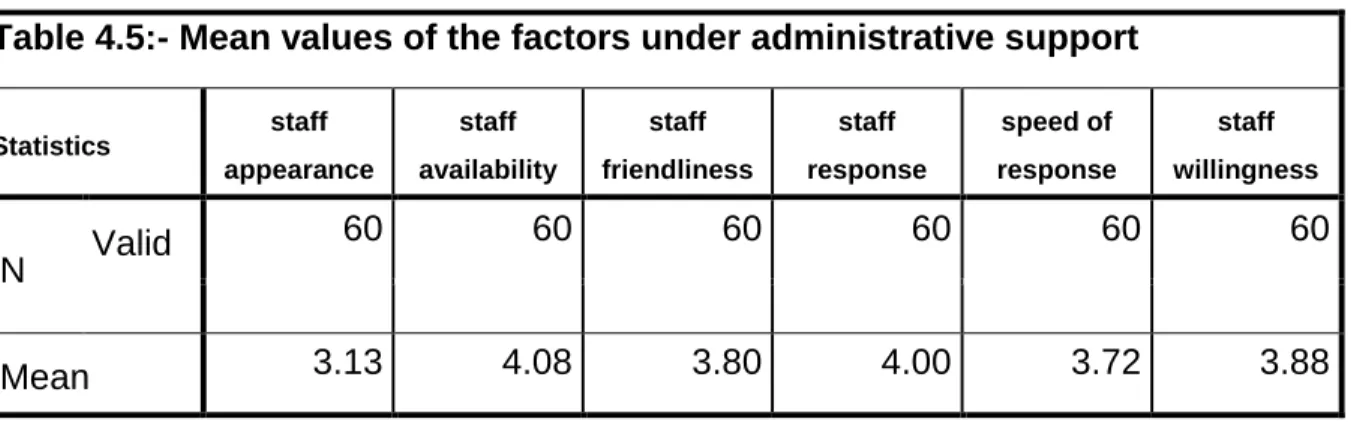
55 Question 24- 30:- influence of the factors under administrative support
Table 4.5:- Mean values of the factors under administrative support
Statistics
staff
appearance
staff
availability
staff
friendliness
staff
response
speed of
response
staff
willingness
N Valid
60 60 60 60 60 60
Mean 3.13 4.08 3.80 4.00 3.72 3.88
56 Question 31 – 34:- influence of the factors under social life
Table 4.6:- Mean values of the factors under Students’ social life
Statistics
activities of student
council
Involvement
in sports
Extracurricular
Activities
rewarding system
for student
achievement
N Valid
60 60 60 60
Mean 3.80 3.50 3.20 3.27
57 Question 35-36:- influence of the factors under reputation.
Table 4. 7:- Mean values of the factors under reputation
Statistics
Culture, believes of the organisation
Institute’s involvement
with the community
N Valid
60 60
Mean 2.52 2.77
58 4.3 Major finding: - Influence level of the major factors on student satisfaction Table 4.8:- Mean values of the major factors on student satisfaction
Factors Mean value
Design of the course 3.03
Teaching personal 3.91
Tangibles/physical evidence 2.96
Administrative support 3.76
Social life 3.44
Reputation 2.64
The above mean values are calculated through adding the mean values of each sub factor of the major factors and dividing the total by number of sub factors.
59 4.3 Analysis of Interviews
This part of the research contains a very brief qualitative analysis of the interviews conducted with mangers to understand the managerial interest on CS. Only the important questions have been discussed in the table 4.3.1. Author is avoided the questions which generated answers that are not necessary to the current study.
Table: - 4. 9 Analysis of interview of questions
Question Rational Analysis
1. What do you mean by term student
satisfaction?
Different
manager/leaders interpret business terms in different ways (Amor, 2000).
Therefore this question was asked to
understand the basic idea of how managers view student
satisfaction.
None of the 3 managers of the institutes were able to provide a clear definition on student satisfaction. In fact instead of defining student satisfaction they started to analyze the impact of student satisfaction in their organisation. Three of them stated that, they try to achieve high level customer satisfaction in order to retain their customers. One the respondents believes that student satisfaction is the ultimate aim of their institute in order to achieve high profitability and market share. It is clear that educational organisations have understood the benefits of CS despite the minimum understating of the meaning of CS. The importance of customer satisfaction in retaining customers is further justified through the answers of this question.
What are the activities you undertake in order to attract
customers?
Reputation and advertisements
determine expectation and demand towards the educational