Design
of
fl
uorinated
cyclopropane
derivatives
of
2-phenylcyclopropylmethylamine
leading
to
identi
fi
cation
of
a
selective
serotonin
2C
(5-HT
2C
)
receptor
agonist
without
5-HT
2B
agonism
Guiping
Zhang
a,*,1,
John
D.
McCorvy
b,2,
Sida
Shen
c,
Jianjun
Cheng
d,
Bryan
L.
Roth
b,
Alan
P.
Kozikowski
a,1aDrugDiscoveryProgram,DepartmentofMedicinalChemistryandPharmacognosy,CollegeofPharmacy,UniversityofIllinoisatChicago,Chicago,IL, 60612,UnitedStates
bNationalInstituteofMentalHealthPsychoactiveDrugScreeningProgram,andDepartmentofPharmacologyandDivisionofChemicalBiologyand MedicinalChemistry,UniversityofNorthCarolinaChapelHillMedicalSchool,ChapelHill,NC,27599,UnitedStates
cDepartmentsofChemistry,ChemistryofLifeProcessesInstitute,CenterforMolecularInnovationandDrugDiscovery,andCenterforDevelopmental Therapeutics,NorthwesternUniversity,Evanston,IL,60208,UnitedStates
diHumanInstitute,ShanghaiTechUniversity,Shanghai,201210,China
a r t i c l e i n f o
Article history: Received 15 July 2019 Received in revised form 14 August 2019 Accepted 14 August 2019 Available online 14 August 2019
Keywords:
5-HT2Creceptor
5-HT2Breceptor
Agonist
Fluorinated cyclopropane Asymmetric synthesis
a b s t r a c t
A new series offluorinated 5-HT2Cagonists were designed and synthesized on the basis of our previous
work on 2-phenylcyclopropylmethylamines as a potential approach for the treatment of central nervous system disorders. Keyfluorinated cyclopropane moieties were constructed through transition metal catalyzed [2þ1]-cycloaddition of aromatic vinylfluorides, and the absolute stereochemistry of the representative compound (e)-21awas established. Functional activity measuring calciumflux at 5-HT2
receptors reveals high potency for compounds (þ)-21a-d. In particular, (þ)-21bhad no detectable 5-HT2B
agonism and displayed reasonable selectivity against 5-HT2A. Molecular docking studies were further
performed to explain the compounds’possible binding poses to the 5-HT2Creceptor.
1. Introduction
The 5-HT2-family of serotonin receptors are members of the G
protein-coupled receptor (GPCR) superfamily and consist of three
subtypes including 5-HT2C, 5-HT2B, and 5-HT2A, which share high
sequence homology [1]. The 5-HT2Creceptor represents a
prom-ising drug target for obesity and central nervous system disorders,
such as schizophrenia and drug addiction [1e4]. Subtype selectivity
is essential for the development of potential 5-HT2C-targeted
therapeutics [5], as drugs with 5-HT2B agonism may induce
potentially life-threatening valvular hypertrophy [6,7], while
5-HT2A agonists are hallucinogenic [8]. However, it is currently a
major challenge to develop agonists that are highly selective for
5-HT2C over 5-HT2B and 5-HT2A due to these subtypes’significant
homology at structural, genetic, and functional levels. Indeed, the lack of truly selective ligands that are able to fully discriminate
among these receptor subtypes, especially between 5-HT2Cand
5-HT2B, has hampered the development of therapies based on these
compounds. For example, the withdrawal of fenfluramine and
pergolide as well as the restriction of sales of cabergoline are
related to their off-target agonist activity at the 5-HT2Breceptor [7].
Furthermore, concern about the anti-obesity drug lorcaserin has
been raised because of its moderate 5-HT2Bagonism, which may
induce lethal cardiac valvulopathy and pulmonary hypertension Abbreviations:ADMET, absorption; distribution, metabolism; excretion, and
toxicity; 2-PCPMA, 2-phenylcyclopropylmethylamine; RIT, ritanserin; ERG,
ergotamine.
*Corresponding author.
E-mail address:[email protected](G. Zhang).
1 StarWiseTherapeuticsLLC,Madison,Wisconsin53719,UnitedStates.
2 DepartmentofCellBiology,NeurobiologyandAnatomy,MedicalCollegeof
Wisconsin,Milwaukee,Wisconsin53226,UnitedStates.
[9,10]. Therefore, high selectivity for 5-HT2C over 5-HT2B has
emerged as paramount to develop 5-HT2Cagonists as a new
gen-eration of therapeutic drugs [1].
Fluorination of bioactive molecules as a drug design strategy has achieved remarkable success as evidenced by a number of marketed drugs, mainly because of the strong
electron-withdrawing effects of thefluorine atom and the metabolic
sta-bility of the CeF bond [11e13]. In our systematic structural
optimization of 2-phenylcyclopropylmethylamines (2-PCPMAs),
the introduction of a halogen, especiallyfluorine, onto the phenyl
ring was demonstrated as a robust strategy to develop potent and
selective 5-HT2Cagonists with improved drug-like properties. For
thefirst generation of 2-PCPMAs, introducing afluorine
substit-uent at the 3-position of the phenyl ring (compound3) generated
one of the most selective 5-HT2Cagonists reported to date [14].
Subsequent structure-activity relationship (SAR) studies indi-cated that an additional 2-alkoxy substituent represents a
beneficial functional group for maintaining reasonable potency
and selectivity as illustrated in compounds7and 8 [15].
Intro-duction of a second halogen substituent resulted in the drug
candidate 9, which displayed exquisite 5-HT2C potency and
selectivity over 5-HT2Aand 5-HT2B, excellent ADMET profiles, and
in vivo antipsychotic drug-like effects [16] (Fig. 1). Further
N-alkylation of the 2-(5-fl
uoro-2-alkoxyphenyl)cyclopropylmethyl-amines led to the identification of the potent N-benzyl
com-pound11with full selectivity over 5-HT2B, and of theN-methyl
compound10, which is the first fully Gq-biased 5-HT2Cagonist
reported to date [17].
Based on the promising properties of 2-PCPMA derivatives
fluorinated in the phenyl ring reported in our prior work, we
further explored the incorporation of fluorine atom(s) into the
cyclopropane ring, which could: (1) change the compounds’
conformation and thereby possibly lead to higher potency and selectivity; (2) increase lipophilicity for optimal brain penetration; and (3) block potential sites of oxidative metabolism, such as the
benzylic position (Fig. 1). Accordingly, a series of fluorinated
cyclopropylmethylamine derivatives were designed, synthesized,
and evaluated for their activities at 5-HT2receptors. Furthermore,
modelling studies were performed to understand their possible
binding poses at the 5-HT2Creceptor.
2. Results and discussion
2.1. Structure-activity relationship studies
Based on our previousfindings that the second-generation
2-PCPMAs possessing 2-alkoxy and 5-fluoro substituents exhibited
the best 5-HT2C potency and selectivity over 5-HT2A and 5-HT2B
receptors [15], an analog of the lead compound, 2-(5-fl
uoro-2-methoxyphenyl)cyclopropylmethylamine (6, cLogP¼1.59,
LogBB¼ 0.04) that is fluorinated at the benzylic position, and
which can be readily modified to form different 2-alkoxy
de-rivatives, was synthesizedfirst. Unfortunately, the resulting
com-pound (±)-12 showed only weak activity at 5-HT2C
(EC50¼598 nM). For our third-generation 2-PCPMAs with
N-sub-stituents, the introduction of anN-(2-methoxybenzyl) group led to
compounds with high 5-HT2Cselectivity over 5-HT2Bwhile
main-taining good potency at 5-HT2C [17]. However, the
N-(2-methoxybenzyl) analog (±)-13 of compound (±)-12 exhibited
only slightly improved activity at 5-HT2C (EC50¼230 nM,
Emax¼103%) together with poor selectivity against 5-HT2Band
5-HT2A. Therefore, we concluded that thefluorinated cyclopropane
moiety and the 2-alkoxy group could not be accommodated simultaneously, in line with our observation from prior structure-activity relationship studies that suggested strict steric limitations
applying to 2-PCPMAs [14e16].
Therefore, we further designed fluorinated cyclopropane
de-rivatives based on the first-generation 2-PCPMAs, which were
considered to have less steric hindrance. According to the previous
SAR studies on thefirst-generation 2-PCPMAs (Fig. 1), substitutions
at the 3-position of the benzene ring with F (compound 3), Me
(compound2), Cl (compound4), and even Br and CF3groups were
well tolerated without significant loss of activity at 5-HT2Cdespite a
gradual increase of the substituent size in this series. Moreover, mono- and disubstituted ligands bearing Br and Cl at the 2-position
displayed higher potency than the corresponding analogs
substituted with F, Me, or CF3groups, while the replacement of the
fluorine atom at the 4-position with other substituents led to
dramatically reduced 5-HT2Cpotency and selectivity [14]. On the
basis of these previousfindings, thefluorinated cyclopropane
de-rivatives21a-eof the potent and selectivefirst-generation 5-HT2C
agonists 2e5 were investigated. The biological results are
summarized in Table 1. Compared to the parent
(2-phenylcyclopropyl)methylamine ((þ)-1, EC50¼5.2 nM,
Emax¼108% at 5-HT2C, selectivity (2B/2C)¼7) [14], thefluorinated
cyclopropane derivative (þ)-21a showed comparable 5-HT2C
ac-tivity (EC50¼4.7 nM, Emax¼98%) and selectivity (2-fold) over
5-HT2B. Substitution with a methyl group at the 3-position of the
phenyl ring of (þ)-21a led to identification of a potent 5-HT2C
agonist ((þ)-21b, EC50¼8.0 nM, Emax¼96%) with no detectable
agonism at 5-HT2B and about 20-fold selectivity against 5-HT2A
(EC50¼162 nM, Emax¼71%), while intriguingly the corresponding
parent (2-(3-methylphenyl)cyclopropyl)methaylamine ((±)-2,
EC50¼4.8 nM, Emax¼95% at 5-HT2C, selectivity (2B/2C)¼14) [14]
also had the best selectivity for 5-HT2Cover 5-HT2Bamong thefi
rst-generation 2-PCPMAs. The 3-fluoro and 3-chloro analogs ((þ)-21c
and (þ)-21d, respectively) displayed high potency (EC50<15 nM) at
5-HT2Cbut poor selectivity against 5-HT2Band 5-HT2Areceptors. In
contrast, the introduction of a bromo substituent into the
2-position of the phenyl ring (compound (þ)-21e) resulted in
decreased potency (EC50¼312 nM, Emax¼71%) at 5-HT2C, although
the ligand showed no activity at 5-HT2B. N-Methylation and
N-benzylation of (þ)-21a, which was shown to be a successful
opti-mization strategy in the third-generationN-substituted PCPMAs
[17], caused loss of potency (EC50>250 nM) at 5-HT2Cas found in
compounds (þ)-22and (þ)-23. Furthermore, thegem-difluorinated
cyclopropane derivative 24 was almost inactive (EC50>4
m
M),which possibly resulted from the bulkier difluorinated
cyclopro-pane moiety.
Compound (þ)-21bhas thus been identified as the best ligand in
the series with excellent selectivity for the 5-HT2Creceptor against
5-HT2B(no agonism at 10
m
M) and a reasonable selectivity against5-HT2A. Moreover, the introduction of a fluorine atom into the
cyclopropane ring is beneficial for improving cLogP and logBB (for
example, 21b: cLogP¼1.92, logBB¼0.38 vs 2: cLogP¼1.95,
LogBB¼0.08), which might contribute to a better brain penetrance
of the compound for the treatment of central nervous system (CNS) diseases.
2.2. Chemistry
As shown inScheme 1, the monofluorinated cyclopropane
de-rivative12was synthesized starting from commercially available
5-fluoro-2-methoxybenzaldehyde (12a). Wittig reaction of
benzal-dehyde12awith methyltriphenylphosphonium bromide afforded
the olefin12bin a high yield. Bromofluorination of12bwith NBS/
Et3N·3HF followed by elimination of HBr provided the vinylfluoride
12d. Cyclopropanation of12dwith ethyl diazoacetate in the
pres-ence of Cu(acac)2 as catalyst generated the monofluorinated
cyclopropanecarboxylate 12e as an approximate 3:2 racemic
mixture of trans- andcis-isomers. Thetrans-isomer12ewas
ob-tained by chromatographic separation. Its reduction to the corre-sponding aldehyde with diisobutylaluminium hydride (DIBAL-H) proceeded in a good yield, but this compound was found to readily decompose under weakly acidic conditions such as in presence of deuterated chloroform. This problem was solved by the direct
reduction of12ewith LiAlH4to alcohol12f, which was transformed
to azide 12g via a Mitsunobu azidation with PPh3/DEAD/DPPA.
Staudinger reduction of 12g followed by Boc-protection of the
primary amine in one pot produced theN-Boc amide12h, which
Table 1
Functional activity and selectivity offluorinated cyclopropylmethylamine derivatives 12e13, 21a-e, and 22e24 at 5-HT2receptors in the calciumflux assaya
Compd. X R3 R2 cLogP LogBB 5-HT
2C 5-HT2B 5-HT2A
pEC50(EC50,nM) Emax(%) pEC50(EC50,nM) Emax(%) pEC50(EC50,nM) Emax(%)
serotonin - 9.72±0.03 (0.19) 100±0.8 9.07±0.03 (0.86) 100±0.8 9.56±0.02 (0.27) 100±0.7
lorcaserin - 8.32±0.03 (4.77) 101±1.2 7.10±0.06 (80) 92±2.6 7.49±0.04 (33) 92±1.3
(±)-12 F OMe H 1.52 0.26 6.22±0.07 (598) 90±3.0 6.94±0.07 (116) 79±2.2 6.45±0.03 (352) 86±1.2
(±)-13 F OMe 3.40 1.02 6.64±0.05 (229) 103±2.4 6.55±0.04 (285) 61±1.2 7.51±0.02 (31) 92±0.6
(þ)-21a H H H 1.71 0.29 8.33±0.05 (4.7) 98±1.5 8.00±0.08 (10) 104±3.0 8.01±0.05 (10) 106±1.7
(e)-21a 5.39±0.05 (4106) 87±3.0 6.04±0.11 (903) 77±4.5 5.74±0.04 (1829) 47±1.1
(þ)-21b Me H H 1.92 0.38 8.10±0.61 (8.0) 96±1.5 NA NA 6.79±0.87 (162) 71±1.1
(e)-21b 5.28±0.15 (5245) 97±0.8 NA NA NA NA
(þ)-21c F H H 1.71 0.29 8.56±0.69 (3.0) 107±1.9 8.64±0.77 (2.0) 106±2.0 8.57±0.53 (3.0) 83±1.7
(e)-21c NA NA NA NA NA NA
(þ)-21d Cl H H 2.24 0.42 7.91±0.82 (12) 110±1.6 7.66±0.20 (22) 91±1.8 7.64±0.56 (23) 102±1.3
(e)-21d 5.97±0.41 (1064) 92±1.3 NA NA NA NA
(þ)-21e H Br H 2.29 0.51 6.51±0.30 (312) 71±1.2 NA NA 6.91±0.19 (122) 38±1.3
(e)-21e NA NA NA NA NA NA
(þ)-22 H H Me 2.07 0.46 6.54±0.14 (291) 96±1.1 6.25±0.02 (565) 42±1.3 6.81±0.80 (156) 40±1.1
(þ)-23 H H 3.63 1.10 6.10±0.04 (789) 85±1.9 6.44±0.20 (363) 27±2.4 6.50±0.04 (320) 83±1.4
(±)-24 - 1.60 0.27 5.35±0.11 (4426) 82±6.4 5.63±0.16 (2347) 62±6.3 5.43±0.12 (3679) 43±3.6
aAll new compounds were tested as HCl salts. Pharmacological data were acquired with recombinant, stably expressed human 5-HT
2receptors in the HEK-293 cell line,
using afluorescence imaging plate reader (FLIPR) assay. All data are expressed as average and standard error of the mean and represent three independent experiments
performed in triplicate.“NA”indicates no activity up to 10mM“”indicates structures of 5-HT and lorcaserin are not shown. cLogP and LogBB values were calculated for the
was easily purified by column chromatography. Deprotection of
12hwith HCl solution (2.0M in diethyl ether) afforded the primary
amine derivative12as its HCl salt. TheN-benzylated derivate13
was prepared by reductive alkylation of 12 with
2-methoxybenzaldehyde.
As shown inScheme 2, the styrenes14a-ewere converted to the
trans-isomers of monofluorinated cyclopropanecarboxylates17a-e
according to the same method as described inScheme 1.
Subse-quently, compounds17a-ewere subjected to afive-step sequence
following similar procedures as reported previously by us [16].
Reduction of 17a-ewith LiAlH4 afforded alcohols 18a-ein good
yields, which were then converted into phthalimides 18a-e via
Mitsunobu reactions with phthalimide. Deprotection of the imides with hydrazine hydrate and subsequent Boc-protection produced
intermediates 20a-e. Separation of racemic20a-eby chiral
pre-parative HPLC followed by deprotection of the Boc group under
acidic conditions (2M HCl/Et2O) gave optically pure enantiomers
(þ)-21a-eand (e)-21a-eas HCl salts. TheN-methylamine (þ)-22
was prepared by introduction of theN-methyl group into the
in-termediate (e)-20awith sodium hydride and iodomethane
fol-lowed by removal of the Boc group under acidic conditions, while the N-benzylamine (þ)-23 was directly synthesized from the
enantiomer (þ)-21a through reductive amination with
2-methoxybenzaldehyde.
The synthesis of the gem-difluorinated cyclopropane 24was
accomplished starting from the precursor 24b (Scheme 3),
ob-tained through difluorocyclopropanation of cinnamyl acetate
(24a) with an excesses of sodium chlorodifluoroacetate in
diglyme under reflux [18]. Saponified afforded the alcohol24cin
quantitative yield, which was then subjected to similar synthetic
procedures as described above to provide the gem-difl
uor-ocyclopropane24.
Unless otherwise noted, the fluorinated
cyclopropylmethyl-amine derivatives were tested as racemic mixtures. The absolute
stereochemistry of compound (e)-21a was established by
com-parison of the optical rotation of itsN-Boc precursor (þ)-20a
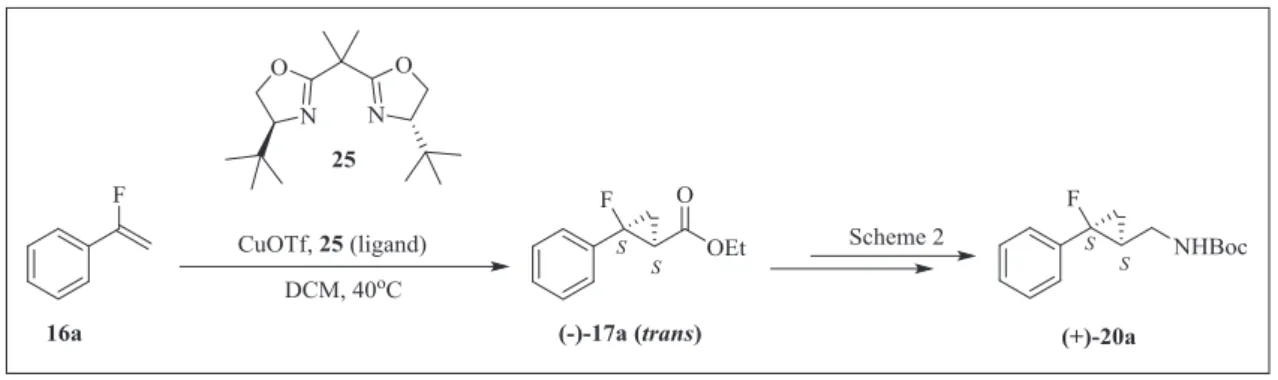
ob-tained from chiral HPLC separation to that of a sample synthesized asymmetrically. The enantioselective synthesis of the key
inter-mediate trans-(e)-(1S,2S)-17a for preparation of (þ)-(1S,2S)-20a
was achieved by asymmetric cyclopropanation of
a
-fluorostyrene(16a) in the presence of an enantiopure copper catalytic system
consisting of the chiral bis(oxazoline) ligand25and copper(I)
tri-flate [19,20] (Scheme 4). Following the same synthetic route as
shown inScheme 2, trans-(e)-(1S,2S)-17awas transformed into
(þ)-(1S,2S)-20a, which was identical to the enantiomer (þ)-20a
obtained from chiral HPLC separation in terms of optical rotation
and spectral data. Based on this result, the absolute configuration of
(e)-21aobtained by removal of theN-Boc group from (þ)-20awas
assigned as (1S,2S) and that of the other enantiomer, (þ)-20a, as
(1R,2R). Furthermore, ourfinding that the (þ)-enantiomers of all
new fluorinated cyclopropylmethylamine derivatives 21a-e are
more potent than their (e)-enantiomers is in agreement with that
previously observed for the 2-phenylcyclopropylmethylamine
scaffold [14]. Taken together, the absolute configuration of
com-pounds (þ)-21a-e is generally assumed as (1R,2R) and that of
(e)-21a-eas (1S,2S).
2.3. Molecular docking studies
To clarify the potential binding poses of the new fluorinated
cyclopropane compounds compared to those of our previous compounds, we conducted molecular docking studies using the
recently published crystal structures of the 5-HT2Creceptor [21].
The transition from 5-HT2Cinactive to active states is thought to
be triggered by helix movements accompanied by rotamer
switches in the conserved P3265.50-I1423.40-F3206.44(PeIeF) motif
and a shift of the W3246.48in helix VI, a hallmark of representative
active-state-like structures at biogenic amine and other GPCRs
[22,23]. The recently reported inactive and active structures of the
5-HT2Creceptor in complex with ritanserin (RIT) and ergotamine
(ERG), respectively, demonstrate that, by comparing the confor-mational changes between inverse agonist- and agonist-bound
5-HT2C, hydrogen bonds between the highly conserved D1343.32
and Y3587.43residues are in place in both structures, while one of
RIT's 4-fluorophenyl rings forms a strong, tight interaction with
W3246.48and I1423.40, as well as F3206.44side chains, thus
appar-ently preventing the conformational changes in these key
activa-tion microswitch structures [21].
Scheme 1.Synthesis of target compounds 12-13aaReagents and conditions: (a) Ph
3(CH3)PþBr, NaH, THF; (b) Et3Ne3HF, NBS, CH2Cl2; (c) DBU, CH2Cl2, reflux; (d) N2CHCOOEt,
Cu(acac)2, 1,2-dichloroethane, 60C; (e) LiAlH4, THF; (f) DPPA, DEAD, Ph3P, THF, 0C ~ rt; (g) Ph3P, H2O/THF; then Boc2O; (h) 2M HCl/Et2O; (i) 2-methoxybenzaldehyde, NaBH4,
On the basis of the available 5-HT2C-activecrystal structure (PDB
code: 6BQG,Fig. 2A), a docking simulation was carried out on the
potent and highly selective agonist8and its correspondingfl
uori-nated cyclopropane derivative 21c to interpret their possible
binding modes (Fig. 2B and C). Expectedly, both ligands engage in a
strong salt bridge with D1343.32, which is critical for charged
ami-nergic ligand recognition. Furthermore, the salt bridge is enhanced
by an interaction between D1343.32 and the fluorine-substituted
Scheme 2.Synthesis of Target Compounds 21a-e, 22, and 23aaReagents and conditions: (a) Et
3Ne3HF, NBS, CH2Cl2; (b) DBU, CH2Cl2, reflux; (c) N2CHCOOEt, Cu(acac)2, CH2Cl2, 40C;
(d) LiAlH4, THF; (e) phthalimide, PPh3, DEAD, THF, 0C ~ rt; (f) 1. N2H4eH2O, EtOH, reflux; 2. Boc2O, Et3N, DCM; (g) chiral preparative HPLC separation; (h) 2M HCl/Et2O; (i) NaH, MeI,
THF; (j) 2-methoxybenzaldehyde, NaBH4, MeOH.
Scheme 3.Synthesis of target compounds 24aaReagents and conditions: (a) ClCF
2COONa, diglyme, 162C; (b) 2N NaOH, MeOH; (c) phthalimide, PPh3, DEAD, THF, 0C ~ rt; (d) 1.
alkoxy tail in the case of8, while an additional interaction between
the amino group and S1383.36is observed in the complex of21c.
Both the alkyl side chain in8and the cyclopropyl ring in21calso
participate in additional
p
-alkyl interactions with W3246.48 thatmay reinforce interactions with helix VI toward an active
confor-mation. In addition, the fluorophenyl rings in both compounds
engage in an interaction with G2185.42and an edge-to-face
p
-p
stacking with F3286.52, suggesting that interhelical interactions are
involved to stabilize helices III, V, and VI in 5-HT2C-active. The
superimposed structures of8and21cinFig. 2D further
demon-strate that bothfluorophenyl rings occupy relatively similar
bind-ing poses (Fig. 2D). However, the cyclopropane moiety of8forms a
salt bridge from the top of D1343.32, while thefluorinated
cyclo-propane moiety of21cbinds to D1343.32from the downside of the
residue and locates at a similar position as the 2-fluoroethoxy
group of8.
Scheme 4.Asymmetric synthesis of intermediate (þ)-20a.
Fig. 2. Docking simulations of 8 and 21c with 5-HT2C-active.(A) Empirical conformation of ERG (orange) in 5-HT2C-active(PDB: 6BQG); (B) docking pose of8(green) in the binding
site of 5-HT2C-active; (C) docking pose of21c(magenta) in the binding site of 5-HT2C-active; (D) superimposed structures of8(green) and21c(magenta) in the binding site of 5-HT
3. Conclusions
Based on the expected favorable drug-like properties imparted
by fluorine substituent(s) on the phenyl ring of the 2-PCPMA
scaffold, new fluorinated cyclopropylmethylamine derivatives
were designed and synthesized by construction of the
cyclopro-pane ring via transition metal catalyzed [2þ1]-cycloaddition of a
diazo compound to an aromatic vinylfluoride. The absolute
ste-reochemistry of the enantiomers (þ)-21a-e and (e)-21a-e was
indirectly determined by comparison of theN-Boc protected
pre-cursor of the representative compound (e)-21aobtained by chiral
HPLC separation to a sample synthesized asymmetrically by a
well-proven methodology. Further pharmacological profiling of these
compounds led to identification of a potent and highly selective
5-HT2Cagonist, (þ)-21b, without 5-HT2Bagonism. Molecular docking
studies using recently disclosed crystal structures of the 5-HT2C
receptor indicate that the new fluorinated cyclopropane
com-pounds such as21chave similar interaction patterns with 5-HT2C
compared to the best ligand8reported previously by us.
Intro-duction of thefluorine atom at the benzylic position of 2-PCPMA
may contribute to improved drug-like properties with regard to metabolic stability and brain penetration crucial for CNS drugs.
4. Experimental section
4.1. General
All chemicals and solvents were purchased from Sigma-Aldrich
or Fisher Scientific and were used as obtained without further
purification. Synthetic intermediates were purified on 230e400
mesh silica gel using a Teledyne CombiFlash Rfflash
chromato-graph.1H,13C, and19F NMR spectra were recorded on Bruker
DPX-400 or AVANCE-DPX-400 spectrometers at DPX-400 MHz, 100 MHz, and
376 MHz, respectively. NMR chemical shifts are reported in
d
(ppm)using residual solvent peaks as standards (CDCl3e7.26 (H), 77.16
(C); CD3ODe3.31 (H), 49.00 (C)). High resolution mass spectra
(HRMS) were acquired using an LCMS-IT-TOF (Shimadzu) mass
spectrometer in ESI mode. Preparative HPLC purification of
syn-thetic intermediates was performed on a Shimadzu LC-8A
instru-ment with an ACE 5AQ column (15021.2 mm, particle size 5
m
m;eluent: 8e100% MeOH (0.05% TFA)/H2O (0.05% TFA) gradient,
30 min;flow rate: 17 mL/min; UV detection at 220 and 254 nm).
The purity of allfinal compounds (greater than 95% in all cases) was
determined by analytical HPLC on an ACE 3AQ C18 column
(1504.6 mm, particle size 3
m
m; eluent: MeOH (0.05% TFA)/H2O(0.05% TFA) gradient, 25 min;flow rate: 1.0 mL/min).
The synthetic procedures and characterization data of all in-termediates can be found in the Supporting Information.
4.2. General Method A
Chiral Separation ofN-Boc-amines 20a-e.The racemic
N-Boc-amines20a-ewere separated by preparative HPLC using a
Regis-Pack chiral column (25 cm21.1 mm, particle size 10
m
M) and2e10% ethanol inn-hexane as the eluent (flow rate¼18 mL/min,
l
¼220 and 254 nm; isocratic elution, stacked injections). Thefirst-and second-eluting peaks were collected rst-and concentrated, rst-and separations were repeated when necessary to ensure obtention of
both enantiomers with optical purities>90% ee(determined by
analytical HPLC using a RegisPack (25 cm4.6 mm, particle size
10
m
m) chiral column and ethanol/n-hexane as the eluent). Specificrotations were recorded on a Rudolph Research Autopol IV
auto-matic polarimeter. Compounds (þ)-20a-ewere isolated as thefi
rst-eluting peaks, and ()-20a-eas the second-eluting peaks.
4.3. General Method B
Preparation of HCl Salts 12,(þ)/()-21a-e, 22, and 24.The
N-Boc-amines12h,(þ)/()-20a-e,(þ)-22a,and24ewere dissolved in
2M HCl (g) in diethyl ether (5 equiv.) and stirred at room
temper-ature for 24e48 h. The resulting white solids were filtered off,
washed with diethyl ether, and dried under vacuum to give the HCl
salts as white solids in high yields (75e90%).
4.4. [2-Fluoro-2-(5-fluoro-2-methoxyphenyl)cyclopropyl] methanamine hydrochloride (12)
Obtained from the intermediate12hemploying General Method
B as a white solid.1H NMR (CD
3OD)
d
7.24 (ddd,J¼8.6, 3.0, 1.9 Hz,1H), 7.17 (tdd,J¼8.1, 3.1, 1.7 Hz, 1H), 7.08 (dd,J¼9.1, 4.3 Hz, 1H),
3.91 (s, 3H), 3.42 (ddd,J¼13.3, 6.3, 1.2 Hz, 1H), 3.22e3.14 (m, 1H),
1.66e1.56 (m, 1H), 1.52 (td,J¼10.2, 7.1 Hz, 1H), 1.35 (dt,J¼20.0,
7.0 Hz, 1H).13C NMR (CD3OD)
d
157.86 (d,J¼238.0 Hz), 156.15 (d,J¼8.5 Hz), 126.64 (dd,J¼19.8, 7.3 Hz), 118.16 (dd,J¼22.7, 2.2 Hz),
118.02 (dd, J¼24.0, 4.2 Hz), 113.53 (d, J¼8.0 Hz), 79.24 (d,
J¼216.1 Hz), 56.58 (s), 40.16 (d, J¼9.3 Hz), 21.38 (d,J¼12.1 Hz),
16.28 (d,J¼13.4 Hz).19F NMR (CD3OD)
d
125.90 (s),184.10 (s);HRMS (ESI) calculated for C11H14F2NO ([MþH]þ):m/z 214.1038;
found: 214.1021.
4.5. 1-[2-Fluoro-2-(5-fl uoro-2-methoxyphenyl)cyclopropyl]-N-(2-methoxybenzyl)methanamine hydrochloride (13)
To a solution of the HCl salt 12 (50 mg, 0.30 mmol) and
2-methoxybenzaldehyde (40 mg, 0.30 mmol) in methanol (5 mL) was added triethylamine (90 mg, 0.90 mmol). The reaction mixture
was stirred at rt for 6 h, and then NaBH4(35 mg, 0.90 mmol) was
added in portions. The resulting mixture was further stirred for 30 min, quenched by the addition of water and extracted with DCM.
The organic layer was washed with brine, dried over Na2SO4, and
concentrated. The resulting residue was purified by silica gel
chromatography to give the free base as a colorless oil (72 mg). The above free base was dissolved in 2 M HCl in diethyl ether (3 mL) and stirred at room temperature for 2 h. The precipitate was collected
byfiltration, washed with diethyl ether, and dried under vacuum to
obtain the desired salt as a white solid (76 mg, 78%). 1H NMR
(CDCl3)
d
12.19 (s, 2H), 7.50e7.36 (m, 2H), 7.18e7.00 (m, 3H), 6.95 (d,J¼8.3 Hz, 1H), 6.91 (dd,J¼9.0, 4.1 Hz, 1H), 4.55 (d,J¼12.7 Hz, 1H),
4.02 (d,J¼11.9 Hz, 1H), 3.91 (s, 3H), 3.86 (s, 3H), 3.83e3.70 (m, 1H),
2.77e2.62 (m, 1H), 2.04e1.84 (m, 1H), 1.46e1.36 (m, 1H), 1.24e1.12
(m, 1H);19F NMR (CDCl3)
d
123.00 (s),184.03 (s). HRMS (ESI)calculated for C11H14F2NO ([MþH]þ): m/z 334.1613; found:
334.1602.
4.6. (þ)-[(1R,2R)-2-fluoro-2-phenylcyclopropyl]methanamine hydrochloride ((þ)-21a)
Obtained from the intermediate (-)-20a employing General
Method B as a white solid.1H NMR (CD3OD)
d
7.52e7.30 (m, 5H),3.40e3.21 (m, 2H), 1.81e1.68 (m, 1H), 1.60e1.44 (m, 2H);13C NMR
(CD3OD)
d
139.36 (d,J¼20.8 Hz), 129.64 (s, 2C), 129.15 (s), 125.67(d,J¼6.4 Hz, 2C), 82.24 (d,J¼217.7 Hz), 39.65 (d,J¼9.8 Hz), 23.68
(d, J¼11.2 Hz), 19.17 (d, J¼12.3 Hz); HRMS (ESI) calculated for
C10H13FN ([MþH]þ):m/z166.1027; found: 166.1008. [
a
]D20þ68.3 (c0.3, MeOH).
4.7. (-)-[(1S,2S)-2-fluoro-2-phenylcyclopropyl]methanamine hydrochloride ((-)-21a)
Method B as a white solid.1H NMR (CDCl3)
d
7.53e7.30 (m, 5H),3.40e3.20 (m, 2H), 1.81e1.68 (m, 1H), 1.60e1.44 (m, 2H);13C NMR
(CD3OD)
d
139.36 (d,J¼20.8 Hz), 129.64 (s, 2C), 129.15 (s), 125.67(d,J¼6.4 Hz, 2C), 82.24 (d,J¼217.6 Hz), 39.65 (d,J¼9.8 Hz), 23.68
(d, J¼11.2 Hz), 19.17 (d, J¼12.3 Hz); HRMS (ESI) calculated for
C10H13FN ([MþH]þ):m/z166.1027; found: 166.1008. [
a
]D20-67.4 (c0.2, MeOH).
4.8. (þ)-[(1R,2R)-2-fluoro-2-(m-tolyl)cyclopropyl]methanamine hydrochloride ((þ)-21b)
Obtained from the intermediate (-)-20b employing General
Method B as a white solid.1H NMR (CD3OD)
d
7.30 (t,J¼7.6 Hz, 1H),7.24e7.13 (m, 3H), 3.37e3.30 (m, 1H), 3.24 (dd,J¼13.3, 8.2 Hz, 1H),
2.38 (s, 3H), 1.73e1.61 (m, 1H), 1.60e1.41 (m, 2H);13C NMR (CD3OD)
d
139.56 (s), 139.25 (d, J¼20.3 Hz), 129.87 (s), 129.53 (d,J¼10.7 Hz), 126.28 (d, J¼6.4 Hz), 122.77 (d,J¼6.5 Hz), 82.22 (d,
J¼217.7 Hz), 39.68 (d,J¼9.9 Hz), 23.63 (d, J¼11.2 Hz), 21.43 (s),
19.02 (d,J¼12.5 Hz);19F NMR (CD3OD)
d
192.4 (s); HRMS (ESI)calculated for C11H15FN ([MþH]þ):m/z180.1183; found: 180.1176.
[
a
]D20þ53.6 (c0.5, MeOH).4.9. (-)-[(1S,2S)-2-fluoro-2-(m-tolyl)cyclopropyl]methanamine hydrochloride ((-)-21b)
Obtained from the intermediate (þ)-20b employing General
Method B as a white solid.1H NMR (CD
3OD)
d
7.30 (t,J¼7.6 Hz, 1H),7.25e7.13 (m, 3H), 3.37e3.30 (m, 1H), 3.24 (dd,J¼13.3, 8.0 Hz, 1H),
2.38 (s, 3H), 1.73e1.62 (m, 1H), 1.60e1.41 (m, 2H);13C NMR (CD3OD)
d
139.56 (s), 139.25 (d, J¼20.3 Hz), 129.87 (s), 129.53 (d,J¼10.7 Hz), 126.28 (d, J¼6.4 Hz), 122.77 (d,J¼6.5 Hz), 82.22 (d,
J¼217.6 Hz), 39.68 (d,J¼9.9 Hz), 23.63 (d, J¼11.2 Hz), 21.43 (s),
19.02 (d,J¼12.5 Hz);19F NMR (CD3OD)
d
192.4 (s); HRMS (ESI)calculated for C11H15FN ([MþH]þ):m/z180.1183; found: 180.1175.
[
a
]D20-49.8 (c0.1, MeOH).4.10. (þ)-[(1R,2R)-2-fluoro-2-(3-fluorophenyl)cyclopropyl] methanamine hydrochloride ((þ)-21c)
4.10.1. Obtained from the intermediate(-)-20cemploying General Method B as a white solid
1H NMR (CD
3OD)
d
7.48e7.39 (m, 1H), 7.19e7.13 (m, 2H),7.13e7.05 (m, 1H), 3.39e3.34 (m, 1H), 3.23 (dd,J¼13.4, 8.1 Hz, 1H),
1.78e1.68 (m, 1H), 1.65e1.48 (m, 2H);13C NMR (CD3OD)
d
164.40 (d,J¼245.1 Hz), 142.39 (dd, J¼21.6, 7.5 Hz), 131.65 (d, J¼8.4 Hz),
120.89 (d, J¼4.3 Hz), 115.72 (d, J¼21.4 Hz), 112.45 (dd, J¼23.9,
7.8 Hz), 81.69 (d, J¼218.7 Hz), 39.50 (d, J¼9.9 Hz), 24.34 (d,
J¼11.0 Hz), 19.56 (d, J¼11.9 Hz); 19F NMR (CD3OD)
d
114.77(s),194.54 (s); HRMS (ESI) calculated for C10H12F2N ([MþH]þ):m/z
184.0932; found: 184.0948. [
a
]D20þ40.8 (c0.2, MeOH).4.11. (-)-[(1S,2S)-2-fluoro-2-(3-fluorophenyl)cyclopropyl] methanamine hydrochloride ((-)-21c)
Obtained from the intermediate (þ)-20c employing General
Method B as a white solid.1H NMR (CD
3OD)
d
7.48e7.39 (m, 1H),7.19e7.13 (m, 2H), 7.13e7.05 (m, 1H), 3.39e3.34 (m, 1H), 3.23 (dd,
J¼13.4, 8.0 Hz, 1H), 1.78e1.68 (m, 1H), 1.65e1.48 (m, 2H);13C NMR
(CD3OD)
d
164.40 (d, J¼245.2 Hz), 142.39 (dd, J¼21.6, 7.5 Hz),131.65 (d,J¼8.4 Hz), 120.89 (d,J¼4.3 Hz), 115.72 (d,J¼21.4 Hz),
112.45 (dd, J¼23.9, 7.8 Hz), 81.69 (d, J¼218.7 Hz), 39.50 (d,
J¼9.9 Hz), 24.34 (d, J¼11.0 Hz), 19.56 (d, J¼11.9 Hz); 19F NMR
(CD3OD)
d
114.77 (s), 194.54 (s); HRMS (ESI) calculated forC10H12F2N ([MþH]þ):m/z184.0932; found: 184.0935. [
a
]D20-42.6 (c0.1, MeOH).
4.12. (þ)-[(1R,2R)-2-(3-chlorophenyl)-2-fluorocyclopropyl] methanamine hydrochloride ((þ)-21d)
Obtained from the intermediate (-)-20d employing General
Method B as a white solid.1H NMR (CD3OD)
d
7.46e7.34 (m, 3H),7.28 (d,J¼7.5 Hz, 1H), 3.39e3.33 (m, 1H), 3.24 (dd,J¼13.4, 8.1 Hz,
1H), 1.81e1.68 (m, 1H), 1.66e1.48 (m, 2H); 13C NMR (CD3OD)
d
141.84 (d,J¼21.3 Hz), 135.69 (s), 131.31 (s), 129.08 (d,J¼9.7 Hz),125.64 (d,J¼7.6 Hz), 123.66 (d,J¼6.8 Hz), 81.66 (d,J¼218.5 Hz),
39.48 (d,J¼9.8 Hz), 24.19 (d,J¼10.9 Hz), 19.42 (d,J¼12.1 Hz);19F
NMR (CD3OD)
d
194.37 (s); HRMS (ESI) calculated for C10H12ClFN([MþH]þ): m/z 200.0637; found: 200.0626. [
a
]D20 þ38.2 (c 0.2,MeOH).
4.13. (-)-[(1R,2R)-2-(3-chlorophenyl)-2-fluorocyclopropyl] methanamine hydrochloride ((-)-21d)
Obtained from the intermediate (þ)-20d employing General
Method B as a white solid.1H NMR (CD3OD)
d
7.46e7.34 (m, 3H),7.28 (d,J¼7.5 Hz, 1H), 3.39e3.33 (m, 1H), 3.24 (dd,J¼13.4, 8.0 Hz,
1H), 1.81e1.68 (m, 1H), 1.66e1.48 (m, 2H); 13C NMR (CD3OD)
d
141.84 (d,J¼21.3 Hz), 135.69 (s), 131.31 (s), 129.08 (d,J¼9.7 Hz),125.64 (d,J¼7.6 Hz), 123.66 (d,J¼6.8 Hz), 81.66 (d,J¼218.5 Hz),
39.48 (d,J¼9.8 Hz), 24.19 (d,J¼10.9 Hz), 19.42 (d,J¼12.0 Hz);19F
NMR (CD3OD)
d
194.37 (s); HRMS (ESI) calculated for C10H12ClFN([MþH]þ): m/z 200.0637; found: 200.0626. [
a
]D20 -37.8 (c 0.2,MeOH).
4.14. (þ)-[(1R,2R)-2-(2-bromophenyl)-2-fluorocyclopropyl] methanamine hydrochloride ((þ)-21e)
4.14.1. Obtained from the intermediate(-)-20eemploying General Method B as a white solid
1H NMR (CD
3OD)
d
7.72 (d,J¼7.9 Hz, 1H), 7.60 (dt,J¼7.6, 1.9 Hz,1H), 7.45 (t,J¼7.5 Hz, 1H), 7.38 (m, 1H), 3.52 (dd,J¼13.4, 6.2 Hz,
1H), 3.19 (ddd,J¼13.4, 8.7, 1.2 Hz, 1H), 1.72e1.61 (m, 1H), 1.60e1.45
(m, 2H); 13C NMR (CD3OD)
d
136.51 (d,J¼19.0 Hz), 134.54 (s),133.15 (d,J¼2.3 Hz), 132.76 (d,J¼2.4 Hz), 128.93 (s), 126.94 (s),
82.88 (d,J¼218.9 Hz), 39.94 (d, J¼8.4 Hz), 21.70 (d,J¼11.8 Hz),
17.40 (d,J¼13.3 Hz);19F NMR (CD3OD)
d
181.76 (s); HRMS (ESI)calculated for C10H12BrFN ([MþH]þ): m/z 244.0132; found:
244.0105. [
a
]D20þ80.3 (c0.2, MeOH).4.15. (-)-[(1R,2R)-2-(2-bromophenyl)-2-fluorocyclopropyl] methanamine hydrochloride ((-)-21e)
Obtained from the intermediate (þ)-20e employing General
Method B as a white solid.1H NMR (CD3OD)
d
7.72 (d,J¼8.0 Hz, 1H),7.60 (dt,J¼7.6, 1.9 Hz, 1H), 7.45 (t,J¼7.5 Hz, 1H), 7.38 (m, 1H), 3.52
(dd, J¼13.4, 6.2 Hz, 1H), 3.19 (ddd, J¼13.4, 8.7, 1.2 Hz, 1H),
1.72e1.62 (m, 1H), 1.60e1.45 (m, 2H);13C NMR (CD3OD)
d
136.51 (d,J¼19.0 Hz), 134.54 (s), 133.15 (d,J¼2.3 Hz), 132.76 (d,J¼2.4 Hz),
128.93 (s), 126.94 (s), 82.88 (d,J¼218.9 Hz), 39.94 (d,J¼8.4 Hz),
21.70 (d, J¼11.8 Hz), 17.40 (d, J¼13.3 Hz); 19F NMR (CD3OD)
d
181.76 (s); HRMS (ESI) calculated for C10H12BrFN ([MþH]þ):m/z244.0132; found: 244.0110. [
a
]D20-85.6 (c0.1, MeOH).4.16. (þ)-1-[(1R,2R)-2-fl uoro-2-phenylcyclopropyl]-N-methylmethanaminehydrochloride ((þ)-22)
To a solution of(-)-21a(23 mg, 0.09 mmol) in THF (12 mL) was
and extracted with EtOAc. The organic phase was washed with
brine, dried over anhydrous Na2SO4, and concentrated. The crude
product was purified byflash chromatography to give the
inter-mediate N-Boc-N-methylmethanamine 22a as a colorless oil
(20 mg). SubsequentN-Boc deprotection afforded the desired HCl
salt according to General Method B as a white solid (12 mg, 64%
yield).1H NMR (CDCl3)
d
9.40 (s, 2H), 7.42e7.35 (m, 2H), 7.35e7.29(m, 3H), 3.64e3.44 (m, 1H), 3.27e3.09 (m, 1H), 2.73 (s, 3H),
2.00e1.81 (m, 1H), 1.58e1.40 (m, 2H);13C NMR (CDCl3)
d
137.48 (d,J¼20.8 Hz), 128.83 (s, 2C), 128.32 (s), 124.54 (d, J¼6.7 Hz, 2C),
80.81 (d, J¼219.2 Hz), 47.24 (d, J¼8.6 Hz), 32.40 (s), 21.07 (d,
J¼10.9 Hz), 18.81 (d,J¼12.5 Hz); 19F NMR (CDCl3)
d
188.7 (s);HRMS (ESI) calculated for C11H15FN ([MþH]þ):m/z180.1183; found:
180.1175. [
a
]D20þ40.5 (c0.1, MeOH).4.17. (þ)-1-[(1R,2R)-2-fl uoro-2-phenylcyclopropyl]-N-(2-methoxybenzyl)methanamine hydrochloride ((þ)-23)
To a solution of the HCl salt(þ)-21a(50 mg, 0.30 mmol) and
2-methoxybenzaldehyde (40 mg, 0.30 mmol) in methanol (5 mL) was
added Et3N (90 mg, 0.90 mmol). The reaction mixture was stirred at
rt for 6 h, and then NaBH4(35 mg, 0.90 mmol) was added in
por-tions. The resulting mixture was further stirred for 30 min, quenched by the addition of water, and extracted with DCM. The
organic layer was washed with brine, dried over Na2SO4, and
concentrated. The resulting residue was purified by silica gel
chromatography to give the free base as a colorless oil (72 mg). The above free base was dissolved in 2 M HCl in diethyl ether (3 mL) and stirred at room temperature for 2 h. The precipitate was collected
byfiltration, washed with diethyl ether, and dried under vacuum to
obtain the desired salt as a white solid (76 mg, 78%).1H NMR
(CDCl3)
d
9.98 (br s, 2H), 7.48 (dd,J¼7.4, 1.2 Hz, 1H), 7.39e7.35 (m,2H), 7.32e7.28 (m, 4H), 6.92 (t,J¼7.4 Hz, 1H), 6.85 (d,J¼8.2 Hz,
1H), 4.18e4.06 (m, 2H), 3.82 (s, 3H), 3.35e3.28 (m, 1H), 3.06e3.01
(m, 1H), 1.97e1.93 (m, 1H), 1.46e1.28 (m, 2H);13C NMR (CDCl3)
d
157.97 (s), 137.77 (d,J¼20.7 Hz), 132.14 (s), 131.22 (s), 128.67 (s,2C), 128.15 (s), 124.65 (d,J¼6.6 Hz, 2C), 120.95 (s), 118.88 (s), 110.60
(s), 81.11 (d,J¼218.6 Hz), 55.54 (s), 45.55 (s), 44.77 (d,J¼8.7 Hz),
21.23 (d,J¼10.8 Hz), 19.13 (d,J¼12.5 Hz); HRMS (ESI) calculated
for C18H21FNO ([MþH]þ): m/z 286.1602; found: 286.1589. [
a
]D20þ53.6 (c0.1, MeOH).
4.18. (2,2-Difluoro-3-phenylcyclopropyl)methanamine hydrochloride (24)
Obtained from the intermediate24eemploying General Method
B as a white solid.1H NMR (CD3OD)
d
7.42e7.27 (m, 5H), 3.40e3.23(m, 2H), 2.99 (dd,J¼14.8, 7.5 Hz, 1H), 2.46e2.33 (m, 1H);13C NMR
(CD3OD)
d
131.99 (s), 128.26 (s, 2C), 127.78 (s, 2C), 127.28 (s), 112.80(t,J¼288.0 Hz), 36.69 (d,J¼5.9 Hz), 32.00 (t,J¼11.0 Hz), 25.63 (t,
J¼10.7 Hz); HRMS (ESI) calculated for C10H12F2N ([MþH]þ):m/z
184.0932; found: 184.0914.
4.19. Calciumflux assay
Calciumflux assay were performed with Flp-In-293 cells stably
expressing the human 5-HT2A, 5-HT2B, or 5-HT2CeINI using a
FLIPRTETRAfluorescence imaging plate reader (Molecular Dynamics)
as previously described [17,24]. Briefly, cells were seeded in
384-well poly-L-lysine plates at a density of 10,000 cells/well in 1%
dialyzed FBS DMEM containing 1
m
g/mL tetracycline for inducibleexpression. Next day, the medium was decanted, and cells were
loaded with Fluo-4 Direct dye (Invitrogen, 20
m
L/well) for 1 h at37C in drug buffer (1HBSS, 2.5 mM probenecid, and 20 mM
HEPES, pH 7.4). Drug dilutions were prepared at 5final
concentration in drug buffer (1HBSS, 20 mM HEPES, 0.1% BSA,
0.01% ascorbic acid, pH 7.4). Plates were loaded into the FLIPR, a 10 s
baseline was acquired, 5
m
L per well of drug was added, and calciumflux was measured (1 read/s) for 300 s. Fluorescence in each well
was normalized to the average of thefirst 10 reads (i.e., baseline
fluorescence), then the maximum-fold increase and
fold-over-baseline were acquired and plotted as a function of drug concen-tration. Data were normalized to % 5-HT stimulation and analyzed using log(agonist) vs. response in Graphpad Prism 5.0.
4.20. Docking simulation
The three-dimensional (3D) structures of8and21cwere built
up in their protonated forms and energy-minimized by molecular mechanics using ChemBio3D 12.0 (MM2). The crystallographic
structure of 5-HT2C-activewas obtained from the Protein Data Bank
(PDB) with the access code 6BQG (resolution of 3 Å). All docking
simulations were conducted in the binding pocket of 5-HT2C-active
by using GOLD 5.4 software (CCDC Software Limited). GOLD 5.4 has
four fitness functions available: GoldScore, ChemScore, ASP, and
ChemPLP. Allfitness functions were evaluated by re-docking of the
co-crystallized ligands of each crystallographic complex to identify
the most suitablefitness function for the docking into 5-HT2C-active.
Crystallographic waters were removed during docking. Hydrogen atoms were added to the protein according to the data inferred by the program on the ionization and tautomeric states. The set of amino acid residues selected as the binding site was determined within a 6 Å radius from each co-crystallized ligand. After re-docking, the root-mean-square deviation (RMSD) between the
best result for eachfitness function, and the experimental
confor-mation of ERG were calculated. Thefitness function with the lower
value of RMSD (no more than 2.0 Å), and the best performance in
the re-docking was used for the docking of8and21c. The
Gold-Score was the best fitness function found for both structures
(higher RMSD obtained equal to 1.15 Å). The program optimizes hydrogen-bond geometries by rotating hydroxyl and amino groups
of the amino acid side chains. The score of each pose identified is
calculated as the negative of the sum of a series of energy terms involved in the protein-ligand interaction process, so higher
posi-tive score values means better interactions. Thefigures of the best
docking poses for each compound were generated using PyMOL (Schr€odinger, LLC).
Notes
The authors declare no competingfinancial interest.
Acknowledgments
Financial support from the National Institute of Mental Health (Grant R01MH99993) is gratefully acknowledged. We thank Dr. Werner Tueckmantel for proofreading the manuscript and providing valuable suggestions.
Appendix A. Supplementary data
Supplementary data to this article can be found online at https://doi.org/10.1016/j.ejmech.2019.111626.
References
[1] J.D. McCorvy, B.L. Roth, Structure and function of serotonin G protein-coupled receptors, Pharmacol. Ther. 150 (2015) 129e142.
[3] S. Rosenzweig-Lipson, T.A. Comery, K.L. Marquis, J. Gross, J. Dunlop, 5-HT2C agonists as therapeutics for the treatment of schizophrenia, Handb. Exp. Pharmacol. (2012) 147e165.
[4] V.M. Pogorelov, R.M. Rodriguiz, J. Cheng, M. Huang, C.M. Schmerberg, H.Y. Meltzer, B.L. Roth, A.P. Kozikowski, W.C. Wetsel, 5-HT2Cagonists modu-late schizophrenia-like behaviors in mice, Neuropsychopharmacology 42 (2017) 2163e2177.
[5] J. Cheng, A.P. Kozikowski, We need 2C but not 2B: developing serotonin 2C (5-HT2C) receptor agonists for the treatment of CNS disorders, ChemMedChem 10 (2015) 1963e1967.
[6] R.B. Rothman, M.H. Baumann, J.E. Savage, L. Rauser, A. McBride, S.J. Hufeisen, B.L. Roth, Evidence for possible involvement of 5-HT2Breceptors in the cardiac valvulopathy associated with fenfluramine and other serotonergic medica-tions, Circulation 102 (2000) 2836e2841.
[7] B.L. Roth, Drugs and valvular heart disease, N. Engl. J. Med. 356 (2007) 6e9. [8] D. Wacker, S. Wang, J.D. McCorvy, R.M. Betz, A.J. Venkatakrishnan, A. Levit,
K. Lansu, Z.L. Schools, T. Che, D.E. Nichols, B.K. Shoichet, R.O. Dror, B.L. Roth, Crystal structure of an LSD-bound human serotonin receptor, Cell 168 (2017) 377e389.
[9] Lorcaserin, In obesity: unacceptable risks, Prescrire Int. 23 (2014) 117e120. [10] J.J. DiNicolantonio, S. Chatterjee, J.H. O'Keefe, P. Meier, Lorcaserin for the
treatment of obesity? A closer look at its side effects, Open Heart 1 (2014), e000173.
[11] Y. Zhou, J. Wang, Z. Gu, S. Wang, W. Zhu, J.L. Acena, V.A. Soloshonok, K. Izawa, H. Liu, Next generation offluorine-containing pharmaceuticals, compounds currently in phase II-III clinical trials of major pharmaceutical companies: new structural trends and therapeutic areas, Chem. Rev. 116 (2016) 422e518. [12] S. Purser, P.R. Moore, S. Swallow, V. Gouverneur, Fluorine in medicinal
chemistry, Chem. Soc. Rev. 37 (2008) 320e330.
[13] N.A. Meanwell, Fluorine andfluorinated motifs in the design and application of bioisosteres for drug design, J. Med. Chem. 61 (2018) 5822e5880. [14] S.J. Cho, N.H. Jensen, T. Kurome, S. Kadari, M.L. Manzano, J.E. Malberg,
B. Caldarone, B.L. Roth, A.P. Kozikowski, Selective 5-hydroxytryptamine 2C receptor agonists derived from the lead compound tranylcypromine: identi-fication of drugs with antidepressant-like action, J. Med. Chem. 52 (2009) 1885e1902.
[15] J. Cheng, P.M. Giguere, O.K. Onajole, W. Lv, A. Gaisin, H. Gunosewoyo, C.M. Schmerberg, V.M. Pogorelov, R.M. Rodriguiz, G. Vistoli, W.C. Wetsel,
B.L. Roth, A.P. Kozikowski, Optimization of 2-phenylcyclopropylmethylamines as selective serotonin 2C receptor agonists and their evaluation as potential antipsychotic agents, J. Med. Chem. 58 (2015) 1992e2002.
[16] J. Cheng, P.M. Giguere, C.M. Schmerberg, V.M. Pogorelov, R.M. Rodriguiz, X.P. Huang, H. Zhu, J.D. McCorvy, W.C. Wetsel, B.L. Roth, A.P. Kozikowski, Further advances in optimizing (2-phenylcyclopropyl)methylamines as novel serotonin 2C agonists: effects on hyperlocomotion, prepulse inhibition, and cognition models, J. Med. Chem. 59 (2016) 578e591.
[17] G. Zhang, J. Cheng, J.D. McCorvy, P.J. Lorello, B.J. Caldarone, B.L. Roth, A.P. Kozikowski, Discovery of N-substituted (2-phenylcyclopropyl)methyl-amines as functionally selective serotonin 2C receptor agonists for potential use as antipsychotic medications, J. Med. Chem. 60 (2017) 6273e6288. [18] D. Munemori, K. Narita, T. Nokami, T. Itoh, Synthesis of gem-difl
uoro-methylene building blocks through regioselective allylation ofgem-difl uor-ocyclopropanes, Org. Lett. 16 (2014) 2638e2641.
[19] O.G.J. Meyer, R. Fr€ohlich, G. Haufe, Asymmetric cyclopropanation of vinyl fluorides: access to enantiopure monofluorinated cyclopropane carboxylates, Synthesis 10 (2000) 1479e1490.
[20] G.R. Haufe, T.C. Rosen, O.G.J. Meyer, R. Fr€ohlich, K. Rissanen, Synthesis, re-actions and structural features of monofluorinated cyclopropanecarboxylates, J. Fluorine Chem. 114 (2002) 189e198.
[21] Y. Peng, J.D. McCorvy, K. Harpsoe, K. Lansu, S. Yuan, P. Popov, L. Qu, M. Pu, T. Che, L.F. Nikolajsen, X.P. Huang, Y. Wu, L. Shen, W.E. Bjorn-Yoshimoto, K. Ding, D. Wacker, G.W. Han, J. Cheng, V. Katritch, A.A. Jensen, M.A. Hanson, S. Zhao, D.E. Gloriam, B.L. Roth, R.C. Stevens, Z.J. Liu, 5-HT2Creceptor struc-tures reveal the structural basis of GPCR polypharmacology, Cell 172 (2018) 719e730.
[22] A.J. Venkatakrishnan, X. Deupi, G. Lebon, C.G. Tate, G.F. Schertler, M.M. Babu, Molecular signatures of G-protein-coupled receptors, Nature 494 (2013) 185e194.
[23] D. Wacker, C. Wang, V. Katritch, G.W. Han, X.P. Huang, E. Vardy, J.D. McCorvy, Y. Jiang, M. Chu, F.Y. Siu, W. Liu, H.E. Xu, V. Cherezov, B.L. Roth, R.C. Stevens, Structural features for functional selectivity at serotonin receptors, Science 340 (2013) 615e619.