Master’s Thesis Methodology and Statistics Master Methodology and Statistics Unit, Institute of Psychology,
Faculty of Social and Behavioral Sciences, Leiden University
Date: August 2018
Student number: 1754378
Supervisor: Dr. Dusseldorp
Decision Trees:
Amelioration, Simulation, Application
Master’s Thesis
Decision Trees: Amelioration, Simulation, Application 21
samples were used, and in pruning the tree, the one-standard-error pruning rule is used. To
test the difference in means of the two groups in each leaf of the pruned tree, independent
t-tests were performed. Since the significance level of the t-t-tests are inflated, bias-corrected
effect sizes in the leaves are given. These were estimated using a validation procedure for
small data sets found in QUINT.
Results
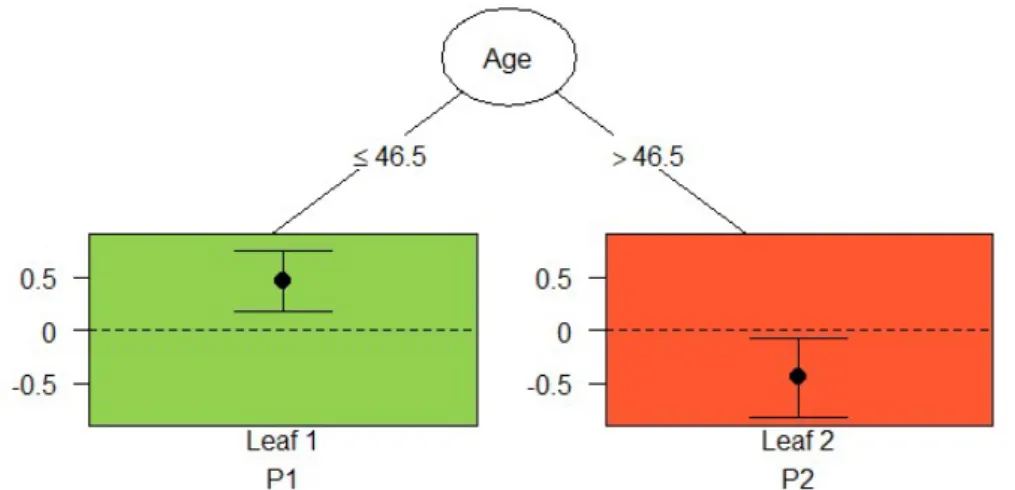
Trees with criterium Effect size. The qualitative interaction tree for the social environmental intervention is a pruned tree with two leaves. The variable “Age” is the
splitting variable with a split point of 46.5 years. Figure 11 displays the tree.
The qualitative interaction tree for the physical environmental intervention is a pruned
tree with two leaves. The variable “Working overtime” is the splitting variable with a split
point of 2.25 hours. Figure 12 displays the tree. Table 3 gives the descriptive statistics of the
Table 3
Descriptive statistics in the leaves of the results for QUINT (version 2.0) for the social environmental intervention (SEI; Figure 11) and the physical environmental intervention (PEI; Figure 12).
n Mean SD n Mean SD
Difference in means (95 % CI)
Bias-cor- rected effect size d
Fig. 4 SEI+ SEI-
Leaf 1 90 8.29 22.27 107 -2.23 23.20 10.52
(4.12, 16.92)**
0.31 Leaf 2 59 -3.00 28.22 56 7.66 17.89 10.66
(-19.35, -1.96)*
-0.27 Fig. 5 PEI+ PEI-
Decision Trees: Amelioration, Simulation, Application 22
former trees. Comparing this table to Table 3 from Formanoy et al. (2016) shows that the
results for trees with the difference in means criterium are the same for QUINT (version 2.0)
as for QUINT (version 1.2).
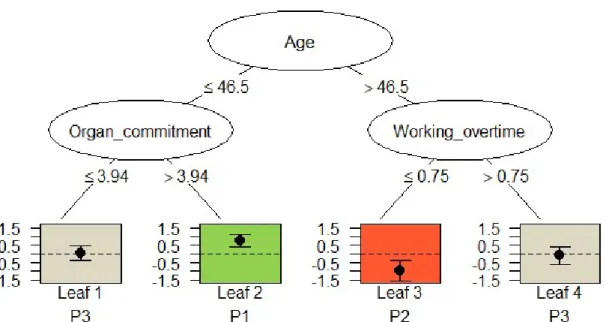
Trees with criterium Difference in means. The qualitative interaction tree for social environmental intervention is a pruned tree with four leaves. The variable “Age” is the first
splitting variable with a split point of 46.5 years, the variables “Organizational commitment”
and “Working overtime” are the second and third splitting variables with split points of 3.94
and 0.75 hours respectively (see Figure 13).
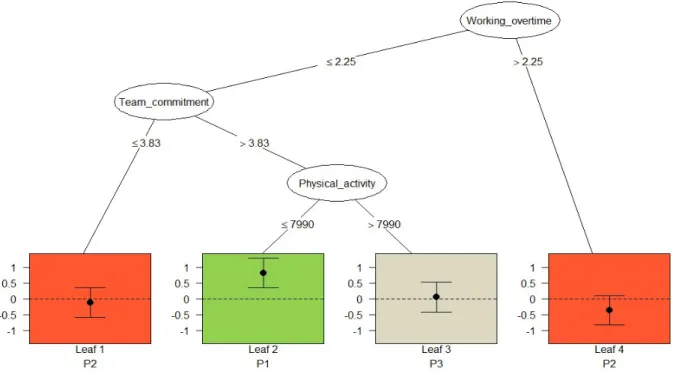
The qualitative interaction tree for physical environmental intervention is a pruned tree
with four leaves. The variable “Working overtime” is the first splitting variable with a split
point of 2.25 hours, the variables “Team commitment” and “Physical activity” are the second
and third splitting variables with split points of 3.83 and 7990 minutes respectively (see
Figure 14). Figure 7 and 8 are the same as Figure 3 and 4 of Formanoy et al. (2016). QUINT
(version 2.0) thus returns the same results as QUINT (version 1.2). Contrary to QUINT
(version 1.2), QUINT (version 2.0) also returns a tree when a minimum effect size of 0.30 is
used.
Decision Trees: Amelioration, Simulation, Application 23
Figure 12. Pruned tree with splitting variable Working overtime and a split point at 2.25 hours. Office workers who work fewer hours overtime (≤ 2.25) have a better outcome with the physical environmental intervention than without the physical environmental
intervention (Leaf 1) and those who work more hours overtime (> 2.25) have a worse outcome with the physical environmental intervention than without (Leaf 2). The criterium used in this tree is the effect size.
Figure 13. Pruned tree with splitting variables Age, Organizational commitment and
Working overtime and split points at 46.5 years, 3.94 and 0.75 hours. Office workers younger than 46.5 and committed to the organization benefit from the social environmental
Decision Trees: Amelioration, Simulation, Application 24
Discussion
In this paper, QUINT is adapted with the aim to improve its Type II error rate. Subsequently,
a simulation study is used to compare the new version, QUINT (version 2.0), to MOB on
several criteria. The measures of evaluation are the proportion of patients correctly assigned,
the Type I error rate and the Type II error rate. Ultimately, an application study is done to
compare the subgroups that are found by QUINT (version 2.0) to the subgroups that are found
by QUINT (version 1.2). The next paragraphs present the main findings of the simulation and
the application study.
Decision Trees: Amelioration, Simulation, Application 25
Findings
To provide an answer to the first research question, the proportion of patients assigned to the
best treatment by QUINT (version 2.0) is compared to the proportion correctly assigned by
MOB. As it turns out, whether there is a difference between the two methods depends upon
the calculation of the proportion correctly assigned by QUINT. QUINT can assign patients to
a subgroup that is indifferent to the assigned treatment alternative. One possibility is to
consider this class incorrectly assigned. A second possibility is to consider this class correctly
assigned. Using the first operationalization, MOB performs better than QUINT. This result
can also be found in earlier studies that compared the methods to each other (Sies & Van
Mechelen, 2016; Van der Geest, 2017). However, whereas other studies use this
operationalization without second thought, it is not so straightforward how the proportion
correctly assigned by QUINT should be calculated. While the first calculation takes into
account that the worst treatment alternative is not ruled out as a possible treatment, the second
calculation takes into account that the best treatment alternative is not ruled out as a possible
treatment. Using the last operationalization, part of the difference between MOB and QUINT
is accounted for by the interaction between method and scenario. This result can be found in
earlier studies as well (Sies & Van Mechelen, 2016; Van der Geest, 2017). Either way the
answer to the research question is not affected by the adaptation of QUINT. If we average the
results of both operationalizations, QUINT and MOB do not differ in the proportion of
patients assigned to the best treatment.
The second research question concerns the Type I error rate and Type II error rate of
QUINT (version 2.0) and MOB. The Type I error rate of QUINT is lower than the Type I
error rate of MOB. These error rates are influenced by interactions between method on one
side and effect size, the number of pre-treatment characteristics and sample size on the other.
Decision Trees: Amelioration, Simulation, Application 26
first three results were found earlier (Sies & Van Mechelen, 2016). It should be noted that
Sies and Van Mechelen (2016) used a higher cut-off value for the effect size. Using the same
cut-off value in this study means the third and fourth result would not be present.
The Type I error rate of QUINT is much higher in the present study than in the pilot
study (Van der Geest, 2017). The reverse is true for MOB. Since the Type I error rate is
different for QUINT as well as for MOB it is highly likely that this is due to differences in the
simulation design, i.e. smaller sample sizes and more iterations, rather than the adaptation of
QUINT. Although the Type I error rate of QUINT is high, Dusseldorp and Van Mechelen
(2014) show that this kind of error rate is to be expected with a medium- or large-sized effect
size and a small sample size.
The Type II error rate is influenced by the interaction between method and sample
size. This is in line with earlier research (Sies & Van Mechelen, 2016). There is no substantial
difference between the Type II error rate of QUINT and the Type II error rate of MOB. This
contrasts with findings from earlier research (Sies & Van Mechelen, 2016; Van der Geest,
2017). The Type II error rate (0.216) of QUINT (version 2.0) is clearly lower than the Type II
error rate (0.776) of QUINT (version 1.2) as found in the pilot study. Since the sample sizes
in the simulation study differ, direct comparison of the overall Type II error rate of QUINT is
not appropriate, however. Both simulations do have Type II error rates for datasets consisting
of 300 cases. With this sample size QUINT (version 2.0) still has a much lower Type II error
rate than QUINT (version 1.2) (0.265 versus 0.717). The Type II error rate is changed for the
better by the adaptation.
The third research question is answered by comparing the application of QUINT
(version 2.0) to the application of QUINT (version 1.2) on data used in Formanoy et al.
(2016). When the partitioning criterion is effect size, both versions of QUINT result in the
Decision Trees: Amelioration, Simulation, Application 27
to return a tree for the physical environmental intervention when in fact there is a qualitative
interaction. QUINT (version 2.0) does return a tree in this situation. In this respect QUINT
(version 2.0) is better. The application shows QUINT (version 2.0) is at least as good as
QUINT (version 1.2).
Limitation
Although it seems like QUINT (version 2.0) is better than QUINT (version 1.2), the sample
sizes currently used to study the effectiveness of QUINT (version 2.0) are rather small. Earlier
studies have used sample sizes of 300 and 1000 (Sies & Van Mechelen, 2016; Van der Geest,
2017), whereas the present study uses sample sizes of 150 and 300. Using larger sample sizes
could shed more light on the (acceptability of) the Type I error rate of QUINT (version 2.0).
Future research
Future research could expand the present study by adding an extra evaluation criterion. Sies
and Van Mechelen (2016) used an evaluation criterion that takes into account the expected
outcome that patients theoretically could have achieved when all patients receive their optimal
treatment. To achieve this, the benefit of administering the treatments based on the decision
trees over administering the overall best treatment is divided by the benefit of administrating
each patient their optimal treatment over administering the overall best treatment. This
criterion might be the most relevant criterion to the patient himself.
Another issue for future research is the method(s) used to compare QUINT to. MOB is
a tree-based method, but not a method specifically designed to search for treatment-subgroup
interactions. It would be appropriate to compare QUINT to another tree-based method
Decision Trees: Amelioration, Simulation, Application 28
Conclusion
The simulation study shows that QUINT (version 2.0) has a lower Type II error rate than
QUINT (version 1.2). The adaptation does not have a negative impact on the proportion good
predicted and the Type I error rate. In addition, the application study shows that QUINT
(version 2.0) is at least as competent as QUINT (version 1.2). Clearly, the adaptation of
QUINT appears to be successful.
Decision Trees: Amelioration, Simulation, Application 29
References
Albisser, A.M. (2000). The disease management equation. IFAC Proceedings Volumes 33(3),
47-52.
Cohen, J. (1988). Statistical Power Analysis for the Behavioral Sciences. New York:
Routledge.
Dusseldorp, E., Conversano, C., & Van Os, B. J. (2010). Combining an additive and tree-
based regression model simultaneously: Stima. Journal of Computational and
Graphical Statistics, 19(3), 514–530. doi:10.1198/jcgs.2010.06089
Dusseldorp, E., Doove, L., & Van Mechelen, I. (2015). Quint: An R package for
identification of subgroups of clients who differ in which treatment alternative is best for them. Behavior Research Methods.
Dusseldorp, E., & Meulman, J. J. (2004). The regression trunk approach to discover treatment covariate interaction. Psychometrika, 69(3), 355–374.
Dusseldorp, E., & Van Mechelen, I. (2014). Qualitative interaction trees: a tool to identify qualitative treatment–subgroup interactions. Statistics in Medicine, 33(2), 219-237. Epstein, R.S., & Sherwood, L.M. (1996). From outcomes research to disease management: a
guide for the perplexed. Ann Intern Med. 124(9), 832–837.
Formanoy, M. A., Dusseldorp, E., Coffeng, J. K., Van Mechelen, I., Boot, C. R., Hendriksen, I. J., & Tak, E. C. (2016). Physical activity and relaxation in the work setting to reduce the need for recovery: what works for whom? BMC Public Health, 16(1), 866.
Foster, J., Taylor, J., & Ruberg, S. (2011). Subgroup identification from randomized clinical trial data. Statistics in Medicine, 30(24), 2867–2880.
Decision Trees: Amelioration, Simulation, Application 30
Peile, E. (2004). Reflections from medical practice: balancing evidence-based practice with practice-based evidence. In R. Pring & G. Thomas (Ed.), Evidence-Based Practice in Education (pp. 102-108). McGraw-Hill Education: London.
Sies, A., & Van Mechelen, I. (2016). Comparing four methods for estimating tree-based treatment regimes. Manuscript in preparation.
Su, X., Tsai, C. L., Wang, H., Nickerson, D. M., & Li, B. (2009). Subgroup analysis via recursive partitioning. The Journal of Machine Learning Research, 10, 141–158. Van der Geest, M. (2017). Simulation study QUINT vs. MOB. Internal Leiden University
Report: unpublished.
Zeileis, A., Hothorn, T., & Hornik, K. (2008). Model-based recursive partitioning. Journal of Computational and Graphical Statistics, 17, 492–514. doi:
Decision Trees: Amelioration, Simulation, Application 31
Appendix A: R code quint2()
This appendix shows the code to search for a qualitative interaction tree. Red text is used to highlight code present in quint() but not in quint2() and green text is used to highlight code present in quint2() but not in quint().
quint2<- function(formula, data, control=NULL){ #Dataformat without use of formula:
#dat:data; first column in dataframe = the response variable
#second column in dataframe = the dichotomous treatment vector
#(coded with treatment A=1 and treatment B=2)
#rest of the columns in dataframe are the predictors
#maxl: maximum total number of leaves (terminal nodes) of the final tree :
#Lmax
dat <- as.data.frame(data) if (missing(formula)) { y <- dat[, 1]
tr <- dat[, 2]
Xmat <- dat[, -c(1, 2)] dat <- na.omit(dat)
if (length(levels(as.factor(tr))) != 2) {
stop("Quint cannot be performed. The number of treatment conditions does not equal 2.")
} } else {
F1 <- Formula(formula)
mf1 <- model.frame(F1, data = dat) y <- as.matrix(mf1[, 1])
origtr <- as.factor(mf1[, 2]) tr <- as.numeric(origtr)
if (length(levels(origtr)) != 2) {
stop("Quint cannot be performed. The number of treatment conditions does not equal 2.")
}
Xmat <- mf1[, 3:dim(mf1)[2]] dat <- cbind(y, tr, Xmat) dat <- na.omit(dat)
cat("Treatment variable (T) equals 1 corresponds to", attr(F1, "rhs")[[1]], "=", levels(origtr)[1], "\n") cat("Treatment variable (T) equals 2 corresponds to", attr(F1, "rhs")[[1]], "=", levels(origtr)[2], "\n") names(dat)[1:2] <- names(mf1)[1:2]
}
Decision Trees: Amelioration, Simulation, Application 32
N<-length(y)
if(is.null(control)) {
control <- quint.control() #Use default control parameters and criter
ion
}
#specify criterion , parameters a and b (parvec), weights and maximum
#number of leaves:
crit <- control$crit parvec <- control$parvec w <- control$w
maxl <- control$maxl
#if no control argument was specified ,use default parameter values
#Default parameters a1 and a2 for treatment cardinality condition:
if(is.null(parvec)){
a1 <- round(sum(tr==1)/10) a2 <- round(sum(tr==2)/10) parvec <- c(a1, a2)
control$parvec <- parvec }
if(is.null(w)){
#edif=expected mean difference between treatment and control; default
#value for effect size criterion: edif = 3 (=Cohen's d),
#and for difference in means criterion: edif= IQR(Y)
edif <- ifelse(crit=="es", 3, IQR(y)) w1 <- 1/log(1+edif)
#bal= balance (ratio) between "difference in treatment outcomes
#component" and "cardinality component"
w2 <- 1/log(length(y)/2) w <- c(w1, w2)
control$w <- w }
##Create matrix for results
allresults <- matrix(0, nrow=maxl-1, ncol=6) splitpoints <- matrix(0, nrow=maxl-1, ncol=1) ## create a vector for true split points
##Start of the tree growing: all persons are in the rootnode. L=1; #Criterion value (cmax)=0
root <- rep(1, length(y)) cmax <- 0
#Step 1
#Generate design matrix D with admissable assignments after first split
dmat1 <- matrix(c(1,2,2,1), nrow=2)
#Select the optimal triplet for the first split: the triplet resulting i n
#the maximum value of the criterion (critmax1)
Decision Trees: Amelioration, Simulation, Application 33
#meant0
rootvec <- c(sum(tr==1), sum(tr==2), mean(y[tr==1])-mean(y[tr==2]))
critmax1 <- bovar(y, Xmat, tr, gm=root, dmatsg=dmat1,
dmatsel=rep(1,nrow(dmat1)), parents=rootvec, parvec, w ,
nsplit=1, crit=crit)
#Make the first split
if(is.factor(Xmat[,critmax1[1]])==FALSE){
Gmat <- makeGchmat(root, Xmat[,critmax1[1]], critmax1[2]) } if(is.factor(Xmat[,critmax1[1]])==TRUE){
possibleSplits <- determineSplits(x=Xmat[,critmax1[1]], gm=root) assigMatrix <- makeCatmat(x=Xmat[,critmax1[1]], gm=root,
z=possibleSplits[[1]], splits=possibleSplits[[2]]) Gmat <- makeGchmatcat(gm=root, splitpoint=critmax1[2], assigMatrix=assigMatrix)
}
cat("split 1","\n") cat("#leaves is 2","\n")
##Keep the child node numbers nnum; #ncol(Gmat) is current number of ##leaves (=number of candidate parentnodes)=L; #ncol(Gmat)+1 is total ##number of leaves after the split (Lafter)
nnum <- c(2,3) L <- ncol(Gmat)
##Keep the results (split information, fit information, end node ##information) after the first split
if(critmax1[4]!=0){
allresults[1,] <- c(1,critmax1[-3]) #Keep the splitpoints
ifelse(is.factor(Xmat[,critmax1[1]])==F, splitpoints[1] <- critmax1[2] ,
splitpoints[1] <- paste(as.vector(unique(
sort(Xmat[Gmat[,1]==1, critmax1[1]]))), collapse=", ")) dmatrow<-dmat1[critmax1[3],]
cmax <- allresults[1, 4]
endinf <- ctmat(Gmat,y,tr,crit=crit) ####changed
} else { ##if there is no optimal triplet for the first split: Gmat <- Gmat*0
dmatrow <- c(0,0)
endinf <- matrix(0, ncol=8, nrow=2) }
##Check the qualitative interaction condition: Cohen's d in the leafs
#after the first split >=dmin qualint <- "Present"
if(abs(endinf[1,7])<control$dmin | abs(endinf[2,7])<control$dmin) { L <- maxl
Decision Trees: Amelioration, Simulation, Application 34
both of the effect sizes are lower than absolute value",
control$dmin,". There is no clear qualitative interaction present in the data.","\n")
}
# Return an object of length 1 when C is 0
if (cmax == 0) { object <- 1
print("Quint cannot be performed. C is 0.") class(object) <- "quint"
return(object) } else {
##Perform bias-corrected bootstrapping for the first split: if(control$Boot==TRUE&cmax!=0){
#initiate bootstrap with stratification on treatment groups:
indexboot <- Bootstrap(y, control$B, tr)
critmax1boot <- matrix(0, ncol=6, nrow=control$B)
#initialize matrices to keep results
Gmattrain <- array(0, dim=c(N,maxl,control$B)) Gmattest <- array(0, dim=c(N,maxl,control$B))
allresultsboot <- array(0, dim=c(maxl-1,9,control$B)) #find best first split for the k training sets
for (b in 1:control$B) {
cat("Bootstrap sample ",b,"\n")
##use the bootstrap data as training set critmax1boot[b,]<-
bovar(y[indexboot[,b]],Xmat[indexboot[,b],],
tr[indexboot[,b]],root,dmat1,rep(1,nrow(dmat1)), rootvec,parvec,w,1,crit=crit)
if(is.factor(Xmat[,critmax1boot[b,1]])==FALSE){ Gmattrain[,c(1:2),b]<-
makeGchmat(gm=root, varx=Xmat[indexboot[,b],critmax1boot[b,1]], splitpoint=critmax1boot[b,2])
##use the original data as testset
Gmattest[,c(1:2),b]<-makeGchmat(gm=root,
varx=Xmat[,critmax1boot[b,1]], splitpoint=critmax1boot[b,2]) }
if(is.factor(Xmat[,critmax1boot[b,1]])==TRUE){ possibleSplits <-
determineSplits(x=Xmat[indexboot[,b], critmax1boot[b,1]], gm=root)
assigMatrixTrain <-
makeCatmat(x=Xmat[indexboot[,b], critmax1boot[b,1]], gm=root, z=possibleSplits[[1]], splits=possibleSplits[[2]]) Gmattrain[,c(1:2),b]<-
makeGchmatcat(gm=root, splitpoint=critmax1boot[b,2], assigMatrix=assigMatrixTrain)
Decision Trees: Amelioration, Simulation, Application 35
makeCatmat(x=Xmat[,critmax1boot[b,1]], gm=root,
z=possibleSplits[[1]], splits=possibleSplits[[2]]) Gmattest[,c(1:2),b]<-
makeGchmatcat(gm=root, splitpoint=critmax1boot[b,2], assigMatrix=assigMatrixTest)
}
End <- cpmat(Gmattest[,c(1:2),b], y, tr, crit=crit)
#select the right row in the design matrix
dmatsel <- t(dmat1[critmax1boot[b,3],])
allresultsboot[1,c(1:8),b] <- c(1,critmax1boot[b,c(1:2)], computeCtest(End, dmatsel, w)) allresultsboot[1,9,b] <- critmax1boot[b,4]-allresultsboot[1,4,b] if(critmax1boot[b,4]==0) {allresultsboot[1,,b]<-NA}
} }
#Repeat the tree growing procedure
stopc <- 0
while(L<maxl){
cat("current value of C", cmax,"\n") cat("split", L, "\n")
Lafter <- ncol(Gmat)+1
cat("#leaves is", Lafter, "\n")
##make a designmatrix (dmat) for the admissible assignments of the #leaves after the split
dmat <- makedmat(Lafter) dmatsg <- makedmats(dmat)
#make parentnode information matrix, select best observed parent node
#(with optimal triplet)
parent <- cpmat(Gmat,y,tr,crit=crit)
critmax <- bonode(Gmat,y,Xmat,tr,dmatrow,dmatsg,parent,parvec,w,L, crit=crit)
##Perform the best split and keep results if(is.factor(Xmat[,critmax[2]])==FALSE){
Gmatch <- makeGchmat(Gmat[,critmax[1]], Xmat[,critmax[2]], critmax[3])
}
if(is.factor(Xmat[,critmax[2]])==TRUE){
possibleSplits <- determineSplits(x=Xmat[,critmax[2]], gm=Gmat[,critmax[1]])
assigMatrix <- makeCatmat(x=Xmat[,critmax[2]], gm=Gmat[,critmax[1]], z=possibleSplits[[1]],
splits=possibleSplits[[2]])
Gmatch <- makeGchmatcat(gm=Gmat[,critmax[1]], splitpoint=critmax[3], assigMatrix=assigMatrix)
}
Gmatnew <- cbind(Gmat[,-critmax[1]], Gmatch)
Decision Trees: Amelioration, Simulation, Application 36
ifelse(is.factor(Xmat[,critmax[2]])==F,
splitpoints[L] <- round(critmax[3], digits = 2), splitpoints[L] <-
paste(as.vector(unique(sort(Xmat[Gmatch[,1]==1,critmax[2]]))) ,
collapse=", ")) dmatrownew <- dmatsg[critmax[4],]
#check if cmax new is higher than current value
if(allresults[L,4]<=cmax){
cat("splitting process stopped after number of leaves equals",L, "because new value of C was not higher than current value of C","\n")
stopc<-1 }
##repeat this procedure for the bootstrap samples if(control$Boot==TRUE & stopc!=1){
critmaxboot<-matrix(0,nrow=control$B,ncol=7) for (b in 1:control$B){
cat("Bootstrap sample ",b,"\n")
#make parentnode information matrix pmat
parent <- cpmat(Gmattrain[,c(1:(Lafter-1)),b], y[indexboot[,b]], tr[indexboot[,b]], crit=crit)
critmaxboot[b,] <-
bonode(Gmat=Gmattrain[,c(1:(Lafter-1)),b], y=y[indexboot[,b]], Xmat=Xmat[indexboot[,b],], tr=tr[indexboot[,b]], dmatrow, dmatsg, parent, parvec, w, nsplit=L, crit=crit)
#best predictor and node of this split for the training samples
if(is.factor(Xmat[,critmaxboot[b,2]])==FALSE){
Gmattrainch <- makeGchmat(Gmattrain[, critmaxboot[b,1],b],
Xmat[indexboot[,b], critmaxboot[b,2]], critmaxboot[b,3])
Gmattestch <- makeGchmat(Gmattest[,critmaxboot[b,1],b], Xmat[, critmaxboot[b,2]],
critmaxboot[b,3]) }
if(is.factor(Xmat[,critmaxboot[b,2]])==TRUE){ possibleSplits <-
determineSplits(x=Xmat[indexboot[,b], critmaxboot[b,2]], gm=Gmattrain[,critmaxboot[b,1],b])
assigMatrixTrain <-
makeCatmat(x=Xmat[indexboot[,b], critmaxboot[b,2]], gm=Gmattrain[,critmaxboot[b,1],b],
z=possibleSplits[[1]], splits=possibleSplits[[2]]) Gmattrainch <- makeGchmatcat(gm=Gmattrain[,critmaxboot[b,1],b], splitpoint=critmaxboot[b,3],
assigMatrix=assigMatrixTrain)
assigMatrixTest <-
makeCatmat(x=Xmat[,critmaxboot[b,2]],
Decision Trees: Amelioration, Simulation, Application 37
z=possibleSplits[[1]], splits=possibleSplits[[2]])
Gmattestch <- makeGchmatcat(gm=Gmattest[,critmaxboot[b,1],b], splitpoint=critmaxboot[b,3], assigMatrix=assigMatrixTest) }
Gmattrain[,c(1:Lafter),b] <-
cbind(Gmattrain[,c(1:(Lafter-1))[-critmaxboot[b,1]],b], Gmattrainch)
Gmattest[,c(1:Lafter),b] <-
cbind(Gmattest[,c(1:(Lafter-1))[-critmaxboot[b,1]],b], Gmattestch)
##compute criterion value for the test sets
End <- cpmat(Gmattest[,c(1:Lafter),b],y,tr,crit=crit)
#select the right row in the design matrix
if(critmaxboot[b,5]!=0){
dmatsel<-t(dmatsg[critmaxboot[b,4],]) allresultsboot[L,c(1:8),b] <-
c(nnum[critmaxboot[b,1]],critmaxboot[b,2],critmaxboot[b,3], computeCtest(End, dmatsel, w))
allresultsboot[L,9,b]<-critmaxboot[b,5]-allresultsboot[L,4,b] }
if(critmaxboot[b,5]==0){ allresultsboot[L,,b] <-NA }
}
if(sum(is.na(allresultsboot[L,9,]))/control$B > .10 ){
warning("After split ",L,", the partitioning criterion cannot be computed in more than 10 percent of the bootstrap samples. The split is unstable." )
} }
#update the parameters after the split:
if(stopc==0) { Gmat <- Gmatnew
dmatrow <- dmatrownew cmax <- allresults[L,4] L <- ncol(Gmat)
nnum <- c(nnum[-critmax[1]],nnum[critmax[1]]*2,nnum[critmax[1]]*2+1) } else {L <- maxl}
#end of while loop
}
Lfinal <- ncol(Gmat) #Lfinal=final number of leaves of the tree
#create endnode information of the tree
Decision Trees: Amelioration, Simulation, Application 38
endinf[,c(2:9)] <- ctmat(Gmat,y,tr,crit=crit)} ####changed endinf <- data.frame(endinf)
endinf[,10] <- dmatrow endinf[,1] <- nnum index <- leafnum(nnum) endinf <- endinf[index,]
rownames(endinf) <- paste("Leaf ",1:Lfinal,sep="") if(crit == 'es'){ ### this was added/changed
colnames(endinf) <- c("node","#(T=1)", "meanY|T=1", "SD|T=1","#(T=2)", "meanY|T=2","SD|T=2","d", "se", "class")}
if(crit == 'dm'){ ### this was added
colnames(endinf) <- c("node","#(T=1)", "meanY|T=1", "SD|T=1","#(T=2)", "meanY|T=2","SD|T=2","diff", "se", "class")} if(Lfinal==2){allresults <- c(2,allresults[1,])}
if(Lfinal>2){
allresults <- cbind(2:Lfinal, allresults[1:(Lfinal-1),]) }
#compute final estimate of optimism and standard error:
if(control$Boot==TRUE){ #raw mean and sd:
opt <- sapply(1:(Lfinal-1),
function(kk, allresultsboot){mean(allresultsboot[kk,9,], na.rm=TRUE)},
allresultsboot=allresultsboot) se_opt <- sapply(1:(Lfinal-1),
function(kk,allresultsboot){sd(allresultsboot[kk,9,], na.rm=TRUE) /
sqrt(sum(!is.na(allresultsboot[kk,9,])))}, allresultsboot=allresultsboot)
if(Lfinal==2){allresults <- c(allresults[1:5], allresults[5]-opt,opt, se_opt, allresults[6:7])
allresults <- data.frame(t(allresults)) }
if(Lfinal>2){
allresults <- cbind(allresults[,1:5], allresults[,5]-opt,opt, se_opt ,
allresults[,6:7]) allresults <- data.frame(allresults) }
allresults[,3] <- colnames(Xmat)[allresults[,3]] splitnr <- 1:(Lfinal-1)
allresults <- cbind(splitnr, allresults)
colnames(allresults) <- c("split", "#leaves", "parentnode",
"splittingvar", "splitpoint", "apparent", "biascorrected", "opt", "se","compdif", "compcard")
}
if(control$Boot==FALSE){ if(Lfinal>2){
Decision Trees: Amelioration, Simulation, Application 39
}
if(Lfinal==2){
allresults <- data.frame(t(allresults)) }
allresults[,3] <- colnames(Xmat)[allresults[,3]] splitnr <- 1:(Lfinal-1)
allresults <- cbind(splitnr, allresults)
colnames(allresults) <- c("split", "#leaves", "parentnode",
"splittingvar", "splitpoint", "apparent", "compdif","compcard")
}
colnames(Gmat) <- nnum
##split information (si): also include childnode numbers si <- allresults[,3:5]
cn <- paste(si[,1]*2, si[,1]*2+1, sep=",")
si <- cbind(parentnode=si[,1], childnodes=cn, si[,2:3], truesplitpoint=splitpoints[1:nrow(si)]) rownames(si) <- paste("Split ", 1:(Lfinal-1), sep="")
if(control$Boot==FALSE){
object <- list(call=match.call(), crit=crit, control=control,
data=dat, si=si, fi=allresults[,c(1:2,6:8)], li=endinf, nind=Gmat[,index])
}
if(control$Boot==TRUE){
nam <- c("parentnode", "splittingvar", "splitpoint", "C_boot", "C_compdif", "checkdif", "C_compcard", "checkcard", "opt")
dimnames(allresultsboot) <- list(NULL, nam, NULL)
object <- list(call = match.call(), crit = crit, control = control, indexboot = indexboot, data = dat, si = si,
fi = allresults[, c(1:2, 6:11)], li = endinf, nind = Gmat[, index], siboot = allresultsboot) }
class(object) <- "quint" return(object)
}
Decision Trees: Amelioration, Simulation, Application 40
Appendix B: R code prune.quint2()
This appendix shows the code to prune the qualitative interaction tree. Green text is used to highlight code present in prune.quint2() but not in prune.quint().
prune.quint2 <- function(tree, pp=1,...){ object <- tree
if(length(object) == 1) { besttree <- 1
class(besttree) <- "quint" return(besttree)
} else {
#pp=pruning parameter
if(names(object$fi[4])=="Difcomponent"){
stop("Pruning is not possible; The quint object lacks estimates of t he
biascorrected criterion. Grow again a large tree using the bootstrap procedure." )}
object$fi[is.na(object$fi[,4]),4]<-0 object$fi[is.na(object$fi[,5]),5]<-0
maxrow<-which(object$fi[,4]==max(object$fi[,4]))[1]
if(is.na(object$fi[maxrow,6])) maxrow <- maxrow - 1
bestrow<-min( which(object$fi[,4]>=
(object$fi[maxrow,4]-pp*object$fi[maxrow,6]) ) ) con<-object$control
con$Boot<-FALSE
con$maxl <- bestrow + 1
besttree <- quint2(data = object$data, control = con) besttree$fi <- object$fi[1:bestrow, ]
objboot <- list(siboot = object$siboot[1:bestrow, , ]) besttree <- c(besttree, objboot)
besttree$control$Boot <- object$control$Boot
# Check whether there is a qualitative interaction
if(colnames(besttree$li)[8]=="d"){ # criterium is es
if((any(abs(subset(besttree$li, class == 1, d)) >= con$dmin) & any(abs(subset(besttree$li, class == 2, d)) >= con$dmin)) == FALSE) {
besttree <- 1 }
} else { # criterium is dm
if((any(abs(subset(besttree$li, class == 1, diff) /
Decision Trees: Amelioration, Simulation, Application 41
(sum(besttree$li[besttree$li[,10]==1, c(2, 5)]) - 2))) >= con$dmin) &
any(abs(subset(besttree$li, class == 2, diff) /
sqrt(((besttree$li[besttree$li[,10]==2, 2] - 1) * besttree$li[besttree$li[,10]==2, 4] ^ 2 + (besttree$li[besttree$li[,10]==2, 5] - 1) * besttree$li[besttree$li[,10]==2, 7] ^ 2) /
(sum(besttree$li[besttree$li[,10]==2, c(2, 5)]) - 2))) >= con$dmin)) == FALSE) {
besttree <- 1 }
}
class(besttree) <- "quint" return(besttree)
Decision Trees: Amelioration, Simulation, Application 42
Appendix C: Example R code for MOB and QUINT
Example code MOB with Pima Indians diabetes data # Load MOB
library(party)
# Load Pima Indians diabetes data
data(PimaIndiansDiabetes2, package = "mlbench")
PimaIndiansDiabetes <- na.omit(PimaIndiansDiabetes2[,-c(4, 5)]) # remove missing values
# Create formula with diabetes as outcome variable
fmPID <- mob(diabetes ~ glucose | pregnant + pressure + mass + pedigree + age, data = PimaIndiansDiabetes, model = glinearModel, family = binomial())
# Visualize the model plot(fmPID)
# Show coefficients and corresponding odds ratios coef(fmPID)
exp(coef(fmPID)[,2])
Example code QUINT with BCRP data # Load QUINT
library(quint)
# Read data into memory data(bcrp)
ex_data <- subset(bcrp, cond < 3) # exclude the control condition
Decision Trees: Amelioration, Simulation, Application 43
# Fix the seed set.seed(47)
# Analysis with change score in depression as outcome variable quint1 <- quint(formula1, data = ex_data)
# Give a summary of the analysis summary(quint1)
quint1$fi quint1$si quint1$li
# Prune tree to avoid overfitting quint1pr <- prune(quint1)
# Plot the pruned tree plot(quint1pr)
Decision Trees: Amelioration, Simulation, Application 44
Appendix D: Repeated measures ANOVA Proportion good predicted (excl. class 3)
This appendix shows the SPSS table of the within-subjects effects with the proportion good predicted as the dependent variable. Class 3 is considered as predicted incorrectly.
Table D1
Repeated Measures Analysis of Variance of Proportion good predicted with class 3 excluded (Within-Subjects Effects)
Source
Type III Sum of Squares df
Mean
Square F Sig.
Partial Eta Squared
Eta Squared Method Sphericity
Assumed
14.417 1 14.417 982.795 .000 .094 .081
Greenhouse-Geisser
14.417 1.000 14.417 982.795 .000 .094 .081
Huynh-Feldt 14.417 1.000 14.417 982.795 .000 .094 .081 Lower-bound 14.417 1.000 14.417 982.795 .000 .094 .081 Method *
n
Sphericity Assumed
.621 1 .621 42.357 .000 .004 .004
Greenhouse-Geisser
.621 1.000 .621 42.357 .000 .004 .004
Huynh-Feldt .621 1.000 .621 42.357 .000 .004 .004 Lower-bound .621 1.000 .621 42.357 .000 .004 .004 Method *
J
Sphericity Assumed
3.700 1 3.700 252.201 .000 .026 .021
Greenhouse-Geisser
3.700 1.000 3.700 252.201 .000 .026 .021
Huynh-Feldt 3.700 1.000 3.700 252.201 .000 .026 .021 Lower-bound 3.700 1.000 3.700 252.201 .000 .026 .021 Method *
effect.size
Sphericity Assumed
4.356 1 4.356 296.938 .000 .030 .025
Greenhouse-Geisser
4.356 1.000 4.356 296.938 .000 .030 .025
Decision Trees: Amelioration, Simulation, Application 45
Table D1 Continued
Source
Type III Sum of Squares df
Mean
Square F Sig.
Partial Eta Squared Eta Squared Method * rho Sphericity Assumed
.265 2 .133 9.049 .000 .002 .001
Greenhouse-Geisser
.265 2.000 .133 9.049 .000 .002 .001
Huynh-Feldt .265 2.000 .133 9.049 .000 .002 .001 Lower-bound .265 2.000 .133 9.049 .000 .002 .001 Method *
scenario
Sphericity Assumed
2.180 3 .727 49.527 .000 .015 .012
Greenhouse-Geisser
2.180 3.000 .727 49.527 .000 .015 .012
Huynh-Feldt 2.180 3.000 .727 49.527 .000 .015 .012 Lower-bound 2.180 3.000 .727 49.527 .000 .015 .012 Method *
n * J
Sphericity Assumed
.013 1 .013 .861 .353 .000 .000
Greenhouse-Geisser
.013 1.000 .013 .861 .353 .000 .000
Huynh-Feldt .013 1.000 .013 .861 .353 .000 .000 Lower-bound .013 1.000 .013 .861 .353 .000 .000 Method *
n * effect.size
Sphericity Assumed
.263 1 .263 17.957 .000 .002 .001
Greenhouse-Geisser
.263 1.000 .263 17.957 .000 .002 .001
Huynh-Feldt .263 1.000 .263 17.957 .000 .002 .001 Lower-bound .263 1.000 .263 17.957 .000 .002 .001 Method *
n * rho
Sphericity Assumed
.010 2 .005 .346 .707 .000 .000
Greenhouse-Geisser
.010 2.000 .005 .346 .707 .000 .000
Huynh-Feldt .010 2.000 .005 .346 .707 .000 .000 Lower-bound .010 2.000 .005 .346 .707 .000 .000 Method *
n * scenario
Sphericity Assumed
6.771 3 2.257 153.853 .000 .046 .038
Greenhouse-Geisser
6.771 3.000 2.257 153.853 .000 .046 .038
Decision Trees: Amelioration, Simulation, Application 46
Table D1 Continued
Source
Type III Sum of Squares df
Mean
Square F Sig.
Partial Eta Squared Eta Squared Method *
J * effect.size
Sphericity Assumed
.675 1 .675 46.006 .000 .005 .004
Greenhouse-Geisser
.675 1.000 .675 46.006 .000 .005 .004
Huynh-Feldt .675 1.000 .675 46.006 .000 .005 .004 Lower-bound .675 1.000 .675 46.006 .000 .005 .004 Method *
J * rho
Sphericity Assumed
.178 2 .089 6.084 .002 .001 .001
Greenhouse-Geisser
.178 2.000 .089 6.084 .002 .001 .001
Huynh-Feldt .178 2.000 .089 6.084 .002 .001 .001 Lower-bound .178 2.000 .089 6.084 .002 .001 .001 Method *
J * scenario
Sphericity Assumed
.042 3 .014 .954 .413 .000 .000
Greenhouse-Geisser
.042 3.000 .014 .954 .413 .000 .000
Huynh-Feldt .042 3.000 .014 .954 .413 .000 .000 Lower-bound .042 3.000 .014 .954 .413 .000 .000 Method *
effect.size * rho
Sphericity Assumed
.061 2 .031 2.089 .124 .000 .000
Greenhouse-Geisser
.061 2.000 .031 2.089 .124 .000 .000
Huynh-Feldt .061 2.000 .031 2.089 .124 .000 .000 Lower-bound .061 2.000 .031 2.089 .124 .000 .000 Method * effect.size * scenario Sphericity Assumed
2.006 3 .669 45.573 .000 .014 .011
Greenhouse-Geisser
2.006 3.000 .669 45.573 .000 .014 .011
Huynh-Feldt 2.006 3.000 .669 45.573 .000 .014 .011 Lower-bound 2.006 3.000 .669 45.573 .000 .014 .011 Method *
rho * scenario
Sphericity Assumed
.337 6 .056 3.829 .001 .002 .002
Greenhouse-Geisser
.337 6.000 .056 3.829 .001 .002 .002
Decision Trees: Amelioration, Simulation, Application 47
Table D1 Continued
Source
Type III Sum of Squares df
Mean
Square F Sig.
Partial Eta Squared Eta Squared Method *
n * J * effect.size
Sphericity Assumed
.090 1 .090 6.112 .013 .001 .001
Greenhouse-Geisser
.090 1.000 .090 6.112 .013 .001 .001
Huynh-Feldt .090 1.000 .090 6.112 .013 .001 .001 Lower-bound .090 1.000 .090 6.112 .013 .001 .001 Method *
n * J * rho
Sphericity Assumed
.031 2 .015 1.056 .348 .000 .000
Greenhouse-Geisser
.031 2.000 .015 1.056 .348 .000 .000
Huynh-Feldt .031 2.000 .015 1.056 .348 .000 .000 Lower-bound .031 2.000 .015 1.056 .348 .000 .000 Method *
n * J * scenario
Sphericity Assumed
.549 3 .183 12.476 .000 .004 .003
Greenhouse-Geisser
.549 3.000 .183 12.476 .000 .004 .003
Huynh-Feldt .549 3.000 .183 12.476 .000 .004 .003 Lower-bound .549 3.000 .183 12.476 .000 .004 .003 Method *
n * effect.size * rho
Sphericity Assumed
.020 2 .010 .671 .511 .000 .000
Greenhouse-Geisser
.020 2.000 .010 .671 .511 .000 .000
Huynh-Feldt .020 2.000 .010 .671 .511 .000 .000 Lower-bound .020 2.000 .010 .671 .511 .000 .000 Method *
n * effect.size *
scenario
Sphericity Assumed
.471 3 .157 10.695 .000 .003 .003
Greenhouse-Geisser
.471 3.000 .157 10.695 .000 .003 .003
Huynh-Feldt .471 3.000 .157 10.695 .000 .003 .003 Lower-bound .471 3.000 .157 10.695 .000 .003 .003 Method *
n * rho *
scenario
Sphericity Assumed
.110 6 .018 1.246 .279 .001 .001
Greenhouse-Geisser
.110 6.000 .018 1.246 .279 .001 .001
Decision Trees: Amelioration, Simulation, Application 48
Table D1 Continued
Source
Type III Sum of Squares df
Mean
Square F Sig.
Partial Eta Squared Eta Squared Method *
J * effect.size * rho
Sphericity Assumed
.018 2 .009 .600 .549 .000 .000
Greenhouse-Geisser
.018 2.000 .009 .600 .549 .000 .000
Huynh-Feldt .018 2.000 .009 .600 .549 .000 .000 Lower-bound .018 2.000 .009 .600 .549 .000 .000 Method *
J * effect.size *
scenario
Sphericity Assumed
.091 3 .030 2.067 .102 .001 .001
Greenhouse-Geisser
.091 3.000 .030 2.067 .102 .001 .001
Huynh-Feldt .091 3.000 .030 2.067 .102 .001 .001 Lower-bound .091 3.000 .030 2.067 .102 .001 .001 Method *
J * rho * scenario
Sphericity Assumed
.022 6 .004 .255 .958 .000 .000
Greenhouse-Geisser
.022 6.000 .004 .255 .958 .000 .000
Huynh-Feldt .022 6.000 .004 .255 .958 .000 .000 Lower-bound .022 6.000 .004 .255 .958 .000 .000 Method *
effect.size * rho * scenario
Sphericity Assumed
.141 6 .024 1.602 .142 .001 .001
Greenhouse-Geisser
.141 6.000 .024 1.602 .142 .001 .001
Huynh-Feldt .141 6.000 .024 1.602 .142 .001 .001 Lower-bound .141 6.000 .024 1.602 .142 .001 .001 Method *
n * J * effect.size * rho
Sphericity Assumed
.172 2 .086 5.866 .003 .001 .001
Greenhouse-Geisser
.172 2.000 .086 5.866 .003 .001 .001
Huynh-Feldt .172 2.000 .086 5.866 .003 .001 .001 Lower-bound .172 2.000 .086 5.866 .003 .001 .001 Method *
n * J * effect.size *
scenario
Sphericity Assumed
.057 3 .019 1.286 .277 .000 .000
Greenhouse-Geisser
.057 3.000 .019 1.286 .277 .000 .000
Decision Trees: Amelioration, Simulation, Application 49
Table D1 Continued
Source
Type III Sum of Squares df
Mean
Square F Sig.
Partial Eta Squared Eta Squared Method *
n * J * rho * scenario
Sphericity Assumed
.030 6 .005 .336 .918 .000 .000
Greenhouse-Geisser
.030 6.000 .005 .336 .918 .000 .000
Huynh-Feldt .030 6.000 .005 .336 .918 .000 .000 Lower-bound .030 6.000 .005 .336 .918 .000 .000 Method *
n * effect.size * rho * scenario
Sphericity Assumed
.160 6 .027 1.821 .091 .001 .001
Greenhouse-Geisser
.160 6.000 .027 1.821 .091 .001 .001
Huynh-Feldt .160 6.000 .027 1.821 .091 .001 .001 Lower-bound .160 6.000 .027 1.821 .091 .001 .001 Method *
J * effect.size * rho * scenario
Sphericity Assumed
.193 6 .032 2.192 .041 .001 .001
Greenhouse-Geisser
.193 6.000 .032 2.192 .041 .001 .001
Huynh-Feldt .193 6.000 .032 2.192 .041 .001 .001 Lower-bound .193 6.000 .032 2.192 .041 .001 .001 Method *
n * J * effect.size * rho * scenario
Sphericity Assumed
.031 6 .005 .353 .909 .000 .000
Greenhouse-Geisser
.031 6.000 .005 .353 .909 .000 .000
Huynh-Feldt .031 6.000 .005 .353 .909 .000 .000 Lower-bound .031 6.000 .005 .353 .909 .000 .000 Error(Met
hod)
Sphericity Assumed
139.414 9504 .015 .785
Greenhouse-Geisser
139.414 9504. 000
.015 .785
Huynh-Feldt 139.414 9504. 000
.015 .785
Lower-bound 139.414 9504. 000
Decision Trees: Amelioration, Simulation, Application 50
Appendix E: Repeated measures ANOVA Proportion good predicted (incl. class 3)
This appendix shows the SPSS table of the within-subjects effects with the proportion good predicted as the dependent variable. Class 3 is considered as predicted correctly.
Table E1
Repeated Measures Analysis of Variance of Proportion good predicted with class 3 included (Within-Subjects Effects)
Source
Type III Sum of Squares df
Mean
Square F Sig.
Partial Eta Squared
Eta Squared Method Sphericity
Assumed
.491 1 .491 53.899 .000 .006 .004
Greenhouse-Geisser
.491 1.000 .491 53.899 .000 .006 .004
Huynh-Feldt .491 1.000 .491 53.899 .000 .006 .004 Lower-bound .491 1.000 .491 53.899 .000 .006 .004 Method *
n
Sphericity Assumed
.813 1 .813 89.125 .000 .009 .007
Greenhouse-Geisser
.813 1.000 .813 89.125 .000 .009 .007
Huynh-Feldt .813 1.000 .813 89.125 .000 .009 .007 Lower-bound .813 1.000 .813 89.125 .000 .009 .007 Method *
J
Sphericity Assumed
.334 1 .334 36.587 .000 .004 .003
Greenhouse-Geisser
.334 1.000 .334 36.587 .000 .004 .003
Huynh-Feldt .334 1.000 .334 36.587 .000 .004 .003 Lower-bound .334 1.000 .334 36.587 .000 .004 .003 Method *
effect.size
Sphericity Assumed
2.013 1 2.013 220.774 .000 .023 .017
Greenhouse-Geisser
2.013 1.000 2.013 220.774 .000 .023 .017
Decision Trees: Amelioration, Simulation, Application 51
Table E1 Continued
Source
Type III Sum of Squares df
Mean
Square F Sig.
Partial Eta Squared Eta Squared Method * rho Sphericity Assumed
.052 2 .026 2.842 .058 .001 .000
Greenhouse-Geisser
.052 2.000 .026 2.842 .058 .001 .000
Huynh-Feldt .052 2.000 .026 2.842 .058 .001 .000 Lower-bound .052 2.000 .026 2.842 .058 .001 .000 Method *
scenario
Sphericity Assumed
15.214 3 5.071 556.162 .000 .149 .130
Greenhouse-Geisser
15.214 3.000 5.071 556.162 .000 .149 .130
Huynh-Feldt 15.214 3.000 5.071 556.162 .000 .149 .130 Lower-bound 15.214 3.000 5.071 556.162 .000 .149 .130 Method *
n * J
Sphericity Assumed
.007 1 .007 .802 .371 .000 .000
Greenhouse-Geisser
.007 1.000 .007 .802 .371 .000 .000
Huynh-Feldt .007 1.000 .007 .802 .371 .000 .000 Lower-bound .007 1.000 .007 .802 .371 .000 .000 Method *
n * effect.size
Sphericity Assumed
.367 1 .367 40.239 .000 .004 .003
Greenhouse-Geisser
.367 1.000 .367 40.239 .000 .004 .003
Huynh-Feldt .367 1.000 .367 40.239 .000 .004 .003 Lower-bound .367 1.000 .367 40.239 .000 .004 .003 Method *
n * rho
Sphericity Assumed
.124 2 .062 6.821 .001 .001 .001
Greenhouse-Geisser
.124 2.000 .062 6.821 .001 .001 .001
Huynh-Feldt .124 2.000 .062 6.821 .001 .001 .001 Lower-bound .124 2.000 .062 6.821 .001 .001 .001 Method *
n * scenario
Sphericity Assumed
6.496 3 2.165 237.456 .000 .070 .056
Greenhouse-Geisser
6.496 3.000 2.165 237.456 .000 .070 .056
Decision Trees: Amelioration, Simulation, Application 52
Table E1 Continued
Source
Type III Sum of Squares df
Mean
Square F Sig.
Partial Eta Squared Eta Squared Method *
J * effect.size
Sphericity Assumed
.046 1 .046 5.023 .025 .001 .000
Greenhouse-Geisser
.046 1.000 .046 5.023 .025 .001 .000
Huynh-Feldt .046 1.000 .046 5.023 .025 .001 .000 Lower-bound .046 1.000 .046 5.023 .025 .001 .000 Method *
J * rho
Sphericity Assumed
.085 2 .042 4.657 .010 .001 .001
Greenhouse-Geisser
.085 2.000 .042 4.657 .010 .001 .001
Huynh-Feldt .085 2.000 .042 4.657 .010 .001 .001 Lower-bound .085 2.000 .042 4.657 .010 .001 .001 Method *
J * scenario
Sphericity Assumed
.424 3 .141 15.506 .000 .005 .004
Greenhouse-Geisser
.424 3.000 .141 15.506 .000 .005 .004
Huynh-Feldt .424 3.000 .141 15.506 .000 .005 .004 Lower-bound .424 3.000 .141 15.506 .000 .005 .004 Method *
effect.size * rho
Sphericity Assumed
.022 2 .011 1.229 .293 .000 .000
Greenhouse-Geisser
.022 2.000 .011 1.229 .293 .000 .000
Huynh-Feldt .022 2.000 .011 1.229 .293 .000 .000 Lower-bound .022 2.000 .011 1.229 .293 .000 .000 Method * effect.size * scenario Sphericity Assumed
1.326 3 .442 48.465 .000 .015 .011
Greenhouse-Geisser
1.326 3.000 .442 48.465 .000 .015 .011
Huynh-Feldt 1.326 3.000 .442 48.465 .000 .015 .011 Lower-bound 1.326 3.000 .442 48.465 .000 .015 .011 Method *
rho * scenario
Sphericity Assumed
.684 6 .114 12.499 .000 .008 .006
Greenhouse-Geisser
.684 6.000 .114 12.499 .000 .008 .006
Decision Trees: Amelioration, Simulation, Application 53
Table E1 Continued
Source
Type III Sum of Squares df
Mean
Square F Sig.
Partial Eta Squared Eta Squared Method *
n * J * effect.size
Sphericity Assumed
.191 1 .191 20.893 .000 .002 .001
Greenhouse-Geisser
.191 1.000 .191 20.893 .000 .002 .001
Huynh-Feldt .191 1.000 .191 20.893 .000 .002 .001 Lower-bound .191 1.000 .191 20.893 .000 .002 .001 Method *
n * J * rho
Sphericity Assumed
.005 2 .002 .248 .780 .000 .000
Greenhouse-Geisser
.005 2.000 .002 .248 .780 .000 .000
Huynh-Feldt .005 2.000 .002 .248 .780 .000 .000 Lower-bound .005 2.000 .002 .248 .780 .000 .000 Method *
n * J * scenario
Sphericity Assumed
.468 3 .156 17.105 .000 .005 .004
Greenhouse-Geisser
.468 3.000 .156 17.105 .000 .005 .004
Huynh-Feldt .468 3.000 .156 17.105 .000 .005 .004 Lower-bound .468 3.000 .156 17.105 .000 .005 .004 Method *
n * effect.size * rho
Sphericity Assumed
.060 2 .030 3.293 .037 .001 .001
Greenhouse-Geisser
.060 2.000 .030 3.293 .037 .001 .001
Huynh-Feldt .060 2.000 .030 3.293 .037 .001 .001 Lower-bound .060 2.000 .030 3.293 .037 .001 .001 Method *
n * effect.size *
scenario
Sphericity Assumed
.139 3 .046 5.089 .002 .002 .001
Greenhouse-Geisser
.139 3.000 .046 5.089 .002 .002 .001
Huynh-Feldt .139 3.000 .046 5.089 .002 .002 .001 Lower-bound .139 3.000 .046 5.089 .002 .002 .001 Method *
n * rho *
scenario
Sphericity Assumed
.101 6 .017 1.854 .085 .001 .001
Greenhouse-Geisser
.101 6.000 .017 1.854 .085 .001 .001
Decision Trees: Amelioration, Simulation, Application 54
Table E1 Continued
Source
Type III Sum of Squares df
Mean
Square F Sig.
Partial Eta Squared Eta Squared Method *
J * effect.size * rho
Sphericity Assumed
.026 2 .013 1.403 .246 .000 .000
Greenhouse-Geisser
.026 2.000 .013 1.403 .246 .000 .000
Huynh-Feldt .026 2.000 .013 1.403 .246 .000 .000 Lower-bound .026 2.000 .013 1.403 .246 .000 .000 Method *
J * effect.size *
scenario
Sphericity Assumed
.123 3 .041 4.481 .004 .001 .001
Greenhouse-Geisser
.123 3.000 .041 4.481 .004 .001 .001
Huynh-Feldt .123 3.000 .041 4.481 .004 .001 .001 Lower-bound .123 3.000 .041 4.481 .004 .001 .001 Method *
J * rho * scenario
Sphericity Assumed
.062 6 .010 1.137 .338 .001 .001
Greenhouse-Geisser
.062 6.000 .010 1.137 .338 .001 .001
Huynh-Feldt .062 6.000 .010 1.137 .338 .001 .001 Lower-bound .062 6.000 .010 1.137 .338 .001 .001 Method *
effect.size * rho * scenario
Sphericity Assumed
.050 6 .008 .908 .488 .001 .000
Greenhouse-Geisser
.050 6.000 .008 .908 .488 .001 .000
Huynh-Feldt .050 6.000 .008 .908 .488 .001 .000 Lower-bound .050 6.000 .008 .908 .488 .001 .000 Method *
n * J * effect.size * rho
Sphericity Assumed
.044 2 .022 2.418 .089 .001 .000
Greenhouse-Geisser
.044 2.000 .022 2.418 .089 .001 .000
Huynh-Feldt .044 2.000 .022 2.418 .089 .001 .000 Lower-bound .044 2.000 .022 2.418 .089 .001 .000 Method *
n * J * effect.size *
scenario
Sphericity Assumed
.049 3 .016 1.796 .146 .001 .000
Greenhouse-Geisser
.049 3.000 .016 1.796 .146 .001 .000
Decision Trees: Amelioration, Simulation, Application 55
Table E1 Continued
Source
Type III Sum of Squares df
Mean
Square F Sig.
Partial Eta Squared Eta Squared Method *
n * J * rho * scenario
Sphericity Assumed
.041 6 .007 .752 .607 .000 .000
Greenhouse-Geisser
.041 6.000 .007 .752 .607 .000 .000
Huynh-Feldt .041 6.000 .007 .752 .607 .000 .000 Lower-bound .041 6.000 .007 .752 .607 .000 .000 Method *
n * effect.size * rho * scenario
Sphericity Assumed
.048 6 .008 .879 .509 .001 .000
Greenhouse-Geisser
.048 6.000 .008 .879 .509 .001 .000
Huynh-Feldt .048 6.000 .008 .879 .509 .001 .000 Lower-bound .048 6.000 .008 .879 .509 .001 .000 Method *
J * effect.size * rho * scenario
Sphericity Assumed
.129 6 .022 2.365 .028 .001 .001
Greenhouse-Geisser
.129 6.000 .022 2.365 .028 .001 .001
Huynh-Feldt .129 6.000 .022 2.365 .028 .001 .001 Lower-bound .129 6.000 .022 2.365 .028 .001 .001 Method *
n * J * effect.size * rho * scenario
Sphericity Assumed
.046 6 .008 .841 .538 .001 .000
Greenhouse-Geisser
.046 6.000 .008 .841 .538 .001 .000
Huynh-Feldt .046 6.000 .008 .841 .538 .001 .000 Lower-bound .046 6.000 .008 .841 .538 .001 .000 Error(Met
hod)
Sphericity Assumed
86.661 9504 .009 .742
Greenhouse-Geisser
86.661 9504. 000
.009 .742
Huynh-Feldt 86.661 9504. 000
.009 .742
Lower-bound 86.661 9504. 000
Decision Trees: Amelioration, Simulation, Application 56
Appendix F: Repeated measures ANOVA Type I error rate
This appendix shows the SPSS table of the within-subjects effects with the Type I error rate as the dependent variable.
Table F1
Repeated Measures Analysis of Variance of Type I error rate (Within-Subjects Effects)
Source
Type III Sum of Squares df
Mean
Square F Sig.
Partial Eta Squared
Eta Squared tree_returned Sphericity
Assumed
84.801 1 84.801 602.622 .000 .202 .143
Greenhouse-Geisser
84.801 1.000 84.801 602.622 .000 .202 .143
Huynh-Feldt 84.801 1.000 84.801 602.622 .000 .202 .143 Lower-bound 84.801 1.000 84.801 602.622 .000 .202 .143 tree_returned
* n
Sphericity Assumed
37.101 1 37.101 263.651 .000 .100 .063
Greenhouse-Geisser
37.101 1.000 37.101 263.651 .000 .100 .063
Huynh-Feldt 37.101 1.000 37.101 263.651 .000 .100 .063 Lower-bound 37.101 1.000 37.101 263.651 .000 .100 .063 tree_returned
* J
Sphericity Assumed
50.430 1 50.430 358.372 .000 .131 .085
Greenhouse-Geisser
50.430 1.000 50.430 358.372 .000 .131 085
Huynh-Feldt 50.430 1.000 50.430 358.372 .000 .131 085 Lower-bound 50.430 1.000 50.430 358.372 .000 .131 085 tree_returned
* effect.size
Sphericity Assumed
62.563 1 62.563 444.595 .000 .158 .106
Greenhouse-Geisser
62.563 1.000 62.563 444.595 .000 .158 .106
Decision Trees: Amelioration, Simulation, Application 57
Table F1 Continued
Source
Type III Sum of Squares df
Mean
Square F Sig.
Partial Eta Squared Eta Squared tree_returned * rho Sphericity Assumed
7.152 2 3.576 25.411 .000 .021 .012
Greenhouse-Geisser
7.152 2.000 3.576 25.411 .000 .021 .012
Huynh-Feldt 7.152 2.000 3.576 25.411 .000 .021 .012 Lower-bound 7.152 2.000 3.576 25.411 .000 .021 .012 tree_returned
* scenario
Sphericity Assumed
.000 0 . . . .000 .000
Greenhouse-Geisser
.000 .000 . . . .000 .000
Huynh-Feldt .000 .000 . . . .000 .000
Lower-bound .000 .000 . . . .000 .000
tree_returned * n * J
Sphericity Assumed
.480 1 .480 3.411 .065 .001 .001
Greenhouse-Geisser
.480 1.000 .480 3.411 .065 .001 .001
Huynh-Feldt .480 1.000 .480 3.411 .065 .001 .001 Lower-bound .480 1.000 .480 3.411 .065 .001 .001 tree_returned
* n * effect.size
Sphericity Assumed
.120 1 .120 .853 .356 .000 .000
Greenhouse-Geisser
.120 1.000 .120 .853 .356 .000 .000
Huynh-Feldt .120 1.000 .120 .853 .356 .000 .000 Lower-bound .120 1.000 .120 .853 .356 .000 .000 tree_returned
* n * rho
Sphericity Assumed
2.252 2 1.126 8.001 .000 .007 .004
Greenhouse-Geisser
2.252 2.000 1.126 8.001 .000 .007 .004
Huynh-Feldt 2.252 2.000 1.126 8.001 .000 .007 .004 Lower-bound 2.252 2.000 1.126 8.001 .000 .007 .004 tree_returned
* n * scenario
Sphericity Assumed
.000 0 . . . .000 .000
Greenhouse-Geisser
.000 .000 . . . .000 .000
Huynh-Feldt .000 .000 . . . .000 .000
Decision Trees: Amelioration, Simulation, Application 58
Table F1 Continued
Source
Type III Sum of Squares df
Mean
Square F Sig.
Partial Eta Squared Eta Squared tree_returned
* J * effect.size
Sphericity Assumed
.101 1 .101 .717 .397 .000 .000
Greenhouse-Geisser
.101 1.000 .101 .717 .397 .000 .000
Huynh-Feldt .101 1.000 .101 .717 .397 .000 .000 Lower-bound .101 1.000 .101 .717 .397 .000 .000 tree_returned
* J * rho
Sphericity Assumed
3.705 2 1.852 13.164 .000 .011 .006
Greenhouse-Geisser
3.705 2.000 1.852 13.164 .000 .011 .006
Huynh-Feldt 3.705 2.000 1.852 13.164 .000 .011 .006 Lower-bound 3.705 2.000 1.852 13.164 .000 .011 .006 tree_returned
* J * scenario
Sphericity Assumed
.000 0 . . . .000 .000
Greenhouse-Geisser
.000 .000 . . . .000 .000
Huynh-Feldt .000 .000 . . . .000 .000
Lower-bound .000 .000 . . . .000 .000
tree_returned * effect.size * rho
Sphericity Assumed
3.307 2 1.653 11.749 .000 .010 .006
Greenhouse-Geisser
3.307 2.000 1.653 11.749 .000 .010 .006
Huynh-Feldt 3.307 2.000 1.653 11.749 .000 .010 .006 Lower-bound 3.307 2.000 1.653 11.749 .000 .010 .006 tree_returned
* effect.size * scenario
Sphericity Assumed
.000 0 . . . .000 .000
Greenhouse-Geisser
.000 .000 . . . .000 .000
Huynh-Feldt .000 .000 . . . .000 .000
Lower-bound .000 .000 . . . .000 .000
tree_returned * rho * scenario
Sphericity Assumed
.000 0 . . . .000 .000
Greenhouse-Geisser
.000 .000 . . . .000 .000
Huynh-Feldt .000 .000 . . . .000 .000
Decision Trees: Amelioration, Simulation, Application 59
Table F1 Continued
Source
Type III Sum of Squares df
Mean
Square F Sig.
Partial Eta Squared Eta Squared tree_returned
* n * J * effect.size
Sphericity Assumed
.521 1 .521 3.701 .054 .002 .001
Greenhouse-Geisser
.521 1.000 .521 3.701 .054 .002 .001
Huynh-Feldt .521 1.000 .521 3.701 .054 .002 .001 Lower-bound .521 1.000 .521 3.701 .054 .002 .001 tree_returned
* n * J * rho
Sphericity Assumed
.945 2 .472 3.358 .035 .003 .002
Greenhouse-Geisser
.945 2.000 .472 3.358 .035 .003 .002
Huynh-Feldt .945 2.000 .472 3.358 .035 .003 .002 Lower-bound .945 2.000 .472 3.358 .035 .003 .002 tree_returned
* n * J * scenario
Sphericity Assumed
.000 0 . . . .000 .000
Greenhouse-Geisser
.000 .000 . . . .000 .000
Huynh-Feldt .000 .000 . . . .000 .000
Lower-bound .000 .000 . . . .000 .000
tree_returned * n * effect.size * rho
Sphericity Assumed
1.820 2 .910 6.467 .002 .005 .003
Greenhouse-Geisser
1.820 2.000 .910 6.467 .002 .005 .003
Huynh-Feldt 1.820 2.000 .910 6.467 .002 .005 .003 Lower-bound 1.820 2.000 .910 6.467 .002 .005 .003 tree_returned
* n * effect.size * scenario
Sphericity Assumed
.000 0 . . . .000 .000
Greenhouse-Geisser
.000 .000 . . . .000 .000
Huynh-Feldt .000 .000 . . . .000 .000
Lower-bound .000 .000 . . . .000 .000
tree_returned * n * rho * scenario
Sphericity Assumed
.000 0 . . . .000 .000
Greenhouse-Geisser
.000 .000 . . . .000 .000
Huynh-Feldt .000 .000 . . . .000 .000
Decision Trees: Amelioration, Simulation, Application 60
Table F1 Continued
Source
Type III Sum of Squares df
Mean
Square F Sig.
Partial Eta Squared Eta Squared tree_returned
* J *
effect.size * rho
Sphericity Assumed
1.307 2 .653 4.643 .010 .004 .002
Greenhouse-Geisser
1.307 2.000 .653 4.643 .010 .004 .002
Huynh-Feldt 1.307 2.000 .653 4.643 .010 .004 .002 Lower-bound 1.307 2.000 .653 4.643 .010 .004 .002 tree_returned
* J *
effect.size * scenario
Sphericity Assumed
.000 0 . . . .000 .000
Greenhouse-Geisser
.000 .000 . . . .000 .000
Huynh-Feldt .000 .000 . . . .000 .000
Lower-bound .000 .000 . . . .000 .000
tree_returned * J * rho * scenario
Sphericity Assumed
.000 0 . . . .000 .000
Greenhouse-Geisser
.000 .000 . . . .000 .000
Huynh-Feldt .000 .000 . . . .000 .000
Lower-bound .000 .000 . . . .000 .000
tree_returned * effect.size * rho * scenario
Sphericity Assumed
.000 0 . . . .000 .000
Greenhouse-Geisser
.000 .000 . . . .000 .000
Huynh-Feldt .000 .000 . . . .000 .000
Lower-bound .000 .000 . . . .000 .000
tree_returned * n * J * effect.size * rho
Sphericity Assumed
1.047 2 .523 3.719 .024 .003 .002
Greenhouse-Geisser
1.047 2.000 .523 3.719 .024 .003 .002
Huynh-Feldt 1.047 2.000 .523 3.719 .024 .003 .002 Lower-bound 1.047 2.000 .523 3.719 .024 .003 .002 tree_returned
* n * J * effect.size * scenario
Sphericity Assumed
.000 0 . . . .000 .000
Greenhouse-Geisser
.000 .000 . . . .000 .000
Huynh-Feldt .000 .000 . . . .000 .000