Psychological Health and Smoking
in Young Adulthood
Allison M. Schmidt
1, Shelley D. Golden
1, Nisha C. Gottfredson
1,
Susan T. Ennett
1, Allison E. Aiello
2, and Kurt M. Ribisl
1Abstract
Introduction:Young adulthood is a critical time for the emergence of risk behaviors including smoking. Psychological health is associated with smoking, but studies rarely track both over time. We used longitudinal data to assess whether average patterns of psychological health influenced average patterns of smoking and whether short-term fluctuations in psychological health influ-enced fluctuations in smoking.Method:Young adults aged 18–30 from the Panel Study of Income Dynamics were followed from 2007 to 2013, and mean trajectories of smoking were modeled. Psychological health variables included ever having a mental health diagnosis and time-varying distress.Results:In regression models, individuals with poorer psychological health (higher distress or a diagnosis) were more likely to be smokers and to smoke greater number of cigarettes. The association of diagnosis with number of cigarettes smoked increased with age. Conclusions:Smoking-related interventions should target individuals with poorer psychological health, even if they have no formal mental health diagnosis.
Keywords
smoking, substance use/abuse, mental health, distress, trajectories
Tobacco use continues to be the leading cause of preventable death in the United States, responsible for the loss of 440,000 lives each year (U.S. Department of Health and Human Services, 2012). While the prevalence of tobacco use has declined in the general population in the past several decades, it has not signif-icantly declined among those with indications of poorer psycho-logical health (Steinberg, Williams, & Li, 2015). In this article, we use the term “psychological health” broadly to encompass both psychological distress and having a clinically defined men-tal health condition. Individuals with indications of poorer psy-chological health are more likely to smoke and experience nicotine dependence than those without any indications of poorer psychological health (Breslau, 1995; Breslau, Novak, & Kessler, 2004; Fagerstro¨m & Aubin, 2009; Hitsman, Moss, Montoya, & George, 2009; Primack, Land, Fan, Kim, & Rosen, 2013; Smith, Homish, Saddleson, Kozlowski, & Giovino, 2013; U.S. Department of Health and Human Services, 2012). Individ-uals with any mental health condition comprise only 28.3%of the U.S. population yet make up nearly 60% of ever smokers (Lasser et al., 2000). Overall, significant disparities in smoking by psychological health persist (Prochaska, Das, & Young-Wolff, 2017).
Young adulthood is a pivotal time for determining smoking behavior over the life course as individuals who continue to smoke throughout this period are likely to remain regular
smokers and to be more susceptible to a host of tobacco-related diseases (Chassin, Presson, Rose, & Sherman, 1996; McCarron, Smith, Okasha, & McEwen, 2001; U.S. Department of Health and Human Services, 2014). Although many regular smokers start smoking before the age of 18, smoking preva-lence and levels of cigarette consumption continue to increase in young adulthood (Chassin et al., 1996; U.S. Department of Health and Human Services, 2014). If poorer psychological health is experienced during young adulthood, individuals may be particularly likely to develop longer term smoking habits. Thus, young adulthood is an important period during which to understand how different aspects of psychological health shape smoking likelihood and smoking amount to inform suc-cessful interventions.
1
Department of Health Behavior, Gillings School of Global Public Health, University of North Carolina at Chapel Hill, Chapel Hill, NC, USA
2Department of Epidemiology, Gillings School of Global Public Health,
University of North Carolina at Chapel Hill, Chapel Hill, NC, USA
Corresponding Author:
Allison M. Schmidt, PhD, MPH, Department of Health Behavior, Gillings School of Global Public Health, University of North Carolina at Chapel Hill, Chapel Hill, NC, USA.
Theories such as the transactional model of stress and cop-ing (Glanz & Schwartz, 2008) and the tension reduction theory (Little, 2000; Stewart, Karp, Pihl, & Peterson, 1997) explain how smoking can be used as a coping response to unpleasant feelings. The transactional model of stress and coping posits that feelings of stress stemming from difficult experiences, dis-tress, or symptoms of a mental health condition can lead to maladaptive coping responses, especially when other coping resources like social support and perceived ability to change the situation are low. Maladaptive responses are responses focused on avoidance rather than problem-solving and can lead to substance use to alleviate, at least temporarily, negative feel-ings (Glanz & Schwartz, 2008; Meyer, 2001). Individuals with poorer psychological health are exposed to greater stress and stressful events (Anda et al., 1999) and also have fewer coping resources such as social support or financial resources (Kinnunen, Doherty, Militello, & Garvey, 1996). They are often less able than their peers to regulate their negative affective experi-ences or unpleasant feelings in healthy ways and thus are more prone to smoke as a coping response (Meyer, 2001).
Maladaptive coping strategies (e.g., avoidance, self-blame, denial) as compared to adaptive coping strategies (e.g., seeking social support) are more common among young adult smokers (Vollrath, 1998), predictive of continued smoking among young people (Sussman et al., 1993), and repeatedly associated with depressive symptoms (Meyer, 2001; Rabois & Haaga, 1997). Similarly, with respect to diagnosed mental health conditions, adaptive coping responses are less likely among people with schi-zophrenia with increasing symptoms severity (Meyer, 2001) and among those with a history of major depressive disorder (Kahler, Brown, Strong, Lloyd-Richardson, & Niaura, 2003).
The transactional model of stress and coping is closely related to the tension reduction hypothesis that posits that those with indications of poorer psychological health may smoke to reduce tension and negative affect or mood (Hussong, Hicks, Levy, & Curran, 2001). The tension reduction hypothesis does not presuppose an external source of stress but rather focuses on an individual’s responses to experiencing unpleasant feel-ings resulting from poorer psychological health. In support of this model, young adults have been shown to use substances to regulate negative affect (Hussong et al., 2001). A study of college students found that the link between higher depressive symptoms and higher smoking was fully mediated by expecta-tions that smoking would reduce nervousness, improve mood, and help cope with feelings of being upset (Schleicher, Harris, Catley, & Nazir, 2009). Thus, coping with stress by lowering feelings of tension and improving mood has been shown to be an important motivation for smoking behavior, particularly among those with poorer psychological health. Although evi-dence indicates that the relationship between psychological health and smoking also works in reverse (Breslau, Peterson, Schultz, Chilcoat, & Andreski, 1998; Chaiton, Cohen, O’Lough-lin, & Rehm, 2009; Fluharty, Taylor, Grabski, & Munafo`, 2017; Weiser et al., 2004), such that smoking cigarettes, or adapting the body to the intake of nicotine, worsens psychological health over time, smoking is used as a coping mechanism to
temporarily manage indications of poorer psychological health (Picciotto, Brunzell, & Caldarone, 2002).
Research suggests that psychological health may influence smoking progression over time throughout young adulthood. Studies have shown that participants with poorer psychologi-cal health were disproportionately found among groups that smoked, those with increased smoking trajectories over young adulthood (Goodwin, Perkonigg, Ho¨fler, & Wittchen, 2013; Orlando, Tucker, Ellickson, & Klein, 2004; Xie, Palmer, Li, Lin, & Johnson, 2013), and those who initiated smoking dur-ing young adulthood (Bares & Pascale, 2014). Another study tracking smoking from adolescence to young adulthood found that psychological health explained individual variability in smoking status at age 13 and changes in the trajectory of smoking behavior between ages 13 and 32 (Fuemmeler et al., 2013).
Past research on psychological health and smoking among young adults, however, rarely examines how psychological health throughout young adulthood affects smoking behaviors overall and at specific times. Many studies use a dichotomous and/or time-stable definition of psychological health, making it difficult to examine how changing psychological health could impact smoking. As a result, it is unclear whether poor psycho-logical health during young adulthood, experiencing periods of high distress at particular points, or both, is associated with smoking. In the current work, we investigate how psychologi-cal health impacts the trajectory of smoking over the course of young adulthood and during fluctuations in psychological dis-tress, measuring both smoking and psychological health at dif-ferent points in time, and including a time varying measure of psychological health. After describing the trends of smoking in a national longitudinal sample of young adults, we investigate two research questions: (1) to what extent is poor psychological health throughout young adulthood associated with smoking behaviors, and (2) do young adults with any smoking history increase their smoking behavior during periods when their dis-tress levels rise?
Method
Data Source
The Panel Study of Income Dynamics (PSID) is a longitudinal panel survey that has tracked a probability sample of U.S. fam-ilies since 1968 (Data.gov, 2015). Surveys are now conducted every other year (PSID, 2016). Children of the original families who form their own households are tracked as well, increasing the sample size each year, from about 5,000 families in 1968 to over 9,000 in 2013, and immigrant samples have been added. In each household, only one respondent is surveyed. Although respondents answer some questions about other members of their households, only respondents themselves were included in the current study.
information about young adults aged 18–24 years who are not yet heads of their own households. The TA supplement was added to the PSID in 2005 and has been conducted via tele-phone interview in parallel with the PSID every other year shortly after completion of the main interview.
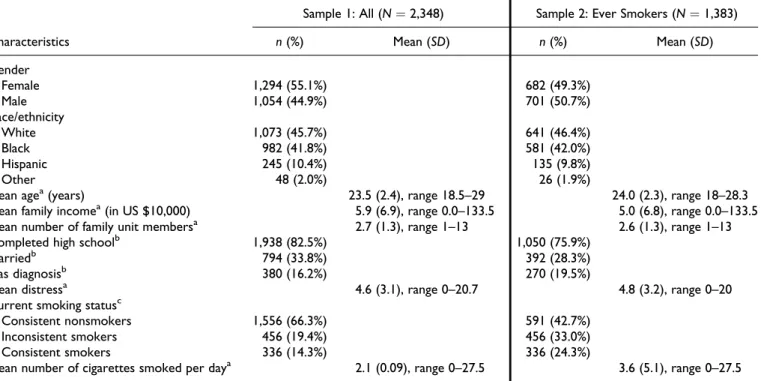
Analytical samples.Psychological health data were not consis-tently collected in both the main survey and TA supplement prior to 2007. Our sample was therefore derived from the 2007 cohort of young adults aged 18–24 years, as well as any new individuals aged 18 or 19 who entered the PSID (TA or main interview) in 2009. This group was followed across years 2007, 2009, 2011, and 2013 until they were aged 22–30 years by 2013. To enable longitudinal analysis, we retained only those individuals who were interviewed more than once in the main interview and/or TA survey (95.7%of sample members). Dropping 35 interviews with missing data relevant to our anal-yses resulted in a final analytical sample size of 2,348 people interviewed collectively a total of 7,730 times (Table 1). The full sample was used to analyze measures of smoking status. Models of cigarette consumption, however, are often limited to smokers (Bonnie, Stratton, & Kwan, 2015); because young adults may be experimenting with cigarettes at different times, and be in the process of establishing a smoking habit, we lim-ited the cigarette consumption sample to young adults with any smoking history during or prior to the interview (n ¼ 1,374 individuals, interviewed a total of 3,349 times; Table 1).
Measures
This research incorporated two outcome measures of smok-ing and two independent variables measursmok-ing psychological health.
Current smoking status.Whether a participant currently smoked at each available year of data was assessed with the question, “Do you smoke cigarettes?” with responses “yes” or “no.”
Smoking amount.Current smoking amount was measured as the number of cigarettes smoked per day. Current smokers were asked: “How many cigarettes per day do you usually smoke?” If an individual did not report smoking at a particular wave, their smoking amount was coded as “0.”
Self-reported mental health diagnosis. Affirmative responses to the question, “Has a doctor or other health professional ever told you that you had any emotional, nervous, or psychiatric problems?” in any wave of data in the study identified partici-pants with a self-reported clinically significant and diagnosed mental illness. A measure of ever diagnosis was used because a mental health condition may emerge years before it is offi-cially diagnosed (Kessler et al., 2005), and responses were very stable over time. The measure captured any participant who was diagnosed at any point within the 6 years of the observa-tion period.
Table 1.Aim 1 Sample Characteristics.
Characteristics
Sample 1: All (N¼2,348) Sample 2: Ever Smokers (N¼1,383)
n(%) Mean (SD) n(%) Mean (SD)
Gender
Female 1,294 (55.1%) 682 (49.3%)
Male 1,054 (44.9%) 701 (50.7%)
Race/ethnicity
White 1,073 (45.7%) 641 (46.4%)
Black 982 (41.8%) 581 (42.0%)
Hispanic 245 (10.4%) 135 (9.8%)
Other 48 (2.0%) 26 (1.9%)
Mean agea(years) 23.5 (2.4), range 18.5–29 24.0 (2.3), range 18–28.3
Mean family incomea(in US $10,000) 5.9 (6.9), range 0.0–133.5 5.0 (6.8), range 0.0–133.5
Mean number of family unit membersa 2.7 (1.3), range 1–13 2.6 (1.3), range 1–13
Completed high schoolb 1,938 (82.5%) 1,050 (75.9%)
Marriedb 794 (33.8%) 392 (28.3%)
Has diagnosisb 380 (16.2%) 270 (19.5%)
Mean distressa 4.6 (3.1), range 0–20.7 4.8 (3.2), range 0–20
Current smoking statusc
Consistent nonsmokers 1,556 (66.3%) 591 (42.7%)
Inconsistent smokers 456 (19.4%) 456 (33.0%)
Consistent smokers 336 (14.3%) 336 (24.3%)
Mean number of cigarettes smoked per daya 2.1 (0.09), range 0–27.5 3.6 (5.1), range 0–27.5
a
Psychological distress. The Kessler-6 measure of psychological distress assesses the frequency with which respondents have experienced feeling six indications of psychological distress in the past 30 days: (1) nervous, (2) hopeless, (3) restless or fidgety, (4) so sad or depressed that nothing could cheer the respondent up, (5) that everything is an effort, and (6) worth-less. Response options includedall of the time¼4,most of the time¼3,some of the time¼2,a little of the time¼1, andnone of the time¼0. Scores of each item on a 5-point scale were summed. Thus, every one-unit increase in this measure could mean an individual was experiencing a particular indication of distress more often, or it could mean the presence of a new indication of distress.
To capture psychological distress in general over young adulthood, we created a measure of an individual’s personal average distress level across all years of data. To capture time periods when individuals felt particularly high levels of distress compared to their average, we created a second variable that measured the amount of an individual’s positive or negative deviation from this average at each year. This method of disag-gregating the distress variable allows for the separate testing of within- and between-individual effects of distress on smoking (Aiken, West, & Reno, 1991).
Age.To test how smoking develops over young adulthood, age of the respondent at the time of interview was used as an inde-pendent variable. To consider potential nonlinear effects of age, a quadratic term for age (Age Age) was included in models. Age was centered at 18.
Demographics and year.Several covariates were incorporated in models because they may confound the association between smoking and psychological health. Race/ethnicity was mea-sured by participants’ first response (if more than one race was ever mentioned) to “What is your race?” Owing to small sample sizes, American Indians, Asians, and Pacific Islanders were combined into the “Other” category. A separate question assessed Hispanic ethnicity. From these questions, we created four mutually exclusive race/ethnicity categories: non-Hispanic White, non-Hispanic Black or African American, Hispanic, and non-Hispanic other. To capture educational attainment during a time when young adults are often in the process of obtaining higher education, an indicator of whether respondents reported having completed high school by any wave of data collection was incorporated. To measure sources of social and financial support, marital status, family income (including taxable income, transfer income, and social security income for the previous year reported by all family unit members living together in a household) coded in US $10,000 units, and num-ber of family unit memnum-bers were included. An indicator of year of data collection was added to the model to control for period effects. Income, number of family unit members, and year varied over time; all other controls were kept time-stable to be consistent across all models.
Analytic Approach
This research used a growth curve model to obtain estimates of between-person differences and within-person perturbations in smoking development around a subject-specific smoking tra-jectory. First, the visual nature of the two growth trajectories was inspected by plotting the mean smoking trajectories over young adulthood across the sample; the trajectories appeared quadratic in form. Next, unconditional growth models with age and AgeAge were fit for each smoking outcome, and the intraclass correlation coefficient (ICC), or the proportion of total variation in smoking attributable to between-person dif-ferences, was measured. From these unconditional analyses, we determined whether sufficient within-individual variation in the smoking outcome existed to proceed with a multilevel model of observations nested within individuals over time or whether most variation occurred between individuals indicat-ing use of a sindicat-ingle-level model.
Time-stable and time-varying measures of psychological health were then added to the unconditional growth model. Two time-invariant measures of psychological health (self-reported mental health diagnosis and average distress during young adulthood) were used to assess the degree to which aver-age psychological health during young adulthood affects smok-ing. In multilevel models, one time-varying measure (deviation in distress relative to personal average distress) was used to assess the degree to which variation within one’s own psycho-logical health affects smoking.
To test how psychological health affects between-person variability in overtime smoking trajectories, an interaction term of age by psychological health (diagnosis or distress) was added. To probe significant interactions, results were plotted and the point estimates and significance level of the simple slope of self-reported diagnosis on smoking at each age were reported (Preacher, Curran, & Bauer, 2006).
Results
Unconditional Models
Smoking trajectories. The unconditional model of the odds of smoking over young adulthood, with a random coefficient specified for age to allow the relationship between age and smoking to vary by person, showed a mean trajectory of current smoking over young adulthood that was quadratic in form. The odds of smoking over time significantly increased by age (OR: 1.23; 95% CI [1.06, 1.43]); however, the rate of growth decreased over time (OR: 0.96; 95%CI [0.95, 0.98]).
Among current or ever smokers, the unconditional model of number of cigarettes smoked per day over young adulthood was quadratic in form. Smoking amount significantly increased by age, such that every 1-year increase in age was associated with a 1.11 factor increase in the number of cigarettes smoked (95%CI [1.05, 1.17]), and this growth rate decreased over time (Incidence rate ratio: 0.97; 95%CI [0.97, 0.98]).
The ICC of this model was 0.56. Thus, multilevel models were used to allow for the assessment of both between-individual and within-between-individual predictors of smoking amount among ever smokers.
Conditional Models
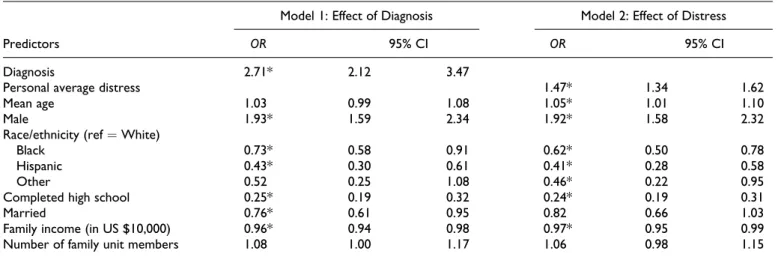
Odds of being a smoker: Self-reported mental health diagnosis.The odds of a young adult with a mental health diagnosis also being a smoker were 2.71 times as high as the odds of a young adult with-out a diagnosis being a smoker (95%CI [2.12, 3.47]; see Table 2). Covariates associated with higher odds of being a smoker included being male (OR: 1.93, 95%CI [1.59, 2.34]) and lower odds of being a smoker included being Black (OR: 0.73, 95% CI [0.58, 0.91]), being Hispanic (OR: 0.43, 95% CI [0.30, 0.61]), having completed high school (OR: 0.25, 95%CI [0.19, 0.32]), being married (OR: 0.76, 95%CI [0.61, 0.95]), and having US $10,000 more in income (OR: 0.96, 95%CI [0.94, 0.98]).
Odds of being a smoker: Distress.Higher levels of psychological distress, on average across young adulthood, were associated with higher odds of being a smoker, such that a one-unit increase in average distress was associated with 1.47 higher odds of being a smoker (95% CI [1.34, 1.62]). Covariate associations were similar to the self-reported diagnosis model, with the addition of a positive association of smoking with older age (OR: 1.05, 95% CI [1.01, 1.10]) and a negative association with being of “Other” race (OR: 0.46, 95%CI [0.22, 0.95]; see Table 2).
Number of cigarettes smoked per day: Self-reported mental health diagnosis. Being diagnosed with a psychological illness was
positively associated with the number of cigarettes that smokers smoked, but only at older ages. (Figure 1; Table 3). At age 18, the effect of diagnosis was not significant (Incidence rate ratio: 1.27, 95% CI [0.91, 1.78]), but at age 24 (the mean age), the effect of diagnosis was significant and positive; having a diagno-sis was associated with a 1.58 factor increase in the number of cigarettes smoked (95%CI [1.01, 2.25]). At age 32 (the maxi-mum age), the effect of having a diagnosis was even stronger; having a diagnosis was associated with a 2.48 factor increase in the number of cigarettes smoked (95%CI [1.21, 5.08]).
Being male was associated with more cigarettes smoked (Incidence rate ratio: 1.33, 95% CI [1.07, 1.64]). Covariates associated with fewer cigarettes smoked included being Hispa-nic (Incidence rate ratio: 0.39, 95% CI [0.26, 0.58]), having completed high school (Incidence rate ratio: 0.31, 95% CI [0.24, 0.39]), and having more family unit members (Incidence rate ratio: 0.95, 95%CI [0.93, 0.98]).
Number of cigarettes smoked per day: Distress.There was no sig-nificant interaction between distress and age. For parsimony,
Table 2.Odds of Being a Current Smoker.
Predictors
Model 1: Effect of Diagnosis Model 2: Effect of Distress
OR 95% CI OR 95% CI
Diagnosis 2.71* 2.12 3.47
Personal average distress 1.47* 1.34 1.62
Mean age 1.03 0.99 1.08 1.05* 1.01 1.10
Male 1.93* 1.59 2.34 1.92* 1.58 2.32
Race/ethnicity (ref¼White)
Black 0.73* 0.58 0.91 0.62* 0.50 0.78
Hispanic 0.43* 0.30 0.61 0.41* 0.28 0.58
Other 0.52 0.25 1.08 0.46* 0.22 0.95
Completed high school 0.25* 0.19 0.32 0.24* 0.19 0.31
Married 0.76* 0.61 0.95 0.82 0.66 1.03
Family income (in US $10,000) 0.96* 0.94 0.98 0.97* 0.95 0.99
Number of family unit members 1.08 1.00 1.17 1.06 0.98 1.15
Note.N¼2,348.
*95% CI does not include 1; indicates statistical significance.
0 5 10 15 20 25
18 24 30
Number of Cigarettes Smoked per Day
Age (Years)
Diagnosis
No Diagnosis
we present the model without the interaction term in Table 3. Average distress across the time period was significantly asso-ciated with more cigarettes being smoked; every one-unit increase in mean distress score was associated with a 1.31 fac-tor increase in the number of cigarettes smoked (95%CI [1.18, 1.45]). Being more stressed than usual, measured as the differ-ence between stress level in a specific time period and an indi-vidual’s average over the period, was marginally associated with a greater number of cigarettes smoked (Incidence rate ratio: 1.02; 95%CI [1.00, 1.04]).
Covariates associated with higher number of cigarettes smoked included being male (Incidence rate ratio: 1.37, 95% CI [1.10, 1.70]) and being married (Incidence rate ratio: 1.37, 95%CI [1.06, 1.76]). In addition, every 1-year increase in age was associated with a 1.10 factor increase in the number of cigarettes smoked (95%CI [1.03, 1.19]), although this growth rate decreased over time. Covariates associated with lower number of cigarettes smoked included being Hispanic (Inci-dence rate ratio: 0.35, 95%CI [0.23, 0.52]), having completed high school (Incidence rate ratio: 0.31, 95%CI [0.24, 0.40]), having more family unit members (Incidence rate ratio: 0.95, 95%CI [0.92, 0.98]), and being interviewed at Wave 4, relative to Wave 1 (Incidence rate ratio: 0.77, 95%CI [0.60, 0.99]).
Conclusions
As expected, poorer psychological health was associated with a greater likelihood and amount of smoking; this study showed that these effects operated primarily between individuals,
rather than within individuals over time. In other words, young adults with consistently poorer psychological health were more likely to smoke at all and to smoke more cigarettes throughout the observation period. The results are consistent with some past research (Anda et al., 1999; Brown, Lewinsohn, Seeley, & Wagner, 1996; Jamal et al., 2014) but contribute additional information in several ways.
First, by using multiple measures of psychological health, we gain a more nuanced understanding of associations with smoking. One previous study using a similar methodological approach to ours tracked smoking from adolescence to young adulthood, finding that psychological health, measured as the presence of depressive symptoms at baseline, explained indi-vidual variability in smoking status at age 13 and changes in the trajectory of smoking behavior between ages 13 and 32 (Fuemmeler et al., 2013). These results corroborate our find-ings that psychological health, as measured by self-reported mental health diagnosis, is associated with smoking status. Targeting individuals who are experiencing psychological distress during young adulthood with smoking prevention and cessation interventions to prevent and/or successfully manage indications of distress without turning to smoking is therefore critical. Our study adds to the literature by also showing a lin-ear association of a continuous measure of psychological distress with smoking. This suggests that even incremental changes in psychological health are associated with both smoking status and cigarette consumption. Targeted interven-tions that screen only for mental health condiinterven-tions may fail to identify high-risk individuals. Higher levels of distress
Table 3.Number of Cigarettes Smoked per Day Among Current or Ever Smokers.
Predictors
Model 1: Effect of Diagnosis Model 2: Effect of Distress
IRR 95% CI IRR 95% CI
Diagnosis 1.27 0.91 1.78
Personal mean distress 1.31* 1.18 1.45
Deviation from mean distress 1.02 1.00 1.04
Age 1.07 0.99 1.15 1.10* 1.03 1.19
Age2 0.98* 0.97 0.98 0.98* 0.97 0.98
DiagnosisAge 1.08* 1.02 1.15
Male 1.33* 1.07 1.64 1.37* 1.10 1.70
Race/ethnicity (ref¼White)
Black 0.91 0.72 1.15 0.82 0.65 1.04
Hispanic 0.39* 0.26 0.58 0.35* 0.23 0.52
Other 0.72 0.31 1.70 0.63 0.26 1.48
Completed high school 0.31* 0.24 0.39 0.31* 0.24 0.40
Married 1.26 0.99 1.62 1.37* 1.06 1.76
Family income (in US $10,000) 1.00 0.99 1.00 1.00 0.99 1.01
Number of family unit members 0.95* 0.93 0.98 0.95* 0.93 0.98
Wave (ref¼Wave 1)
2 1.02 0.93 1.12 1.01 0.92 1.12
3 0.88 0.74 1.04 0.87 0.73 1.03
4 0.78 0.61 1.00 0.77* 0.60 0.99
Note. N¼1,383. There was no significant interaction between distress and age; for parsimony, we present and interpret the model without the interaction term. IRR¼incidence rate ratio.
without symptoms that warrant diagnosis should be consid-ered a risk factor as well. This is consistent with intervention literature that suggests smoking cessation programs for young adults may need to be more comprehensive in the factors they target, including, in addition to smoking-related factors, social influences and causes of distress, and presented in an accessible and engaging manner for young adults (Curry, Mermelstein, & Sporer, 2009).
Second, we demonstrate variation in the association between psychological health and smoking as people progress through young adulthood. Previous studies have identified subgroups of individuals, including individuals with poorer psychologi-cal health, who share distinct patterns of smoking development (Bares & Pascale, 2014; Goodwin et al., 2013; Orlando et al., 2004; Xie et al., 2013). The methods used in these studies pre-sume associations are stable over time. Using analyses similar to ours, Fuemmeler et al. (2013) found that having depressive symptoms at baseline did not explain any individual variability in number of cigarettes smoked per day at any age. In contrast, we documented age-based associations of psychological health and smoking amount but only for one of our measures. Specifically, we show that having any mental health diagnosis was not only associated with greater odds of smoking but also explained variability in smoking amount between individuals over time, such that the effect of diagnosis became positive, significant, and stronger as age increased. This suggests that conditions other than depression (which in Fuemmeler et al., 2013, did not have an effect on number of cigarettes smoked), for example, anxiety, may be important contributors to cigar-ette consumption, especially for older young adults, and that young adults with a range of mental health conditions may benefit from screening and resources to prevent and reduce their smoking. Considering the results of the current research, it is possible that those in early young adulthood have better access to social communities, parental involvement, parents’ health insurance, or smoking cessation resources (e.g., at a col-lege) and thus may have less of a need for additional targeted smoking prevention efforts. Future research should assess whether this risk continues to increase further into adulthood and identify strategies to reach older young adults with mental health conditions to prevent smoking escalation.
Finally, our time-varying measure of psychological distress allowed us to assess whether poor psychological health overall, or periods of particularly high distress relative to an individu-al’s average level, contributed more to cigarette consumption among ever smokers. Distinguishing between- and within-person effects of psychological health on smoking has impor-tant intervention implications. Psychological health primarily explained differencesbetween individuals in this study, sug-gesting that individuals who experience poorer psychological health on average are predisposed to smoke, to smoke more, and to exhibit more steeply increasing trajectories of smoking amount over time than others in better psychological health. By contrast, we only found marginally significant associations between periods of high distress and cigarette consumption. These results suggest that between-individual differences in
psychological health (i.e., having a diagnosis or experiencing usually higher levels of distress) may matter more for deter-mining smoking than experiencing a particularly distressing time (e.g., transitioning to college, failing a course, having rela-tionship difficulties). Although more work is needed to corro-borate these results, our study reinforces the need to target and treat (for psychological health and smoking) certain individuals rather than enact interventions for young adults more broadly at especially stressful points in their lives to prevent smoking.
Recommendations for clinical or other interventions, how-ever, should be interpreted in light of study limitations. First, the single item self-reported measure of mental health diagno-sis includes only those who have seen a doctor and been diag-nosed, which could be limited by factors such as financial resources and health insurance. Furthermore, diagnosis could be underreported due to potential stigma of having a mental ill-ness and recall challenges (Takayanagi et al., 2014). Finally, biennial measures of smoking and psychological health may not sufficiently capture short-term variation in either, limiting our ability to detect the impact of high stress periods. Theory suggests that smoking is used as a fairly immediate coping response to unpleasant feelings (Glanz, Rimer, & Viswanath, 2008), so more frequent measures of psychological health and smoking are needed to fully explore short-term responses to stressful events or circumstances.
Despite these limitations, the findings of this study, when taken together with other literature on this topic, indicate that efforts to integrate mental health care and smoking prevention and cessation efforts for young adults are warranted. One bar-rier to such programs, however, may be a misperception among some people with mental health conditions, and alarmingly among some of their mental health-care providers, that smok-ing is a reasonable way to cope with daily challenges and symptoms that is less harmful than the use of other substances or behaviors (Prochaska, 2010). Furthermore, existing inter-ventions that incorporate psychological health and smoking components have yielded mixed results (Rabois & Haaga, 1997). However, research shows that while providing tempo-rary relief, smoking ultimately worsens psychological health, contrary to the goals of treatment providers, and comes with high physical health consequences (Picciotto et al., 2002; Pro-chaska, 2010). Future research to identify effective interven-tion approaches to screen, identify, and intervene with young adults with a history or current indications of poorer psycholo-gical health to prevent current smoking or escalation in smok-ing amount is needed for the protection of both mental and physical health during this critical developmental period.
Author Contributions
contributed to conception, design, analysis, and interpretation; criti-cally revised the manuscript; gave final approval; and agreed to be accountable for all aspects of work ensuring integrity and accuracy. Susan T. Ennett contributed to conception, design, analysis, and inter-pretation; critically revised the manuscript; gave final approval; and agreed to be accountable for all aspects of work ensuring integrity and accuracy. Allison E. Aiello contributed to conception, design, and interpretation; critically revised the manuscript; gave final approval; and agreed to be accountable for all aspects of work ensuring integrity and accuracy. Kurt M. Ribisl contributed to conception, design, and interpretation; critically revised the manuscript; gave final approval; and agreed to be accountable for all aspects of work ensuring integrity and accuracy.
Declaration of Conflicting Interests
The author(s) declared the following potential conflicts of interest with respect to the research, authorship, and/or publication of this article: K. M. Ribisl is serving as an expert consultant in litigation against tobacco companies. The other authors have no competing interests to disclose.
Funding
The author(s) disclosed receipt of the following financial support for the research, authorship, and/or publication of this article: N. Gottfred-son’s time was supported by K award K01DA035153 from the National Institute on Drug Abuse (NIDA).
Open Practices
Data and materials for this study have not been made publicly avail-able. The design and analysis plans were not preregistered.
ORCID iD
Allison M. Schmidt https://orcid.org/0000-0003-1991-4294
References
Aiken, L. S., West, S. G., & Reno, R. R. (1991).Multiple regression: Testing and interpreting interactions. Thousand Oaks, CA: Sage. Anda, R. F., Croft, J. B., Felitti, V. J., Nordenberg, D., Giles, W. H.,
Williamson, D. F., & Giovino, G. A. (1999). Adverse childhood experiences and smoking during adolescence and adulthood. Jour-nal of the American Medical Association,282, 1652–1658. Bares, C. B., & Pascale, A. (2014). Trajectories of daily cigarette use
from mid-adolescence to young adulthood: The role of depressive symptoms.Drug and Alcohol Dependence,140, e10–e11. Bonnie, R. J., Stratton, K., & Kwan, L. Y. (2015).Public Health
Impli-cations of Raising the Minimum Age of Legal Access to Tobacco Products. Washington, DC: National Academies Press (US). Breslau, N. (1995). Psychiatric comorbidity of smoking and nicotine
dependence.Behavior Genetics,25, 95–101.
Breslau, N., Novak, S. P., & Kessler, R. C. (2004). Psychiatric disor-ders and stages of smoking.Biological Psychiatry,55, 69–76. Breslau, N., Peterson, E. L., Schultz, L. R., Chilcoat, H. D., & Andreski,
P. (1998). Major depression and stages of smoking: a longitudinal investigation.Archives of General Psychiatry,55, 161–166. Brown, R. A., Lewinsohn, P. M., Seeley, J. R., & Wagner, E. F.
(1996). Cigarette smoking, major depression, and other psychiatric disorders among adolescents.Journal of the American Academy of Child and Adolescent Psychiatry,35, 1602–1610.
Chaiton, M. O., Cohen, J. E., O’Loughlin, J., & Rehm, J. (2009). A systematic review of longitudinal studies on the association
between depression and smoking in adolescents. BMC Public
Health,9, 356.
Chassin, L., Presson, C. C., Rose, J. S., & Sherman, S. J. (1996). The natural history of cigarette smoking from adolescence to adult-hood: demographic predictors of continuity and change. Health Psychology,15, 478.
Curry, S. J., Mermelstein, R. J., & Sporer, A. K. (2009). Therapy for specific problems: Youth tobacco cessation.Annual Review of Psy-chology,60, 229–255.
Data.gov. (2015, October 31). The Panel Study of Income Dynamics (PSID). Retrieved from https://catalog.data.gov/dataset/the-panel-study-of-income-dynamics-psid
Fagerstro¨m, K., & Aubin, H. J. (2009). Management of smoking ces-sation in patients with psychiatric disorders. Current Medical Research and Opinion,25, 511–518.
Fluharty, M., Taylor, A. E., Grabski, M., & Munafo`, M. R. (2017). The association of cigarette smoking with depression and anxiety: A systematic review.Nicotine & Tobacco Research,19, 3–13. Fuemmeler, B., Lee, C. T., Ranby, K. W., Clark, T., McClernon, F. J.,
Yang, C., & Kollins, S. H. (2013). Individual- and community-level correlates of cigarette-smoking trajectories from age 13 to 32 in a US population-based sample.Drug and Alcohol Depen-dence,132, 301–308.
Glanz, K., Rimer, B. K., & Viswanath, K. (2008).Health behavior and health education: Theory, research, and practice. Hoboken, NJ: John Wiley.
Glanz, K., & Schwartz, M. D. (2008). Stress, coping, and health beha-vior. In K. Glanz, B. Rimer, & K. Viswanath (Eds.),Health beha-vior and health education: Theory, research, and practice(4th ed., pp. 211–236). San Francisco, CA: Jossey-Bass.
Goodwin, R. D., Perkonigg, A., Ho¨fler, M., & Wittchen, H. U. (2013). Mental disorders and smoking trajectories: A 10-year prospective study among adolescents and young adults in the community.Drug and Alcohol Dependence,130, 201–207.
Hitsman, B., Moss, T. G., Montoya, I. D., & George, T. P. (2009). Treatment of tobacco dependence in mental health and addictive disorders.Canadian Journal of Psychiatry. Revue Canadienne de Psychiatrie,54, 368.
Hussong, A. M., Hicks, R. E., Levy, S. A., & Curran, P. J. (2001). Spe-cifying the relations between affect and heavy alcohol use among young adults.Journal of Abnormal Psychology,110, 449. Jamal, A., Agaku, I. T., O’Connor, E., King, B. A., Kenemer, J. B., &
Neff, L. (2014). Current cigarette smoking among adults—United
States, 2005–2013. MMWR: Morbidity and Mortality Weekly
Report,63, 1108–1112.
Kahler, C. W., Brown, R. A., Strong, D. R., Lloyd-Richardson, E. E., & Niaura, R. (2003). History of major depressive disorder among smokers in cessation treatment: Associations with dysfunctional attitudes and coping.Addictive Behaviors,28, 1033–1047. Kessler, R. C., Berglund, P., Demler, O., Jin, R., Merikangas, K. R., &
Kinnunen, T., Doherty, K., Militello, F. S., & Garvey, A. J. (1996). Depression and smoking cessation: characteristics of depressed smokers and effects of nicotine replacement.Journal of Consulting and Clinical Psychology,64, 791.
Lasser, K., Boyd, J. W., Woolhandler, S., Himmelstein, D. U., McCor-mick, D., & Bor, D. H. (2000). Smoking and mental illness: A population-based prevalence study.Journal of the American Med-ical Association,284, 2606–2610.
Little, H. J. (2000). Behavioral mechanisms underlying the link between smoking and drinking.Alcohol Research & Health,24, 215–215.
McCarron, P., Smith, G. D., Okasha, M., & McEwen, J. (2001). Smok-ing in adolescence and young adulthood and mortality in later life: Prospective observational study. Journal of Epidemiology and Community Health,55, 334–335.
Meyer, B. (2001). Coping with severe mental illness: Relations of the Brief COPE with symptoms, functioning, and well-being.Journal of Psychopathology and Behavioral Assessment,23, 265–277. Orlando, M., Tucker, J. S., Ellickson, P. L., & Klein, D. J. (2004).
Developmental trajectories of cigarette smoking and their corre-lates from early adolescence to young adulthood.Journal of Con-sulting and Clinical Psychology,72, 400.
Panel Study of Income Dynamics. (2016).PSID: A national study of socioeconomics and health over lifetimes and across generations. Retrived from https://simba.isr.umich.edu/data/data.aspx
Picciotto, M. R., Brunzell, D. H., & Caldarone, B. J. (2002). Effect of nicotine and nicotinic receptors on anxiety and depression. Neu-roreport,13, 1097–1106.
Preacher, K. J., Curran, P. J., & Bauer, D. J. (2006). Computational tools for probing interactions in multiple linear regression, multi-level modeling, and latent curve analysis.Journal of Educational and Behavioral Statistics,31, 437–448.
Primack, B. A., Land, S. R., Fan, J., Kim, K. H., & Rosen, D. (2013). Associations of mental health problems with waterpipe tobacco and cigarette smoking among college students.Substance Use and Misuse,48, 211–219.
Prochaska, J. J. (2010). Failure to treat tobacco use in mental health and addiction treatment settings: A form of harm reduction?Drug and Alcohol Dependence,110, 177–182.
Prochaska, J. J., Das, S., & Young-Wolff, K. C. (2017). Smoking, mental illness, and public health.Annual Review of Public Health,
38, 165–185.
Rabois, D., & Haaga, D. A. (1997). Cognitive coping, history of depression, and cigarette smoking. Addictive Behaviors, 22, 789–796.
Schleicher, H. E., Harris, K. J., Catley, D., & Nazir, N. (2009). The role of depression and negative affect regulation expectancies in tobacco smoking among college students.Journal of American College Health,57, 507–512.
Smith, P. H., Homish, G. G., Saddleson, M. L., Kozlowski, L. T., & Giovino, G. A. (2013). Nicotine withdrawal and dependence among smokers with a history of childhood abuse. Nicotine & Tobacco Research,15, 2016–2021.
Steinberg, M. L., Williams, J. M., & Li, Y. (2015). Poor mental health and reduced decline in smoking prevalence.American Journal of Preventive Medicine,49, 362–369.
Stewart, S. H., Karp, J., Pihl, R. O., & Peterson, R. A. (1997). Anxiety sensitivity and self-reported reasons for drug use.Journal of Sub-stance Abuse,9, 223–240.
Sussman, S., Brannon, B. R., Dent, C. W., Hansen, W. B., Johnson, C. A., & Flay, B. R. (1993). Relations of coping effort, coping strate-gies, perceived stress, and cigarette smoking among adolescents.
Substance Use and Misuse,28, 599–612.
Takayanagi, Y., Spira, A. P., Roth, K. B., Gallo, J. J., Eaton, W. W., & Mojtabai, R. (2014). Accuracy of reports of lifetime mental and physical disorders: Results from the Baltimore Epidemiological Catchment Area study.JAMA Psychiatry,71, 273–280.
U.S. Department of Health and Human Services. (2012).Preventing tobacco use among youth and young adults: A report of the Sur-geon General. Atlanta, GA: Author.
U.S. Department of Health and Human Services. (2014). Surgeon
General’s Report: The health consequences of smoking—50 Years of progres. Rockville, MD: Public Health Service, Office of the Surgeon General.
Vollrath, M. (1998). Smoking, coping and health behavior among uni-versity students.Psychology and Health,13, 431–441.
Weiser, M., Reichenberg, A., Grotto, I., Yasvitzky, R., Rabinowitz, J., Lubin, G.,. . .Davidson, M. (2004). Higher rates of cigarette smoking in male adolescents before the onset of schizophrenia: A historical-prospective cohort study.American Journal of Psy-chiatry,161, 1219–1223.
Xie, B., Palmer, P., Li, Y., Lin, C., & Johnson, C. A. (2013). Devel-opmental trajectories of cigarette use and associations with multi-layered risk factors among Chinese adolescents. Nicotine & Tobacco Research,15, 1673–1681.
Author Biographies
Allison M. Schmidt is a research scientist with expertise in tobacco control, health communication, and stress and coping among young adults. She received her PhD and MPH in Health Behavior from the Gillings School of Global Public Health at the University of North Carolina at Chapel Hill.
Shelley D. Goldenis an assistant professor in the Department of Health Behavior at the Gillings School of Global Public Health at the University of North Carolina at Chapel Hill. Her research assesses the role of economic and social welfare pub-lic popub-licies on health behaviors, particularly smoking and alco-hol use. Dr. Golden received her MPH in Health Behavior and PhD in Public Policy at the University of North Carolina at Chapel Hill.
Quantitative Psychology from the University of North Carolina at Chapel Hill.
Susan T. Ennettis a professor in the Department of Health Behavior at the Gillings School of Global Public Health at the University of North Carolina at Chapel Hill. Her research focuses on how social contexts, including family, peers, schools, and neighborhoods, interrelate in promoting and constraining health risk behaviors over the early life course.
Allison E. Aiellois a professor of Epidemiology at the Gillings School of Global Public Health at the University of North Car-olina at Chapel Hill. Her research investigates the influence of
stressors on biomarkers of aging and immunity, the relationship between infection and chronic diseases, and the prevention of infectious disease in the community setting. She received her PhD in Epidemiology from Columbia University’s Mailman School of Public Health.