Compiling Scala for
the Java Virtual Machine
Michel Schinz
Contents
1 Introduction 7
1.1 Scope . . . 7
1.2 Background . . . 8
1.2.1 The Scala programming language . . . 8
1.2.2 The Java virtual machine . . . 9
1.2.3 The Scala compiler . . . 10
1.3 Inheritance graph notation . . . 13
2 Mixins 15 2.1 Introduction . . . 15
2.1.1 Single inheritance . . . 15
2.1.2 Multiple inheritance . . . 15
2.1.3 Mixin inheritance . . . 16
2.1.4 Trait inheritance . . . 16
2.2 Mixin inheritance in Scala . . . 17
2.2.1 Mixin example . . . 18
2.3 Encoding mixins on the JVM . . . 19
2.3.1 Typing aspect . . . 20
2.3.2 Code sharing aspect . . . 20
2.3.3 Encoding used byscalac . . . 22
2.4 Interfaces for types . . . 25
2.4.1 The AddInterfaces phase . . . 25
2.4.2 Unmixable classes . . . 26
2.4.3 Subclasses of Java classes . . . 27
2.4.4 Private members . . . 28
2.5 Inlining mixin code . . . 29
2.5.1 The ExpandMixins phase . . . 29
2.5.2 Mixin type parameters . . . 30
2.5.3 Mixin constructors . . . 30
2.5.4 Private members . . . 31
2.5.6 Nested classes . . . 31
2.6 Example translation . . . 32
2.7 Cost of code copying . . . 32
3 Run Time Types 35 3.1 Introduction . . . 35
3.1.1 Pattern matching . . . 35
3.1.2 Reflection . . . 36
3.1.3 Type-safe serialisation . . . 36
3.2 Run time types in Scala . . . 37
3.2.1 The language of types . . . 37
3.2.2 Run time types of values . . . 37
3.2.3 Operations on run time types . . . 38
3.2.4 Pattern matching . . . 38
3.2.5 Implementation restrictions . . . 40
4 Representing Run Time Types 43 4.1 Introduction . . . 43
4.2 Mapping source types to JVM types . . . 43
4.2.1 Full erasure . . . 44
4.2.2 Isomorphic mapping . . . 44
4.2.3 Partial erasure . . . 44
4.2.4 Erasure of terms . . . 45
4.2.5 Mapping examples . . . 45
4.2.6 The Scala mapping . . . 46
4.3 Type representations . . . 51
4.3.1 A note about concurrency . . . 53
4.3.2 Class types . . . 54
4.3.3 Java class types . . . 56
4.3.4 Scala class types . . . 56
4.3.5 Array types . . . 59
4.3.6 Singleton types . . . 62
4.3.7 Compound types . . . 62
4.3.8 Value types . . . 64
4.3.9 Special types . . . 65
5 Compiling Run Time Types 67 5.1 Introduction . . . 67
5.2 Compiling type expressions . . . 67
5.3 Polymorphic methods and classes . . . 68
CONTENTS III
5.5 Type accessor methods . . . 73
5.6 Type reflection method . . . 74
5.7 Membership tests . . . 75
5.8 Type casts . . . 77
5.9 Default values . . . 78
5.10 Array creation . . . 78
5.11 Possible improvements . . . 79
6 Performance impact of run time types 81 6.1 Micro benchmark . . . 81
6.2 Large benchmarks . . . 84
6.2.1 Benchmark programs . . . 84
6.2.2 Execution statistics . . . 86
6.2.3 Execution time . . . 88
6.2.4 Code size . . . 89
6.2.5 Memory consumption . . . 89
7 Related Work 91 7.1 Mixins . . . 91
7.1.1 Jam . . . 91
7.1.2 MIXEDJAVA . . . 92
7.1.3 MIXGEN . . . 93
7.1.4 Animorphic Smalltalk . . . 93
7.2 Run time types . . . 94
7.2.1 Heterogeneous translations . . . 94
7.2.2 Homogeneous translations . . . 96
8 Conclusion and Future Work 101 A Scala’s type language 103 A.1 Singleton types . . . 103
A.2 Class types . . . 104
List of Figures
1.1 Phases of the Scala compiler . . . 11
1.2 Inheritance graph notation . . . 14
2.1 Super calls and mixins . . . 21
2.2 Mixins in Java implemented through code copying . . . 23
2.3 Mixins in Java implemented through delegation . . . 24
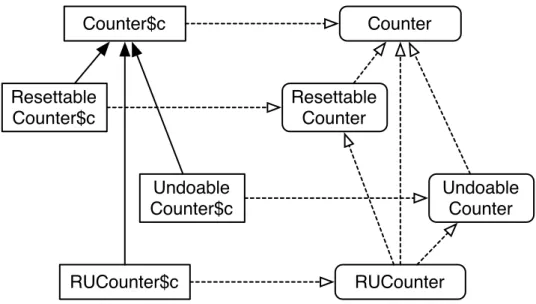
2.4 Counter class hierarchy before mixin expansion . . . 26
2.5 Counter class hierarchy after AddInterfaces . . . 27
2.6 Translation of a Scala class inheriting from a Java class . . . . 28
2.7 Counter class hierarchy after ExpandMixins . . . 29
2.8 Translation ofRUCounterclass . . . 33
4.1 Hierarchy of Java classes representing Scala types . . . 52
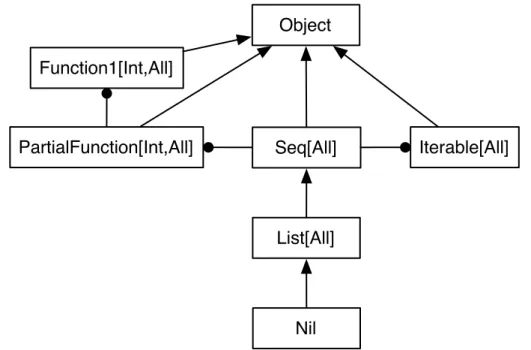
4.2 Ancestors of objectscala.Nil . . . . 58
4.3 Ancestor caches forscala.Seqand its parents . . . 59
6.1 Micro benchmark program . . . 83
List of Tables
2.1 Top code growth in the Scala library . . . 34
2.2 Code growth for Scala programs . . . 34
4.1 Ancestor cache of objectscala.Nil . . . 58
6.1 Micro benchmark timings . . . 82
6.2 Size of benchmark programs . . . 84
6.3 Instances of various types . . . 87
6.4 Calls to instance test and type cast methods . . . 87
6.5 Ancestor cache searches . . . 88
6.6 Impact of run time types on execution speed . . . 89
6.7 Code size increase due to run time types . . . 90
6.8 Memory collected during benchmark runs . . . 90
Version abrégée
Scala est un nouveau langage de programmation, développé à l’EPFL, combinant les principales caractéristiques des langages orientés-objets et fonctionnels. Scala a été conçu pour interagir aisément aussi bien avec Java qu’avec .NET. Pour ce faire, son compilateur peut produire des
pro-grammes s’exécutant sur la machine virtuelle de chacune de ces deux pla-teformes.
Cette thèse se focalise sur la compilation de deux concepts importants de Scala : l’héritage par mixins et les types à l’exécution. Les techniques de compilation sont présentées dans le cadre de la machine virtuelle Java, mais pourraient être adaptées sans difficulté à d’autres environnements similaires.
L’héritage par mixins est une forme d’héritage relativement récente, plus puissante que l’héritage simple, mais évitant la complexité de l’hé-ritage multiple. Nous proposons deux techniques de compilation de cet héritage : par copie de code, et par délégation. La mise en œuvre actuelle, basée sur la copie de code, est ensuite présentée puis justifiée.
Par types à l’exécution on entend la possibilité qu’a un programme d’examiner, lors de son exécution, le type de ses valeurs. Cette possibilité est d’une part intéressante en soit, puisqu’elle offre de nouveaux moyens au programmeur. D’autre part, elle est requise pour la mise en œuvre d’autres concepts de haut niveau, comme le filtrage de motifs, la sérialisa-tion sûre, ou la réflecsérialisa-tion. Nous proposons une technique de compilasérialisa-tion basée sur la représentation des types sous forme de valeurs, et montrons comment il est possible d’utiliser les types à l’exécution de la machine vir-tuelle sous-jacente comme base pour les types à l’exécution de Scala.
Les techniques présentées dans cette thèse ont été mises en œuvre dans le cadre de notre compilateur Scala, nomméscalac. Cela nous a permis
Abstract
Scala is a new programming language developed at EPFL and incorpo-rating the most important concepts of object-oriented and functional lan-guages. It aims at integrating well with the Java and .NET platforms: their
respective libraries are accessible without glue code, and the compiler can produce programs for both virtual machines.
This thesis focuses on the compilation of two important concepts of Scala :mixin inheritanceandrun time types. The compilation techniques are presented in the context of the Java virtual machine, but could be adapted easily to other similar environments.
Mixin inheritance is a relatively recent form of inheritance, offering new capabilities compared to single inheritance, without the complex-ity of multiple inheritance. We propose two implementation techniques for mixin inheritance: code copying and delegation. The implementation used in the Scala compiler is then presented and justified.
Run time types make it possible for a program to examine the type of its values during execution. This possibility is interesting in itself, offer-ing new capabilities to the programmer. Furthermore, run time types are also required to implement other high level concepts, like pattern match-ing, type-safe serialisation and reflection. We propose an implementation technique based on the representation of types as values, and show how to use the run time types of the underlying virtual machine to implement those of Scala.
Acknowledgements
I would first like to thank my adviser Prof. Martin Odersky for accepting me in his group and for his support during the time I spent at LAMP.
My colleague Philippe Altherr, who shared both his office and his many insights about programming languages, helped me immensly during all those years. His efforts to clean up the internals of the Scala compiler saved me countless hours of debugging, and generally made it a pleasure to work on the project.
Vincent Cremet spent a lot of time discussing various issues with me, and proof-read this thesis very carefully, providing many valuable com-ments about it. His help was very much appreciated.
Many people contributed to the Scala project — and its predecessor Funnel — and working with all of them proved very enjoyable. Besides the persons already mentioned, I would therefore like to thank Iulian Dra-gos, Gilles Dubochet, Burak Emir, Sebastian Maneth, Stéphane Micheloud, Nikolay Mihaylov, Christine Röckl, Erik Stenman, Christoph Zenger and Matthias Zenger.
The second half of the LAMP, composed of Sébastien Briais, Daniel Bünzli, Johannes Borgström, Rachele Fuzzati, Simon Kramer, and Prof. Uwe Nestmann provided great company at lunch, and many interesting subjects for discussion during our coffee breaks.
I would also like to express my gratitude to the members of my jury, Prof. Rachid Guerraoui, Prof. Paolo Ienne, Prof. Shriram Krishnamurthi and Prof. Mirko Viroli, for taking the time to read my thesis.
Chapter 1
Introduction
1.1
Scope
Scala is a new programming language developed by Martin Odersky and his team at LAMP [19]. Scala aims at being a practical language, usable for large-scale programs, and incorporating several advanced concepts from recent research.
From the beginning, Scala was designed to run on the Java Virtual Ma-chine (JVM) and on the .NET Common Language Runtime (CLR). Even though the design of the language was often directed to ease the integra-tion with these platforms, the compilaintegra-tion of Scala still presented several challenges.
This thesis explains and evaluates the solutions we developed for the implementation of two important concepts of Scala : mixins and run time types. It focuses on the Java platform, because run time types are currently available only on that platform.
1.2
Background
This section presents the background necessary to understand the rest of the thesis. We start with a quick overview of the Scala language itself, fol-lowed by a description of the Java virtual machine and finally the overall architecture of the current Scala compiler.
1.2.1
The Scala programming language
Scala attempts to blend smoothly concepts taken from object-oriented and functional programming languages.
From the object-oriented world, it inherits the concept of classes, which plays a central role in that all values manipulated are viewed as being in-stances of a class. Classes can be built incrementally using two inheritance mechanisms: single inheritance, and a form of mixin inheritance.
From functional languages, Scala borrows algebraic data-types, pat-tern matching, closures and anonymous functions. These concepts are all integrated coherently, in a way that fits with the object-oriented nature of the language: algebraic data-types are a special kind of classes calledcase classes, and closures are objects with a single method.
Scala is a typed programming language, featuring an advanced type system. This type system is described in detail in the official language specification [20], which we will not reproduce here. It is however inter-esting to quickly review its major features, which are also presented using examples in appendix A:
Polymorphism Classes and methods can take type parameters, and these parameters can have both lower and upper bounds, which can refer to the parameter itself (F-bounded polymorphism).
Type members A class can include type members as well as value mem-bers; like value members, type members can be either abstract or concrete. Abstract type members — also known as virtual types [31] — are bounded by a type, and this bound can be refined by subclasses.
1.2. BACKGROUND 9
Singleton types A basic form of dependent types is provided by singleton types, which refer to a value. There are always two values of a given singleton type: nulland the value to which the type refers.
Scala also tries to integrate well with current popular platforms: both Java and .NETclasses are viewed as if they were normal Scala classes, from
which one can even inherit. This automatically makes a large body of libraries available to the programmer.
The core aspects of Scala have been formalised in theνObjcalculus [21].
1.2.2
The Java virtual machine
The Java virtual machine [16] (JVM) is a stack-based machine targeted to-wards the execution of compiled Java programs. It receives as input a singleclass file, containing the definition of the main class of the program, and executes a particular method of that class. As the execution proceeds, the class files corresponding to the other classes needed by the program are loaded on demand.
One of the novel aspects of the JVM is that it verifies the class files after loading them, to make sure that their execution will not violate some defined safety properties. The checks performed by the verifier include a complete type checking of the program [13].
To make this type checking possible, all the instructions of the JVM are typed: the type of the operands they expect on the stack as well as the type of the result they push back can be inferred from the instructions themselves or their parameters. The type language of the JVM is very close to the one of the Java language itself prior to version 5,i.e. without generics: a type is a class or interface name, or one of the nine primitive types (boolean,int, etc.).
Although very Java centric, the JVM has been used extensively over the recent years as a target platform for many compilers. A web page listing such compilers and interpreters currently contains close to 190 entries [32]. This popularity seems to be due mostly to two factors:
1. a large body of Java libraries is available, and targeting the JVM in-stantly gives access to them,
2. the JVM is available on all major platforms, and compiled Java pro-grams run on all of them without needing any recompilation.
1.2.3
The Scala compiler
The Scala compiler,scalac, transforms a Scala program into either a set of Java class files or an MSIL assembly file, depending on the chosen target. Currently, run time types are only supported on the Java platform, and for that reason we will ignore the .NET platform in the rest of this document.
It should however be noted that version 2.0 of the .NET common lan-guage runtime (CLR) will provide full support for generics, including run time types [12]. This could be used to implement run time types for Scala on that platform, provided that a good mapping from Scala types to CLR types can be devised. This is no easy task, though, as the type system of Scala contains many features which do not appear in the one of .NET, e.g.
variance annotations, singleton types and compound types.
Scalacis organised as a set of successive phases, which can broadly be split into two groups:
1. the front end phases, which perform the analysis of the input file to make sure that it is a valid Scala program, and produce a fully attributed abstract syntax tree (AST),
2. the back end phases, which gradually simplify the AST, to the point where it is very similar to Java or C# code; at that point, a byte code generation phase produces the actual class or assembly files which constitute the final output of the compiler.
Each phase is composed of two transformation functions: a tree trans-former, and a type transformer. The tree transformer is applied to the AST of the program being compiled, while the type transformer is applied to the type of all identifiers needed during compilation—be they defined in the AST or loaded from files compiled separately.
Figure 1.1 on the facing page illustrates the organisation of the com-piler.1 Phases in bold will be described in detail in the rest of this docu-ment. Each phase is listed in the order in which it is applied, along with a short description of the concept it translates. Most phases work by trans-forming an input tree (or type) in which their concept can appear, into one where this concept has been translated away. For example, before the Un-Curry phase, curried functions can appear in the tree or in the types of imported identifiers, but after it, they will all have been transformed into uncurried, multi-argument functions.
1.2. BACKGROUND 11
Back end Front end
Scanner
Parser
Analyzer
RefCheck
TypesAsValues
LambdaLift
AddAccessors UnCurry
TransMatch
ExplicitOuter
AddConstructors
AddInterfaces
ExpandMixins
Erasure
GenJVM GenMSIL
curried methods
pattern matching
classes/functions nested in functions
class constructor arguments
classes nested in classes
class
constructors
mixins
JVM byte codes MSIL byte codes
run time types
"complex" types
Some phases which are not the main subject of this thesis still play an important role in its understanding. These phases are: TransMatch, Lamb-daLift, ExplicitOuter, AddConstructors and Erasure. They deserve being explained in some details, and are therefore the subject of the following sections.
The TransMatch phase
TransMatch translates pattern-matching expressions (see [20, chapter 7]) into conditional expressions that make use of tags attached to values as well as run time types to match values with patterns. This makes Trans-Match the biggest user of run time types, as we will see in chapter 3. Pat-tern matching is a central concept of Scala, and the importance of run time types is mostly due to the fact that they are key to its implementation.
The LambdaLift phase
Scala classes and functions can be defined inside many contexts: classes, functions, blocks, etc. Additionally, classes can be defined directly inside of a package, and are then said to be at the top level. Top-level classes which do not appear in the scope of an explicit package declaration are implicitly placed inside of a special, anonymous package.
The aim of the LambdaLift phase is to lift classes and functions so that the former appear either at the top level or directly inside other classes, and the latter are (possibly private) methods of classes. During this lift-ing, free variables appearing in lifted entities — classes or functions — get added to them as parameters. When such variables are mutable, they are turned into reference cells.
The ExplicitOuter phase
In Scala, all nested classes have full access to the members of their enclos-ing class(es). The task of ExplicitOuter is to lift nested classes to the top level by augmenting them with an explicit reference to their enclosing ob-ject. This reference is then used to access all the members of enclosing classes.
1.3. INHERITANCE GRAPH NOTATION 13
The AddConstructors phase
In Scala, a class does not contain an explicit method definition for its con-structor, like it does for example in Java. Rather, the class itself can take ar-guments, which are visible in its whole body, including any nested classes. Furthermore, the body of a class can contain arbitrary expressions, which are evaluated each time a new instance is created.
This implicit constructor is called theprimary constructorof the class. It is also possible to define secondary constructors as members of the class namedthis, but all have to end with a call the primary constructor.
The aim of AddConstructors is to make the primary constructor ex-plicit by turning it into a method called <init>. This method takes the same arguments as the class. Its body is composed of all the expressions which originally appeared in the body of the class itself, and of calls to constructors of the super-class and mixins, if any.
After AddConstructors, the class does not have value parameters any-more, and its body is composed exclusively of member definitions, one of which is the constructor <init>. At this stage, and with respect to con-structors, the class is very similar to a standard Java or C# class.
The Erasure phase
Erasure performs a partial erasure of the types appearing in a program. The aim of this partial erasure is to transform all the Scala types appearing in the program into JVM or CLR types. The exact transformation per-formed in Scala will be described in chapter 4.
1.3
Inheritance graph notation
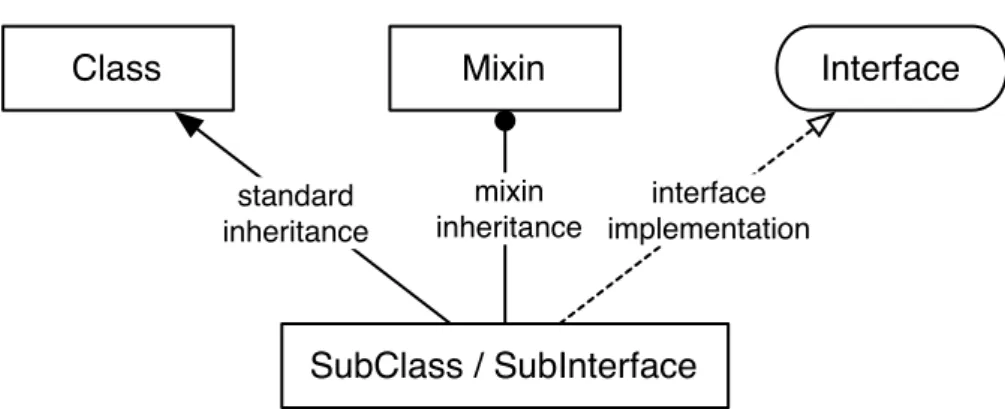
Several inheritance graphs appear in the remainder of this document. These graphs are composed of classes and interfaces, related by standard inheri-tance, mixin inheritance or interface implementation. The notation is pre-sented in figure 1.2.
Class
SubClass / SubInterface standard
inheritance
Interface
interface implementation Mixin
mixin inheritance
Chapter 2
Mixins
2.1
Introduction
To support code reuse, all object-oriented languages support some notion of inheritance. The simplest and most common form is single inheritance which, while powerful and adequate in many cases, is usually perceived as being too limited to solve all reuse problems. To overcome these lim-itations, several new forms of inheritance have been proposed: multiple inheritance, mixin inheritance, and recently trait inheritance.
Scala offers a kind of mixin inheritance which is slightly different from what exists in other mixin-based languages. For that reason, before detail-ing its implementation, we present it after reviewdetail-ing the various kinds of inheritance mentioned above.
2.1.1
Single inheritance
Single inheritance is the most common, and simplest, form of inheritance. It enables a class to inherit all the members (methods and fields) from another class, called its superclass, and possibly override some of them with new definitions.
2.1.2
Multiple inheritance
A well-known one is thediamond problem, where a class inherits a sin-gle ancestor twice, from two different parents. While inheriting methods several times is not a problem, as it cannot be observed, the repeated in-heritance of mutable fields certainly is. Apart from wasting space in the heir class, it raises tricky questions about which copy of a field is modified or read when.
Multiple inheritance also has limitations which make certain kinds of abstractions difficult to express. For example, it doesn’t provide a way to abstract over an extension of many classes with the same set of members. This kind of abstractions is precisely what mixins provide, as detailed be-low.
2.1.3
Mixin inheritance
Mixins are partial class definitions, whose superclass is abstract [7]. When applied to a class, they yield a new subclass of that class, obtained by adding or overriding members. Basically, mixins can be seen as (meta) functions which, when given a class, produce a new subclass of that class. Two mixins can be composed together to form a composite mixin. Ap-plying that composite to a class means apAp-plying its second component to the class, resulting in a new class to which the first component of the composite is applied to obtain the final class. In other words, mixins are composed like functions.
Composite mixins open the door to a variant of the diamond problem: when two composite mixins are composed, it is possible that both com-posites have a component in common. Applying the resulting mixin to a class results in the same set of members to be added twice.
Apart from that problem, the fact that mixins have to be composed in a given order has been criticised by Schärliet al. [29]. They argue that an order which is appropriate for all the methods of the mixins to compose does not always exist. To solve that problem, they proposetrait inheritance, an unordered variant of mixin inheritance, which is examined next.
2.1.4
Trait inheritance
2.2. MIXIN INHERITANCE IN SCALA 17
Trait inheritance is similar to mixin inheritance, the key difference be-ing the lack of order among traits: when a set of traits is inherited by a class, they are all inherited simultaneously, and any member defined by more than one trait results in an ambiguity. This ambiguity must be ex-plicitly resolved by providing an overriding definition in the class.
The lack of order among traits also has a consequence on the meaning of the super keyword. When it appears in a trait, it always refers to the superclass of the class inheriting the trait. This differs from mixins, where
super refers to the previous mixin in the composition. This behaviour extends naturally to the occurrences ofsuperappearing in the body of the class itself: with mixin inheritance, they refer to the mixin inherited last, whereas with traits they always refer to the superclass.
We will see in §2.5.5 that along with trait inheritance comes a special form ofsuper, providing access to any method of any inherited trait. No equivalent usually exists with mixin inheritance.
2.2
Mixin inheritance in Scala
Apart from single inheritance, Scala supports a form of mixin inheritance which does not correspond exactly to either mixin or trait inheritance as described above. Despite its name, it is actually closer to the latter than to the former, as we will now see.
A classC can be declared to inherit from one superclassS and several mixinsM1,M2, . . .,Mn. This is written as follows:
class C extends S with M1 with M2 with ... with Mn { ... }
For such a definition to be valid, the type of the superclass S must be a
subtype of the type of the superclass of every mixinM1toMn. It is easy to understand the motivation of this restriction: since S will be used as the actual superclass of all the mixins, its type should guarantee that it can be. Like for trait inheritance, the order of the various mixins does not mat-ter in Scala, and any concrete member defined in more than one of them must be overridden in the heir class to resolve the ambiguity.
Both single and mixin inheritance are tied with subtyping. This means that with the above definition, the typeCis a subtype of the type of classes
SandM1toMn.
are inherited, while with mixin inheritance only the ones introduced or overridden by the mixin class itself or its own mixins are. In other words, when a class is used as a mixin, only the difference between it and its su-perclass is considered.
To avoid the diamond problem mentioned before, it is illegal in Scala to inherit a single mixin through more than one path, unless the mixin in question is declared as being a trait. A trait is a special kind of abstract class, restricted so that it can be repeatedly inherited without problem. The restrictions on traits are:
1. The primary constructor of a trait cannot have value parameters, and secondary constructors are disallowed altogether — this ensures that when a trait is inherited multiple times, all copies receive the same (empty) constructor arguments;
2. The construction of a trait cannot have side effects — this ensures that multiple inheritance of a trait will not lead to multiple evalu-ation of side effects, and potentially to distinguishable copies of the same trait;
3. The parent constructors of a trait cannot have value parameters — this ensures that all copies of a trait inherited repeatedly pass the same arguments to their superclasses (i.e.none),
4. A trait only inherits from other traits, not standard mixins, through mixin inheritance — this ensures that the rules just presented cannot be circumvented by hiding mixins behind traits.
2.2.1
Mixin example
To illustrate the translation steps performed by the Scala compiler, we use a small example. We start by defining a class representing an inte-ger counter, with one method to obtain the current value of the counter, and one to increment it:
class Counter {
protected var v: Int = 0;
def value: Int = v;
def increment: Unit = (v = v + 1); }
2.3. ENCODING MIXINS ON THE JVM 19
The first of these subclasses provides a method to reset the counter:
trait ResettableCounter extends Counter {
def reset: Unit = (v = 0); }
The second one provides a method to bring the counter back to some earlier state:
abstract class UndoableCounter extends Counter {
private var history: List[Int] = List();
override def v_=(newV: Int): Unit = { history = (v :: history);
super.v_=(newV); }
def undo: Unit = {
super.v_=(history.head); history = history.tail }
}
Notice the redefinition of v_=, which is the setter method for the field v, implicitly introduced by the compiler whenvwas defined1.
We can now define a class for a resettable and undoable counter by composing the appropriate mixins:
class RUCounter
extends Counter
with ResettableCounter
with UndoableCounter;
2.3
Encoding mixins on the JVM
The first step in implementing Scala mixin inheritance is to find a way to encode it on the JVM, which does not offer it as such.
There are two aspects to the encoding of mixin inheritance on the JVM: first, since the language of the JVM is typed, we must make sure that our encoding produces well-typed JVM programs; second, we must find a
way to share the code of the mixins among all classes which inherit from them.
2.3.1
Typing aspect
For the typing aspect, we need to ensure that the type of a class which inherits from superclassS and mixinsM1toMnis a subtype of all of them. This is a form of multiple subtyping, which suggests the use of interfaces to express the subtyping aspect of mixin inheritance on the JVM: our en-coding must provide one interface per mixin, and any class inheriting from a set of mixins must implement the corresponding interfaces.
2.3.2
Code sharing aspect
To share the code of the mixins among their heir classes, we can either copy it, or really share it at the level of the JVM using delegation. We explore these two options below.
Sharing by copying
Like for all forms of inheritance, the code sharing aspect of mixin inheri-tance can be implemented by simple code copying: each time a class in-herits from a mixin, the code from the latter is copied into the former. This approach is relatively easy to implement, and produces efficient code. Its main disadvantage is its cost in terms of code size.
Sharing by delegation
To try to avoid the cost of code copying, it is possible to share code using delegation [15]. The idea is that classes hold one delegate object per mixin from which they inherit, and forward calls to mixin methods to these del-egates.
With this approach, calls to methods of the superclass appearing in mixins are problematic: they cannot be resolved statically, as they usually are, because the exact method to call depends on the context in which the mixin is used. This is illustrated by figure 2.1, which shows two mixins
M1andM2, both redefining methodm of classA. It is clear that whenM1is inherited by B, the call super.m it contains refers to A’s version of m; but
2.3. ENCODING MIXINS ON THE JVM 21
B
C
D
E A
def m = ...
M1
def m =
... super.m ...
M2
def m =
... super.m ...
Figure 2.1: Super calls and mixins
To solve this problem, delegate objects should have a way to identify the location of their heir class in the hierarchy. This can be obtained by as-sociating a level to every class, which is the length of the path leading from that class to the top of the hierarchy, following only single-inheritance links. In our example, classAcould be at level 0, classesBandDat level 1,
and classesCandEat level 2.
With this in place, it is relatively easy to provide access to any version of an overridden method, usingsuper-accessormethods. Every method of every class has such a method associated to it. The super-accessor gets the same arguments as the original method, as well as the level of the class which should perform the super call.
For example, the super-accessor method super_mbelow provides ac-cess to all versions of methodmfor classesA,BandC:
class A {
void m() { /* ... */ }
void super_m(int lvl) { throw new Error(); } }
class B extends A {
void m() { /* forward to delegate for M1 */ }
void super_m(int lvl)
{ if (lvl == 1) super.m(); else super.super_m(lvl); } }
class C extends B {
void super_m(int lvl)
{ if (lvl == 2) super.m(); else super.super_m(lvl); } }
Given an instance of classC, callingsuper_mwith an argument of 1 callsm
inA, while an argument of 2 callsminB.
These super-accessor methods can be used by mixins to perform su-per calls. On creation every delegate object receives the level of the class inheriting from it. To perform a super call, it invokes the super-accessor method of its delegator, passing it that level.
In our example, mixinM1would look as follows:
class M1Delegate {
private final int lvl;
public M1Delegate(int lvl) { this.lvl = lvl; }
void m(A self) {
/* ... */ self.super_m(lvl); /* ... */ }
}
All copies ofM1Delegateused by instances ofBwould get a level of 1 on creation, while the ones used by instances ofEwould get a level of 2. This
ensures that super calls performed by M1Delegate are routed appropri-ately.
Example translations
To illustrate the two translation techniques for mixins just presented, we show in figure 2.2 how classRUCountercould be written in Java using code copying, and in figure 2.3 how it could be written using delegation.
Notice that in the second translation we have made the assumption that mixins are not normal classes, since we have translated them differ-ently. To shorten the code, we also provided only one implementation of a super-accessor method,super_setV, while in reality such methods should be provided for all methods of all classes.
2.3.3
Encoding used by
scalac2.3. ENCODING MIXINS ON THE JVM 23
interface ResettableCounter { public void reset(); }
interface UndoableCounter { public void undo(); }
class Counter {
private int v = 0;
public int getV() { return v; }
public void setV(int newV) { v = newV; }
public int value() { return getV(); }
public void increment() { setV(getV() + 1); } }
class RUCounter extends Counter
implements ResettableCounter, UndoableCounter {
public void reset() { setV(0); }
private LinkedList history = new LinkedList();
public void setV(int newV){
history.addFirst(new Integer(getV()));
super.setV(newV); }
public void undo() {
super.setV(((Integer)history.removeFirst()).intValue()); }
}
interface ResettableCounter { public void reset(); }
class ResettableCounterDelegate {
public static void reset(Counter self) { self.setV(0); } }
interface UndoableCounter { public void undo(); }
class UndoableCounterDelegate {
private LinkedList history = new LinkedList();
private final int level;
public UndoableCounterDelegate(int l) { level = l; }
public void setV(Counter self, int newV){ history.addFirst(new Integer(self.getV())); self.super_setV(level, newV);
}
public void undo(Counter self) {
int last = ((Integer)history.removeFirst()).intValue(); self.super_setV(level, last);
} }
class Counter {
private int v = 0;
public int getV() { return v; }
public void setV(int newV) { v = newV; }
public void super_setV(int level, int newV) { throw new Error(); }
public int value() { return getV(); }
public void increment() { setV(getV() + 1); } }
class RUCounter extends Counter
implements ResettableCounter, UndoableCounter { UndoableCounterDelegate ucDelegate =
new UndoableCounterDelegate(1);
public void reset() { ResettableCounterDelegate.reset(this); }
public void undo() { ucDelegate.undo(this); }
public void setV(int newV) { ucDelegate.setV(this, newV); }
public void super_setV(int level, int newV) {
if (level == 1) super.setV(newV);
else super.super_setV(level, newV); }
}
2.4. INTERFACES FOR TYPES 25
This translation is performed by two successive phases: AddInterfaces introduces interfaces and then ExpandMixins copies code. These two phases are described in detail in the rest of this chapter.
Code duplication was chosen instead of delegation for performance reasons. Currently, any Scala class can be used either as a mixin or as a normal class. If delegation was used to implement mixins, all the code of methods would have to be put in delegates. Therefore,everyScala method call would result in two JVM method calls: one to the forwarding method, and one to the delegate method.
That said, even if Scala distinguished explicitly mixins from normal classes, it is not evident that a delegation-based approach would be inter-esting. The overhead of super-accessor and forwarding methods would first have to be measured on real programs as it might be important, espe-cially in terms of performance.
2.4
Interfaces for types
As we have seen, the concepts of types and classes are usually tied in object-oriented languages, and Scala and Java are no exceptions. How-ever, Java provides the notion of interface which defines a type without defining a class at the same time.
This makes it possible to completely untie inheritance and subtyping, by strictly adhering to the following discipline: always use interfaces to represent types, and inheritance solely to reuse code. This implies ignor-ing completely the types automatically created for classes, and always ex-plicitly specifying the type(s) of a class using interfaces.
Such an approach is not really practical for a Java programmer, as it implies a lot of redundant declarations. But for a compiler targeting the JVM, it is very interesting as it provides a lot of freedom in building the subtyping relation independently of the inheritance relation. This freedom is precisely what is needed to implement mixin inheritance inscalac. The
first step of the mixin translation is therefore to make sure that the program distinguishes types from classes.
2.4.1
The AddInterfaces phase
AddInterfaces splits all class definitions in a program into two parts: an interface to represent the type, and a class to represent the class.
The interface contains a declaration for all the methods of the class, including private ones which are renamed first, as we will see in §2.4.4.
The subtyping hierarchy of the original program is reflected by the in-terfaces, in that the interface for a given class is made to implement all the interfaces of the class’ parents, mixins included. If the class originally im-plemented a Java interface, this interface is also imim-plemented by the class’ interface. We will see below that a small problem appears with classes inheriting from Java classes, as no interface exists for them.
Once the subtyping hierarchy has been constructed using interfaces, the link between classes and their type is made by simply adding the ap-propriate interface to the parent of each class.
Finally, the program is transformed so that interfaces are used for types, and classes for themselves. This implies replacing references to the origi-nal class with the new interface, except in two locations: instance creation expressions (new) and the parents of a class still refer to the class.
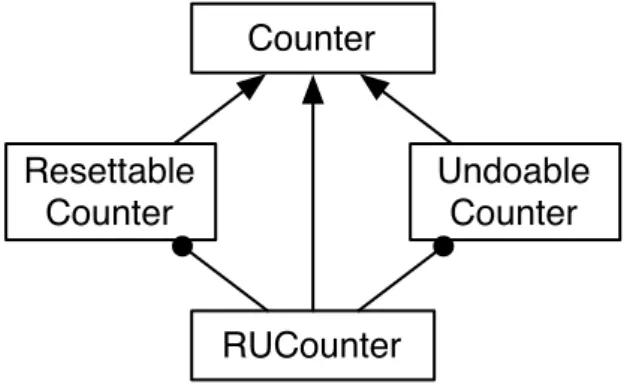
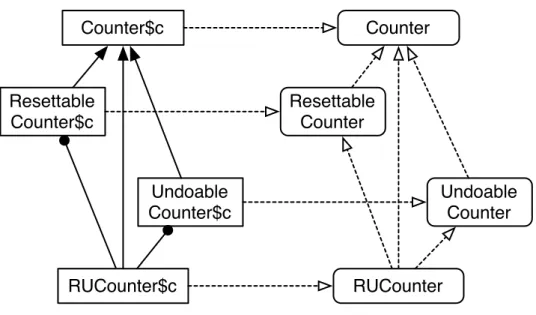
This process is illustrated in figures 2.4 and 2.5 on the next page, which show the inheritance hierarchy for theRUCounterclass and its parents — Objectexcepted — before and after AddInterfaces2.
Counter
Resettable Counter
Undoable Counter
RUCounter
Figure 2.4: Counter class hierarchy before mixin expansion
2.4.2
Unmixable classes
Almost all classes in the original program receive an interface, but there are exceptions. Since the aim of these interfaces is to enable mixin inher-itance, only classes which can actually be used as mixins need one. The following kinds of classes are not usable as mixins, and therefore do not get an interface:
2.4. INTERFACES FOR TYPES 27
Counter$c
Resettable Counter$c
Undoable Counter$c
RUCounter$c
Counter
RUCounter Resettable
Counter
Undoable Counter
Figure 2.5: Counter class hierarchy after AddInterfaces
1. classes corresponding to Scala singleton objects [20, §5.4], since they are not exposed to the programmer, and
2. classes created by the compiler to represent closures, since they are not visible as classes in the original program.
Strictly speaking, only classes which actuallyareused as mixins should get an interface. But in the presence of separate compilation, it is not possible to determine whether a class will be used as a mixin or not. AddInterfaces therefore makes the conservative assumption that all classes which can be used as mixins will be.
To obtain a better approximation of the classes in need of an interface, an analysis of the whole program is required. Alternatively, mixins could be explicitly distinguished from normal classes in Scala.
2.4.3
Subclasses of Java classes
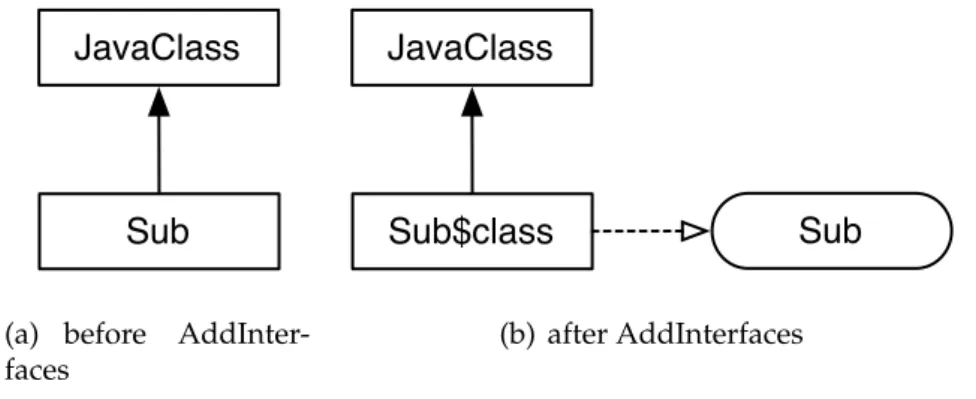
The translation just presented is problematic for Scala classes which inherit from a Java class other than Object. Figure 2.6 on the following page illustrates the translation by AddInterfaces of such a class, calledSuband
the fact that these instances also have typeJavaClasshas been lost in the translation.
To work around this problem, the Scala compiler inserts a type cast each time a value of typeSubis used as a value of typeJavaClass. These casts are safe, in the sense that they will never fail at run time. This is due to the fact that the only values of typeSubare either instances ofSub$class
or one of its subclasses, or instances of a classCwhich inherits fromSubas a mixin. In the latter case,Cwill have to be a subclass ofJavaClasstoo, as
required by Scala’s notion of valid mixin inheritance.
Sub JavaClass
(a) before AddInter-faces
Sub$class JavaClass
Sub
(b) after AddInterfaces
Figure 2.6: Translation of a Scala class inheriting from a Java class
2.4.4
Private members
Ideally, private members should not be part of the interface created by AddInterfaces. But in some cases it is actually not possible to exclude them, as the following example illustrates:
class C {
private def privateFun: Int = 123;
def f(c: C): Int = c.privateFun; }
After AddInterfaces, the argumentc passed tof will have the type of the
interfaceC, and it is clear that ifprivateFunis not part of that interface, the underlined call is not legal.
A similar problem appears with private members which are accessed from nested classes.
2.5. INLINING MIXIN CODE 29
2.5
Inlining mixin code
Once mixin interfaces have been created, mixin code can be copied in the heir classes, which is the task of the ExpandMixins phase.
2.5.1
The ExpandMixins phase
The ExpandMixins phase traverses the mixins of a heir class, and copies all their code into that class. Once this is done, mixin inheritance has been translated away, and the mixins can be removed from the parents of the heir class. This will not affect the subtyping relation, as it has been pre-served using the interfaces introduced by AddInterfaces.
The process is illustrated by figure 2.7 which shows the hierarchy of figure 2.5 after its transformation by ExpandMixins. The only difference between this figure and the previous one is that the two mixin inheritance arrows have disappeared.
Counter$c
Resettable Counter$c
Undoable Counter$c
RUCounter$c
Counter
RUCounter Resettable
Counter
Undoable Counter
Figure 2.7: Counter class hierarchy after ExpandMixins
2.5.2
Mixin type parameters
When importing the code of a mixin, its type parameters, if any, must be replaced by their actual value, given by the heir class. As an illustration, consider the following mixin which, given a method to produce a random element, defines a method to obtain a random list:
trait RandomList[T] {
def random: T;
def randomList(n: Int): List[T] =
if (n == 0) List() else random :: randomList(n-1); }
When used in a heir class, the type parameterT must be replaced by its
actual value. For example, the following object makes use of that mixin to produce random numbers or lists thereof:
object RandomDouble with RandomList[Double] {
def random: Double = Math.random(); }
After mixin expansion, all occurrences ofThave been replaced byDouble
in objectRandomDouble:
interface RandomList[T] {
def random: T;
def randomList(n: Int): List[T]; }
object RandomDouble with RandomList[Double] {
def randomList(n: Int): List[Double] =
if (n == 0) List() else random :: randomList(n-1);
def random: Double = Math.random(); }
2.5.3
Mixin constructors
The AddConstructors phase comes just before AddInterfaces (figure 1.1), and this means that the two phases concerned with mixin expansion see classes with explicit constructors.
This makes constructors easy to handle during mixin expansion, as they behave like standard methods, with two exceptions:
2.5. INLINING MIXIN CODE 31
it is superseded by the one of the heir class,
2. because all constructors have the same name (<init>), the ones in-herited from mixins must be renamed uniquely to avoid collision with the constructor of the heir class.
A future redesign of Scala will probably syntactically distinguish mixins from normal classes, and mixins will not contain calls to the constructor of the superclass. This would remove the need to delete these calls during mixin expansion.
2.5.4
Private members
Private members of mixins cannot be simply copied into the heir class, as their name might clash with the name of some other imported member. For that reason, they are given a unique name as they are imported.
2.5.5
Overridden members
Mixin members that are overridden in the heir class can generally be omit-ted during copying, unless they are accessed throughmixin super reference
[20, §6.3]. For example, in the code sample below, the print method of
classCcalls the methodprintof mixinMeven though it overrides it:
class M { def print: Unit = Console.println("M") }
class C with M {
override def print: Unit = {
super[M].print; // prints M
Console.println("C"); // prints C
} }
It is clear that the print method of mixin M has to be imported too, but
under a new and unique name. It also has to be made private in the pro-cess. The mixin super reference can then be transformed to refer to that imported member, which is now accessed throughthisinstead ofsuper.
2.5.6
Nested classes
Expand-Mixins does not contain nested classes anymore. As a consequence, classes nested inside of mixins are not copied during mixin expansion.
Notice that it would actually not be possible to perform mixin expan-sion before phase ExplicitOuter, as classes would then not be closed over their enclosing class. This is illustrated by the following example:
class Outer {
var x: Int = 1;
class Inner {
def incX: Unit = { x = x + 1; } }
}
object Main {
val o = new Outer;
class C with o.Inner; }
If classInnerwas simply inlined into classC without first being lifted to the top level, variablexwould become free inC.
2.6
Example translation
To illustrate the translation of mixins, figure 2.8 shows the translation of the declaration of classRUCounter. Not surprisingly, the translated code is very close to its Java equivalent presented in figure 2.2.
2.7
Cost of code copying
To get a rough idea of the cost of code copying, we measured the amount of duplicated code due to mixins in the standard Scala library and in sev-eral benchmark programs. This was done by comparing the size of the class files with mixin expansion disabled and enabled. When mixin expan-sion is disabled, the code produced is not valid and cannot be executed, but we are only interested in measuring its size.
2.7. COST OF CODE COPYING 33
interface RUCounter extends Counter
with ResettableCounter with UndoableCounter;
class RUCounter$class extends Counter$class with RUCounter {
// part imported from ResettableCounter
private def mixin$ResettableCounter$class$init$: Unit = ();
def reset: Unit = v_=(0);
// part imported from UndoableCounter
private def mixin$UndoableCounter$class$init$: Unit = { mixin$UndoableCounter$class$history$ = Nil;
};
private var mixin$UndoableCounter$class$history$: List[Int] = _;
def UndoableCounter$history: List[Int] = mixin$UndoableCounter$class$history$;
def UndoableCounter$history_=(x$0: List[Int]): Unit = mixin$UndoableCounter$class$history$ = x$0;
override def v_=(newV: Int): Unit = {
UndoableCounter$history_=(v :: UndoableCounter$history);
super.v_=(newV) };
def undo: Unit = {
super.v_=(UndoableCounter$history.head);
UndoableCounter$history_=(UndoableCounter$history.tail) };
// part corresponding to RUCounter itself
def <init>: Unit = {
super.<init>;
mixin$ResettableCounter$class$init$; mixin$UndoableCounter$class$init$; }
}
proportions, the overall growth is modest for all packages.
The relatively important growth of Scala’s collection library (second and third rows) is not a surprise, as this library makes heavy use of mixins to reuse code. The growth ofscala.xml.parsingis slightly pathological, being due to a single, big mixin.
Code growth
Package maximum overall
scala.xml.parsing 1’020% 38%
scala.collection.immutable 288% 23%
scala.collection.mutable 335% 21%
scala.xml.dtd 170% 10%
scala.testing 80% 6%
Table 2.1: Top code growth in the Scala library
We additionally measured the growth for four real Scala programs: the current Scala compiler (scalac), the new Scala compiler (nsc), a partial compiler for the Scaletta calculus (scaletta), and an object file printer
for Scala (scalap). All these benchmarks are described in more detail in section 6.2.1. As can be seen in table 2.2, the overall growth observed for these programs is even lower than for the Scala library. Once again, even though the growth of single files is sometimes impressive,e.g. in thensc
case, this does not carry on to the total application size.
Code growth Program maximum overall
scalac 11% <1%
nsc 2’160% 4%
scaletta 187% 1%
scalap 11% 1%
Chapter 3
Run Time Types
3.1
Introduction
Types are, by definition, static entities: they get attributed to terms by the type-checker during compilation, and are then usually thrown away. Some languages do keep them, however, and make them available to the programmer at run time, as values. Such languages are said to provide
run time types.
Run time types play an important role in the implementation of sev-eral features of modern programming languages, like pattern matching, reflection or serialisation. Apart from these high-level features, the pro-grammer is usually given indirect access to run time types through two basic operations:
1. the membership test, which tests whether a value is of a given type, and
2. the dynamic type cast, which gives a more precise type to a value than the one inferred by the compiler, deferring the type test until run time.
This chapter and the next three will examine the features related to run time types available in Scala, then describe and evaluate their implementa-tion. We start by explaining in more details the high-level concepts which need run time types, then move on to Scala.
3.1.1
Pattern matching
pattern matching the value. Typically, that code is executed in a context where various parts of the matched value are bound to variables appear-ing in the matchappear-ing pattern.
For some languages, given a type, it is possible to know at compile time the set of possible variants of that type. This is for example true of all languages which provide non-extensible algebraic datatypes, like SML. For such languages, full run time types are not needed to implement pattern matching: simple tags are enough. We will see below that Scala is not such a language, however, since its pattern matching construct is powerful enough to require full run time types in general.
3.1.2
Reflection
Reflection refers to the ability of a program to manipulate (parts of) itself at run time, by reifying the abstractions of the programming languages it was written in.
To implement reflection, some information that is typically discarded during compilation must be kept until run time. The exact nature of this information depends on the capabilities offered by reflection, but might include the name of the methods provided by an object, their visibility, and so on. The type of values is part of this information, and therefore run time types are required to implement reflection for a typed language.
3.1.3
Type-safe serialisation
Serialisation (also called marshaling or pickling) is the process of convert-ing a graph of objects into a stream of bytes, to be stored on disk or trans-ferred across a network.
If objects are serialised without also recording their type, deserialisa-tion becomes an unsafe operadeserialisa-tion, as it is possible to deserialise a value with a different type than the one it had during serialisation. This can result in arbitrary behaviour of the program. This is a well-known prob-lem of Objective Caml’s serialisation API, for example: deserialising some datum with an incorrect type can crash the system [14].
3.2. RUN TIME TYPES IN SCALA 37
3.2
Run time types in Scala
Scala has a very rich language of types, described in detail in its reference (see [20, chap. 3]). Implementing run time types amounts to compiling this language, first by providing a representation for types as values, and then by translating type expressions to corresponding value expressions working on these type representations. A way to access and manipulate these type representations at run time must also exist for run time types to be of interest.
3.2.1
The language of types
The type terms of Scala are either values, described below, or type expres-sions which reduce to type values.
Scala offers a relatively standard set of type expressions: polymorphic classes and methods introduce abstraction, which is eliminated by type application. These expressions are translated to corresponding value ex-pressions by the TypesAsValues phase, described in chapter 5.
The type values of Scala are composed of the following:
Singleton types which have the formx.type where xis a value.
Class types which have the form P#C[T1, . . . ,Tn] where Pis the prefix, C
is a class name and T1, . . . ,Tn are the type parameters. Top-level
classes have an empty prefix, while nested classes have either a sin-gleton type or another class type as prefix. When P is a singleton type of the form p.type, value p is called the outer instance and the type p.type#C[T1, . . . ,Tn] is usually written as p.C[T1, . . . ,Tn]. The
type parameters are empty if classCis monomorphic.
Compound types which have the form T1 with T2 . . . withTn{R}where
T1. . .Tn are the component types andRis a refinement.
At run time, these types are represented by instances of Java classes, which will be described in chapter 4.
3.2.2
Run time types of values
All Scala values being also JVM values, they have in fact two run time types: the Scala one, and the JVM one. As we will often need to talk about these run time types below, we introduce two operators to denote, respec-tively, the Scala and JVM run time type of a value:typeofSandtypeofJ.
3.2.3
Operations on run time types
In Scala, the two basic operations provided on run time types are the mem-bership test and the type cast, modelled after Java. They are provided by the following two methods, defined in thescala.Any class and therefore available for all values:
def isInstanceOf[T]: Boolean; // membership test
def asInstanceOf[T]: T; // dynamic type cast
The meaning of these methods is the following:
• v.isInstanceOf[T] has type Boolean and evaluates to true if and
only if valuevis not null and has typeTat run time,
• v.asInstanceOf[T]has typeTand evaluates tovif valuevhas type
Tat run time, and fails with aClassCastExceptionotherwise.
The meaning ofisInstanceOf can be expressed using thetypeofS opera-tor introduced before:
v.isInstanceOf[T] ⇔typeofS(v)<:ST (3.1)
where <:S is Scala’s subtyping relation, defined in [20, §3.5.2] where it is
calledconformance.
TheasInstanceOf method is also used to perform conversion among numeric types. Therefore, ifvis a number and T is a numeric type, then
v.asInstanceOf[T]never throws an exception, but returns the numberv
converted to a number of type T, with a possible loss of information. A consequence of this special behaviour for numeric types is that it is possi-ble forasInstanceOfto succeed even ifisInstanceOfreturns false.
3.2.4
Pattern matching
3.2. RUN TIME TYPES IN SCALA 39
Constructor patterns
Constructor patterns check whether a value is an instance of a given case class, and if it is, optionally bind fresh variables to the components of the value.
To illustrate their translation, we use the following small program. It defines classes to represent lists, and later introduces a functionlengthto compute the length of such a list.
abstract class List[+T];
case class Cons[+T](hd: T, tl: List[T]) extends List[T];
case object Nil extends List[All];
object Main {
def length[T](l: List[T]): Int = l match {
case Cons(_, tl) => 1 + length(tl)
case Nil => 0 }
}
The length method uses a constructor pattern for the Cons case, and is translated as follows:
def length[T](l: List[T]): Int = {
var $result: Int = _;
if (if (l.isInstanceOf[Cons[T]]) {
val tl: List[T] = l.asInstanceOf[Cons[T]].tl(); $result = 1 + length(tl);
true
} else if (l == Nil) { $result = 0;
true
} else false) $result
else
scala.MatchError.report(l) }
We will see in sections 5.7 and 5.8 that it is sometimes possible to op-timise this code, to avoid paying the full cost of the membership test and type cast.
Typed patterns
Typed patterns test whether a value is of a given typeT and, if it is, bind the value to a fresh variable of typeT.
To illustrate the translation of these patterns, consider the implementa-tion of the methodequalsfor a Scala class representing integer cells:
class IntCell(val x: Int) {
override def equals(thatAny: Any): Boolean = thatAny match {
case that: IntCell => x == that.x
case _ => false
} }
The TransMatch phase translates this code into the following, which makes use ofisInstanceOf andasInstanceOf, and closely resembles what one
would write in Java :
class IntCell(val x: Int) {
override def equals(thatAny: Any): Boolean = {
if (thatAny.isInstanceOf[IntCell]) {
val that: IntCell = thatAny.asInstanceOf[IntCell]; x == that.x
} else false
} }
3.2.5
Implementation restrictions
Before presenting our implementation of run time types for Scala, we re-view its limitations. They will be justified later, and possible techniques to overcome them will be proposed for future work. These limitations are:
1. Only prefixes composed of a singleton type are supported (see §5.11).
3.2. RUN TIME TYPES IN SCALA 41
3. Array types do not support all operations: the creation of array types with singleton or compound types is prohibited, and the member-ship test and type cast fail in some well-defined circumstances (see §4.3.5).
Chapter 4
Representing Run Time Types
4.1
Introduction
The implementation of run time types is composed of two parts: first, a li-brary to represent Scala types as JVM values, offering the operations neces-sary to manipulate them at run time; and second, a set of transformations performed at compile time to encode the types as values. This chapter will detail the first part, and the next one will concentrate on the second part.
Before looking at the representation of Scala types as JVM objects, we examine how Scala types are mapped to JVM types, since the latter has an important influence on the former.
4.2
Mapping source types to JVM types
Like all compilers targeting the JVM, the Scala compiler must make sure that it produces programs which are type-correct, in order to be accepted by the JVM byte-code verifier. This implies that it must map source (Scala) types to target (JVM) types.
Since the JVM provides its own run time type operations — the IN
-STANCEOFandCHECKCASTinstructions [16] — it is natural to ask whether
4.2.1
Full erasure
At one extreme, it is possible to map all source types to a single target type, which could beObject for the JVM, but any arbitrary empty inter-face would also do. We will say that this mapping performs thefull erasure
of source types, because all information contained in the types is lost. Ob-viously, such a mapping doesn’t provide any help when implementing run time types.
Full erasure is generally not used by real compilers for typed languages, unless they produce untyped code.
4.2.2
Isomorphic mapping
At the other extreme, the mapping of types can be an isomorphism: each different source type is mapped to a different target type, in such a way that the subtyping relation is preserved. Such a mapping is interesting be-cause run time type operations on source types can be directly translated to the equivalent operations on target types.
An example of such a mapping is the trivial one performed by Java compilers before generics were added to the language: source and target types were then basically the same. A more interesting example of an isomorphic mapping is NEXTGEN’s, which encodes type parameters into the name of JVM types. It is explored in more detail in section 4.2.5.
4.2.3
Partial erasure
Between these two extremes lie a range of mappings which we will call
partial erasures, which preserve some parts of the source types and erase the rest. The idea behind these mappings is to make source types as simple as needed for them to correspond to JVM types, but not simpler.
Since part of the source types is preserved by these mappings, run time types for the source language can generally be implemented partly using the run time types of the JVM. But to provide precise run time types, the erased parts of source types have to be preserved until run time, and this is accomplished by representing them as values.
4.2. MAPPING SOURCE TYPES TO JVM TYPES 45
calledreifiable types(see [11, §4.7]). These are the types for which the partial erasure is the identity.
There are other partial erasure mappings in use, and we will shortly examine below the one proposed by Viroli and Natali [36]. As we will see, the Scala compiler itself uses a partial erasure to map Scala types to JVM types.
4.2.4
Erasure of terms
It should be noted that the transformation of types during compilation cannot be performed alone: it must be accompanied by a transformation on terms, and the two must work hand-in-hand to ensure that all well-typed source programs are turned into well-well-typed target programs. For example, all the erasure schemes mentioned above require the code to be augmented with type casts, which aim at restoring the typing information lost by the erasure.
4.2.5
Mapping examples
Before describing the mapping we chose for Scala, we examine two map-pings used by other language implementations targeting the JVM. These implementations are:
1. the NEXTGEN compiler, which compiles an extension of Java with generic types, and uses an isomorphic mapping,
2. the LM translator, which compiles another extension of Java with generic types, and performs partial erasure of types, preserving the erased parts using Java’s reflection capabilities.
The NEXTGENmapping
NEXTGEN [8] extends Java with the ability to define parametric classes
and methods, with a syntax similar to the one of Java 5. For example, a class to represent pairs of values is defined as follows:
class Pair<T1,T2> { T1 fst; T2 snd;
public Pair(T1 fst, T2 snd) {
this.fst = fst; this.snd = snd; }