85
Real time MATLAB Interface for speed control of
Induction motor drive using dsPIC 30F4011
R. Arulmozhiyal
Senior Lecturer,
Sona College of
Technology, Salem,
TamilNadu, India.
K. Baskaran
Assistant Professor,
Government College of
Technology, Coimbatore,
TamilNadu, India
N. Devarajan
Assistant Professor,
Government College of
Technology, Coimbatore,
TamilNadu, India
.
J. Kanagaraj
Assistant Professor,
PSG College of
Technology, Coimbatore,
TamilNadu, India.
ABSTRACT
This paper presents design and implementation of Real time MATLAB Interface for speed control of induction motor drive using dsPIC 30F4011. In recent years, the field oriented control of induction motor drive is widely used in high performance drive system .It is due to its unique characteristics like high efficiency, good power factor and extremely rugged .This scheme leads to be able to adjust the speed of the motor by control the frequency and amplitude of the stator voltage, the ratio of stator voltage to frequency should be kept constant
Keywords
Fuzzy logic control (FLC), Membership Function, PIC digital signal microcontroller Induction motor, Intelligent Power Module.
1. INTRODUCTION
In recent years, speed control of induction motor drive is widely used in high performance drive system ,because of its advantages like high efficiency, very simple , extremely rugged, good power factor and it does not require starting motor. Induction motors are used in many applications such as HVAC, Industrial drives control, automotive control, etc... In recent years there has been a great demand in industry for adjustable speed drives [1].
Recently, Fuzzy logic control has found many applications in the past decade. Fuzzy Logic, deals with problems that have vagueness, uncertainty and use membership functions with values varying between 0 and 1[2]. This means that if the a reliable expert knowledge is not available or if the controlled system is too complex to derive the required decision rules, development of a fuzzy logic controller become time consuming and tedious or sometimes impossible. In the case that the expert knowledge is available, fine-tuning of the controller might be time consuming as well [3, 4]. Real time implementation of MATLAB Interface for speed control of induction motor drive using dsPIC 30F4011 as quite new. [5,6]. The aim of this paper is that it shows the dynamics response of speed with design the fuzzy logic controller to control a speed of Induction motor. This paper presents design and real time implementation of MATLAB Interface for speed control of induction motor drive using dsPIC 30F4011.
2. Proposed speed control system:
Figure-1 shows the block diagram the proposed system. From the induction motor sense the speed using Quadature Encoder pulse (QEP) sensor , then Speed is given back to the Intelligent power Module(IPM) , From the IPM , speed converted into the voltage in analog form. Through the PIC controller analog form of the voltage converted in digital form. Digital form input to the MATLab Work. In the MATLab work we design the fuzzy logic control, from that we obtain the controlled output given to
the dsPIC controller. Depends upon the controlled output, the controller produce the SVPWM signals, that signals feed back into the gate drive of the IGBT of Intelligent Power Module. Inverter output from the intelligent power module is given to the input of the induction motor.
Figure-1 Block diagram for the proposed system
Figure-2 show the MATLAB work, where Query instrument is Digital signal PIC controller (dsPIC 30F 4011).The speed error e and the change of speed error ce are processed inputs through the fuzzy logic controller whose output is the controlled voltage to dsPIC controller. The controlled output voltage from the fuzzy logic controller is processed by PIC controller to produce a control frequency and Amplitude. This control frequency adjusts the V/f of SVPWM such that the desired speed of the motor can be obtained.
Figure-2 MATLAB work
3.
FUZZY LOGIC CONTROL
3.1 FLC design
The process of fuzzy logic controller design includes the following steps. (i)Fuzzification: process of representing the inputs as suitable linguistic variable. (ii) decision Making: appropriate control action to carried out. It is based on the knowledge base and rule base. Knowledge base and rule base
86
are the details about the linguistic variables and control rules(iii) Defuzzification: Process of converting fuzzified output into crisp value. The inputs to the FLC are error (e) and change in error (ce). The output is the voltage of the switching signal. The universe of discourse of all the variables, covering the whole region, is expressed in per unit values. All the MFs are asymmetrical because near the origin, the signals require more precision. There are seven MFs for e and ce signal, whereas there are seven MFs for the output. All the MFs are symmetrical for positive and negative values of the variables. Table 1 shows the corresponding rule table for the speed controller. The top row and left column of the matrix indicate the fuzzy sets of the variables e and ce, respectively, and the MFs of the output variable du are shown in the body of the matrix. There may be 7*7 = 49 possible rules in the matrix. Mamdani type controller is chosen for this application and the basic rule of this type of controller is
IF ce is PS AND e is NM THEN du is NS.
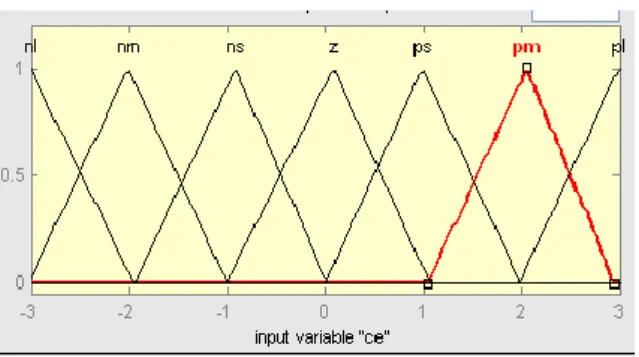
Figure 3 (a). MF for speed error
Figure 3 (b). MF for change in speed error
Figure 3 (c). MF for voltage Table 2. Rule base Speed control
ce/e NB NM NS Z PS PM PB NB NB NB NB NB NM NS Z NM NB NB NB NM NS Z PS NS NB NB NM NS Z PS PM Z NB NM NS Z PS PM PB PS NM NS Z PS PM PB PB PM NS Z PS PM PB PB PB PB Z PS PM PB PB PB PB
4. Space Vector Pulse Width Modulation :
The basic power circuit topology of a three-phase voltage source inverter supplying a star connected three-phase load is given in Figure 4. The power circuit contains in general six semiconductor switches such as MOSFETs, IGBTs, BJTs etc with antiparallel diodes for protection. The two power switch of one leg is complimentary in operation with a small dead band between the switching of two devices. Switching operation of the inverter yield in total 8 output vectors with 6 being active or non zero and two zero vectors. The six active vectors are labeled as V1, V2, V3, V4, V5,V6 and the two zero vectors are
labeled as Vo and V7.
Degree of MF
Speed Error
Change in speed error
Degree of MF
Degree of MF
87
-+ dc V S1 S3 S5 S2 S6 S4 a b N c PWM 1 PWM 4 PWM 3 PWM 5 PWM 6 PWM 2Figure 4 Power Circuit topology of a three-phase VSI.
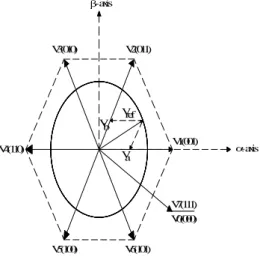
1If these 8 voltage vectors are converted to 2 axis, it can be plotted as shown in Figure 5. The tips of the 6 non zero vectors, when cornered form a regular hexagon with the two zero vectors lying at the origin.
V4(110) V1(001) V3(010) V2(011) V5(100) V6(101) V7(111) V0(000) a V Vb ref V - axis - axis
Figure - 5 Space voltage vectors of a three-phase VSI.
The Vref in α-β plane rotates circularly, so that the output
voltage will be sinusoidal. Since the voltage source inverter can have 8 states, Vref can only be synthesized by using 8 voltage vectors. There can be infinite ways to synthesize the input reference but the most simple is by using the two neighboring active vectors and a zero vector. In other words it can be said that the inverter is switched in such a way that the two neighboring output voltage is generated. If the direction of rotation of the reference vector is assumed as anticlockwise then the vector to the right is designated with suffix „a‟ and the vector lying on the left of the reference is denoted with suffix „b‟. The inverter switching is done is such a way that one state (say 001) remains for some time (say Ta) and is followed by
another state (say 011) for some time (say Tb). The remaining
time out of one switching period (Ts) is filled with the
application of vector Vo for time T0/2 and vector V7 for time
T0/2. Thus a symmetrical space vector modulation is obtained.
If Vref is in 1 st
sector, then, where,
Ta - Switching time for non zero vector (V1) in 1st sector
Tb - Switching time for non zero vector (V2) in 1 st
sector T0 - Zero vector switching time (Vo ,V7) in 1st sector
Ts - Total switching time period
The second equation is termed as equal volt-sec. principle. 2The
inverter output voltage
V
k
can assume only eight discrete locations in the complex plane, including the zero voltage vectors. The zero voltage vector will be included in the switching sequence to minimize the commutations in the inverter (Turn ON and Turn OFF losses will be less).3One can generate any voltage vector laying inside the hexagon whose corners on the six active switching state vectors (V1 to
V6) in space vector modulation strategy, the inverter out net
reference vector
V
ref
can be approximated during a sampling time Δt = 1/(2fs) by a sequence of 3 space voltagevectors Va, Vb and VN, where Va and Vb are 2 of the adjacent
six active vector V1....V6 VN is a zero vector Vo and V7 chosen
in such a way to minimize the commutations in the inverter fs is
the switching frequency.
The above time intervals Ta, Tb and To during which the
switching state vectors Va, Vb and VN are applied are derived
from the geometry of the hexagon and can be written as the following formulas
4where θ is the angle between Va and
V
ref
, m is the modulation index. This is the generic solution for each sector in the plane, θ always varies in the interval (0-60°). By varying the modulation index m and θ, the output voltage amplitude and frequency can be varied. Modulation index control the output voltage magnitude and θ controls the frequency of the output voltage.
where,
m - Modulation index θ - Vector Angle
When equations for Ta, Tb & To are implemented in digital
signal PIC micro controller, the compare registers value corresponding to Ta, Tb & To have to be calculated and loaded
to generate the 6 PWMs for the three phase voltage source inverter. This results in 3 phase voltage output from a voltage inverter using space vector pulse width modulation. This SVPWM is used in vector control implementation when rotating reference frame operation is considered.
5. dsPIC MicroController:
The dsPIC30F is a High Performance Digital Signal Controllers with CPU module has a 16-bit (data) modified Harvard architecture with an enhanced Instruction set, including significant support for DSP. The instruction set includes many addressing modes and was designed for optimum C complier efficiency.
88
A. Features1. High performance modified RISC CPU
2. 48 Kbytes on-chip Flash program space (16K Instruction words)
3. 2 Kb of on-chip data RAM and 1 Kb of nonvolatile data EEPROM
4. 4 MHz- 10 MHz oscillator input with PLL active (4x, 8x, 16 as)
5. 16 x 16- bit working register array 6. Timer module with programmable presale
7. 6-bit Capture input and 16- bit Compare/PWM output functions
8. 2 UART modules with FIFO Buffer 9. 6 PWM output channels
10. Analog-to-Digital Converter (A/D) with 4 S/H Inputs For more about features of aspic refer respective data sheet.
6. Pulse Generation Using dsPIC
A. Register Involved:
I/O Port control registers:
All I/O ports have three registers directly associated with the operation of the port, where „x‟ is a letter that denotes the particular I/O port. TRISx: Data Direction registers, PORTx: I/O Port registers, LATx: I/O Latch registers. Each I/O pin on the device has an associated bit in the TRIS, PORT and LAT Registers.
Timers:
TMRx: 16-bit timer count register, PRx: 16-bit period register associated with the timer, TxCON: 16-bit control register associated with the timer. Some16-bit timers can be combined to form a 32-bit timer.
Input capture and output compare:
The Input Capture module has multiple operating modes, which are selected via the ICxCON register. The dsPIC30F device may have up to eight output compare channels, designated OC1, OC2, OC3, etc., Each output compare channel can use one of two selectable time bases. The time base is selected using the OCTSEL bit (OCxCON<3>).
Motor control PWM control registers:
The control registers are PTOCN, PTMR, PTPER, PWMCON and PDC.
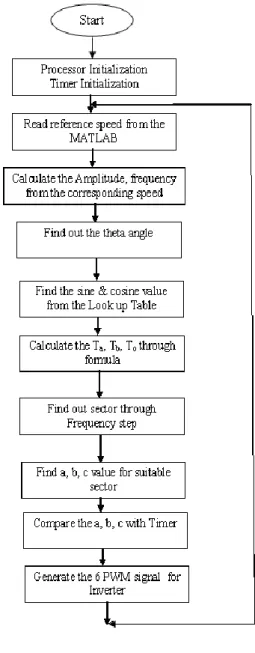
B. Flow chart:
7.
Hardware Results:
To evaluate the performance of the system, a series of measurements has been accomplished.
Figure- 7 SVPWM
By using the experimental setup we find the following results. Figure 7 show the Space Vector PWM. Figure. 8 (a, b) as shown speed response of the fuzzy logic controller with a fuzzy tuning rule based on Reference speed of 1000rpm and 1200 rpm.
89
Figure-8.a
Figure-8.b
Figure.9 – a as shown step up speed response for 500 to1000 RPM of the proposed system.
Figure.9 – b as shown step up speed response for 1000 to1200 RPM of the proposed system.
Figure-9.a
Figure-9.b
Figure.10 – a as shown step down up speed response for 1400 to1000 RPM of the proposed system
Figure.10 –b as shown step down speed response for 1000 to500 RPM of the proposed system.
Figure-10.a
Figure-10.b
8. Conclusion
This paper presents implementation of Real time MATLAB Interface for speed control of induction motor drive using dsPIC 30F4011. The experimental results are analyzed and, it‟s found that the speed of the induction motor can be controlled in Normal, step up , step down response.
ACKNOWLEDGMENT
The authors wish to thank the Management, Principal and the Department of Electrical and Electronics Engineering, Sona
90
College of Technology, Salem-5, TamilNadu who have givenfacilities to do this research work successfully.
REFERENCE:
1) W. Leonhard, Control of Electrical Drives, Springer-Verlag Berlin Heidelberg, New York, Tokyo, 1985.
2) Chuen Chien Lee, “Fuzzy Logic in Control Systems: Fuzzy Logic controller –Part1,2” 1990 IEEE ..
3) R.Arulmozhiyal and K.Baskaran,“A Novel Approach to Induction motor speed control using FPGA”,International Journal of Applied Engineering Research, ISSN 0973-4562, Volume 4, Number 1 (2009), pp 1-14.
4) R.Arulmozhiyal and K.Baskaran, “ Space vector pulse width modulation based speed control of Induction motor using Fuzzy PI controller”, International Journal of Computer and Electrical Engineering, ISSN 1793-8198, Volume 1, Number 1 (2009), pp 98-103.
5) High Performance Digital Signal Controllers “dspic30f Family Reference Manual and data sheet ”