© 2018, IRJET | Impact Factor value: 7.211 | ISO 9001:2008 Certified Journal | Page 3112
AN EXPERIMENTAL STUDY ON COMPRESSIVE STRENGTH OF CONCRETE
USING SEA SAND AS A PARTIAL REPLACEMENT FOR RIVER SAND
Abhishek H.D
1, Aashu Bedrae R.K
2, Harsha J
3, Shridhara Y
4, Devaraju T.S
5, Shwetha D
61,2,3Students, Dept. of Civil Engineering, N.D.R.K.I.T., Hassan, Karnataka, India.
4,5,6 Asst. Professor, Dept. of Civil Engineering, N.D.R.K.I.T., Hassan, Karnataka, India.
---***---Abstract: The construction industry is growing with major
trust on infrastructure and the demand for sand is also increasing. The overuse of river sand for construction has many undesirable environmental and social consequences. The natural sand deposits are depleting and illegal sand mining is becoming uncontrollable issue. In-stream sand mining has become a common practice and resulted in a mushrooming of river sand mining activities which have given rise to various problems that require urgent action by the authorities. These include river bank erosion, river bed degradation, river buffer zone encroachment and deterioration of river water quality and groundwater availability. The main natural and cheapest sources of sand are riverbeds and these natural resources are depleting very fast. Due to various reasons good sand is not necessarily readily available and it should be transported from long distances. Transportation is a major factor in the delivered price of construction sand. Moving construction sand to the market increases the sale price of the market significantly, due to the high cost of transportation. The use of specific deposits of sand depends on the performance of these materials in standardized engineering tests, including, but not limited to, grain size distribution, shape and percentage of silt or clay.
Key Words: Aggregate, Sea Sand, Concrete, Salt content, Compressive Strenght.
1. INTRODUCTION
It is generally known that, the fundamental requirement for making concrete structures is to produce good quality concrete. Good quality concrete is produced by carefully mixing cement, water, and fine and coarse aggregate and combining admixtures as needed to obtain the optimum product in quality and economy for any use.
Good concrete, whether plain, reinforced or pre-stressed, should be strong enough to carry superimposed loads during its anticipated life. Other essential properties include impermeability, durability, minimum amount of shrinkage, and cracking.
In the present scenario of the construction industry, it is difficult to meet the on raising demand for the fine aggregate. As though the cost of construction has increased over the years, the downfall of resource materials has also a rise. It is essential to search for the alternative that available for the construction purpose, that could effectively rephrase the conventional resources. As we are available with a bulk
amount of sea sand in our country, it may result as profitable alternative in the future.
2. Environmental Issues and Problems
The environmental impact is attributed to the non-renewable character of the natural resources, the environmental impact on neighbourhood, land use conflicts, high energy consumption needed for aggregate production and the potential environmental or health impact of materials produced due to leaching of heavy metals, radioactivity and to special mineral suspects to have hazardous health effects. Over a period of time waste management has become one of the most complex and challenging problems in India affecting the environment. The rapid growth of industrialization gave birth to numerous kinds of waste by products which are environmentally hazard and create problems of storage. Therefore, due to the above-mentioned facts, looking for viable alternatives to natural sand is a must.
3. AIM AND OBJECTIVES
The objective of this project work is:
To study the influence of sea sand on the Compressive strength in development of concrete and compare the result with that of concrete produced using river sand.
To provide information on sea sand, cement, aggregates and mix design processes.
To examine the suitability of sea sand as fine aggregate in concrete.
4. CONCRETE MIX DESIGN AND PROPORTION
© 2018, IRJET | Impact Factor value: 7.211 | ISO 9001:2008 Certified Journal | Page 3113 The compressive strength of hardened concrete
which is generally considered to be an index of its other properties, depends upon many factors, e.g. quality and quantity of cement, water and aggregates; batching and mixing; placing, compaction and curing.
4.1 MIX PROPORTIONS
Cement = 430kg/m3 Water = 197 kg/m3
Fine aggregate = 764 kg/m3 Coarse aggregate = 1015 kg/m3 Chemical admixture = none Water-cement ratio = 0.45
5. MATERIALS AND PROPERTIES 5.1 Sea Sand
Sea sand which is being available in mass can be processed in the treatment plants and can be replaced for the fine aggregate in suitable proportions. The salt content present in the sea sand should be of moderate content and it can be purified either by washing with ample water. To overcome the problem of removal of chloride and lower durability certain precautionary measures are being taken for the effective usage of sea sand in the construction regions.
5.2 Properties of Sea Sand
Physical properties of coastal soils are scarce in number. Usually, these properties are studied together with the other soil characteristics. The texture of coastal soils may vary in a wide range from loose sandy deposits to heavy soils. The distribution of size fractions along the profiles of coastal soils is very uneven and rather random. As a rule, sandy layers of coastal soils are structure less and loose, sometimes they are somewhat compacted or rather even dense. Sandy horizons are characterized by a high water and air permeability. Therefore, the aeration of sandy soils is rather good; they are not so strongly affected by water logging as clayey soils.
The bulk density of sandy soils is somewhat higher than 1 g/cm3. The water content does not exceed 10-20 %. The bulk density of coastal soils generally decreases from sandy to clayey soils, from mineral to organic soils. Simultaneously, increase in the water holding capacity is observed. The Physical and Chemical properties of sea sand are determined using granular size, pH test, chloride test.
5.3 Properties of River Sand
The color of the sand is Orange yellow and brown. Granular size of river sand is less than 4.75 mm.99.5 % of SiO2 is pure in condition. Al2O3 and Fe2O3 are the impurities present (0.5%). Melting point is (1722 °C) with flux agent it reduces to 1290C2. River sand is uniform in size
and also offered in various particle sizes. It has the property of reducing the shrinkage cracks.
5.4 Comparison of Sea Sand and River Sand
Sea sand is more stable (high SBC - Safe Bearing Capacity) than river sand. It is due to the fact that sea sand, which is brought by travelling water either pushed by sea shore or by river during the continuous rolling in between water layers in rivers and sea shore (which can be assumed as infinite time process) bigger stone particles continuously decaying during travelling towards sea and dissociates into as small as possible. Remaining dissociates particles at beach will be of much strength than any other sand in the earth surface.
5.5 Cement
[image:2.595.307.561.579.716.2]Generally OPC (43 grade) is used for the investigation and construction works. It confirmed to the requirements of Indian standard Specification IS: 8112-1989. The tests on cement are carried out as per IS: 4031-1991.
Table 1: Physical properties of Ordinary Portland cement
5.6 RIVER SAND AND SEA SAND
IS: 383-1970 defines the fine aggregates as particles, which will pass through 4.75mm, IS sieve. It is also called as sand.
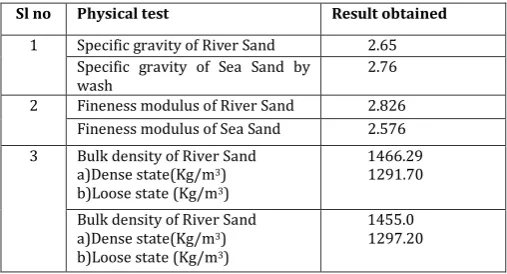
Table 2: Test results of Fine Aggregate
Sl no Physical test Result obtained
1 Specific gravity of River Sand 2.65 Specific gravity of Sea Sand by
wash 2.76
2 Fineness modulus of River Sand 2.826 Fineness modulus of Sea Sand 2.576 3 Bulk density of River Sand
a)Dense state(Kg/m3) b)Loose state (Kg/m3)
1466.29 1291.70
Bulk density of River Sand a)Dense state(Kg/m3) b)Loose state (Kg/m3)
1455.0 1297.20
Sl no Physical test Result
obtained Requirement (IS:8112-1989)
1 Fineness (retained on
90µm sieve)% 2.33 10 maximum 2 Normal consistency (%) 32 -
3 Specific gravity of cement 3.15 - 4 Vicat time of
setting(minutes) a)Initial setting time b)Final setting time
40
430
30 minimum
© 2018, IRJET | Impact Factor value: 7.211 | ISO 9001:2008 Certified Journal | Page 3114 5.7 Coarse aggregate
The properties of the coarse aggregate are tested as per IS 2386-part III. The results obtained are shown in the table.
Table 3: Test results of Coarse aggregate
Sl no Physical test Results obtained
1 Specific gravity of C.A 2.67 2 Fineness modulus of C.A 4.46 3 Bulk density of C.A
a)Dense state(Kg/m3) b)Loose state(Kg/m3)
1382.55 1224.63 4 Absorption capacity of C.A (%) 0.6 5 Impact value (%) 28 6 Crushing strength (%) 28.4
5.7 TESTS CONDUCTED ON WATER SAMPLE OF SEA SAND Chlorides
Chlorides are soluble mineral compound that are dissolved by the water as it filters through the earth. Chlorides are generally present in the Sea Sand. According to World Health Organization, the maximum acceptable chloride concentration in drinking water is 250 to 1000 mg/l. The chloride content in Sea water can be determined by titrating the water with standard silver nitrate solution using potassium dichromate.
Table 4: Chloride Content in mg\lit
Water
samples River sand In mg\lit Sea Sand With Out Wash In mg\lit
Sea Sand With Wash In mg\lit
Amount of Chloride Content
238 419 269
pH
pH is a measure of how acidic/basic water is. The range goes
from 0 - 14, with 7 being neutral. pH of less than 7 indicates
acidity, whereas pH of greater than 7 indicates a base. pH is
really a measure of the relative amount of free hydrogen and
hydroxyl ions in the water. pH meter is an electronic
instrument consisting of a special bulb that is sensitive to 0 is amplified and sent to an electronic meter connected to the bulb, which measures and display the pH reading. It gives more precise values than the pH papers.
Table 5: pH values
Water samples River sand Sea Sand With
Out Wash Sea Sand With Wash
pH values 9.55 9.97 9.47
Hardness
Hardness is the property of water which prevents the formation of lather or foam when such water is mixed with soap. It is usually caused by the presence of calcium and magnesium divalent metallic ions. Hardness is generally defined as the calcium carbonate equivalent of calcium and
magnesium ions presence in water and is expressed in mg/l. There are mainly two types of hardness.
Temporary hardness
Permanent hardness
Table 6: Hardness values
Water samples River sand Sea Sand With
Out Wash Sea Sand With Wash
Hardness values 350 515 573
Total Dissolved Solids
Total dissolved solids (TDS) comprise inorganic salts (principally calcium, magnesium, potassium, sodium, bicarbonates, chlorides, and sulfates) and some small amounts of organic matter that are dissolved in water. TDS in drinking-water originate from natural sources, sewage, urban run-off, industrial wastewater, and chemicals used in the water treatment process, and the nature of the piping or hardware used to convey the water, i.e., the plumbing.
Table 7: Total Dissolved Solids values
Water
samples River sand In mg\lit Sea Sand With Out Wash In mg\lit Sea Sand With Wash In mg\lit
Permissible
Limits 236 2141 301
[image:3.595.321.543.489.559.2]6. RESULTS AND DISCUSSIONS 6.1 Test on Fresh Concrete Slump Test
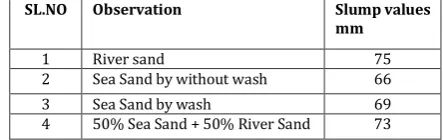
Table 9: Slump Test
SL.NO Observation Slump values mm
1 River sand 75
2 Sea Sand by without wash 66 3 Sea Sand by wash 69 4 50% Sea Sand + 50% River Sand 73
6.2 Tests on Hardened Concrete COMPRESSION-TEST
Compressive Strength N/mm2 of River Sand
Table 10: Compressive Strength of River Sand
SL.NO Days CUBE 1 CUBE 2 CUBE 3
1. 3 12.89 13.07 12.91 2. 14 21.96 22.01 22.17 3. 28 39.85 38.34 39.06
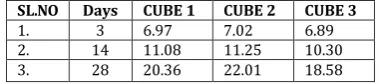
© 2018, IRJET | Impact Factor value: 7.211 | ISO 9001:2008 Certified Journal | Page 3115 Table 11: Compressive Strength of Sea Sand without wash
SL.NO Days CUBE 1 CUBE 2 CUBE 3
1. 3 6.97 7.02 6.89 2. 14 11.08 11.25 10.30 3. 28 20.36 22.01 18.58
[image:4.595.65.258.198.242.2]Compressive Strength N/mm2 of 10% Sea Sand
Table 12: Compressive Strength of 10% Sea Sand
SL. NO Days CUBE 1 CUBE 2 CUBE 3
1. 3 8.01 7.89 8.45 2. 14 16.98 16.76 17.08 3. 28 33.43 32.85 33.05
[image:4.595.65.258.296.342.2]Compressive Strength N/mm2 of 20% Sea Sand
Table 13: Compressive Strength of 20% Sea Sand
SL. NO Days CUBE 1 CUBE 2 CUBE 3
1. 3 8.67 7.23 8.21
2. 14 17.21 17.76 17.38
3. 28 34.97 34.23 33.65
[image:4.595.308.560.370.687.2]Compressive Strength N/mm2 of 30% Sea Sand
Table 14: Compressive Strength of 30% Sea Sand
SL. NO Days CUBE 1 CUBE 2 CUBE 3
1. 3 9.45 9.25 8.95 2. 14 18.23 18.01 17.76 3. 28 35.39 35.69 35.25
[image:4.595.61.261.394.452.2]Compressive Strength N/mm2 of 40% Sea Sand
Table 15: Compressive Strength of 40% Sea Sand
SL. NO Days CUBE 1 CUBE 2 CUBE 3
1. 3 10.02 9.89 10.36 2. 14 20.78 20.54 19.91 3. 28 36.59 35.36 36.95
Compressive Strength N/mm2 of 50% Sea Sand
Table 16: Compressive Strength of 50% Sea Sand
Compressive Strength N/mm2 of 100% Sea Sand
Table 17: Compressive Strength of 100% Sea Sand
SL. NO Days CUBE 1 CUBE 2 CUBE 3
1. 3 10.25 10.37 10.13 2. 14 17.63 18.01 17.94 3. 28 34.28 34.72 34.55
0 2 4 6 8 10 12 14
River sand
Sea sand with out wash
10% 20% 30% 40% 50% 100%
C
o
m
p
re
ss
iv
e
s
tr
e
n
gt
h
in
M
pa
(A
vg
)
Percentage of Replacement
Chart - 1 : 3 Days
3 Days
0 5 10 15 20 25
Co
m
p
re
ss
iv
e
str
en
gth
in
M
p
a(
A
vg
)
Percentage of Replacement
Chart - 2 : 14 Days
14 Days
0 5 10 15 20 25 30 35 40 45
Co
m
p
re
ss
iv
e
str
en
gth
in
M
p
a(
A
vg
)
Percentage of Replacement
Chart-3 : 28 Days
28 Days
Through washing of sea sand by ample amount of fresh water, the salt content is predominantly reduced to an extent and can be used in some construction works. But the sea sand by wash which is being washed and it is mixed with conventional fine aggregate that is river sand for about 50% SL. NO Days CUBE 1 CUBE 2 CUBE 3
1. 3 11.98 12.10 11.95
2. 14 20.65 21.12 21.08
[image:4.595.65.255.502.545.2]© 2018, IRJET | Impact Factor value: 7.211 | ISO 9001:2008 Certified Journal | Page 3116 in equal proportions and this mixture provides equal
strength equal to that of conventional river sand.
7. CONCLUSION
After washing the sea sand is used for construction. This washed sea sand consists of less amount of salt content. The specific gravity and salt content are under tolerable limits. But higher fineness of sea sand carks brittle behavior in the concrete. This results in the lesser durability of concrete even though having higher initial compressive strength. By proper treatment to the sea sand that through clear removal of salt content it is possible to ensure larger durability of concrete. This work deals with the usage of sea sand in the construction field with the removal of salt content from sand. After the purification of the sea sand using the experimental setup many tests are conducted on the sand and water is removed from the apparatus after the rinse mechanism. Partial mixing of purified sea sand and the river sand attains adequate strength at 28 days. The replacement of river sand by sea sand overcomes the future demand in the requirement of the river sand in construction. The purified sea sand has more strength than the unpurified sea sand and river sand. Hence, it is proved that the corrosion is controllable. This project concluded that the removal of salt content from sea sand is mandatory for improving the workability and durability of any construction works.
REFERENCES
1) Effect on Compressive Strength of Concrete Using Sea Sand as a Partial Replacement for Fine Aggregate”. IJRET 20150406030 W. Sai Deepak, G. Tirupathi Naidu.
2) “Experimental Investigation of Sea Sand for Construction Purposes” B.Subashini, G. Sivaranjani, G. Dhanalakshmi, K. Gayathri, A. Ashok Kumar, A. Srimathi and C. Revathi.
3) Evaluation of the Potential of Sea Sand as an Alternative to River Sand for Concrete Production in Sri Lanka; Journal of Geaological of Sri Lanka Vol. 16 (2014), 109-117 Professor P.G. Cooray Memorial Volume.
4) “Experimental Investigation on Concrete Using Sea Sand as Fine Aggregate”.
V.Mahalakshmi, S.Priyadharshini, K.Sandhana Roja, M.Sountharya, V.K.Palanisamy U.G, Dept. of Civil Engineering, Cheran College of Engineering, K.Paramathi, Karur, India.
Shridhara Y Asst.Professor
Department of Civil Engineering N.D.R.K.I.T Hassan
Karnataka, India.
Devaraju T S Asst.Professor
Department of Civil Engineering N.D.R.K.I.T Hassan