ISO/IEC DIR 2
Edition 6.0 2011-04ISO/IEC Directives
Part 2
Rules for the structure and drafting of International Standards
O/IE
C
DI
R 2
:20
11
(E
THIS PUBLICATION IS COPYRIGHT PROTECTED Copyright © 2011 ISO/IEC, Geneva, Switzerland
All rights reserved. It is permitted to download this electronic file, to make a copy and to print out the content for the purpose of preparing ISO and IEC documents only. You may not copy or “mirror” the file, or any part of it, for any other purpose without permission in writing from the publishers.
International Organization for International Electrotechnical
Standardization Commission
1, ch. de la Voie-Creuse 3, rue de Varembé
Case postale 56 CH-1211 Geneva 20
CH-1211 Geneva 20 Switzerland
Email: [email protected] Email: [email protected]
ISO/IEC DIR 2
Edition 6.0 2011-04ISO/IEC Directives
Part 2
CONTENTS
FOREWORD ... 5
INTRODUCTION ... 6
1 Scope ... 7
2 Normative references ... 7
3 Terms and definitions ... 8
4 General principles ... 10
4.1 Objective ... 10
4.2 Performance approach ... 10
4.3 Homogeneity ... 11
4.4 Consistency of documents ... 11
4.5 Equivalence of official language versions ... 12
4.6 Fitness for implementation as a regional or national standard ... 12
4.7 Planning ... 12
5 Structure ... 12
5.1 Subdivision of the subject matter ... 12
5.2 Description and numbering of divisions and subdivisions ... 15
6 Drafting ... 17
6.1 Preliminary informative elements ... 17
6.2 General normative elements ... 19
6.3 Technical normative elements ... 20
6.4 Informative supplementary elements ... 25
6.5 Other informative elements... 26
6.6 Common rules and elements ... 27
6.7 Aspects of conformity assessment ... 41
6.8 Aspects of quality management systems, reliability and sampling ... 42
7 Preparation and presentation of documents ... 42
Annex A (informative) Principles for drafting ... 43
A.1 General ... 43
A.2 The aim-oriented approach ... 43
A.3 The performance approach ... 44
A.4 The principle of verifiability ... 45
A.5 Choice of values ... 45
A.6 Accommodation of more than one product size... 46
A.7 Avoidance of repetition ... 46
Annex B (informative) Basic reference works ... 47
B.1 Introduction ... 47
B.2 Reference works for language ... 47
B.3 Standardized terminology ... 47
B.4 Principles and methods of terminology ... 47
B.5 Quantities, units and their symbols ... 47
B.6 Abbreviated terms ... 48
B.7 Bibliographic references ... 48
B.8 Technical drawings and diagrams ... 48
B.9 Technical documentation ... 48
B.10 Graphical symbols, public information symbols and safety signs ... 48
B.12 Preferred numbers ... 49
B.13 Statistical methods ... 49
B.14 Environmental conditions and associated tests ... 49
B.15 Safety ... 49
B.16 Chemistry ... 50
B.17 EMC (electromagnetic compatibility) ... 50
B.18 Conformity and quality ... 50
B.19 Adoption of International Standards and other International deliverables ... 50
B.20 Environmental management ... 50
B.21 Packaging ... 50
B.22 Consumer issues ... 50
B.23 Guides ... 51
Annex C (informative) Example of numbering of divisions and subdivisions ... 52
Annex D (normative) Drafting and presentation of terms and definitions... 53
D.1 General principles ... 53
D.2 Arrangement ... 55
D.3 Terminological entries in different language sections of a document ... 55
D.4 Presentation ... 56
Annex E (normative) Drafting of the title of a document ... 60
E.1 Elements of the title ... 60
E.2 Avoidance of unintentional limitation of the scope ... 61
E.3 Wording ... 61
Annex F (normative) Patent rights ... 62
Annex G (normative) Designation of internationally standardized items... 63
G.1 General ... 63
G.2 Applicability ... 63
G.3 Designation system ... 64
G.4 Use of characters ... 64
G.5 Description block ... 65
G.6 Identity block ... 65
G.7 Examples ... 66
G.8 National implementation ... 67
Annex H (normative) Verbal forms for the expression of provisions ... 69
Annex I (informative) Quantities and units ... 71
Tables Table 1 — Names of divisions and subdivisions ... 13
Table 2 — Example of a typical arrangement of elements in a document ... 14
Table H.1 — Requirement ... 69
Table H.2 — Recommendation ... 69
Table H.3 — Permission ... 70
FOREWORD
The ISO/IEC Directives are published as two parts: • Part 1: Procedures for the technical work;
• Part 2: Rules for the structure and drafting of International Standards.
They have been approved by the ISO Technical Management Board and the IEC Standardization Management Board.
This sixth edition incorporates changes agreed by both organizations. Changes which have been adopted in only one of the organizations are being published separately in the ISO Supplement and the IEC Supplement, respectively, which are to be used in conjunction with the Directives.
This sixth edition of the ISO/IEC Directives, Part 2, is presented in such a way that it serves as an example of the rules that it provides. In addition to a number of editorial revisions, the following main changes have been made with respect to the previous edition:
• updating of references and their associated requirements (in particular those relating to terms and definitions) (Clause 2 and Annex B);
• replacement of the term "required element" by "mandatory element" and "optional element" by "conditional element" (Clause 3);
• revision of the boilerplate text for the normative references clause to clarify that a normative reference may apply in whole or in part (6.2.2);
• revision of provisions related to conformity assessment (6.3.5.1, 6.7 and 6.8);
• revision of the requirement concerning alternative test methods such that the referee method is optional rather than required (6.3.5.4);
• addition of the possibility to include headings in a bibliography (6.4.2);
• clarification of the provisions relating to notes and examples integrated in the text (6.5.1); • revision of the provisions concerning patent rights for alignment with the
ISO/IEC Directives, Part 1 (6.6.4 and Annex F);
• addition of requirement that imprecise references to elements of text shall not be used (6.6.7.3.1);
• revision of the rules concerning dated references to allow for the month and, if necessary, the day to be cited (6.6.7.5.3);
• replacement of the term "equation" by "formula" as appropriate (6.6.10);
• addition of reference works relating to consumer issues and international standardization (B.22 and B.23).
This sixth edition of the ISO/IEC Directives, Part 2 is applicable to all enquiry drafts and to all final drafts registered after 2011-10-01.
Both ISO and IEC have published guides on the use of templates and other tools for the preparation of documents prepared in accordance with the ISO/IEC Directives. These guides are available on the ISO web site (http://www.iso.org) and IEC web site (http://www.iec.ch).
INTRODUCTION
It is recognized that amongst standards writers many different tools are used for the drafting of documents, and that these tools will not necessarily permit the same options for the presentation of text elements. Therefore, wherever possible, optional presentations have been allowed for in these rules [e.g. it is permitted to precede the items in an unordered list by dashes or bullets (see 5.2.5)]. However, for such cases it should be noted that the ISO Central Secretariat and the IEC Central Office reserve the right to apply only one presentation.
NOTE This English version of the ISO/IEC Directives, Part 2, was prepared using the IEC template. The French version was prepared using the ISO template.
ISO/IEC Directives — Part 2:
Rules for the structure and drafting of International Standards
1 Scope
This part of the ISO/IEC Directives specifies rules for the structure and drafting of documents intended to become International Standards, Technical Specifications or Publicly Available Specifications. As far as practicable, these rules also apply to documents intended to become Technical Reports or Guides. All these document types are referred to collectively hereinafter as documents, unless otherwise necessary.
The rules are intended to ensure that such documents, prepared by the committee secretariats of the International Organization for Standardization (ISO) and the International Electrotechnical Commission (IEC), are drafted in as uniform a manner as practicable, irrespective of the technical content.
It also gives some guidance with regard to presentation.
It does not specify the typography and layout of published documents, which are determined by the house style of the publishing organization.
2 Normative references
The following documents, in whole or in part, are normatively referenced in this document and are indispensable for its application. For dated references, only the edition cited applies. For undated references, the latest edition of the referenced document (including any amendments) applies.
ISO 78-2, Chemistry — Layouts for standards — Part 2: Methods of chemical analysis
ISO 128-30:2001, Technical drawings — General principles of presentation — Part 30: Basic conventions for views
ISO 128-34:2001, Technical drawings — General principles of presentation — Part 34: Views on mechanical engineering drawings
ISO 128-40:2001, Technical drawings — General principles of presentation — Part 40: Basic conventions for cuts and sections
ISO 128-44:2001, Technical drawings — General principles of presentation — Part 44: Sections on mechanical engineering drawings
ISO 639-1, Codes for the representation of names of languages — Part 1: Alpha-2 code
ISO 690, Information and documentation — Guidelines for bibliographic references and citations to information resources
ISO 3098-2, Technical product documentation — Lettering — Part 2: Latin alphabet, numerals and marks
ISO 3166 (all parts), Codes for the representation of names of countries and their subdivisions
ISO 6433, Technical drawing — Item references
ISO 7000, Graphical symbols for use on equipment — Index and synopsis
ISO 10241-1:2011, Terminological entries in standards — Part 1: General requirements and examples of presentation
ISO 14617 (all parts), Graphical symbols for diagrams
ISO 15924, Information and documentation — Codes for the representation of names of scripts
ISO 80000 (all parts), Quantities and units
IEC 60027 (all parts), Letter symbols to be used in electrical technology IEC 60417, Graphical symbols for use on equipment
IEC 60617, Graphical symbols for diagrams
IEC 61082-1, Preparation of documents used in electrotechnology — Part 1: Rules
IEC 61175, Industrial systems, installations and equipment and industrial products — Designation of signals
IEC 61355-1, Classification and designation of documents for plants, systems and equipment — Part 1: Rules and classification tables
IEC 80000 (all parts), Quantities and units
IEC 81346 (all parts), Industrial systems, installations and equipment and industrial products — Structuring principles and reference designations
ISO/IEC 17000, Conformity assessment — Vocabulary and general principles ISO/IEC Directives, Part 1, Procedures for the technical work
ISO/IEC Directives, Supplement— Procedures specific to IEC ISO/IEC Directives, Supplement— Procedures specific to ISO ISO eServices Guide, ISO, available at
<http://www.iso.org/iso/standards_development/it_tools.htm>
ITSIG specification for the preparation and exchange of graphics, ISO ISO Template, ISO, available at <http://www.iso.org/templates> IECSTD Template, IEC, available at
<http://www.iec.ch/standardsdev/resources/docpreparation/iec_template/>
Quality management systems — Guidance and criteria for the development of documents to meet needs of specific product and industry/economic sectors, ISO/TC 176, available at <http://www.iso.org/directives> in the section Normative references
3 Terms and definitions
For the purposes of this document, the following terms and definitions apply. 3.1 Document type
3.1.1 standard
document, established by consensus and approved by a recognized body, that provides, for common and repeated use, rules, guidelines or characteristics for activities or their results, aimed at the achievement of the optimum degree of order in a given context
Note 1 to entry: Standards should be based on the consolidated results of science, technology and experience, and aimed at the promotion of optimum community benefits.
[SOURCE: ISO/IEC Guide 2:2004, definition 3.2] 3.1.2
international standard
standard that is adopted by an international standardizing/standards organization and made available to the public
[SOURCE: ISO/IEC Guide 2:2004, definition 3.2.1.1] 3.1.3
International Standard
3.1.4
Technical Specification TS
document published by ISO or IEC for which there is the future possibility of agreement on an International Standard, but for which at present
• the required support for approval as an International Standard cannot be obtained, • there is doubt on whether consensus has been achieved,
• the subject matter is still under technical development, or
• there is another reason precluding immediate publication as an International Standard Note 1 to entry: The content of a Technical Specification, including its annexes, may include requirements. Note 2 to entry: A Technical Specification is not allowed to conflict with an existing International Standard. Note 3 to entry: Competing Technical Specifications on the same subject are permitted.
Note 4 to entry: Prior to mid-1999, Technical Specifications were designated as Technical Reports of type 1 or 2.
3.1.5
Technical Report TR
document published by ISO or IEC containing collected data of a different kind from that normally published as an International Standard or Technical Specification
Note 1 to entry: Such data may include, for example, data obtained from a survey carried out among the national bodies, data on work in other international organizations or data on the “state of the art” in relation to standards of national bodies on a particular subject.
Note 2 to entry: Prior to mid-1999, Technical Reports were designated as Technical Reports of type 3.
3.1.6 Guide
document published by ISO or IEC giving rules, orientation, advice or recommendations relating to international standardization
Note 1 to entry: Guides can address issues of interest to all users of documents published by ISO and IEC.
3.1.7
Publicly Available Specification PAS
document published by ISO or IEC to respond to an urgent market need, representing either a) a consensus in an organization external to ISO or IEC, or
b) a consensus of the experts within a working group
Note 1 to entry: A Publicly Available Specification is not allowed to conflict with an existing International Standard. Note 2 to entry: Competing Publicly Available Specifications on the same subject are permitted.
3.2 Element 3.2.1
normative element
element that describes the scope of the document or sets out provisions 3.2.2 Informative element
3.2.2.1
preliminary informative element
element that identifies the document, introduces its content and explains its background, its development and its relationship with other documents
3.2.2.2
supplementary informative element
element that provides additional information intended to assist the understanding or use of the document
3.2.3
mandatory element
element the presence of which in a document is obligatory 3.2.4
conditional element
element the presence of which in a document is dependent on the provisions of the particular document
3.3 Provision 3.3.1
requirement
expression in the content of a document conveying criteria to be fulfilled if compliance with the document is to be claimed and from which no deviation is permitted
Note 1 to entry: Table H.1 specifies the verbal forms for the expression of requirements.
3.3.2
recommendation
expression in the content of a document conveying that among several possibilities one is recommended as particularly suitable, without mentioning or excluding others, or that a certain course of action is preferred but not necessarily required, or that (in the negative form) a certain possibility or course of action is deprecated but not prohibited
Note 1 to entry: Table H.2 specifies the verbal forms for the expression of recommendations.
3.3.3 statement
expression in the content of a document conveying information
Note 1 to entry: Table H.3 specifies the verbal forms for indicating a course of action permissible within the limits of the document. Table H.4 specifies the verbal forms to be used for statements of possibility and capability.
3.4
state of the art
developed stage of technical capability at a given time as regards products, processes and services, based on the relevant consolidated findings of science, technology and experience [SOURCE: ISO/IEC Guide 2:2004, definition 1.4]
4 General principles
4.1 Objective
The objective of documents published by ISO and IEC is to define clear and unambiguous provisions in order to facilitate international trade and communication. To achieve this objective, the document shall
• be as complete as necessary within the limits specified by its scope, • be consistent, clear and accurate,
• take full account of the state of the art (see 3.4),
• provide a framework for future technological development,
• be comprehensible to qualified persons who have not participated in its preparation, and • take into account the principles for the drafting of documents (see Annex A).
4.2 Performance approach
Whenever possible, requirements shall be expressed in terms of performance rather than design or descriptive characteristics. This approach leaves maximum freedom to technical
development. Primarily those characteristics shall be included that are suitable for worldwide (universal) acceptance. Where necessary, owing to differences in legislation, climate, environment, economies, social conditions, trade patterns, etc., several options may be indicated. See A.3 for further information.
4.3 Homogeneity
Uniformity of structure, of style and of terminology shall be maintained not only within each document, but also within a series of associated documents. The structure of associated documents and the numbering of their clauses shall, as far as possible, be identical. Analogous wording shall be used to express analogous provisions; identical wording shall be used to express identical provisions.
The same term shall be used throughout each document or series of associated documents to designate a given concept. The use of an alternative term (synonym) for a concept already defined shall be avoided. As far as possible, only one meaning shall be attributed to each term chosen.
These requirements are particularly important not only to ensure comprehension of the document, or of the series of associated documents, but also to derive the maximum benefit available through automated text processing techniques and computer-aided translation. 4.4 Consistency of documents
In order to achieve the aim of consistency within the complete corpus of documents published by ISO and IEC, the text of every document shall be in accordance with the relevant provisions of existing basic documents published by ISO and IEC. This relates particularly to a) standardized terminology,
b) principles and methods of terminology, c) quantities, units and their symbols, d) abbreviated terms,
e) bibliographic references,
f) technical drawings and diagrams, g) technical documentation, and
h) graphical symbols, public information symbols and safety signs.
In addition, specific technical aspects shall be drafted in accordance with the provisions of general documents published by ISO and IEC dealing with the following subjects:
i) limits, fits and surface properties;
j) tolerancing of dimensions and uncertainty of measurement; k) preferred numbers;
l) statistical methods;
m) environmental conditions and associated tests; n) safety;
o) chemistry;
p) EMC (electromagnetic compatibility); q) conformity and quality;
r) environmental management; s) packaging;
t) consumer issues;
A list of basic reference works is given in Annex B. 4.5 Equivalence of official language versions
The texts in the different official language versions shall be technically equivalent and structurally identical.
The use of bilingualism from the initial stage of drafting is of great assistance in the preparation of clear and unambiguous texts.
4.6 Fitness for implementation as a regional or national standard
The content of a document published by ISO and IEC shall be drawn up in such a way as to facilitate its direct application and its adoption without change as a regional or national standard.
4.7 Planning
Rules for the planning of new work item proposals are given in the ISO/IEC Directives, Part 1. In order to ensure the timely publication of a document or of a series of associated documents, the intended structure and any interrelationships shall be established before detailed drafting begins. In particular, consideration shall be given to the subdivision of the subject matter (see 5.1). In the case of a multipart document, a list of the intended parts together with their titles in English and French shall be drawn up. The rules given in the ISO/IEC Directives and ISO and IEC Supplements shall be applied from the very beginning of the work and throughout all subsequent stages to avoid delay at any stage.
5 Structure
5.1 Subdivision of the subject matter 5.1.1 General
Documents are so diverse that no universally acceptable rules can be established for the subdivision of the subject matter.
However, as a general rule, an individual document shall be prepared for each subject to be standardized, and published as a complete entity. In specific cases and for practical reasons, for example if
a) the document is likely to become too voluminous, b) subsequent portions of the content are interlinked,
c) portions of the document could be referred to in regulations, or
d) portions of the document are intended to serve for certification purposes,
the document may be split into separate parts under the same number. This has the advantage that each part can be changed separately when the need arises.
In particular, the aspects of a product which will be of separate interest to different parties (e.g. manufacturers, certification bodies, legislative bodies) shall be clearly distinguished, preferably as parts of a document or as separate documents.
Such individual aspects are, for example, • health and safety requirements, • performance requirements,
• installation rules, and • quality assessment.
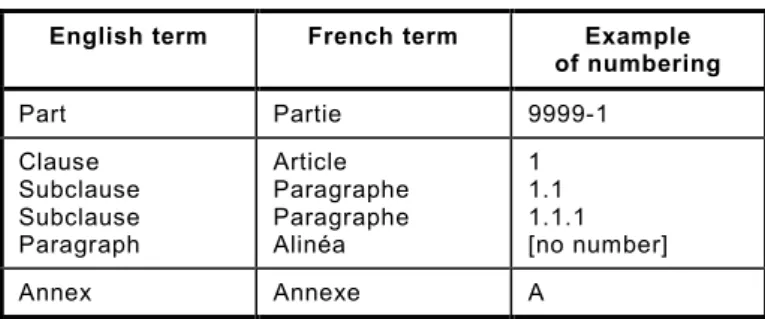
The terms which shall be used to designate the divisions and subdivisions that a document may have are shown in Table 1 in English and in French. For an example of numbering, see Annex C.
Table 1 — Names of divisions and subdivisions English term French term Example
of numbering
Part Partie 9999-1
Clause Subclause Subclause Paragraph
Article Paragraphe Paragraphe Alinéa
1 1.1 1.1.1 [no number]
Annex Annexe A
5.1.2 Subdivision of the subject matter within a series of parts There are two ways of achieving this.
a) Each part deals with a specific aspect of the subject and can stand alone. EXAMPLE 1
Part 1: Vocabulary Part 2: Requirements Part 3: Test methods Part 4: …
EXAMPLE 2
Part 1: Vocabulary Part 2: Harmonics
Part 3: Electrostatic discharge Part 4: …
b) There are both common and specific aspects to the subject. The common aspects shall be given in Part 1. Specific aspects (which may modify or supplement the common aspects and therefore cannot stand alone) shall be given in individual parts.
EXAMPLE 3 In ISO or IEC
Part 1: General requirements Part 2: Thermal requirements Part 3: Air purity requirements Part 4: Acoustical requirements
EXAMPLE 4 In ISO or IEC
Part 1: General requirements
Part 21: Particular requirements for electric irons Part 22: Particular requirements for spin extractors Part 23: Particular requirements for dishwashers
EXAMPLE 5 In terms of numbering, subdivision of part numbers is permitted in IEC only
Part 1: General requirements
Part 2-1: Requirements for plasma displays Part 2-2: Requirements for monitors Part 2-3: Requirements for LCDs
Where the system described in b) is used, care shall be taken that the references from one part to another are valid. There are two ways of achieving this.
• If reference is made to a particular element, the reference shall be dated (see 6.6.7.5.3). • Since the complete series of parts is normally under the control of the same committee,
the use of undated references (see 6.6.7.5.2) is permitted, provided that corresponding changes are implemented simultaneously in all parts. The use of undated references requires a high degree of discipline by the committee responsible for the document.
Each part of a multipart document shall be drafted in accordance with the rules for an individual document as specified in this part of the ISO/IEC Directives.
5.1.3 Subdivision of the subject matter within an individual document
The elements that together form a document may be classified in two different ways: a) by their normative or informative nature and their position within the structure, i.e.
preliminary informative elements (see 3.2.2.1),
general and technical normative elements (see 3.2.1), and supplementary informative elements (see 3.2.2.2);
b) by their mandatory or conditional presence (see 3.2.3 and 3.2.4).
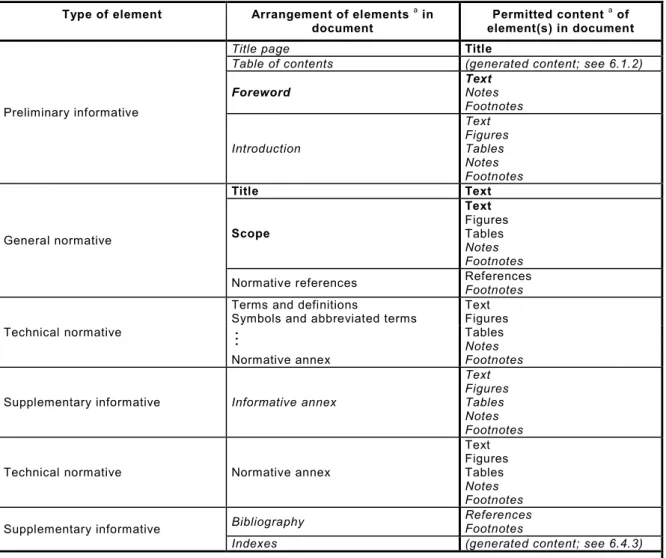
An example of a typical arrangement is given in Table 2. Table 2 also lists the permitted content of each of the elements constituting the arrangement.
Table 2 — Example of a typical arrangement of elements in a document Type of element Arrangement of elements a in
document Permitted content
a of
element(s) in document
Preliminary informative
Title page Title
Table of contents (generated content; see 6.1.2)
Foreword Text Notes
Footnotes Introduction
Text Figures Tables Notes Footnotes
General normative
Title Text
Scope
Text Figures Tables
Notes Footnotes
Normative references References Footnotes
Technical normative
Terms and definitions Text
Symbols and abbreviated terms Figures
TablesNotesNormative annex Footnotes
Supplementary informative Informative annex
Text Figures Tables Notes Footnotes
Technical normative Normative annex
Text Figures Tables
Notes Footnotes
Supplementary informative Bibliography References Footnotes
Indexes (generated content; see 6.4.3)
A document need not contain all the normative technical elements shown and it may contain normative technical elements other than those shown. Both the nature of the normative technical elements and their sequence are determined by the nature of the document in question.
A document may also contain notes and footnotes to figures and tables (see 6.6.5.9, 6.6.5.10, 6.6.6.6 and 6.6.6.7).
Terminology standards have additional requirements for the subdivision of content (see Annex D).
5.2 Description and numbering of divisions and subdivisions 5.2.1 Part
5.2.1.1 The number of a part shall be indicated by Arabic numerals, beginning with 1, following the document number and preceded by a hyphen; for example,
9999-1, 9999-2, etc.
Parts shall not be further subdivided. See also the examples in 5.1.2.
5.2.1.2 The title of a part shall be composed in the same way as that of a document as described in 6.1.1. All the individual titles in a series of parts shall contain the same introductory element (if present) and main element, while the complementary element shall be different in each case in order to distinguish the parts from one another. The complementary element shall be preceded in each case by the designation “Part …:”.
5.2.1.3 If a document is published in the form of a number of separate parts, the first part shall include in its foreword (see 6.1.3) an explanation of the intended structure. In the foreword of each part belonging to the series, a reference shall be made to the titles of all other parts that have been or are planned to be published.
5.2.2 Clause
A clause is the basic component in the subdivision of the content of a document.
The clauses in each document or part shall be numbered with Arabic numerals, beginning with 1 for the “Scope” clause. The numbering shall be continuous up to but excluding any annexes (see 5.2.6).
Each clause shall have a title, placed immediately after its number, on a line separate from the text that follows it.
5.2.3 Subclause
A subclause is a numbered subdivision of a clause. A primary subclause (e.g. 5.1, 5.2, etc.) may be subdivided into secondary subclauses (e.g. 5.1.1, 5.1.2, etc.), and this process of subdivision may be continued as far as the fifth level (e.g. 5.1.1.1.1.1, 5.1.1.1.1.2, etc.).
Subclauses shall be numbered with Arabic numerals (see Annex C for an example).
A subclause shall not be created unless there is at least one further subclause at the same level. For example, text in Clause 10 shall not be designated subclause “10.1” unless there is also a subclause “10.2”.
Each primary subclause should preferably be given a title, which shall be placed immediately after its number, on a line separate from the text that follows it. Secondary subclauses may be treated in the same way. Within a clause or subclause, the use of titles shall be uniform for
subclauses at the same level, e.g. if 10.1 has a title, 10.2 shall also have a title. In the absence of titles, key terms or phrases (composed in distinctive type) appearing at the beginning of the text of the subclause may be used to call attention to the subject matter dealt with. Such terms or phrases shall not be listed in the table of contents.
5.2.4 Paragraph
A paragraph is an unnumbered subdivision of a clause or subclause.
“Hanging paragraphs” such as those shown in the following example shall be avoided since reference to them is ambiguous.
EXAMPLE In the following example, the hanging paragraphs indicated cannot be uniquely identified as being in “Clause 5” since strictly speaking the paragraphs in 5.1 and 5.2 are also in Clause 5. To avoid this problem it is necessary to identify the hanging paragraphs as subclause “5.1 General” (or other suitable title) and to renumber the existing 5.1 and 5.2 accordingly (as shown), to move the hanging paragraphs elsewhere, or to delete them.
Incorrect Correct
5 Designation
The quick brown fox jumps over the lazy dog. The quick brown fox jumps over the lazy dog. The quick brown fox jumps over the lazy dog. 5.1 Xxxxxxxxxxx
The quick brown fox jumps over the lazy dog. 5.2 Xxxxxxxxxxx
The quick brown fox jumps over the lazy dog. The quick brown fox jumps over the lazy dog. The quick brown fox jumps over the lazy dog. The quick brown fox jumps over the lazy dog.
6 Test report
5 Designation 5.1 General
The quick brown fox jumps over the lazy dog. The quick brown fox jumps over the lazy dog. The quick brown fox jumps over the lazy dog. 5.2 Xxxxxxxxxxx
The quick brown fox jumps over the lazy dog. 5.3 Xxxxxxxxxxx
The quick brown fox jumps over the lazy dog. The quick brown fox jumps over the lazy dog. The quick brown fox jumps over the lazy dog. The quick brown fox jumps over the lazy dog.
6 Test report 5.2.5 Lists
Lists should be introduced by a sentence (see Example 1), a complete grammatical proposition followed by a colon (see Example 2), or by the first part of a proposition (without a colon — see Example 3), completed by the items in the list.
Each item in a list shall be preceded by a dash or a bullet or, if necessary for identification, by a lower case letter followed by a parenthesis. If it is necessary to subdivide further an item in the latter type of list, Arabic numerals followed by a parenthesis shall be used (see Example 1).
To aid comprehension, it may be preferable not to continue a sentence after the end of the type of list given in Example 3. Key terms or phrases may be composed in distinctive type to call attention to the subject matter dealt with in the various list items (see Example 1). Such terms or phrases shall not be listed in the table of contents; if it is necessary that they be included in the table of contents, they shall not be presented as list items but as subclause titles (see 5.2.3).
EXAMPLE 1 The following basic principles shall apply to the drafting of definitions. a) The definition shall have the same grammatical form as the term:
1) to define a verb, a verbal phrase shall be used; 2) to define a singular noun, the singular shall be used.
b) The preferred structure of a definition is a basic part stating the class to which the concept belongs, and another part enumerating the characteristics that distinguish the concept from other members of the class.
c) The definition of a quantity shall be formulated in accordance with the provisions of ISO 80000-1. This
means that a derived quantity may be defined by means of other quantities only. No unit shall be used in the hanging
definition of a quantity. Neither should a quantity name reflect any unit. Thus quantity names such as voltage should be avoided; instead electric tension could be used.
EXAMPLE 2 No switch is required for any of the following categories of apparatus:
apparatus having a power consumption not exceeding 10 W under normal operating conditions;
apparatus having a power consumption not exceeding 50 W, measured 2 min after the application of any of the fault conditions;
apparatus intended for continuous operation.
EXAMPLE 3 Vibrations in the apparatus may be caused by
• unbalance in the rotating elements,
• slight deformations in the frame,
• the rolling bearings, and
• aerodynamic loads.
5.2.6 Annex
For the description of the two types of annex, see 6.3.8 and 6.4.1.
Annexes shall appear in the order in which they are cited in the text. Each annex shall be designated by a heading comprising the word “Annex” followed by a capital letter designating its serial order, beginning with “A”, e.g. “Annex A”. The annex heading shall be followed by the indication “(normative)” or “(informative)”, and by the title, each on a separate line. Numbers given to the clauses, subclauses, tables, figures and mathematical formulae of an annex shall be preceded by the letter designating that annex followed by a full-stop. The numbering shall start afresh with each annex. A single annex shall be designated “Annex A”. Annexes may be subdivided into clauses (see 5.2.2), subclauses (see 5.2.3), paragraphs (see 5.2.4) and lists (see 5.2.5). A clause shall not be created unless there is at least one further clause in the annex.
EXAMPLE Clauses in Annex A are designated “A.1”, “A.2”, “A.3”, etc. Subclauses in A.1 are designated “A.1.1”, “A.1.2”, “A.1.3”, etc.
5.2.7 Bibliography
A bibliography, if present, shall appear after the last annex. For the drafting rules, see 6.4.2. 5.2.8 Indexes
Indexes, if present, shall appear as the last element. For the drafting rules, see 6.4.3.
6 Drafting
6.1 Preliminary informative elements 6.1.1 Title page
The title page shall contain the title of the document.
The wording of the title shall be established with the greatest care; while being as concise as possible, it shall indicate, without ambiguity, the subject matter of the document in such a way as to distinguish it from that of other documents, without going into unnecessary detail. Any necessary additional particulars shall be given in the scope.
The title shall be composed of separate elements, each as short as possible, proceeding from the general to the particular. In general, not more than the following three elements shall be used:
a) an introductory element (conditional) indicating the general field to which the document belongs (this can often be based on the title of the committee which prepared the document);
b) a main element (mandatory) indicating the principal subject treated within that general field;
c) a complementary element (conditional) indicating the particular aspect of the principal subject or giving details that distinguish the document from other documents, or other parts of the same document.
Detailed rules for the drafting of titles are given in Annex E.
NOTE The title pages of enquiry drafts, final drafts and final publications are prepared in a standard format by the Central Secretariat of ISO or by the Central Office of the IEC, as appropriate. In addition to the title itself, the cover pages and, in IEC, title pages are prepared to include the reference number of the document (which is allocated by the Central Secretariat of ISO or by the Central Office of the IEC), and bibliographic and (for final publications) pricing information.
6.1.2 Table of contents
The table of contents is a conditional preliminary element, but it is necessary if it makes the document easier to consult. The table of contents shall be entitled “Contents” and shall list clauses and, if appropriate, subclauses with titles, annexes together with their status in parentheses, the bibliography, indexes, figures and tables. The order shall be as follows: clauses and subclauses with titles; annexes (including clauses and subclauses with titles if appropriate); the bibliography; indexes; figures; tables. All the elements listed shall be cited with their full titles. Terms in the “Terms and definitions” clause shall not be listed in the table of contents.
The table of contents shall be generated automatically and not composed manually. 6.1.3 Foreword
The foreword shall appear in each document. It shall not contain requirements, recommendations, figures or tables.
It consists of a general part and a specific part. The general part (supplied by the Central Secretariat of ISO or by the Central Office of the IEC, as appropriate) gives information relating to the organization responsible and to International Standards in general, i.e.
a) the designation and name of the committee that prepared the document, b) information regarding the approval of the document, and
c) information regarding the drafting conventions used, comprising a reference to this part of the ISO/IEC Directives.
The specific part (supplied by the committee secretariat) shall give a statement of significant technical changes from any previous edition of the document and as many of the following as are appropriate:
d) an indication of any other international organization that has contributed to the preparation of the document;
e) a statement that the document cancels and replaces other documents in whole or in part; f) the relationship of the document to other documents (see 5.2.1.3);
g) in IEC, an indication of the next stability date (see ISO/IEC Directives, Supplement — Procedures specific to IEC).
6.1.4 Introduction
The introduction is a conditional preliminary element used, if required, to give specific information or commentary about the technical content of the document, and about the reasons prompting its preparation. It shall not contain requirements.
Whenever alternative solutions are adopted internationally in a document and preferences for the different alternatives provided, the reasons for the preferences shall be explained in the introduction [see A.6 d)]. Where patent rights have been identified in a document, the introduction shall include an appropriate notice. See Annex F.
The introduction shall not be numbered unless there is a need to create numbered subdivisions. In this case, it shall be numbered 0, with subclauses being numbered 0.1, 0.2, etc. Any numbered figure, table, displayed formula or footnote shall be numbered normally beginning with 1.
6.2 General normative elements 6.2.1 Scope
This element shall appear at the beginning of each document and define without ambiguity the subject of the document and the aspects covered, thereby indicating the limits of applicability of the document or particular parts of it. It shall not contain requirements.
In documents that are subdivided into parts, the scope of each part shall define the subject of that part of the document only.
The scope shall be succinct so that it can be used as a summary for bibliographic purposes. This element shall be worded as a series of statements of fact. Forms of expression such as the following shall be used:
“This International Standard
— specifies
the dimensions of …” a method of …”
the characteristics of …” — establishes a system for …”
general principles for …” — gives guidelines for …”
— defines terms …”
Statements of applicability of the document shall be introduced by wording such as: “This International Standard is applicable to …”
The wording shall be altered as a function of the document type concerned, i.e. International Standard, Technical Specification, Publicly Available Specification, Technical Report or Guide.
6.2.2 Normative references
This conditional element shall give a list of the referenced documents cited (see 6.6.7.5) in the document in such a way as to make them indispensable for the application of the document. For dated references, each shall be given with its year of publication, or, in the case of enquiry or final drafts, with a dash together with a footnote “To be published.”, and full title. The year of publication or dash shall not be given for undated references. When an undated reference is to all parts of a document, the publication number shall be followed by the indication “(all parts)” and the general title of the series of parts (i.e. the introductory and main elements, see Annex E).
In principle, the referenced documents shall be documents published by ISO and/or IEC. Documents published by other bodies may be referred to in a normative manner provided that
a) the referenced document is recognized by the ISO and/or IEC committee concerned as having wide acceptance and authoritative status as well as being publicly available,
b) the ISO and/or IEC committee concerned has obtained the agreement of the authors or publishers (where known) of the referenced document to its inclusion and to its being made available as required — the authors or publishers will be expected to make available such documents on request,
c) the authors or publishers (where known) have also agreed to inform the ISO and/or IEC committee concerned of their intention to revise the referenced document and of the points the revision will concern, and
d) the ISO and/or IEC committee concerned undertakes to review the situation in the light of any changes in the referenced document.
The list shall be introduced by the following wording:
“The following documents, in whole or in part, are normatively referenced in this document and are indispensable for its application. For dated references, only the edition cited applies. For undated references, the latest edition of the referenced document (including any amendments) applies.”
The above wording is also applicable to a part of a multipart document. The list shall not include the following:
• referenced documents which are not publicly available;
• referenced documents which are only cited in an informative manner;
• referenced documents which have merely served as bibliographic or background material in the preparation of the document.
Such referenced documents may be listed in a bibliography (see 6.4.2). 6.3 Technical normative elements
6.3.1 Terms and definitions
This is a conditional element giving definitions necessary for the understanding of certain terms used in the document. The following introductory wording shall be used where all terms and definitions are given in the document itself:
“For the purposes of this document, the following terms and definitions apply.”
In the case where terms defined in one or more other documents also apply (for example, in the case of a series of associated documents where Part 1 specifies the terms and definitions for several or all of the parts), the following introductory wording shall be used, altered as necessary:
“For the purposes of this document, the terms and definitions given in … and the following apply.”
Rules for the drafting and presentation of terms and definitions are given in Annex D, together with special rules for terminology standards, such as vocabularies, nomenclatures or lists of equivalent terms in different languages.
Note that the introductory text is not a hanging paragraph, as described in 5.2.4, as the terms and definitions are a definitions list and not a series of subclauses.
6.3.2 Symbols and abbreviated terms
This is a conditional element giving a list of the symbols and abbreviated terms necessary for the understanding of the document.
Unless there is a need to list symbols in a specific order to reflect technical criteria, all symbols should be listed in alphabetical order in the following sequence:
• upper case Latin letter followed by lower case Latin letter (A, a, B, b, etc.);
• letters without indices preceding letters with indices, and with letter indices preceding numerical ones (B,b, C,Cm, C2, c,d,dext, dint, d1, etc.);
• Greek letters following Latin letters (Z, z,Α, α, Β, β, …, Λ, λ, etc.); • any other special symbols.
For convenience, this element may be combined with element 6.3.1 in order to bring together terms and their definitions, symbols, abbreviated terms and perhaps units under an appropriate composite title, for example “Terms, definitions, symbols, units and abbreviated terms”.
6.3.3 Requirements
This element is conditional. If present, it shall contain the following:
a) all characteristics relevant to the aspects of the products, processes or services covered by the document, either explicitly or by reference;
b) the required limiting values of quantifiable characteristics;
c) for each requirement, either a reference to the test method for determining or verifying the values of the characteristic, or the test method itself (see 6.3.5).
A clear distinction shall be made between requirements, statements and recommendations. Contractual requirements (concerning claims, guarantees, covering of expenses, etc.) and legal or statutory requirements shall not be included.
In some product standards, it may be necessary to specify that the product shall be accompanied by warning notices or by instructions to the installer or user, and to specify their nature. On the other hand, requirements concerning installation or use as such shall be included in a separate part or a separate document, since they are not requirements applicable to the product itself.
Documents listing characteristics for which suppliers or purchasers are required to state values or other data not specified by the document itself shall specify how such values are to be measured and stated.
The policy to be adopted for accommodating more than one product size is given in A.6. 6.3.4 Sampling
This conditional element specifies the conditions and methods of sampling, as well as the method for the preservation of the samples. This element may appear at the beginning of element 6.3.5.
6.3.5 Test methods 6.3.5.1 General
This conditional element gives all the provisions concerning the procedure for determining the values of characteristics or checking conformity to stated requirements, and for ensuring the reproducibility of the results. If appropriate, tests shall be identified to indicate whether they are type tests, routine tests, sampling tests and so on. In addition, the document shall specify the sequence of testing if the sequence can influence the results.
a) principle;
b) reagents and/or materials (see 6.3.5.2); c) apparatus (see 6.3.5.3);
d) preparation and preservation of test samples and test pieces; e) procedure;
f) expression of results, including method of calculation and precision of the test method, and, in ISO, the measurement uncertainty;
g) test report.
Test methods may be presented as separate clauses, or be incorporated in the requirements (see 6.3.3), or be presented as annexes (see 6.3.8) or as separate parts (see 5.2.1). A test method shall be prepared as a separate document if it is likely to be referred to in a number of other documents.
Requirements, sampling and test methods are interrelated elements of product standardization and shall be considered together even though the different elements may appear in separate clauses in a document, or in separate documents.
When drafting test methods, account shall be taken of documents for general test methods and of related tests for similar characteristics in other documents. Non-destructive test methods shall be chosen whenever they can replace, within the same level of confidence, destructive test methods.
Test methods should comply with the metrological principles concerning validation, measurement traceability and estimation of measurement uncertainty described ISO/IEC 17025:2005, Clause 5. Other documents which may be applicable include ISO/IEC Guide 98-3, Uncertainty of measurement — Part 3: Guide to the expression of uncertainty in measurement (GUM:1995) and ISO/IEC Guide 99, International vocabulary of metrology ― Basic and general concepts and associated terms (VIM). Requirements related to testing equipment should comply with the provisions concerning accuracy and calibration specified in ISO/IEC 17025:2005, Clause 5.
For the drafting of methods of chemical analysis, see ISO 78-2. Much of ISO 78-2 is also applicable to test methods for products other than chemical products.
Documents specifying test methods involving the use of hazardous products, apparatus or processes shall include a general warning and appropriate specific warnings. For recommended wording, see ISO/IEC Guide 51 (see B.15).
A document which specifies test methods shall not imply any obligation to carry out any kind of test. It shall merely state the method by which the assessment, if required and referred to (for example in the same or another document, in a regulation, or in contracts), is to be carried out.
If a statistical method for the assessment of the conformity of a product, process or service is specified in the document, any statements of compliance with the document only relate to the conformity of the population or the lot.
If it is specified in the document that every single item is to be tested in accordance with the document, any statements concerning the conformity of the product to the document mean that every single item has been tested and that each has fulfilled the corresponding requirements.
If test methods which differ from that most acceptable for general application are in use, this shall not be a reason for not specifying the most acceptable in a document.
6.3.5.2 Reagents and/or materials
This is a conditional element giving a list of the reagents and/or materials used in the document.
The content of a reagents and/or materials clause will usually comprise an optional introductory text together with a list detailing one or more reagents and/or materials.
The introductory text shall be used only to specify general provisions to which cross-reference is not made. Any item to which it is necessary to cross-refer shall not be included in this text but shall be listed as a distinct entry as described below.
Note that the introductory text explaining the general provisions is not a hanging paragraph as described in 5.2.4 since the list detailing the reagents and/or materials is not a series of subclauses but a list. It would be unreasonable to expect every document to include at least two reagents and/or materials whereas it is not permissible to have a single subclause within a clause (see 5.2.3).
Each reagent and/or material entry shall be numbered for purposes of cross-referencing, even if there is only one.
The following example shows the presentation style used (for further examples of drafting, see ISO 78-2). Note that the typographic presentation is different from that of clauses and subclauses: the title of a clause or subclause shall appear on the same line as the clause or subclause number, but “on a line separate from the text that follows it”; a reagent and/or material in a reagents and/or materials list is followed optionally by a description of the reagent and/or material, which appears on the same line, with any further description being given in a separate paragraph.
EXAMPLE
3 Reagents
Use only reagents of recognized analytical grade and only distilled water or water of equivalent purity. 3.1 Cleaning medium, for example methanol or water containing a few drops of liquid detergent.
6.3.5.3 Apparatus
This is a conditional element giving a list of the apparatus used in the document. The rules for the structure, numbering and presentation of the “Apparatus” clause are identical to those for the “Reagents and/or materials” clause (see 6.3.5.2). Wherever possible, equipment produced by a single manufacturer should not be specified. Where such equipment is not readily available, this clause shall include such specifications for the equipment as to ensure that comparable testing can be conducted by all parties. See also 6.6.3 regarding the use of trade names and trademarks.
6.3.5.4 Alternative test methods
If more than one adequate test method exists for a characteristic, only one shall in principle be the subject of a document. If, for any reason, more than one test method is to be standardized, a referee (often called “reference”) method may be identified in the document to resolve doubts or dispute.
6.3.5.5 Choice of test methods according to accuracy
6.3.5.5.1 The accuracy of the chosen test method shall be such as to allow unambiguous determination of whether the value of the characteristic to be assessed lies within the specified tolerance.
6.3.5.5.2 When it is considered technically necessary, each test method shall incorporate a statement as to its limit of accuracy.
6.3.5.6 Avoidance of duplication and unnecessary deviations
Avoidance of duplication is a general principle in the methodology of standardization but the greatest danger of duplication appears in the field of test methods because a test method is often applicable to more than one product, or type of product, with little or no difference. Before standardizing any test method, it shall therefore be determined whether an applicable test method already exists.
If a test method is, or is likely to be, applicable to two or more types of product, a document shall be prepared on the method itself, and each document dealing with a given product shall refer to it (indicating any modifications that may be necessary). This will help to prevent unnecessary deviations.
If, in preparing a document related to a product, it is necessary to standardize some kind of testing equipment that is likely to be used for testing other products as well, it shall be dealt with in a separate document, prepared in consultation with the committee dealing with such equipment.
6.3.6 Classification, designation and coding
This conditional element may establish a system of classification, designation (see Annex G) and coding of products, processes or services that conform to stated requirements. For convenience, this element may be combined with element 6.3.3. It is left to the relevant committee to decide whether requirements concerning designation are to be included in a given document. If they are included, the requirements shall conform to Annex G. This element may be supplemented by an informative annex, giving an example of ordering information.
6.3.7 Marking, labelling and packaging 6.3.7.1 General
Marking, labelling and packaging are complementary aspects that shall be included wherever relevant, particularly for product standards concerning consumer goods.
If necessary, the means of marking shall also be specified or recommended.
This element shall not deal with marks of conformity. Such marks are ordinarily to be applied under the rules of a certification system — see ISO/IEC Guide 23. The marking of products with reference to a standards body or its documents is discussed in ISO/IEC 17050-1 and ISO/IEC 17050-2.
Provisions concerning safety standards and aspects related to safety are given in ISO/IEC Guide 51.
This element may be supplemented by an informative annex giving an example of ordering information.
6.3.7.2 Requirements concerning marking, labelling and packaging of products
Documents containing a reference to the marking of the product shall specify, where applicable, the following:
• the content of any marking that is used to identify the product including, where applicable, the manufacturer (name and address) or responsible vendor (trade name, trademark or identification mark), or the marking of a product itself [e.g. manufacturer's or vendor's trademark, model or type number, designation (see Annex G)], or the identification of different sizes, categories, types and grades;
• the means of presentation of such marking, for example by the use of plates (sometimes called “name-plates”), labels, stamps, colours, threads (in cables), as appropriate;
• the location on the product, or in some cases on the packaging, where such marking is to appear;
• requirements for the labelling and/or packaging of the product (e.g. handling instructions, hazard warnings, date of manufacture);
• other information as may be required.
If the application of a label is required by the document, the document shall also specify the nature of the labelling and how it is to be attached, affixed or applied to the product or its packaging.
Symbols specified for marking shall conform to relevant documents published by ISO and IEC. Documents relating to packaging are found under the ICS classification 55 in the ISO and IEC Catalogues.
6.3.7.3 Requirements concerning documentation accompanying the product
Documents may require that the product be accompanied by some kind of documentation (for example, test report, handling instructions, other information appearing in the product packaging). Rules for the classification and designation of such documentation for plants, systems and equipment are provided in IEC 61355-1; rules for such documentation in administration, commerce and industry are found under the ICS classification 01.140.30. When relevant, the content of such documentation shall be specified.
6.3.8 Normative annexes
Normative annexes give provisions additional to those in the body of the document. Their presence is conditional. An annex’s normative status (as opposed to informative — see 6.4.1) shall be made clear by the way in which it is referred to in the text, by an indication in the table of contents and under the heading of the annex.
For rules for informative annexes, see 6.4.1. 6.4 Informative supplementary elements 6.4.1 Informative annexes
6.4.1.1 Informative annexes give additional information intended to assist the understanding or use of the document. They shall not contain requirements, except as described in 6.4.1.2. Their presence is conditional. An annex’s informative status (as opposed to normative — see 6.3.8) shall be made clear by the way in which it is referred to in the text, by an indication in the table of contents and under the heading of the annex.
For rules for normative annexes, see 6.3.8.
6.4.1.2 Informative annexes may contain optional requirements. For example, a test method that is optional may contain requirements but there is no need to comply with these requirements to claim compliance with the document.
6.4.2 Bibliography
For references to ISO and IEC documents, the presentation rules specified in 6.2.2 shall be followed. For other referenced documents and information resources (printed, electronic or otherwise), the relevant rules set out in ISO 690 shall be followed.
For online referenced documents, information sufficient to identify and locate the source shall be provided. Preferably, the primary source of the referenced document should be cited, in
order to ensure traceability. Furthermore, the reference should, as far as possible, remain valid for the expected life of the document. The reference shall include the method of access to the referenced document and the full network address, with the same punctuation and use of upper case and lower case letters as given in the source (see ISO 690).
EXAMPLE 1 ISO/IEC Directives and ISO Supplement. International Organization for Standardization,
©2004-2010 [viewed ©2004-2010-04-19]. Available from <http://www.iso.org/directives>
EXAMPLE 2 Statutes and directives. International Electrotechnical Commission, ©2004-2010 [viewed
2011-02-09]. Available from <http://www.iec.ch/members_experts/refdocs/>
EXAMPLE 3 ISO 7000/IEC 60417 [online database], Graphical symbols for use on equipment [viewed
2010-06-14] Available from <http://www.graphical-symbols.info/equipment>
Referenced documents in the bibliography may be grouped under descriptive headings. Such headings shall not be numbered and shall not be listed in the table of contents.
6.4.3 Indexes
Authors of non-terminology standards wanting to introduce indexes are invited to contact the ISO Central Secretariat or the IEC Central Office to discuss the best means of achieving their automated generation.
6.5 Other informative elements
6.5.1 Notes and examples integrated in the text
Notes and examples integrated in the text of a document shall only be used for giving additional information intended to assist the understanding or use of the document. They shall not contain requirements ("shall"; see 3.3.1 and Table H.1) or any information considered indispensable for the use of the document, e.g. instructions (imperative; see Table H.1), recommendations ("should"; see 3.3.2 and Table H.2) or permission ("may"; see Table H.3). Notes may be written as a statement of fact.
EXAMPLE 1 This example (Example 1) comprises an extract of a clause together with a corresponding note. The note is correctly drafted since it contains additional information intended to assist the understanding of the document.
"Each label shall have a length of between 25 mm and 40 mm and a width of between 10 mm and 15 mm. NOTE The size of the label was chosen so that it will fit most sizes of syringe without obscuring the graduation marks."
EXAMPLE 2 The following notes are incorrectly drafted since they contain respectively a requirement, an instruction, a recommendation and permission, none of which constitutes “additional information”. The problematic text is highlighted in italics and explained in parentheses after the respective example.
NOTE In this context a part shall be regarded as a separate document … ("shall" constitutes a requirement; see 3.3.1 and Table H.1).
NOTE Alternatively, test at a load of … ("test" constitutes a requirement, expressed here in the form of an instruction using the imperative; see Table H.1).
NOTE Where a laboratory is part of a larger organization, the organizational arrangements should be such that departments having conflicting interests … ("should" constitutes a recommendation expressed using "should"; see 3.3.2 and Table H.2).
NOTE Individuals may have more than one function … ("may" constitutes permission expressed using the verbal form "may"; see Table H.3).
Notes and examples should be placed after the paragraph to which they refer.
Notes and examples are not numbered unless more than one appears in the same clause, subclause, figure or table.
When several notes occur within the same clause, subclause, figure or table, they shall be designated “NOTE 1”, “NOTE 2”, “NOTE 3”, etc. When several examples occur within the same clause, subclause, figure or table, they shall be designated “EXAMPLE 1”, “EXAMPLE 2”, “EXAMPLE 3”, etc.
6.5.2 Footnotes to the text
Footnotes to the text give additional information; their use shall be kept to a minimum. As is the case for notes and examples integrated in the text (see 6.5.1) footnotes shall not contain requirements or any information considered indispensable for the use of the document.
Footnotes to figures and tables follow different rules (see 6.6.5.10 and 6.6.6.7).
Footnotes to the text shall be placed at the foot of the relevant page and be separated from the text by a short thin horizontal line on the left of the page.
Footnotes to the text shall normally be distinguished by Arabic numerals, beginning with 1, followed by one parenthesis and forming a continuous numerical sequence throughout the document: 1), 2), 3), etc. The footnotes shall be referred to in the text by inserting the same numerals, as superscripts, after the word or sentence in question: 1) 2) 3) etc.
In certain cases, for example in order to avoid confusion with superscript numbers, one or more asterisks or other appropriate symbols may be used instead: *, **, ***, etc.; †, ‡, etc. 6.6 Common rules and elements
6.6.1 Verbal forms for the expression of provisions
6.6.1.1 A document does not in itself impose any obligation upon anyone to follow it. However, such an obligation may be imposed, for example, by legislation or by a contract. In order to be able to claim compliance with a document, the user needs to be able to identify the requirements he/she is obliged to satisfy. The user also needs to be able to distinguish these requirements from other provisions where there is a certain freedom of choice.
6.6.1.2 Clear rules for the use of verbal forms (including modal auxiliaries) are therefore essential.
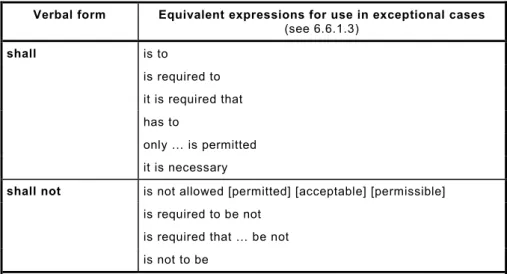
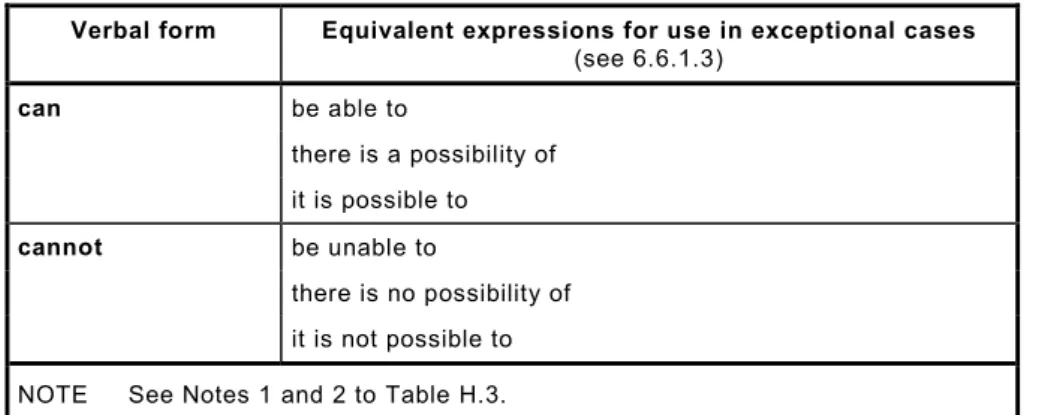
6.6.1.3 Annex H gives, in the first column of each table, the verbal form that shall be used to express each kind of provision. The equivalent expressions given in the second column shall be used only in exceptional cases when the form given in the first column cannot be used for linguistic reasons.
6.6.2 Spelling and abbreviation of names of organizations, style, reference works and abbreviated terms
The spelling of the names of organizations, and their abbreviations, shall be as used by those organizations, in English, French or Russian.
To facilitate understanding by all readers, the style shall be as simple and concise as possible. This is particularly important for those readers whose mother tongue is not one of the official languages of ISO and IEC.
The following reference works for language are suggested:
• for English, The Shorter Oxford English Dictionary, The Concise Oxford Dictionary, The Collins Concise English Dictionary, Webster’s New World College Dictionary or Chambers Concise Dictionary;
• for French, Dictionnaire Le Robert, Dictionnaire Larousse and Dictionnaire des difficultés de la langue française (V. Thomas, Larousse).
Abbreviated terms shall be used with care, and their use shall be limited to those cases where it is not likely to cause confusion.