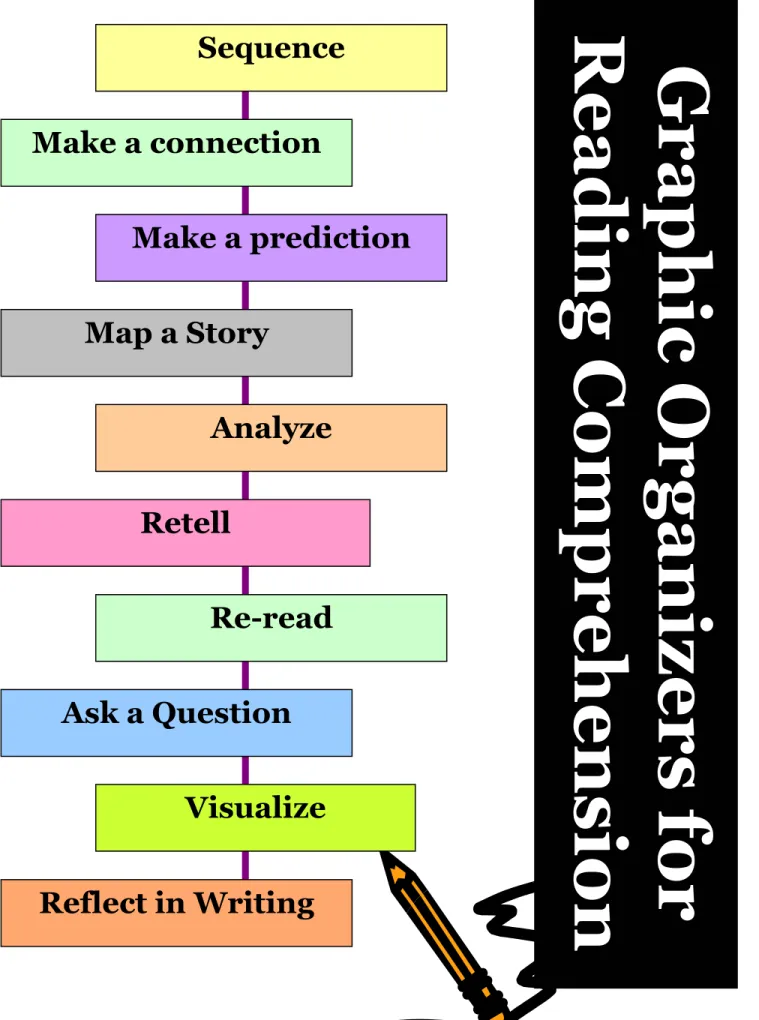
Graphic Organizers for
Reading Comprehension
Make a connection
Make a prediction
Map a Story
Analyze
Ask a Question
Reflect in Writing
Visualize
Sequence
Retell
Title:
Setting:
Characters:
Problem:
Event1
Event2
Event3
Event4
Solution:
Story Map
Characters – Who Setting – When & Where
Problem
Event Event Event
Solution
Sequencing
Problem And Solution
Problem 1
Problem 2
Problem 3
Proof Proof
Prediction
Proof Proof Proof Proof
Prediction Prediction
Major Question
Characters (Who)
Setting (Where?)
First
Problem
Solution
Summary:
Title:
Climax:
10.
11.
9.
12.
8.
13.
7.
14.
6.
5.
4.
Problem:
3.
2.
Solution:
1.
Setting:
Author’s Theme:
Main Characters:
Note: From
Classroom strategies for interactive learning,
by Doug Buehl,
1995, Schofield, WI: Wisconsin State Reading Association.
Copyright 1995 by the Wisconsin State Reading Association.
Person’s Name and Title
Notes about
Person’s Physical Appearance
Notes about Person’s Family/Growing UP Years
Notes about Person’s Education/Work Experiences
Notes about Person’s Problems/Challenges
Notes about Person’s Accomplishments
Conflict Falling Action
Antagonist Point of View
Protagonist Theme
Setting
Climax
Ending
What
Happened?
Where did it
happen?
When did it
happen?
EVENT MAP
Who was
involved in the
event?
How did it
happen?
Why
did
it
happen?
Character, Setting, Problem, Solution
Characters (who?) Setting (time?, place?, where?)
Problem / Conflict Solution / Resolution
Concept 1 Concept 2
HOW ALIKE?
HOW DIFFERENT?
With Regard To
Title Main Character(s)
Strengths Weaknesses Outcome
Feelings Description
Behavior Personality Traits
Character
Character Ma
Character
Trait #1 Trait #2
Evidence Evidence
Evidence
Evidence Evidence Evidence Evidence
Evidence Evidence
Trait Trait
Trait Trait
Character
Event
Event
Describe the character in the beginning. Event #1 Event #2 Event #3 Event #4 Event #5 Event #6
Describe the character at the end.
The character feels… The character feels… The character feels… The character feels… The character feels… The character feels…
Acts:
1.
2.
3.
4.
Feels:
1.
2.
3.
4.
Looks:
1.
2.
3.
4.
Says:
1.
2.
3.
4.
Character Web
How he looks: His behavior: His thoughts:
Character:
His statements: His fears: Others’ actions toward him:
Character One Word
Description Appearance Significance the Story to anyone similar? Do you know
Character
Acts
Actions
Lives
Looks
Feels
Says
Illustration Of Character:
Traits:
was
was
was
was
Character
because:
because:
because:
because:
Physical Appearance:
Actions:
Thoughts and Words:
Other Characters Thoughts and Feelings:
Author Tells Directly:
Character:
BOOK
Character Trait 1
Trait 3
Trait 2
Proof, page #
Proof, page # Proof, page # Proof, page #
Proof, page # Proof, page #
Character
Trait:
Quote (pg. ___ )
:
Explanation:
Quote (pg. ___ )
:
Explanation:
Quote (pg. ___ )
:
Explanation:
Quote (pg. ___ )
:
Explanation:
TITLE OF STORY: ____________________
ASSIGNMENT CHAPTER(S) OR PAGES: _______
Keep a list of characters in the story/novel and use the character trait list to describe each one. Circle the page and the paragraph that proves these characters have the traits you mention.
Name:
Traits:
Page: Paragraph:
1.
2.
4.
3.
Name:
Title:
DESCRIPTION FOR _________________
Directions: Place your character’s name in the center of the graphic organizer. On the top line of each section of the organizer, list an essential human attribute your character possesses. On the lines below each attribute, provide pieces of evidence from the story that exhibit the attributes you have chosen.Character A:
Character B:
Trait:
Trait:
Evidence page Evidence page
Concept 1
Concept
2
How Alike?_____________________________
_____________________________
_____________________________
_____________________________
_____________________________
How Different?___________
___________
___________
___________
___________
___________
___________
___________
___________
___________
___________
___________
___________
___________
___________
___________
With Regard To
How Alike?
_____________________________________________________________________________ _____________________________________________________________________________
How Different?
Title/Topic__________________________________________
THEN
NOW
Items Being Compared
Characteristics
Conclusions
Comparing A _________________________________________________ B _________________________________________________
C
_________________________________________________
A
B
C
HIGH
LOW
From the point of view of:
10
Story Event
Story Event
Story Event
Story Event
9
8
7
6
5
4
3
2
1
How The Same
How Different
Because
1. ________________________________________________________
2. ________________________________________________________
__________________________________________________________
__________________________________________________________
3. ________________________________________________________
__________________________________________________________
__________________________________________________________
4. ________________________________________________________
__________________________________________________________
__________________________________________________________
is
similar
Title of Story Book________________________________________
Example
Example
Example
Example
Example
Example
Description of Literary Device
Description of Literary Device
Description of Literary Device
Topic: _______________________________________________________
_______________________________________________________
_______________________________________________________
What are four great questions that could
show how much we understand about this
topic?
Initial Understanding
Developing An Interpretation
Making Connections
Critical Stance
1.
7.
2.
6.
3.
5. 4.
Objects that can fit in a box Things we don’t want
Things we can say/do with our voice Words related to money
1. 2.
3. 4.
1. Before reading, write the word to be learned __________________ 2. Brainstorm – What is it? What is it like? What are some examples? 3. Graphic Organizer:
Definition: Synonym: 1.
Vocabulary Word
Sentence: Picture:
1. Before reading, write the word to be learned __________________ 2. Brainstorm – What is it? What is it like? What are some examples? 3. Graphic Organizer:
Definition: Synonym: 2.
Vocabulary Word
Sentence: Picture:
1. Write each word from the chapter vocabulary list in the first column. 2. Read each word as it is used in the above novel before you look it up. 3. Write your guess for the meaning of each word in the column on the right. 4. Look up the word in the dictionary.
5. In the middle column, place the definition of the word which best matches the use of the word in the book.
Word
Definition Guess
1. 2. 3. 4. 5. 6. 7. 8. 9.
Word Part of Speech
Definition
In the book, it is on page ____. Copy the complete sentence below.
Word Part of Speech
Definition
In the book, it is on page ____. Copy the complete sentence below.