1. Introduction
The transient flow and heat transfer in a vertical inverted UTSG is analyzed using its mathematical model [3]. The UTSG starts up from cold condition. The time dependent transients at a particular Reactor Power (RP) level have been simulated. These are the major normal transients that occur in any Power Plant (PP) and the operators must have familiarity with these transients. The model for simulation is developed on the assumption that as long as enough steam is not produced in the chest of the boiler, a bypass valve in the secondary loop takes care of mass conservation. The amount of steam generated depends on the temperature of primary fluid which, in turn, depends on RP. Therefore, for simulation of start up conditions, an empirical relation for rate of increase of RP has been developed. Another empirical relation developed provides the inlet temperature of primary fluid (Tpin) to the boiler as a
function of RP.
For simulating transient conditions, an initial guess of temperature distribution of secondary fluid is required. It is assumed that prior to the entrance of primary fluid, secondary fluid in the boiler is initially at a uniform temperature of 334 oF. This is a fairly valid assumption as for this particular UTSG, the feed water practically enters at a temperature of 334 oF. For the start up guess, the Euler– Cauchy numerical scheme has been used.
It is also assumed that for start up from cold conditions, RP is at 2% of its rated value and the boiler contains secondary fluid at a uniform temperature of 334 oF and at a pressure of 550 psi. As under these conditions there can be no production of steam, it has been assumed that
there is a bypass valve on the secondary side which takes care of mass conservation and during this period the turbine is kept on turning gear at an rpm not above 100 so that prior to its exposure to steam, all its parts are dynamically balanced.
As the reactor power is increased gradually at a predetermined rate, the temperature of primary fluid and, in turn, that of secondary fluid increases till the time the RP has increased to a point where primary fluid is hot enough to produce sufficient steam. After this the bypass valve is closed and steam passes through the turbine and then to the condenser completing the designed cycle of PP.
2. Empirical Relations
For simulation of boiler start up conditions, a linear relation of RP with time and a linear dependence of Tpin to
the boiler on RP has been assumed.
2.1 RP and time relationship
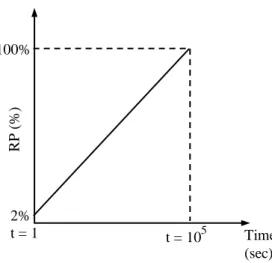
It has been assumed that RP varies linearly from 2% to 100% of its rated value in 105 seconds. This is a fairly reasonable assumption as start up from cold conditions to full RP normally takes that much time as shown in figure 1. Suppose RP and time linear relation is as follows:
RP = a * time + b (1)
Using boundary conditions in equation (1), we get RP = 9.8 10–4 time + 1.999 (2) which is the required RP and time relation.
Analysis of Transient Flow and Heat Transfer in a Vertical Inverted U–
Tube Steam Generator
N.A. Shahid1 , M.O. Ahmad1 , M. Mushtaq1 and S. Nazir1
1
Department of Mathematics, University of Engineering & Technology, Lahore–Pakistan.
ABSTRACT
A mathematical model of a vertical inverted U–tube steam generator (UTSG) is used to analyze the transient flow and heat transfer in it. To simulate the transients, the mathematical model is discretised in time and space coordinates. For the solution of this one dimensional heat problem, a finite differences numerical simulation technique is employed in order to find the temperature distribution of primary and secondary fluids. An optimum boiling length of the tube is also obtained. For further analysis, the temperature distribution profiles of secondary and primary fluids are drawn at specified intervals of time.
Keywords: Steam generator, Transient flow, Heat transfer, Empirical relations, Temperature distribution, Optimum boiling length.
Fig. 1 Relation of RP (%) with time (sec). 2.2 RP and Tpin Relationship
It has been assumed that Tpin to the boiler varies
linearly with RP. This variation has its boundary conditions based on the fact that Tpin when enters the reactor is at
temperature of 474 oF and for 100% rated power, the rise in temperature of primary fluid is 560 oF approximately as shown in figure 2.
Fig. 2 Relation of Tpin (oF) with RP (%).
Let the linear relation between RP and Tpin be as
follows:
Tpin = c RP + d (3)
Using the boundary conditions in equation (3), we get Tpin = 0.857 RP + 474.28 (4)
Which is the required relation between RP and Tpin.
Here RP is expressed as % of full RP.
3. Transients during PP Start-up
If no disturbances occur, simply starting the appropriate systems in a fixed order is sufficient to start up PP automatically. However, such a simple procedure cannot
respond to the transients or abnormalities that may occur during start up [1, 2].
The transients always occur and are normal to any PP operation. Their main cause is the gradual increase in RP at an operator specified rate. These time dependent variations in RP result in a gradual increase in Tpin to the boiler,
which in turn causes transients in temperature distributions of primary fluid as well as secondary fluid [4].
Empirical relations for RP and Tpin developed above
have been used to simulate the gradual increase in Tpin to
the boiler. This causes transients in temperature distribution of primary fluid as well as in secondary fluid. For evaluating the consecutive effects of temperature distribution of primary and secondary fluids on each other as a function of time, the following numerical simulation scheme has been developed with a convergence criteria of relative error being imposed on Tpout. That is when all the absolute values of
(
Tpoutnew – Tpoutold Tpoutold)
are small enough, theprocess is finished.
4. Mathematical Model
4.1 Finite Difference Numerical Simulation Technique
Mathematical model of UTSG in transient condition is as follows [3].
R2 Cp T
t = 2 Rh Tf (x) – 2 Rh T (x, t) – v Cp
.
Tx
Dividing by R2 Cp, we get T
t = A Tf (x) – A T (x, t) – B T x (5)
where A = 2 h
R Cp and B =
.
v R2
Applying forward difference for time (t), we can write T
t as follows: T
t =
T (i + 1, j) – T (i, j)
t (6)
Applying backward difference for space (x), we can write T
x as follows: T
x =
T (i, j – 1) – T (i, j)
x (7)
where i is used for time and j for space Substituting T
t and T
x from equations (6) and (7) in equation (5), we get the following temperature 100%
2%
t = 1 t = 105 Time
(sec)
RP
(%)
560 oF
474 oF
2% 100% RP (%)
Tp
in
(
distribution equations for primary and secondary fluids respectively.
Primary Fluid
Tp (i + 1, j) = Tp (i, j)
+ Ap t [Ts (i, j) – Tp (i, j)] – Bp t
x [Tp (i, j – 1) – Tp (i, j)] (8)
Secondary Fluid
Ts (i + 1, j) = Ts (i, j) + As t [Tp (i, j) – Ts (i, j)] – Bs t
x [Ts (i, j – 1) – Ts (i, j)] (9)
This scheme [equations (8) and (9)] works with two initial input guesses of temperature distribution of both primary and secondary fluids. At each particular RP, these input guesses are provided by the Euler–Cauchy Scheme[5].
5. Implementation of finite difference
numerical simulation technique
The solution of the mathematical model of UTSG in transient condition provides temperature distribution of both primary and secondary fluids along the whole length of the tube from the start up of boiler at cold condition to 100% RP level. Equations (8) and (9) are used for this purpose.
For program execution, a set of certain input parameters are provided interactively. This option provides the flexibility to the user to run the program at any desired combination of input parameters.
For simulating the transient conditions, an input guess of the temperature distribution of secondary fluid at the time of the start up is required and it has been assumed that prior to the entrance of primary fluid in the boiler, secondary fluid is initially at a uniform temperature of 334 oF. Based on this initially provided input guess, the program computes the temperature distribution of primary fluid at the start up condition (i.e. at 2% RP), then the temperature distribution of secondary fluid is determined at the same RP level based on the temperature distribution of primary fluid.
The increase in RP level is evaluated based on an empirical relation developed between time and RP. Then Tpin to the boiler at a particular RP level is determined using
the empirical relation between RP and Tpin. The process of
computation for the temperature distribution of primary and secondary fluids is followed in the same way as described above.
As secondary fluid is at a temperature of 334 oF at the cold condition and as RP increases, the temperature of secondary fluid rises with time until it reaches its saturation temperature of 481.5 oF and at a pressure of 550 psi. This section of UTSG is termed as preheating section.
During the passage of time RP rises and primary fluid carries more heat and obviously Tpin rises due to which
more heat is transferred to secondary fluid. As a result of this fact, secondary fluid acquires the saturation temperature much early than the previous time. For this reason, the boiling section increases and more steam is produced due to the rise of RP. For demonstrating the transients at a particular RP level, the program switches over to another set of equations which computes the temperature distribution of secondary and primary fluids at a particular RP level whose value is provided as an input to the computer.
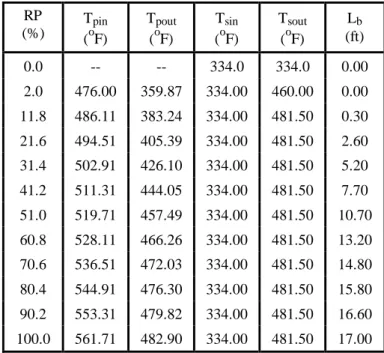
The data is collected in table 1 which comprises of Tpin , Tpout , Tsin , Tsout and the length of boiling section
(Lb) at the different RP levels.
Table 1. Computed data at different RP levels
RP (%)
Tpin
(oF)
Tpout
(oF)
Tsin
(oF)
Tsout
(oF)
Lb
(ft)
0.0 -- -- 334.0 334.0 0.00
2.0 476.00 359.87 334.00 460.00 0.00 11.8 486.11 383.24 334.00 481.50 0.30 21.6 494.51 405.39 334.00 481.50 2.60 31.4 502.91 426.10 334.00 481.50 5.20 41.2 511.31 444.05 334.00 481.50 7.70 51.0 519.71 457.49 334.00 481.50 10.70 60.8 528.11 466.26 334.00 481.50 13.20 70.6 536.51 472.03 334.00 481.50 14.80 80.4 544.91 476.30 334.00 481.50 15.80 90.2 553.31 479.82 334.00 481.50 16.60 100.0 561.71 482.90 334.00 481.50 17.00
6. Results and Discussion
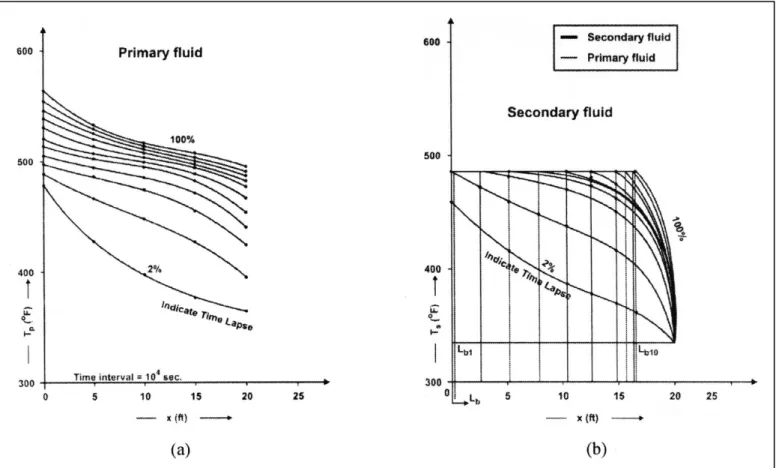
(i) Using the computed data of table 1, the graphs can be drawn for the temperature distribution of secondary and primary fluids relative to RP. These graphs will show the trend of heat exchange in UTSG during the transient period. The temperature distributions of primary and secondary fluids from 0.0% RP level to 100% RP level along the whole length of the tube are shown graphically in figures 3 (a) and 3 (b) respectively. Here it is noted that during the execution of the program from 2% RP level to 100% RP level, the temperature distribution of primary fluid varies from 476.00 oF to 561.71 oF in Tpin and 359.87 oF
to 482.90 oF in Tpout. The Tsin remains constant at
a temperature of 334.0 oF, throughout during the process. Tsout gains the saturation temperature only at
11.8% RP level and remains the same throughout until Lb = 17 ft, where the steam is formed.
(ii) The temperature distributions of primary and secondary fluids from 0.0% RP level to 100% RP level along the whole length of the tube are also shown in the bar graphs figure 4. In these bar graphs it is noted that Tpin and Tpout increases
from 476.00 oF to 561.71 oF and 359.87 oF to 482.90 oF respectively. Tsin does not change
during the execution of the program. Tsout gains
the saturation temperature earlier and remains the same throughout until Lb = 17 ft.
(iii) The complete picture of the temperature distributions during the process of the computer simulation with time interval 100000 seconds is shown below in table 2. Here it is seen that the results of simulation at 100% RP level during the whole process are in good agreement with the experimental data.
Fig..3 Temperature variation of fluids from 0.0% RP levels to 100% RP level.
Figure 4. Variation of temperature in the primary and secondary sides.
The tabular results show that at 100% RP level and for the given time interval of 100000 seconds, secondary fluid in UTSG attains the saturation temperature of 481.5 oF when the length of the tube L is 5 ft. After this it remains constant throughout the length of the tube. On the other hand primary fluid decreases its temperature from 560.71 oF to 482.52 oF along the length of the tube from L = 0.0 ft to L = 20 ft. respectively.
7. Conclusion
The transient behavior of heat transfer in a UTSG has been studied numerically using its mathematical model. The results obtained from the suggested model have been found to be in good agreement with the experimental data. These results will provide more full guidance for the real designer. The procedure can be used for a multi–objective optimization of the steam generator. The UTSG design can be improved by using future mathematical developments.
8. References
[1] B. Noel and R. Deruaz, “Reflux Condensation with Nitrogen in Steam Generator U–Tubes Analysis of Bethsy Test 72.c Using CATHARE Code”, 3rd
Intl. Symposium on Multiphase Flow and Heat Transfer, Xi’an, China (1994).
[2] W.H. Strohmayer, Dynamic Modeling of Vertical U– Tube Steam Generators for Operational Safety Systems, P. 4–19, Ph.D Thesis (1982).
[3] N.A. Shahid, N.A. Shah, “Analysis of Temperature Distribution in a Power Plant”, Research Journal of University of Engineering and Technology, Lahore (Pakistan), Volume 7 July–December (1993).
[4] N.A. Shahid, M.O. Ahmad, S. Nazir and M. Mushtaq, “Analysis of Mathematical Model of a U–Tube Steam Generator Under Steady State Conditions”, Pakistan Journal of Scientific Research Lahore, Vol. 60 No. 1–2 (March, 2008).
[5] N.A. Shahid, M.O. Ahmad, M. Mushtaq, and S. Nazir “Numerical Simulation of Heat Transfer in a Vertical Inverted U–Tube Steam Generator”, Pakistan Journal of Engineering and Applied Sciences, University of Engineering & Technology, Lahore, Vol. 4 January 2009.
9. Nomenclature
h = convective heat transfer coefficient (Btu/hr – ft2oF)
= density of fluid (Lb/ft3)
Cp = heat capacity at constant pressure (Btu/Lb oF) L = length of the tube (ft)
Lb = length of the tube where boiling occurs (ft)
.
v = volume flow rate of the secondary fluid (ft3/hr)
R = equivalent radius of tubes (inch)
m = mass flow rate of the primary fluid (Lbs/hr) Tsat = saturation temperature of the secondary fluid
(oF)
Tsin = inlet temperature of the secondary fluid (oF)
Tsout = outlet temperature of the secondary fluid (oF)
Tpin = inlet temperature of the primary fluid (oF)
Tpout = outlet temperature of the primary fluid (oF)
t = time (s)
t = increment time step (t)
x = increment space step (x)
Tf (x) = temperature of the fluid on the surface of the
tube due to convection (oF) A = 2 h / R Cp
B = v / R
.
2As, Bs = constants involving quantities for secondary
fluid
Ap, Bp = constants involving quantities for primary
fluid
Ts = temperature of the secondary fluid (oF)
Tp = temperature of the primary fluid (oF)
i = space coordinate j = time coordinate