ISSN: 2252-8938, DOI: 10.11591/ijai.v8.i3.pp292-298 292
Multi-verse optimization based evolutionary programming
technique for power scheduling in loss minimization scheme
Muhamad Hazim Lokman1, Ismail Musirin2, Saiful Izwan Suliman3, Hadi Suyono4, Rini NurHasanah5, Sharifah Azma Syed Mustafa6, Mohamed Zellagui7
1,2,3,6Faculty of Electrical Engineering, Universiti Teknologi MARA (UiTM), Shah Alam, Selangor, Malaysia 4,5Department of Electrical Engineering, Universitas Brawijaya (UB), Malang, Indonesia
7Départment de Génie Électrique, Faculté de Génie, École de Technologie Supérieure, Université du Québec,
Montréal, Canada
Article Info ABSTRACT
Article history: Received Apr 30, 2019 Revised Jul 20, 2019 Accepted Aug 5, 2019
The growth of computational intelligence technology has witnessed its application in numerous fields. Power system study is not left behind as far as computational intelligence trend is concerned. In power system community, optimization process is one of the crucial efforts for most remedial action to maintain the power system security. Basically, power scheduling refers to prior to fact action (such as scheduling generators to generate certain powers for next week). Power scheduling process is one of the most important routines in power systems. Scheduling of generators in a power transmission system is an important scheme; especially its offline studies to identify the security status of the system. This determines the cost effectiveness in power system planning. This paper investigates the performance of multi-verse based evolutionary programming (lowest EP) technique in the application of power system scheduling to ensure loss is gained by the system. Losses in the system can be controlled through this implementation which can be realized through the validation on a chosen reliability test system as the main model. Validation on IEEE 30-Bus Reliability Test System resulted that both techniques are reliable and robust in addressing this issue.
Keywords:
Evolutionary programming Losses control
Multi-verse optimization technique
Optimization Power scheduling
Copyright © 2019 Institute of Advanced Engineering and Science. All rights reserved. Corresponding Author:
Ismail Musirin,
Faculty of Electrical Engineering, Universiti Teknologi MARA (UiTM), Shah Alam, Selangor, Malaysia. Email: [email protected]
1. INTRODUCTION
In recent decades, development in the world has grown rapidly due to massive growth of technology. This growth of technology will increase linearly with the demand of electrical energy. Electrical energy is mainly refers to energy which has been converted from electric potential energy. Power plant is an important component which generally a place where the electrical energy is generated in a power system. An efficient electrical power plant must fulfil the load demand for the consumer. To ensure the efficiency and sustainable supply of a power plant is quite a challenging task. This is the normal problem mostly faced by an electrical engineer in a generation section. In order to have an efficient power plant, there are some actions that can be taken into consideration by the engineers. The challenge comes when the load demand becomes too high. The amount of power generated must be equal or more than the load demand to maintain secure power delivery and avoid loss of generation. The power generated cannot easily be produced without any planning or schedule. This is because, the cost of producing electrical energy can be too high when there are no consideration or calculation in planning. The power produced must undergo scheduling
process to avoid high generation cost. A technique is needed to solve this problem. The best planning for scheduling need to be the easiest and fastest method. The total loss must be hardly considered in power scheduling. With the arrival of era that rich with development of information and technology, residential demand increases day by day for high quality and reliability of electrical energy increases [1]. This increasing demand has become the most critical challenge to the power system utility to ensure smooth delivery to the consumers [2]. With the various needs, such as environmental compliance, energy conservation, better grid reliability, improved operational efficiency, and customer service, electric power systems have experienced many changes as response to all demand [3]. Under energy constraints, lack of energy may lead to unfinished tasks at the responsible entities [4]. Problems derived due to voltage decay and lack of reactive power support required immediate action to avoid any undesirable circumstances.
New liberalization of the electric market in some countries has raised the need for tools and risk management methods that can be used in the electricity market. Risk management is far more complex for market players who are exposed to quantities (inflow) and price uncertainty [5]. Thus, power scheduling responded to handle this increasing demand. Understanding of power system generation, transmission and distribution is important to educate the community on the knowledge of power system engineering. The involvement of main components such as transformers, circuit breaker, protection system, generators and loads can help the understanding of the power engineering operators and other technical and engineering personnel. Knowledge on distribution system aids the understanding of distributing electricity to the end users [6]. For power scheduling scheme, power system community at the generator sides will make use the knowledge more frequently. They may involve with optimization process, especially during online studies. In addition, transmission system operators will also benefit with the optimization processes as they are the responsible entity to monitor the whole system performance. Optimization techniques have been known to be the effective ways to deal with complex mathematical problems. This is important to ensure no over-compensation or under- compensation will be experienced by the system. Otherwise, all the control schemes will not worth as the efforts do not solve the related problems. Several optimizations have been invented since few decades ago. Among the popular optimization techniques are genetic algorithm (GA), cuckoo search algorithm (CSA), evolutionary strategy (ES), particle swarm optimization (PSO), evolutionary programming (EP), bee colony optimization (BCO), ant colony optimization (ACO) and other techniques either they are swarm-based or population-based approaches. This paper presents the application of MVO-based EP in the power scheduling schemes in the attempt to control the losses in power transmission system. Both techniques were employed for transmission loss control under load variations. In this case, EP and MVO-based EP were conducted independently on the similar reliability test system i.e. IEEE 30-Bus RTS which has 6 generators. Results obtained from the study are convincing and revealed the feasibility of both techniques in power scheduling scheme for loss control in power system.
2. RESEARCH METHOD
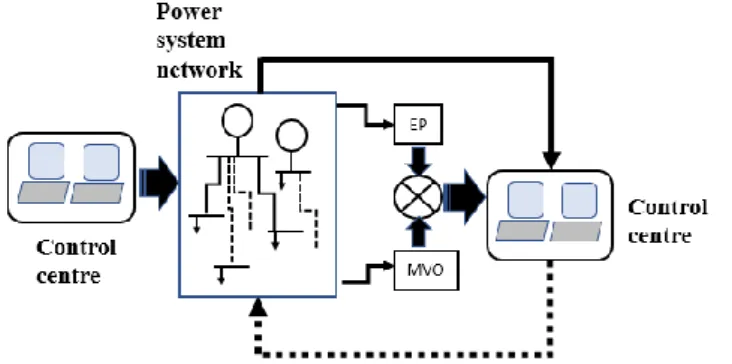
This section presents the mechanics of power scheduling, MVO and EP for loss control in power system. Figure 1 illustrates the power scheduling scheme in a power system network. The control centre collects the data from the power system network and input variables are identified from this system. The data are sent to the EP and MVO for further process. EP and MVO will perform the optimization of power scheduling and sent back the optimal solution to the system so that optimal solution can be achieved.
2.1. Power scheduling
Power scheduling is basically a schedule plan used in power system. This schedule was conducted to avoid or reduce any loss in power system flow. Optimize the existing power source tables to reduce losses more easily and effectively than finding the optimal location of the capacitor (which needs to be done only once before installation) or optimize the limited number of switches to restore the distribution system [7]. Consideration of power has become a dominant factor in the design of mobile systems and desk-top systems [8]. The purpose of the short-term power system planning is to minimize the system's operating costs to meet the forecast load [9]. It is therefore important to consider all associated costs associated with system operation. These costs can be divided into two different divisions; i.e. the power conversion costs and operating costs of the power system. It has been shown that the optimum power scheduling scheme reduces the resolution of the node quantization resolution corresponding to bad channels or poor observation quality [10].
2.2. Multi-verse optimizer
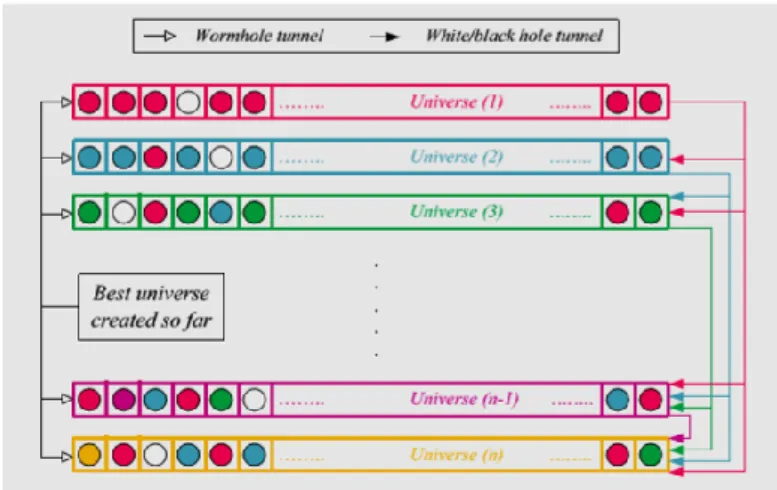
In the math, management, and artificial intelligence of Science, the optimization algorithm is finding the best solution among a set of candidate solutions [11 MuIti-Verse Optimizer (MVO) is a natural algorithm inspired in the novel proposed in 2015 by Seyedali Mirjalili. MVO is driven by multi-verse philosophy in astronomy [12]. MVO uses the concepts of white and black hole to carry out the exploration of the search space and the concept of wormholes to develop the exploitation of the search space [13]. In multi-verse theory, there are three main concepts as inspiration for big bang theory in this algorithm: white hole, black hole and wormhole [14]. Instead, wormholes help MVO in exploiting the search space [15]. MVO has the ability to find global solutions, rapid convergence rates and able to evaluate ongoing and discrete optimization problems [16]. The main inspiration of this algorithm is based on three concepts in cosmology: white holes, black holes, and worm holes. These three conceptual mathematical models were developed to carry out exploration, exploitation, and local search. Big bang can be considered a white hole and may be a major component of the birth of the universe [16]. The black hole attracts everything including light rays with very high gravity [16]. Worm hole in multi-verse theory act as a travel tunnel of time/space where objects can travel quickly between any angles of the universe. During optimization. Figure 2 illustrates the conceptual model of MVO algorithm, the following rules apply to the MVO universe [16]:
Higher inflation rates, the higher the probability of having a white hole. Higher inflation rates, lower probability of having a black hole.
Universe with higher inflation rate tends to send objects through white holes. Universe with lower inflation rate tends to accept more objects through black holes.
Objects in all universes may face random moves towards the best universe through worm hole regardless of inflation rate. It is often possible to move objects from the universe to high inflation to the universe with low inflation rates.
Figure 2. Conceptual Model of MVO algorithm
𝑈 = [
𝑥11 𝑥12 … 𝑥1𝑑
⋮ ⋮ … ⋮
⋮ ⋮ … ⋮
𝑥𝑛1 𝑥𝑛2 … 𝑥𝑛𝑑
] (1)
where U is a set of solutions, d is the number of variables (dimensions) and n is the number of universes (potential solutions) that can be described as follows:
𝑥𝑛1= {
𝑥𝑘𝑗 𝑥𝑖𝑗
𝑟1 < 𝑁𝐼(𝑈𝑖)
𝑟1 ≥ 𝑁𝐼(𝑈𝑖)
(2)
where xij is the jth parameter of ith universe, Ui represents the universe ith, NI (Ui) is the normal rate of inflation in the universe ith, r1 is the random number between 0 and 1, and xkj is the jth parameter the universe kth selected by the mechanism selection of roulette wheels. The universe continues to exchange objects without interruption. To preserve the diversity of the universe and to exploit the search process at MVO, every universe is estimated to have a wormhole to transport its object through space at random. To provide local change for each universe and have a high probability of raising inflation rates by using wormholes, the wormholes are always formed between the universe and the best universe formed so far, which can be described as follows:
𝑥𝑖𝑗= {
{𝑋𝑗+ 𝑇𝐷𝑅 × ((𝑢𝑏𝑗− 𝑙𝑏𝑗) × 𝑟4 + 𝑙𝑏𝑗) ; 𝑟3 < 0.5 𝑋𝑗− 𝑇𝐷𝑅 × ((𝑢𝑏𝑗− 𝑙𝑏𝑗) × 𝑟4 + 𝑙𝑏𝑗) ; 𝑟3 < 0.5
; 𝑟2 ≥ 𝑊𝐸𝑃 𝑥𝑖𝑗 ; 𝑟2 ≥ 𝑊𝐸𝑃
(3)
where Xj is the best universe formation of jth parameter set up so far, TDR (travelling distance rate) and WEP (wormhole existence probability) are coefficients, lbj and ubj are the lower bound and upper bound of jth variable respectively, xij is the jth parameter of ith universe and r2, r3, r4 are random numbers between 0 and 1.
2.3. Evolutionary programming
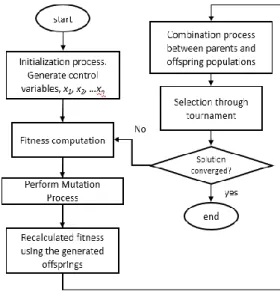
This study will integrate the element of MVO with evolutionary programming in order to minimize power loss for power scheduling. Using the EP alone may take a long time to achieve optimum solution or maybe trapped in local optimum [17]. The general flowchart for the EP is illustrated in Figure 3. The detail description of the process can be referred to any published work in the literature.
EP was first proposed as an approach to intelligence, it has been used recently successfully for many numerical and computational optimization problems [18]. EP is a mutation-based evolution algorithm used for discrete search space [19-22]. EP is a search technique. It moves from one solution to another using a probabilistic search method. In this technique, strong behavioral relationships are sought between each parent and their children, at the species level. It has a good advantage over good convergence properties, and, therefore, the timing of calculations has been significantly reduced. The behavior of the fitness function is observed in all the iterations of the optimization process to confirm the convergence of the solution. EPs with Gaussian mutation techniques and others have been developed and tested on a multi-reservoir cascaded hydroelectric system with prohibited operating zones and thermal units by loading point valves. Therefore, the problem of multi-level scheduling is exempt from many sub-level small sub-problems with cost-go-evolved functions that use EP [23-26]. The research methodology involved the following processes:
Identification of Targeted Output: The target output for this program are the pre-optimization and post-optimization of the losses in the system. The output should suitable to be implemented for minimization of loss.
Identification of Input Variables: The input variable in this program are the active power setting and the reactive load increment. There are five generator bus chosen for active power setting and three load busses for reactive load increment to act as input of this program.
Data Generation: The data collected by using the initialization process in EP. The initialization process generated random number as the value of active power in five different generator bus. This value were used as the variable in the program.
Network Configuration: Both basic EP and MVO based-EP technique use the same flowchart but there is slightly different in the mutation process. Both techniques use different equation in the mutation process to generate the offsprings.
3. RESULTS AND DISCUSSION
This study was conducted to optimize the value of real power at generator buses for minimization value of loss in the system. EP technique was used in this study. In this study, reactive load increment was subjected to the system. The value pre-optimization and post-optimization of the loss in the system act as the output of the optimization process. Minimization of loss is the objective function, controlled by the power generated by all the generators in the system. The increment of reactive power loading is increased from 20 MVAR up to 60 MVAR. This allows the monitoring of losses profile in the system. Buses 26. G2, G5 G8, G11 and G13 are the generator buses involved for optimal active power scheduling process.
Figure 4 illustrates the results for loss profile with respect to the load variation in the IEEE 3-Bus RTS using EP. The reactive power loading was increased from 0 MVAR up to 60 MVAR. In general, the loss profiles for pre- and post-optimization processes gradually increase as the load is increased in steps. With the implementation of optimal power scheduling using EP; loss in the system has been significantly reduce to very much lower value as can be observed in the figure. This phenomenon happens for all reactive load values. On the other hand, Figure 5 illustrates the results for loss variation optimized using the MVO-based EP, in which the mutation process in the original EP has been replaced by the MVO mutation process. Apparently, the trend looks the same where losses values with the optimization process using MVO-based EP are all lower than the pre-optimization values. This is a good indicator to demonstrate the effectiveness of the proposed optimization process.
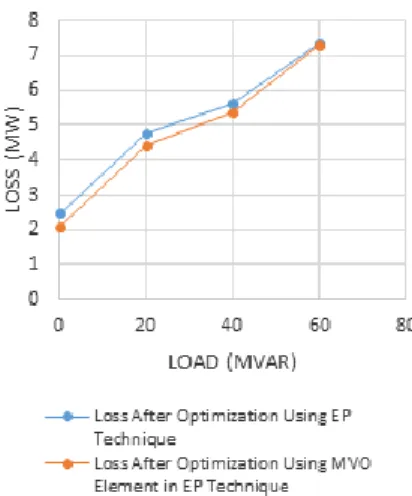
Table 1 tabulates the numerical values for loss control through the implementation of optimal power scheduling using EP and MVO-based EP. In all reactive power loading values, the proposed MVO-based EP performed better than the traditional EP in terms of achieving lower loss values through the implementation of optimal power scheduling in power system. This implies that the implementation of any optimization techniques for optimal power scheduling is worth. It is also worth to mention that the proposed MVO-based EP is worth for loss control scheme. On the other hand, Figure 6 illustrates the profiles of loss optimized using the traditional EP and MVO-based EP. The proposed MVO-based EP performed slightly better than EP at the high load value. However, at the lower reactive load value, MVO-based EP demonstrates a significantly low loss profile. This implies that the proposal to integrate the MVO element in the original EP is feasible to achieve better results without burden and complicated modifications.
Figure 4. Load vs loss using basic EP technique Figure 5. Load vs loss using MVO based EP technique
Table 1. Loss value by MVO and MVO-Based EP
Load (Qd) (MVAR)
Power Loss (MW)
Pre-Optimization
Post-Optimization using EP Technique Without MVO With MVO Element
0 17.59 2.47 2.10
20 20.25 4.75 4.39
40 21.39 5.64 5.35
60 23.48 7.34 7.29
Figure 6. Load vs loss using basic EP technique and MVO Element in EP techniqu
4. CONCLUSION
This paper has presented the multi-verse based evolutionary programming technique for power scheduling in loss minimization scheme. Through the implementation on the IEEE 30-Bus RTS; it can be highlighted that the proposed MVO-based EP is a flexible and robust algorithm to solve the optimal power scheduling process in the attempt to control the loss in power system. With only minor modification in the EP algorithm, better results have been achieved which in turn can be translated into monetary values. Further studies can concentrate on solving larger power system network, along with the implementation of power scheduling and other compensation scheme. The developed optimization engines on EP and MVO-based EP can be improved further to cater larger optimization problems and even in a larger system. Larger number of control variables need to be addressed as well to ensure power system problem can be solved. Other than implementation in a larger system, with larger number of control variables; the proposed MVO-based EP can be integrated with other optimization technique or artificial intelligence technique to solve other problems related to power system. It is a good note to mention that the developed optimization engine will require only minor modification to solve problems related to optimization in a power system network. On top of that, integration with other orientation of computational intelligence (CI) function can be explored either for decision making or prediction processes.
ACKNOWLEDGMENT
The authors would like to acknowledge The Institute of Research Management and Innovation (IRMI) UiTM, Shah Alam, Selangor, Malaysia for the support given in this research. This research is supported by the Ministry of Education (MOE) under the 600-IRMI/PERDANA 5/3 BESTARI (044/2018).
REFERENCES
[1] Z. Zhao, W. C. Lee, Y. Shin, S. Member, and K. Song, “An Optimal Power Scheduling Method for Demand Response in Home Energy Management System,” vol. 4, no. 3, pp. 1391-1400, 2013.
[2] A. Khodabakhshian and M. H. Andishgar, “Simultaneous placement and sizing of DGs and shunt capacitors in distribution systems by using IMDE algorithm,” Int. J. Electr. Power Energy Syst., vol. 82, pp. 599-607, 2016. [3] S. Ahn, S. Nam, and J. Choi, “Power Scheduling of Distributed Generators for Economic and Stable Operation of a
Microgrid,” vol. 4, no. 1, pp. 398-405, 2013.
[4] M. Chetto, “Optimal Scheduling for Real-Time Jobs in Energy Harvesting Computing Systems,” vol. 2, no. 2, 2014.
[5] B. Mo, A. Gjelsvik, and A. Grundt, “Integrated risk management of hydro power scheduling and contract management,” Power Syst. IEEE Trans. …, vol. 16, no. 2, pp. 216-221, 2001.
[6] B. Bakhshideh Zad, H. Hasanv and, J. Lobry, and F. Vallée, “Optimal reactive power control of DGs for voltage regulation of MV distribution systems using sensitivity analysis method and PSO algorithm,” Int. J. Electr. Power Energy Syst., vol. 68, pp. 52-60, 2015.
[7] Ziadi, S. Taira, M. Oshiro, and T. Funabashi, “Optimal power scheduling for smart grids considering controllable loads and high penetration of photovoltaic generation,” IEEE Trans. Smart Grid, vol. 5, no. 5, pp. 2350-2359, 2014.
[8] A. Manzak and C. Chakrabarti, “A low power scheduling scheme with resources operating at multiple voltages,”
IEEE Trans. Very Large Scale Integr. Syst., vol. 10, no. 1, pp. 6-14, 2002.
[9] O. Nilsson and D. Sjelvgren, “Hydro unit start-up costs and their impact on the short-term scheduling strategies of swedish power producers,” IEEE Trans. Power Syst., vol. 12, no. 1, pp. 38-44, 1997.
[10] T. Wimalajeewa and S. K. Jayaweera, “Optimal power scheduling for correlated data fusion in wireless sensor networks via constrained PSO,” IEEE Trans. Wirel. Commun. vol. 7, no. 9, pp. 3608–3618, 2008.
[11] M. Meshkat and M. Parhizgar, “Stud Multi-Verse Algorithm,” in 2017 2nd Conference on Swarm Intelligence and Evolutionary Computation (CSIEC), Kerman, 2017, pp. 42–47.
[12] N. Chopra and J. Sharma, “Multi-objective optimum load dispatch using Multi-verse optimization,” in 1st IEEE International Conference on Power Electronics, Intelligent Control and Energy Systems, ICPEICES 2016, 2017. [13] M. Valenzuela, A. Peña, L. Lopez, and H. Pinto, “A binary multi-verse optimizer algorithm applied to the set
covering problem,” in 2017 4th International Conference on Systems and Informatics (ICSAI), Hangzhou, 2017, pp. 513–518.
[14] T. Wangchamhan, S. Chiewchanwattana, and K. Sunat, “Multilevel thresholding selection based on chaotic multi-verse optimization for image segmentation,” 2016 13th Int. Jt. Conf. Comput. Sci. Softw. Eng. JCSSE 2016, 2016. [15] N. El Yakine Kouba, M. Menaa, M. Hasni, K. Tehrani, and M. Boudour, “A novel optimized fuzzy-PID controller
in two-area power system with HVDC link connection,” Int. Conf. Control. Decis. Inf. Technol. CoDIT 2016, pp. 204-209, 2016.
[16] I. N. Trivedi, P. Jangir, and S. A. Parmar, “Optimal power flow with enhancement of voltage stability and reduction of power loss using ant-lion optimizer,” Cogent Engineering, 2016.
[17] M. Y. El-Sharkh and A. A. El-Keib, “Maintenance scheduling of generation and transmission systems using fuzzy evolutionary programming,” IEEE Transactions on Power Systems, vol. 18, no. 2, pp. 862–866, May 2003.X. Yao, Y. Liu, and G. Lin, “Evolutionary Programming Made Faster,” vol. 3, no. 2, pp. 82-102, 1999.
[18] D. P. Kothari, “Power system optimization,” 2012 2nd Natl. Conf. Comput. Intell. Signal Process. pp. 18-21, 2012. [19] N. Cherkaoui, A. Belfqih, F. El Mariami, J. Boukherouaa, and A. Berdai, “Optimal location and reactive power injection of wind farms and SVC ’ s units using voltage indices and PSO,” International Journal of Electrical and Computer Engineering (IJECE), vol. 9, no. 5, pp. 3407–3414, 2019.
[20] K. A. Juste, “An evolutionary programming solution to the unit commitment problem,” IEEE Transactions on Power Systems, 1999.
[21] C. C. A. Rajan and M. R. Mohan, “An Evolutionary Programming-Based Tabu Search Method For Solving The Unit Commitment Problem,” IEEE Transactions on Power Systems. 2004.
[22] A. C. Nerves and J. C. K. Roncesvalles, “Application of evolutionary programming to optimal siting and sizing and optimal scheduling of distributed generation,” in TENCON 2009 - 2009 IEEE Region 10 Conference, Singapore, 2009, pp. 1-6.
[23] N. Sinha, R. Chakrabarti, and P. K. Chattopadhyay, “Fast evolutionary programming techniques for short-term hydrothermal scheduling,” IEEE Transactions on Power Systems, vol. 18, no. 1, pp. 214-220, Feb. 2003.
[24] T. D. H. Cau and R. J. Kaye, “Multiple distributed energy storage scheduling using constructive evolutionary programming,” in PICA 2001. Innovative Computing for Power - Electric Energy Meets the Market. 22nd IEEE Power Engineering Society. International Conference on Power Industry Computer Applications (Cat. No.01CH37195), Sydney, 2001, pp. 402-407.
[25] B. Banhthasit, C. Jamroen, and S. Dechanupaprittha, “Optimal generation scheduling of power system for maximum renewable energy harvesting and power losses minimization,” International Journal of Electrical and Computer Engineering (IJECE), vol. 8, no. 4, pp. 1954-1966, 2018.
[26] S. Surender Reddy, “Optimal reactive power scheduling using cuckoo search algorithm,” International Journal of Electrical and Computer Engineering (IJECE), vol. 7, no. 5, pp. 2349-2356, 2017.