Comparative Study of Thermodynamic
Parameters of Vanadium (IV) and
(V) Acetohydroxamate Complexes
K. Ali
1, N. Fatima
and Z.T. Maqsood
1Acetohydroxamic acid, CH3CONHOH, forms highly stable complexes with vanadium (V) and
vanadium (IV) in 1:1, 1:2 and 1:3 mole ratios. The stability of these complexes can be determined in terms of thermodynamic parameters GH and S. The preliminary data, obtained
through pH titration at various temperatures, was processed and analyzed by the computer program BEST for the renement of graphically calculated log values. Graphs ofln versus
1=T, gave a straight line, with a slope;H=Rand interceptS=R. Enthalpy and free energy
changes for V(V) complexes were found in the order of ML >ML 2
>ML
3 with a negative
sign. Whereas entropy change was found to be in the same order but positive, for vanadium (IV) acetohydroxamic acid complexes, the order ofGH andSwasML>ML
3 >ML
2.
TheS is most positive for a 1:1 complex, whileGandH are more negative for the same.
INTRODUCTION
The chemistry of siderophores has attracted signicant attention in recent years, due to their metal acquisition role in microorganisms and plants and their poten-tial application in the treatment of metal overload disease 1]. Among numerous siderophore structures, the hydroxamates are of interest, due to their ability to form stable transition metal complexes through the formation of a ve-membered chelate ring 2]. Hydroxamic acids have been used as therapeutic agents in chelation therapy 3].
Most mammalian cells contain vanadium at a concentration of about 20 nM, the bulk of which is probably in the reduced vanadyl (+4) form 4]. Like Molybdenum, vanadium assumes an exceptional position among the biometals because its anionic and cationic forms can participate in biological processes 5-7]. Dierent aspects of the coordination chemistry of vanadium (IV) and vanadium (V) relevant to bioinor-ganic chemistry, have been extensively discussed. Some of the investigated complexes are good models for
1. Department of Chemistry, University of Karachi, Karachi, Pakistan.
*. Corresponding Author, Department of Chemistry, Uni-versity of Karachi, Karachi, Pakistan.
dierent aspects of the metabolism and detoxication of vanadium or for a better characterization and under-standing of the structural and electronic peculiarities of the coordination sphere of VO2+ and VO
+
2 in
bio-molecules 8].
Several organically chelated compounds were found more potent and less toxic than vanadium salts in vivo. For example, L-Glu()HXM (H
2
N-CH(CH2CH2CONHOH)-COOH]) is highly active in
potentiating the capability of free vanadium ions to activate glucose uptake and glucose metabolism in vivo and in vitro 9].
Dietary vanadium probably occurs mainly as H2VO4
# and may enter cells through the phosphate
transport mechanism. The standard potential of the vanadate (H2VO4)
; to vanadyl (VO)2+is 1.31 V 10].
Most or all of the ingested V(V) undergoes a one-electron reduction generating VO2+ by biological
re-ductants, such as glutathion, ascorbate and NADH, in the gastrointestinal tract and vanadyl undergoes auto-oxidation to vanadate in the presence of oxygen. This facile change between V(V) and V(IV) has an interest-ing feature in the biological signicance of vanadium. Endogenous reducing agents and dissolved oxygen en-sures that both V(V) and V(IV) species are present in serum 11-13]. The reduction kinetics of vanadate complexes with some bio-reducing agents, such as
glutathione and ascorbic acid, are currently reported. The reaction chemistry of the potent insulin-mimetic agent, bis(maltolato) oxo-vanadium (IV) has gained signicant attention during the last few years 13]. The reduction rate of VO2(ma)2]
# with glutathione
is about 2000 times slower than that with ascorbic acid. An acid dependent mechanism can also be used to explain the results for the reduction with glutathione 14]. Although cis-VO2(ma)2]
# is not a
good insulin enhancing agent 15], it may be reduced in vivo to form VO(ma)2, which is active. On the
other hand, there is a precedent for V(V) compounds having insulin-enhancing activity. Vanadate and some peroxovanadate complexes also have potency 16].
Not a common component of enzymes, vanadium, as the vanadate ion, is an essential prosthetic group of some haloperoxidase enzymes 17]. These are the enzymes currently being elucidated in great detail 18]. Although information about the metabolism of physiological amounts of vanadium in higher forms of life is scarce, during the last few years some general aspects related to the absorption, transport, biological transformations, toxicity and excretion of vanadium, as well as its presence and activity in biological systems, could be understood 19-22].
The thermodynamic stability of the species is a measure of the extent to which these species will form, or be transferred, into other species under a set of conditions, once the system has reached equilibrium. In the language of thermodynamics, the equilibrium constant of a reaction is the measure of the heat released in the reaction and the entropy change during the reaction 23]. Entropy change values play a signicant role in determining complex stability.
The entropy of a system is a measure of the amount of disorder. The greater the amount of disorder in the products of a reaction relative to the reactants, the greater will be the increase in entropy during the reaction and the greater the stability of the products.
Determination of the thermodynamic stability of the vanadium ions in +4 and +5 will help to elucidate possible mechanistic pathways which would increase its potency, as well as decrease the toxicity. The most successful complexes contained organic ligands that are reasonably soluble in both organic and aqueous environments and which are compatible with human metabolism 24]. It has recently been found that hydroxamic acid conjugated to the tripyrrolepeptide distamycin induced highly specic DNA cleavage in the presence of vanadyl ions 25]. Thus, the hydroxamate ligand seems to be the most suitable for the study of the complexation and stability of vanadium complexes. Acetohydroxamic acid is the simplest ligand, it has only two coordination sites, so, the probability of any polynuclear complex is obscured and the complexes with 1:1, 1:2 and 1:3 L/M ratios can be formed.
The thermodynamic parameters of vanadium (IV) and vanadium (V) complexes were studied with aceto-hydroxamic acid, which is the simplest and most basic hydroxamate analog.
The theoretical values were calculated for all
species from the titration curves and then the data le \FOR004.DAT" was written for each titration. Data obtained by these titrations were subjected to the computer calculation based program \BEST", for the determination of equilibrium constants. Calculations were carried out with an algorithm which calculates pH directly and minimizes the sum of the weighted squares of -logH+] residuals 26].
The computer program \BEST" rst hypothe-sizes all the dierent species possible in equilibrium, then, guesses equilibrium constants for these species, which were initially calculated by rough manual cal-culation by a titration curve. Based on these guessed species values, \BEST" calculates the pH at all equilib-rium points solving a set of simultaneous mass balance equations for total metal ion, total ligand and total proton ion concentration, i.e.,
T M=
M]+K ML
M]L]+K ML
K ML2
M]L] 2+
;; T
L= L] +K
HL
H]L] +K H2L
H] 2
L] +;;
+K ML
M]L] + 2K ML2
M]L] 2+
;; T
H= H] +K
HL
H]L] + 2K H2L
H] 2+
;;:
The set of simultaneous equations is solved for each component, then, the weighted sum of the squares of the deviations in pH is calculated:
U = w(pH] obs
;pH] calc)
2
where w =
1 (pH]i+1;pH]i;1)
2 as a weighted factor,
which serves to lessen the inuence of less accurate pH values on the calculation. After that, the program adjusts the unknown stability constants and repeats the calculations till no further minimization of U is
possible and, thus, provides the nal results.
The standard deviation in pH units is obtained by the use of the following equation:
t= (
U=N) 1 2 :
The program, PKAS, is used to calculate the proto-nation constants of the ligands. It is simpler than BEST because, here, only two components (L&H) are involved. The distinguishing dierences in the renement of the protonation constants by the use of PKAS rather than BEST includes the initial advantage of selecting reasonably close approximations of the protonation constants by seeing the dierence between the observed and computed average pHs.
The data le for this program requires knowledge about the:
1. Total volume of the solution,
2. Molarity of the base used for pH titration, 3. Change in pH after each step,
4. Number of millimoles of metal ions present in the solution,
5. Number of millimoles of ligand present in the solution.
RESULTS AND DISCUSSION
Recent eorts have focused on identifying vanadium compounds with increased ecacy and decreased tox-icity 27-29]. The extent to which a metal will complex with a ligand is characterized by the stability constant. Large stability constants indicate that the concentration of a complex is much greater than the concentration of components. The electrostatic inu-ence of the charge and size of a ligand is also important in determining the stability of the complex.
Potentiometry is an informative and convenient technique that has been reported for determination of the formation constant of the successive complexes formed by the metal ion and a ligand molecule or ion. When metal and ligand solutions are mixed, many species of dierent MLnformula may form at the same
time. As the pH varies, the relative concentration of these species changes, e.g, at low pH 1:1(ML) is the dominating species. Concentration of ML2 increases
with further increase of pH, whereas, above pH 5, ML3
is in the highest concentration (Figures 1 and 2). It is found that for V(IV)AHA, after pH 3, at least all the metal was complexed, where 60% was 1:3 bidentate species with no axial oxygen, while 20% was 1:2 bidentate. At pH 10, 80% of 1:2 with axial oxygen, a water molecule and 20% 1:3 were observed (Figure 3) 30].
Figure1. Potentiometric titration of V(IV)-AHA
complexes VOSO4.5H2O = CH3CONHOH = 0.250 mM
and NaOH=0.20 M.
Figure 2. Potentiometric titration of V(V)-AHA
complexes VCl5 = CH3CONHOH = 0.250 mM and
NaOH=0.20 M.
Figure 3. Species distribution graph for V(IV)-AHA
complexes.
Figure 4 shows that for V(V)AHA above pH 3 nearly all metal is found to be complexed, in which 60% may be 1:6 monodentate species while 15-20% 1:2 bidentate and an almost equal percentage of 1:3 biden-tate was found. For the same system at pH 10, 70% 1:3 and 30% 1:2 were observed with no monodentate species 31].
Acetohydroxamic acids behave as a mono as well as bidentate ligand. Their stability constant (K)
values were determined by potentiometric titrations at dierent temperatures. In the case of vanadium (V), a slight change in the titration curve, with respect to temperature, was observed. In this case, the length of the depression of the curve was found to be sensitive to the temperature and was found to increase as the temperature increased (Figure 2).
In the case of vanadium (IV), some changes were also observed in the titration curve at dierent tem-peratures but were dierent as compared to vanadium
Figure4. Species distribution graph for V(V)-AHA
complexes.
(V). These curves had less depression but more twists, which showed the low stability constant values with more species present at a time. The stability of these species present at lower pH was found to be more sensitive to temperature (Figure 1). The computer program \BEST" was used for rening log values.
These renedvalues with least sigma t were selected
for each species (Tables 1 and 2).
Since, at equilibrium G=;R TlnK:
lnK= ;G
R T
=;
H R T
+S R
:
Since, lnK= ln, therefore:
ln= ;H
R :
1
T
+ S R
where is the overall formation constant 32] and
n= K
1 :K
2 :K
3 K
n
Table1. lnvalues for V(IV)-AHA complexes at
dierent temperatures.
S.
#
Complexes
35
C 40
C 45
C 50
C
1 VO(AHA)(H2O)3]
+ 7.139 7.599 8.061 8.521
2 VO(AHA)2(H2O)]
0 12.21 12.67 13.13 13.59
3 V(AHA)3]
+ 17.04 17.50 17.96 18.42 Table2. lnvalues for V(V)-AHA complexes at dierent
temperatures.
S.
#
Complexes
35
C 40
C 45
C 50
C
1 V(AHA)(H2O)4]
4+ 7.021 8.011 9.202 11.10
2 V(AHA)2(H2O)2]
3+ 10.11 11.05 12.31 13.21
3 V(AHA)3]
2+ 11.30 12.21 13.12 14.33
or:
n=
ML n]
M]L] n
:
Therefore, the parameter for can be (mol/L) ;n.
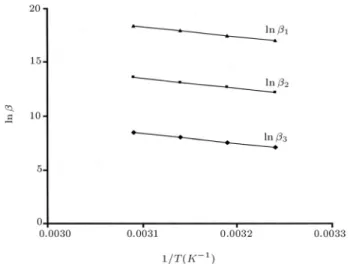
The graphs were plotted against ln and 1=T to
calculate HS and G values (Figures 5 and 6).
The slope of the graph gave -H=R values and the
intercept was found to be equal to S=R. Using G=
H;TS:Gfor each species of vanadium (IV) and
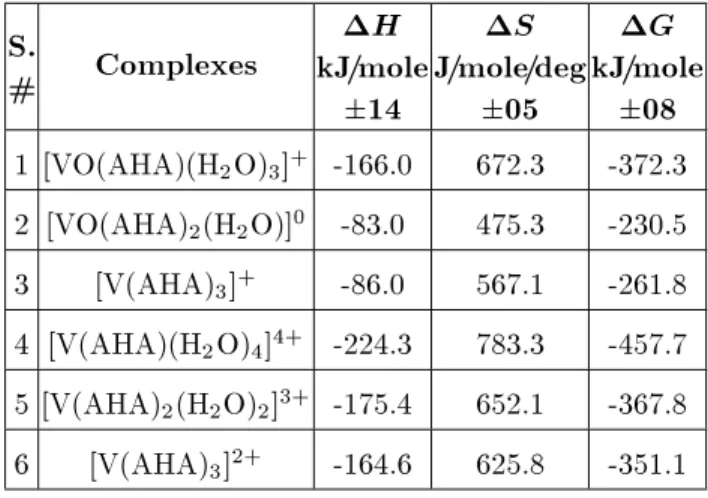
vanadium (V), acetohydroxamate complexes were also obtained (Table 3). All H and Gvalues calculated
for vanadium (IV) and vanadium (V) acetohydroxamic acid complexes were found to be negative showing high thermal stability. In case of vanadium (IV), 1:1 complex showed a greater negative enthalpy value (-166 kJmol;1), approximately double to that of 1:2 and
1:3 (-83 kJmol;1and -86 kJmol;1, respectively),
show-ing a high change in internal energy durshow-ing formation of the complex from aqua metal ions. Free energy change,
Figure5. Heat energies of V(IV)-AHA complexes.
Table3. Thermodynamic parameters for V(IV)and V(V) acetohydroxamate complexes.
S.
# Complexes
HkJ/mole
14
SJ/mole/deg
05
GkJ/mole
08
1 VO(AHA)(H2O)3]
+ -166.0 672.3 -372.3
2 VO(AHA)2(H2O)]
0 -83.0 475.3 -230.5
3 V(AHA)3]
+ -86.0 567.1 -261.8
4 V(AHA)(H2O)4]
4+ -224.3 783.3 -457.7
5 V(AHA)2(H2O)2]
3+ -175.4 652.1 -367.8
6 V(AHA)3]
2+ -164.6 625.8 -351.1
in cases of each type of complex in vanadium (IV)-acetohydroxamate, were slightly dierent from each other, but in the order 1:1>1:3>1:2, the ML
3 type
complex showed greater negative G(-261.8 kJmol ;1)
value than ML
2 (-230.5 kJmol
;1). It may be due to
the removal of vanadyl oxygen during formation of the hexadentate complex with the bidentate ligand. The Gis -372.2 kj/mol for 1:1 colmplex, the highest value
among all mentioned VO+2 complexes. Change in
entropy values were also observed high and positive in all cases and in the same order as discussed in the free energy case (672.3 Jmol;1, 475.38 Jmol;1 and 567.12
Jmol;1, respectively). This can be easily proved from
the following equations: VO(H2O)5]
2++HL
VO(H
2O)3L]
++H++ 2H 2O
(1) VO(H2O)3L]
++HL
VO(H
2O)L2]+H ++ 2H
2O,
(2) or:
VL3]
++OH;+H 2O
VO(H
2O)L2]+HL
(3)
VO(H2O)5]
2++3HL
VL
3]
++H++6H 2O
: (4)
Equations 1 and 2 show that, in the cases of 1:1 and 1:3, the entropy should be the same. In the case of 1:2, there may be two types of mechanism, as shown in Equations 2 and 3. In case of Equation 2, the entropy should be equal to 1:1 and 1:2, but, in the case of the second mechanism, as it is in Equation 3, the change in entropy should come in as a negative value. Results showed that formation of the ML
2 species
may go through both types of mechanism occurring simultaneously, therefore, the value is in between these two.
In the case of vanadium (V)-acetohydroxamate complexes, again, H values are very high and
neg-ative, showing a very large change in total internal
energy during the complex formation towards stability. The highest;Hvalue is found for 1:1 (-224 kJmol
;1)
complexes, next for 1:2 (-175 kJmol;1) and, then for
1:3 (-164 kJmol;1).
G were also obtained at high
negative values and in the same order (-457 kJmol;1,
-370 kJmol;1 and -351 kJmol;1, respectively).
Simi-larly, a decreasing trend in Svalues was also observed
for these species of vanadium (V), but with positive signs (783 Jmol;1deg;1, 652 Jmol;1 deg;1 and 625
Jmol;1 deg;1, respectively). The following equations
can justify these values: V(H2O)6]
5++HL V(H
2O)4L]
4++H++ 2H 2O
(5)
V(H2O)4L] 4++HL
V(H
2O)2L2]
3++ H++2H 2O,
(6) or:
V(H2O)4L] 4++L;
V(H
2O)2L2]
3++ 2H 2O
(7)
V(H2O)2L2] 3++HL
VL
3]
2++H++ 2H
2O, (8)
or:
V(H2O)2L2] 3++L;
VL
3] 2++2H
2O. (9)
The results related to S values of the species showed
that if the mechanism shown in Equations 5, 6 and 8 is valid, then, the entropy change should be almost equal for all species. As it changes and decreases for 1:2 and 1:3, it can be concluded that, for 1:2, both of the mechanisms shown in Equations 6 and 7 may simultaneously occur while, for 1:3, the mechanism shown in Equation 9 is more favorable than in Equa-tion 8.
When HS and Gvalues of vanadium (IV)
and vanadium (V) were compared with each other, it was observed that these values were much higher in the case of vanadium (V). For example, the change in enthalpy and free energy was four to ve times higher, while the change in entropy values was two, to three times greater in the higher oxidation state. This may be due to the very low positive charge of the free aqua vanadyl ion VO(H2O)5]
2+, in the case of vanadium
(IV), as compared to the highly charged free aqua vanadium ion V(H2O)6]
5+, in the case of vanadium
(V) as a starting material.
EXPERIMENTAL
In the present research work, all reagents used were of A. R. grade supplied by dierent sources, such as Merck, Sigma and Aldrich Riedel-de-Haen, and were employed without further purication. Doubly distilled and deionized water was used in the preparation of all stock/standard solutions.
For all pH titration, CO2free water was prepared
by boiling redistilled and deionized water for 10 min-utes and, then, cooling it in an air tight ask 33]. A 0.050 M solution of potassium hydrogen phthalate, which has the pH value of 4.01 at 25C, was used to
calibrate the pH meter.
The titration was carried for V(IV) and V(V) with acetohydroxamic acid at variable temperatures. The temperature ranges selected were 35-50C. The
same volumes of equimolar acetohydroxamic acid and vanadium(V) solutions were mixed, taken in a double walled titration cell kept on a magnetic stirrer. The rubber stopper on the cell had holes for the addition of a standard base thermometer and for a glass elec-trode. The temperature was controlled by circulating thermostated water through the jacket.
The temperature of the reaction mixture was maintained throughout the experiment. Aliquotes of standard 0.20 M NaOH were added with the help of a micropipette and the pH was measured after each addition with a combination glass electrode attached to a pH meter, Orion S.A model 720 having a resolution of0.001 pH units.
CONCLUSIONS
From the above results, it is observed that 1:1 com-plexes of both comcom-plexes have high;H values. This
may be due to a greater residual positive charge on these complexes. In V(IV) for 1:2, when the complex is neutral, less negative H was observed (-83 kJ/mole),
which was about 1
2of the 1:1(-166 kJ/mole). For V(V),
a high positive charge on the aqua complex produces greater penetration for the ligand and, therefore, a very high negative H value (-224 kJ/mole), which shows
a stable complexation. Formation of such a highly stable complex ion of V5+ may help to decrease its
toxicity.
Replacement of monodentate ligands by bidentate also show very high S values. In the case of vanadyl
ion (VO2+) for 1:3 complex replacement of oxygen by
ligand also shows greater S (567.12 kJ/mole) than
1:2 complex (475.38 kJ/mole). The highest degree of freedom is for V5+ 1:1 acetohydroxamate complex
(783 J/mol/deg) and, therefore, G is -457 kJ/mole.
All values showed a most stable complexation. All V5+ complexes are much more favorable then V+4
complexes.
The above study may be very important for the removal of V5+ from the biological system. V4+
is found to be valuable for diabetes treatment and, therefore, is not toxic. It also showed less anity towards hydroxamate as compared to V5+ and, hence,
it can be concluded that hydroxamate may play an eective role in detoxication of the V+5 from the
biological system.
REFERENCES
1. Sigel, H. and Sigel, A., Eds.,Metal Ions in Biological Systems,35, M. Dekker, Inc. New York, USA (1998).
2. Kuzrak, B., Kozlowski, H. and Farkas, E. Coord. Chem. Rev.,114, p 169 (1992).
3. Bergeron, R.J. and Brittenham, G.M., Eds., CRC Press, Boca Raton, FL, USA (1994).
4. Goldwaser, I., Gefel, D., Gershonov, E., Fridkin, M. and Shechter, Y.,Inorg. J. Biochem.,80, p 21 (2000).
5. Rehder, D.,Angew. Chem., Int. Ed. Engl.,30, p 148
(1991).
6. Rehder, D.,Biometals,5, p 3 (1992).
7. Rehder, D.,Coord. Chem. Rev.,182, p 297 (1999).
8. Baran, E.J.,Inorg. J. Biochem.,80, pp 1-10 (2000).
9. Goldwaser, I., Li, J., Gershonov, E., Armoni, M., Karneili, E., Fridkin, M. and Shechter, Y., J. Biol. Chem.,274, p 26617 (1999).
10. Black, D. and Hartshorn, A.,J. Coord. Chem. Rev.,9,
p 219 (1972).
11. Baran, E.J.,Bol. Soc. Chil. Quim.,42, p 247 (1997).
12. Harris, W.R., Friedman, S.B. and Silberman, D., J. Inorg. Biochem.,20, p 157 (1984).
13. Chasteen, N.D., Grady, J. and Holloway, K.Inorg. C. E. Chem.,25, p 2754 (1986).
14. Song, B., Aebischer, N. and Orvig, C.,Inorg. Chem.,
20, p 14 (2001).
15. Yuen, V.G., Caravan, P., Gelmini, L., Glover, N., McNeill, J.H. Setyawati, I.A. Zhou, Y. and Orvig, C.,
J. Inorg. Biochem.,68, p 109 (1997).
16. Crans, D.C., Yang, L., Jakusch, T. and Kiss, T.,Inorg. Chem.,39, p 4409 (2000).
17. Shigeki, H., Takahiro, I. and Yushin, N., Chem. Pharm. Bull.,48(5), pp 603-609 (2000).
18. Dekker, M. \Vanadium and its role in life",Biological Systems, H. Sigel, A. Sigel, Eds.,31, New York, USA
(1995).
19. Slebodnick, C., Hamstra, B.J. and Pecoraro, V.L.,
Struct. Bonding,89, p 51 (1997).
20. Crans, D.C.,Comments Inorg. Chem.,16, p 1 (1994).
21. Baran, E.J.,An Acad. Nac. Ciene. Exactas Fis Nat.,
46, p 35 (1994).
22. Butler, A. and Walker, J.V.,Chem. Rev.,93, p 1937
(1993).
23. Barnett, P., Hemrika, W., Dekker, L.H., Muijsers, A.O., Renirie, R. and Wever, I.R.,J. Biol. Chem.,273,
p 23381 (1998).
24. Cotton, F.A., Wilkinson, G., Advanced Inorganic Chemistry, 5th Ed., Wiley InterScience Publication, p 112 (1988).
25. Shaver, A., Ng, J.B., Hall, D.A., Lum, B.S. and Posner, B.I.,Mol. Cell. Biochem.,153, p 5 (1995).
26. Martell, A.E. and Motekaitis, A.J.The Determination
&Use of Stability Constants, 1st Ed., VCH (1988). 27. Kawabe, K., Tadokoro, M., Kojima, Y., Fujisawa, Y.
and Sakurai, H.,Chem. Lett.,9(1998).
28. Li, J., Elberg, G., Crans, D.C. and Shechter, Y.,
Biochemistry,35, p 8314 (1996).
29. Reul, B.A., Amin, S.S., Buchet, J.P., Ongemba, L.N., Crans, D.C. and Brichard, S.M.,Br. J. Pharm.,126,
p 467 (1999).
30. Ali, K., Fatima, N. and Maqsood, Z.T.,J. Iran Chem. Soc.,1(1), pp 65-70 (2004).
31. Ali, K., Fatima, N. and Maqsood, Z.T.,J. Saudi Chem. Soc.,7(3), pp 359-355 (2003).
32. Jordan, R.B., Reaction Mechanisms of Inorganic and Organometallic Systems, Ed. 1st, Oxford Univ. Press Inc. (1991).
33. Maqsood, Z.T. \Formation and activity of Fe(III) complexes with gallic acid", Ph.D Thesis, Department of Chemistry, Univ. of Karachi, Pakistan (1992).