Contents
Foreword 5
Part 1: Introduction and Background 7
Who should use this handbook and why? 8
What is the human rights framework? 8
How is the human rights framework relevant to regulation and inspection? 8
What you will find in this handbook 9
Part 2: How can Human Rights Assist Regulators and Inspectorates? 11
Using the human rights framework to make the right decisions when faced with a complex problem 12
Types of rights 12
The principle of proportionality 12
Using human rights principles to design regulatory and inspection frameworks which help to build 14 more effective public services
Clarifying priorities for public service providers 14
Using human rights as an additional lever for regulators and inspectors to raise standards of service 16 Addressing inequality in a way that goes beyond mechanical adherence to the law 18 Using the human rights framework to ensure that public services meet the needs of individual service users 20
Avoiding legal challenges 21
Meeting the State’s positive obligations 22
Applying a human rights flowchart - next steps for using a human rights framework in your work 24 Avoiding legal challenges meeting the State’s positive obligations 24 Applying a human rights flowchart - next steps for using a human rights framework in your work 26
Part 3: An Overview of the Human Rights Act 29
What is the European Convention on Human Rights? 30
What is the Human Rights Act? 30
The Convention rights in more detail 31
The Ministry of Justice (MoJ) recognises that regulation has become an increasingly important element in the management of public services and that regulatory bodies have a hugely important role to play in
promoting human rights in public services. This is true not only through ensuring that public authorities take account of human rights, but also through providing guidance, disseminating best practice and involving service users in monitoring standards. I am pleased to note as the Minister responsible for Human Rights that a wide range of organisations have worked in partnership with MoJ to produce The Human Rights Framework as a Tool for Regulators and Inspectorates handbook.
This handbook explains how the Human Rights Act can be used as a helpful set of standards to improve decision making, particularly when elaborating and implementing regulatory principles and resolving complex issues which call for the balancing of competing rights and interests.
Many of those who will use this guide have already taken human rights, and the Human Rights Act itself, into account in the design and monitoring of their regulatory or inspection standards. However, The Human Rights Framework as a Tool for Regulators and Inspectorates handbook aims to expand this important work across the field by;
explaining how the Human Rights Act is relevant to •
the work of inspectorates and regulatory bodies; showing how it can be used as a tool for improving •
effectiveness; and
including best-practice examples, which illustrate •
how many inspectorates and regulators have already successfully applied the human rights framework and engaged services users in their work.
By using a human rights framework in the design, interpretation and application of regulatory and inspection practices, bodies working in this field can benefit from improved coherence and the protection of human rights at all levels within their organisation.
Part 1
Introduction and
Background
Who should use this handbook and why?
If you work for a regulatory body or
inspectorate, this handbook can give you
more knowledge about how the Human
Rights Act (1998) relates to what you do
and how you do it. After reading this, you
will have a better understanding of how to
use the human rights framework as a tool
for effective, efficient and objective
regulation and inspection.
What is the human rights framework?
In the context of this handbook, “human rights framework” refers principally to the human rights drawn from the European Convention of Human Rights that are contained in the Human Rights Act 1998 (known as “the Convention rights”), along with associated guidelines and principles about how they should be interpreted and applied. These are outlined in Part 3 of this handbook.
The Convention rights are particularly important, because they have been given further effect in UK law through the Human Rights Act. However, many areas of regulation will also require consideration of other human rights, drawn from a wide range of international human rights instruments. For example regulation of immigration matters is likely to draw crucially on the Refugee Convention; regulation of places of detention will require knowledge of the UN Convention Against Torture and its Optional Protocol; regulation and inspection of services including education, health, social care, and other local authority services will require knowledge of the UN Convention on the Rights of the Child, the UN Convention on the Elimination of All Forms of Discrimination against Woman, and the UN Convention on the Rights of Disabled Persons. The precise application of such rights will vary from sector to sector and is therefore not considered in detail in this publication. In general, however, it should be remembered that, whilst such standards may form part of the background to regulation in these areas, and may be used in a positive way to influence service provision, in most cases they do not have binding legal force in UK law.
How is the human rights framework relevant to regulation and inspection?
The Human Rights Act gave a number of the rights from the European Convention of Human Rights direct effect in UK law. As public authorities, regulators and inspectorates are themselves required by section 6 of the Act to comply with these rights in their dealings with private individuals and non-governmental bodies. In some instances they may also have a role to play in ensuring human rights compliance on the part of the public authorities which they regulate (although this is a complex area where legal advice may be required – see paragraph (a) on page 21). But the main focus of this guide is on other ways in which a human rights framework may be used, which go beyond questions of strict legal compliance by regulators and those they regulate. Using human rights principles in this wider way can assist in ensuring delivery of effective public services, which respect individual rights and put the needs of individual service-users at their heart. In recent years, significant progress has been made by regulators and inspectorates in ensuring that their own policies, procedures and activities comply with the Human Rights Act. However, the Act is still often seen in a negative light because it is considered to have placed an additional legislative burden on public authorities. This handbook has been designed to show how the human rights framework can be a valuable, positive tool for inspectorates and regulators, by contributing to effective but proportionate regulation – and can thereby also be a positive influence on the provision of services by regulated public authorities. Applying human rights principles, such as justification and proportionality, can be a powerful tool for
elaborating and implementing regulatory principles and resolving complex issues which call for the balancing of competing rights and interests.
Regulation has become an increasingly important element in the management of public services. As the services themselves have become subject to market disciplines and the private sector has become more involved in the delivery of services, regulators and inspectorates have assumed the responsibility of defending the public interest. This involves a range of duties, including supervising the governance of services, and ensuring that administration is transparent,
service managers, and that there is a need to ensure regulation is effective but not overly bureaucratic. For this reason, the Government’s own Better
Regulation Task Force has produced Principles of Good Regulation, calling upon government departments and regulators to apply these principles when considering the regulatory role.
According to these principles, regulation should be:
Proportionate: regulators should only
•
intervene when necessary. Remedies should be appropriate to the risk posed, and costs identified and minimised.
Accountable: regulators must be able to justify
•
decisions, and be subject to public scrutiny. Consistent: Government rules and standards
•
must be joined up and implemented fairly. Transparent: regulators should be open, and
•
keep regulations simple and user friendly. Targeted: regulation should be focused on the
•
problem, and minimise side effects.
The human rights framework can be used to interpret and apply these principles in your everyday work, fleshing out what they mean for regulators and inspectors in practice. Proportionality is a key principle within the human rights framework. Under the
European Convention, some rights can be restricted in certain circumstances, for example to protect the rights of other individuals or if the restriction is in the public interest. However, any restriction must be strictly proportionate or, in other words, “you mustn’t use a sledgehammer to crack a nut”. Public authorities must interfere with the right in question as little as possible, only going as far as is necessary to achieve the desired aim. Under the human rights framework, blanket measures or rules are discouraged as they do not take into account the varying ways in which the rights of others will be affected. The human rights framework can therefore help you to take account of the needs of individual service users, targeting interventions in ways that take the rights of all stakeholders into consideration.
inspection principles in a way that is in accordance with national and international law, that is objective and fair to all stakeholders and that places the dignity and respect that all individuals deserve at the core of policy and procedure.
What you will find in this handbook
Information on the Human Rights Act and •
the European Convention on Human Rights relevant to people working at all levels within regulatory bodies.
An outline of how to use the human rights •
framework to assist your work (Part 2). Case studies that show how regulators and •
inspectorates have successfully used human rights frameworks in their work (Part 2). The background on where the Human Rights •
Act originated and the rights it protects (Part 3). Explanations of human rights and what they •
mean in practice for different public authorities (Part 3). A further detailed explanation of each Article can be found in a separate Ministry of Justice handbook, Human Rights: Human Lives (see links on page 49).
A jargon buster and answers to frequently •
asked questions (Part 3).
Details on where to find further information •
and useful contacts (Part 3).
What you will not find in this handbook
A substitute for proper legal advice or an •
exhaustive explanation of human rights law: always take proper legal advice if you have a specific issue to deal with.
Detailed sector-specific information. •
This guide is deliberately generic to make it as relevant as possible to a broad range of regulatory bodies and inspectorates. Lots of legal jargon.
•
Detailed information about other human •
Part 2
How can human
rights assist
regulators and
inspectorates?
Using the human rights framework in your everyday work can help you to:
Make the right decisions when faced with a 1)
complex problem
Design regulatory and inspection frameworks 2)
which help to build more effective public services Ensure that public services meet the needs of 3)
individual service users
Ensure you meet your legal obligations. 4)
Each of these is discussed in more detail below.
Using the human rights framework to make the right decisions when faced with a complex problem
The human rights framework provides guidance on how to interpret rights and balance them against each other. This can help you to manage risk by fairly and objectively mediating between competing claims from individuals, and through balancing the rights of one person against the needs of the wider community.
a) Types of rights
The framework classifies rights according to whether it is acceptable to place restrictions on them in certain circumstances:
Absolute rights: These rights must be upheld at all times. There is no possible justification for interference with them and they cannot be balanced against any public interest. Examples include the prohibition of torture and inhuman or degrading treatment (Article 3), and the prohibition of slavery (Article 4).
Limited rights: These rights can only be limited under explicit and finite circumstances as laid out in the European Convention. An example is the right to liberty and security (Article 5).
Qualified rights: These are rights that can be limited in order to protect the rights of other people or the public interest. In particular, the rights in Articles 8 to 11 can be restricted where it is lawful, necessary and proportionate to do so in order to achieve a legitimate aim as specified in the European Convention. Examples of these include freedom of thought, conscience and religion (Article 9), and freedom of expression (Article 10).
b) The principle of proportionality
The distinction between absolute, limited and qualified rights can help you decide what action to take when faced with a decision. You can only make decisions that
limited or qualified. The principle of proportionality is at the heart of how the qualified rights are interpreted, although the word itself does not appear in the text of the Convention. The principle can most easily be understood by the saying “don’t use a sledgehammer to crack a nut”. When taking decisions that may affect any of the qualified rights, a public authority must interfere with the right as little as possible, only going as far as is necessary to achieve the desired aim.
In short, the human rights framework’s classification of rights, coupled with the notion of proportionality, makes it a useful tool to use when making complex decisions such as where to draw the line between an individual’s concerns and the wider public interest when designing regulatory standards. Importantly, the human rights framework can help you to ensure that the decision you arrive at is made objectively and takes into account the effect on all stakeholders involved. It is important to note that if you are responsible for dealing with official decisions or appeals, Article 6 of the Convention may be relevant. This provides people with the right to have their civil rights and obligations determined within a reasonable time by an independent and impartial court or tribunal. However not all decisions are covered by Article 6. As this is a complex area of law, inspectorates and regulators are advised to take legal advice in order to identify whether Article 6 does apply to their decisions, and if so, as to the impact which it has on decision-making processes. In areas not covered by Article 6, it will still be best practice to ensure that official decisions are made in an unbiased way and using fair procedures.
Case Study:
Using the human rights framework as a tool for decision making
Focus rights:
Article 10– Freedom of expression
Article 8 – Right to respect for private and family life
Article 6 – Right to a fair trial
Freedom of expression is a qualified right and can be restricted, but only when strictly necessary in a democratic society and to pursue one of the recognised legitimate aims laid out in the European Convention. Ofcom (the Office of Communications) has a statutory duty to protect audiences against harmful or offensive content, but also recognises that upholding and exercising the right to freedom of expression can mean that some people may be offended by broadcast content. Ofcom has developed the Broadcasting Code which sets standards for the content of television and radio broadcasting. Standards in the Code around harm, offence, fairness and privacy have been designed to be compliant with the human right to freedom of expression.
In line with the principle of proportionality, Ofcom does not monitor broadcast content but rather intervenes only when complaints are made. Where members of the public complain that their privacy has been breached in a broadcast, Ofcom balances broadcasters’ rights to freedom of expression under Article 10 with the rights of those referred to in the broadcast under Article 8, the right to respect for private life. Ofcom first asks if the complainant’s right to respect for private life has been interfered with, and then asks if this interference was warranted. For example, was the interference in the public interest, helping to preserve freedom of expression of journalists and meeting the cases in which the right to respect for private life can be limited as defined in Article 8? If the broadcaster is judged to have interfered with the complainant’s right to respect for private life, care is taken to ensure that a solution is found that is proportionate and that maintains standards in a manner that best guarantees freedom of expression, both for the people in the case in question and through setting precedent for the wider media industry.
Ofcom’s decision-making procedure is consistent with the values of Article 6, the right to a fair trial. Using a human rights framework helps Ofcom to ensure that its procedures are robust and that its decisions are fair, taking the rights of all parties into consideration and balancing these with the rights of the wider community.
Using human rights principles to design regulatory and inspection frameworks which help to build more effective public services
a) Clarifying priorities for public service providers
An important role for regulators and inspectorates is to defend the public interest. As human rights are based on internationally accepted standards of how to treat people with dignity and respect, assessing whether the public services that you work with are meeting human rights standards is an effective way of doing this. Where regulators and inspectors have the power to set or influence regulatory and inspection frameworks, using human rights standards explicitly will allow you to identify where public services could do better, and to make recommendations for improvements.
For example, where the public services you are regulating or inspecting are provided to disabled people you should take account of the provisions of the UN Convention on the Rights of Disabled Persons, as well as the Human Rights Act.
Case Study:
Using the human rights framework to design and report on standards
Focus rights:
Article 5 – Right to liberty and security
The human rights framework is very relevant to healthcare service providers as they deal with issues that affect the inherent dignity and respect of service users on a daily basis. The Care Quality Commission has an important role to play in helping to build a health system that responds effectively to the needs of staff and individual service users in a manner that protects their fundamental human rights.
One way that the Care Quality Commission, formerly through the Healthcare Commission,
is responding to this challenge is through referring to human rights standards explicitly in its reports on reviews and inspections. This is helping healthcare service providers to understand what upholding staff and service users’ human rights means in practice, so that they can make improvements through putting appropriate procedures and practices in place.
For example, the Healthcare Commission recently reviewed the quality of acute inpatient mental health services and psychiatric intensive care provided by NHS trusts. Article 5(2) of the European Convention, the right to liberty and security, requires that anyone arrested or detained should be “informed promptly, in a language which he understands, of the reasons for his arrest”.
They must also know under whose authority the detention has been made, and know how they can challenge it.
The Commission’s report of its review explains that this provision of the Convention places a wider obligation on healthcare service providers to provide information to detained patients than the 1983 Mental Health Act. Drawing on evidence from the former Mental Health Act Commission,
now also part of the Care Quality Commission, the report states that, in 10% of the case notes checked, there was no formal record that service users had had their rights explained to them. A key recommendation of the report is that “Staff should consider how practices can be adapted to involve and engage service users as much as possible, however unwell the person may be. Involvement should be based on a human rights approach, so that services are focused around the needs of service users rather than those of the services”.
Further steps to use the human rights framework that are being taken by the Care Quality Commission will hopefully lead to the incorporation of human rights standards into more of the Commission’s inspections. For example, human rights criteria have recently been added to the Care Quality Commission’s equality impact assessment process. This is a toolkit and framework that staff complete when designing and implementing new policies, projects and functions in order to ensure that their impact on equality and rights issues are taken into consideration. The incorporation of human rights standards into the assessment and action plan is an important step towards building a human rights framework into all of the Commission’s work.
The Healthcare Commission, Commission for Social Care Inspection and the Mental Health Act Commission ceased to exist on 31 March 2009. The Care Quality Commission is the new health and social care regulator for England following the Health and Social Care Act 2008.
b) Using human rights as an additional lever for regulators and inspectors to raise standards of service.
Using human rights language when reporting on inspections or decisions regarding complaints can give these assessments added weight, rooting them in international and national standards. Whilst final
judgments about whether rights have been violated in a specific case can only be made by the courts, regulators and inspectorates can highlight instances where rights are likely to have been neglected and make recommendations as to how public service providers can remedy the situation, improve services and avoid legal challenge.
Case Study:
Using the human rights framework to assess complaints
Focus rights:
Article 8 – Respect for private and family life.
The Local Government Ombudsman regularly uses human rights standards to assess complaints that it receives from members of the public about treatment that they have received by local councils. The human rights framework not only helps the Ombudsman to make fair and balanced recommendations that take the needs of all stakeholders into consideration, but also adds moral weight and authority to the decision.
The Ombudsman has received a number of complaints that relate to accusations that the local government has breached the privacy of complainants. Article 8 of the European Convention states that everyone has the right to respect for private and family life, home and correspondence. The right to a private life includes protection of reputation and of personal data. In such cases, the Ombudsman looks to see if the individual rights of the complainant have been appropriately balanced with the interests of the wider community to arrive at a solution that has taken the needs of all stakeholders into account.
For example, in one case, a local council sought to evict a group of travellers living on an
unauthorised site through exercising planning enforcement powers. The council published sensitive information about a number of the travellers and their families in a public report to its Development Control Committee. This included details of medical conditions, financial affairs, children’s schools and a named child’s learning difficulties. The individuals concerned complained to the Local
Government Ombudsman as they were shocked that such sensitive information had been made public, and were concerned about the possible repercussions for themselves and their children. The Ombudsman recognised the need for the council to collect information about the travellers’ circumstances, but concluded that the decision to publish all of the information in the report was maladministration. He concluded that the council had failed to properly balance the need for open decision-making with its duty to respect the private lives of the individuals concerned, and that the information could have been handled in such a way as to achieve the desired aim whilst also respecting the complainant’s right to respect for private life.
The Ombudsman acknowledged that only the courts could determine whether there had been a breach of Article 8 of the Convention, but was still able to conclude that, “the Council should have given more considered and conscious attention to the principle of respect for private life enshrined in Article 8 and, if it had done so, it is likely that it would have reached a more proportionate decision that did not imperil the privacy of vulnerable children and members of their families.”
Case Study:
Using the human rights framework to assess complaints
Focus rights:
Article 3 - Prohibition of torture (including the right not to be subjected to treatment or punishment that is inhuman or degrading).
Article 8 - Respect for private and family life.
Article 14 - Prohibition of discrimination.
A joint investigation by the Health Services Ombudsman and the Local Government Ombudsman
used human rights standards to assess and explain why a county council and NHS trust were guilty of maladministration in the care they provided to an adult (Frank) with severe learning disabilities. The investigation found that the adult’s needs had not been adequately assessed at the outset of care, particularly in relation to taking human rights into account in planning and providing services. The report found that Articles 3, 8 and 14 had not been given proper or timely consideration. The investigation found that this failure to take adequate steps to protect rights was likely to be the result of the care service providers only considering human rights as an indirect part of their decision making, rather than addressing them directly and consciously. The report concludes that “a proper consideration of human rights issues at any point would have led to improvements in Frank’s and his parents’ situation.”
Case Study:
Using the human rights framework to design and report on standards
Her Majesty’s Inspectorate of Prisons has developed and published criteria for inspecting prisons, referenced to international human rights standards and aimed at achieving best practice. These criteria, called Expectations, go behind processes and output measures to examine the quality and outcomes for prisoners of the application of Prison Service standards and policies. For example, they explicitly require that ‘all prisoners are treated with humanity and with respect for the inherent dignity of the person.’ Sometimes, they go beyond what an overcrowded prison system can
currently achieve: for example, criticising the practice of holding two men in a cell meant for one, with a shared toilet, and where they eat all their meals; or sanitary arrangements which mean in practice that prisoners have to use buckets. It is important to set out these deficiencies; otherwise what is becoming normal may become normative.
c) Addressing inequality in a way that goes beyond mechanical adherence to the law
When considering the prohibition of discrimination within the human rights framework (Article 14), it is important to note that this is a ‘conjunctive right’, meaning that a claim under this Article can only be made in relation to the protection of one of the other rights contained in the European Convention. Furthermore, differential treatment may be justified where it is proportionate to a legitimate aim. It may therefore be legitimate to treat people differently in some circumstances.
Nonetheless, using a human rights framework can help you to address issues of inequality within public service provision. Rather than simply seeing equality issues as a matter of compliance with legislation such as the Race Relations Act and the Disability Discrimination Act, human rights help to place these issues within a broader framework of what it means to treat people with the dignity and respect that they deserve. This can help to shift the emphasis from negative compliance to positive cultural change. As well as considering whether you and the public services that you work with are complying with the law, the human rights framework can help to highlight what extra steps can be taken to make human rights real for service users.
With regard to disability, for example, the UK has ratified the UN Convention on the Rights of Disabled Persons and the Convention is, therefore, part of this human rights framework. Whilst the Convention does not establish new human rights for disabled people it expresses existing rights in a manner that addresses the needs and situation of persons with disabilities. In doing so, it sets out with much greater clarity the obligations on States to promote, protect and ensure the rights of disabled people. The Convention covers key areas including the right to life, access to justice, personal mobility, health, education, work and recreation, and cites practical measures to be taken. A copy of the Convention can be found on the UN website at: http://www.un.org/disabilities/
Case Study:
Designing people-centred inspection frameworks
Focus rights:
Article 14 - Prohibition of discrimination
Article 8 - Respect for private and family life.
Article 14 of the European Convention is a key right for regulators and inspectorates, as it can help to determine whether public authorities are meeting the needs of all service users equally or whether some are being treated differently. The Article states that all rights and freedoms in the Convention should be enjoyed by all people, without discrimination on any ground. The Article contains a short list of discriminatory grounds such as sex, race, language or religion, but this list is not exhaustive. Whilst the question of exactly where Article 14 applies may be a complex one in legal terms, it can be useful to use principles of equality drawn from Article 14 in a wider range of circumstances, regardless of whether this is strictly required as a matter of law. Using the human rights framework in this way can help to bring the notion of equality to life, exploring what it means in practice for service users. Regulators and inspectors can devise mechanisms and make recommendations to ensure that all service users receive equally good levels of service.
One example comes from the former Commission for Social Care Inspection (CSCI), now part of the Care Quality Commission, which has designed a framework to enable inspectors to understand the experience of people using care services by users who are unable to share this information directly due to cognitive or communication impairments. Without a good understanding of the experience of these service users, inspectors would be unable to determine accurately whether they are being discriminated against because of their disability, for example whether they enjoy the same respect for private and family life as other service users. The framework is called SOFI – Short Observational Framework for Inspection – and is used to find out whether people are receiving good quality care that meets their individual needs regardless of their ability to make their voice heard in other ways.
SOFI consists of a datasheet that is filled in by inspectors at five minute intervals over the course of two hours whilst they are observing people receiving care. A maximum of five people are observed in one session, and all people present, including service users and staff, are given information about the procedure so they know what is happening.
Observations are made in three categories concerning the service users’ state of well-being, their engagement with the surrounding environment and their interaction with staff. Evidence collected using the framework is triangulated with that collected using other inspection tools to increase accuracy and reliability.
This framework is important as it ensures that people with cognitive and communications impairments are involved in the inspection process. It allows inspectors to ensure that no service user is discriminated against as a result of disability, and helps to identify areas where service providers can make improvements so that everyone can enjoy the principle of equality that is enshrined in the human rights framework.
Using the human rights framework to ensure that public services meet the needs of individual service users
One of the major benefits of a human rights framework is that it helps public authorities to consider members of the public as individuals, rather than as blocks of people. This is because human rights standards are based on the basic principles that everyone deserves to be treated equally and with dignity and respect. People are entitled to be able to act autonomously, in so far as this does not interfere disproportionately with the rights of other people. But what do these principles mean in practice for regulators and inspectorates? In short, it means having a full understanding of how individual users experience public services, of what their needs are and of whether these needs are being met. One way to do this is to engage directly with service users in order to build a more individualised approach to standards assessment. Many regulators and inspectorates are already doing this, working directly with service users to assess and monitor standards and drawing on their knowledge and experience of using services to improve the accuracy and effectiveness of their work. For example, the former Mental Health Act Commission, now part of the Care Quality Commission, has encouraged a more systematic involvement of service users through establishing a Service User Reference Panel and through direct patient contact on wards. These panels have helped produce easy-read materials, improving communication with patients and carers. Another example comes from the Commission for Social Care Inspection’s Experts by Experience programme (see case study).
Once you fully understand the needs of service users, you can help the public authorities that you work with to build people-centred services that meet these needs. One way to do this is to develop guidelines and tools for service providers to use. For example, the Audit Commission’s Knowing your Communities toolkit includes an online human rights assessment and best practice case studies so that public authorities can better understand and meet the needs of the people that they serve.
The notion of treating service users as individuals is closely related to the idea of ‘proportionality’ – that is, all measures that are taken to balance one individual’s
Case Study:
Transforming service user experience into effective inspection
Human rights are built on principles of individual dignity, equality and autonomy, and public services should always support these principles. One way of doing this is to ensure that public services meet the needs of their users. Involving service users in inspections can help to clarify and address these needs. The former Commission for Social Care Inspection (CSCI), now part of the Care Quality Commission,
involves people who have experience of using the social care system in its inspections through the Experts by Experience programme. Following training in inspection procedures, the experts by experience accompany inspectors on visits. Because the experts by experience have used social care facilities themselves and understand the needs of service users, they are able to pick up on details that others might miss. These might include problems with accessibility and care practices. Experts by experience also help with communication between inspectors, service users and service providers. Referring to their experience of an inspection involving an expert by experience, one person with learning difficulties said: “thank you for sending someone who really understands me.”
The programme has been extremely successful, with positive reports from the experts themselves, service users, and CSCI inspectors. One inspector commented, “this is one of the most positive things that CSCI have introduced in a long time.The insight that the experts have provided has been invaluable, and they have been extremely well received by care homes.”
Using the human rights framework to ensure that you – and the public services you regulate - meet your legal obligations under the Human Rights Act. a) Avoiding legal challenges
Under the Human Rights Act, public authorities, including regulatory bodies and inspectorates and many of the service providers they regulate, have an obligation not to act incompatibly with the Convention rights. Any member of the public who feels their rights have been infringed by a public authority can take their complaint to a UK court or tribunal, as can non-governmental organisations (including some regulated bodies). It is therefore important that you understand the Convention rights and the way they apply to you and those you regulate.
The Human Rights Act says that persons carrying out certain functions of a public nature will fall within the definition of a public authority. You will need to take advice on whether your organisation has potential liabilities under the Human Rights Act, and to be aware of the extent to which those you regulate are exercising public functions (which are also governed by the Human Rights Act), or purely private functions (which are not). This guide does not attempt to offer the necessary legal advice in this area, which will require close attention to the specific circumstances of each regulator. If you are unclear of the position in relation to your organisation and those you regulate, it may be necessary for you to secure separate legal advice on such issues. However general adherence to the values and principles which underpin the Convention rights will assist in ensuring compliance with any actual responsibilities envisaged by the Act.
It should also be borne in mind that very few of the Convention rights under the Human Rights Act are absolute – most contain some limitations or require a balance to be struck between the rights of the individual and the wider public interest. It is the Government’s strong view that public authorities should approach this balancing exercise in a robust way giving human rights due consideration, but also giving proper weight to the rights and interests of others. In particular it is of paramount importance that public authorities take appropriate steps to protect the life and security of the public. Regulators and
inspectorates need to remain aware of this at all times when exercising their functions. They must ensure that a proper emphasis on compliance with human rights does not inadvertently lead to a situation where the wider public interest and the importance of public safety and security are obscured.
It is also worth remembering that the work of public authorities is usually governed by specific legislation or policies which, in most cases, already take full account of human rights requirements and include any safeguards and procedures necessary to ensure compliance. For example where appeal rights are set out in legislation, this will generally already have taken account of any applicable rights under Article 6 of the European Convention on Human Rights (the right to a fair hearing). On a day-to-day basis, front-line officials are expected to apply the legislation and policy specifically applying to them, rather than second guessing whether it fully complies with human rights requirements (which would be a recipe for inconsistent decision-making, and could easily lead to legislation being improperly disregarded). Regulators and inspectorates should not act in a way which might undermine the certainty which this approach provides. Human rights compliance is more likely to be relevant at the stage when a public authority is formulating, or assessing the impact of, policies and practices, or in areas where legislation and policies do not set out what is required. If you are unsure of the way in which human rights and legislation interact in the area for which your organisation is responsible, you may wish to seek further advice.
b) Meeting the State’s positive obligations
Most human rights law is concerned with things that the state must not do, and puts public authorities under an obligation to refrain from interfering with a right. However, the European Court of Human Rights has decided that in order to make the Convention effective, a number of rights also place positive obligations on states. These require the state to take action to prevent the breach of a right. The circumstances in which a positive obligation will arise under the Convention are generally quite narrow. It is recognised that public authorities cannot be expected to intervene to deal with completely unforeseeable events and levels of knowledge and available resources can justifiably limit the extent of positive obligations. However there is a more general duty on the state to put in place systems and procedures to protect individuals and regulatory and inspection systems often play an important part here. So it is important that when planning policies and activities you consider risks to the life, liberty and security of end users of services, and ensure that the regulatory and inspection system you operate is an effective way of detecting and deterring these.
Case Study:
Designing people-centred inspection frameworks
Focus rights:
Article 2 - Right to life
Article 3 – Prohibition of torture & inhuman or degrading treatment or punishment
Under Articles 2 and 3 of the European Convention, public authorities are obliged to take appropriate steps to protect the lives of individuals and ensure that they do not suffer from torture or from inhuman or degrading treatment. Public institutions such as prisons and care homes are responsible for both intentional and unintentional adverse treatment that people receive whilst they are under their care and could be held liable if an incident occurs that could have been foreseen and prevented and which falls within the remit of either or both of these articles.
Regulators and inspectorates have an important role to play in ensuring that these rights are upheld. In certain circumstances they will have a legal responsibility to investigate thoroughly incidents in which these rights may have been violated. They also have a responsibility to ensure that appropriate positive steps are taken to minimise the risk of the rights being violated in the first place, for example by helping public authorities to ensure that appropriate procedures and facilities are in place.
For example, Her Majesty’s Inspectorate of Constabulary and Her Majesty’s Inspectorate of Prisons
have worked together to develop a joint programme of inspection of police custody, based on an agreed framework. This is just one part of the joint programme of work being developed by criminal justice inspectorates. It is a programme of regular inspection, as part of the UK’s obligations under the Optional Protocol to the UN Convention against Torture, which requires the regular independent inspection of all places of detention. This framework is based on the underlying principles of treating all detainees with respect whilst ensuring that they are safe from harm at all times. The framework draws on the knowledge and experiences of service users to understand what these principles mean in practice, as well as on the experience of inspectors from the healthcare, police and prison sectors.
As well as being used in inspections, the framework is being circulated to all police forces so that they can start to take active steps to ensure that the rights of people held in police custody suites are always upheld, without having to wait for inspection visits before they can begin to do so. In this way, the inspectorates are helping the police force to build effective services that protect the rights of all stakeholders, including members of the public and detainees.
Applying a human rights flowchart - next steps for using a human rights framework in your work
In order fully to capture the benefits of the human rights framework as a tool for effective regulation and inspection, it is important to build rights principles and approaches into the fabric of your organisation. Rather than simply seeing human rights as a matter of compliance, putting the needs of individuals at the heart of your organisational thinking and processes is key to achieving sustainable organisational change. The result should be one where human rights are embedded not only in its structure and policies, but also in the culture of an organisation.
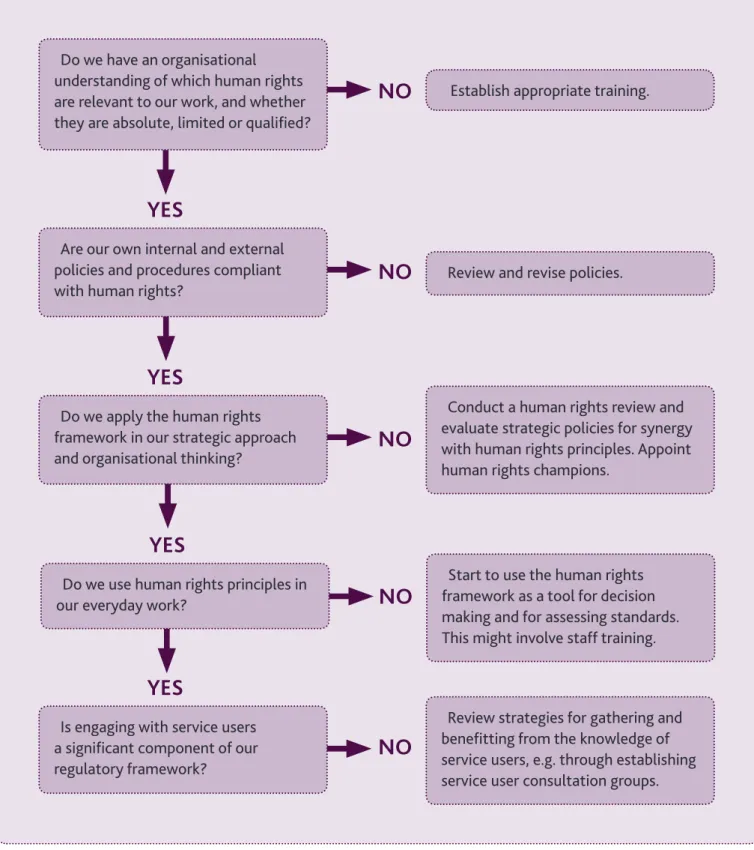
To assist in this process we have developed the following flowchart (set out on page 26) to illustrate the steps that you can take within your organisation to harness the human rights framework and make it work for you. These steps start at the broad organisational level, looking at whether human rights are part of your corporate culture, including whether there is an organisational understanding of which human rights are relevant to your work and whether your own internal and external policies and procedures are compliant with human rights, and then narrow the focus down to look at how you can use the rights framework in your day to day work. If you answer ‘no’ to any of the questions, look at the examples contained in this handbook for ideas on how to harness the human rights framework as a positive tool. You will need to tailor this tool so that it can meet your specific needs and address the issues that you face. However, this initial ground work will yield significant benefits, helping you in your day to day work whilst also ultimately ensuring that public service users can enjoy effective services which meet their needs and uphold their fundamental rights and freedoms.
If we look at the flowchart in more detail there are a number of steps to help you harness the human rights framework as a tool for effective regulation and inspection:
Step One is to consider whether there is a clear
understanding of human rights within your organisation - and in particular, whether the distinction between absolute, limited or qualified rights is understood, and whether you have a clear appreciation of the application of the Convention rights to those you regulate (see paragraph (a) on page 21). This would
breach. If you believe there is insufficient understanding of human rights that affect your working environment within your organisation, then it might be appropriate to provide training.
A good example of an integrated organisational approach to human rights practice is that of the Parliamentary and Health Service Ombudsman, who have initiated what they see as an organic process of embedding human rights principles in the organisation. This has involved training and awareness-raising around the human rights dimensions of complaints so that staff cease to be afraid of human rights or see them as legalistic. Similarly, the Healthcare Commission has employed external trainers to help staff to develop action plans for implementing the human rights framework in their work. If you have any questions or queries on design or implementation of training, the Ministry of Justice is happy to provide help and advice where possible.
Step Two is to examine, in more detail, whether your internal and external policies and procedures are sufficient to make the human rights framework operational by undertaking a policy review. This assessment of your own internal and external policies and procedures would, at the outset, include an identification of the rights that are most relevant to your particular regulatory role and deciding which are most likely to require reflections in your own policies and procedure. Following this, to establish whether your policies are compliant with human rights, you should assess whether these objectives are being met in practice and applied within your organisation. This will require attention to internal procedures that ensure appropriate scrutiny and monitoring. It might be beneficial to seek external assistance at this stage. As an extension of this, it may be useful for regulatory bodies to designate human rights champions who can act as a focus of expertise and source of support to give people the confidence to apply what they have learned in an unfamiliar environment. This could make up part of your internal challenge function, with human rights champions helping your organisation to ensure that policy and practice are in line with human rights standards and principles. The champions would in this way be able to act as a continued source of advice and support.
process is to undertake an organisational human rights review or assessment, involving all staff and relevant stakeholders. This would include methods of assessment such as questionnaires and interviews with all staff members, as well as more in-depth conversations and interviews with key staff and stakeholders. This process is useful for developing a shared organisational understanding of how human rights are relevant to your specific area of work, and how you could use the human rights framework as a positive tool for effective regulation or inspection. This should help create an assessment of strategic organisational human rights, which is an accurate reflection of actual practice and attitudes within your organisation. This should also be instrumental in ensuring buy-in and engagement by staff, who are often excluded from these types of consultations. One example of such a review is the former Mental Health Act Commission’s Making It Real project (see case study on page 27).
This stage, by developing an organisational understanding of the human rights framework, puts the regulator in a better position to use human rights as a positive tool for carrying out its work, not just in the narrow sense of carrying out the legal responsibilities but in the broader sense of helping public authorities design and assess standards and for building people-centred public services. Further, it enables staff and stakeholders alike to see themselves as part of the wider strategic picture and provide an understanding of how their daily contribution and interactions can contribute to the wider agenda of embedding human rights in their particular regulatory environment.
Step Four is to consider whether human rights principles are used in the day to day work of the
regulator itself. The important question here is whether the human rights framework is found to be useful in the day to day interaction between regulator and staff. Perhaps, notwithstanding the overarching policy framework, staff continue to be unconvinced of the “added value” that a human rights framework can bring to their own dealings with the services they regulate. Given the fear of human rights (and particularly of human rights litigation) that can affect organisations, and the attendant publicity, this would be perfectly
be applied. In addition there might be a role for the human rights “champions” referred to above, who can provide points of expertise and reassurance to your staff.
Step Five the final stage, requires that regulators consider carefully how utilising a human rights framework helps public services engage with service users as individuals rather than as blocks of “clients”. Although apparently simple this is a significant
organisational challenge. Even if the regulator believes that this is common practice, it is worth looking at best practice across the regulatory environment. Here, a hands-on approach, which puts the user at the centre, is key to engaging effectively with the user on an individual level. For example some regulators themselves have established direct links with groups of service users for purposes of consultation, to ensure that their views form a key element of how public services are managed and delivered.
Do we have an organisational understanding of which human rights are relevant to our work, and whether they are absolute, limited or qualified?
Establish appropriate training.
NO
Are our own internal and external policies and procedures compliant with human rights?
YES
Review and revise policies.
NO
Do we apply the human rights framework in our strategic approach and organisational thinking?
YES
Conduct a human rights review and evaluate strategic policies for synergy with human rights principles. Appoint human rights champions.
NO
Do we use human rights principles in our everyday work?
YES
Start to use the human rights framework as a tool for decision making and for assessing standards. This might involve staff training.
NO
Is engaging with service users a significant component of our regulatory framework?
YES
Review strategies for gathering and benefitting from the knowledge of service users, e.g. through establishing service user consultation groups.
NO
Figure 1 - A step by step process for harnessing the human rights framework as a tool for effective regulation and inspection
Case Study:
Embedding human rights in organisational culture
The former Mental Health Act Commission (MHAC), now part of the Care Quality Commission, launched Making It Real in January 2006, a project designed to strengthen the Commission’s understanding of the relevance of human rights to its work. The project involved:
• Extensive consultation with staff, commissioners and service users about attitudes to human rights. • Training in human rights, including a DVD to share best practice.
• The identification of opportunities to integrate a human rights approach into the Commission’s work. • Development of a human rights strategy.
As a result of the project, the MHAC and its staff have a good understanding of how human rights are relevant to the organisation, and are using its findings to bring human rights to life through its work. Initiatives have included the systematic involvement of service users in the Commission’s planning, inspection and communications work through the Service User Reference Panel, and the explicit incorporation of human rights standards into inspection frameworks.
The MHAC’s chairman believes that the project has yielded benefits both for service users and for the Commission itself: “Human rights can have a real impact on the daily life of service users: they are a lever for effecting change and improvements in services for people who are less able to assert their rights or are more vulnerable, and can make a real difference to people’s every day lived experience”.
“But what this project has also shown, which I had not particularly predicted, is that a clear focus on human rights can have a positive impact on organisations themselves as well as for those who use services.
Part 3
An Overview of the
Human Rights Act
What is the European Convention on Human Rights? The European Convention on Human Rights was drafted after World War II by the Council of Europe. The Council of Europe was set up as a group of like-minded nations, pledged to defend human rights, parliamentary democracy and the rule of law, and to make sure that the atrocities and cruelties committed during the war would never be repeated. The UK had a major role in the design and drafting of the European Convention on Human Rights, and ratified the
Convention in March 1951. The Convention came into force in September 1953.
The Convention is made up of a series of Articles. Each Article is a short statement defining a right or freedom, together with any permitted exceptions. For example: “Article 3 – Prohibition of torture. No one shall be subjected to torture or to inhuman or degrading treatment or punishment.” The rights in the Convention apply to everyone in the states that have signed the Convention. Anyone who believes that a state has breached their human rights should first take every possible step to have their case resolved in the domestic courts of that state. If they are unhappy with the result they can then take their case to the European Court of Human Rights, set up by the European Convention on Human Rights and based in Strasbourg, France.
What is the Human Rights Act?
The Human Rights Act came into force in the UK in October 2000. The Act incorporated provisions contained in the European Convention on Human Rights into UK law and enabled people in the UK to take cases about their human rights to a UK court. Previously they had to take complaints about their human rights to the European Court of Human Rights in Strasbourg.
What are human rights?
There are 16 basic rights in the Human Rights Act, all taken from the European Convention on Human Rights. They do not only affect matters of life and death like freedom from torture and killing; they also affect people’s rights in everyday life: what they can say and do, their beliefs, their right to a fair trial and many other similar basic entitlements. The following is a brief outline of the human rights that are included in the Human Rights Act. For a more detailed explanation
authorities, see the separate handbook by the Ministry of Justice, Human Rights: Human Lives.
Article 1
This article is introductory and is not incorporated into the Human Rights Act.
Article 2: Right to life
Everyone’s right to life must be protected by law. There are only very limited circumstances where it is acceptable for the state to use force against a person that results in their death, for example a police officer can use reasonable force in self-defence.
Article 3: Prohibition of torture
Everyone has the absolute right not to be tortured or subjected to treatment or punishment that is in human or degrading.
Article 4: Prohibition of slavery and forced labour Everyone has the absolute right not to be treated as a slave or to be required to perform forced or compulsory labour.
Article 5: Right to liberty and security
Everyone has the right not to be deprived of their liberty except in limited cases specified in the Article (for example where they are suspected or convicted of committing a crime) and provided there is a proper legal basis in UK law for the arrest or detention. Article 6: Right to a fair trial
Everyone has the right to a fair and public hearing within a reasonable period of time. This applies both to criminal charges against them and to cases determining their civil rights and obligations. Hearings must be before an independent and impartial court or tribunal established by law. It is possible to exclude the press and public from the hearing (though not the judgment) if that is necessary to protect things like national security or public order. A person who is charged with a criminal offence is presumed innocent until proven guilty according to law and must also be guaranteed certain minimum rights in relation to the conduct of criminal investigation and trial.
Article 7: No punishment without law
Everyone has the right not to be found guilty of an offence arising out of actions which, at the time they
Apart from the right to hold particular beliefs, the rights in Articles 8 to 11 are qualified rights and may be limited where that is necessary to achieve a legitimate aim. The precise aims for which limitations are permitted are set out in each Article – they include things like protecting public health or safety, preventing crime and protecting the rights of others.
Article 8: Right to respect for private and family life Everyone has the right to respect for their private and family life, their home and their correspondence. This right can be restricted only in specified circumstances. Article 9: Freedom of thought, conscience
and religion
Everyone is free to hold a broad range of views, beliefs and thoughts, and to follow a religious faith. The right to manifest those beliefs may be limited only in specified circumstances.
Article 10: Freedom of expression
Everyone has the right to hold opinions and express their views on their own or in a group. This applies even if these views are unpopular or disturbing. This right can be restricted only in specified circumstances. Article 11: Freedom of assembly and association Everyone has the right to assemble with other people in a peaceful way. They also have the right to associate with other people, which includes the right to form a trade union. These rights may be restricted only in specified circumstances.
Article 12: Right to marry
Men and women have the right to marry and start a family. National law will govern how and at what age this can take place.
Article 13
This article is procedural and is not included in the Human Rights Act.
Article 14: Prohibition of discrimination
In the application of the other Convention rights, people have the right not to be treated differently because of their race, religion, sex, political views or
whatever their status.
Article 1 of Protocol 1: Protection of property (A ‘protocol’ is a later addition to the Convention.) Everyone has the right to the peaceful enjoyment of their possessions. Public authorities cannot usually interfere with a person’s property or possessions or the way that they use them except in specified limited circumstances. Article 2 of Protocol 1: Right to education
Everyone has the right not to be denied access to the educational system.
Article 3 of Protocol 1: Right to free elections Elections for members of the legislative body (for example Parliament) must be free and fair and take place by secret ballot. Some qualifications may be imposed on who is eligible to vote (for example a minimum age).
Article 1 of Protocol 13: Abolition of the death penalty This provision prohibits the use of the death penalty. The Convention rights in more detail
This section contains a detailed explanation of what the rights protected by the Human Rights Act mean in practice for public authorities. It is important for regulators and inspectors to understand human rights so that they can uphold them directly in their own work and also help the public services that they work with to do the same.
When reading the explanations of Convention rights contained in this section, try to think about how they apply to the work that you – and those you regulate - do and how you could use the human rights framework to balance out different people’s interests when you make decisions.
It is important to note that this section is not intended to be a comprehensive guide to the legal position, which will change as new cases are decided by the courts. It provides only a general introductory guide to the kinds of issues which are covered by each Article. If you require a definitive view as to the requirements of any of the Convention rights, you must take legal advice as appropriate.
Article 2: Right to life What does this right mean?
The right to life means that the state has an obligation to protect life. This means, generally, that the state must not take the lives of its citizens. However, there are three very limited circumstances when taking life may not contravene Article 2:
when
• defending oneself or someone else from unlawful violence
when lawfully
• arresting someone or preventing the escape of someone lawfully detained
when acting lawfully to stop a
• riot or insurrection.
Nevertheless, even if the action taken by the public authority falls into one of these three categories, any force used must be no more than absolutely necessary, which means that it must be strictly proportionate to the situation.
Article 2 also requires the state to take certain •
positive steps to protect the lives of people within its jurisdiction. For example, the taking of life must be illegal under a state’s law.
Article 2 can also create a more active obligation to •
protect life, for example where a public authority is aware of a real and imminent threat to someone’s life, or where a person is under the care of a public authority.
Protection of the right to life may in certain •
circumstances also require an official investigation into deaths.
Public safety
The fact that a policy/decision restricts a Convention right does not necessarily mean that it will be
incompatible with the Convention. It is a fundamental responsibility of the state – arising from Article 2 of the Convention itself – to take appropriate steps to safeguard the lives of its citizens. So while some rights conferred by the Convention are absolute (for example the right not to be subjected to torture or inhuman or degrading treatment or punishment), in general the rights of one person cannot be used to ‘trump’ the right of the general public to be kept safe from a real risk of serious injury or loss of life. In particular the rights in Articles 8 to 11 can be restricted where it is necessary and proportionate to do so in order to protect public safety.
Is Article 2 relevant to my work?
Article 2 will be relevant particularly if you, or the public services that you work with, are involved in any of the following:
policy decisions that may affect someone’s right to •
life
care for other people or protecting them from •
danger
investigation of deaths •
use of the power of arrest •
work with police officers, prison officers or parole •
officers
you suspect that someone’s life is at risk. •
What must a public authority do?
Article 2 impacts on the work of public authorities in many different ways.
For example:
If a public authority knows of the existence of a •
real and immediate risk to someone’s life from the criminal acts of another individual, then it should take appropriate preventive operational measures to protect that person.
If a public authority undertakes care of a person, for •
example by putting them in prison or placing them in a home, then it must take appropriate steps to safeguard the life of that person.
The protection of the right to life also means that •
there should be an effective official investigation into deaths resulting from the use of force by a public authority. This duty to investigate may also be triggered in other situations where there has been a suspicious or unlawful killing.
If a public authority is planning an operation •
which may result in a risk to life, the control and organisation of the operation must be such as to ensure that only the minimum necessary force is used.
Where the work of a public authority concerns •
persons known to be dangerous, there may in certain circumstances be an obligation to take certain steps to safeguard the public from such persons. For example this will be relevant to the parole and probation services, the police and social services.
Article 3: Prohibition of torture What does this right mean?