The Health Planner’s Toolkit
Health System Intelligence Project – 2006Information Management
A System We Can Count On
Assessing Need
M O D U L EIntroduction: The Planner’s Challenge. . . iii
Module Purpose and Summary. . . iv
The Context: Private and Public Visions. . . v
The Market Model and the Social Model. . . v
Section 1 What is Health Needs Assessment?. . . 1
1.1 Skills and Techniques. . . 3
1.2 The Nine Core Steps. . . 3
1.3 The Five Start-Up Activities. . . 3
1.3.1 Start-Up: Establishing the Process. . . 5
1.3.2 Start-Up: Determining the Purpose. . . 5
1.3.3 Start-Up: Choosing Geographic Boundaries . . 5
1.3.4 Start-Up: Identifying the Population of Interest. . . 7
1.3.5 Start-Up: Examining who Should be Involved. . . 7
Section 2 Health Needs Assessment Choices: Concepts and their Values. . . 9
2.1 What is “Need”?. . . 9
2.2 Distinguishing “Real” Needs. . . 11
2.3 What is a Health Need?. . . 11
2.3.1 Health Need as Medical Necessity . . . 11
2.3.2 Health Need as Burden of Illness . . . 12
2.3.3 Health Need as Comparative Health Deficit . 15 2.3.4 Health Need as Capacity to Benefit . . . 15
2.4 Health Need, or Health Care Need?. . . 17
Section 3 Health Needs Assessment Choices: “Burden of Disease” Indicators. . . 21
3.1 Health Services Utilisation. . . 22
3.2 Mortality Measures. . . 22
3.3 Health-Adjusted Measures: Morbidity, Disability and Self-Assessed Health. . . 23
3.4 Risk Factors. . . 25
3.5 Economic Burden Of Illness . . . 25
3.6 Deprivation . . . 26
3.7 Demographics . . . 27
3.8 Stakeholder Perceptions . . . 27
3.9 Community Indicators. . . 28
Section 4 Summary – Making Choices in Health Needs Assessments. . . 31
References . . . 33
Appendix A Needs Assessment Practical Guides and Workbooks . . . 40
Appendix B Five Steps of Health Needs Assessment . . . 41
Page i
The Health System Intelligence Project
(HSIP)
The Health Planning Toolkitis produced by the Health System Intelligence Project. HSIP consists of a team of health system experts retained by the Ministry of Health and Long-Term Care’s Health Results Team for
Information Management (HRT-IM) to provide the Local Health Integration Networks (LHINs) with:
• sophisticated data analysis • interpretation of results
• orientation of new staff to health system data analysis issues
• training on new techniques and technologies pertaining to health system analysis.
The Health Results Team for Information Management created the Health System Intelligence Project to complement and augment the existing analytical capacity within the Ministry of Health and Long-Term Care. The project team is working in concert with Ministry analysts to ensure that LHINs are provided with the analytic supports they need for their local health system planning activities.
Report Authors
Sten Ardal John Butler
Rick Edwards (Module 2 Lead Author)
Lynne Lawrie
Module 2 Acknowledgements
Suzanne Jackson, Centre for Health Promotion,
University of Toronto
Page ii
Yasmin, a LHIN planner, has been given responsibility for planning and carrying out an assessment of the needs of people living with mental illness in a small city within the LHIN’s area. When Yasmin began discussing the preliminaries of the assessment with colleagues within and beyond the LHIN, she discovered that: • nobody seems to agree on what a “need” is • nobody seems to agree on the scope of “mental
health”
• nobody seems to agree on who should be involved in the needs assessment
• nobody seems to agree on the specific steps involved in the assessment.
Despite conflicting advice, Yasmin knows that
assessment of needs must go ahead. It is the precursor to other planning steps necessary to ensure people living with mental health problems are well served in the community.
Yasmin believes that each person who offered her advice has a grain of truth in their advice. So what does she do?
This module is meant to help Yasmin and other readers who are involved in, or effected by, assessment of health needs. The module does not give Yasmin all the right answers (because sometimes there are no right answers). Instead, this module is meant to help Yasmin and others to ask the right questions.
Introduction Page iii
Introduction
The Planner’s Challenge
“The opposite of a correct statement is a false statement. But the opposite of a profound truth may well be another profound truth.”
This module provides an overview of health needs assessment (HNA) and helps readers understand the choices involved in defining and identifying health needs. It outlines practical methods used in needs-based resource allocation, while also identifying complex issues that underlie these methods – issues that relate to the most critical of questions: “who gets what”.
Module 1 (The Planning Process) defined the primary accountability of an effective health planning process as
“an actionable link between needs and resources”. Module 2 will help planners deal with an initial and crucial part of this process, as illustrated in Figure 1.
Page iv Introduction
Module’s Purpose and Summary
Figure 1: Needs Assessment and the Actionable Link
need
s
the actionable linkneeds assessment helps a planning process to define needs,
and helps to create the actionable link with resources
The resources available for health – services, providers, products, finances – are limited compared with demand. All health systems find ways to ration or allocate these limited health resources. The challenge can be shown in simple terms:
Figure 2: The Demand-Supply Challenge
The Market Model and the Social Model
One common way by which to ration resources is through consumer markets:
• People who want a health service will express their want through demand (willingness-to-pay for the service).
• Under ideal market conditions, providers will supply the service for a price.
There are both ideal and actual versions of this market model:
Figure 3: The Ideal Market Model
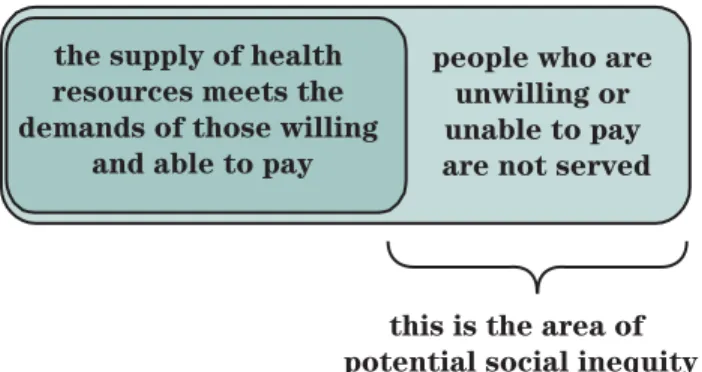
The price is the means by which services will be rationed: consumers able and/or willing to pay will be the ones who receive the service. But a number of well-recognised features of health inhibit the development of an ideal market. These factors produce the actual market model, which may have social inequities built into it.
Introduction Page v
The Context: Private and Public Visions
the supply
of health resources
the demand for health
resources
all health systems
try to find ways to
close the gap
between need and demand
the supply of health resourcessatisfies
the demand for health resources
under the ideal market model, supply satisfies demand because: • sellers of service increase the supply
to meet the demand
• buyersof service are willingand able to pay to meet their demand
Figure 4: The Actual Market Model
Social inequity may result, but does not inevitably result, from the market model’s emphasis on ability to pay. For instance:
• Under the market model, an athlete might want surgery to extend her toes so she can get more quickly out of the starter’s block at the beginning of races. She may not be able to pay for the surgery, but few would consider it a social inequity that she is unable to get the surgery done: her “need” for surgery has a low social value.
• Also under the market model, a child may need major surgery to correct a heart defect. Failure to correct the problem will lead to the child’s death, but the child’s family cannot afford the surgery. Most of us would consider it a social inequity if the child cannot get the surgery done: her “need” for surgery has a high social value.
As a result of market imperfections, including the possibility of inequitable results, societies intervene to varying degrees to ensure that health resources are not solely rationed by the ability of individuals to pay for them:
• Societies near the “market model” end of the
spectrum often make provision for those who cannot afford to pay for socially high value services.
But most societies also allow the market model to exist. • Societies near the “social model” end of the spectrum still make provision for the market model to prevail for services that have a low social priority (toe enhancement for instance).
Page vi Introduction
the supply of health
resources meets the
demands of those willing
and able to pay
people who are unwilling or unable to pay
are not served
this is the area of
The rest of this module focuses on assessing need within a social model that has features of the market model as well. This is the mixed model (but weighted toward the social model) that exists in Canada. If health resources are not going to be allocated by markets, other means of allocation must be used. Public health systems have several potential approaches for resource allocation. These include:
1. approaches based on the concept of meeting the needs of the population
2. economic approaches that identify the most efficient allocation of resources to maximise health benefits or other social benefits
3. approaches that ration health care by age
4. approaches that resolve allocation disputes through debate and bargaining.1
Underlying most approaches to allocation of resources in public health systems is the idea that health care should be allocated equitably based on the needs of the
population. That health care allocated on the basis of need rather than on the ability to pay is fundamental to publicly insured health services in Canada.
Within the social model of publicly insured health services, needs assessment is crucial for two reasons: • Public funds are used to underwrite much of the cost
of the model. Citizens increasingly expect
demonstrable value for money when the public purse pays for services, and health needs assessment tries to both discover and demonstrate value for money. • Key features of the public model inevitably constrain
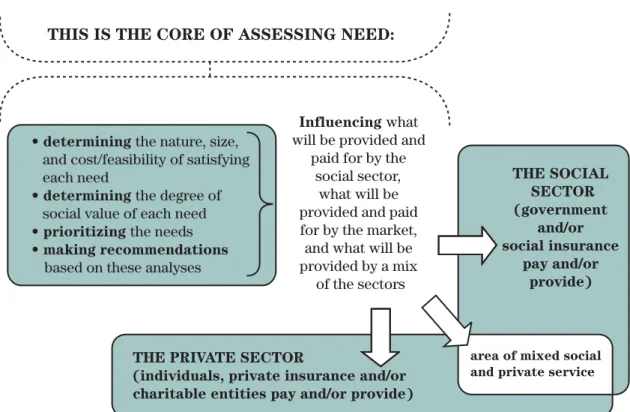
some of the freedom found in the free market model: sellers cannot sell everything they want within the public arena, nor can buyers buy everything they want. Needs assessment, then, is a tool for helping ensure that people are free to provide and receive the most crucial services, and for helping the public sector to decide what is most important to fund. Under this model, assessing needs looks like Figure 5.
Section 1: What is Health Needs Assessment? Page 1
Section 1
What is Health Needs Assessment?
Figure 5: The Nature and Effects of Assessing Needs
THIS IS THECORE OF ASSESSING NEED:
Influencing what
will be provided and paid for by the
social sector, what will be provided and paid for by the market, and what will be provided bya mix of the sectors
THESOCIAL
SECTOR
(government and/or
social insurance
pay and/or provide)
THE PRIVATESECTOR
(individuals, private insurance and/or
charitable entities pay and/or provide)
area of mixed social and private service • determining the nature, size,
and cost/feasibility of satisfying each need
• determining the degree of
social value of each need • prioritizing the needs
• making recommendations
a technical act, because it usesanalytical toolsand technologies to generate and evaluate evidence
a social act, because it engages citizensand provider communities in the decision-makingprocess
an ethical act, because it deals with issues of the worth of health and life, and issues of societal fairness
Health Need
s
A
ss
e
ss
ment (HNA) i
s
:
If consumer demand is not going to be the means bywhich health resources are distributed, then defining and identifying health needs will be essential for priority setting, resource allocation and policy development – particularly in the social model since, unlike the private model, it does not presuppose ever-expanding supply if unlimited demand occurs.
Much work has been conducted in health needs assessment (HNA), a systematic process for allocating resources on the basis of need. This process includes: • describing the extent of health needs
• describing existing services to address the needs • evaluating the evidence base for services and
identifying best practices
• setting priorities among various needs
• recommending new programs and/or change in existing programs to address the priorities.
The concepts and practices of health needs assessment have been discussed for many years,2,3,4,5even though
health resource allocation continued to be based largely on patterns of past service provision and utilisation.4
As responsibility for managing the delivery of health
services has devolved to regional authorities in Canada and elsewhere, health needs assessment has emerged as a way to help avoid the trap of merely projecting the past into the future. Nonetheless, despite the processes and tools that exist and the new prominence of health needs assessment, there are still choices to be made about the type of process, the scope, the concepts and
Page 2 Section 1: What is Health Needs Assessment?
“A health needs assessment identifies and measures the health status of a population of a Regional Health Authority. It examines the way health services are used, what health services are needed, and the ability of the region to respond to those needs. It also measures the various
environmental and behavioural influences on health and well-being in communities and the region as a whole. It is an ongoing process that incorporates a wide range of information and analysis that can be used for a variety of purposes”.
From: Health Needs Assessment: A Guide for Regional Authorities. Alberta Health and Wellness, 2000; p.8
the indicators for each health needs assessment. The next sections of this module set out and discuss these choices. Detailed practical guidance for the needs assessment process can be found in workbooks created for various health planning authorities (see Appendix A). As other sections of this module demonstrate, health needs assessment is not merely a technical act. Because it is conducted in the sphere of social activity and because it engages a number of people in the assess-ment process, it is also a social act. And because it must take into account ethical issues such as the worth of human life and health, and principles of fairness in distributing social goods, it is also an ethical act. All three dimensions – ethical, social and technical – will be addressed throughout this module.
1.1 Skills and Techni
q
ues
The skills involved in health needs assessment are not a world apart from skills normally associated with planning (since, after all, assessing needs is one major component within the overall planning process). The skills and techniques needed to conduct a health needs assessment include:
• Project management: To ensure that the
assessment of needs is carried out thoroughly but efficiently and on time. Other steps in the planning process will depend on the needs assessment meeting its time and quality targets.
• Information collection and analysis: Module 3
(Evidence Based Planning) contains useful
information on information collection and analysis.
• Community engagement: Because community
insight and concurrence are important for identifying and understanding need. Module 5 (Community
Engagement and Communication) provides
suggestions on engaging communities.
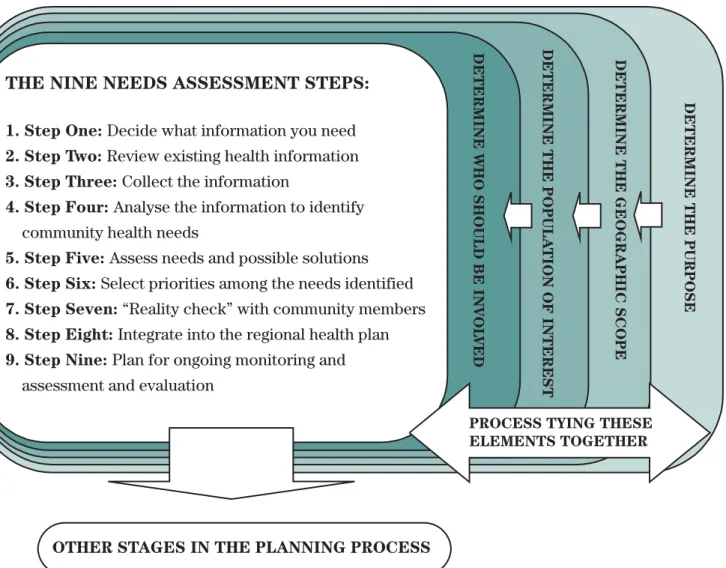
1.2 The Nine Core Steps
A health needs assessment comprises nine core steps that may differ in their particulars but that all contribute to identifying need:
1. Step One: Decide what information you need
2. Step Two: Review existing health information
3. Step Three: Collect the data
4. Step Four: Analyse the data to identify community
health needs
5. Step Five: Assess needs and possible solutions
6. Step Six: Select priorities among the needs
identified
7. Step Seven: “Reality check” with community
members
8. Step Eight: Integrate into the regional health plan
9. Step Nine: Plan for ongoing monitoring and
assessment and evaluation
1.3 The Five Start-up Activities
The steps are nested within five start-up activities that shape how the steps will be applied:
1. Determining the purposeof the health needs
assessment
2. Determining the geographyto be covered by the
assessment
3. Determining the population of interestto be
covered by the assessment
4. Determining the stakeholderswho should be
involved in the assessment
5. Establishing a processto connect and manage
these four other activities and the nine core steps. The connections among these components can be shown graphically (see Figure 7).
Health needs assessors should work closely with partners in the larger planning process to ensure the identified health needs are monitored and to evaluate progress in meeting those needs. A common reason for lack of success in health needs assessments has been the failure to integrate the results with planning and funding to ensure change: “Needs assessments that do not include sufficient attention to implementation will become little more than academic or public relations exercises.”6
As well, evaluation of the activities, products and outcomes of the health needs assessment itself allows participants to identify strengths and areas for improvement and measures the level of internal and external stakeholder satisfaction with its processes and outcomes.
Page 4 Section 1: What is Health Needs Assessment?
1.3.1 Start-Up: Establishing the Process
Any health needs assessment must establish a process to ensure the assessment is conducted within available time and resources. Determining the basics of a process is necessary near the beginning of an assessment, but will likely require adjustment as the assessment unfolds and as choices about purpose, geographic scope, population of interest, stakeholder involvement, information-gathering scope, and information-gathering tools are made.
As indicated in section 1.3.5, a multi-stakeholder team may be useful in defining the assessment’s purpose. If created at the project’s start, this team may also be useful in helping to develop, or commenting on, the assessment process.
1.3.2 Start-Up: Determining the Purpose
The purpose of the health needs assessment should be clear and accompanied by a statement of objectives. When framing the purpose, choices will have to be made about the theories and concepts of health to be used during the assessment and about a range of practical, ethical and political issues that may be controversial. Accordingly, it is useful if a
multi-stakeholder team oversees development of the purpose, to allow differing perspectives to be aired and
reconciled. This group can then become the body that: • oversees the entire assessment;
• and/or is convened at key points during the assessment to review progress and findings.
1.3.3 Start-Up: Choosing Geographic Boundaries
Health needs assessments can be carried out at various levels: international; national; provincial; regional; by institution or service; neighbourhood; and individual.7
An initial choice, then, is to decide the geographic scope and boundaries of the assessment.
There are two dimensions to geographic scope:
1. The level of geography whose standards and policies will be used in carrying out the assessment. For instance, national standards rather than provincial ones may be chosen as the focus.
2. The geographical boundaries of the actual
assessment. For instance, a large city or a rural and small town area might be chosen.
It is not a paradox, then, for a choice to be made to apply national standards to a much smaller area than the whole nation.
Most basic is the question of what geographic area “makes sense” for health planning. The geographic boundaries appropriate for planning community-based primary care will differ from those for tertiary care, yet will influence, for example, questions of service integration: what should be the relationship between services that serve the immediate geographic area with those with national or even international scope? At the local level, readily available sets of boundaries such as aggregations of census tracts may misrepresent socially relevant communities formed around focal points of residence and service provision. Studies of neighbour-hood influences on health, for example, have been criticised for using arbitrary geostatistical units (for example, Census Tracts or Postal Code Districts) rather than “naturally” defined neighbourhoods.8
Commonly the boundaries of a planning area and the geographic boundaries within which health data are collected do not match. There are also issues of who should define the geographic area, ranging from: • a bottom-up approach involving consumers and
community groups
• to a top-down approach driven at the regional or provincial level by senior managers.9, 10
For regional health planning, boundaries may already have been established by the province, but that makes them no less important for the practicalities of
assessing health needs.
Examples of Geographic Scope
International: By the World Health Organization.
National:A number of countries have developed and
implemented health goals since the late 1980s, including the United States, the United Kingdom, Sweden and the Netherlands.11 Healthy People 2010 in the United
States, for example, addresses what are considered the most significant preventable threats to health and establishes national goals to reduce these threats.12
In 2005, Canada initiated a health goals process, intended to provide a framework that enables all levels of government to align their individual and collective efforts on public health.13 However, the actual
application of the goals through needs assessment will ultimately be at a more local level.
But not everything is local. Provincial or regional health needs assessments could identify priorities in the context of the overarching national health goals. For example, the United Kingdom’s government has set as a national priority the reduction of health inequalities within the population, and regional as well as local health needs assessments are considered vital tools to meet this objective.14
Provincial: At the provincial level, for example,
Ontario has successfully addressed the need for advanced cardiac care through the Cardiac Care Network of Ontario.15 The provincial level may also be
the most appropriate for addressing needs derived from the broader determinants of health. Many income support programs, for example, are provincial responsibilities, although need for such support has distinctly regional characteristics (northern compared to southern Ontario, for instance).
Regional health authority or board level:Ontario’s
Local Health Integration Networks (LHINs), like regional authorities in other provinces, are designed to plan, integrate and fund health services including hospitals, community care access centres, home care, long-term care, and addictions and mental health services, within a specific geographic area. LHINs will determine the health care priorities and services required in their communities. They will begin by engaging community and health care providers in identifying needs, setting priorities and planning health services in their area. LHINs will then support local service coordination and systems integration, and eventually provide funding and allocate resources.16
While the ultimate source of funding to address area needs may be the province, the responsibility for assessing local area needs will lie with LHINs.
Organizational:Health service organisations may
conduct needs assessments in the context of their own planning processes. Their geographic catchment areas may overlap with other community or service boundaries.
Service/population specific:A single piece of needs
assessment work may be worthwhile in the context of a larger organizational needs assessment or when a service (or service cluster) is relatively prominent in an area of particular need. In the context of a broader needs assessment conducted by a community health centre (CHC), it may be found that a more focused assessment of need is required for specific sub-groups in the CHC’s community, such as youth, seniors or new immigrants. Or, for example, in a disadvantaged area where mental health and addiction services already make up much of the total service array, a separate and distinct mental health/addictions needs assessment may be warranted in order to tailor the services most appropriately.
Small neighbourhood:Some health services have a
group of patients who live in a well-defined area. Such an area can be targeted for needs assessment and may be an appropriate scale for service delivery.
Individual:Patient needs assessments are used daily in consultations by health care practitioners.
In general, higher level assessments provide context for more local assessments. Even international perspectives are increasingly relevant for local assessments because health needs in some localities may have their origins in other countries. Certainly health resource allocation decisions at higher levels will frame and constrain those at lower levels, restricting the range of needs that can be served and requiring that priorities be set.17
Conflicts may arise among needs and priorities identified at different levels, however:
• In Canada, the relationship between national and more local priorities is complicated by
federal/provincial jurisdictional responsibilities. • The most common complaints presented by patients,
such as stress, arthritis, and dyspepsia, may not be identified as national priorities.
• Neighbourhood activists with a determinants of health perspective may identify broader social and economic needs as the root causes of health care needs and may advocate that priority be given to root causes rather than “band-aid” health care solutions. • Clinically oriented stakeholders on the other hand
may argue that priority be given to immediate health care needs.
• Specific services will vie for attention within a larger institution, sometimes on the basis of historical patterns of utilisation rather than on anticipated needs. • The traditionally individualistic focus of health care
practitioners may be difficult to reconcile with the broader priorities of decision makers who must attend to the health needs of the whole population of a given area.
The choices and tensions in health needs assessment become real in the relationships among levels of needs assessment, definitions of needs at different levels, competing priorities among them, and consequent resource allocation.
1.3.4 Start-Up: Identifying the Population of Interest
The population for a health needs assessment might be identified as people sharing:
• a geographic location– living in a region,
neighbourhood or catchment area
• a setting– school, workplace, prison or hospital
• a social experience– age, ethnicity, homelessness; or
• a health condition– a disease, a mental illness, a
physical or developmental disability, or a risk factor. Health needs assessments often define populations through a combination of main and sub-categories, such as “older people living in a deprived neighbourhood and recovering from a stroke”.18 LHIN area health needs
assessments might examine health needs for the general population in their area, but in that context they may also include sub-populations such as new immigrants and their families in specific urban neighbourhoods.
1.3.5 Start-Up: Examining who Should be Involved
Two dimensions of involvement are important for health needs assessments:
1. Deciding who needs to be involved in design, management and oversight of the assessment. 2. Determining who needs to be involved as
stakeholders to provide knowledge, opinions and insights as raw material for the assessment. This group will likely be larger and more varied than those involved in design, management and oversight. Resolving disagreements over “needs” requires a deliberative process that incorporates the public as well as experts and health practitioners. Health needs assessment is a form of “procedural rationality” for decision-making under conditions in which there may be: • multiple demands
• but no obviously right answer.
Consistent with procedural rationality, health needs assessors should have the most representative and pertinent expertise relevant to their assessments.19, 20
Participation of members of the broader community, such as consumer or advocacy groups, may be recommended. Roy Romanow’s Commission on the Future of Health Care in Canada, for example, consulted with health professionals, experts, and the public to identify Canadians’ values and priorities. Strengthened community involvement in decision-making, and improved partnership, are reported as outcomes of community participation in health needs assessments.18
Choices and processes for community engagement and participatory decision-making are discussed in Module 5
(Community Engagement and Communication).
These choices – process, purpose, stakeholders, geographic scope, population of interest, and who to involve as participants – interact and help to define each other. Any of these choices will set parameters that influence available choices in the other areas. A narrower geographic scope may have a more homogenous population of interest, for example, requiring fewer stakeholders. On the other hand, choosing to include a wide range of stakeholders may bring a similarly wide range of views to the decision table, resulting in multiple perspectives on relevant populations, geographic scope and needs.
While difficult process decisions must be made (regarding who should be involved in the needs
assessment for instance), conceptual and value choices must also be made in the substance of the health needs assessment.
Early steps in the health needs assessment process will decide its scope and purpose and the type of
information desired. The outcomes of these steps will be determined by theoretical perspectives as well as practical information availability. Choices must be made regarding the definition of health need to be used, the theory of health to follow and the indicators by which health needs will be measured.
2.1 What is “Need”?
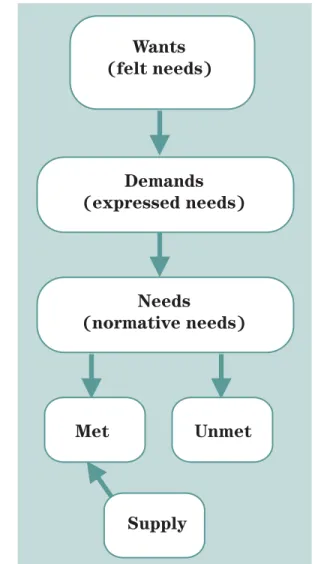
If health resources are to be distributed according to need, a way of defining “health need” must be found. But “need” is an ambiguous concept, defined in many ways. The following types of need have been
proposed21:
Felt needis the subjective experience of need, a need
seen as important by the person concerned. Felt need is the basis of, but may or may not translate into, expressed need.
Expressed needis vocalised needs or how people use
services, often referred to as demand for (or utilisation of) service.
Normative needis typically defined by experts and
professionals. Regarding health, this is usually
expressed in terms of acceptable minimum and maximum population health status and/or levels of service provision.
Met and unmet need:Needs thus can be met or unmet
in various ways: felt needs may or may not be expressed; demand may or may not be satisfied. The norms of need may or may not be similar across populations or regions. A community might define its own notion of health need, then assess its resource requirements on that basis, but comparative need often substitutes as a gauge of unmet need in the absence of an absolute standard.
Section 2: Health Needs Assessment Choices: Concepts and Their Values Page 9
Section 2
Health Needs Assessment Choices: Concepts
and Their Values
“Photography implies that we know all about the world if we accept it as the camera records it. But this is the opposite of understanding, which starts from not accepting the world as it looks.”
Susan Sontag, On Photography, 1973
Want
s
(felt need
s
)
Demand
s
(expre
ss
ed need
s
)
Need
s
(normative need
s
)
Met
Unmet
S
upply
Comparative needis determined by comparing populations based on certain indicators; it is underpinned by the concept of equal allocation of resources. If nothing else is known about the optimum level of health (and therefore need in relation to that level), there is at least reason for investigation if levels differ markedly among different populations. Similarly, with respect to the services received by the population in one area compared to those received in other areas, if nothing else is known about the optimum service to be provided, there is at least reason for investigation if the level of service differs markedly from that provided elsewhere.22
Supplyis the health resources provided. Their size and
range depend on the definition of need and the interests of health professionals, the priorities of government and communities, and the amount of money available. While felt or subjective need may be legitimate grounds for personal motivation, it is not the basis for allocating health resources. People’s subjective experience of need will be the origin of their expressed need, but the subjective expression of need can become endless. Subjective needs may also be “irrational” or socially unacceptable. Especially with respect to public services, a society could never reasonably expect to meet all possible needs, least of all irrational or unacceptable ones.4
Some economists argue that the concept of demand (expressed need) does all the theoretical work of the idea of “need”, that any notion of “real” need more fundamental than demand is superfluous. The
advantage of the economic model in health planning is that it considers both the population and the provider perspective. The demand can be thought of as the health need of the population, while the supply is the provision of health resources. In theory, economic markets balance demand with supply. Under an ideal market system, expressed need or demand would be a sufficient basis on which to provide or distribute health resources.
Health care markets, however, are characterised by “market failure”: the conditions for the ideal market do not hold. People may have legitimate needs that they do not express as demands, for example. People may not have the money to satisfy their needs or they may not know what they need for the purposes of their health. As well, the economic definition of demand, as
“a desire for a good or service, accompanied by the means to pay for it” 23confuses the distinction drawn
earlier that, for the purposes of equity, health resources should be available on the basis of need rather than ability to pay. Finally, even authors who advocate economic models to analyse and plan public services contrast “rational” and “irrational” demands, using “needs” as shorthand for rational demands in contrast to mere “wants” and/or irrational demands.23
This presents a dilemma for needs-based health system planning:
• On the one hand, responding to public demand would increase both the scope of health resources – for example, alternative and complementary therapies would probably be included in the health system – and the total cost.
• On the other hand, a stricter definition of health needs could evoke hostile reactions from those whose demands are not being met.
International experience shows that demand (market) based health systems are more costly because demand for health care seems open-ended and market provision of health services is more expensive.24 However,
systems that are strictly and rationally “needs-based” but unresponsive to public demands are unlikely to enjoy continued public support. In practice, a balance is sought: each of the types of need listed above has been taken into consideration when planning for resource allocation; that is, a population’s expressed and/or felt needs, along with its comparative needs, are often taken into account when normative assessments are made.
2.2 Distinguishing “Real” Needs
Taking into consideration these ideas about need when assessing health need does not resolve the problem of how to balance them. If health need is to determine the distribution of health resources, rational and responsive health planning still requires a definition of legitimate or real need to guide resource distribution.
To distinguish “real needs” from felt needs or “wants”, philosophers appeal to fundamental concepts. At its roots, need is defined instrumentally, i.e. as a need for something. Needs are defined in relation to some goal. The urgency and/or moral status of the needs flow from the urgency and/or moral status of the goals. A “want”, therefore, does not have the same weight as a “need” because the want is not as ethically compelling as the need. Need in this sense is used when talking about basic human needs: these are needs that people require in order to avoid serious harm, serious harm entailing the inability to flourish as a human being, whatever this might mean culturally for any individual.19 Harm will
befall a person if his or her needs are not met. Health itself, simply in terms of survival and physical health, is considered the first basic human need, without which no other valued human ends can be achieved.25, 26
Specific health needs then are ancillary to the basic human health need. They are therefore subject to ethical claims: more specific health needs must be met in order that the basic human need of health be met. But in practice there can be fundamental disagreements about what are health needs and which ones are more imperative than others. Need is both relative and graduated since health is also relative and graduated. Health is variable in terms of functioning, experience of pain, longevity and quality, and is at least in part culturally determined.27
While the notion of health as a basic human need implies that it is an objective condition, and thus that health needs themselves will be objectively defined, health needs, and the ethical claims they support, are open to interpretation, partly because there are differing scientific and cultural theories of health and what is needed to promote it:
• To what kind of health do people have a right? Physical health? Mental health? Social health? • What health needs must therefore ethically be met?
Biomedical health needs? Social health needs? Different notions of health will have different
implications for the definition of health needs and for the ethical obligations of planners/providers. The possible range of interpretation suggests that explicit decisions will have to be made about which definition of real health needs will guide health planning.
2.3 What is a Health Need?
If health resources are to be distributed on the basis of need, then defining “health need” is essential.
The previous discussion presented definitions of need in general, pointing out the challenge of attaining a
balance among them. For health planning, however, general definitions of need must be translated into specific definitions of health need. Familiarity with different ways by which health need has been defined will help planners and decision-makers to clarify their health planning goals, anticipate conflicts among them and make informed choices.
The rest of this section explores four major ways of defining health need and analyses each of the four ways.
2.3.1 Health Need as Medical Necessity
The Canada Health Actsets the terms that provinces must meet in order to receive funding for hospital and doctor’s services. The Act uses the term “medically necessary” to identify services that must be funded by the provincial health insurance plans. The Act says that to receive federal funding for health care, provinces must pay for all hospital services that are “medically necessary” as well as doctor’s services that are “medically required.” When a service provided to a patient is medically necessary it is fully funded by public health insurance and delivered based on the patient’s need, not on the patient’s ability to pay. If a service is deemed unnecessary, however, patients must pay for it directly. The idea is to have need, not want or
“demand”, determine what the health care system provides. Although medical need is the main criterion by which medical services are publicly funded, and thereby a possible guide to deciding about health care needs more generally, it is not defined in the Act.28
In the absence of an explicit definition of medical necessity in the Act, a common implicit definition has become “what physicians and hospitals do”.29
As noted above, however, people’s needs may never show up in medical services. People may not recognise that they have a health problem or they may believe that they cannot be helped by medical care, so their needs will not be expressed. Other groups such as homeless people and people with chronic mental illness may have medical needs but may not seek care,6while the largest
burden of illness in the community – chronic diseases and conditions – may not be well-served by existing medical services.30 TheCanada Health Act’sversion of
medical necessity is therefore not a good model for defining health need. It perpetuates current practices rather than shaping practices to meet expected needs.
2.3.2 Health Need as Burden of Illness
When thinking about health needs, it is natural to consider how big the health problems are. The burden of illness or disease concept is based on the idea that health need is related to the magnitude of the health problem. The World Health Organization (WHO) uses a burden of disease measure to gauge the size of
population health problems and as an indicator of health system performance: health systems that perform well will minimise the burden of disease as efficiently as possible.31
The notion of burden of disease is called a “summary measure” because it represents the overall health status of a population in a single figure. Life expectancy is another common summary measure, and life
expectancy comparisons provide a very general gauge of health status and health need among different populations. Measures of disease burden allow a finer discrimination among health needs: overall disease burden is estimated by aggregating all burdens
measured for individual diseases, so individual diseases may also be ranked by relative size of burden.
Page 12 Section 2: Health Needs Assessment Choices: Concepts and Their Values
Figure 9: Definitions of Health Needs
Health Need as
Medical Necessity
(Expert authority says it isaneed.)
Health Need as
Burden of Illness
(How sick or incapacitated are we?)
PEOPLE
AND
POPULATIONS
Health Need as
Comparative Health Deficit
(Are we better or worse than others?)
Health Need as
Capacity to Benefit
(How much health and wellbeingare we capable
Prevalence and incidence of disease are measures of disease frequency commonly used in needs assessment as indicators of disease burden:22
• The prevalenceof a disease is the proportion of a population that has a disease or illness at a specific point in time.
• The incidenceof a disease is the rate at which new cases occur in a population during a specified period; the mortality rate in fact is the incidence of death, mortality from specific conditions being the incidence of death from those conditions.32
(See Section 3.2, Mortality Measures).
Prevalence and incidence measures serve different purposes:
• Prevalence measures are important for planning current curative and rehabilitative services, while incidence-based measures are more relevant to the planning of prevention activities.33
• Prevalence is particularly important when the duration of disease is long, for example, asthma, diabetes, or multiple sclerosis, implying ongoing need for services.34 Incidence is an important gauge for
diseases or conditions that are of short duration (such as many communicable diseases) or for those for which a substantial amount of the healthcare input occurs shortly after diagnosis (myocardial infarction for example).
However, these measures of disease frequency do not completely measure disease burden. Other choices will have to be made beyond incidence or prevalence to convey the “weight” of the burden of ill health in a population. What is the burden, for instance, of a relatively uncommon condition that causes great individual suffering and/or certain death, compared to a common but less severe condition? Prevalence and incidence represent the number of afflicted people and the number of deaths caused by the disease, but burden is also expressed in measures such as reduced life expectancy, disability, severity of disease, loss of quality of life and the economic impact of disease. All these measures incorporate not only the number of events, but also some other, qualitative sense of their significance.
As used internationally, the burden of disease concept incorporates:
• personal health experience (which is qualitative) • and disease frequency (which is quantitative). As a gauge of health need, burden of disease has the advantage of incorporating many dimensions of health experience, not only mortality but premature mortality and morbidity or disability as well. Several measures of disease burden have been developed, however, among which health planners will have to choose. Quality-adjusted life years commonly used in cost effectiveness analysis, disability-adjusted life years (DALYs), used in the WHO’s Global Burden of Disease estimates, and health-adjusted life years (HALYs), used in Canada to estimate summary measures of health for some 200 diseases,35are examples of summary measures to
represent disease burden.
All such measures of health involve social value choices. Quality-adjusted life years (QALYs) for example, look at a health intervention by examining: • how many years of life an intervention will add to the
life of a person experiencing a health problem • the value of each life year before the intervention,
expressed on a scale on which “1” represents perfect life quality (a score of 0.3, for instance would
represent relatively low quality), and the added value of each year of life after the intervention.
A person could undergo an intervention that adds no additional years to life, but that adds quality to each remaining year of life so that it increases from, say, a pre-intervention score of 0.4 to 0.6 per year (it could well be in this example, for instance, that the
intervention might have increased quality to 0.8, except that the intervention has side effects that in turn reduce the quality from 0.8 to 0.6).
The basic question that underlies QALYs (and similar tools) is: “Who defines quality, or level of disability, or health improvement?” While survey tools have in turn been developed that attempt to gauge how a population
itself evaluates things like health, disability and quality of life, the tools themselves demonstrate that
establishing a measure involves making a social choice about value. Accordingly, choosing among the measures is tantamount to choosing among values.
Other value choices involved in measuring burden include such things as:
• whether lost years of healthy life are valued more at some ages than others,36
• the “weight” assigned to years lived with different diseases and disabilities.
As an example of value related to age, consider before what age a death should be judged premature. The age standard for premature mortality has varied historically and internationally. The World Health Report (WHR) 2000 defined life expectancy at birth as 82.5 years for women, and 80 years for men, the average life expectancy of the Japanese, who at present have the world’s longest overall life expectancy. The World Health Report chose these life expectancies on equity grounds, arguing that all nations should be able to obtain the survival results of the most successful.37
Great swaths of health need thus can be added or removed simply by taking premature death to be any death before the age of 80 or before the age of 65. Premature mortality in Canada is defined as any death before age 75. This definition makes a more or less explicit choice, implying that someone who dies after age 75 does not count in the same way as someone who dies before.38
Similar to determining scales for quality of life or quality of disability, some tools involve scales meant to
determine the weight or value of time spent in a specific state of health. Some of these measures incorporate an arbitrary threshold below which the value of the health state is zero (i.e. equivalent to death) and above which the value is one (i.e. equivalent to full health). Such valuations make the measures very sensitive to variation in the arbitrary threshold definition, compromising their usefulness.
Other measures allow, in principle, continuous
valuations of health states from 0 to 1, although how the values are decided is still an issue (see the HALE – health-adjusted life expectancy – example described in Section 3.3). For measures that incorporate continuous valuations, approaches to health state valuation can be distinguished further on the basis of:
• the persons whose values are used • the type of valuation question that is used • the manner of describing the health states to be
valued
• the range of health states – from mild to severe – valued at the same time
• the combination of valuation questions
• more generally, the type of deliberative process undertaken, if any.33
Severity, for instance, is an element of the weight of disease: more severe disease is a “bigger” burden than less severe conditions. Yet severity is open to different interpretations. Whether a disease is fatal or likely to lead to permanent disability is one aspect, but severity also includes:
• the level of pain or current disability • the urgency of treatment demands
• the extent to which the disease can be treated in the first place.39
The severity of the disease thus turns out to be a multifaceted concept, another choice that must be defined if measures of health need are to be transparent.
The merits of each choice are debated extensively in health economics literature, and health planners may not be directly involved in decisions about how health and burden of disease measures are constructed. Most measures for health needs assessment will be “off the shelf”, but health planners should be aware that even seemingly objective measures of health involve choices and value judgements in their construction and
application. These choices have implications for Page 14 Section 2: Health Needs Assessment Choices: Concepts and Their Values
comparing the health of one population with another, monitoring changes in health, identifying and
quantifying health inequalities, and informing debates on priority setting for health services.33
A distinction can also be drawn between avoidable and unavoidable burdens of illness. Whether an illness is avoidable is a function of available knowledge and technology, making illnesses that are avoidable in some countries, regions or populations unavoidable in others.3
Two phenomena illustrate the inherently social nature of health needs assessment:
• Choices must be made regarding the different values (more or less) implicit in different measures. • “Avoidability” of illness varies by country or region. In short, what counts as a legitimate health need will depend on the values and level of development of the society in which the assessment is conducted.
2.3.3 Health Need as Comparative Health Deficit
In the absence of absolute definitions of need, health need in one population is often defined in comparison to the health status in another: health need is defined as a “measurable health status deficit”, suggesting a comparison to some standard. Typically the standard is the average across the province or country for the chosen indicator, but – as the World Health Report example (cited in the previous section) indicates - a higher standard may be chosen. Health need has also been defined as a “measurable opportunity to maintain or enhance health”. This definition was proposed in the interest of extending the definition of health need beyond merely the presence or absence of disease.5
The comparison in this case would be a comparison of the current state to a theoretical “target” for health. The target would in turn be based on the nature of one’s theory of health. A broad theory of health that incorporates social determinants will identify many more, and different, opportunities to maintain or enhance health (i.e. “more needs”) than a narrow biological model. The broad theory of health might
include increased income as a health need because income is a key determinant of health, but the biological model would emphasise medical care needs.
2.3.4 Health Need as Capacity to Benefit
The definition of need most widely favoured by health economists is “the ability of people to benefit from health care provision. “In other words, “need” exists only if there is a capacity to benefit from a health care service.40 This definition highlights the outcomes to be
achieved by allocating resources on the basis of need, and it introduces priority-setting criteria: it recognises as a need only those things about which something can be done, and among the things that can be done, selects those that will provide the most benefit.
There would be no benefit from an intervention that is not effective, so according to this approach, resources should be applied to needs for which:
• interventions are effective in producing benefit such as health protection and enhancement, disease prevention, or the postponement of death; and • the most benefit will occur.6
The Upside of the Concept of Capacity to Benefit The value of these desired ends (i.e. effective
interventions, and most benefit) makes the notion of need ethically compelling in comparison to mere wants or demands. Demands are related to desired ends too, but the value of those ends is given less moral weight. Allocation on the basis of need is therefore more equitable than allocation by demand because the ends served are more highly valued or fundamental.41In
short, there is no value in an ineffective intervention., even if it is demanded.42
Need, defined as capacity to benefit, also promotes efficiency because it directs attention to interventions that produce the most benefit, thereby maximising health benefits for resources invested. 43
The largest health benefit, however, may come from investments beyond clinical care. Despite confusion
between the two, health needs are not the same as health care or medical needs. Health need defined as capacity to benefit, may draw attention away from health care toward broader determinants of health, through which larger total health benefit might be achieved.
Need as capacity to benefit, therefore, has the advantages of:
• drawing attention to the desired end that a need is supposed to serve
• emphasising the effectiveness of proposed interventions
• promoting efficiency by allocating resources to those needs where the most benefit will accrue
• drawing attention away from health care toward broader determinants of health, which may have greater payoff.
The Downside of the Concept of Capacity to Benefit
On the other hand, allocating resources on the basis of capacity to benefit can have socially questionable results.
For instance, benefit from health care may be affected inversely by the severity of disease: someone suffering from mild symptoms of coronary heart disease may have a greater chance of receiving coronary bypass surgery than an older patient with severe disease (whose life may not be extended greatly by surgery) on the grounds that the former has more capacity to benefit.40
Yet in health care, preference is commonly given to helping the worst off, a preference supported by several theories of distributive justice and health ethics. In this case, priority should be given to people whose suffering and inability to function is most pronounced or severe (most in need, under this definition) even if treatment available for them is less effective than for other conditions and if the overall health benefits gained are fewer. Studies have shown that people are often
pre-pared to sacrifice overall health benefits to ensure that more severely ill people are given priority over the less severely ill.44 Defining need as capacity to benefit thus
conflicts with this humane impulse to aid the worst off. A related issue arises from the “Rule of Rescue” – society’s desire to rescue people facing avoidable death or serious harm, without giving thought to the foregone benefits of doing so:
• Rescue efforts will be mounted for lost or stranded individuals even when the efforts are futile. • Critically ill patients will receive intensive care,
despite a discouraging prognosis.
• Some patients receive a second or third heart or liver transplant even though first-time transplants have a better chance of survival.
These practices ignore the cost effectiveness
calculations served by the notion of need as capacity to benefit.44 The most popular definition of need among
economists thus seems to conflict with compassionate desire to aid the afflicted.
To the extent that capacity to benefit depends not only on one’s health condition but also on other
determinants of health – socioeconomic status (SES) primary among them – there is a risk that decisions to allocate health resources to those who have more capacity to improve their health will benefit groups in society with favourable prospects for health, rather than groups with less favourable prospects.45 Higher
socioeconomic groups generally have more favourable prospects for health and thus have greater capacity to benefit from health interventions. For example, health promotion initiatives to reduce behavioural risk factors for chronic disease have been more easily adopted by higher socio-economic groups, leaving lower groups at a larger relative disadvantage.46 Investing resources in
those who can better take advantage of life-extending and quality enhancing care might be the policy that maximises aggregate health, but it might widen the gap between the healthy and the less healthy.47
Allocating resources on the basis of need defined as capacity to benefit, therefore, may increase inequities.
2.4 Health Need, or Health Care Need?
Health care needsare those that can benefit from
health care (health education, disease prevention, diagnosis, treatment, rehabilitation, end-of-life care).
Health needson the other hand incorporate the wider
social and environmental determinants of health such as deprivation, housing, diet, education and employment. This wider definition directs attention beyond the confines of the medical model that is based on health care services, to the broader determinants of health in which the focus is on improving the health status of a whole population or sub-population, rather than individuals.
Emphasising broader population health and its determinants has several implications for health planning and health needs assessment choices. The health care needs of individual patients might not reflect the health needs of the population, and
distinguishing between individual needs and the broader needs of the population is important in the planning and provision of health services.6 In fact, central to the
theory of population health is a distinction between the causes of individual cases on the one hand and
population incidence of disease on the other:
• For individual cases one asks, “Why is this person sick at this time?”
• But for population incidence one asks, “Why is this rate high (or low) in one population but not another?”
Section 2: Health Needs Assessment Choices: Concepts and Their Values Page 17
H
E
ALTH
C
A
RE
N
EE
D
S
are met by the
health care
s
y
s
tem
H
E
ALTH N
EE
D
S
are met partly by the health
care
s
y
s
tem, but al
s
o by a
number of other
s
ocial and economic
initiative
s
the overlapping
area of
active cooperation
THI
S
I
S
TH
E
SC
OP
E
OF
TH
E
H
E
ALTH
C
A
RE
S
Y
S
T
E
M:
• meeting health care need
s
• and contributing to meeting
(but not wholly meeting) health need
s
THI
S
I
S
TH
E
SC
OP
E
OF
MANY
S
Y
S
T
E
M
S
:
addre
ss
ing health need
s
will reduce the need
for health care
Addressing the cause of individual cases may not address the cause of the population’s incidence of disease, but the largest health benefit is likely to arise from the latter because small improvement over a larger population will result in more total benefit than large improvement in fewer individual cases.56Planning on the
basis of population health needs may therefore conflict with planning on the basis of individual care needs. Research in the broader determinants of health shows that a population’s health is influenced by a wide range of factors. The availability of health care is only one factor among such issues as lifestyle options, nutrition, housing, work, education and income.49 Health needs in
this case are those states, conditions or factors in the community which, if absent, prevent people from achieving optimal physical, mental and social well-being.50 Meeting such health needs is more a matter of
addressing social and material living conditions than reducing unmet service need (the usual scope of health planning).51
Focusing on the health of populations also draws attention to inequalities in health status between population groups. Many authors argue that the central moral concern in health policy is that inequalities in health, both globally and within countries, are too high.47
A large body of empirical research suggests that health care has limited consequences for population health status, and thus for narrowing health inequalities, relative to other policies that affect education, income, wealth and social status. The rationale for health planning within the determinants of health model becomes the promotion of equity in health, beyond equity in access to health care.
Attention to health equity in turn requires attention to the health status of disadvantaged populations, since evidence demonstrates that health inequalities can worsen even as average levels of health improve.52
Thus, interventions proposed to reduce health inequalities will be more in the realm of social and economic policy and programs than in health care.53, 54
Health services proposed will tend to be in the realm of public health, health promotion, disease prevention and perhaps primary care.
A broad population health approach, therefore, would tend to draw attention to:
• population rather than individual needs
• social and material living conditions rather than health care
• health inequalities rather than average health • public health rather than clinical care.
The more familiar theoretical perspective for health needs assessment, however, focuses on the need for
health care servicesrather than the need for health. Although planning processes may recommend a broad perspective on health,5although more health could be
gained through improved social and material conditions than through health care, and although the contribution of health care services to population health is a matter of some debate,55the demand for health care captures
the lion’s share of planning attention.
LHINs have the mandate to “plan, fund and integrate the local health system”. While health services defined in the Local Health System Integration Actare traditional health care services, non-traditional health-related services are not explicitly excluded.56 This
holds promise for a broader scope of definition of health within the work of LHINs.
While public demand, conventional health planning and the inertia of existing health services all emphasise health care needs, tension may emerge between planning and assessing needs for health care and planning and assessing needs for health. Some of the tension may be resolved if the issue is framed as a question of the most efficient response to health care need:
• The best way to address a disease may be to prevent it. • And the best way to prevent it may be through a
broader determinants of health policy initiative.
Even if needs assessment is restricted to health care, a broad conceptualisation of health and health care can allow for choosing creative options to address needs – options that take into account the place of health care within the broader environment called “health”.
The graphic below shows some of the choices that must be made in assessing need for health and/or health care.
Section 2: Health Needs Assessment Choices: Concepts and Their Values Page 19 Figure 11: Conceptual and Value Choices
Health Need
s
A
ss
e
ss
ment I
ss
ue
s
felt need
need
choice
choice
choice
choice
choice
choice
choice choice choice
choice choice
demand
demand
felt need real need
compared to what reference standard?
need as ìcapacity to benefit”
need as
“severity”
need as
“threat to an individual”
need as
“burden of illness”
need as defined by biomedical theories
need as defined by
broader theories of health
population health need individual health need
improving health overall reducing health inequities