OncoTargets and Therapy 2017:10 2609–2619
OncoTargets and Therapy
Dove
press
submit your manuscript | www.dovepress.com 2609
O r i g i n a l r e s e a r c h
open access to scientific and medical research
Open access Full Text article
rna-binding protein hur promotes bladder
cancer progression by competitively binding to
the long noncoding hOTair with mir-1
Dapeng Yu1,*
chao Zhang2,*
Junqing gui2
1Department of Urinary surgery, the Jining no 1 People’s hospital, Jining, 2Department of Urinary surgery, the Qujing no 1 People’s hospital, Qujing, People’s republic of china
*These authors contributed equally to this work
Abstract: The elevated expressions of RNA-binding protein HuR and long noncoding HOX
transcript antisense RNA (HOTAIR) are observed in numerous cancers. And HuR often exerts its promotive effects on tumorigenesis via binding to AU-rich elements in target transcripts and thus regulating the expression of target transcripts. However, the roles and related mechanisms of HuR/HOTAIR in bladder cancer progression have never been formally tested. Here, we found that the expression level of HuR was higher in clinical bladder cancer samples than in normal adjacent samples, mirroring that of HOTAIR, and their expression showed strong correlation. Knockdown of HuR/HOTAIR in bladder cancer inhibited cell proliferation, migration, inva-sion, and promoted cell apoptosis. Notably, HuR interacted and stabilized HOTAIR mRNA and knockdown of HuR decreased HOTAIR expression. Additionally, HOTAIR was identified as a potential target of miR-1 in bladder cancer cells. Interestingly, overexpression of HOTAIR enhanced HuR expression and increased cytoplasmic accumulation of HuR, thus enhancing HOTAIR expression in turn. But mutation of miR-1 binding site in HOTAIR canceled the effects of HOTAIR on HuR expression. Overall, we identified a regulatory loop between HOTAIR and HuR during the progression of bladder cancer, which could be exploited to curb bladder cancer progression.
Keywords: HuR, HOTAIR, bladder cancer, miR-1
Introduction
Bladder cancer is the most common genitourinary tumor, and it is a leading cause of cancer-associated deaths in developed countries.1 However, few achievements have been made in identifying new targets for bladder cancer. Therefore, it is vital to understand the mechanisms underlying the progression of bladder cancer, and thus help us find potential novel biomarkers or agents that combat bladder cancer.
Noncoding RNAs (ncRNA) have emerged as a new player in gene regulations that contribute to carcinogenesis, including long noncoding RNAs (lncRNAs)2 and miRNAs.3 The changes in miRNAs or lncRNAs expression levels have been observed in many cancers, and modulated various pathways involved in survival, proliferation, invasion, and apoptosis.4 One of the lncRNAs, HOX transcript antisense RNA (HOTAIR), has been shown to be correlated with disease progression in patients with prostate cancer,5 breast cancer,6 and head and neck squamous cell carcinoma,7 and also in bladder cancer, although HOTAIR has been proved to be related to poor survival of bladder cancer and contained in Bladder Cancer Patient Urinary Exosomes.8 However, the mechanisms regulating the expression of HOTAIR in bladder cancer are unclear.
correspondence: Junqing gui Department of Urinary surgery, The Qujing no 1 People’s hospital, gardan road no 1, Qilin District, Qujing 655000, People’s republic of china
Tel +86 087 4332 6951 email [email protected]
Journal name: OncoTargets and Therapy Article Designation: Original Research Year: 2017
Volume: 10
Running head verso: Yu et al
Running head recto: HuR and HOTAIR promote the bladder cancer progression collectively DOI: http://dx.doi.org/10.2147/OTT.S132728
OncoTargets and Therapy downloaded from https://www.dovepress.com/ by 118.70.13.36 on 25-Aug-2020
For personal use only.
Number of times this article has been viewed
This article was published in the following Dove Press journal: OncoTargets and Therapy
Dovepress Yu et al
HuR, as one of the well-known RNA binding proteins implicated in tumor development, is necessary for the mRNA stability via binding to AU-rich RNA motifs in 3′-untranslated region.9 Additionally, HuR enhanced mRNA stability and thus induced lncRNAs expression by binding to AU-rich RNA motifs.10 Although HuR is predominantly located in the nucleus, its nucleo-cytoplasmic translocation has been implicated in tumor development.11 Moreover, HuR inhibition held antimetastatic, proapoptotic, or antian-giogenic effects, demonstrating the strong potential of HuR as a therapeutic target in cancer.12 Recently, a feed-forward regulatory loop between HuR and HOTAIR has been shown in the progression and metastasis of head and neck squamous cell carcinoma,7 and we asked whether this relationship holds true in human bladder cancer.
In this study, we found that the expression levels of HuR and HOTAIR were upregulated and positively correlated in bladder cancer tissues and cells. In addition, we showed that knockdown of HuR or HOTAIR inhibited bladder cancer cell proliferation, migration, invasion, and increased cell apoptosis. Furthermore, HuR competitively bound to HOTAIR with miR-1 enhanced HOTAIR mRNA stabil-ity and promoted HOTAIR expression in bladder cancer. Conversely, HOTAIR induced the nucleo-cytoplasmic translocation of HuR. Meanwhile, the level of miR-1 was negatively correlated with HuR and HOTAIR expression levels in bladder cancer. Taken together, these results con-tribute significantly to our understanding of the role of the feed-forward regulatory loop between HuR and HOTAIR in bladder cancer and provide critical insights as to how HuR or HOTAIR may be targeted therapeutically to prevent bladder cancer.
Materials and methods
clinical samples and cell culture
A total of 43 bladder transitional cell carcinoma (TCC) and 36 normal adjacent bladder transitional cell (NBTC) specimens were obtained from the Qujing No 1 People’s Hospital from May 2014 to October 2016. The Ethics Committees of Qujing No 1 People’s Hospital approved this study, and written informed consent from all patients was obtained before operation. Human TCC J82 and T24 cell lines and human bladder epithelial immortalized SV-HUC-1 cell line, and HEK293T cells were purchased from the Chinese Academy of Sciences Cell Bank, and were cultured in Dulbecco’s Minimum Essential Medium, which contained 10% fetal bovine serum (Life Technologies, USA), and culture condition was 5% CO2 at 37°C.
Quantitative real-time polymerase
chain reaction
Total RNA was extracted by using Trizol reagent (Invitrogen, USA) following the manufacturer’s standard procedure, and then reverse transcribed into cDNA using RevertAid™ First Strand cDNA Synthesis Kit (ThermoFisher Scientific, Grand Island, NY, USA) and All-in-One™ miRNA First-Strand cDNA Synthesis Kit (GeneCopoeia) according to the manufacturer’s instructions. The mRNA and miRNA expression levels were determined following the protocols of SYBR mix™ kit (Biomics, China) on an ABI Prism 7500 Detection System (Applied Biosystems, Inc., USA). β-actin was used as an internal reference for mRNAs and U6 was an internal reference for miRNAs. The relative gene expression levels were analyzed via 2−∆∆ct method.
construction of hur and hOTair
stable knockdown cells
The shRNA sequences were purchased from Santa Cruz, and inserted into pLKO.1. HuR coding sequences and HOTAIR sequences were inserted into pLVX-IRES-ZsGreen1, named as Lenti-HuR and Lenti-HOTAIR. The lentivirus was pro-duced in HEK293T cells by co-transfection with pCMV-dR8.2 and pMD2.G constructs. After 72 h, supernatants were col-lected and centrifuged to remove cell debris. The J82 and T24 cells were infected with the virus in the presence of 2 µg/mL Polybrene. The virus was removed after 24 h, and the infected cells were selected with puromycin (Sigma, 1.5 µg/mL for J82 cells and 2 µg/mL for T24 cells) for 2 weeks. Quantitative real-time polymerase chain reaction (qRT-PCR) and Western blot analyses were used to verify the stable knockdown cells.
cell migration and invasion assays
Transwell migration and invasion assays were performed by 24-well MILLIcell Hanging Cell Culture inserts 8 mm PET (MILLIPORE) precoated with or without Matrigel matrix gel (BD Biosciences). The detailed procedure was referred to the previous study.7 A total of 8×10⁴ cells/200 µL in serum-free medium were added to the upper chamber. Twenty percent FBS in 800 µL medium was used as a chemoattractant in the bottom chamber. Cells were allowed to migrate or invade for 24 h. Cells on the upper side of the membrane were wiped off, and cells on the lower side of the membrane were fixed and stained with crystal violet solution. Five random fields from each of the triplicate migration assays were counted by using phase contrast microscopy. Quantification was done by measuring with Microplate Reader (optical density 570 nm) after being destained with glacial acetic acid. All migration
OncoTargets and Therapy downloaded from https://www.dovepress.com/ by 118.70.13.36 on 25-Aug-2020
Dovepress hur and hOTair promote the bladder cancer progression collectively
and invasion assays were done in triplicate for at least three independent experiments.
cell viability assay
3-(4,5-dimethyl-2-thiazolyl)-2,5-diphenyl-2-H-tetrazolium bromide (MTT) (KeyGEN BioTECH, China) was used to examine cell viability. Cells with HuR knockdown, HOTAIR knockdown, or the wide-type cells were seeded in 96-well plates at 3,000 cells/well. After 24, 48, and 72 h, the growth rates were determined. Triplicate experiments were per-formed for each assay.
cell cycle distribution
Cells (5×10⁵ cells/well) with different treatment were seeded in six-well plates and serum starved for 24 h. Then washed with ice-cold phosphate-buffered saline (PBS), centrifuged, and fixed in ice-cold 75% (v/v) ethanol for overnight at 4°C. Then cells were suspended in propidium iodide (PI) solution (50 µg/mL) (KeyGEN BioTECH, Nanjing, China) with ribonuclease A (RNase A) (0.1 mg/mL) for 30 min in the dark. Cell cycle distribution was assessed using flow cytometer (Becton-Dickinson, San Jose, CA, USA).
cell apoptosis assay
Flow cytometry analysis was used to determine the cell apop-tosis with AnnexinV–FITC (fluorescein isothiocyanate) and PI (ab14085, Abcam). Cells stained with Annexin V–FITC and PI were followed with the flow cytometry analysis (BD Biosciences) according to the manufacturer’s protocol.
luciferase reporter assays
pMIR-Reporter was used to introduce the sequences of HOTAIR containing the wild-type (wt) (TATGCAGTGGG ACCCTGCTGC) and mutant binding sites (mut) (TATG CAGTGGGGATACATGAC) for miR-1. miR-1 mimic and inhibitor were purchased from Biomics (China). β-gal expres-sion was used as an internal control. The HOTAIR promoter sequence was introduced into the pGL3 vector (Promega) for the HOTAIR promoter transcriptional activity assays.
rna binding protein
immunoprecipitation assay
TCC J82 and T24 cells with or without HuR stable knock-down were lysed with 100 U/mL RNase inhibitor (Sigma) and 25 mM Tris–HCl buffer (pH 7.5), and incubated with protein-A Sepharose beads precoated with 3 µg HuR anti-body (ab200342, Abcam) or control rabbit IgG for 1.5 h at 4°C. The RNA–protein complexes were pulled down by protein
A/G agarose beads and RNA was extracted with Trizol, fol-lowed by detecting HOTAIR level with qRT-PCR.
immunohistochemistry staining
The detailed procedure was referred to in the previous study.13 Antibody against HuR (ab200342) was purchased from Abcam. The horseradish peroxidase polymer-conjugated anti-rabbit secondary antibody (BA1054) was purchased from Boster.
Immunofluorescent assay
Cells were grown on glass bottom plates, fixed with 4% paraformaldehyde in PBS for 30 min, permeabilized in 0.1% Triton X-100 for 30 min, and blocked with 5% bovine serum albumin in PBS for 1.5 h at room temperature. The cells were incubated with anti-HuR antibody overnight at 4°C. Then, the cells washed with PBS for three times and were incubated with FITC-conjugated secondary antibody (ab6717, Abcam) for 1 h, and washed with PBS for three times, and observed under the confocal microscope.
Western blot
Detailed procedure was described elsewhere.2 The antibodies against HuR (ab200342), E-Cadherin (ab40772), vimentin (ab8978), caspase-3 (ab2171), cleaved-caspase-3 (ab32042), cleaved-poly ADP-ribose polymerase (PARP) (ab32064), PARP (ab32138), and β-actin (ab8227) were purchased from Abcam. The antibodies against Bcl-2 (sc-509) and Bax (sc-4239) were purchased from Santa Cruz. Chemilumines-cence was detected using an enhanced chemiluminesChemilumines-cence kit (Thermo Scientific) followed by visualizing using the ChemiDoc XRS Detection System (Bio-Rad).
statistical analysis
All data are presented as mean ± SD. For three independent experiments, the Student’s t-test was used to evaluate the differences between the groups. n.3, *P,0.05, or **P,0.01 was considered significant.
Results
The expression levels of hur and
hOTair were strongly correlated in
bladder cancer tissues
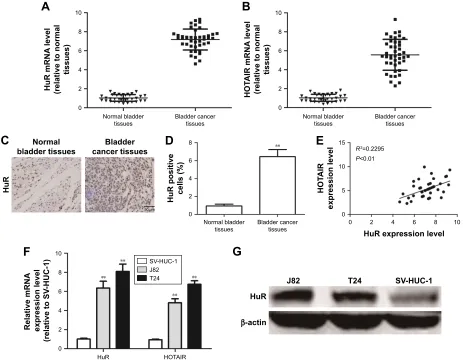
We first investigated whether HuR or HOTAIR expres-sion is linked to bladder cancer. qRT-PCR and immuno-histochemistry analyses showed that both HuR and HOTAIR expressions were upregulated in bladder cancer tissues (Figure 1A–D), which is concordant with the previous
OncoTargets and Therapy downloaded from https://www.dovepress.com/ by 118.70.13.36 on 25-Aug-2020
Dovepress Yu et al
studies,11,13 and HuR expression was positively correlated to HOTAIR expression (Figure 1E). Additionally, HuR and HOTAIR expression levels were detected in bladder cancer cell lines (J82 and T24 cells) and normal bladder epithelial cell line (SV-HUC-1). As shown in Figure 1F and G, both HuR and HOTAIR expressions were more increased in J82 and T24 cells than in SV-HUC-1 cells. These results indicated that HuR or HOTAIR may hold promotive effects in bladder cancer progression.
Knockdown of hur or hOTair
inhibited bladder cancer cell proliferation
and apoptosis
Based on the upregulation of HuR and HOTAIR expres-sion in bladder cancer, we further investigated the effects of HuR and HOTAIR on bladder cancer progression via
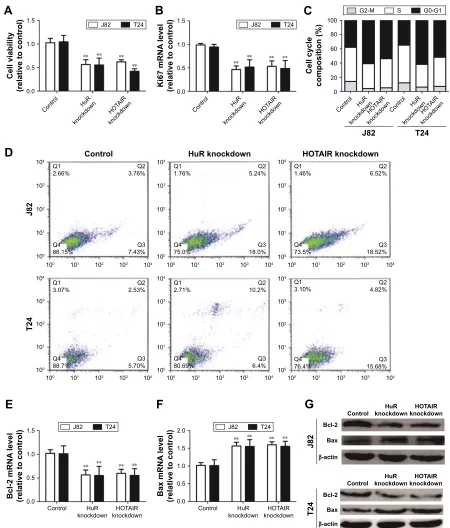
knockdown of HuR and HOTAIR expression. First, MTT analysis showed that knockdown of HuR or HOTAIR inhibited cell proliferation of bladder cancer (Figure 2A), and ki67, a cell proliferation marker, was blocked in HuR or HOTAIR knockdown cells (Figure 2B). Furthermore, knockdown of HuR or HOTAIR blocked bladder cancer cells in G1 phase of the cell cycle (Figure 2C), and cell apoptosis analysis was performed and indicated that knockdown of HuR or HOTAIR promoted cell apoptosis in J82 (23%±0.4% vs 11%±0.5% and 33%±0.3% vs 11%±0.5%) and T24 (16%±0.5% vs 8%±0.4% and 20%±0.3% vs 8%±0.4%) cells (Figure 2D). And the mRNA and protein levels of anti-apoptotic gene (Bcl-2) and proanti-apoptotic gene (Bax) were also measured via qRT-PCR and Western blot assays. Consistent with the above results, the expression levels of Bcl-2 were downregulated, but Bax expression levels were upregulated Figure 1 The association between hur and hOTair expression levels in clinical samples.
Notes: (A and B) The mrna levels of hur and hOTair were examined in 43 Tcc tissues and 36 normal bladder tissues. (C and D) The protein level of hur was examined in 43 Tcc tissues and 36 normal bladder tissues. (E) correlation between the levels of hur and hOTair. (F) The mrna levels of hur and hOTair were examined in Tcc cell lines and normal bladder epithelial cells via qrT-Pcr analyses. (G) The protein level of hur was determined in Tcc cell lines and normal bladder epithelial cells via Western blot analysis. Data are presented as mean ± sD; **P,0.01 vs control.
Abbreviations: hOTair, hOX transcript antisense rna; qrT-Pcr, quantitative real-time polymerase chain reaction; sD, standard deviation; Tcc, transitional cell carcinoma.
+X5P51$
OHYHO
UHODWLYHWRQRUPDO
WLVVXHV
1RUPDOEODGGHU
WLVVXHV %ODGGHUFDQFHUWLVVXHV
$
+27
$,5P51$
OHYHO
UHODWLYHWRQRUPDO
WLVVXHV
1RUPDOEODGGHU
WLVVXHV %ODGGHUFDQFHUWLVVXHV
%
1RUPDO
EODGGHUWLVVXHV FDQFHUWLVVXHV%ODGGHU
+X5
P
&
1RUPDOEODGGHU
WLVVXHV %ODGGHUFDQFHUWLVVXHV
+X5SRVLWLYH FHOOV
'
5
3
+27
$,5
H[SUHVVLRQOHYHO
+X5H[SUHVVLRQOHYHO
(
5HODWLYHP51$
H[SUHVVLRQOHYHO
UHODWLYHWR69
+8&
+X5 +27$,5
69+8& -7
)
+X5
69+8&
- 7
βDFWLQ
*
OncoTargets and Therapy downloaded from https://www.dovepress.com/ by 118.70.13.36 on 25-Aug-2020
Dovepress hur and hOTair promote the bladder cancer progression collectively
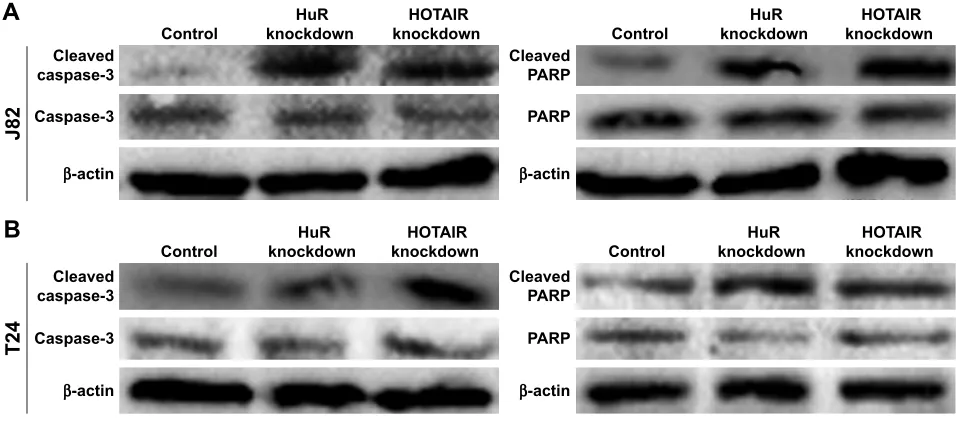
in HuR or HOTAIR knockdown cells (Figure 2E–G). In addi-tion, the cleaved-caspase-3 and cleaved-PARP levels were evaluated in J82 and T24 cells with HuR/HOTAIR knock-down. HuR/HOTAIR knockdown significantly increased
cleaved-caspase-3 and cleaved-PARP levels (Figure S1). Overall, these results suggested that HuR or HOTAIR holds promotive effects on cell proliferation and inhibitory effects on cell apoptosis in bladder cancer.
&RQWURO -7 4 4 4 4 +X5NQRFNGRZQ 4 4 4 4 +27$,5NQRFNGRZQ 4 4 4 4 4 4 4 4 4 4 4 4 4 4 4 4 &RQWURO +X5
NQRFNGRZQ NQRFNGRZQ+27$,5
%FOP51$ OHYHO UHODWLYHWRFRQWURO &RQWURO +X5 NQRFNGRZQ +27$,5 NQRFNGRZQ %D[P51$ OHYHO UHODWLYHWRFRQWURO
-&RQWURO NQRFNGRZQ+X5 NQRFNGRZQ+27$,5 %FO
%D[
βDFWLQ
&RQWURO NQRFNGRZQ+X5 NQRFNGRZQ+27$,5
7 %FO %D[ βDFWLQ &RQWURO +X5 NQRFNGRZQ +27 $,5 NQRFNGRZQ &HOOYLDELOLW\ UHODWLYHWRFRQWURO &RQWURO +X5 NQRFNGRZQ +27 $,5 NQRFNGRZQ .LP51$ OHYHO UHODWLYHWRFRQWURO &RQWURO +X5 NQRFNGRZQ +27 $,5 NQRFNGRZQ &RQWURO +X5 NQRFNGRZQ +27 $,5 NQRFNGRZQ - 7 &HOOF\FOH FRPSRVLWLRQ
*0 6 **
- 7
- 7
- 7 - 7
$
%
&
'
(
)
*
Figure 2 Knockdown of hOTair and hur inhibits Tcc cell proliferation and promotes apoptosis.
Notes: (A) The cell viability of J82 and T24 cells with or without hur shrna or hOTair shrna stable expression was evaluated by MTT assays. (B) ki67, a proliferation marker, was detected in cells depicted in (A) via qrT-Pcr assays. (C) cell-cycle assays were carried out in cells described in (A). (D) The cell apoptosis was examined in the cells depicted in (A). (E and F) The antiapoptotic gene (Bcl-2) and proapoptotic gene (Bax) mrna levels were evaluated in cells depicted in (A). (G) The anti-apoptotic gene (Bcl-2) and proapoptotic gene (Bax) protein levels were evaluated in cells depicted in (A). Data are presented as mean ± sD; **P,0.01 vs control.
Abbreviations: hOTair, hOX transcript antisense rna; MTT, 3-(4,5-dimethyl-2-thiazolyl)-2,5-diphenyl-2-h-tetrazolium bromide; qrT-Pcr, quantitative real-time polymerase chain reaction; sD, standard deviation; Tcc, transitional cell carcinoma.
OncoTargets and Therapy downloaded from https://www.dovepress.com/ by 118.70.13.36 on 25-Aug-2020
Dovepress Yu et al
Knockdown of hur or hOTair inhibited
bladder cancer cell migration, invasion,
and epithelial–mesenchymal transition
process
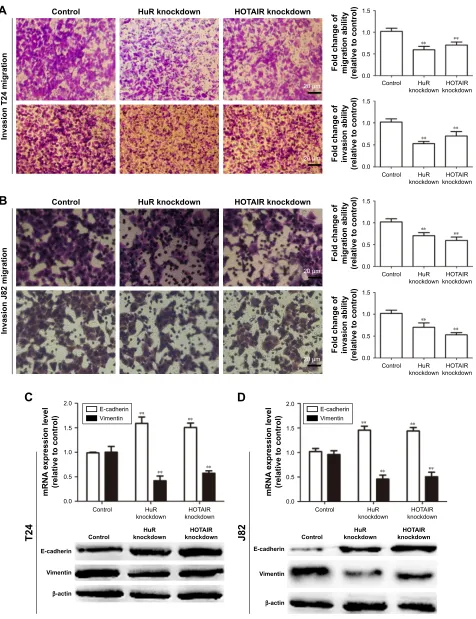
We further investigated whether HuR or HOTAIR holds promotive effects on bladder cancer cell migration, inva-sion, and epithelial–mesenchymal transition (EMT) process. Transwell migration and invasion assays showed that knock-down of HuR or HOTAIR significantly inhibited bladder cancer cell migration (Figure 3A) and invasion (Figure 3B). Additionally, the EMT markers (E-cadherin and vimentin) expression were further determined. As shown in Figure 3C and D, E-cadherin’s (the epithelial marker) expression levels were markedly upregulated in HuR or HOTAIR knockdown cells, while vimentin’s (the mesenchymal marker) expres-sion levels were significantly downregulated. These results demonstrated that knockdown of HuR or HOTAIR could significantly inhibit bladder cancer migration, invasion, and EMT process.
hur increased hOTair expression
through directly binding with hOTair
in bladder cancer
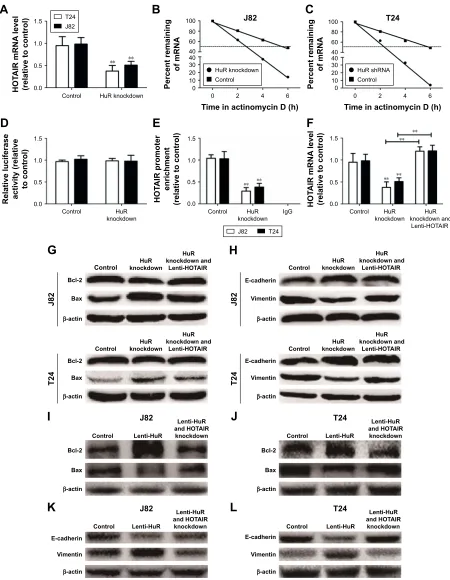
As HuR is known to interact with HOTAIR in head and neck squamous cell carcinoma,7 it is, thus, plausible that this inter-action holds true in human bladder cancer. First, HOTAIR expression levels were downregulated in HuR knockdown cells (Figure 4A). In addition, when HuR was knocked down and the de novo synthesis was blocked with actinomycin D, the decay rate of HOTAIR was faster in HuR knockdown cells than in control cells (t1/2=5.2±0.4 h and t1/2=2.2±0.3 h vs t1/2=5.5±0.3 h and t1/2=2.1±0.4 h) (Figure 4B and C). In particular, the HOTAIR promoter activity was not changed in HuR knockdown cells (Figure 4D), indicating that HuR could not affect the activity of HOTAIR promoter. Further-more, RNA binding protein immunoprecipitation assays showed that HuR could interact with HOTAIR directly in bladder cancer cells (Figure 4E). HuR knockdown was then performed with Lenti-HOTAIR infection in bladder cancer cells, as shown in Figure 4F, and Lenti-HOTAIR infection could significantly upregulate HOTAIR level and overexpression of HOTAIR could attenuate the inhibitory effects of HuR knockdown on bladder cancer cell apoptosis and migration, characterized as the modulation of apoptotic (Figure 4G) and EMT (Figure 4H) markers. What is more, HOTAIR knockdown could attenuate or even reverse the
promotive effects of HuR overexpression on bladder cancer cell apoptosis and migration, characterized as the modula-tion of apoptotic (Figure 4I and J) and EMT (Figure 4K and L) markers. Thus, these results indicated that HuR could also bind to and stabilize HOTAIR in bladder cancer, and regulate bladder cancer progression partly dependent on HOTAIR expression.
hOTair increased cytoplasmic
accumulation and expression of hur
in a mir-1-dependent way
In silico analysis was performed to search for miRNAs that could potentially interact with HOTAIR and showed putative binding sites for miR-1. Transfection with miR-1 mimics reduced HOTAIR level, while transfection with miR-1 inhibitor increased HOTAIR level in bladder cancer cells (Figure 5A). Furthermore, transfection with miR-1 mimics significantly decreased the activity of luciferase constructs carrying the sequences of HOTAIR containing the wt for miR-1, but no repression of luciferase activity was observed when miR-1 binding sites were mutated (Figure 5B), indicat-ing that miR-1 could bind to HOTAIR. Interestindicat-ingly, upregu-lation of HOTAIR promoted HuR expression, but mutation of miR-1 binding sites in HOTAIR canceled the effects of HOTAIR on HuR expression in bladder cancer cells, and knockdown of HOTAIR also decreased HuR expression (Figure 5C and D). And knockdown of HOTAIR increased HuR cytoplasmic accumulation in J82 cells (Figure 5E). In addition, miR-1 level was examined in bladder cancer and NBTC tissues. The level of miR-1 was higher in nor-mal tissues than in bladder cancer tissues (Figure 5F) and negatively correlated with HuR and HOTAIR expression levels (Figure 5G and H).
Discussion
LncRNA has been emerging as a new class of potential therapeutic target for cancers. A number of studies have shown that one of its members, HOTAIR, could modu-late the progression of various cancers: regulating c-KIT expression through sponging miR-193a in acute myeloid leukemia,14 promoting carcinogenesis and invasion of gastric adenocarcinoma,15 and inducing cell migration and invasion via downregulation of RNA binding motif protein 38 in hepatocellular carcinoma cells.16 However, the roles of HOTAIR in bladder are elusive. Here, we have observed that HOTAIR expression was elevated in bladder cancer tissues and cells, and knockdown of HOTAIR promoted
OncoTargets and Therapy downloaded from https://www.dovepress.com/ by 118.70.13.36 on 25-Aug-2020
Dovepress hur and hOTair promote the bladder cancer progression collectively
$
%
,QYDVLRQ-PLJUDWLRQ
+X5NQRFNGRZQ +27$,5NQRFNGRZQ &RQWURO
P
P
&RQWURO +X5
NQRFNGRZQNQRFNGRZQ+27$,5
)ROGFKDQJHRI PLJUDWLRQDELOLW\ UHODWLYHWRFRQWURO
)ROGFKDQJHRI LQYDVLRQDELOLW\
UHODWLYHWRFRQWURO
&RQWURO
+X5
NQRFNGRZQNQRFNGRZQ+27$,5
)ROGFKDQJHRI PLJUDWLRQDELOLW\ UHODWLYHWRFRQWURO
&RQWURO +X5
NQRFNGRZQNQRFNGRZQ+27$,5
)ROGFKDQJHRI LQYDVLRQDELOLW\ UHODWLYHWRFRQWURO
&RQWURO +X5
NQRFNGRZQNQRFNGRZQ+27$,5
,QYDVLRQ7PLJUDWLRQ
+X5NQRFNGRZQ +27$,5NQRFNGRZQ &RQWURO
P
P
'
&
&RQWURO +X5
NQRFNGRZQ NQRFNGRZQ+27$,5
P51$
H[SUHVVLRQOHYHO
UHODWLYHWRFRQWURO
&RQWURO
(FDGKHULQ
9LPHQWLQ
βDFWLQ
+X5
NQRFNGRZQ NQRFNGRZQ+27$,5
9LPHQWLQ (FDGKHULQ
7
&RQWURO +X5
NQRFNGRZQ NQRFNGRZQ+27$,5
P51$
H[SUHVVLRQOHYHO
UHODWLYHWRFRQWURO
(FDGKHULQ
9LPHQWLQ
βDFWLQ
&RQWURO NQRFNGRZQ+X5 NQRFNGRZQ+27$,5
9LPHQWLQ (FDGKHULQ
-Figure 3 The effects of hOTair and hur on Tcc cell migration and invasion in vitro.
Notes: (A and B) Knockdown of hur and hOTair inhibited cell migration in J82 and T24 cells. (C and D) Knockdown of hOTair inhibited eMT in J82 and T24 cells. Data are presented as mean ± sD; **P,0.01 vs control.
Abbreviations: eMT, epithelial–mesenchymal transition; hOTair, hOX transcript antisense rna; sD, standard deviation; Tcc, transitional cell carcinoma.
OncoTargets and Therapy downloaded from https://www.dovepress.com/ by 118.70.13.36 on 25-Aug-2020
Dovepress Yu et al
Figure 4 hur could bind to hOTair and thus stabilizes hOTair mrna stability in Tcc cells.
Notes: (A) The hOTair expression level was detected in J82 and T24 cells with or without hur knockdown by qrT-Pcr. (B and C) cells depicted in (A) were treated with actinomycin D (2.5 µg/ml) for the indicated times. hOTair mrna levels were measured by qrT-Pcr and the percentage of mrna that remained was plotted. (D) ectopic hur expression does not affect the promoter activity of hOTair. after treatment with hur shrna for 24 h, J82 and T24 cells were transiently transfected with the luciferase plasmids containing the hOTair promoter for 24 h. luciferase activities in these cells were measured using the Dual-luciferase reporter assay system (Promega, Madison, Wi, Usa). (E) qrT-Pcr was used to measure the abundance of hOTair mrna present in the hur-iP materials after the riP assay. (F) hOTair level was examined in cells with hur knockdown and lenti-hOTair infection. (G) The apoptotic markers (Bcl-2 and Bax) expressions were determined as indicated. (H) The eMT markers (e-cadherin and vimentin) expressions were determined as indicated. (I and J) The apoptotic markers (Bcl-2 and Bax) expressions were determined as indicated. (K and L) The eMT markers (e-cadherin and vimentin) expressions were determined as indicated. Values are mean ± standard deviation. **P,0.01.
Abbreviations: eMT, epithelial–mesenchymal transition; hOTair, hOX transcript antisense rna; qrT-Pcr, quantitative real-time polymerase chain reaction; riP, rna binding protein immunoprecipitation; Tcc, transitional cell carcinoma.
-&RQWURO /HQWL+X5 /HQWL+X5 DQG+27$,5 NQRFNGRZQ %FO %D[ βDFWLQ
,
-
7&RQWURO %FO %D[ βDFWLQ /HQWL+X5 /HQWL+X5 DQG+27$,5 NQRFNGRZQ -(FDGKHULQ 9LPHQWLQ βDFWLQ &RQWURO /HQWL+X5 /HQWL+X5 DQG+27$,5 NQRFNGRZQ
.
/
7(FDGKHULQ 9LPHQWLQ βDFWLQ &RQWURO /HQWL+X5 /HQWL+X5 DQG+27$,5 NQRFNGRZQ 7
&RQWURO NQRFNGRZQ+X5 +X5 NQRFNGRZQDQG /HQWL+27$,5 %FO %D[ βDFWLQ
-&RQWURO NQRFNGRZQ+X5 +X5 NQRFNGRZQDQG /HQWL+27$,5
*
+
%FO %D[ βDFWLQ 7&RQWURO NQRFNGRZQ+X5 +X5 NQRFNGRZQDQG /HQWL+27$,5 (FDGKHULQ 9LPHQWLQ βDFWLQ
-&RQWURO NQRFNGRZQ+X5 +X5 NQRFNGRZQDQG /HQWL+27$,5 (FDGKHULQ 9LPHQWLQ βDFWLQ 5HODWLYHOXFLIHUDVH DFWLYLW\UHODWLYH WRFRQWURO &RQWURO +X5 NQRFNGRZQ +27 $,5SURPRWHU HQULFKPHQW UHODWLYHWRFRQWURO &RQWURO +X5 NQRFNGRZQ ,J* +27 $,5P51$ OHYHO UHODWLYHWRFRQWURO &RQWURO +X5
NQRFNGRZQ NQRFNGRZQDQG+X5 /HQWL+27$,5
'
(
)
7-$
&RQWURO +27 $,5P51$ OHYHO UHODWLYHWRFRQWURO +X5NQRFNGRZQ 3HUFHQWUHPDLQLQJ RIP51$ -7LPHLQDFWLQRP\FLQ'K 3HUFHQWUHPDLQLQJ RIP51$ 7%
&
-7 &RQWURO +X5NQRFNGRZQ &RQWURO +X5VK51$ 7LPHLQDFWLQRP\FLQ'KOncoTargets and Therapy downloaded from https://www.dovepress.com/ by 118.70.13.36 on 25-Aug-2020
Dovepress hur and hOTair promote the bladder cancer progression collectively
Figure 5 mir-1 could target hOTair in Tcc cells.
Notes: (A) J82 and T24 cells were transfected with mir-1 mimics or inhibitor for 48 h. The level of hOTair mrna was measured by qrT-Pcr. (B) J82 and T24 cells were co-transfected with mir-1 mimics and luc-hOTair-wt or luc-hOTair-mut. The luciferase activity was detected. (C and D) hur mrna and protein levels were detected in lenti-hOTair-wt-, lenti-hOTair-mut-, or lenti-hOTair-shrna-infected J82 and T24 cells by qrT-Pcr and Western blot. (E) The nucleo-cytoplasmic translocation of hur was detected in J82 cells with or without hOTair knockdown. (F) The level of mir-1 was examined in 43 Tcc tissues and 36 normal bladder tissues via qrT-Pcr analyses. (G and H) correlation between the levels of mir-1 and hur or hOTair. Data are presented as mean ± sD; **P,0.01 vs control.
Abbreviations: hOTair, hOX transcript antisense rna; Pcr, polymerase chain reaction; qrT-Pcr, quantitative real-time polymerase chain reaction; sD, standard deviation; Tcc, transitional cell carcinoma.
+
+2
7$
,5
H[SUHVVLRQOHYHO PL5OHYHO
±
3
5
*
PL5OHYHO
+X
5
H[SUHVVLRQOHYHO
±
3
5
)
PL5OHYHOUHODWLYH WRQRUPDOWLVVXHV
1RUPDOWLVVXHV +16&&WXPRUV
3
'
(
+27
$,5NQRFNGRZQ
&RQWURO
-7
&RQWURO +27$,5
NQRFNGRZQ
+27$,5PXW +X5
βDFWLQ
βDFWLQ +X5
+27$,5ZW
$
%
&
&RQWURO PL5PLPLFV PL5 LQKLELWRU
+X5H[SUHVVLRQOHYHO UHODWLYHWRFRQWURO
&RQWURO /XF +27
$,5ZW /XF
+27 $,5PXW
5HODWLYHOXFLIHUDVH DFWLYLW\UHODWLYH
WRFRQWURO
&RQWURO +27
$,5ZW +27
$,5PXW +27 $,5
NQRFNGRZQ
+X5H[SUHVVLRQOHYHO UHODWLYHWRFRQWURO
7
-bladder cancer apoptosis, and inhibited cell proliferation, migration, and invasion.
Differential regulation of lncRNAs has been reported in different types of cancer, and given the critical roles of HuR in stabilizing various RNA transcripts, we further investigated whether HuR could bind to HOTAIR in bladder cancer. Previous study had indicated that high expression of HuR was associated with malignant aggressiveness and prognosis in bladder cancer.11 In the present study, we demonstrated that HuR and HOTAIR expression exhibited positive correlation in bladder cancer tissues. Notably, HuR
directly interacted with HOTAIR and enhanced HOTAIR mRNA stability, and HuR exerted its promotive effects in bladder cancer in a HOTAIR-dependent manner. Interest-ingly, HOTAIR could also induce HuR expression depen-dent on miR-1 expression, and knockdown of HOTAIR decreased cytoplasmic accumulation of HuR in bladder cancer. As competitive endogenous RNAs (ceRNAs) have recently been shown to regulate expression in a miRNA-dependent way2 and HOTAIR has been shown to act as a ceRNA for HuR in other tumors,7 further studies should be performed to prove whether HOTAIR could also act
OncoTargets and Therapy downloaded from https://www.dovepress.com/ by 118.70.13.36 on 25-Aug-2020
Dovepress Yu et al
as a ceRNA for HuR in bladder cancer and other cancers. Although HOTAIR had been identified as a target for miR-7 in head and neck squamous cell carcinoma,7 we did not observe any correlation between miR-7 and HOTAIR expression in bladder cancer (data not shown), which sug-gests that the ceRNA network between HOTAIR and HuR may be mediated by different miRNAs in different cancers. Here, we speculate that the targeting of miR-1 to HuR is necessary for the ceRNA loop between HOTAIR and HuR in bladder cancer. Meanwhile, as inhibiting cytoplasmic accumulation of HuR synergizes genotoxic agents in bladder cancer,17 our study strongly indicated that the feed-forward regulatory loop between HuR and HOTAIR did exist in bladder cancer, and further studies should be carried out to confirm whether this feed-forward regulatory loop is a universal phenomenon.
Based on our study, we illustrate the roles of the relation-ship between HuR and HOTAIR in promoting bladder cancer progression. We strongly believe that our studies on the effect of the feed-regulatory loop between HuR and HOTAIR in bladder cancer could bring new lights in bladder tumori-genesis, and further research on this loop could establish it as a potential target or new biomarker for the treatment or diagnosis of bladder cancer.
Acknowledgment
We thank Professor Hu for critical review of this work.
Disclosure
The authors report no conflicts of interest in this work.
References
1. Martínez-Fernández M, Feber A, Dueñas M, et al. Analysis of the Polycomb-related lncRNAs HOTAIR and ANRIL in bladder cancer.
Clin Epigenetics. 2015;7:109.
2. Zheng L, Li X, Meng X, et al. Competing endogenous RNA networks of CYP4Z1 and pseudogene CYP4Z2P confer tamoxifen resistance in breast cancer. Mol Cell Endocrinol. 2016;427:133–142.
3. Kim do Y, Park EY, Chang E, et al. A novel miR-34a target, protein kinase D1, stimulates cancer stemness and drug resistance through GSK3/beta-catenin signaling in breast cancer. Oncotarget. 2016;7(12): 14791–14802.
4. Croce CM, Calin GA. miRNAs, cancer, and stem cell division. Cell. 2005;122(1):6–7.
5. Aiello A, Bacci L, Re A, et al. MALAT1 and HOTAIR long non-coding RNAs play opposite role in estrogen-mediated transcriptional regulation in prostate cancer cells. Sci Rep. 2016;6:38414.
6. Zhang L, Song X, Wang X, et al. Circulating DNA of HOTAIR in serum is a novel biomarker for breast cancer. Breast Cancer Res Treat. 2015;152(1):199–208.
7. Xu CZ, Jiang C, Wu Q, Liu L, Yan X, Shi R. A feed-forward regulatory loop between HuR and the long noncoding RNA HOTAIR promotes head and neck squamous cell carcinoma progression and metastasis.
Cel Physiol Biochem. 2016;40(5):1039–1051.
8. Berrondo C, Flax J, Kucherov V, et al. Expression of the long non-coding RNA HOTAIR correlates with disease progression in bladder cancer and is contained in bladder cancer patient urinary exosomes.
PLoS One. 2016;11(1):e0147236.
9. Brennan CM, Steitz JA. HuR and mRNA stability. Cel Mol Life Sci. 2001;58(2):266–277.
10. Jakstaite A, Maziukiene A, Silkuniene G, Kmieliute K, Gulbinas A, Dambrauskas Z. HuR mediated post-transcriptional regulation as a new potential adjuvant therapeutic target in chemotherapy for pancreatic cancer. World J Gastroenterol. 2015;21(46):13004–13019.
11. Miyata Y, Watanabe S, Sagara Y, et al. High expression of HuR in cytoplasm, but not nuclei, is associated with malignant aggressiveness and prognosis in bladder cancer. PLoS One. 2013;8(3):e59095. 12. Dong R, Yang GD, Luo NA, Qu YQ. HuR: a promising therapeutic
target for angiogenesis. Gland Surg. 2014;3(3):203–206.
13. Yan TH, Lu SW, Huang YQ, et al. Upregulation of the long noncod-ing RNA HOTAIR predicts recurrence in stage Ta/T1 bladder cancer.
Tumour Biol. 2014;35(10):10249–10257.
14. Xing CY, Hu XQ, Xie FY, et al. Long non-coding RNA HOTAIR modulates c-KIT expression through sponging miR-193a in acute myeloid leukemia. FEBS Lett. 2015;589(15):1981–1987.
15. Lee NK, Lee JH, Park CH, et al. Long non-coding RNA HOTAIR promotes carcinogenesis and invasion of gastric adenocarcinoma.
Biochem Biophys Res Commun. 2014;451(2):171–178.
16. Ding C, Cheng S, Yang Z, et al. Long non-coding RNA HOTAIR promotes cell migration and invasion via down-regulation of RNA binding motif protein 38 in hepatocellular carcinoma cells. Int J Mol Sci. 2014;15(3):4060–4076.
17. Guo J, Lv J, Chang S, et al. Inhibiting cytoplasmic accumulation of HuR synergizes genotoxic agents in urothelial carcinoma of the bladder.
Oncotarget. 2016;7(29):45249–45262.
OncoTargets and Therapy downloaded from https://www.dovepress.com/ by 118.70.13.36 on 25-Aug-2020
OncoTargets and Therapy
Publish your work in this journal
Submit your manuscript here: http://www.dovepress.com/oncotargets-and-therapy-journal OncoTargets and Therapy is an international, peer-reviewed, open access journal focusing on the pathological basis of all cancers, potential targets for therapy and treatment protocols employed to improve the management of cancer patients. The journal also focuses on the impact of management programs and new therapeutic agents and protocols on
patient perspectives such as quality of life, adherence and satisfaction. The manuscript management system is completely online and includes a very quick and fair peer-review system, which is all easy to use. Visit http://www.dovepress.com/testimonials.php to read real quotes from published authors.
Dovepress
Dove
press
hur and hOTair promote the bladder cancer progression collectively
Supplementary material
7
-&RQWURO &OHDYHG
FDVSDVH
&DVSDVH
βDFWLQ
+X5
NQRFNGRZQ NQRFNGRZQ+27$,5
&OHDYHG FDVSDVH
&DVSDVH
βDFWLQ
&RQWURO NQRFNGRZQ+X5 NQRFNGRZQ+27$,5
&OHDYHG 3$53
3$53
βDFWLQ
&RQWURO NQRFNGRZQ+X5 NQRFNGRZQ+27$,5
&OHDYHG 3$53
3$53
βDFWLQ
&RQWURO NQRFNGRZQ+X5 NQRFNGRZQ+27$,5
$
%
Figure S1 The effects of hOTair/hur knockdown on cleaved-caspase-3 and ParP.
Note: (A and B) The cleaved-caspase-3 and cleaved-ParP levels were evaluated in J82 and T24 cells with hur/hOTair knockdown. Abbreviations: hOTair, hOX transcript antisense rna; ParP, poly aDP-ribose polymerase.
OncoTargets and Therapy downloaded from https://www.dovepress.com/ by 118.70.13.36 on 25-Aug-2020