O R I G I N A L R E S E A R C H
A framework for developing rural academic general
practices: a qualitative case study in rural Victoria
JB Brown1, T Morrison2, M Bryant3, L Kassell1, D Nestel2
1Southern General Practice Training, Churchill, Victoria, Australia 2Gippsland Medical School, Monash University, Churchill, Victoria, Australia 3Charles Sturt University, Boorooma Street, Wagga Wagga, New South Wales, Australia
Submitted: 26 March 2014; Revised: 6 August 2014; Accepted: 6 November 2014; Published: 29 May 2015
Brown JB, Morrison T, Bryant M, Kassell L, Nestel D
A framework for developing rural academic general practices: a qualitative case study in rural Victoria
Rural and Remote Health 15: 3072. (Online) 2015 Available: http://www.rrh.org.au
A B S T R A C T
Introduction: There is increasing pressure for Australian rural general practices to engage in educational delivery as a means of addressing workforce issues and accommodating substantial increases in learners. For practices that have now developed a strong focus on education, there is the challenge to complement this by engaging in research activity. This study develops a rural academic general practice framework to assist rural practices in developing both comprehensive educational activity and a strong research focus thus moving towards functioning as mature academic units.
Methods: A case study research design was used with the unit of analysis at the level of the rural general practice. Purposively sampled practices were recruited and individual interviews conducted with staff (supervisors, practice managers, nurses), learners (medical students, interns and registrars) and patients. Three practices hosted ‘multi-level learners’, two practices hosted one learner group and one had no learners. Forty-four individual interviews were conducted with staff, learners and patients. Audio recordings were transcribed for thematic analysis. After initial inductive coding, deductive analysis was undertaken with reference to recent literature and the expertise of the research team resulting in the rural academic general practice framework.
Results: Three key themes emerged with embedded subthemes. For the first theme, organisational considerations, subthemes were values/vision/culture, patient population and clinical services, staffing, physical infrastructure/equipment, funding streams and governance. For the second theme, educational considerations, subthemes were processes, clinical supervision, educational networks and learner presence. Third, for research considerations, there were the subthemes of attitude to research and research activity. The framework maps the development of a rural academic practice across these themes in four progressive stages: beginning, emerging, consolidating and established.
Conclusions: The data enabled a framework to be constructed to map rural general practice activity with respect to activity characteristic of an academic general practice. The framework offers guidance to practices seeking to transition towards becoming a mature academic practice. The framework also offers guidance to educational institutions and funding bodies to support the development of academic activity in rural general practices. The strengths and limitations of the study design are outlined.
Key words: academic, education, general practice, primary care, research, rural pipeline, teaching, workforce.
Introduction
In this article the concept of the rural academic general practice in Australia is explored. Recent Australian general practice history is described with a particular focus on education and research activity. There is a strong demand for an increase in training capacity in rural general practice to accommodate recent increases in learner numbers and to address the current rural general practice workforce shortage. There is also a need to address the dearth of general practice research. The aim of this study was to develop a rural academic general practice framework to assist practices in developing both comprehensive educational activity and a strong research focus.
General practices in Australia
General practices in Australia have traditionally arisen from small businesses focused primarily on health service delivery by general medical practitioners. Since the early 1990s, Australia has seen a steady change in the range of clinical services educational activity undertaken by general practices. This has in part been driven by the Australian Government General Practice Strategy1 and been
supported by financial incentives2. There has been a move towards
larger practices with an increasing range of allied health services. Practice accreditation against formal standards and compulsory vocational training for general practice has been introduced. Vocational training for general practice in Australia is an apprenticeship model largely based in private general practices. Australian General Practice Training funds vocational training of general practitioners (GPs) through a network of 17 regional training providers (RTPs) that work to the standards of the Royal
Australian College of General Practice and the Australian College of Rural and Remote Medicine. As well as the opportunity to host registrars in general practice vocational training, practices can host medical students in community-based placements and interns on rotation.
While many practices in Australia now engage in teaching3,
there remains a dearth of active involvement in research4.
Publication rates for general practitioners in Australia are low, sitting at 2–5% of the rates achieved by their physician and surgical colleagues5. The Australian Government has
endeavoured to support primary care research through the Primary Health Care Research, Evaluation Development (PHCRED) strategy established in 20006. This has largely
been a top-down approach by funding universities to undertake primary health research and has not been reflected by an increase in rural primary health publication rates6.
An important but limited initiative supported by PHCRED has been the formation of practice-based networks to facilitate research activity at the level of the general practice and other primary care services7. These networks are
supported by university research expertise and organisational structures8. After initially taking a top-down approach, a
Victoria-based network (VicReN) has recently adopted a more bottom-up approach by undertaking a member-directed research project with community-based general practitioners as members of the research team8,9. This project has resulted
in the publication of two peer-reviewed research papers with community-based general practitioners included in the authorship10,11. Elsewhere, international trends in primary
care research identify significant success with practice-based research networks12-14.
In Australia, general practices tend to engage in education delivery in response to opportunities offered by universities and/or general practice training providers. Similarly, active research programs in general practice are most likely associated with university-based research initiatives14. Engagement in education and research by
general practice tends to be piecemeal with disjointed funding streams and uncoordinated support. Practices are left to create their own solutions for the required structures for managing educational and research activity.
Pressure for increased training capacity by rural general practices
Currently in Australia demand is increasing for medical student, intern and registrar training placements in rural general practices. This demand is being driven by two imperatives. The first is a need for training placements for the growing number of medical students, interns and registrars. Medical student numbers have increased by 81% between 2005 and 201215 with the majority of these students
undertaking their placements in rural clinical schools. Following this increase in medical student numbers is a steep increase in the number of medical interns, many of whom are being accommodated in general practice placements. General practice training program entrants doubled, from 600 to 1200 nationally, between 2010 and 201416,17.
The second imperative seeks to address shortages in the rural medical workforce by placing higher numbers of learners in rural settings both to provide an immediate workforce and to build a rural medical workforce. The ‘rural pipeline’ is considered to be a means of graduating doctors who are likely to practice rurally: preferentially selecting students from rural backgrounds into medical school and providing them with undergraduate, postgraduate, vocational and post-vocational training in the rural context18-21. Education in rural
general practices is core to the ‘rural pipeline’22. It has been
well established that medical students who are exposed to rural settings during their training are more likely to engage in rural practice after graduating20. Also, placing GP
registrars in rural practices provides a rural workforce and is a way of attracting more experienced practitioners to rural
communities23. The ‘rural pipeline’ also supports practising
rural doctors by enriching their experience, addressing isolation and helping to develop skills18.
While increasing the number of learners in rural general practice may be a way of attracting and retaining rural GPs, the capacity for rural practices to host more learners is limited. Laurence and Black’s 2007 survey of urban and rural training practices found that although GPs were usually willing to increase teaching loads, the ability to do so depended on adequate additional resources and support, particularly in areas such as funding for teaching, practice subsidies and consulting space3.
There is capacity for rural general practices to increase engagement in education. For example, practices that do not host learners could be recruited as teaching practices, while practices that host one learner may have capacity to host several learners at different levels of training. To achieve this, educational and funding models that are attractive and sustainable for both practices and learners must be developed. For education to be considered as a core activity, the approach to funding, educational support and learner placement must be an integrated one22. Further, issues such
as effective teacher orientation and professional development, physical space, infrastructure and internal organisational structures need to be considered22,24.
Elsewhere the authors have reported the advantages and challenges for rural general practices to host several learners at varying levels25. In that report, the perspective of the
practice, the learners and the practice patient community was examined. This article addresses the research question, ‘What considerations contribute to the development of a rural academic general practice?’
The rural academic general practice
To inform the development of a rural academic general practice, the model of the academic health sciences centre (AHSC) was explored for use in the context of a rural academic general practice. AHSCs are well established in the
USA and the UK and are beginning to be acknowledged in Australia26. The AHCS model describes three complementary
pillars of service, education and research. A principle of the AHCS model is fostering the ‘discovery–care’ continuum by bringing clinical services, education and research together in the one institution. AHSCs are characterised by their large scale, resulting in improved patient outcomes and cost efficiencies26. Dzau et al. describe the value of extending this
structure into primary care as an AHSC system where the emphasis is not so much a tertiary institution as a vertically integrated system spanning from community-based care through to tertiary hospitals and universities27. Dzau’s model
of extending the AHSC model to primary care may facilitate progression within the proposed rural academic practice framework, especially in enabling research activity. If rural general practices are enabled to develop internal research capacity, they will have the means to drive research agendas from the bottom up and in this way meaningfully engage local general practitioners to ‘address questions relevant to local health needs’8.
Methods
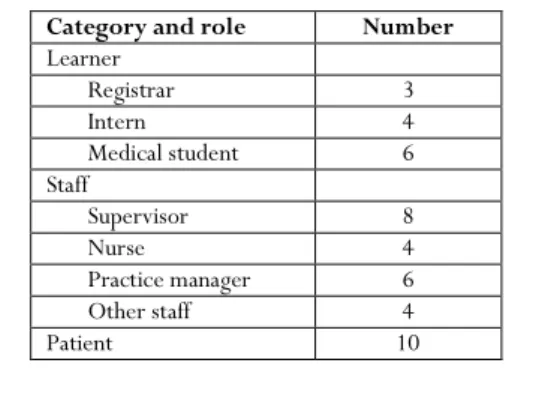
The research question is best answered using a qualitative paradigm. An experienced researcher (TM) conducted semi-structured interviews. Six rural general practices in Victoria were recruited: three practices with multi-level learners, two practices with one learner group, and one practice without learners. This sample was selected to explore the diversity of rural general practice engagement in education. Within the practices purposive sampling of staff (GP supervisors, practice managers, senior administration staff, nurses), learners (registrars, interns, medical students) and patients was undertaken (Table 1). A topic guide was developed after reviewing relevant literature around general practice education and training to guide interviewing. Each respondent group had parallel questions and was designed to address the research question (Table 2 contains an example). Audio recordings of interviews were transcribed and checked against the original recording to ensure transcripts were
accurate. Transcripts were not offered for respondent validation.
The data were analysed in several stages. Using an inductive thematic analysis28,29, all four members of the research team
(TM, JB, MB, DN) independently coded transcripts. Key themes and subthemes were negotiated and all transcripts were analysed again using this thematic template30 with the
unit of analysis by general practice. A deductive thematic approach was used to create the framework, revisiting the data for confirmation and for negative case analysis. The creation of the framework was informed further by the literature and the expertise of the research team.
Ethics approval
Human research ethics approval was obtained from Monash University Human Research Ethics Committee, project number CF11/3006 - 2011001694.
Results
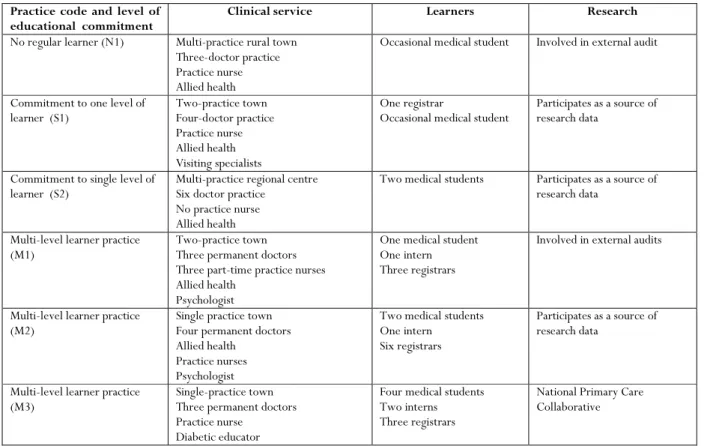
Data were collected from 44 participants using a topic guide developed for each respondent group. Table 2 contains an example. Interviews ranged from 20 to 60 minutes and were audio-taped and transcribed verbatim. Table 3 summarises the characteristics of each general practice unit of analysis. The results are presented in two parts: first, the thematic analysis representing the thematic template and, second, the resulting framework for a rural academic general practice. Like many classifications, there is some overlap between themes.
Thematic analysis
The three major themes were organisational, educational and research considerations. Under each major theme, several subthemes were identified. These major and subthemes are detailed in Table 4 with example quotes from the data. In describing and discussing the analysis below, italics are used to highlight subthemes.
Table 1: Interviewees categorised by role
Category and role Number
Learner
Registrar 3
Intern 4
Medical student 6 Staff
Supervisor 8
Nurse 4
Practice manager 6
Other staff 4
Patient 10
For organisational considerations, there were six subthemes. Prominent were the values, vision and culture of each practice. Business and service considerations were not always seen to align with educational considerations, hence the degree to which a practice engaged in education was associated with the value that the practice attached to education in relation to business and service: ‘[Teaching and its requirements] takes you away from your core business which is basically earning a living and keeping the place on the rails.’ (Supervisor S2 – single-learner practice).
The patient population and clinical services was an organisational consideration. Registrars and interns require a clinical load. The patient population of practices with a strong educational focus accepted learners as legitimate practitioners and clinical service delivery was structured to accommodate and utilize learners: ‘Well, I don’t actually see them as interns, they’re doctors to me.’ (Patient M3 – multi-level learner practice).
Staffing appeared as an organizational subtheme. For practices with little educational activity, existing staff absorbed education tasks. For practices with significant engagement in education, tasks were more likely to be allocated to staff designated and trained for the role: ‘[I] have just undertaken an educational coordinator role which is a new role that they have created.’ (Staff member M2 – multi-level learner practice).
Physical infrastructure was a fundamental consideration in a practice’s capacity to host learners. For example, ‘I don’t know if we have got the room. If we had the room, we would.’ (Practice nurse S1 – single-learner practice). The practices with a strong learner presence had all undertaken infrastructure expansion specifically for hosting learners. Two had received government infrastructure grants for this purpose.
Funding streams for education was an important consideration for all practices: ‘It’s all to do with time and money; it’s as simple as that.’ (Supervisor S2 – single-learner practice). The greater the engagement in education the more significant the educational funding as an income stream for the practice. These practices were also more positive about the remuneration afforded by funding for education: ‘I think funding’s pretty good.’ (Supervisor 1 M2 – multi-level learner practice). However, funding was piecemeal and from multiple sources: ‘There is a funding stream which comes with them, it’s different for all of them.’ (Supervisor M3 – multi-level learner practice).
As practices increased their engagement with education, they developed the governance structures to manage the organisational requirements of hosting the learners: ‘I have everyone marked on there as all the new learners are coming and leaving. So I really do keep a strict eye on that.’ (Practice manager M1 – multi-level learner practice).
Table 2: Interview topic guide for practice staff
1) What is your role within this practice?
a) To what extent are you involved with the registrars/interns/medical students within the practice?
b) What are the advantages of having the registrars/interns/medical students within the general practice? What are the disadvantages? c) How do you think the presence of the learners influence the practice? Feel free to comment on the:
i) atmosphere
ii) service delivery (care of patients) iii) financial influence
iv) supervisors/treating general practitioners 2) What would the practice look like without learners?
a) Benefits? b) Costs?
3) How would the practice be different if there was only one level of learner (multi-level learner practices only) a) Benefits?
b) Costs?
4) To what extent do the registrars/interns/medical students interact with each other (multi-level learner practices only) 5) How would the practice be different if there were multiple level of learners (single-learner practices only)
a) Benefits? b) Costs?
6) What teaching resources and support for practices is provided? a) Who provided this?
b) How effective are the current resourcing and support models? c) What works/doesn’t work?
d) How could these be changed?
7) How would you define an academic general practice? 8) Organisational change
a) Ideally, what would you like the practice to look like?
b) What would need to change in the practice to become an academic practice? c) What are the current barriers to change?
d) How could these barriers be overcome?
e) What are the current strengths of the organisation that would enable an academic practice? f) How would practice strategies need to change to enable a rural academic practice?
g) What would the implications for resourcing be, ie staffing levels; training; professional development; size of practice; current strategy? h) What resources are needed for change?
i) What role do broader institutions play in ability to develop into an academic practice? j) What are the Issues surrounding resistance to change?
9) Research
a) Can you comment on any research that has been conducted in this general practice? b) What was the aim of this research?
c) Were you involved in the research? d) How did this research affect the practice?
e) How important is it for general practices to be involved in research? f) What areas of research would you like to see general practices involved in? 10) (Multi-level learner practices only)
a) How has the practice changed in terms of day-to-day operation?
b) What were the key barriers to developing into a multi-level learner practice?
Table 3: General practice characteristics summary
Practice code and level of educational commitment
Clinical service Learners Research
No regular learner (N1) Multi-practice rural town Three-doctor practice Practice nurse Allied health
Occasional medical student Involved in external audit
Commitment to one level of learner (S1)
Two-practice town Four-doctor practice Practice nurse Allied health Visiting specialists
One registrar
Occasional medical student
Participates as a source of research data
Commitment to single level of learner (S2)
Multi-practice regional centre Six doctor practice
No practice nurse Allied health
Two medical students Participates as a source of research data
Multi-level learner practice (M1)
Two-practice town Three permanent doctors Three part-time practice nurses Allied health
Psychologist
One medical student One intern Three registrars
Involved in external audits
Multi-level learner practice (M2)
Single practice town Four permanent doctors Allied health
Practice nurses Psychologist
Two medical students One intern Six registrars
Participates as a source of research data
Multi-level learner practice (M3)
Single-practice town Three permanent doctors Practice nurse
Diabetic educator
Four medical students Two interns Three registrars
National Primary Care Collaborative
For educational considerations there were four subthemes.
Educational processes exhibited increasing complexity with greater numbers of learners. Practices with multiple levels of learners used a range of teachers and educational processes, were aware of each learner’s curriculum and facilitated formal and informal peer assisted learning. For example:
The teaching sessions always had a plan on, you know, we’ll talk up to this level and make sure that we get the student involved to this level and then we go through to the next level. (Practice manager M1 – multi-level learner practice).
Clinical supervision became more structured with greater engagement of learners. Practices with multiple levels of learners had several senior doctors identified as supervisors
and there were examples of senior learners being supported to supervise other learners: ‘..part of me trying to learn exam stuff has been helped by supervising other people.’ (Registrar M2 – multi-level learner practice). These practices may have supervisors that have allocated clinical sessions where they supervised without having their own booked patients:
There are times when my role as the supervisor is just supervising … there’d be some sessions where I won’t see any patients booked in for myself. (Supervisor M3 – multi-level learner practice).
Educational networks, facilitated by universities and regional training providers, were important in supporting educational skills and resources:
Well the RTP provided not only payment for us to do the work, but educational material and educational forums for learning … and the university would be providing educational material … as well. (Supervisor M1 – multi-level learner practice).
Educational networking was a greater feature of practices with a strong educational engagement.
The impact of learner presence on the practice environment was the fourth educational subtheme. The part that the learners themselves played in the practice environment became much more significant with increasing educational engagement. When one or two learners are present, they tended to be absorbed into the established working community. When there are a number of learners present in a practice at a time, they generated their own social and educational networks. With multiple learners in a practice, learners took on the role of teaching other learners and bringing senior staff up to date:
The registrars taught the interns, the registrars and the interns taught the medical students. In fact that’s where most of the teaching happened for the medical students.
(Supervisor M1 – multi-level learner practice).
Although not a dominant theme, research considerations had two subthemes. Attitude to research while mixed was on the whole positive across all practices and participants:
… if there is no research everything stagnates and you’ve absolutely got to have research … (Patient S1 – single-learner practice). There were reflections from two supervisors that research processes may be at odds with the way that general practitioners think and operate:
It’s time consuming, it’s tedious, it’s methodologically rigorous. None of those things sit well with most GPs I know.
(Supervisor 2 M2 – multi-level learner practice).
There was very little research activity in any of the practices other than clinical audits and being participants in research undertaken by external organisations.
Developing a rural academic general practice framework
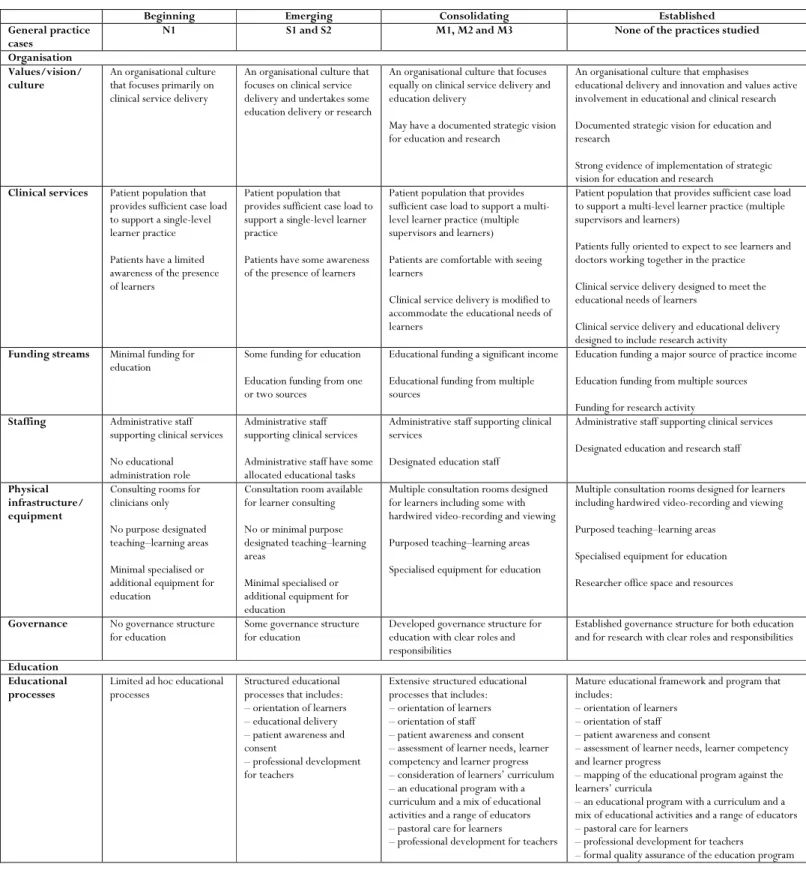
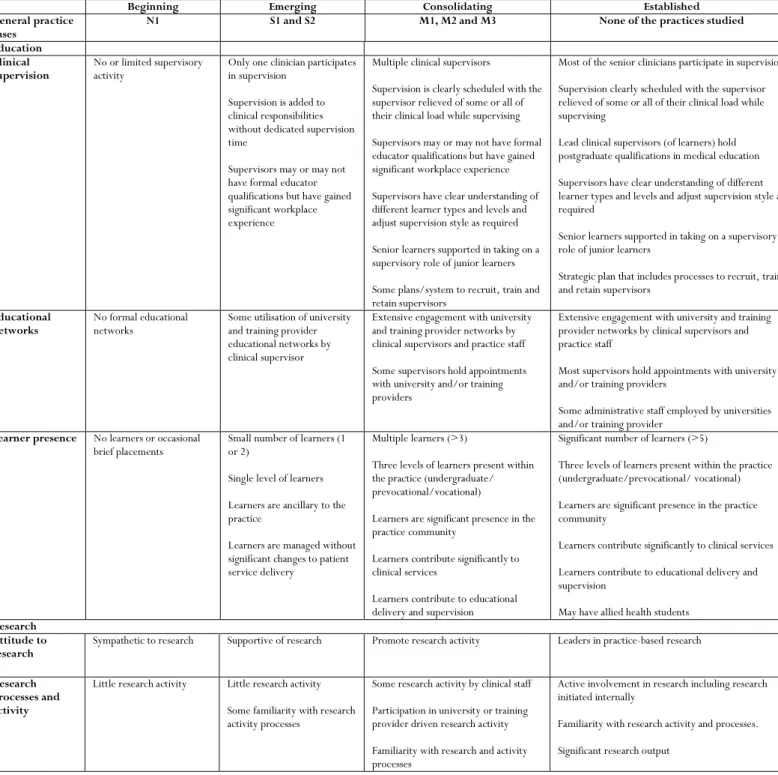
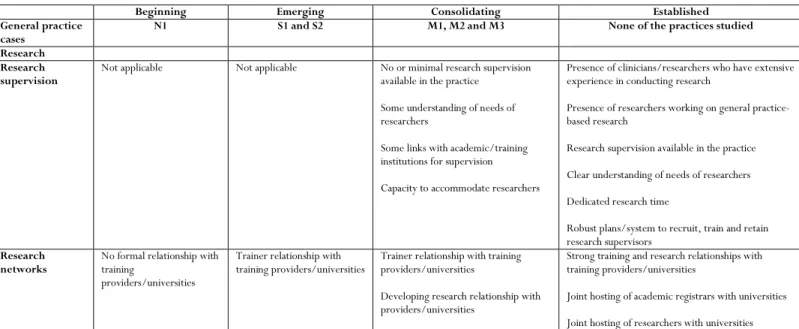
This rural academic general practice framework was based on the thematic analysis above and published literature (Table 5). Four levels of academic engagement by rural general practices are described in the columns beginning, emerging, consolidating and established. All subthemes are reflected in the cells under the broad theme rows. Leveraging the case study research design, the six practices studied were conceived to provide representations of the first three levels of academic engagement: beginning, emerging and consolidating. The features of an established academic rural general practice were supposed from the literature, from extrapolation of the progression of beginning to consolidating rural academic practice, and from the experience of the research team in the rural general practice and academic environments.
Discussion
Considerations were identified for progressing on a trajectory from a rural general practice without a training focus to one that has extensive training activity to one that undertakes both training and research and thus could be described as a rural academic general practice. Stages on this pathway have been conceptualised as beginning, emerging, consolidating and
established. To effectively foster education and research activity in rural general practices, the considerations identified in the thematic analysis and represented in the framework need to be addressed.
A beginning practice may be reluctant to host learners because of uncertainty about the impact of learners on the patient population and on the doctor–patient relationship. They may be concerned about the additional workload that learners might bring and how to manage this. They may be unsure of the financial consequences of hosting learners, may not have the physical space and may be uncertain of their knowledge and capacity for teaching. To encourage these practices to take on learners, training providers and universities need to be able to clearly articulate how these concerns might be addressed.
Table 4: Themes and subthemes, with example quotes
Theme 1: Organisational considerations
Subtheme 1: Values/vision/culture
‘The fact that we’re small, you know, we’re a fairly small clinic and that’s what the doctors want to keep.’ Practice manager (N1) ‘[Teaching and its requirements] takes you away from your core business which is basically earning a living, and keeping the place on the rails.’ Supervisor (S2)
‘… if it’s going to work. I mean the patients are important, but they need to be, they’re not in some ways the main focus. If the patients are the main focus you can’t do the education properly.’ Supervisor (M1)
Subtheme 2: Patient population and clinical services
‘You know, like if I’ve got something that’s life threatening, I don’t want to be seeing a learner that goes oh, ah, um, er.’ Patient (N1) ‘… if you write it in the newsletter, write a little bit about them, and you know explain to people how wonderful they are, and things like that; and it, they eventually warm to it all.’ Practice manager (S1)
‘Well, I don’t actually see them as interns, they’re doctors to me.’ Patient (M3) Subtheme 3: Staffing
‘… it does add to your day. … increases your work load.’ Practice nurse (N1)
‘And it, I suppose you have to employ a bit more staff probably, or it’s busier for them out the front.’ Supervisor (Emerging 1)
‘[I] have just undertaken an educational coordinator role which is a new role that they have created for me to make sure that the interns, registrars and medical students all adhere to the requirements of their training. And to help Dr X have it all streamlined so that when he comes in and does tutorials he knows what he is doing on what particular days, whether they’re to be a one on one, in a group, a video consult review and things like that.’ Other staff (education coordinator) (M2)
Subtheme 4: Physical infrastructure/equipment
‘… I don’t know if we’ve got the room. If we had the room we could, we would.’ Practice nurse (S1)
‘You need far more infrastructure than you would otherwise. You need to have larger spaces, you need to make sure all your rooms are of adequate size to be able to fit a learner in potentially, and you need to have extra consulting rooms up your sleeve.’ Supervisor 2 (M2) Subtheme 5: Funding streams
‘It would be nice not to be out of pocket for taking students’ Supervisor (N1) ‘It’s all to do with time and money, it’s as simple as that.’ Supervisor (S2) ‘It is financially beneficial for me to supervising the learners.’ Supervisor (M1)
‘There is a funding stream which comes with them, it’s different for all of them’ Supervisor (M3) Subtheme 6: Governance
‘… it probably runs more smoothly without a student.’ Practice nurse (N1)
‘The compliance demands of teaching registrars were starting to erode the sort of teaching time.’ Supervisor (S2)
‘I work very closely with the doctors in the training process, making sure that like with the interns they have their five week interviews, and the end of their term interviews; make sure that they’re happy. I look after all the accommodation for all levels of training.’ Practice manager (M1)
Theme 2: Educational considerations
Subtheme 1: Processes
‘I suppose there’s always a bit of doubt whether you’re teaching them the right thing. I guess some doctors might feel inadequate.’ Practice nurse (N1)
‘We have the computer, we can check up what patients have consented or not consented to see us. Then we can bring them in to our own little office, and do an interview and examination if we need to. Then we can go see the doctor together.’ Medical student (S2) ‘Their teaching sessions always had a plan on, you know, we’ll talk up to this level and make sure that we get the student involved to this level and then we go through to the next level, and if the student continues through, that’s good, but there is outcomes there for that, let’s say level one, and then level two, and then finally the level three.’ Practice manager (M1)
‘[The learners] have different things that they have to accomplish while they’re here at the practice this year. They have so many pap smears they have to do; they have to find some diabetic patients; they have to find some patients with psychological issues. So we have some strategies for finding those patients and I help them in that role as well.’ Practice manager (M3)
Table 4: cont’d
Subtheme 2: Clinical supervision
‘I find it’s a bit stressful when she rings me to come into the room.’ Supervisor (N1)
‘Look ideally you’d have another senior doctor they could bounce things off, so it wasn’t just me twenty four hours, you know, ideally.’ Supervisor (S1)
‘I get aware when I have a medical student, and a practice nurse, and a registrar; you really are hammering them. You’re doing sort of like a four in one, you’re doing your own patient, the registrar’s, the medical student who takes a bit more time, and perhaps the practice nurse too … Yeah, because it is, it’s a lot of extra time input from my point of view … Oh yeah, I feel a bit sorry for the, yeah it makes it a bit more disjointed, and I always run late, you know, up to an hour late.’ Supervisor (S1)
‘So it means that the overall work load of supervision gets spread around, and everyone gets the benefits of supervising in terms of keeping their own practice.’ Supervisor 2 (M2)
‘There are times when my role as the supervisor is just supervising those learners, and so there’d be some sessions where I won’t see any patients booked in for myself at all that haven’t, so I won’t see anyone that hasn’t seen somebody else prior.’ Supervisor (M3)
‘Obviously I’m still learning, I haven’t passed my exams yet, so part of me trying to learn exam stuff has been helped by supervising other people.’ Registrar (M2)
‘And I think it’s good for the registrars to be supervising interns, or medical students. It gives them a different look from, you know, not being the learner but being the educator.’ Practice manager (M2)
Subtheme 3: Educational networks
‘To me, oh they do give you some stuff, but look I don’t look at it, or read it as much as I should probably.’ Supervisor (S1) ‘We also have PGPPP [Prevocational General Practice Placement Program] meetings with the other practices.’ Practice manager (M3) ‘Well, the RTP [regional training provider] provided not only payment for us to do the work, but educational material, and educational forums for learning … And the university would be providing education material for the medical student as well.’ Supervisor (M1) Subtheme 4: Learner presence
‘But probably more stability in a practice that doesn’t have them.’ Practice nurse (N1)
‘… it brings someone else in to like the clinic; someone new, you know, it just adds a bit a change for us, you know, breaks from the routine a little bit.’ Practice manager (S1)
‘In clinics where you’re the only learner … you can get sort of pushed aside and tend to be just part of the workforce rather than a specific entity. [Having learners in the practice] creates the sort of instant social network for people that do come. So I think that’s really supportive, and it improves the experience.’ Supervisor (M3)
‘They’re laughing, they’re enjoying it, they’re challenging each other, you know, and oh no that’s not right, oh yes it is.’ Practice manager (M1)
‘The tea room’s a different atmosphere at lunch time, that you’ll have your, you know, the junior registrars who are interacting with your medical students and your interns; and education goes on there as well.’ Supervisor2 (M2)
‘The registrars taught the interns, the registrars and interns taught the medical students. In fact, that’s where most of the teaching happened for the medical students.’ Supervisor (M1)
‘Also being in the learning environment with a learner refreshes and improves my clinical skills, my clinical skills and knowledge; so the learner often knows things I don’t know, and my teaching usually has an emphasis on them bringing the knowledge and me providing the wisdom.’ Supervisor 1 (M2)
Theme 3: Research considerations
Subtheme 1: Attitude to research
‘I don’t know that that was any advantage to the practices.’ Practice nurse (N1)
‘But no, what I mean, if there’s no research everything stagnates and you’ve absolutely got to have research in every field.’ Patient (S1) ‘It’s essential, and I suppose that’s where we haven’t developed the capacity or, we haven’t developed the knowledge of what research is and how to do it. I mean, it’s been a huge missing link.’ Supervisor (M1)
Table 4: cont’d
Subtheme 2: Research activity
‘We’re doing ASPREE [international study on the effect of aspirin on healthy lifespan]at the moment, yeah and then I think, I think that’s about it at present.’ Practice manager (S1)
‘We’ve been involved with National Primary Care Collaborative.’ Practice manager (M3)
‘So I do a lot of audits and I’ll find out how many people over fifty have never had their blood pressure recorded and then we’d chase them up. How many people haven’t had a pap done and then we’d chase them up.’ Practice nurse (S1)
M, multi-level learner practice. N, no regular learner practice. S, single-learner practice.
Emerging practices in the framework have had some involvement in education while health service delivery remains the primary focus. Usually only one level of learner and a single supervisor are present in the practice. A culture of teaching is appreciated but is not significant. Patients may or may not be aware that the practice hosts a learner. The supervisor’s interest in teaching is often the motivator for the practice’s involvement in education. The practice receives a small amount of educational income. Resources required to support several learners and a strong culture of education (more than one supervisor, physical space for learners and administrative support) are often the barriers for these practices moving towards the consolidating and established academic status. There may be the concern that hosting more learners will erode the financial viability of the practice. To encourage an emerging practice to take the next step in increasing their engagement in education, support for infrastructure and training supervisors is critical. Also there needs to be clear financial value in making education a stronger focus. This value needs to be well articulated.
Consolidating practices are likely to have been involved in education for some time and to hold learning to be a significant priority within the practice culture. Patients within these practices are well aware of the presence of learners and generally expect and accept learner involvement in consultations. Consolidating practices have multiple supervisors who are involved in teaching and who value the presence of students, interns and registrars. As teaching is a developed activity in these practices, educational payments
form an important component of the practice’s business revenue. Dedicated administrative support for education is present. While research is appreciated, there is minimal engagement. For advancement of research activity, a clear route needs to be articulated for developing research skills with mentoring and role models. Research networks are essential to supporting research activity development in the practice. There also needs to be a good business case for practices to engage in research.
In an established practice, service, education and research are viewed as equal priorities. Strong relationships with educational and research institutions (universities and regional training providers) are present. As with the consolidated practices, resources (patient population, physical infrastructure, supervision and educational administration) are sufficient to host multiple learners at varying stages of their training. Also, processes for curriculum development, orientation and teaching are well established. Supervisors are likely to hold formal educational qualifications. There is administrative support for both the educational and the research activities. These practices conduct research either independently or in close partnership with academics from outside institutions. Personnel within the practice are familiar with research paradigms and processes, ethics approval and scholarly writing. Research grants together with education payments and grants are significant funding streams for the practice.
Table 5: Framework for rural academic general practices
Beginning Emerging Consolidating Established
General practice cases
N1 S1 and S2 M1, M2 and M3 None of the practices studied
Organisation Values/vision/ culture
An organisational culture that focuses primarily on clinical service delivery
An organisational culture that focuses on clinical service delivery and undertakes some education delivery or research
An organisational culture that focuses equally on clinical service delivery and education delivery
May have a documented strategic vision for education and research
An organisational culture that emphasises educational delivery and innovation and values active involvement in educational and clinical research Documented strategic vision for education and research
Strong evidence of implementation of strategic vision for education and research
Clinical services Patient population that
provides sufficient case load to support a single-level learner practice Patients have a limited awareness of the presence of learners
Patient population that provides sufficient case load to support a single-level learner practice
Patients have some awareness of the presence of learners
Patient population that provides sufficient case load to support a multi-level learner practice (multiple supervisors and learners) Patients are comfortable with seeing learners
Clinical service delivery is modified to accommodate the educational needs of learners
Patient population that provides sufficient case load to support a multi-level learner practice (multiple supervisors and learners)
Patients fully oriented to expect to see learners and doctors working together in the practice Clinical service delivery designed to meet the educational needs of learners
Clinical service delivery and educational delivery designed to include research activity
Funding streams Minimal funding for
education
Some funding for education Education funding from one or two sources
Educational funding a significant income Educational funding from multiple sources
Education funding a major source of practice income Education funding from multiple sources Funding for research activity
Staffing Administrative staff
supporting clinical services No educational administration role
Administrative staff supporting clinical services Administrative staff have some allocated educational tasks
Administrative staff supporting clinical services
Designated education staff
Administrative staff supporting clinical services Designated education and research staff
Physical infrastructure/ equipment
Consulting rooms for clinicians only No purpose designated teaching–learning areas Minimal specialised or additional equipment for education
Consultation room available for learner consulting No or minimal purpose designated teaching–learning areas
Minimal specialised or additional equipment for education
Multiple consultation rooms designed for learners including some with hardwired video-recording and viewing Purposed teaching–learning areas Specialised equipment for education
Multiple consultation rooms designed for learners including hardwired video-recording and viewing Purposed teaching–learning areas
Specialised equipment for education Researcher office space and resources
Governance No governance structure
for education
Some governance structure for education
Developed governance structure for education with clear roles and responsibilities
Established governance structure for both education and for research with clear roles and responsibilities Education
Educational processes
Limited ad hoc educational processes
Structured educational processes that includes: – orientation of learners – educational delivery – patient awareness and consent
– professional development for teachers
Extensive structured educational processes that includes: – orientation of learners – orientation of staff – patient awareness and consent – assessment of learner needs, learner competency and learner progress – consideration of learners’ curriculum – an educational program with a curriculum and a mix of educational activities and a range of educators – pastoral care for learners
– professional development for teachers
Mature educational framework and program that includes:
– orientation of learners – orientation of staff – patient awareness and consent
– assessment of learner needs, learner competency and learner progress
– mapping of the educational program against the learners’ curricula
– an educational program with a curriculum and a mix of educational activities and a range of educators – pastoral care for learners
– professional development for teachers
Table 5: cont’d
Beginning Emerging Consolidating Established
General practice cases
N1 S1 and S2 M1, M2 and M3 None of the practices studied
Education Clinical supervision
No or limited supervisory activity
Only one clinician participates in supervision
Supervision is added to clinical responsibilities without dedicated supervision time
Supervisors may or may not have formal educator qualifications but have gained significant workplace experience
Multiple clinical supervisors
Supervision is clearly scheduled with the supervisor relieved of some or all of their clinical load while supervising Supervisors may or may not have formal educator qualifications but have gained significant workplace experience Supervisors have clear understanding of different learner types and levels and adjust supervision style as required Senior learners supported in taking on a supervisory role of junior learners Some plans/system to recruit, train and retain supervisors
Most of the senior clinicians participate in supervision Supervision clearly scheduled with the supervisor relieved of some or all of their clinical load while supervising
Lead clinical supervisors (of learners) hold postgraduate qualifications in medical education Supervisors have clear understanding of different learner types and levels and adjust supervision style as required
Senior learners supported in taking on a supervisory role of junior learners
Strategic plan that includes processes to recruit, train and retain supervisors
Educational networks
No formal educational networks
Some utilisation of university and training provider educational networks by clinical supervisor
Extensive engagement with university and training provider networks by clinical supervisors and practice staff Some supervisors hold appointments with university and/or training providers
Extensive engagement with university and training provider networks by clinical supervisors and practice staff
Most supervisors hold appointments with university and/or training providers
Some administrative staff employed by universities and/or training provider
Learner presence No learners or occasional
brief placements
Small number of learners (1 or 2)
Single level of learners Learners are ancillary to the practice
Learners are managed without significant changes to patient service delivery
Multiple learners (>3)
Three levels of learners present within the practice (undergraduate/ prevocational/vocational)
Learners are significant presence in the practice community
Learners contribute significantly to clinical services
Learners contribute to educational delivery and supervision
Significant number of learners (>5)
Three levels of learners present within the practice (undergraduate/prevocational/ vocational) Learners are significant presence in the practice community
Learners contribute significantly to clinical services Learners contribute to educational delivery and supervision
May have allied health students Research
Attitude to research
Sympathetic to research Supportive of research Promote research activity Leaders in practice-based research
Research processes and activity
Little research activity Little research activity Some familiarity with research activity processes
Some research activity by clinical staff Participation in university or training provider driven research activity Familiarity with research and activity processes
Active involvement in research including research initiated internally
Familiarity with research activity and processes. Significant research output
Table 5 cont’d
Beginning Emerging Consolidating Established
General practice cases
N1 S1 and S2 M1, M2 and M3 None of the practices studied
Research Research supervision
Not applicable Not applicable No or minimal research supervision
available in the practice Some understanding of needs of researchers
Some links with academic/training institutions for supervision Capacity to accommodate researchers
Presence of clinicians/researchers who have extensive experience in conducting research
Presence of researchers working on general practice-based research
Research supervision available in the practice Clear understanding of needs of researchers Dedicated research time
Robust plans/system to recruit, train and retain research supervisors
Research networks
No formal relationship with training
providers/universities
Trainer relationship with training providers/universities
Trainer relationship with training providers/universities
Developing research relationship with providers/universities
Strong training and research relationships with training providers/universities
Joint hosting of academic registrars with universities Joint hosting of researchers with universities M, multi-level learner practice. N, no regular learner practice. S, single-learner practice.
This model has two particular strengths. First, this is a holistic model that places service, education and research together as integrated activities for the mature academic rural general practice. In this way, each activity supports the other activities. Second, this is a bottom-up model putting the individual general practice at the centre rather than on the periphery. Putting the individual general practice at the centre gives a capacity for genuine ownership of academic activity by general practices. This focus is likely to engender research agenda setting and ownership by general practices14
and integration of research into clinical services31 and
educational activity in the community setting.
It is acknowledged that the model suggests that engagement in education precedes engagement in research. This is consistent with the historical reality of the recent steep increase in the engagement of general practices in education while engagement in research has remained low5. The present
study’s sample of general practices and subsequent model was based on engagement in education. It would be valuable to test the framework on a sample based on engagement in research.
Strengths and limitations
The study strengths include the sampling of the diverse types of practices and the interviews with multiple stakeholders. The method of analysis was robust, with several rounds of data interrogation. The case study method enabled interpretation of results at the level of the practice, reflecting a realistic unit of analysis for propelling significant change. The study was set in rural Victoria, which may not reflect the broader landscape of general practices, training providers and higher education in other locations. The multidisciplinary research team (general practitioner, allied health academic/practitioner, organisational behaviour academic and education academic) enabled several perspectives to be offered during each phase of the study. This strengthens the study, reducing biases associated with a singular perspective. However, it may also mean that nuances were overlooked in data that are evident to those immersed in practice. Throughout the project, the research team met regularly and shared their perspectives and analyses. As in all interview-based studies, the quality of data may have been influenced by
the context of the interview itself. Although the interviewer is experienced, it is possible that interviewees offered views that they thought socially desirable. However, early interview transcripts were reviewed by at least one other research member and interview technique examined. The interviewer approach was considered ‘neutral’ and ‘encouraging’. The interviewer made notes on each interview and although some interviewees were noted as more forthcoming than others, with rapport established the flow of conversation in all interviews became easy.
Future research may investigate the transferability of the findings, especially using negative case analysis. It would be valuable to test the framework in other settings.
Conclusions
There is already sturdy evidence that learners are essential to addressing long-term workforce issues in Australian rural general practices. An established culture of learning is a fertile environment for developing research activity. This study documents that the pathway to becoming an academic rural general practice is a complex process, which requires many years of deliberate development. This development is best driven by a strategic vision of the practice shared by the key stakeholders such as practice owners, the permanent practitioners and the senior practice management staff. It is considered that the proposed framework will provide guidance to practices exploring one or more steps in the transition towards a full rural academic practice. It will also provide guidance for educational institutions and funding bodies wishing to support educational and research activity in rural general practices.
Acknowledgements
The authors acknowledge General Practice Education and Training for funding for this project and the five rural general practices that participated. The authors thank Associate Professor Elmer Villanueva for his contribution to the conception of the project.
References
1. General Practice Consultative Committee, Department of Human Services and Health. The future of general practice: a strategy for the nineties and beyond. Canberra, ACT: National Health Strategy, 1992.
2. Coote W. General practice reforms, 1989–2009. Medical Journal of Australia 2009; 191(2): 58-61.
3. Laurence C, Black L. Teaching capacity in general practice: results from a survey of practices and supervisors in South Australia. Medical Journal of Australia 2009; 191: 102-104.
4. Magin P, Pirotta M, Farrell E, Van Driel M. General practice research – training and capacity building. Australian Family Physician
2010; 39(5): 265-266.
5. Askew D, Schluter P, Gunn J. Research productivity in Australian general practice: what has changed since the 1990s?
Medical Journal of Australia 2008; 189(2): 103-104.
6. Brown L, McIntyre E. The contribution of primary health care research, evaluation and development-supported research to primary health care policy and practice. Australian Journal of Primary Health 2012; 20(1): 47-55.
7. Oceania Health Consulting. Evaluation of the Primary Health Care Research, Evaluation and Development Strategy. (Online) 2005. Available: http://www.phcris.org.au/phcred/reports/PHCRED %20Evaluation%20-%20Full%20Report.pdf (Accessed 24 March 2014).
8. Soos M, Temple-Smith M, Gunn J, Johnston-Ata'Ata K, Pirotta M. Establishing the Victorian Primary Care Practice Based Research Network. Australian Family Physician 2010; 39(11): 857-862. 9. Temple-Smith M, Clark M, Pirotta M. Making a difference – are you game? Australian Family Physician 2011; 40(1-2): 49.
10. Garth B, Temple-Smith M, Clark M, Hutton C, Deveny E, Biezen R, et al. Managing same day appointments – a qualitative study in Australian general practice. Australian Family Physician
2013; 42(4): 238-243.
11. Garth B, Temple-Smith M, Clark M, Hutton C, Deveny E, Biezen R, et al. ‘Your lack of organisation doesn’t constitute our emergency’ – repeat prescription management in general practice.
Australian Family Physician 2014; 43(6): 404-408.
12. Gunn J, Temple-Smith M, Pirotta M, Sanci L, Deveny E. 2011 Strategic roadmap for Australian research infrastructure. Submission to the Department of Innovation, Industry, Science and Research General Practice and Primary Health Care Academic Centre. Melbourne, VIC: University of Melbourne, 2011.
13. Cooke J. A framework to evaluate research capacity building in health care. BMC Family Practice 2005; 6: 44.
14. Del Mar C, Askew D. Building family/general practice research capacity. Annals of Family Medicine 2004;2:535-540.
15. Joyce C, Stoelwinder J, McNeil J, Piterman L. Riding the wave: current and emerging trends in graduates from Australian university medical schools. Medical Journal of Australia 2007; 186(6): 309-312. 16. Willcock S, Coote W. The Australian General Practice Training program – reflections on the past decade. Medical Journal of Australia 2011; 194(11): S55-S58.
17. Department of Health and Ageing. Building a national health and hospitals network — training record numbers of GPs. Media release. Department of Health and Ageing, 2010.
18. Tesson G, Curran V, Pong R, Strasser R. Advances in rural medical education in three countries: Canada, the United States and Australia. Education for Health 2005; 18(3): 405-415.
19. Wilson NW, Couper ID, De Vries E, Reid S, Fish T, Marais BJ. A critical review of interventions to redress the inequitable distribution of healthcare professionals to rural and remote areas.
Rural and Remote Health. 9(2):1060. (Online) 2009. Available: www.rrh.org.au (Accessed 7 July 2014).
20. Henry JA, Edwards BJ, Crotty B. Why do medical graduates choose rural careers? Rural and Remote Health 9(1): 1083. (Online) 2009. Available: www.rrh.org.au (Accessed 6 July 2014).
21. Campbell DG, Greacen JH, Giddings PH, Skinner LP. Regionalisation of general practice training – are we meeting the needs of rural Australia? Medical Journal of Australia 2011; 194(11): S71-S74.
22. Walters L, Worley P. Training in rural practice: time for integration? Australian Journal of Rural Health 2006; 14(5): 171-172. 23. Rosenthal D, Worley P, Mugford B, Stagg P. Vertical integration of medical education: Riverland experience, South Australia. Rural and Remote Health 4(1): 228. (Online) 2004. Available: www.rrh.org.au (Accessed 25 May 2013).
24. Larsen K, Perkins D. Training doctors in general practices: a review of the literature. Australian Journal of Rural Health 2006; 14(5): 173-177.
25. Morrison T, Brown J, Bryant M, Nestel D. Benefits and challenges of multi-level learner rural general practices – an interview study with learners, staff and patients. BMC Medical Education 2014; 14: 234.
26. Fisk N, Wesselingh S, Beilby J, Glasgow N, Puddey I, Robinson B, et al. Academic health science centres in Australia: let’s get competitive. Medical Journal of Australia 2011; 194(2): 59-60. 27. Dzau V, Ackerly D, Sutton-Wallace P, Merson M, Williams R, Krishnan K, et al. The role of academic health science systems in the transformation of medicine. Lancet 2009; 375: 949-953. 28. Fereday J, Muir-Cochrane W. Demonstrating rigor using thematic analysis: a hybrid approach of inductive and deductive coding and theme development. International Journal of Qualitative Methods 2006; 5(1): 80-92.
29. Braun V, Clarke V. Using thematic analysis in psychology.
30. Miles M, Huberman A. Qualitative data analysis: an expanded sourcebook, 2nd edn. Thousand Oaks, CA: SAGE Publications, 1994.
31. Mant D, Del Mar C, Glasziou P, Knottnerus A, Wallace P, van Weel C. The state of primary-care research. Lancet 2004; 364(9438): 1004-1006.