AUSTRALIAN JOURNAL OF BASIC AND
Open Access Journal
Published BY AENSI Publication
© 2016 AENSI Publisher All rights reserved
This work is licensed under the Creative Commons Attribution International License (CC BY). http://creativecommons.org/licenses/by/4.0/
To Cite This Article: P. Pritto Paul, Dr.N.Sankar Ram and M. Usha Wireless Hart In Wireless Sensor Networks (WSN)
Symmetric Key Encryption
Hart In Wireless Sensor Networks (
1P. Pritto Paul, 2Dr.N.Sankar Ram and 3M. Usha
1Research Scholar Department of CSE Velammal Engineering College Chennai, India 2
Professor and Head, Department of CSE, RMK College of Engg and Tech Chennai, India
3Assistant Professor, Department of CSE, Velammal Engineering College Chennai, India
Address For Correspondence:
P. Pritto Paul, Research Scholar Department of CSE Velammal Engineering College Chennai, India E-mail: [email protected]
A R T I C L E I N F O Article history:
Received 12 February 2016 Accepted 12 March 2016 Available online 20 March 2016
Keywords:
Hierarchical Clustering, WirelessHART, ClusterHead (CH), WirelessHART Communication Protocol, WSN, Protocols.
Wireless Sensor Networks (WSNs) consist of multiple sensor nodes with sensing, computation, and wireless communications capabilities. The main aim of Wireless Sensor Network (WSN) is to collect data from
the environment (Du, X., H.H. Chen, 2008
environments where pure human access and monitoring cannot be easily scheduled or efficiently managed. Wireless sensor networks are employed mostly in public and uncontrolled areas; hence the security is a major
challenge (Giruka, V.C., 2008). The traditional security mechanisms are authentication, symmetric key and
Public Key Infrastructure (PKI) cryptography. WSN includes many different types of sensors such as seismic, low sampling rate magnetic, thermal, visual, infrared, acoustic and rada
variety of ambient conditions (Raman, S.,
home and other commercial areas. WirelessHART is a secure and reliable communication standard employed widely for industrial process automation. WirelessHART uses 2.4GHz frequency band, a free unlicensed portion of the spectrum. Channel Hopping can be used to avoid interference among frequency bands which enhances reliabilityWirelessHART is a
self-establish path with those neighbours by channel hopping and synchronization information and measuring signal strength. WirelessHART network includes wired entities such as Network Manager, Gateway, Sec Manager, Plant Automation Hosts (PAH) and wireless entities such as Field Devices, Adapters, Routers, Access
Points and Handheld Devices (Umarani, V., K.S. Sundaram, 2013
divided into three levels such as End
AUSTRALIAN JOURNAL OF BASIC AND
APPLIED SCIENCES
ISSN:1991-8178 EISSN: 2309-8414 Journal home page: www.ajbasweb.com
© 2016 AENSI Publisher All rights reserved
licensed under the Creative Commons Attribution International License (CC BY). http://creativecommons.org/licenses/by/4.0/
P. Pritto Paul, Dr.N.Sankar Ram and M. Usha., Symmetric Key Encryption for Secure Communication Using Wireless Hart In Wireless Sensor Networks (WSN). Aust. J. Basic & Appl. Sci., 10(1): 625-630, 2016
Key Encryption for Secure Communication Using
Hart In Wireless Sensor Networks (WSN)
Usha
Research Scholar Department of CSE Velammal Engineering College Chennai, India Professor and Head, Department of CSE, RMK College of Engg and Tech Chennai, India Assistant Professor, Department of CSE, Velammal Engineering College Chennai, India
Research Scholar Department of CSE Velammal Engineering College Chennai, India
A B S T R A C T
Security is the most questing issue in Wireless Sensor Network (WSN) now because of various attacks on mobile nodes. Since existing security mechanisms are inadequate, new ideas are needed to effectively address the wireless sensor network security. Since a low energy node is more prone to security attacks, secure routing algorithms that consume less energy for communication should be used. Most of the real-world wireless sensor networking applications requires a certain amount of trust in their application in order to maintain proper network functionality. WirelessHART is an emerging secure and reliable communication standard that aims in maximizing the utilization of wireless communication. This paper employs the WirelessHART communication protocol for secure communication between two nodes. The WirelessHART standard is implemented on individual sensor nodes to ensure security. To reduce the communication overhead, hierarchical clustering is performed and sensor nodes are allowed to communicate only based on their trust value.
INTRODUCTION
Wireless Sensor Networks (WSNs) consist of multiple sensor nodes with sensing, computation, and wireless communications capabilities. The main aim of Wireless Sensor Network (WSN) is to collect data from
Du, X., H.H. Chen, 2008). Wireless Sensor Network (WSN) is employed in harsh
environments where pure human access and monitoring cannot be easily scheduled or efficiently managed. Wireless sensor networks are employed mostly in public and uncontrolled areas; hence the security is a major . The traditional security mechanisms are authentication, symmetric key and Public Key Infrastructure (PKI) cryptography. WSN includes many different types of sensors such as seismic, low sampling rate magnetic, thermal, visual, infrared, acoustic and radar, which are able to monitor a wide
Raman, S., 2010). WSN finds its applications in military, environment, health, home and other commercial areas. WirelessHART is a secure and reliable communication standard employed for industrial process automation. WirelessHART uses 2.4GHz frequency band, a free unlicensed portion of the spectrum. Channel Hopping can be used to avoid interference among frequency bands which enhances -healing and self-organizing protocol which can find its neighbours and establish path with those neighbours by channel hopping and synchronization information and measuring signal strength. WirelessHART network includes wired entities such as Network Manager, Gateway, Sec Manager, Plant Automation Hosts (PAH) and wireless entities such as Field Devices, Adapters, Routers, Access
Umarani, V., K.S. Sundaram, 2013). Security in WirelessHART standard can be
d-to-End, Per-hop and Peer-to-Peer. Security inn WirelessHART is enforced
Symmetric Key Encryption for Secure Communication Using
or Secure Communication Using Wireless
Security is the most questing issue in Wireless Sensor Network (WSN) now-a-days mobile nodes. Since existing security mechanisms are inadequate, new ideas are needed to effectively address the wireless sensor network security. Since a low energy node is more prone to security attacks, secure routing less energy for communication should be used. Most of the world wireless sensor networking applications requires a certain amount of trust in their application in order to maintain proper network functionality. WirelessHART is an eliable communication standard that aims in maximizing the utilization of wireless communication. This paper employs the WirelessHART communication protocol for secure communication between two nodes. The sensor nodes to ensure security. To reduce the communication overhead, hierarchical clustering is performed and sensor nodes are allowed to communicate only based on their trust value.
in Network Layer and Data Link Layer. Data Link Layer provides hop-to-hop security between two devices using Network key; and Network Layer enforces end-to-end security between source and destination using session key(s) and/or join key. Network Layer in WirelessHART protocol stack provides Confidentiality, Integrity and Authentication. Advanced Encryption Standard (AES-128 bit) can be used to achieve security in a WirelessHART network. To identify the malicious nodes in a network, a trust model is required. A trust model supports decision making in a Wireless Sensor Network (WSN) such as pre key-distribution, data aggregation, sink node selection and self-reconfiguration of these sensor nodes. Trust model encourages trustworthy nodes to
communicate bit it discourages untrustworthy nodes to even participate in the network (Boukerch, A., 2007).
Trust also increases network lifetime, throughput and resilience in a WSN. Trust may be subjective or objective depending on the task. In general, trust is classified as behavioral or computational trust based on where it is used. Behavioral trust defines trust relations among people and organizations. Computational trust defines trust relation among devices, computers, and networks. Depending on the observation, trust may be direct trust or indirect trust. Direct trust specifies the direct observations and called as first hand information. Indirect trust specifies the indirect observation and called as second hand information.
II.Trusted routing in wireless sensor networks (wsn):
Various routing, power management, and data dissemination protocols have been specifically designed for WSNs where energy consumption is an essential design issue.
2.1. Classification of Routing Protocols:
Since WSN protocols are application-specific, the focus is given to the routing protocols that differ depending on the application and network architecture. The three main categories of routing protocols are data-centric, hierarchical and location-based. Fig. 3 shows the classification of the routing protocols.
Fig. 1: Classification of Routing Protocols in WSN.
2.2. Structure of Trust Model:
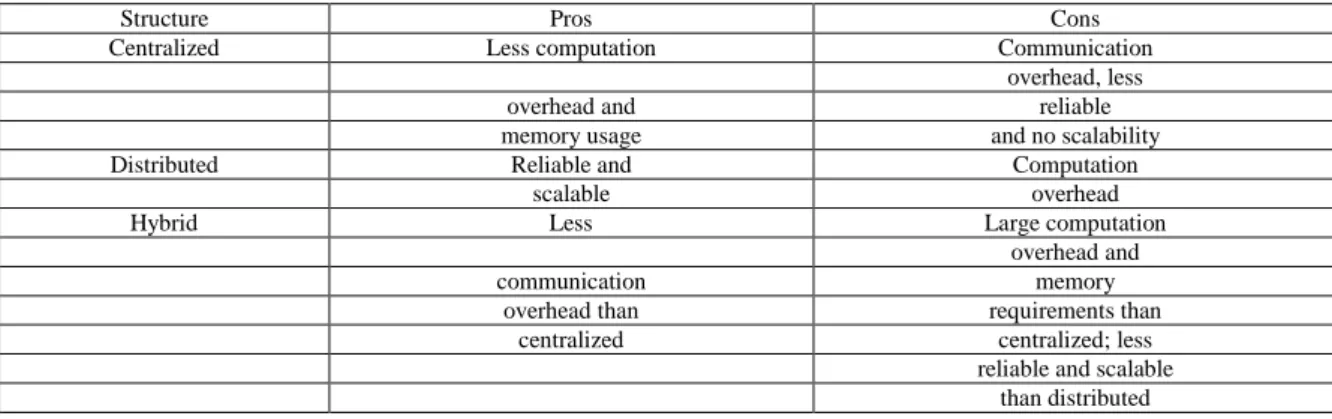
In a network, trust helps a node to determine whether its neighbour node is uncooperative or malicious. In an Ad-hoc network, trust plays a major role in detecting misbehaviours, routing and resource sharing. The advantages and disadvantages of a trust model are given in Table II.
Table 1: The Structure of a Trust Model- Pros and Cons.
Structure Pros Cons
Centralized Less computation Communication
overhead, less
overhead and reliable
memory usage and no scalability
Distributed Reliable and Computation
scalable overhead
Hybrid Less Large computation
overhead and
communication memory
overhead than requirements than
centralized centralized; less
2.3. Various Trust Models:
In WSN, trust plays a major role in detecting a malicious node. The reputation-based framework for high
integrity sensor network (RFSN) (Alzaid, H., 2008) utilizes the watchdog mechanism to collect data and
monitor different events in the node to build reputation thereby getting the trust rating of that node. The LDTS is a lightweight trust system for clustered wireless sensor networks which uses direct trust and feedback trust to enhance decision making and collaborative processing by detecting malicious behaviour. The hierarchical trust management for wireless sensor networks (HTMW) performs multi-path routing to evaluate trustworthiness of a node using subjective trust and objective trust.The bio-inspired trust and reputation model (BTRM-WSN) (Xiang, G., 2012) uses the distributed based ant colony approach to improve the collaboration among nodes by selecting most trustworthy nodes along the path from a sensor node to its sink node. The agent based trust
management (ATRM) (Zhang, J., 2010) approach employs distributed certificate based trust model to monitor
the behaviour of network with the help of agent module. The TMA (Ganeriwal, S., 2008) is dynamic
certification based trust management architecture for hierarchical WSN that lowers the computation and communication overhead by considering both behavioural and direct trust. The reliable data aggregation and
transmission protocol (RDAT) (Chen, D., 2011) is a distributed function based beta reputation model which
amends the reliability of data aggregation and transmission by evaluating each sensor node’s action using a respective function reputation.The reputation-based secure data aggregation (RSDA) improves the accuracy of aggregated data and enhance the network lifetime. The trust management model for internet of things
(TRM-IoT) (Ozdemir, S., 2008) is a fuzzy based reputation model which provides efficient and safe communication
from source to destination. The addition encouragement and multiplication punishment (AEMP) (Mármol, F.G.,
G.M. Pérez, 2011) is a new routing trust based protocol that enhances WSN ability against attacks from within
the network. The direct trust dependent link state routing protocol (DTLSRP) (Kahn, J.M., 1999) is a trust based
routing protocol that protects network from routing attacks.The distributed reputation based beacon trust system
(DRBTS) (Babu, S.S., 2011) is a reputation based distributed structure which helps to monitor misbehaviours in
WSN. The TMA is dynamic certification based trust management architecture for hierarchical WSN that considers behavioural and direct trust and reduces the computation and communication overhead. TABLE III shows various techniques that can be used to build a trust model in sensor networks.
III. Wireless hart communication protocol:
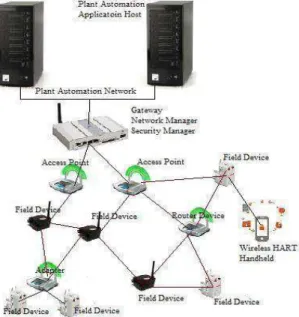
Figure 2 represents a generic WirelessHART network architecture. It is formed by a group of network devices that can either be a field device which is directly connected to the process plant, or handheld devices The network supports two topologies: direct connection between device and gateway (star topology) and connections over multiple hops (mesh topology). Each network device must therefore be able to act as source, sink and router. The WirelessHART gateway serves as a bridge connecting the WirelessHART network to the process plant. It includes a virtual gateway and one or more network access points. Host applications can access the network devices through the service interface, which can have single or multiple ports.
Operators are also allowed to monitor or configure particular field device through the process plant backbone. These network access points provide the actual physical connection to the WirelessHART network. The virtual gateway serves as the sink and source for the network traffic. It should be a HART type device, namely one that supports all HART application commands and also able to translate cached data that can be interpreted by the host applications. The gateway also provides buffering for burst and large data transfers, command responses, event notification and diagnostics. The virtual gateway communicates directly with the network manager, which configures and maintains the WirelessHART network. Each network consists of only one network manager. The manager requests information from field devices via the gateway to make certain decisions. The host application can also provide input to the network manager. The security manager works along with the network manager to prevent possible intrusions and attacks to the WirelessHART network. Multiple networks can be connected to one security manager. It generates session keys, joint keys and network key. These keys are further propagated to the field devices by the network manager.The WirelessHART standard specifies the communication protocol stack using the OSI model. At the bottom is the physical layer which is responsible for signalling, modulation and actual transmission of data. Above that is the data link layer which determines how common wireless medium is shared between the network devices. It is also responsible for formatting data packets, detection/correction of bit errors. The network layer is the core of the WirelessHART standard which is responsible for routing, topology control, end-to-end security and session management. The transport layer ensures end-to-end transmission reliability and flow control.
3.1. Network Manager:
device wants to join the network, the manager validates its integrity using join keys and the network ID to ensure its trustworthiness and whether it is joining the right network. Once authenticated, the network manager provides the device with necessary network and session keys from the security manager and assigns a 16 bit network address. It is required that a device has at least two neighbours to ensure path diversity and hence better reliability.
Table 2: Trust Models in WSN.
Trust Purpose Structure Trust
Model Computat
ion
RFSN To monitor Distributed Beta
[9] fraudulence and distribution
in the cooperative approach
network
ATRM To Hierarchical Agent based
[10] minimize Certificate
overhead based
DRBTS To monitor Distributed Quorum
[11] fraudulence and voting
in the cooperative approach
network
AEMP To support Distributed Weighted
[12] secure approach
routing
RDAT To improve Distributed Beta
[13] the distribution
reliability of data aggregation
TRM- To build Distributed Fuzzy
IoT collaboratio and
[14] n among Behavior
nodes based
BTRM To pick out Distributed Ant colony
[15] trustworthy
Nodes
DTLSR To discover Distributed Weight
P [16] trust based
routing
TMA To Behavior Weight
[17] minimize and based
communicat Certificate
ion and based
storage Hierarchical
overhead
RSDA To amend Distributed Beta
[18] accuracy of probability
aggregated Density
data
LDTS To help Hierarchical Weight
[19] collaborativ based
e processing Approach
by detecting malicious behaviour
HTMW To execute Hierarchical Stochastic
[20] routing and Petri net
intrusion detection
3.2. Transport Layer:
may require the network manager to update its routing and scheduling plan to provide the necessary priority.
Fig. 2: Wireless HART Network Architecture.
RESULTS AND DISCUSSIONS
In this paper, we are comparing two routing protocols namely, the Ad-Hoc On Demand Distance Vector (AODV) routing protocol which is used for mobile data transmission and our new routing protocol, which is the WirelessHART Communication Protocol (WHCP). We simulated the comparison using NS2 and obtained the result as follows from our trace map.
Figure 3 shows the comparison graph of AODV and WHCP routing protocols in terms of their throughput. Here we observe that, after the completion of the tenth round, AODV protocol takes more time to transmit the data to the base station (BS) than WHCP. The major reason behind this is that in case of AODV protocol, the route discovery cycle takes more time.Hence, it is clear that WHCP routing protocol is more secure and effective than AODV routing protocol.
V. Conclusion and future work:
work on applying this WirelessHART protocol into various applications and other routing protocols of Wireless Sensor Networks (WSN). We will conduct a detailed simulation in terms of message overhead, security analysis, and tolerance to intruders.
REFERENCES
Du, X., H.H. Chen, 2008. Security in wireless sensor networks. Wireless Communications, IEEE, 15(4): 60-66.
Abbasi, A.A., M. Younis, 2007. A survey on clustering algorithms for wireless sensor networks. Computer
communications, 30(14): 2826-2841.
Giruka, V.C., M. Singhal, J. Royalty, S.V aranasi, 2008. Security in wireless sensor networks. Wireless
communications and mobile computing, 8(1): 1-24.
Raman, S., A. Prakash, K.B. Pulla, P. Srivastava, A. Srivastava, S. Singh, 2010. Wireless sensor networks: A Survey of Intrusions and their Explored Remedies. International Journal of Engineering Science and
Technology, 2(5): 962-969.
Umarani, V., K.S. Sundaram, 2013. Survey of Various Trust Models and Their Behavior in Wireless Sensor Networks.
Boukerch, A., L. Xu, K. El-Khatib, 2007. Trust-based security for wireless ad hoc and sensor networks. Computer Communications, 30(11): 2413-2427.
Bao, F., I.R. Chen, M. Chang, J.H. Cho, 2012. Hierarchical trust management for wireless sensor networks and its applications to trust-based routing and intrusion detection. Network and Service Management, IEEE
Transactions on, 9(2): 169-183.
Li, X., F. Zhou, J. Du, 2013. LDTS: a lightweight and dependable trust system for clustered wireless sensor networks. Information Forensics and Security, IEEE Transactions on, 8(6): 924-935.
Alzaid, H., E. Foo, J.G. Nieto, 2008. RSDA: reputation-based secure data aggregation in wireless sensor networks. In Parallel and Distributed Computing, Applications and Technologies, PDCAT. Ninth International
Conference on (pp: 419-424). IEEE.
Zhang, J., R. Shankaran, M.A. Orgun, V. Varadharajan, A. Sattar, 2010. A trust management architecture for hierarchical wireless sensor networks. In Local Computer Networks (LCN), 2010 IEEE 35th Conference
on (pp: 264-267). IEEE.
Babu, S.S., A. Raha, M.K. Naskar, 2011. A Direct trust dependent link state routing protocol using route trusts for WSNs (DTLSRP). Wireless Sensor Network, 3(04): 125.
Mármol, F.G., G.M. Pérez, 2011. Providing trust in wireless sensor networks using a bio-inspired technique. Telecommunication systems, 46(2): 163-180.
Chen, D., G. Chang, D. Sun, J. Li, J. Jia, X. Wang, 2011. TRM-IoT: a trust management model based on fuzzy reputation for internet of things.Computer Science and Information Systems, 8(4): 1207-1228.
Ozdemir, S., 2008. Functional reputation based reliable data aggregation and transmission for wireless sensor networks. Computer Communications, 31(17): 3941-3953.
Xiang, G., Q. Jianlin, W. Jin, 2012. Research on trust model of sensor nodes in WSNs. Procedia
Engineering, 29: 909-913.
Kahn, J.M., R.H. Katz, K.S. Pister, 1999. Next century challenges: mobile networking for “Smart Dust”. In Proceedings of the 5th annual ACM/IEEE international conference on Mobile computing and
networking (pp: 271-278). ACM.