ISSN: 2147-611X
www.ijemst.com
An Interview Study of German Teachers’
Views on the Implementation of Digital
Media Education by Focusing on Internet
Forums in the Science Classroom
Johanna Dittmar, Ingo Eilks University of Bremen, Germany
To cite this article:
Dittmar, J. & Eilks, I. (2019). An interview study of German teachers’ views on the
implementation of digital media education by focusing on Internet forums in the science
classroom.
International Journal of Education in Mathematics, Science and Technology
(IJEMST), 7
(4), 367-381.
This article may be used for research, teaching, and private study purposes.
Any substantial or systematic reproduction, redistribution, reselling, loan, sub-licensing,
systematic supply, or distribution in any form to anyone is expressly forbidden.
Authors alone are responsible for the contents of their articles. The journal owns the
copyright of the articles.
Volume 7, Number 4, 2019
ISSN: 2147-611X
An Interview Study of German Teachers’ Views on the Implementation of
Digital Media Education by Focusing on Internet Forums in the Science
Classroom
Johanna Dittmar, Ingo Eilks
Article Info
Abstract
Article History
Received: 15 July 2019
Internet forums are interactive, question-answer-based information resources in the Internet. Users can post questions and others can answer from any place in the world and at any time. Teachers can use Internet forums to find answers on how and what to teach, e.g. science; students find or ask for information for school topics or homework assignments. Digital forums can be even used to organize communication among students or of students with their teachers. The use of Internet forums quite often is initiated unconsciously when Internet search engines, like Google, lead the user to them. The Internet provides various types of forums, ranging from very general forums to domain-specific ones such as those focusing on science-related questions. In more general Internet forums, however, it is quite common that science-related content is discussed on the basis of everyday life questions. In order to educate learners in dealing with science-related content in forums and to contribute to digital media education, it has been suggested that schools integrate and reflect upon Internet forums in formal educational settings, e.g. in science education. The question, however, remains what the individual school subjects should contribute to the process. This survey seeks to map out to which degree science teachers in Germany are aware on Internet forums and whether they are open and prepared to integrate Internet forums into their teaching. An interview study with 16 selected science teachers indicates that teachers are largely open-minded about the use of Internet forums. The survey, however, also shows that Internet forums are used only by a few of the teachers from this sample in science class. Hindering factors mentioned included time constraints, missing concepts, and lack of infrastructure.
Accepted: 15 October 2019
Keywords
Science education ICT
Media education Internet forums
Introduction
Digital media permeate today’s world in every developed and developing society. The growing availability of equipment based on digital technologies and, in particular, computers and mobile telephones, dominate all areas of professional and private life. According to the study "LIFE - Digital Life" by Deutsche Telekom (2009), there were already more mobile phones than people ten years ago in Germany.
New devices and social media also play a growing role in the lives of today’s secondary school learners. Every year since 1998, the MPFS has been investigating how young German people between the ages of twelve and nineteen use media, which websites they visit and how they deal with them for school purposes. The most prominent websites from the Internet that are used by almost all secondary school students include YouTube, Facebook, Twitter and Instagram (MPFS, 2017).
Digital media education is a prominent trend both in international educational policy (UNESCO, 2013) and in national regulations such as those in Germany (KMK, 2012). There seems to be agreement that digital media education needs reflective and constructive components for both the generation and consumption of digital media (UNESCO, 2013). Media education has to find its place among all the different fields and levels of education, including secondary science education (Belova et al., 2017). Relevant science education needs to focus on science in the mass media (Chang-Rundgren & Rundgren, 2015) in order to understand the handling and use of scientific information in and by the public (Belova, Stuckey, Marks & Eilks, 2015).
Although digital media have become an almost constant companion in the life of people of all ages, many teachers still seem to be reluctant to use these media in a similar, quite normal fashion in the classroom. In the case of Germany, a study by Bitkom in 2016 suggested that digital devices were still not represented in school classes at the same level as they occurred in private life. While projectors are used by 81% of teachers, the classroom use of desktop computers, laptop computers, whiteboards, tablets, and other devices decrease from 63% to 24%, respectively. The Bitkom study found that every second teacher in Germany would like to work with digital media quite often, which shows that at least half of the teachers have positive attitudes towards the use of digital media in the classroom. There is, however, the remaining half, which has doubts as to whether digital media can and will actually improve learning (Bertelsmann Stiftung, 2017). Although there is a lot of research which suggests the positive potential of digital media for the improvement of science learning (Dori, Rodrigues & Schanze, 2013), many teachers are still not convinced about both its potential for learning and their responsibility for contributing to digital media education in their own classes.
A large variety of digital resources is provided in the Internet for science education, leading to various teaching and learning scenarios which have been suggested (e.g., Rodrigues, 2010). Presentations, visualisation software, cognitive tools, wikis, or videos are at the forefront when it comes to media use in class or for homework assignments (Dori et al., 2013). In recent years, the social media, learning apps, and blogs were all suggested to aid students with learning (Bertelsmann Stiftung, 2017). There is a growing number of studies focusing on the social media in higher education (Tess, 2013; Gikas & Grant, 2013; Mao, 2014) and in schools (Evans, 2014; Krutka & Carpenter, 2016; Badri, Nuaimi, Guang & Rashedi, 2017). Internet forums, as a part of social media, however, are rarely the focus of educational research in general and in science education in particular. This remains the case, even though Internet forums are a place to ask science and technology questions and receive, discuss and comment upon information. In other words they are a potential place for learning science. That is why this qualitative survey maps German science teachers’ views about the potential use of Internet forums as content and medium in science education.
Background
Media literacy is one suggested part of general education. It is intended to raise learners’ competency when it comes to accessing, analysing, evaluating, and creating information from the media in a variety of forms. This ranges from traditional print-based media to audio-visual and digital forms (CML, w.y.). Media literacy has been suggested as a way for students to achieve competence in critically dealing with media offerings, both as media consumers and as media creators (UNSECO, 2013). Learners need to be able to change, develop and creatively shape media and to understand their role in society. This includes a basic understanding of the ways in which media are communicated and the necessary skills required in handling the corresponding technical devices. Digital media literacy is not just about the proper use of computers and other digital devices, but also about reflective dealing with information, which is provided via digital resources.
The OECD (2005) suggests that digital media should be used in the classroom. Young people should become able to handle digital media flexibly and to make meaningful use of them, not only for private but also for professional purposes. People need to understand how to communicate and interact with other people using digital media. The interactive use of digital media in the classroom can also help reducing fears and reluctances in the use of digital media for learning, thereby promoting students ability to see them as an aid and use them profitably. However, as occurs with any application of new technologies, the general use of digital media in schools and teaching tends to be implemented rather slowly. Part of this is due to the fact that the integration of digital media into the teaching and learning process is perceived as a complex event (Bingimlas, 2009).
multidisciplinary mediation of digital media literacy is necessary and quite advantageous, because in each domain such media are used in different manners. Accordingly, learners should be prepared for the particular environment in which the media play a role. Only in this interdisciplinary fashion can a critical approach, which includes science education be promoted (Belova et al., 2017).
Several studies have already shown that Internet-based information systems have certain advantages in various domains of professional and private life (Donelan, 2015; Li & Greenhow, 2015). One of these systems includes Internet forums. Such forums are part of the social media, which are widely available to the public on the Internet. The forums represent a kind of question-and-answer platform in which knowledge, experiences and opinions can be exchanged. Help is supplied with regard to everyday life problems or professional questions. Internet forums can be divided into general and domain-specific forums, e.g. on computer use or chemistry. Domain-specific forums tend to be significantly smaller than general Internet forums. This is mirrored in the numbers of registered users. For example, the largest forum in the German language (gutefrage.net) has over one million registered users, whereas a very specific, science-based forum such as chemieonline.de has just over 60,000 (Dittmar & Eilks, 2015).
Each of the different forum types has both advantages and disadvantages, depending on the goal of the question. General forums are often useful if one is researching everyday issues such as household tips or holiday experiences. Such questions do not necessarily require an expert and can be discussed with laymen. Once a question focusses on quite specific content matter such as that found in the sciences, one probably needs an expert or at least an educated amateur. The chance of finding relevant experts is higher in smaller forums with a specific focus, since there are often highly-skilled students, teachers, and other professionals answering the questions. The likelihood of finding a profitable and helpful answer is higher than in a general forum.
Although the availability and use of Internet forums are widespread in both private and professional life, Internet forums have thus far received little attention in educational research. While other social media have become an increasingly popular focus of research, only a very few studies have looked at Internet forums. These studies basically focus on the quality of content, which is to be found in such forums (Franke & Hiernerth, 2006; Bourgonjon, Vandermeersche, De Wever, Soetaert & Valcke, 2015; Cole, Watkins & Kleine, 2016). Only a few studies have yet addressed such sites' potential uses in teaching and learning situations. Thomas (2002) or Van Eaton, Clark and Smith (2015), for example, studied the learning outcomes of interaction processes in forum discussions within the classroom in order to assess the learning process.
Studies of Internet forums up until now have shown that domain-specific forums often provide high-quality answers and discussions. For example, Cole, Watkins and Kleine (2016) analysed and compared domain-specific forums in the health sector, as well as general forums that dealt with questions concerning overall health issues. In both cases, previous research (see Impicciatore, Pandolfini, Casella & Bonati, 1997, Whitelaw, Bhattacharya, McLernon & Black, 2014) could be duplicated, in which satisfactory responses of an acceptable quality could be identified. For a well-thought-out and responsible use of media like Internet forums, however, not only content is relevant.
Competence also requires an understanding of the mechanisms and persons involved (Belova, Stuckey, Marks & Eilks, 2015). Attention must be paid to which forum to select, who might be offering information in the forum in question, and who rates and comments on forum postings. There are Internet forums which are driven and controlled by pressure groups or companies (Franke & Hienert, 2006, Mitchell, Sweitzer, Tunno, Collins & McClernon, 2016), which promote certain products or societal views. Only when the background and motives of an information provider are recognized can the questioner make an educated guess as to the balance and reliability of the information offered (Belova et al., 2015). In terms of using Internet forums in class, not only the accuracy of the information provided should play a role, but also a focus on how a certain set of information is generated and provided. This calls for diverse and comprehensive competencies, which must be taught and learned. For this reason, it is important that today's teachers have extensive media and information literacy skills which they can pass on to their students in the classroom (UNESCO, 2013).
Based on the works of Belova and Eilks (2015), which look at advertising as a medium in science education, various ways of using Internet forums in science teaching can emerge. Forums can not only promote different media literacy skills among learners, but also might make teaching more motivating and authentic (Dittmar & Eilks, 2015). The following are potential strategies for learning both with and by Internet forums (Dittmar & Eilks, 2015):
(I) Use of Internet forums posts as an authentic and motivating lesson plan opener (II) Use of Internet forums posts to contextualize theoretical learning or practical work (III) Use of Internet forums to practice communication and evaluation skills
(IV) Use of Internet forums or posts to reflect the role of science in public debate
Internet forums can be a teacher's asset in a variety of ways. They can be used for lesson preparation, as a tool for updating content knowledge in new areas, as a source of content for teaching, or as a medium for communication with other teachers or among student groups. In the field of education, however, different influencing factors can determine why a medium is used or not. The self-efficacy of the person plays a significant role similar to the use of computers (see Awofala, Fatade & Udeani, 2015). There are basically two factors influencing a person's usage behaviour: perceived usefulness and perceived ease of use (Davis et al., 1989). The former factor depends on variable experiences, subjective norms, and images. This includes cognitive reasons such as perceived professional relevance, the quality of output, and the level of comprehensibility for students. The latter factor is concerned with accessibility, user-friendliness, or technical issues. A teacher may have had negative personal experiences with a certain medium and its usefulness. For this reason, he or she may not want to use the resource in class.
Comprehensive studies (Bingimlas, 2009, Afshari, Bakar, Luan, Samah & Fooi, 2009, Unal & Ozturk, 2012, Kafyulilo, Fisser & Vogt, 2015) have highlighted barriers in dealing with digital media in education, which may also be relevant for the use of Internet forums in science education. Bingimlas (2009) differentiated between teacher-related barriers such as lack of trust and competence, a general resistance to change or a negative attitude towards the media. He also referred to limitations in the educational system like a lack of preparation time, the lack of effective training opportunities, and insufficient accessibility and technical support.
A recent German study of secondary school student opinions of Internet forums (Dittmar & Eilks, 2019) revealed that learners are ready to be critically educated on the use of Internet forums. This study showed that almost all secondary school learners are familiar with Internet forums. Most of the students stated that they regularly locate Internet forums with the help of search engines such as Google. Students often look up and read Internet forum entries. As they get older, they also use Internet forums for school tasks and homework assignments. Students value Internet forums, but tend to use general forums rather than domain-specific ones, which focus on the sciences. Part of the students has also developed critical views of the reliability of information, which can be found in Internet forums. Most students, however, rarely participate actively in discussions, do not ask many questions, and prefer not to provide their own views on topics. The study carried out by Dittmar and Eilks (2019) suggests that students’ skills and self-confidence in actively participating in Internet forums have not been fully developed at the level of secondary school users. Comparable data for science teachers’ views on and experiences with Internet forums in science education is unfortunately not available at this time.
Research Questions and Study Design
Research Question
(1) What are the views of science teachers on the use of social media, especially the use of Internet forums in science teaching?
(2) What potential advantages do science teachers see in using Internet forums in science education? (3) What do teachers generally think about the role of science education when it comes to digital media
education?
(4) What hindrances do teachers see when it comes to implementing digital media, especially Internet forums, in science education?
Sample
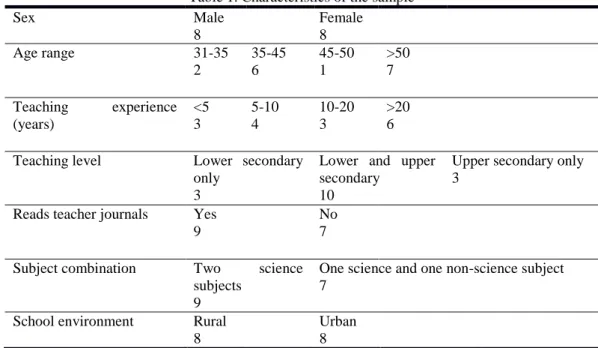
The number of interviews possible in this kind of survey studies is naturally limited. Nevertheless, a representative picture could be achieved with the help of purposeful sampling methods (Patton, 1990). Purposeful sampling allows a triangulation of different perspectives and meanings (Polkinghorne, 2005). Teachers with different characteristics were included in the sample, which tried to balance such factors as age, sex, amount of teaching experience, and the school context (Table 1). We need to state from the beginning that typical German teachers normally qualify for and teach two different school subjects. For this study a combination of teachers with either two science subjects (biology, chemistry, physics) or a science subject combined with a non-science subject were selected. All teachers participated voluntarily in the study.
Table 1. Characteristics of the sample
Sex Male
8
Female 8
Age range 31-35
2
35-45 6
45-50 1
>50 7 Teaching experience
(years)
<5 3
5-10 4
10-20 3
>20 6 Teaching level Lower secondary
only 3
Lower and upper secondary
10
Upper secondary only 3
Reads teacher journals Yes 9
No 7 Subject combination Two science
subjects 9
One science and one non-science subject 7
School environment Rural 8
Urban 8
Data Collection
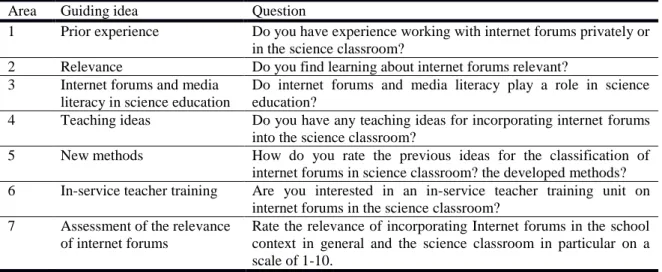
Semi-structured interviews (Patton, 1990) were conducted in order to investigate teachers’ views. Each was supplemented by a personal data questionnaire. The interview guide was inspired by a related study carried out by Belova and Eilks (2015), which investigated the use of advertising in science education. The interview guide encompassed seven areas. Each area started with an open question (Table 2), which was then continued with a discussion based in further impulses. The interviews began with a short introduction explaining the purpose of the interview, why the use of Internet forums in science education was of interest, and a definition of Internet forums, in case the teachers were unclear about their structure or function. A distinction was made between teachers having Internet forum experience and those without.
Table 2. Structure of the interview guide
Area Guiding idea Question
1 Prior experience Do you have experience working with internet forums privately or in the science classroom?
2 Relevance Do you find learning about internet forums relevant? 3 Internet forums and media
literacy in science education
Do internet forums and media literacy play a role in science education?
4 Teaching ideas Do you have any teaching ideas for incorporating internet forums into the science classroom?
5 New methods How do you rate the previous ideas for the classification of internet forums in science classroom? the developed methods? 6 In-service teacher training Are you interested in an in-service teacher training unit on
internet forums in the science classroom? 7 Assessment of the relevance
of internet forums
Rate the relevance of incorporating Internet forums in the school context in general and the science classroom in particular on a scale of 1-10.
Data Analysis
We applied inductive category formation according to Mayring (2000). The interviews were openly coded and the codes were then cyclically refined into general categories. After initial coding, the coding system was re-examined and readjusted. The final coding reached an interrater agreement with Cohen’s Kappa of κ=0.97, which corresponds to very good match (Landis & Koch, 1977). A total of 10 categories resulted (Table 3).
Table 3. Results from the inductive category formation
Category Description
1. Prior experiences Personal experience with the implementation of internet forums outside and within the science classroom
2. Ideas and willingness to innovate
Personal willingness and ideas for implementing internet forums in one’s own teaching
3. Suggested learning objectives
General and science-related goals of using internet forums in school
4. Subjects School subjects rated as responsible for covering learning with and about internet forums
5. Media literacy and science education
Media literacy as part of science teaching and learning 6. Strategies and
methods
Feedback on the developed strategies and methods
7. Hindering factors Limiting factors in the use of internet forums in the science classroom 8. Classroom practice Remarks on practical implementation of internet forums in the science
classroom 9. Relevance to teachers
and students
Relevance from the teacher's point of view and factors that make internet forums in the science classroom relevant for students
10. Teacher professional development
Remarks concerning in-service teacher professional development
Findings and Discussion
Prior Experiences
checking educational legislations, or clarifying issues in the curriculum, but also for promoting projects in school. Although Internet forums were generally perceived as helpful, scepticism about their general usefulness and reliability was expressed by a total of six male and two female teachers:
“I use them, because you come across them more and more often nowadays. There are often links, which appear at the top. I look at them for a moment and realize very quickly that it is just nonsense, if there are such comments as look here and there. Then I usually leave. But, when concrete things are there … That depends on a case-by-case look.” (T5: male, rural, 5- 10 years teaching experience)
Nine teachers used Internet forums directly for their classroom preparation, particularly to find ideas for lessons or exam questions. Six of these teachers were not talking about regular assignments, but rather about the random use of Internet forums when searching for lesson ideas. The content used varied widely, e.g. in chemistry it ranged from dye chemistry via structures and formula to chemical data. Two experienced (more than 20 years) female teachers stated to consciously use Internet forums in this sense. Only one older male teacher reported that he had not had good experiences with Internet forums for lesson preparation, due to poor content quality. Such a lack of confidence in content can contribute to negative attitudes and prohibit use of certain media (Bingimlas, 2009). There were, however, only five teachers who reported that they had used Internet forums directly in the classroom.
One younger and one older teacher said that they had used Internet forums in the classroom to facilitate learner exchange, but their experiences varied. One described Internet forums as a constructive tool to organize homework and practical sessions. The other saw the use of Internet forums as less successful, because learners generally are more familiar with other social media, like Whatsapp. The first case shows concrete support of the learning process via Internet forums. The second viewed such platforms as an area of exchange, not a place to post, answer, or comment on questions.
Five of the teachers had seen presentations about using Internet forums at educational conferences and two teachers had read articles about forums in teacher magazines. Six of the participants reported hearing younger colleagues talking about their commitment to Internet forums. “I saw this already in the form of a colleague, a
teacher in training. She had done it and I considered this to be totally good. I can imagine myself doing it, too”
(T8: female, urban, <5 years teaching experience). With the exception of three older colleagues, all of the
teachers interviewed could imagine using Internet forums in their own science lessons.
“I can imagine, in the context of acid and base chemistry, that someone has a problem in the household and is actively seeking for a solution, as the saying goes: “grandma’s old fix”.” (T2: female, urban, 5-10 years teaching experience)
Ideas and Willingness to Innovate
All of the teachers named innovative ideas for the integration of Internet forums or forum posts in the classroom in the interview. Four of the younger teachers explicitly talked about their experiences in working with forums in the classroom. One older female teacher (>20 years teaching experience), who has also made attempts to include forum posts, also did so. Ten of the teachers supported the idea that Internet forums and forum posts can be used to promote communication and evaluation skills. Eight of them focused on critical reflection of Internet forum posts:
“Forums can be considered as regular records of communication. I also can construct something so that it really contains a problem […] to raise motivation, to pose a problem, or make a provocative claim […] especially when it comes to activities focusing on learners' evaluation competency.” (T10: male, urban, >20 years teaching experience)
There were almost no ideas from most of the teachers when it came to the other two scenarios described above: contextualizing theoretical learning or practical work and reflecting upon the role of science in the public debate. Teachers seemed to have special difficulty with the question of how to integrate forum posts into the contextualization of practical work. This may be due to the fact that only few of the teachers had practical experience with the use of the Internet forums in science education. Imagining complex teaching and learning scenarios like practical work based on Internet forums (see Dittmar & Eilks, 2016) may also have been too large a step to take in the interview situation. The same applies to reflecting on the role of science in the public debate as it pertains to Internet forums. Only one teacher suggested a relevant activity:
the students guess who might have written which post. It was not so easy for the students to identify the authors.” (T1: male, urban, 5-10 years teaching experience)
In order to take be able to operate more complex scenarios in class, Afshari et al. (2009) suggest that teachers should be provided with assistance, e.g. by examples of good practice and continuous professional development. Aside from those teachers who had already used Internet forums in their teaching, none of the other teachers came up with such ideas prior to the interview. Nevertheless, when asked for their ideas, several scenarios were proposed which mostly dealt with pedagogy. Seven teachers said that Internet forums could serve as an exchange tool, as a medium for learners to secure lesson content, or as a way to exchange materials. Fictitious or real Internet forum posts were also suggested as a media resource to be analysed. The teachers believed that not only the content of posts could be checked, but also the spelling and language use. There were only a very few quite spontaneous and quite vague claims for how to support lab work with Internet forum posts, to create hypotheses to test the content claims of such sites, or to develop experiments based on forum posts.
Suggested Learning Objectives
Those pupils should learn how to reflect upon their use of Internet forums was something that almost all the teachers saw as an important objective of school education. Eleven out of the sixteen teachers explicitly agreed that the critical use of Internet forums should be promoted in school. General use of Internet forums in school and their particular application in the science classroom were both considered to be important:
“Perhaps one should put a little bit more emphasis on these forums. Because they are so numerous in the web ... students need help in recognizing solid forums and in differentiating them from poor ones. This includes being sensitized, so that someone does not simply believe everything just because it is written in a forum. … And from this starting point it is perhaps very important to bring this topic more thoroughly into school.” (T5: male, rural, 5-10 years teaching experience)
One experienced colleague from an urban school said that forums may lead to equality in school and science, so that using Internet forums in school takes on even more importance. One suggestion was that forum networking should take place among school learning groups. Another proposed chance in the age of globalization was that international contacts could be established. This would extend teaching to other learning groups and countries in order to look beyond the horizon. For this, learners were suggested to need to be educated in data handling, in the sense of general media literacy, and also to need to become autonomous media users.
The use of Internet forums was primarily seen as a means of supporting the teaching and learning process. But it also was considered to raise learner motivation. The teachers in this study suggested that lesson results can be secured and that student questions can be both exchanged and discussed in depth. The discussion did, however, reach the point where the participants suggested uploading documents such as exam preparation materials, so that learners could be helped and supported in accomplishing specific tasks. Both the presentation of content and potential benefits in time-saving were mentioned. However, these issues can also be achieved by learning platforms such as Moodle and are not necessarily connected to the specific nature of Internet forums. They are also not connected to dealing with authentic forums in the Internet. In the end, the question of how working with Internet forums can support the learning of the scientific lesson content tended to be the focus. Individual teachers mentioned, that the productive use of Internet forums in science education needs:
“Competent use thereof and a critical stance towards the content. To achieve this it is important to first impart the basic knowledge, so that the students know whether the things they find are correct or not. As I stated earlier, only then can you let them search and present information.” (T11: female, rural, >20 years teaching experience)
Subjects
On a general level, with the exception of three teachers, most of the teachers felt that learning about Internet forum usage should affect all school subjects. The teachers agreed that forum posts are available for almost every topic, which increases their usefulness. Accordingly, each subject would need to do its part to raise Internet awareness, including the sciences.
With a more concrete view of the sciences, three female and one male teacher suggested that Internet forums need to be employed better in the humanities and social sciences. Two teachers expressed the wish that, if there ever were a subject such as media education, it should deal not just with Internet forums, but also with a coherent, cross-disciplinary curriculum.
“Indeed, if we are talking about media education I would highly recommend creating a media curriculum from the same mold as is already available in many schools, so that one can do different modules in the various subjects and at different grade levels. Chemistry education cannot do everything by itself.” (T9: male, urban, 10-20 years teaching experience)
A link to language education was also made. One teacher suggested that even if computer education is eventually recognized that in his view languages should be viewed as the subjects focussing on communication, exchange and discussion. Also the need for scientific expertise was stressed when it comes to subject-specific posts or forums, and the evaluation thereof:
“One can naturally say, oh yes, just the humanities. Politics maybe, information technologies, but I think … if one wants to promote science competency then one can focus on this in in all subjects, including the sciences.” (T8: female, urban, <5 years teaching experience)
Media Literacy and Science Education
In the interviews, we found that the teachers reacted largely positively to the idea of media education. Comprehensive media literacy was suggested, in which learners develop the ability to deal critically with media, but also to master the role of being a media creator. This means that a two-pronged, basic understanding of the handling of devices is necessary. The transfer of media content is required on the one hand. On the other, competencies in critical media consumption and design were seen also crucial.
The teachers recognized significant limitations in the implementation of broad media-based education in science education. Only two teachers advocated a comprehensive media education concept for the science subjects. Similar to other studies (Bingimlas, 2009, Afshari, Bakar, Luan, Samah & Fooi, 2009, Unal & Ozturk, 2012, Kafyulilo, Fisser & Vogt, 2015), the teachers pointed to the lack of time and the necessary infrastructure. However, the more general question that was raised asked whether media education should even be considered a central task of science teaching or a task at all, “since I think this does not belong to science education” (P8:
female, urban, under 5 years teaching experience). Although most teachers generally agreed with the aims of
digital media education and the importance of critical media literacy, their place in science education was not considered to be clear. This may be because the relationship to other subjects in this realm was also unclear. Most teachers were unsure where and to which extent media education should happen in science education:
“With respect to digital media, they are actually important. But the question remains, whether such education should happen in science teaching. I mean in the actual time allotted for teaching. When I look at the media infrastructure of bigger schools, we are still very far away from this goal.” (T9: male, urban, 10-20 years teaching experience)
A further hindering factor concerned the teachers’ concerns about their own competence in promoting digital media education. The question arose of how expansive the term media education should be, where it should start and where should it end. This is currently unclear in most teaching and school contexts. Simple elements such as the design of a PowerPoint presentation were often compared with questions like creating an entire Internet forum. What is the right point to focus media and what is too much? The latter endpoint was considered by one teacher as "very far beyond the pale." (T6: male, rural, >20 years teaching experience)
Strategies and Methods
younger teacher stood out by defining where contexts come from: “Does it depend on something other than
what is found in an Internet forum?”
“I would use [Internet forums] less for contextualization, because media are not a context in my opinion. Internet forums are not a context. They are just a mirror reflecting personal opinions about contexts. Instead, I would bring contexts in real forms, real instead of bringing them in just by introducing forums.” (T12: male, rural, 10-20 years teaching experience)
This last quote displays a problem, a few of the teachers tended to ignore the reference world of their learners. Contexts do not just have to be real, tangible everyday situations, which are discussed in Internet forums. Today's media world seems to be real and meaningful to most learners – perhaps in contrast to the perception of their teachers. Maybe the meaning of the Internet to the younger generation is still underestimated in education. One must be careful, however, to separate the perception of “real, meaningful media” in the opinion of students from the fact that adults can generally recognize the existence of “fake news”, out-and-out false statements, preferences instead of facts, etc. in the media offerings readily available to children with less-than-adult perceptions of the world. Seeming is not the same as being, especially when it comes to important or even dangerous ideas and information. The search for truthful and useful information on the Internet has not unjustly been compared to the proverbial search for the needle in the haystack.
The use of Internet forums in science education possesses great learning potential, but may also be viewed as an outdated medium, which might be useless for students. This is the perception of many teachers, but does not match research findings about students (Dittmar & Eilks, 2019). One definite methodological problem is the infrastructure found in most schools:
“If all of them [schools] were equipped so that students could always work in groups of two with a laptop computer, I would view this as wonderful. We could also do this internationally so that kids could inform themselves together with the help of other schools with a corresponding platform.” (T13: female, urban, >20 years teaching experience)
It is, however, suggested to be careful when evaluating strategies proposing the use of difficulty levels and age groups. Science education is suggested to be not overshadowed by technological considerations. The issue is also seen as time-intensive, since technical knowledge must not be developed. This often leads teachers to views that neglect such strategies in the classroom, because costs-benefit aspects of preparation, teaching and learning come into play.
“As I said, I basically do not see this as the right way, since I know from experience what happens, if I ask students to do something on their own. This approach is more effective, instead me just showing them something.” (T17: female, rural, >20 years teaching experience)
Internet forums should not only be understood as a technical tool in the classroom. They should focus on learning with forums, about forums, and the content contained within forums. This factor is often perceived as a fluent transition. However, from a media education point of view it is necessary to differentiate between learning with the aid of a particular tool and learning about the tool itself. Because of this participant considered it important “to be conscious about the level upon which one is to make effective use of forums” (T12: male,
rural, 10-20 years teaching experience).
Hindering Factors
Hindering factors, which limit the use of Internet forums in science education were diverse, as can be seen in the previous sections. As we have already found, time, limited infrastructure and teacher competency were the main factors named by educators. This is in line with the factors reported, e.g., by Bingimlas (2009), Afshari et al., (2009), Unal and Ozturk (2012), or Kafyulilo et al. (2015). Many teachers feel that they are under too much pressure to properly prepare their students for the final exams at the end of school. In the case of chemistry this problem becomes truly acute, since biology and physics are often given twice the teaching hours allotted to chemistry lessons, depending on the school type and individual school curriculum in Germany. One teacher explicitly referred to time constraints by saying: “This actually is a true shame. You send your students content
matter, but they generally rarely find situations where they can apply it in one form or the other.”(T12: male,
rural, 10-20 years teaching experience). Another teacher also referred to time constraints from the student
A further contributing factor is that science is still perceived almost exclusively as a monolithic, practical, experimental subject, whose various areas focus on purely factual content knowledge. Media usage should not shorten experimentation or the learning of scientific theory. A combination of digital media competency with lab work and the learning of theoretical ideas appears foreign to some teachers. This may also be age-dependent.
“If the aim is to learn factual content knowledge and if many colleagues as old as I am or even older cannot deal with the Internet and still practice traditional frontal teaching, it is clear why digital media are not used. Because they [teachers] are not that motivated to concern themselves with this issue.” (T11: female, rural, >20 years teaching experience)
Classroom Practice
Although various studies (e.g., Cavas et al., 2009; Hicham, 2016) report positive attitudes of teachers to the use of ICT in class, it is also said that this largely depends on individual views, age, computer experience and ICT ownership. It needs to look at whether a given teacher is amenable to digital media, for example, how high the information value of certain digital media sources is viewed when it comes to introducing experiments. A teacher's attitude and experience with such media is also important, including how such resources are viewed within a corresponding teaching design (e.g., Davis et al., 1989). Of course, teachers mentioned that the learning group also has to be considered. The teachers also referred to their students’ previous knowledge and experience with Internet forums. They mentioned how the subject-related competencies of their students come into play when it comes to adding such topics as media use to the normal curriculum.
Most teachers found that they were dependent on certain topics when it came to the practical use of Internet forums. Such problems from everyday life include topics like electrochemistry, acids and bases, and the use of plastics. Curricular guidelines were repeatedly criticized by the teachers, since they leave little room for such content. This is why it is so important to anchor media education in the curriculum in cases where it is warranted. For learning about more general issues and theories in the sciences, Internet forums were valued as rather inappropriate. Using digital forums was also seen in a methodological sense as supporting the learning process outside normal lessons: “Especially in lesson preparation and follow-up, meaning that these issues
happen outside school walls, so there is large room for the expansion of forums.”(P9: male, urban, 10-20 years
teaching experience)
Internet forums were also suggested for promoting learner autonomy, since they can be used as a tool for homework, for exam preparation or for deepening scientific content knowledge. At the same time, the practical use of Internet forums in science education should not dominate, but learners still need to learn about them. However, this is not specific to Internet forums and can also be carried out with learning platforms such as Moodle.
Relevance to Teachers and Students
In general, the interviewed teachers saw certain relevance in the use of Internet forums, but not exclusively with respect to science education. When asked about the importance of digital media education on a scale of 1-10, teachers viewed education and science learning similarly with average values of 4.69 and 4.72, correspondingly. In the open-ended answers, however, several additional reasons were given for modern media education. These included the statements that “young people are no longer fixated on computers, but are more into tablets and
smartphones“, that numerous Internet forums are “available in the web” and that the Internet is “a very
important way in which […] our students gain information and form their worldviews” (T12: male, rural, 10-20
years teaching experience). Very experienced, older teachers did not find the implementation of Internet forums
anywhere near as important as their younger colleagues. Although digital media may be an integral part of learners' lives, some teachers argued that Internet forums might not be the right focus when compared to other media tools.
Teacher Professional Development
standards. A balanced link between theory and practice was seen as necessary. This should be accompanied by support in the form of certain teaching tools. Example forums were proposed as one way to quickly and easily transfer the necessary skills and tools to other practice areas. Only three teachers stated that they had no interest in any such professional development. One teacher said that he was too close to retirement, so that further professional development would not be worthwhile.
Conclusion
Internet forums represent an important part of social media in the Internet. Although they are so abundant and diverse, they have been barely recognized in the science education literature. Internet forums are often randomly accessed via search engines and many of the threads and posts deal with questions related to science and technology (Dittmar & Eilks, 2019). It has been suggested that such media as Internet forums need to be used in the classroom. This would help sensitize the younger generation with respect to the use and generation of Internet forum content. It would also contribute to scientific media literacy in general (Chang-Rundgren & Rundgren, 2015).
All secondary school students are familiar with Internet forums, use them in private life, and develop a critical stance towards them. But many pupils are not thoroughly versed in using them in the context of teaching and learning (Dittmar & Eilks, 2019). A similar picture seems to appear among science teachers. Many teachers use Internet forums for private purposes. Few of the teachers in the sample of the current study use forums often for professional purposes or in their classes. Teachers and students tend to arrive in forums more or less by chance. Some teachers have a sceptical view of Internet forums, which may be one reason why they avoid using such resources in their professional field. The large majority, however, is open to innovative approaches and ideas in the classroom. There is a great deal of interest in digital media use. However, implementation remains limited and teachers link many hindering factors to this phenomenon. These include time and infrastructure constraints, a lack in personal self-confidence when it comes to media usage, and missing concepts for the application of Internet forum use in class. Such hindrances are similar to those reported in other studies on the use of media in schools (Beschorner & Kruse, 2015; Unal & Ozturk, 2012; Bingimlas, 2009; Drent & Meelissen, 2008).
From a more general perspective, it was clear that most teachers had positive attitudes towards media literacy. This is considered to be useful and necessary. Various advantages were suggested by the participants, not only for educational aspects but also with respect to potential professional relevance for students’ future lives (Davis, Bagozzi & Warshaw, 1989). Although teachers largely agree that media education is necessary, they were uncertain what the exact contribution of science education should be, both in terms of quantity of teaching time and in terms of the focus of instruction. There was no clear view as to which extent digital media education should play in science education. The same was true for its integration with other components that teachers value highly (perhaps even more) such as lab work and factual content learning.
The interviews quickly revealed that the development of creative approaches in dealing with Internet forums and the integration of digital possibilities into the classroom are both difficult topics for teachers acting on their own. Although there were some ideas about using Internet forums in science education, most teachers want support through professional development measures. Support in the form of practical examples and teaching materials was requested, as was technical support. Provision of sufficient time, relevant infrastructure and proven examples highlight teachers’ ideas of "ease of use". According to Davis et al. (1989), this influences the implementation of any potential innovation such as teaching with or about Internet forums.
Mamlok-Naaman & Eilks, 2013; Eilks & Hofstein, 2015) and a contemporary understanding of scientific literacy (Sjöström & Eilks, 2018) might help to guide this research and discussion.
Research is also needed in area of developing prototypical examples, which are based on evidence for integrating science learning, practical work and media education into the science classroom, e.g. by using Internet forums (Dittmar & Eilks, 2016). This can be connected to action research in order to empower teachers to develop their own bottom-up examples. It can also aid in developing different forms of design-research (Plomp & Nieveen, 2013) that also look into the effects of implemented innovations. Finally, research and development need to answer the question of how to adapt the professional development of teachers to better use ICT in science classes and to keep their knowledge of ICT up-to-date in a fast-changing media society (Mamlok-Naaman, Eilks, Bodner & Hofstein, 2018).
References
Afshari, M., Bakar, K. A., Luan, W. S., Samah, B. A., & Fooi, F. S. (2009). Factors affecting teachers’ use of information and communication technology. International Journal of Instruction, 2 (1), 77-104.
Awofala, A.O.A., Fatade, A.O., & Udeani, U.N. (2015). Nigerian preservice science, technology and mathematics teachers’ computer self-efficacy: An exploration based on gender, age, and discipline of study. International Journal of Education in Mathematics, Science and Technology, 3(2), 101-119. Badri, M., Nuaimi, A. A., Guang, Y., & Rashedi, A. A. (2017). School performance, social networking effects,
and learning of school children: Evidence of reciprocal relationships in Abu Dhabi. Telematics and
Informatics, 34, 1433-1444.
Belova, N., & Eilks, I. (2015). German teachers’ views on promoting scientific media literacy using advertising in the science classroom. International Journal of Science and Mathematics Education, 14, 1233-1254. Belova, N., Dittmar, J., Hansson, L., Hofstein, A., Nielsen, J. A., Sjöström, J., & Eilks, I. (2017).
Cross-curricular goals and the raise of the relevance of science education. In: K. Hahl, K. Juuti, J. Lampiselkä, J. Lavonen & A. Uitto (Eds.), Cognitive and affective aspects in science education research (pp. 297-307). Dordrecht: Springer.
Belova, N., Stuckey, M., Marks, R., Eilks, I. (2015). Understanding the use of chemistry related information in the public. In: I. Eilks & A. Hofstein (eds.), Relevant chemistry education - From theory to practice (pp. 185-204). Rotterdam: Sense.
Berliner Zeitung (2018). www.berliner-zeitung.de/politik/handyverbot-an-schulen-frankreich-als-vorbild-fuer-deutschland--31041992 (13.11.2018)
Bertelsmann Stiftung (2017). Monitor Digitale Bildung. #3 Die Schulen im digitalen Zeitalter [Monitor digital
education. #3 Schools in the digital age].
www.bertelsmann-stiftung.de/fileadmin/files/BSt/Publikationen/GrauePublikationen/BSt_MDB3_Schulen_web.pdf (13.11.2018)
Beschorner, B. & Kruse, J. (2016). Pre-service teachers’ use of a technology integration planning cycle: A case study. International Journal of Education in Mathematics, Science and Technology, 4(4), 258-271. Bingimlas, K. A. (2009). Barriers to the successful integration of ITC in teaching and learning environments: A
review of the literature. Eurasia Journal of Mathematics, Science & Technology Education, 5, 235-245. Bitkom (2016). Digitale Schule – vernetztes Lernen [Digital school – networked learning].
https://www.vbe.de/fileadmin/user_upload/VBE/Service/Meinungsumfragen/2016_01_13_Studiens_Digi tale_Schule_Grafik.pdf (09.07.2019).
Bourgonjon, J., Vandermeersche, G., De Wever, B., Soetaert, R., & Valcke, M. (2015). Players’ perspectives on the positive impact of video games: A qualitative content analysis of online forum discussions. New
Media & Society, 18, 1732-1749.
Cavas, B., Cavas, P., Karaoglan, B., & Kisla, T. (2009). A study on science teachers’ attitudes toward information and communication technologies in education. The Turkish Online Journal of Educational Technology – TOJET, 8 (2).
Chang Rundgren, S.-N., & Rundgren, C. J. (2015). Making chemistry education relevant through mass media. In I. Eilks, & A. Hofstein (Eds.), Relevant chemistry education From theory to pracctice (pp. 205-218). Rotterdam: Sense.
Cole, J., Watkins, C., & Kleine, D. (2016). Health advice from Internet discussion forums: How bad is dangerous? Journal of Medical Internet Research 18 (1): e4.
Davis, F. D., Bagozzi, R. P., & Warshaw, P. R. (1989). User acceptance of computer technology: A comparison of two theoretical models. Management Science, 35, 982-1003.
naturwissenschaftlichen Unterricht [Internet forums – a barely opened sources for science teaching]. Der
Mathematische und Naturwissenschaftliche Unterricht, 68, 213-217.
Dittmar, J., & Eilks, I. (2016). Practical work, cooperative learning and Internet forums - An example on teaching about the chemistry of water. In: I. Eilks, S. Markic, B. Ralle (Eds.), Science education research
and practical work (pp. 239-244). Aachen: Shaker.
Dittmar, J., & Eilks, I. (2019). Eine Studie zum Umgang von Schülerinnen und Schülern mit Internetforen und mögliche Konsequenzen für den Chemieunterricht [A study how students deal with Internet forums and potential consequences for chemistry education]. Chemie konkret, 26, 103-107.
Donelan, H. (2015). Social media for professional development and networking opportunities in academia.
Journal of Further and Higher Education, 40, 706-729.
Dori, Y. J., Rodrigues, S., & Schanze, S. (2013). How to Promote Chemistry Learning Through the use of ICT. In: I. Eilks & A. Hofstein (eds), Teaching chemistry - A studybook (pp. 213-240). Rotterdam: Sense. Drent, M., & Meelissen, M. (2008). Which factors obstruct or stimulate teacher educators to use ICT
innovatively? Computers & Education, 51, 187-199.
Eilks, I., & Hofstein, A. (2015). From some historical reflections on the issue of relevance of chemistry education towards a model and an advance organizer - A prologue. In: I. Eilks & A. Hofstein (eds.),
Relevant chemistry education - From theory to practice (pp. 1-10). Rotterdam: Sense.
Evans, C. (2014). Twitter for teaching: Can social media be used to enhance the process of learning? British
Journal of Educational Technology, 45 (5), 902-915.
Franke, N., & Hienerth, C. (2006). Prädikatoren der Qualität von Geschäftsideen: Eine empirische Analyse eines Online-Ideen-Forums [Predictors of quality in business ideas: An empirical analysis of an online-idea-forum]. eitschrift f r Betriebswirtschaft, 76 (4), 47-68.
Gikas, J., & Grant, M. M. (2013). Mobile computing devices in higher education: Student perspectives on learning with cellphones, smartphones & social media. Internet and Higher Education, 19, 18-26. Hicham, Z. (2016). Integrating computers in the classroom: Barriers and teachers’ attitudes. International
Journal of Instruction, 9 (1), 65-78.
Impicciatore P, Pandolfini C, Casella N, & Bonati M. (1997). Reliability of health information for the public on the World Wide Web: Systematic survey of advice on managing fever in children at home. BMJ. 314 (7098):1875–1879.
Kafyulilo, A., Fisser, P., & Voogt, J. (2015). Factors affecting teachers’ continuation of technology use in teaching. Education and Information Technologies, 21 (6), 1535-1554.
Koehler, M. J., Mishra, P. (2009). What is technological pedagogical content knowledge? Contemporary Issues
in Technology and Teacher Education, 9(1), 60-70.
Krutka, D. G., & Carpenter, J. P. (2016). Why social media must have a place in schools. Kappa Delta Pi
Record 52, 6 – 10.
Kultusminister Konferenz (2012). Medienbildung in der Schule [Media education in school]. https://www.kmk.org/fileadmin/veroeffentlichungen_beschluesse/2012/2012_03_08_Medienbildung.pdf (09.07.2019)
Landis, J. R., & Koch, G. G. (1977). The measurement of observer agreement of categorical data. Biometrics, 33(1), 159-174.
Li, J., & Greenhow, C. (2015). Scholars and social media: tweeting in the conference backchannel for professional learning. Educational Media International, 52, 1-14.
Ma, J., Chiu, D. K., & Tang, J. K. (2016). Exploring the use of social media to advance K12 science education.
International Journal of Systems and Service-Oriented Engineering, 6(4), 47–59.
Mamlok-Naaman, R., Eilks, I., Bodner, G., Hofstein, A. (2018). Professional development of chemistry
teachers: Theory and practice. Cambridge: RSC
Mao, J. (2014). Social media for learning: A mixed methods study on high school students’ technology affordances and perspectives. Computers in Human Behavior, 33, 213-223.
Mayring, P. (2000). Qualitative Content Analysis. Forum: Qualitative Social Research 1(2), Art. 20. Retrieved from http://www.qualitative-research.net/index.php/fqs/article/view/1089/2386 (13.11.2018)
Medienpädagogischer Forschungsverbund Südwest (2017). JIM-Studie 2017 [JIM-study 2017].
www.mpfs.de/fileadmin/files/Studien/JIM/2017/JIM_2017.pdf (13.11.2018).
Mitchell, J. T., Sweitzer, M. M., Tunno, A. M., Kollins, S, H., & McClernon, F. J. (2016). „I Use Weed for My ADHD”: A qualitative analysis of online forum discussions on cannabis use and ADHD. PLoS ONE, 11(5).
Moll, R. & Nielsen, W. 2017. Development and validation of a social media and science learning survey.
International Journal of Science Education, 7, 14-30.
OECD (2005). The definition and selection of key competencies. www.oecd.org/pisa/35070367.pdf (15.05.2017).
Plomp, T., & Nieveen, N. (2013). Educational design research.
https://ris.utwente.nl/ws/portalfiles/portal/62305731/Ch01_51_total.pdf (09.07.2019)
Polkinghorne, D. E. (2005). Language and meaning: Data collection in qualitative research. Journal of
Counseling Psychology, 52, 137-145.
Rodrigues, S. (2010). Multiple literacy and science education. Hershey: IGI Global.
Tess, P. A. (2013). The role of social media in higher education classes (real and virtual) – A literature review.
Computers in Human Behavior, 29, A60-A68.
Sjöström, J., & Eilks, I. (2018). Reconsidering different visions of scientific literacy and science education based on the concept of Bildung. In: Y. J. Dori, Z. Mevarech & D. Baker (eds.), Cognition, metacognition, and culture in STEM education, Dordrecht: Springer, 65-88.
Stuckey, M., Mamlok-Naaman, R., Hofstein, A., & Eilks, I. (2013). The meaning of 'relevance' in science education and its implications for the science curriculum. Studies in Science Education, 49, 1-34.
Thomas, M. J. W. (2002). Learning within incoherent structures: the space of online discussion forums. Journal
of Computer Assisted Learning, 18, 351-366.
Unal, S., & Ozturk, I. H. (2012). Barriers to ICT integration into teachers’ classroom practices: Lessons from a case study on social studies teachers in Turkey. World Applied Sciences Journal 18 (7), 939-944.
UNESCO (2006). Media education. http://unesdoc.unesco.org/images/0014/001492/149278e.pdf (13.11.2018) UNESCO (2013). Media and information literacy. https://unesdoc.unesco.org/ark:/48223/pf0000225606
(09.07.2019)
Uusiaautti, S., & Määttä, K. (2014). I am no longer alone – How do university students perceive the possibilities of social media? International Journal of Adolescence and Youth, 19, 293-305.
Van Eaton, G., Clark, D.B., & Smith, B.E. (2015). Patterns of physics reasoning in face-to-face and online forum collaboration around a digital game. International Journal of Education in Mathematics, Science and Technology, 3(1), 1-13.
Whitelaw N, Bhattacharya S, McLernon D, & Black M. (2014). Internet information on birth options after caesarean compared to the RCOG patient information leaflet: A web survey. BMC Pregnancy
Childbirth,14:361.
Author Information
Johanna Dittmar
University of Bremen, Institute for Science Education Leobener Str. NW2, 28334 Bremen
Germany
Contact e-mail: [email protected]
Ingo Eilks
University of Bremen, Institute for Science Education Leobener Str. NW2, 28334 Bremen