Thakur Sudarshan K et al IJSRE Volume 06 Issue 02 February 2018 Page 7858
Volume||6||Issue||02||February-2018||Pages-7858-7869||ISSN(e):2321-7545 Website: http://jsae.in Index Copernicus Value- 76.10 DOI: http://dx.doi.org/10.18535/ijsre/v6i2.08
Navayas Lauh
; Justification to use as Primary medicine for treating Anaemia; Under
“Anaemia control Programme through
Ayurveda
”
Authors
Thakur Sudarshan K.1, Tak Anjna2, Bajaj Nisha3 1
M.D. Ras Shastra Avum Bhaishajya Kalpna, Lecturer, Ras Shastra Avum Bhaishajya Kalpna, R.G.G.P.G Ayurvedic College, Paprola, Kangra,H.P.
2
M.D. Prasuti Tantra Avum Stri Roga, Associate Professor of Prasuti Tantra Avum Stri Roga, Abhilashi Ayurvedic College and Research Instiute, Mandi, H.P.
3
MD Scholar, Ras Shastra & Bhaishajya Kalpana, R.G.G.P.G Ayurvedic College, Paprola, Kangra,H.P. Coresponding Author: -
Thakur Sudarshan K. ABSTRACT
Navayas Lauh is a well known Ayurvedic iron containing pharmaceutical preparation. It is very commonly used formulation in Ayurveda for Anaemia besides some other diseases. Classical texts describe various aspects from preparation to clinical uses of Navayas lauh. Further Pandu Rog or Anaemia is very common clinical condition existing individually as result of malnutrition or secondary to various other conditions or diseases. The malnutrition is such a serious cause behind anaemia prevalence, that even with extensive drive we are still far behind to control anaemia, especially in India. In this regard many modifications of programme protocol and with changes in medicine like addition of folic acid with Iron Sulphate, fortification of food material with Iron etc. has been done. In this process of development and with an eager expectation from Ayurveda system of medicine, some states like Himachal Pradesh are planning to introduce Ayurveda medicines and line of treatment to combat Anaemia and have better results in anaenia control Programme through Ayurveda.
Key words: - Navayas Lauh, Lauh, Pandu roga, Anaemia, Ayurveda, Anaemia control Programme, Anaemia control Programme through Ayurveda.
INTRODUCTION
Thakur Sudarshan K et al IJSRE Volume 06 Issue 02 February 2018 Page 7859
composed these formulations with addition of Lauh? If Yes! Why this theory not described in Pandu rog samprapti in classical texts? And If No! Then how they got this idea to add Iron (Lauh Bhasma) in such formulations? What are other common conditions or diseases where Navayas Lauh is used frequently? Are these ayurveda medicines really effective in Pandu roga (anaemia). Is Navayas Lauh; the right formulation for anaemia control programme? How to get best results from navayas Lauh in anaemia control? This article is primarily focused to have the answer of these questions. The article will be focused on the pharmaceutical preparation of Navayas Lauh & Lauh Bhasma from the Ras Shastra and Bhaishajya Kalpana point of view to understand its clinical use in a better way and further classical and some information about amemia (Pandu Rog).
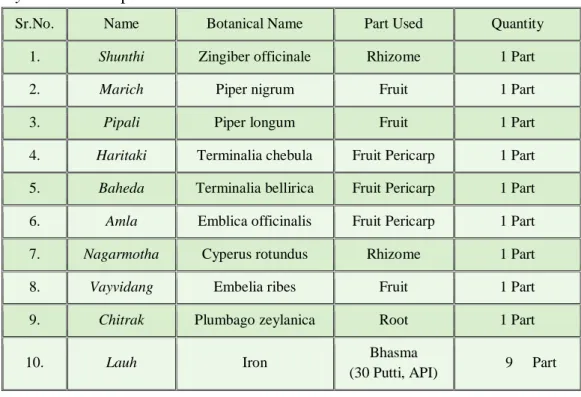
Table 12: Navayas Lauh Composition1: -
Sr.No. Name Botanical Name Part Used Quantity
1. Shunthi Zingiber officinale Rhizome 1 Part
2. Marich Piper nigrum Fruit 1 Part
3. Pipali Piper longum Fruit 1 Part
4. Haritaki Terminalia chebula Fruit Pericarp 1 Part
5. Baheda Terminalia bellirica Fruit Pericarp 1 Part
6. Amla Emblica officinalis Fruit Pericarp 1 Part
7. Nagarmotha Cyperus rotundus Rhizome 1 Part
8. Vayvidang Embelia ribes Fruit 1 Part
9. Chitrak Plumbago zeylanica Root 1 Part
10. Lauh Iron Bhasma
(30 Putti, API) 9 Part
- Navayas Lauh Pharmaceutical Preparation: -
It contains Lauh Bhasma and any formulation prepared with Lauh Bhasma requires following pharmaceutical processing of Lauh i.e.
1. Shodhan &
2. Marana (Bhasmikaran).
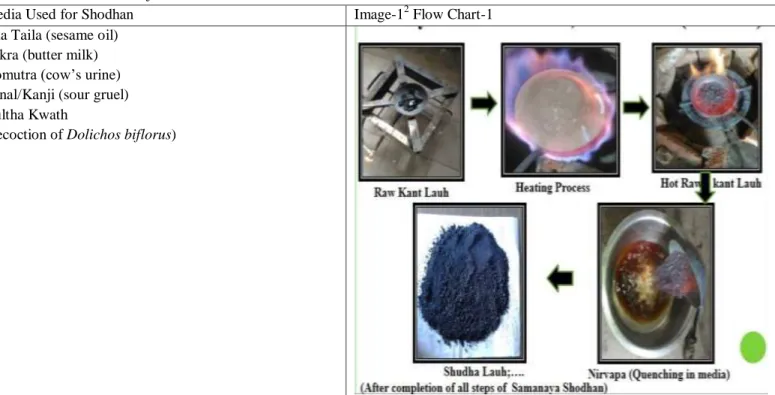
Shodhana of Lauh4 : -
Purpose of Shodhan: - Shodhan is done to make the Lauh free from dosha and to make it usable for further process of Marana.
Thakur Sudarshan K et al IJSRE Volume 06 Issue 02 February 2018 Page 7860
- Table-2: Shodhana of Lauh:
Media Used for Shodhan Image-12 Flow Chart-1 Tila Taila (sesame oil)
Takra (butter milk) Gomutra (cow’s urine) Arnal/Kanji (sour gruel) Kultha Kwath
(decoction of Dolichos biflorus)
Thakur Sudarshan K et al IJSRE Volume 06 Issue 02 February 2018 Page 7861
Image 5: - Bhasma Priksha Classical Methods: -
Other Laboratory Analysis of Lauh Bhasma: -
Tests with special reference to Lauh Bhasma(Mineral origin Content) analysis (Sophisticated Tests): -Chemical Characterization of Bhasma/Material.
EDAX (Energy dispersive Analysis of X-Ray- a Spectroscopy technique for elemental analysis)
XRD (X-Ray Diffraction) (for crystal structural interpretation & Molecule interpretation).
Particle size analysis
Tests for Heavy Metals; Hg, Cd, Pb, As up to permissible limit (Gravitational Methods or sophisticated spectroscopy like ICP MS.
FTIR (Fourier Transform Infrared Spectroscopy)
NAVAYAS LAUHA;METHOD OF PREPARATION14:-
Thakur Sudarshan K et al IJSRE Volume 06 Issue 02 February 2018 Page 7862
This powder form so recovered may be made in to tablets by Triturating with Gomutra and rolling in pills or further; it may be made in to any suitable formulation types; (Powder, Tablet, Capsule, Syrups, Granules, Avaleha after adopting proper product development protocol).
LABORATORY ANALYSIS: -
PLIM Guidelines & Standards as per Ayurvedic Pharmacopeia of India14: -
Description: - Reddish-brown powder with pungent odour and spicy, pungent taste. All pass through sieve number 44 and not less than 50 per cent pass through sieve number 85.
Identification: Microscopy:
Physico-chemical Parameters: (API Protocol & Appendices) Loss on drying at 1050C: Not more than 6 per cent, Total ash: Not more than 56 per cent,
Acid-insoluble ash: Not more than 14 per cent, Alcohol-soluble extractive: Not less than 11 per cent,
TABLE 4;RAW MATERIAL & METHOD OF PREPARATION14: NAVAYAS LAUH(IMAGES)2:
-Sr. Raw Material of Powder Material of Sr. Raw Material of Powder Material of
1.
Shunthi Shunthi
6.
Amla Amla
2.
Marich
Marich
7
Nagarmotha Nagarmotha
3.
Pipali
Pipali
8
Vayvidang Vayvidang
4.
Haritaki Haritaki
9
Chitrak Chitrak
5.
Vibhitak
Vibhitak
10
Thakur Sudarshan K et al IJSRE Volume 06 Issue 02 February 2018 Page 7863
Water-soluble extractive: Not less than 12 per cent, pH (10% aqueous solution): 3 to 4,
Assay: - Iron: Not less than 33 per cent,
Other requirements: - Microbial limit: Aflatoxins
Chromatographic methods; -Thin Layer Chromatography: It shows major spots at Rf 0.26, 0.31, 0.43 (all blue) and 0.91 (fluorescent blue)14.
Other Advanced & Sophisticated Tests: -
HPLC, HPTLC (Herbal Material fingerprinting with Quantitative Analysis of Herbal material with markers), Tests with special reference to Lauh Bhasma (Mineral origin Content) analysis (Sophisticated Tests): - Chemical Characterization of Bhasma/Material.
EDAX (Energy dispersive Analysis of X-Ray- a Spectroscopy technique for elemental analysis)
XRD X-Ray Diffraction (for crystal structural interpretation & Molecule interpretation).
Particle size analysis
Tests for Heavy Metals; Hg, Cd, Pb, As up to permissible limit (Gravitational Methods or sophisticated spectroscopy like ICP MS.
FTIR (Fourier Transform Infrared Spectroscopy)
ANAEMIA:
-Anaemia is a condition in which the number of red blood cells or their oxygen-carrying capacity is insufficient to meet physiologic needs, which vary by age, sex, altitude, smoking, and pregnancy status6. In its broadest sense, anemia is a functional inability of the blood to supply the tissue with adequate O2 for proper metabolic function. Anemia is not a disease, but rather the expression of an underlying disorder or disease. Various diseases and disorders are associated with decreased hemoglobin levels. These include6: -
Nutritional deficiencies;
Iron deficiency is thought to be the most common cause of anaemia globally, although other conditions, such as folate, vitamin B12 and vitamin A deficiencies, chronic inflammation, parasitic infections, and inherited disorders can all cause anaemia6.
External or internal blood loss
Increased destruction of RBCs
Ineffective or decreased production of RBCs
Abnormal hemoglobin synthesis
Bone marrow suppression by toxins, chemicals, or radiation
Infection
Bone marrow replacement by malignant cells Diagnosis of anemia6
1. Patient history
2. Patient physical exam
3. Signs and symptoms exhibited by the patient 4. Hematologic lab findings
Identification of the cause of anemia is important so that appropriate therapy is used to treat the anemia.
1. Patient history8
Dietary habits
Thakur Sudarshan K et al IJSRE Volume 06 Issue 02 February 2018 Page 7864 Possible exposure to chemicals and/or toxins
Description and duration of symptoms
Tiredness
Muscle fatigue and weakness
Headache and vertigo (dizziness)
Dyspnia (difficult or labored breathing) from exertion
G I problems
Overt signs of blood loss such as hematuria (blood in urine) or black stools Patient Physical examination8: -
Specific findings may help to establish the underlying cause: -
1. In vitamin B12 deficiency there may be signs of malnutrition and neurological changes. 2. In iron deficiency there may be severe pallor, a smooth tongue, and esophageal webs.
3. In hemolytic anemias there may be jaundice due to the increased levels of bilirubin from increased RBC destruction.
General findings might include
Hepato or splenomegaly
Heart abnormalities
Skin pallor
Lab investigation. A complete blood count, CBC, are required to reach the diagnosis : -
Anaemia Prevalence8: -
The most recent estimates for 2016 indicate that anaemia affects 33% of women of reproductive age globally. Children under 5 years of age in the WHO African Region represented the highest proportion of individuals affected with anaemia (62.3%).
Infant and young child with breastfeeding and complementary feeding8: -
Children under 2 years of age are one of groups that are most vulnerable to iron deficiency. Thus, appropriate feeding practices – including exclusive breastfeeding for the first 6 months of life, and optimal complementary feeding – during the first 2 years of life are crucial for avoiding the development of iron deficiency, anaemia, micronutrient deficiencies and other forms of under nutrition.
Infants with Breastfeeding8: -
Normal-birth-weight: - Normal-birth-weight (>2500 g), full-term (37 weeks’ gestation or more) infants are generally born with iron stores that are adequate for approximately the first 4–6 months of life.
Low-birth-weight infants and premature infants : -
In contrast, low-birth-weight infants and premature infants will have compromised iron stores at birth, owing to their reduced size and/or premature delivery. It is recommended that these infants receive an external source of iron (e.g. iron supplements) before 6 months of age.
Table -5: Elderly Anaemia8
Cases Type of Anaemia
1/3 Nutritional deficiencies, primarily iron (but also folate and vitamin B12) 1/3 Chronic inflammation or chronic kidney disease
1/3 ―Unexplained anaemia of the elderly‖
Thakur Sudarshan K et al IJSRE Volume 06 Issue 02 February 2018 Page 7865
Also in elderly 1/3 of total aneamia of Nutritional deficiencies, primarily iron (but also folate and vitamin B12) and another 1/3 of total that is ―Unexplained anaemia of the elderly‖ so around 67 % of anaemia in elderly is expected to respond excellently with iron supplement18.
So considering this fact, the Navayas Lauh being an iron source is justified and other constituents of Navayas Lauh may help counter other factors such as folate, vitamin B12 and vitamin A deficiencies, chronic inflammation, parasitic infections GIT disturbance etc.
Samprapti (pathogenesis from Ayurveda Point of view) (Pandu Rog): - Table-6 Flow Chart-5: -
SAMPRAPTI OF PANDU ROG AS EXPLAINDED IN CHARAK CHIKITSA STHAN 5
Lakshan Pandu5: - Karan-kshwed,
mandagani, daurbalya, shram, shwas, Bharam,
Gaurav, Aruchi, nidralu, shathivan, alpavaak, shishirdveshi,
Gaatra piditomathite-eev, shoonakshikut, shirnaloma,
Pindikodveshatan-kati-Uru-pada vedana, Shool,
Jwar,
Understanding Pandu Rog (Anaemia) Treatment: - Chikitsa Sutra Pandu : -
“Tatra pandvamayi sanigdhas-tikshannair-urdhav-anulomikai- sanshodhayo21
Sanigdha-Tikshan – Shodhan (Urdhav-anulomike)
Sharangdhar has contraindicated Vaman in Pandu rogSha. U.3/8 Later Charak while describing treatment of pandu said;
Snehairebhirupkramya –sanigdham-matva- virechyet”21; That is;
Thakur Sudarshan K et al IJSRE Volume 06 Issue 02 February 2018 Page 7866
“Pathaya-annani” i.e.
Pooraan - Shali, Yav, Godhoom
Yoosh – Mudga, arhar, Masoor
Maans Ras – Jangal
Bhaishajya- Yatha Dosh
Table -7; Flow Chart-6; Chikitsa Sutra Pandu : -
Snehana-shodhan(Vamman Virechana)-PathayAnna-Shaman-(Tikta, Sheeta, Snigdha, deepana, pachana, balya, raktavardhak, rasayan).
The primary treatment for any disease is generally, shodhan after desired poorva karma and shodhana karma is followed by shaman chikitsa. Here in Pandu roga, “Haridya sthita Sadhak pitta udirnam” is primary cause. This precipitate hridya spandana initially and in long term Hrid rog. Here in pandu for sadak pitta, Nidana Parivarjan is advised & Snehana is done. (without or mild svedana only, as there is Pitta prakop). (In pandu rog chikitsa there are many types of ghrita indicated for snehan and ghrita is also paramaushadh for pitta). Virechan is primary shodhana technique here for saadak pitta shaman. As it is at kapha sthan (hridya-urdhavjatrugata) so Vaman may first be done but not in krish Pandu rogi (Sharangdhar contraindication). Further, After sansarjan karma and with Pathaya-anna the shaman chikitsa is done. If we see w.s.r. to Navayas Lauh in Pandu Rog chikitsa; it is Pandu, Hridrog, Kushata, Arsh, Kamla Har. In Navayas Lauh all contents;Triphala, Trikatu, Trimad & Lauh all are Deepana & Pachana. Triphala is saarak, Kapha- Pitta Shamak also Rasayana. Lauh Bhasma has many properties Tikta, Sheeta Snigdha and Pandu, Hridrog, Kushata, Arsh, Kamla har13, also Kantivardhak, tridoshshamak, shreshtha rasayana, pliha, agnimandyahar13 thereby giving same properties To Navayas Lauh. Due to its Tridoshashamak and especially Sheet character, it is Primarily saadak pitta shamak here in pandu like condition, it is snigdha so varnya, tvachaya, Kantikar, balya, dhatu poshak & Ojovardhak. Sheeta and tikta guna of Lauh Bhasma and so Navayas Lauh make it more specific for pittaj Pandu roga (Paitike Tiktasheetalam17) & pittaj Pandu roga is most commonly expected due to samanya dosh sidhanta. For more than one dosha prakopa involving Pandu rog, the line of treatment varies like pandu with kamla or other conditions. Then other formulations can be used for better results like Punarnava Mandoor in Shoth yukta pandu, Darvyadi lauh (leham) for yakritapaliha involvement. In more complicated Pandu, yograj, svarnmakshikadi yog and Shilajtvadi vatak may be used. If there is vrika roga, sarvatobhadra vati with punarnava and makoya svaras may be given. Although for better results from Navayas lauh, its annupana should strictly be followed and other formulations may be added like Lohasava or Dhatryarishata.
Table-Flow Chart- Chikitsa Sutra of Pandu & Samprapti Vighatana: -
Chikitsa Sutra of Pandu & Samprapti Vighatana: -
Snehan—shodhan Vamman –Virechana -PathayAnna - Shaman (Tikta, Sheeta, Snigdha, deepana pachana, balya raktavardhak, rasayan).
The primary treatment for any disease is generally, shodhan after desired poorva karma and shodhana karma is followed by shaman chikitsa.
Here in Pandu roga, Haridya sthita Sadhak pitta udirnam is primary cause
This precipitate hridya spandana initially and in long term Hrid rog
Thakur Sudarshan K et al IJSRE Volume 06 Issue 02 February 2018 Page 7867
Snehana is done, (without or mild svedana only, as there is Pitta prakop).
(In pandu rog chikitsa there are many types of ghrita indicated for snehan and ghrita is also paramaushadh for pitta
Virechan is primary shodhana technique here for Saadak Pitta.
As it is at kapha sthan (hridya-urdhavjatrugata) so Vaman may first be done but not in krish Pandu rogi (Sharangdhar contraindication).
Further, After sansarjan karma and with Pathaya-anna
shaman chikitsa is done.
If we see w.s.r. to Navayas Lauh in Pandu Rog chikitsa; (it is Pandu, Hridrog, Kushata, Arsh, Kamla Har).
as all contents (Triphala, Trikatu, Trimad & Lauh all are Deepana & Pachana)
Triphala is sarak, Kapha- Pitta Shamak also Rasayana.
Lauh Bhasma has many properties Tikta, Sheeta Snigdha
Pandu, Hridrog, Kushata, Arsh, Kamla har13, is Kantivardhak, tridoshshamak, shreshtha rasayana, pliha, agnimandyahar13 thereby giving same properties Navayas Lauh
Due to its Tridoshashamak especially Sheet character, it is Primarily sadak pitta shamak here in pandu like condition
it is snigdha so varnya, tvachaya, Kantikar, balya, dhatu poshak & Ojovardhak
Sheeta and tikta guna of Lauh Bhasma and so Navayas Lauh make it more specific for pittaj Pandu roga (Paitike Tiktasheetalam17) & pittaj Pandu roga is most commonly expected due to samanya dosh sidhanta.
For more than one dosh prakopa involving Pandu rog, the line of treatment varies like pandu with kamla or other conditions
Then other formulations can be used for better results like Punarnava Mandoor in Shoth yukta pandu, Darvyadi loah (leham) for yakrita, Paliha involvement. In more complicated Pandu, yograj, svarnmakshikadi yog and Shilajtvadi vatak may be used. If there is vrika roga, sarvatobhadra vati with punarnava and makoya svaras may be used.
Although for better results from Navayas lauh, its annupana should strictly be followed and other formulations may be added like Lohasava or Dhatryarishata.
Modern Literature favouring Use of Navayas Lauh : -
1. WHO and National anaemia control programmers are primarily focused on iron supplements for anaemia control. Navayas Lauh also has a good Iron supplementation.
About 42% of anaemia in children would be amenable to iron supplementation and about 50% of anaemia in women could be eliminated by iron supplementation18.
Also in elderly 1/3 of total aneamia of Nutritional deficiencies, primarily iron (but also folate and vitamin B12) and another 1/3 of total that is “Unexplained anaemia of the elderly18” so around 67 % of anaemia in
Thakur Sudarshan K et al IJSRE Volume 06 Issue 02 February 2018 Page 7868
So considering Navayas Lauh an iron source is justified and other constituents of Navayas Lauh may help counter other factors such as folate, vitamin B12 and vitamin A deficiencies, chronic inflammation, parasitic infections GIT disturbance etc.
Triphala create a very good environment for iron absorption due to rich ascorbic acid9 gallic acid (GA), ellagic acid (EA) and chebulinic acid (CI) content10 as “enhancers” such as the organi acids citric, malic or ascorbic acid (i.e. vitamin C) may improve the absorption of iron Trikatu is bioavailability 11, vayavidang and Musta are anthelmintic & Vermifug12
Navayas Lauh Therapeutic uses: -
Dose:- 2 g daily in divided doses14/1-3 ratti15/1-1 masha subah-Sham18/250 mg19.
Anupana: - Honey, Water14/MadhuSarpi16 Roganisar15/Ghrita, honey, Gomutra, Chhachh18/Madhu-Ghrita19
TOOLS FOR EFFECTIVE PREVENTION AND CONTROL OF ANAEMIA: -
The main nutrients of concern for nutritional anaemia are iron, vitamin A , vitamin B12 and folate, increasing the intake of foods that are rich in these nutrients will help to meet nutrient requirements and thus prevent anaemia.
Dietary diversification through increasing consumption of vegetables, fruits and animal-source foods, and accompanying strategies to improve the bioavailability of nutrients in the diet, should always be part of strategies to prevent anaemia22, (diet and pathya-anna17 in Ayurveda).
Meat, fish and poultry are rich sources of bio-available iron. Plant sources of iron are generally less well absorbed, though including “enhancers” such as the organic acids citric, malic or ascorbic acid (i.e. vitamin C) (Amla, Triphala, etc) may improve the absorption of iron from these foods. 20
Avoiding combination of known inhibitors of non-haem iron – such as tea or coffee – with meals will improve iron absorptio20.
A combination of strategies – increasing iron-rich foods in the diet, adding “enhancers”, avoiding “inhibitors” and exploiting beneficial processing techniques – will be the best approach for improving iron status20.
Vitamin B12 is only found in animal-source foods; shellfish, beef liver, other meats, fish and poultry, as well as dairy products are rich sources of this vitamin, advise this diet20. So anupana sarpi can help more than just as vehicle.
Folate is naturally found in legumes and green leafy vegetables, whole grains and fruits and fruit juices such as oranges20, So honey, amla juice, oranges in diet and anupana is beneficial.
Fortification of food staples (e.g. wheat or corn flour, rice, salt) with one or several nutrients is a common approach, referred to as “mass” or “universal fortification”20
is advisable.
Methods of food processing – such as soaking (Bhawana dravya), fermentation (like lohasav & Dhatreyarishata) , germination (sprouting) or thermal (Paak & Putta etc.) or mechanical processing (Bhawana) – can also improve the bioavailability and absorption of iron20. So, use of Navayas lauh with gomutra or amla svaras bhawana may help a lot.
Thakur Sudarshan K et al IJSRE Volume 06 Issue 02 February 2018 Page 7869
REFERENCES:
1. Tripathi BN. Commentary on Charak Samhita, Chowkhamba Surbharti Prakashan, Varanasi,6th Edition;1999,Vol. II, Chikitsa sthan 16/70-71,pg 603
2. Sankhayan J.R., Bajaj Nisha, Navayas lauh & Pandu, PG research work documentation progress report; Jan. 2018
3. Thakur Sudarshan K. PPT, Navayas Lauh; ―Anaemia control Programme through Ayurveda‖ Jan.2018
4. Kulkarni DA, Rasratan Samuchaya;Part 1, 5/13, 136-139, Mehar Chand Lachhaman Dass Publications, New Delhi; Reprint;1998. Pg 93,103
5. Tripathi BN. Commentary on Charak Samhita, Chowkhamba Surbharti Prakashan, Varanasi,6th Edition;1999,Vol. II, Chikitsa sthan 16/4-16,pg 591-592
6. World Health Organization; [Home page on internet].2018. (cited on 2018 Feb14) Available from: http://www.who.int/topics/anaemia/en/
7. Kulkarni DA, Rasratan Samuchaya;Part 1, 5/13, 125, Mehar Chand Lachhaman Dass Publications, New Delhi; Reprint;1998. Pg 116
8. Nutritional Anaemias; Tools for Effective Prevention and Control, ISBN 978-92-4-151306-7, World Health Organization 2017.pg. 6
9. Chauhan NS. Medicinal and Aromatic Plants of Himachal Pradesh; Indus Publishing Company, New Delhi, second edition; 2006, page 201
10.Pawar, et al.: RP-HPLC, Triphala Curna and Test Variations, Development of a RP-HPLC Method for Analysis of Triphala Curna and its Applicability to Test Variations in Triphala Curna Preparations, Indian J Pharm Sci. 2009 Jul-Aug; 71(4): 382–386.
11.Ghanshyam B. Dudhatra, Shailesh K.Mody,Madhavi M. Awale, Hitesh B. Patel, Chirag M.Modi, Avinash Kumar, Divyesh R. Kamani, And Bhavesh N. Chauhan. A Comprehensive Review On Pharmacotherapeutics of Herbal Bioenhancers. The Scientificworld Journal 2012: 33
12.Nadkarni AK. Indian Materia Medica. 3rd ed. Mumbai: Popular Press; 1976. Pg 479,428.
13.Kulkarni DA, Rasratan Samuchaya;Part 1, 5/136-139, Mehar Chand Lachhaman Dass Publications, New Delhi; Reprint;1998. Pg 120
14.Government of India, MOH&FW, Ayurvedic Pharmacopeia of India,Part II, Vol. I, The Controller of Publications, New Delhi, 1st Edition, pg 51
15.Ras Tantra Saar & Sidha Prayog Sangra; Part 1, Krishana Gopal Ayurveda Bhawan, Kaleda, Pg 418 16.Tripathi BN. Commentary on Charak Samhita, Chowkhamba Surbharti Prakashan, Varanasi,6th
Edition;1999,Vol. II, Chikitsa sthan 16/4-6,pg 603
17.Tripathi BN. Commentary on Charak Samhita, Chowkhamba Surbharti Prakashan, Varanasi,6th Edition;1999,Vol. II, Chikitsa sthan 16/4-6/116,pg 597/610
18.WHO. The global prevalence of anaemia in 2011. Geneva: World Health Organization; 2015.
19.Government of India, MOH&FW, Ayurvedic Formulary of India, The Controller of Publications, New Delhi, 1st Edition, Pat 2, pg 303
20.Nutritional Anaemias; tools for effective prevention and control, ISBN 978-92-4-151306-7, World Health Organization 2017
21.Tripathi BN. Commentary on Charak Samhita, Chowkhamba Surbharti Prakashan, Varanasi, 6th Edition;1999,Vol. II, Chikitsa sthan 16/40,55, pg 597, 600
22.WHO GUIDELINE: USE OF MULTIPLE MICRONUTRIENT POWDERS FOR POINT-OF-USE
FORTIFICATION OF FOODS CONSUMED BY INFANTS AND YOUNG CHILDREN AGED 6– 23 MONTHS AND CHILDREN AGED 2–12 YEARS