Vol. 4, N 1, Special Issue, 2016, pp. 161170
UDC (811.111‟232:(159.953.3+004.738.4)) (535)
STUDENT REFLECTIONS ON COMPUTER-ASSISTED
LEARNING WITH SPECIAL REFERENCE TO THEIR
COURSE BOOKS
Umamaheswara Rao Bontha
Dhofar University, Oman
Phone: +968 93565617, E-Mail: [email protected]
Abstract. Computer-Assisted English Language Learning (CAELL) is an integral part of language education in Oman. It is viewed as a powerful way of learning a language and a tool for improving learning and teaching experiences. The Foundation Program (FP) at Dhofar University (DU) offers English language courses that use technology such as computers, the internet, and projectors. The FP has introduced the new Unlock Series of books that support CAELL across the three levels of the English Language Unit. The present paper focuses on learners’ reflections on CAELL with a special focus on the new Unlock Series course books. It was found that both the students and teachers have positive perceptions toward CAELL and the use of the new Unlock Series of books.
Key words: Computer-Assisted English Language Learning, critical thinking, perceptions, Oman
1. INTRODUCTION
English language teaching has seen tremendous changes in terms of methodology and technology. The implementation of technology in classrooms is a debatable issue. Some view technology as a threat as they believe that technology might replace language instructors. Others feel that technology assists in learning a language effectively. The advent of computers has revolutionized the way English language is taught. Computer technology has had many positive and some negative aspects in teaching English as a Second or Foreign Language. Kern (1995) views that Computer Assisted Language Learning (CALL), especially in second language learning, supports individualized instruction by “offering the student the freedom to choose topics, to repeat input, to increase or decrease task difficulty, and to get help whenever it is needed (p. 457). In other words, computers cater to the individual needs of the learners by providing them an opportunity to study at their own pace and time.
1.1. Computers in language teaching and learning
Language learning has been enriched through the introduction of computers into language teaching and learning. The increasing use of both computers and the internet in adult English language classrooms has widespread repercussions for English language
Submitted February 20
programs (Coryell & Chlup, 2007). They have opened avenues to language learners to access abundant materials and programs that support and assist language learning. The ability to offer students the option of self-directed learning and to connect learning to valuable work skills and personal use has led many adult education programs to incorporate computers in their curriculum (Dillon-Marable & Valentine, 2006). This has led to learner independence where the learner can learn at his/her own time and pace. Nunan (1988) states: “no curriculum can claim to be truly learner-centered unless the learner‟s subjective needs and perceptions relating to the process of learning are taken into account” (p. 177). Therefore, computers and the internet can be used in the language classrooms as they offer adequate opportunities to fulfill the personal needs and expectations of the learners by providing learner autonomy to some extent.
1.2. Computer Assisted English Language Learning (CAELL)
Computer assisted English language teaching and learning has become one of the effective ways of teaching and learning English in an ESL/EFL context. Until the 1980s the success of computer assisted learning was attributed to its capacity to individualize instruction (Säljö, 1994). There are three phases in CALL: behavioristic, communicative and interactive. The initial computer software was designed on “the behaviorist principle that learning is best achieved by an individual practicing tasks in a repetitive manner until mastery is achieved” (Loughlin & Oliver, 1998, p. 126). According to this principle, the computer is viewed as a teacher, providing instant feedback and further practice. The tasks based on the computers can be the fillers in the classroom time where considerable amounts of time spent by the teacher on drilling and practicing can be reduced. However, this variety of software “is limited in terms of engaging students in higher level cognitive processes such as comprehension, hypothesis formation and reflection” (Loughlin & Oliver, 1998, p. 126), as the focus is only on drill and practice. These tasks “also limit educational goals to the attainment of lower order skills such as remembering, reciting or producing isolated segments of information” (Loughlin & Oliver, 1998, p. 126).
In the 1980s communicative CALL appeared. This was the period when the behavioristic approach to language teaching was rejected. Personal computers provided opportunities for the individuals to work alone. Gündüz (2006) states: “Communicative CALL corresponded to cognitive theories which stressed that learning was a process of discovery, expression and development” (p.193). Communicative CALL was in line with the precepts of the popular Communicative Language Teaching. Gündüz (2006) elucidates: “In communicative CALL, the focus was not so much on what students did with the computer, but rather what they did with each other while working at the computer” (p.193).
1.3. Unlock series from Cambridge University Press
Unlock has four series (books 1, 2, 3 and 4). Each book has two modules – reading & writing and listening & speaking. All the skills are integrated and the themes are the same. The books focus on language skills and the development of knowledge. The reading & writing book starts with reading and leads to writing. Similarly, the listening and speaking book starts with listening and leads to speaking. Both books have videos and tasks related to critical thinking skills. Teachers are provided with software named Presentation Plus that has all the multimedia features that make learning interesting. There is also an online workbook that provides additional practice tasks in all the four language skills.
1.4. Critical thinking
2. STUDY
2.1. The purpose of the study
The purpose of this paper is to explore the perceptions of teachers and students about CALL. It attempts to show the following in particular:
1. The perceptions of students and teachers about CALL.
2. The perceptions of students and teachers on the new Unlock Series of books published by Cambridge University Press at level 2 at Foundation Program (FP) in Dhofar University.
2.2. Research tool and method
The questionnaires were designed on a 5 point Likert Scale, wherein 1corresponded to „strongly agree‟ and 5 to „strongly disagree‟, with scale 3 corresponding to „neutral‟, in order to have a comprehensive idea of the perceptions of students and teachers.
A Likert Scale was selected as it was thought that perceptions could best be recorded and analyzed by using it. The questionnaires were developed by the researcher and circulated to the senior teachers for comment. They were further reviewed based on their feedback and recommendations. One hundred students and twenty teachers of level 2 were selected for the study. Teachers involved in the study include teachers from non-native and native English speaking countries. The questionnaires were administered randomly. For the final analysis, the five variables on the Likert Scale were merged into three categories: Agree, Disagree, and Neutral, and the findings were tabulated accordingly.
2.3. Findings
The items on the questionnaires required teachers and students to express their perceptions on CALL and the use of new Unlock Series of books that are based on CALL. The responses of both of them showed that they are positive toward the use of CALL in the English language classrooms. They were also convinced that the new Unlock Series of books by the Cambridge University Press are helpful in facilitating effective learning. They found the books useful. In order to present the perceptions of each category clearly, the findings are presented below. It is quite interesting to know that both teachers and students had positive opinions toward the use of CALL and books related to CALL in the English language learning.
3. DISCUSSION
3.1. Perceptions of students and teachers about computers and internet use in classrooms
society and in the classroom, have transformed from a tool for information processing and display to a tool for information processing and communication (Sperling, 1998). When asked if they would like to learn more about using computers for learning and teaching English, 86.25% of students and 90% of teachers responded positively. Both the students (75%) and the teachers (80%) said that they used computers in doing homework and teaching respectively. Seventy per cent of teachers reported that they encouraged their students to use computers to learn English. The statement “I feel that every educational institution should provide accessibility to computers to their students” received 83.75% of positive response from the students. The perceptions of both students and teachers on using computers in English language classrooms are quite positive.
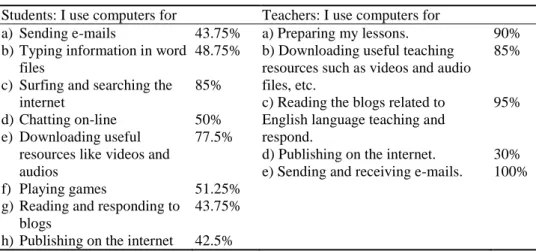
When asked the purposes for which they used computers, the responses of the students and the teachers were as below.
Table 1 Responses of the students and the teachers
Students: I use computers for Teachers: I use computers for a) Sending e-mails
b)Typing information in word files
c) Surfing and searching the internet
d)Chatting on-line e) Downloading useful
resources like videos and audios
f) Playing games
g) Reading and responding to blogs
h) Publishing on the internet
43.75% 48.75%
85%
50% 77.5%
51.25% 43.75%
42.5%
a) Preparing my lessons. b) Downloading useful teaching resources such as videos and audio files, etc.
c) Reading the blogs related to English language teaching and respond.
d) Publishing on the internet. e) Sending and receiving e-mails.
90% 85%
95%
30% 100%
As high as 85% of students said that they used computers for surfing and searching the internet. Similarly, 77.5% of students and 90% of teachers expressed that they used computers for downloading useful resources like videos and audios. Publishing on the internet was the least rated purpose of using a computer with only 42.5% of students and 30% of teachers.
3.2. Perceptions of students and teachers about new Unlock Series of books and the presentation plus software
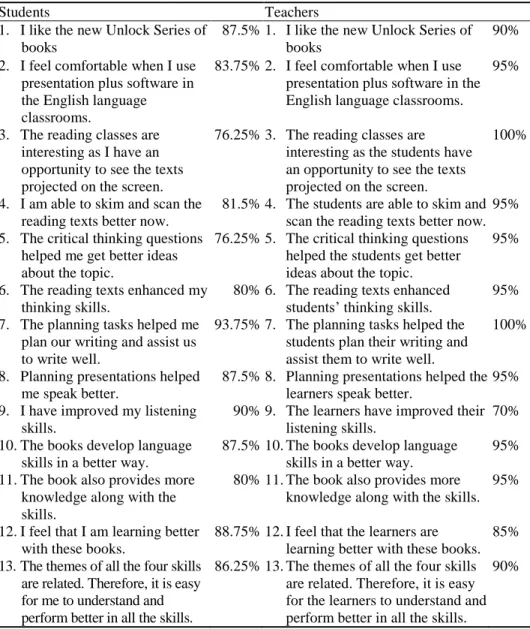
The second purpose of the present study is to find out the perceptions of teachers and students on the use of new Unlock Series of books published by Cambridge University Press at level 2 at Foundation Program (FP) in Dhofar University.
Table 2 Responses of students and teachers on the use of new Unlock Series of books by CUP
Students Teachers
1. I like the new Unlock Series of books
87.5% 1. I like the new Unlock Series of books
90%
2. I feel comfortable when I use presentation plus software in the English language classrooms.
83.75% 2. I feel comfortable when I use presentation plus software in the English language classrooms.
95%
3. The reading classes are interesting as I have an opportunity to see the texts projected on the screen.
76.25% 3. The reading classes are interesting as the students have an opportunity to see the texts projected on the screen.
100%
4. I am able to skim and scan the reading texts better now.
81.5% 4. The students are able to skim and scan the reading texts better now.
95%
5. The critical thinking questions helped me get better ideas about the topic.
76.25% 5. The critical thinking questions helped the students get better ideas about the topic.
95%
6. The reading texts enhanced my thinking skills.
80% 6. The reading texts enhanced students‟ thinking skills.
95%
7. The planning tasks helped me plan our writing and assist us to write well.
93.75% 7. The planning tasks helped the students plan their writing and assist them to write well.
100%
8. Planning presentations helped me speak better.
87.5% 8. Planning presentations helped the learners speak better.
95%
9. I have improved my listening skills.
90% 9. The learners have improved their listening skills.
70%
10. The books develop language skills in a better way.
87.5% 10. The books develop language skills in a better way.
95%
11. The book also provides more knowledge along with the skills.
80% 11. The book also provides more knowledge along with the skills.
95%
12. I feel that I am learning better with these books.
88.75% 12. I feel that the learners are learning better with these books.
85%
13. The themes of all the four skills are related. Therefore, it is easy for me to understand and perform better in all the skills.
86.25% 13. The themes of all the four skills are related. Therefore, it is easy for the learners to understand and perform better in all the skills.
90%
The statement “I like the new Unlock Series of books” received 87.5% of students‟ and 90% of teachers‟ acceptance. They (83.75% of students and 95% of teachers) are comfortable with the presentation plus software supplied by the Cambridge University Press (CUP). They also felt that the themes of the lessons were easy to understand and the videos had been instrumental in making the skills easier.
Then, 81.5% of students and 95% of teachers felt that students were able to skim and scan better with this software being used in classes.
Critical thinking is one of the main aspects of these Unlock Series books. A majority of the students supported the idea that the critical thinking section in the books helped learners generate ideas about the topics (76.25% of students and 95% of teachers). Eighty per cent of the students and 95% of the teachers felt that the reading texts enhanced the thinking skills of the learners.
The planning tasks using various brainstorming exercises helped the learners plan their writing and write well as 93.75% of students and 100% of teachers agreed with it. Gündüz, (2006: p 205) states: “The writing process is another area where computers have added a great deal of value. Some programs help students in the pre-writing stage to generate and outline ideas”. Similarly, 87.5% of the students and 95% of teachers felt that planning presentations helped the learners to make oral presentations in the class. Computers have a useful contribution to the development of oral skills if they are used wisely (Hammersmith, 1998).
Regarding listening skills, 90% of the students felt their listening skills improved, however, only 70% of the teachers felt the same. This shows that the learners were more engaged in listening activities provided in the books.
Both students (87.5%) and teachers (95%) agreed that the books develop language skills in a better way. According to Higgins (1995), the value of CALL is that it allows a richer form of language exploration and play than has ever been possible before. Computers are compatible with various approaches, methods and techniques of teaching a foreign language. As noted previously, the books develop knowledge in addition to language skills. This was reiterated by students and teachers as 80% of the students and 95% of the students felt that the books develop knowledge along with the language skills. Knowledge development is an important aspect for these learners as they lack enough background knowledge of the topics and they, eventually, end up struggling to deal with many simple topics in speaking and writing. There was 88.75% of students and 85% of the teachers who believed that the learners were performing better with these books. One of the reasons could be the thematic integration of skills as 86.25% of the students and 90% of the teachers felt that the themes of all the four skills are related and that it was easy for the learners to understand and perform better in all of them.
4. CONCLUSION
that the reading classes were interesting as the students had the opportunity to view the reading texts projected on the screen. They also believed that the reading texts were helpful in coping with the writing tasks at the end of each unit of the Unlock Series of books. There are many positive aspects of CAELL and the use of books/materials that support CAELL has been reported in this paper. However, Jones and Fortescue (1987) warn that the computer is a resource and not a programmed-learning machine. Therefore, teachers cannot be substituted with computers and teachers should not think that the mere use of computer software facilitates language teaching and learning automatically. Therefore, teachers should view CAELL only as a tool to make language teaching interesting and productive.
5. LIMITATIONS AND SUGGESTIONS
This study was limited to level 2 students and teachers at FP of Dhofar University. The same study could be conducted at other levels and in other colleges and language centers across the Sultanate in order to find out the views of the wider community of teachers and students. It suggests a need for a coming together of ELT practitioners across the Sultanate so that the efficacy of CAELL can be tapped and exploited in English language classrooms to reach the intended learning outcomes as prescribed by Oman‟s Academic Standards of the General Foundation Programs.
REFERENCES
Brown, H. D. (2004). Some practical thoughts about students- sensitive critical pedagogy. The Language Teacher, 28(7), 23-27.
Collier, K., Guenther, T., & Veerman, C. (2002). Developing Critical Thinking Skills Through a Variety of Instructional Strategies. An Action Research Project submitted to the Graduate Faculty of the School of Education as a Requirement of the Degree of Masters of Arts in Teaching and Leadership. Saint-Xavier University. Chicago, Illinois.
Coryell, J. E., & Chlup, D. T. (2007). Implementing E-learning components with adult English language learners: Vital factors and lessons learned. Computer Assisted Language Learning, 20(3), 263-278.
Dillon-Marable, E., & Valentine, T. (2006). Optimizing computer technology integration. Adult Basic Education, 16(2), 99-117.
Elder, L., & Paul, R. (1994). Critical thinking: Why we must transform our teaching. Journal of Developmental Education, 18(1), 34-35.
Gündüz, N. (2006, October). Computer Assisted Language Learning (CALL). Journal of Language and Linguistic Studies, 1(2), 193 - 214.
Halpern, D. F. (1996). Thought and knowledge: An introduction to critical thinking (3 ed.). Mahwah, NJ: Erlbaum.
Hammersmith, L. (1998). Easy internet activities for the ESL teacher. University of Illinois. Retrieved May 23, 2015 from www.eslplanet.com.
Higgins, J. (1995). Computers and English language learning. London: Intellect Ltd. Jones, C., & Fortescue, S. (1988). Using computers in the language classroom. New York:
Lipman, M. (2003). Thinking in education. West Nyack, NY, USA: Cambridge University Press.
Loughlin, C., & Oliver, R. (1998). Maximizing the language and learning link in computer learning environments. British Journal of Educational Technology, 29(2), 125-136. Nunan, D. (1998). The learner-centered curriculum. Cambridge: Cambridge: Cambridge
University Press.
Paul, R. W. (1993). Critical thinking: Fundamental to education for a free society. In J. Willsen, & A. J. Binker, Critical thinking: What every person needs to survive in a rapidly changing world (3 ed.). Santa Rosa, CA: Foundation for Critical Thinking.
Säljö, R. (1994). Adult practices and children‟s learning: Communication and the appropriation of cultural tools. European Journal of Psychology of Education, 9(2), 87-91. Sperling, D. (1988). Internet guide. New Jersey: Prentice Hall Regents.
Taylor, C. (2001). „It‟s the real thing‟ Using ads to promote critical thinking in the EFL classrooms. News In Brief. The Quarterly Newsletter of INGED,10-12.
Thadphoothon, J. (2002). Enhancing critical thinking in language learning through computer-mediated collaborative learning: A preliminary investigation. Proceedings of the International Conference on Computers in Education.
Uden, L., & Beaumont, C. (2006). Technology and Problem-Based Learning. London: Information Science Publishing.
APPENDIX 1
TEACHERS‟ QUESTIONNAIRE WITH RESULTS
(A = Percentage of agreement N = Neutral D = Percentage of disagreement)
Computer-Assisted English Language Learning
No Name A N D
1. I use computers to teach English language. 85 10 5 2. I enjoy teaching English with the help of technology such as
computers.
85 15
3. University provides computers in the classrooms. 90 5 5 4. I have access to the internet on campus and especially in the
classrooms.
85 10 5
5. I love to learn more about using computers for teaching English. 90 10
6. I use internet in the classroom. 80 10 10
7. I encourage students to use computers to learn English. 70 25 5
Tick the boxes
8. I use computer for %
a) preparing my lessons. 90
b) downloading useful teaching resources such as videos and audios etc. 85 c) reading the blogs related to English language teaching and respond. 95
d) publishing on the internet. 30
Unlock Series
No Name A N D
1 I like the unlock books. 90 10 0
2 I feel comfortable when I use presentation plus software in the English language classrooms.
95 5 0
3 The themes of the lessons are interesting and easy to understand. 90 10 0 4 The videos in the books help learners understand the topics and
prepare them for reading or listening.
95 5 0
5 The learners understand vocabulary better through videos. 90 10 0 6. The reading classes are interesting as they have an opportunity to
see the texts projected on the screen.
100 0 0
7. They are able to skim and scan the reading texts better now. 95 5 0 8. The critical thinking questions help them get better ideas about the
topic.
95 0 5
9. The reading texts enhance their thinking skills. 95 5 0 10. Reading 2 provides a good model of writing. 100 0 0 11. The writing tasks in the book help them write better. 95 5 0 12. The planning tasks help them plan their writing and assist them to
write well.
100 0 0
13. Listening audios are very clear. 80 15 5
14. The learners have improved their listening skills. 75 20 5
15. Speaking lessons are interesting. 80 10 10
16. Planning presentations help the learners speak better. 90 10 0 17. The books develop language skills in a better way. 90 5 5 18. The book also provides more knowledge along with the skills. 95 5 0 19. I feel that the learners are learning better with these books. 85 15 0 20. The themes of all the four skills are related. Therefore, it is easy for
the learners to understand and perform better in all the skills.