• No results found

CAS: A Comparison of Resampling Methods for Bootstrapping Triangle GLMs

N/A
N/A
Protected

Academic year: 2020

Share "CAS: A Comparison of Resampling Methods for Bootstrapping Triangle GLMs"

Copied!
14
0
0

Loading.... (view fulltext now)

Full text

(1)

for Bootstrapping Triangle GLMs

by Thomas Hartl

ABSTRACT

Bootstrapping is often employed for quantifying the inherent vari­

ability of development triangle GLMs. While easy to implement,

bootstrapping approaches frequently break down when dealing

with actual data sets. Often this happens because linear rescaling

leads to negative values in the resampled incremental develop­

ment data. We introduce two computationally efficient methods

for avoiding this pitfall: split­linear rescaling and parametric

resampling using a limited Pareto distribution. After describ­

ing the essential mathematical properties of the techniques, we

present a performance comparison based on a VBA for Excel

bootstrapping application. The VBA application is available on

request from the author.

KEYWORDS

(2)

scaling of Pearson residuals. In Section 2 we describe basic mathematical properties of split­linear rescal­ ing, and sampling from a limited and shifted Pareto distribution. Proofs of some key formulas from this section are given in Appendix A. Section 3 is more technical in nature and can be skipped on a first reading, but it does contain information of inter­ est to readers who want to implement the proposed methods themselves. The algorithms and memory requirements needed for linear rescaling, split­ linear rescaling, and sampling from a limited and shifted Pareto distribution are discussed. We pre­ sent performance comparisons based on a VBA for Excel implementation, and thus demonstrate that the new methods are computationally as efficient as linear rescaling. The VBA application is avail­ able from the author on request. Conclusions are discussed in Section 4.

2. Two schemes for generating

pseudo data

Before delving into the mathematical properties of the proposed methods, we briefly review resampling for bootstrapping purposes and introduce the nota­ tion used in this paper.

2.1. Resampling basics

Bootstrapping is a Monte Carlo simulation tech­ nique that is employed to approximate the sampling distribution of a quantity that is estimated from a data sample. To do so, one repeatedly generates pseudo data and re­estimates the quantity in question.

The key idea of non­parametric bootstrapping is to sample the standardized observed residuals rela­ tive to the stochastic model that is assumed to gen­ erate the original data. The sampled standardized observed residuals are then used to generate the pseudo data. As pointed out in Davison and Hinkley (1997), due to the non­unique definition of residuals for GLMs, there are multiple non­parametric resid­ ual resampling methods. We also observe that the various residual standardization schemes typically

1. Introduction

Several authors have described the use of boot­ strapping in the context of GLM­based stochastic reserving models for property and casualty loss development triangles; e.g., England and Verrall (2002), Pinheiro, Silva and Centeno (2003), and Hartl (2013). A more general textbook treatment of the bootstrapping procedure for GLMs can be found in Davison and Hinkley (1997, Section 7.2). While alternative approaches are mentioned, practical examples that are based on linear rescaling of Pearson residuals are often presented. This approach has the appeal of straightforward mathematics: all you need is one addition and one multiplication. As a result, it can be implemented with relative ease in a spreadsheet.

For real data, however, the linear rescaling of Pearson residuals often leads to negative values in the resampling distribution for smaller data values, thus violating the model assumptions of the GLM we started with. In other words, the bootstrapping procedure fails. Both the details of this breakdown and the alternative method of deviance residual resampling are discussed in Hartl (2010). Other authors, e.g., Gluck and Venter (2009), employ para­ metric resampling and thus sidestep the problem. While parametric resampling circumvents the issue of negative values in the resampling distribution, there is an increased computational cost because generating pseudo­random variates from typical exponential family distributions requires the evalua­ tion of logs, exponentials or even more computation­ ally intensive functions. As mentioned above, linear rescaling of Pearson residuals, by contrast, only requires one addition and one multiplication.

(3)

For residual­based bootstrapping, we need a set of standardized residuals, which we denote bys. To avoid bias as a result of the resampling process, we require the mean of s to be exactly zero. This is in addition to the usual requirement that the variance ofs equals one. It is useful to think of a standardized residual as a function of an original data value and the fitted value predicted by the GLM

s=H yyˆ

( )

. (2.1) The function H( ) depends on the definition of residual and the standardization procedure employed. This is discussed in detail in McCullagh and Nelder (1989), Davison and Hinkley (1997), or Pinheiro, Silva, and Centeno (2003). For residual­based boot­ strapping, obtaining a pseudo datum (a.k.a. resam­ pled data value) is a two­step process: we randomly sample from the standardized residuals, and then solve the following equation fory*

s H yy

( )

( )=

Rnd ˆ * .

Note that the function Rnd(s) denotes the operation of randomly sampling from the set of standardized residuals. We summarize the resampling procedure for an individual data point as

y*=Hy−ˆ1(Rnd( )s ). (2.2) For a concrete example, we consider Pearson resid­ ual resampling for an over dispersed Poisson model. In this case equation (2.2) becomes

i

* ˆ ˆ Rnd s , (2.3)

y = + φy y ( )

where is the dispersion factor. From this equa­ tion, one can easily see how a negative standardized residual and sufficiently small values of will lead to negative resampling values. This breakdown is frequently encountered when using Pearson residu­ als for bootstrapping triangle GLMs. A more detailed discussion and examples of this can be found in Hartl (2010). As noted in subsection 2.1, non­parametric residual resampling relies on the assumption that standardized residuals are “approximately” iid. When fail to strictly standardize the residuals.1 To proceed

with the bootstrap we therefore we must consider the iid assumption for the standardized residuals as being “approximately” true.

How these ideas are applied to GLM­based sto­ chastic reserving is described in England and Verrall (2002) and Pinheiro, Silva, and Centeno (2003). An alternative to non­parametric bootstrapping is parametric resampling, where the pseudo data are generated by sampling from an assumed parametric distribution. One version of this approach is used in Gluck and Venter (2009). In either case, pseudo data are repeatedly generated and the model is refit­ ted to the pseudo data. In this way, one generates a Monte Carlo sample of the distribution of fitted parameters or other derived quantities, such as the projected reserve.

2.2. Notation

In the context of our discussion we will have to refer both to individual values and to collections of similar values. To do so we follow the convention thatboldface symbols refer to vector quantities while non­boldface symbols refer to scalar quantities. For example, the symbol y refers to a generic element ofy. Where we do need to distinguish between dif­ ferent elements ofy, we will employ subscripts such asyi andyj.

More specifically,yrefers to the vector of original data. The hat symbol, as in or, indicates that we are talking about fitted values. The asterisk symbol, finally, is used to refer to a full set of pseudo data,y*, or an individual pseudo datum,y*.

(4)

values are “expanded.” The proof that transformation (2.4) preserves the mean is left as an easy exercise for the reader. Figure 1 graphically represents the impact of different values ofc on a set of data points with values of 4.5, 6.5, and 13 and a mean of 8.

If z2 denotes the variance of z, it is also easy to

show that

c

z z

σ = σ2′ 2 2. (2.5)

So we can see that if we “squeeze” a set of val­ ues, we will reduce the variance. Conversely, if we expand the values, we will increase the variance. For split­linear rescaling, however, we apply transforma­ tion (2.4) to two disjoint subsets of the original data set, so we need to consider the impact on the overall variance resulting from the transformation on each subset.

To be specific, let us assume that the original resampling distribution,y*, has m data values and mean . Let us furthermore assume that we have par­ titionedy* into two subsets,y*l andy*u, withq andr

data values, respectively. The corresponding means are l and u. For convenience we will assume that the values in the lower subset are less than the val­ ues in the upper subset. Furthermore, we can assume without loss of generality that the original data set and both subsets are indexed in ascending order. In particular, the first element of each subset can be assumed to be the smallest element. The split­linear transformation can be summarized by the following equation,

y y

l

y c y y

c y y

l l l

u u u u

(

)

(

)

′ = µ + − µ ∈

µ + − µ ∈ ′

   

* * , if * *

* , if * * , (2.6)

wherecl andcu, are the scaling factors for the lower and upper subset. Since transformation (2.4) preserves the mean of each subset, the overall mean is also pre­ served. In A.1 we show that the variance of the trans­ formed resampling distribution can be expressed as

m

q qc

r rc

y

l l y

u u y

l

u

(

)

(

)

σ = µ − µ + σ

+ µ − µ + σ

 

 

′ 1 . (2.7)

* 2

2 2 2

2 2 2

the described breakdown of linear Pearson residual rescaling occurs, we can interpret this as saying that this approximation is not good enough for this data set, prompting one to look for alternatives.

2.3. Split-linear rescaling

Our goal is to avoid the breakdown of the resam­ pling scheme that results from zero or negative pseudo data being generated. To this end we introduce a new parameter, min, that defines the smallest allowable pseudo data values as a percentage of the expected mean. Conceptually this could be different for each data point, but we use a ratio that is uniformly applied to all data points. One might argue that just requiring the pseudo data to be positive is sufficient, and that introducing min is overly restrictive. At the same time, since we are dealing with finite precision computer­ based simulations, we may get into numerical trouble if we get too close to zero. Practitioners who want to explore what happens at the limits are welcome to choose very small values for min.

The intuitive idea behind split­linear rescaling is as follows: if the standard Pearson residual rescaling pro­ cedure results in resampling values that are below min times the expected mean value, we split the standard Pearson residual resampling values into a lower set and an upper set. Next we “squeeze” the lower resampling values together, so that they no longer dip below min times the expected mean value. The “squeezing” operation does preserve the mean, but it will lower the variance of the resampling distribution. To off­ set this, we apply a mean preserving “expansion” operation to the upper resampling values.

We proceed by defining what we mean by “squeez­ ing” and “expanding.” Given any set of values, z, with mean , we can obtain a new set of values,z, that has the same mean. This is accomplished by applying the following linear transformation to each elementz ofz

z′ = µ +c z

(

− µ

)

, (2.4)

where the scaling factor,c, is a positive constant. If

(5)

Step 1 Find a suitable partition of y* such that

l min .

Step 2 Calculate clusing the following formula

c

y

l l

l l

= µ − π µ

µ − 1 .

min

Step 3 Calculate cuaccording to

c c q

r

u l y

y l

u

(

)

= + − σ

σ

1 1 2 2* .

* 2 In practice we proceed by finding a suitable parti­

tion ofy* and a value ofcl such that we satisfy the condition that no value ofy* drops below min . To get a variance preserving split­linear transformation we then set the right­hand side of equation (2.7) equal to the variance ofy*and solve the resulting equation forcu. We summarize the general procedure for split­ linear rescaling as follows.

Step 0 Generate y* using Pearson residual rescal-ing. If y1* min , usey*there is no need to use split-linear rescaling.

c=1.6

2 3 4 5 6 7 8 9 10 11 12 13 14 15 16

2 3 4 5 6 7 8 9 10 11 12 13 14 15 16

2 3 4 5 6 7 8 9 10 11 12 13 14 15 16

2 3 4 5 6 7 8 9 10 11 12 13 14 15 16

c=1.4 c=0.5 c=0.6

(6)

2.4. Sampling from a limited

and shifted Pareto distribution

We briefly discuss the justification for the method, before presenting the mathematical properties of the distribution.

2.4.1. Rationale for parametric resampling

The original idea of bootstrapping is that that the residuals can be interpreted as a sample from the error distribution, and that we can therefore use it to approx­ imate the error distribution itself. In the context of development triangle GLMs, where we only have one data point for each combination of covariate levels, this assumption may be a little shaky. To see why bootstrap­ ping seems to work anyway, we note that from a pseudo likelihood perspective (see chapter 9 in McCullagh and Nelder 1989), the fitted values of the GLM only depend on the assumed relationship between the fitted means and the corresponding expected variances. I.e., the spe­ cific shape of the error distribution beyond the second moment assumption does not affect the fitted param­ eter values, and we are dealing with a semi­parametric model for the data. The residual rescaling procedure ensures that for each data point we sample from a dis­ tribution with the correct mean­variance relationship. Viewed this way, residual bootstrapping is just one way to run a Monte Carlo simulation to determine the shape of the sampling distribution of the model parameters.

Unless we strongly believe that the observed residuals contain good information about the error structure (beyond a way of estimating the dispersion parameter), it seems equally valid to perform the Monte Carlo simulation using another resampling dis­ tribution that satisfies the mean­variance relationship, and is thus consistent with the semi­parametric model assumption for the data that the original model fit is based on. A more detailed discussion of the case for parametric resampling in the context of development triangle GLMs can be found on pages 16 and 17 of Hartl (2010). In this subsection we present one such resampling scheme that is efficient from a computa­ tional point of view and works well for small fitted values and large dispersion factors.

Step 4 Generatey* by applying transformation (2.6) y

y

l

u

y c y y

c y y

l l l

u u u

(

)

(

)

′ = µ + − µ ∈

µ + − µ ∈

   

* * , if * *

* , if * *. (2.8)

Proofs for the formulas given in equation (2.8) can be found in A.2 and A.3. The condition in Step 1 that l min is necessary because the smallest value in the lower set,y*, gets “squeezed” towards1 l, so the trans­ formed valuey1* can only reach min if l min .

We also observe that for Step 1 there can be more than one of partition of y* such that l min . So, which one should we choose? One strategy might be to simply take the first one that comes along, with the smallest number of elements iny*l. The strategy we are employing is to find the partition that makes

cu2 1 as close to 1c

l

2 as possible, by minimizing

the absolute difference between q y2*l andr y*u

2 . This

heuristic decision is motivated by a notion that the adjustment should be as evenly spread over the entire distribution as possible, rather than just “bunching” values in the left tail. Trackingq y2*l andr y*u

2 proved

to be convenient because they can be updated recur­ sively as we move values from the upper set to the lower set, and the optimal partition can be determined without testing all possible partitions.

Finally, we note that there are two situations in which the split­linear rescaling procedure does not work: breakdowns may occur during Step 3 or during Step 4. For Step 3 the breakdown happens if y2*u = 0. This means that all the values inyu* are the same (including

the degenerate case where there are no values iny*u).

In this case we cannot expand the upper subset. Pass­ ing the y2*u 0 hurdle, however, still leaves open the possibility that the procedure breaks down in Step 4 because y*u

(7)

min

a c y

a a

b c y

ab a a a

b V y

( )

( )

( )

− = π

− − =

− − − =

ˆ

1 ln ˆ

2 2 2 1 ln 2 ˆ . (2.12)

It is not possible to solve this non­linear system of equations in closed form, but it can be reduced to the following equation with one unknown

k e

+ γ + + γ − =γ

1 1

2 0, (2.13)

2

wherek= V()(1− min)−2−2. A derivation of equa­ tion (2.13) is provided in A.5.

In A.6 we show that equation (2.13) has a unique positive solution for allk 0. For a brief discussion on how to find the solution the reader is referred to A.7. While it is always possible to use paramet­ ric resampling from a limited and shifted Pareto distribution, we caution that the distribution may become nearly degenerate for small values of k

(P(X=bc) goes to 1) or nearly unlimited for large values ofk (bc becomes large, and P(X=bc) goes to 0).

3. Relative performance

When considering the code needed to implement a bootstrapping scheme, one can distinguish three phases: initialization, Monte Carlo phase, and pro­ cessing of output. During initialization we perform the initial model fit and create the data structures needed to efficiently execute the resampling and refitting during the Monte Carlo phase. Typically we perform a bootstrapping simulation to get a robust measure of the variance or a tail index such as TVar. So, as a general rule, we want to run as many Monte Carlo iterations as possible (given time and memory constraints). For this reason the time spent during initialization and processing of output is small compared to the time spent during the Monte Carlo phase. Therefore we restrict our­

2.4.2. Properties of the limited and shifted Pareto distribution

We are only considering distributions with a Pareto index of one. The cumulative distribution function is given by

F

0

1

1

, (2.9)

x

x c a a

x c a x c b

b x c

( )=

+ < −

+ ≤ + <

≤ + 

 

  

where 0<a<b, andc . Note that this is a mixed distribution with P(X = bc)= a/b. The following formulas for the expectation and variance are derived in A.4:

X a a

b c

X ab a a a

b

( )

( )

( )

( )

= − −

= − − −

E 1 ln ,

Var 2 2 2 1 ln 2. (2.10)

This distribution has three parameters, which generally allows us to match the required mean and variance, while maintaining the minimum per­ centage of mean condition. Actually we employ two strategies.

First, we argue heuristically that it is desirable that a/b is small, but not too small. This ensures that the distribution is largely continuous, while there is also a reasonable chance that the maximum value is predictably attained during a 10,000 or 50,000 run simulation. By settinga/b= 0.001 (any other small, but not too small value would do, as well) we end up with

yˆ 7.908= a c− , V y

( )

ˆ =1,936.467 , (2.11)a2 so the parametersa, b, c can readily be calculated in closed form (each fitted data point has its own set of parameters). Often the distribution obtained using this strategy will satisfy the minimum percentage of mean condition (i.e.ac min).

(8)

linear transformation (2.6) into one linear transforma­ tion (technically one transformation for the lower set and one for the upper set). Details can be found in A.8. We observe that only one line of code from the If . . . then . . . else block will actually be executed for any given data point, so the executed operations for split­ linear resampling are almost the same as linear Pearson resampling, except for the comparison and branching operation needed for the If . . . then . . . else block.

The memory requirements for limited Pareto sampling are

Dim a(1 To n) As Double

Dim bmc(1 To n) As Double ‘ bmc = b minus c Dim c(1 To n) As Double

Dim p(1 To n) As Double

The pseudo code for resampling theith data point is Function ResampleLimitedPareto(i As Integer)

As Double Dim u As Double u = RandUniform(0,1) If u <= p(i) Then

Result = bmc(i) Else

Result = a(i)/u – c(i) End If

End Function (3.3)

This formula is simply the inverse transform method applied to the CDF given by (2.9).

Note that a typical random number generator will produce a uniform random number between 0 and 1. Generating a random integer (between given bounds) is usually accomplished as indicated in the pseudo code above, even if a particular implementation may hide this from the user by providing a RandInteger function. For our operation counts in Table 1 we will exclude the addition in RandInteger, because this can be avoided by using 0­based instead of 1­based arrays.

3.2. Performance comparisons

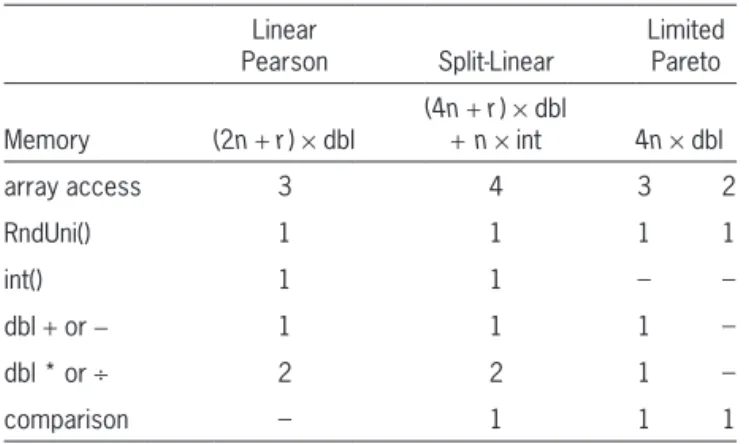
Table 1 summarizes the memory requirements and provides operation counts for each of the three meth­ ods. Please note that in the case of limited Pareto sampling, the operation counts depend on the random number generated, and therefore two columns of oper­ ation counts are provided. With probability (1−p) the selves to analyzing performance during the Monte

Carlo phase.

3.1. Pseudo code for resampling step

For all our methods we assume that the resampling parameters were pre­computed and stored during the initialization phase. Furthermore we assume that there are m data points and r standardized residuals.

The memory requirements for linear Pearson resid­ ual resampling are

Dim Residual(1 To r) As Double Dim Base(1 To n) As Double Dim Scale(1 To n) As Double

The pseudo code for resampling theith data point is Function ResampleLinearPearson

(i As Integer) As Double Dim j As Integer

j = 1 + int(RandUniform(0,1) * r) ‘ RandInteger(1,r)

Result = Base(i) + Scale(i) * Residual(j)

End Function (3.1)

The memory requirements for split­linear residual resampling are

Dim Residual(1 To r) As Double Dim FirstUp(1 To n) As Integer Dim BaseLow(1 To n) As Double Dim BaseUp(1 To n) As Double Dim ScaleLow(1 To n) As Double Dim ScaleUp(1 To n) As Double

The pseudo code for resampling theith data point is Function ResampleSplitLinear

(i As Integer) As Double Dim j As Integer

j = 1 + int(RandUniform(0,1) * r) ‘ RandInteger(1,r)

If j < FirstUp(i)

Result = BaseLow(i) + ScaleLow(i) * Residual(j)

Else

Result = BaseUp(i) + ScaleUp(i) * Residual(j)

End If

End Function (3.2)

(9)

models. Data set (B) is presented in the triangle form familiar to P&C actuaries in Pinheiro, Silva, and Cen­ teno (2003). Both triangles are included in appendix B for reference purposes. Linear Pearson rescaling fails for this second triangle (see Hartl 2010 for a detailed discussion). We are using it to demonstrate that the two alternative methods proposed in this paper do extend the applicability of the bootstrapping approach to triangle GLMs. To further demonstrate the flexibil­ ity of the GLM approach, the second model is fitted to the last five diagonals of the triangle (instead of the full triangle). Note that for data set B we only have 40 data points vs 55 data points for data set A (because we are only using the most recent five diagonals). In each case we are also sampling 45 future cells to simulate the process error component.

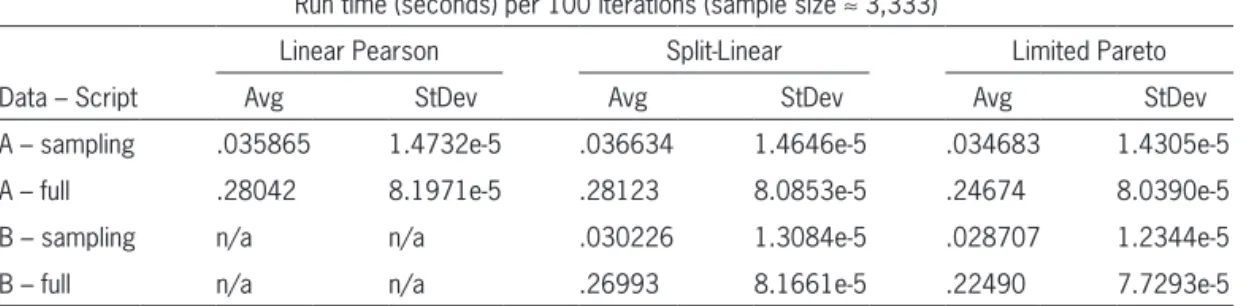
All the test results cited in this paper were pro­ duced with a VBA for Excel application that is available from the author on request. Because VBA for Excel is an interpreted language that is embed­ ded in a complex environment, reliably testing the performance is not straightforward. Since we cannot control for the variation in the environment, we have used a randomized sampling scheme, where we executed a fixed number of test runs and randomly chose which particular method to use for each test run. We ran two different test scripts for each triangle. The first test script (sampling) tested the resampling opera­ tion in isolation. Given our total number of test runs, we expect about 3,333 runs for each method, where each test run consists of resampling the triangle and simulating the reserve runoff 100 times. The second test script (full) tested the resampling methods in the context of the full bootstrapping simulation (i.e., including refitting the model, projecting the reserve based on the refitted model, and simulating the runoff of the reserve). Again, we expect about 3,333 test runs for each method, with 100 bootstrapping iterations each. The scripts were run on the author’s Lenovo X230 tablet (Intel Core i5, 2.6GHz, 4GB ram), under Windows 7(64 bit), with Excel 2010.

Table 2 summarizes the average run time and the standard deviation for 100 iterations, for each data first column applies, and with probabilityp, the second

column applies. The “int()” row refers to the truncation of the fractional part used in RandInteger; the “com­ parison” row refers the If . . . then . . . else block. For the memory row, dbl refers to a 64 bit floating point number, and int refers to a 32 bit integer (some systems may allocate 64 bits for an integer).

The computational cost for the various operations does depend on the programming language and plat­ form used. However, we can unambiguously con­ clude that split­linear rescaling requires slightly more operations (one additional array access, and one comparison) than linear Pearson rescaling. Compar­ ing linear Pearson rescaling to limited Pareto sam­ pling, we note that linear Pearson rescaling requires an additional multiplication operation, while limited Pareto sampling involves an additional comparison. The complexity of the comparison is similar to a sub­ traction operation, so we expect that on most plat­ forms, limited Pareto sampling will perform slightly better than linear Pearson rescaling. Limited Pareto rescaling additionally benefits from the reduced com­ plexity in case we sample the upper limit.

To provide some concrete examples, we have tested the methods on two actuarial development triangles. The first data set (A) is a US Industry Auto paid loss triangle taken from Friedland (2010, p. 107). This triangle was chosen because all three methods work, allowing us to benchmark them against each other. The second data set (B) is taken from the appendix to Taylor and Ashe (1983) and has been used by a num­ ber of authors to demonstrate stochastic reserving

Table 1. Memory requirement and operation counts

Linear

Pearson Split-Linear LimitedPareto

Memory (2n+ r) dbl (4n++n r) dbl int 4n dbl

array access 3 4 3 2

RndUni() 1 1 1 1

int() 1 1 − −

dbl+ or− 1 1 1 −

dbl * or 2 2 1 −

(10)

England, P. D., and R. J. Verrall, “Stochastic Claims Reserving in General Insurance,”British Actuarial Journal 8: 3, 2002, pp. 443–518.

Gluck, S. M., and G. G. Venter, “Stochastic Trend Models in Casualty and Life Insurance,” inEnterprise Risk Management Symposium, 2009.

Friedland, J. F.,Estimating Unpaid Claims Using Basic Techniques, 3rd ed., Arlington, Va.: Casualty Actuarial Society, 2010. Hartl, T., “Bootstrapping Generalized Linear Models for Devel­

opment Triangles Using Deviance Residuals,” CASE-Forum, Fall 2010.

Hartl, T., “GLMs for Incomplete Development Triangles,” pre­ sented at the Casualty Loss Reserving Seminar, 2013. McCullagh, P., and J. A. Nelder,Generalized Linear Models,

2nd ed., New York: Chapman and Hall, 1989.

Pinheiro, P. J. R., J. M. A. Silva, and M. D. L. Centeno, “Boot­ strap Methodology in Claim Reserving,”Journal of Risk and Insurance 70: 4, Dec. 2003, pp. 701–714.

Taylor, G. C., and F. R. Ashe, “Second Moments of Estimates of Outstanding Claims,” Journal of Econometrics 23: 1, 1983, pp. 37–61.

Appendix A

A.1. Derivation of equation (2.7):

The variance ofy* is given by

m y

y

(

)

σ =′ ′ − µ

1

* .

*

2 2

This can be split into separate summations for the lower and upper subset. After substituting the expressions from equation (2.6) we get

m c y

m c y

y l l l l

u u u u

(

)

(

(

)

(

)

)

σ = µ + − µ − µ

+ µ + − µ − µ

1

*

1

* . (A.1)

*

2 2

2 set and test script. All run times are in seconds and

pertain only to the Monte Carlo phase.

The VBA for Excel based performance compari­ son confirms the relative performance we expected based on our operation counts in Table 1.

4. Conclusions

We presented two new methods for generating pseudo data for bootstrapping a GLM. Split­linear rescaling is a residual based resampling technique that extends the class of triangle GLMs that can be bootstrapped, but it can fail for specific triangles. Sampling from a limited and shifted Pareto dis­ tribution is always possible (subject to practical limitations when the distribution becomes almost degenerate or effectively unlimited). Both methods are computationally inexpensive and comparable to linear Pearson residual rescaling. Further research is needed to explore the sensitivity of bootstrapped confidence intervals or tail measures to the resampling distribution employed.

Acknowledgments

This paper was written and revised while the author worked as an Assistant Professor at Bryant Univer­ sity, RI. The author is also grateful for the construc­ tive comments from the anonymous reviewers.

Bibliography

Davison, A. C., and D. V. Hinkley, Bootstrap Methods and their Application, New York: Cambridge University Press, 1997.

Table 2. Performance statistics

Run time (seconds) per 100 iterations (sample size 3,333)

Data – Script

Linear Pearson Split-Linear Limited Pareto

Avg StDev Avg StDev Avg StDev

A – sampling .035865 1.4732e-5 .036634 1.4646e-5 .034683 1.4305e-5

A – full .28042 8.1971e-5 .28123 8.0853e-5 .24674 8.0390e-5

B – sampling n/a n/a .030226 1.3084e-5 .028707 1.2344e-5

(11)

which completes the derivation of the equation for step 2 ■

A.3. Derivation of equation

for step 3 of (2.8):

Note that by lettingcl=cu= 1 transformation (2.6) mapsy* onto itself. As a special case of equation (2.7) we therefore get

m q q r r

y

(

(

l

)

yl

(

u

)

yu

)

σ =2* 1 µ − µ + σ + µ − µ + σ2 2* 2 2* .

Requiring the general transformation (2.6) to be variance preserving (i.e., 2

y* = 2y*), thus leads to

m q qc r rc

m q q r r

l l y u u y

l y u y

l u l u

(

)

(

)

(

)

(

)

(

)

(

)

µ − µ + σ + µ − µ + σ

= µ − µ + σ + µ − µ + σ

1

1

.

2 2

*

2 2 2

* 2 2 * 2 2 * 2 This expression can readily be simplified to yield

qclσ +yl rcuσ = σ + σyu q yl r yu.

2 * 2 2 * 2 * 2 * 2 Solving forcu we end up with

c c q

r

u l y

y l

u

(

)

= + − σ

σ

1 1 2 2* ,

* 2

completing the derivation of the equation for step 3 ■

A.4. Derivation of equation (2.10)

The support of the limited and shifted Pareto random variable defined by (2.9) is (ac, bc], with

x a

x c x a c b c

P X b c a

b

(

)

( ) ( ) ( ) = + ∈ − − = − =

f for , ,

.

2

The derivation of the formulas for the expected value can be simplified by considering the random variableY = X+ c (i.e., by reversing the shift). We obtain

y a

y y a b Y b

a b

( )

= ∈

(

)

( = )=

f 2 for , , P .

Note that the first summation ranges over theq

elements of y*l and the second summation ranges

over the r elements of yu*. For the time being, we

concentrate on simplifying the summation term for the lower subset. We start by grouping all the constant terms together, continue by expanding the square, and then simplify

c y c

c y c y c c

c y q c c

q c

q c c c c y

q c c c y

q qc c y

q c y

q qc

l l l l l

l l l l l l l l l l

l l l l l l l

l l l

l l l l l l l l l l

l l l l l l l l

l l l l l

l l l l

l l yl

(

)

(

)

(

)

(

)

(

(

)

(

)(

)

)

(

)

(

) (

)

(

)

(

)

(

)(

)

(

)

(

)

(

)

(

)

(

)

+ µ − µ − µ

= + µ − µ − µ + µ − µ − µ

= + µ µ − µ − µ

+ µ − µ − µ

= µ − µ − µ µ + µ − µ − µ +

= µ − µ − µ µ − µ + µ +

= µ − µ − µ +

= µ − µ + − µ

= µ − µ + σ

*

* 2 *

* 2 2 * * * * . 2 2 2 2 2 2 2 2 2 2

2 2 2 2 2

2 2 2 2

2 2

* 2

An analogous derivation shows that

c yu u u cu u u r u rcu yl

∑(

*+ µ − µ −

(

)

)

2= µ − µ +

(

)

2 2σ .

* 2 Substituting these last two expressions into equa­ tion (A.1) we end up with

m q qc r rc

y

(

(

l

)

l yl

(

u

)

u yu

)

σ =2*′ 1 µ − µ +2 2σ + µ − µ +2* σ ,

2 2

* 2

which completes the derivation of equation (2.7) ■

A.2. Derivation of equation

for step 2 of (2.8):

To guarantee the minimum percentage of mean condition we require

y*l1′ = µ +l c yl

(

*l1− µ = π µl

)

min .

Solving forcl we get

c y y l l l l l l l

= π µ − µ

− µ = µ − π µµ −

min min

* * ,

(12)

We can eliminate the first equation by setting

c=a− min. SubstitutingU= (1− min),p=a/b, and

V= V() leaves us with

a p a U

a

p a a p V

(

)

(

)

− = + − − − = 1 ln 2

1 ln .

2

2 2 2

Squaring the first equation and substituting into the second, we can eliminate the second equation by setting

p

a a U V

a U a U a V a ( ) = + + + = + + + 1

2 1 2 2 ,

2 2

2

2

2 2

where the second expression is obtained by expand­ ing (a+U)2 and then dividing all terms by 2a2. This

leaves us with only one remaining equation to satisfy

a a− lnp a U= + .

Note that at this point p is considered a function of a. We eliminate the additive a term, apply the exponential to both sides, and finally collect all terms on the left to get the equivalent equation

p e

U a

− =

1

0.

Substituting the above expression for 1/p, =U/a, andk=V/U2 we finally arrive at

k e

+ γ + + γ − γ =

1 1

2 0.

2

Note that sinceU,a 0, we are only interested in solutions with 0. Also note thatk 0. This com­ pletes the derivation of equation (2.13) ■

A.6. Existence of a unique solution

to equation (2.13)

Our analysis is aided by thinking of the LHS of equation (2.13) as defining a functionG( )

k e

( )

γ = + γ + + γ − γ

G 1 1

2 .

2 For the expected value ofY we have

E f P

1

ln ln 1 ln .

2

Y y y dy b Y b

ay

y dy b

a

b a ydy a

a b a a a a a

b a b a b a b

( )

( )

( ) ( )= + = = + = + = − + = −

For the second raw moment ofY we get

Y y y dy b Y b

ay

y dy b

a

b ady ab

a b a ab ab a

a b a b a b

( )

( )

( ) ( ) = + = = + = + = − + = −

E f P

2 .

2 2 2

2 2

2

2

From this we readily obtain the formula for the variance ofY:

Y Y Y

ab a a a

b

( )

( )

( )= − ( )

= − − −

Var E E

2 1 ln .

2

2 2 2

Noting thatX = Yc implies E(X) = E(Y) − c, and Var(X) = Var(Y), we can see that the following formulas hold:

X a a

b c

X ab a a a

b

( )

( )

( ) ( ) = − − = − − −

E 1 ln ,

Var 2 2 2 1 ln 2.

This completes the derivation of equation (2.10)■

A.5. Derivation of equation (2.13)

For convenience we repeat the system of equa­ tions (2.12)

a c y

a a

b c y

ab a a a

b V y

( )

( )

( )

− = π

− − =

− − − =

ˆ

1 ˆ

2 2 2 1 2 ˆ

ln

ln

(13)

stability or the speed of convergence. Also note that the particular form of equation (2.13) has been chosen to streamline the proof of the existence and unique­ ness of the solution to the system of equations (2.12). Numerical methods for solving (2.12) may also work with other equivalent representations (e.g., directly solving fora)■

A.8. Derivation of the formula

for pseudo code (3.2)

The linear Pearson rescaling transformation for a GLM with variance function V() and dispersion factor is given by

s

y*= + φyˆ V ˆ

( )

y iRnd( ),

while the split­linear transformation (2.6) is given by

y c y y

c y y

l l l

u u u

(

)

(

)

′ = µ + − µ ∈

µ + − µ ∈

   

y

y

l

u

* * ,if * *

* ,if * *.

Without loss of generality we can assume that the elements ofs have been indexed in ascending order, starting with index 1 for the smallest (i.e., most nega­ tive) residual. As before, we assume thaty* andl y*,u haveq andr data values, respectively. We can com­ bine both transformations into one transformation using the following definition:

y s i q

s i q

l

l l l

u u l

′ = + ≤

+ >

   

* base scale , if base scale , if .

The reader can easily verify that the parameters for this version are given by the following formulas:

c c y

c y

c c y

c y

l l l l

l l

u u u u

u u

( )

( )

( )

( )

= − µ +

= φ

= − µ +

= φ

base 1 ˆ

scale V ˆ

base 1 ˆ

scale V ˆ .

This completes the derivation of the formula used in pseudo code (3.2)■

We also need the first derivative

k e

( )

( )

′ γ = + + γ − γ

G 1 1 ,

and the second derivative

k e

( )

′′ γ = + − γ

G 1 .

We note the boundary conditions of G(0) = G (0)= 0, while G (0)=k 0.

Clearly G (ln(1 + k)) = 0, G ( ) 0 for 0 < < ln (1+k), and G ( )< 0 for ln(1+k). Given that G (0)= 0, we can conclude that there exists a unique value max ln(1+k) such that G ( max)= 0, G ( ) 0 for 0 < < max, and G ( )< 0 for max. Since we also have G(0)= 0, the same argument also implies that there exists a unique value root max such that G( root) = 0, G( ) 0 for 0< < root, and G( )< 0 for root.

This establishes that root is the unique solution to equation (2.13)■

A.7. Remarks on numerically

solving equation (2.13)

Using the definitions from Appendix A.6, we can apply the Newton­Raphson method to solve equation (2.13) using the iteration

i i i

i

( )

( )

γ = γ − γ

′ γ

+ G

G .

1

Without providing the details, we comment that the above iteration is guaranteed to converge to root, provided we can find an initial guess such that

0 max. Based on our analysis in Appendix A.6, we know that root max ln(1 + k) and that G ( ) < 0 if and only if max. So a brute force strategy for finding a suitable 0, is the following procedure (pseudo code):

Step 0 0= ln(1+k) Initialize 0

Step 1 0= 2 0 Double 0

Step 2 If G ( 0) 0 Repeat until 0 max

then go back to Step 1.

(14)

Appendix B

For reference we provide the data used to test the methods in section 3. Both data sets are given in incre­ mental format, organized as development triangles with rows corresponding to accident years and columns corresponding to development years.

B.1. Triangle A

This data set is taken from Friedland (2010, p. 107). We divided the amounts by 1,000.

18,539 14,692 6,831 3,830 2,004 869 456 226 109 89

20,410 15,680 7,169 3,900 2,049 954 464 253 122

22,121 16,855 7,413 4,173 2,173 1,005 544 249

22,992 17,104 7,672 4,326 2,270 1,015 500

24,093 17,703 8,108 4,449 2,401 1,053

24,084 17,315 7,671 4,514 2,346

24,370 17,120 7,747 4,538

25,101 17,602 7,943

25,609 17,998

27,230

B.2. Triangle B

This data set is taken from the appendix of Taylor and Ashe (1983). Note that the original data set is provided in claim count and severity format. We have rounded total paid claim amounts to the nearest integer.

357,848 766,940 610,542 482,940 527,326 574,398 146,342 139,950 227,229 67,948

352,118 884,021 933,894 1,183,289 445,745 320,996 527,804 266,172 425,046

290,507 1,001,799 926,219 1,016,654 750,816 146,923 495,992 280,405

310,608 1,108,250 776,189 1,562,400 272,482 352,053 206,286

443,160 693,190 991,983 769,488 504,851 470,639

396,132 937,085 847,498 805,037 705,960

440,832 847,631 1,131,398 1,063,269

359,480 1,061,648 1,443,370

376,686 986,608

Figure

Figure 1. Impact of different values of C
Table 2 summarizes the average run time and the standard deviation for 100 iterations, for each datafirst column applies, and with probability p, the second
Table 2. Performance statistics

References

Related documents

Japan’s universal health insurance system is composed of four main insurance systems, i.e., community health insurance for the self-employed and unemployed (National Health

These spectra along with literature spectra can aid assignment of a radical species residing on the cross-linked Tyr-His structure in the P M (associated radical)

While weight gain, relative breast weight, and relative abdominal fat pad weight were maintained across diets, average adipocyte size was decreased (P &lt; 0.0001) by feeding the

The functional complementation of the mutant strain with only the ABC transporter also restored the growth on cellulose, although the final protein content at the stationary phase

Keywords: Intimate partner violence, Lesbian, Non-physical forms of abuse, Queer... Intimate partner violence (IPV) is a term that refers to something much

The Collection Interface boolean add(Object o) boolean addAll(Collection c) void clear() boolean contains(Object o) boolean containsAll(Collection c) boolean

Our study aim is to evaluate changes in the team climate of surgical teams, associated with the introduc- tion of the perioperative briefings and debriefing in the operating

This result may be explained because Nurses and allied health professionals and Nonmedical support staff were the larger groups (46% and 23%, respectively, of the total sample)