Available Online at www.ijpret.com
271
INTERNATIONAL JOURNAL OF PURE AND
APPLIED RESEARCH IN ENGINEERING AND
TECHNOLOGY
A PATH FOR HORIZING YOUR INNOVATIVE WORK
ADAPTIVE DYNAMIC MOBILE COMPUTING ENVIRONMENT WITH CLOUD
COMPUTING - FUTURE CHALLENGES AND SCOPE
PROF. N. S. BAND
Department of Computer Science & Engg., IBSS COET, Amravati. Accepted Date: 27/02/2014 ; Published Date: 01/05/2014
\
Abstract:Cloud computing in mobile platforms has invoked a new wave of evolution in the
rapidly developing mobile world. Although several striking research work has been conducted in the high computing counterparts of mobile technology, the field of cloud computing for mobile world is vastly unexplored. In mobile cloud computing the mobile device acts as a remote Visualization, capturing user input and rendering the display updates received from the distant server. Varying wireless channel conditions, short battery lifetime and interaction latency introduce major challenges for the remote display of cloud applications on mobile devices. We introduce the concept of Mobile Cloud Computing (MCC), its inner workings and the various implementable architectures related to MCC. In MCC all application logic is executed on distant servers and only user interface Functionalities reside on the mobile device .
Keywords: Cloud Computing, Mobile Devices, Communication, Server, Clients.
Corresponding Author: PROF. N. S. BAND
Access Online On:
www.ijpret.com
How to Cite This Article:
Available Online at www.ijpret.com
272
INTRODUCTION
Mobile devices (e.g., Smartphone, tablet PCs, etc) are increasingly becoming an essential part of human life as the most effective and convenient communication tools not bounded by time and place. Mobile users accumulate rich experience of various services from mobile applications (e.g., iPhone apps, Google apps, etc), which run on the devices and/or on remote servers via wireless networks. The rapid progress of mobile computing (MC) [1],[2] becomes a powerful trend in the development of IT technology as well as commerce and industry fields. Mobile devices have proliferated at a spectacular rate, with more than 3.3 billion active cell phones in the world. Soon, improvements to today’s smart phones, such as high-bandwidth Internet access, high-definition video processing, and interactive video conferencing will be commonplace. The International Telecommunications Union has proposed fourth-generation (4G) wireless technology to increase bandwidth to maximum data rates of 100 Mbps for high-mobility situations and 1 GBPS for stationary and low-mobility scenarios like Internet hot spots. This translates into an increase in computational requirements of 10 to 1,000 times over previous third-generation (3G) wireless technologies, with a power budget of approximately 1 W for all the computation. Mobile cloud computing is the ability to take advantage of cloud computing resources and benefits with a mobile device like a smart phone or mobile phone. At the same time, the web hosts increasingly powerful computing resources and has evolved to a ubiquitous computer, offering applications ranging from simple word processors, over all-encompassing enterprise resource planning suites to 3D games [3] . Mobile and cloud computing technologies have enabled sophisticated pervasive applications. Yet, the applications on the latest generation of mobile devices today, e.g. smart phones and tablets, are still constrained by power consumption, speed of computation, size of memory, band width of wireless network, etc[4] . Since the Internet became popular, a mobile device might overcome the constraints by off loading portions of application work load on to a server machine via the network to save execution time and conserve energy [5]. Recently, cloud computing has changed software infrastructure sand business model soft Internet services with technologies to provide and manage a bund and sources of computation and data storage over the network at relatively low a mortised operation costs[1].
II. HOWMOBILECLOUDCOMPUTING WORKS
Available Online at www.ijpret.com
273
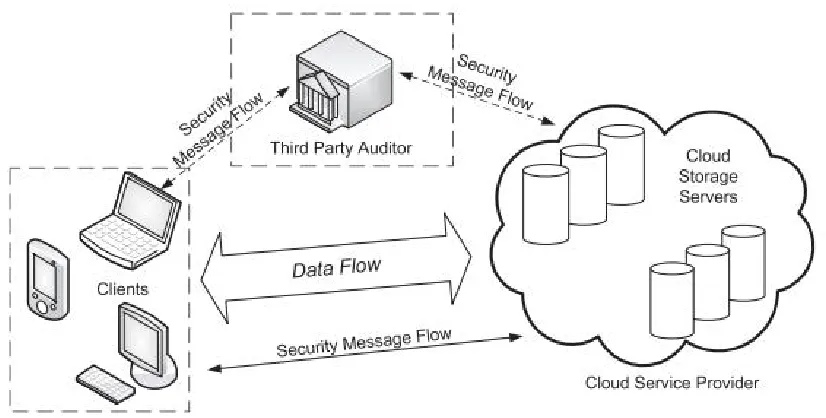
Client: an entity, which has large data files to be stored in the cloud and relies on the cloud for data maintenance and computation, can be either individual consumers or organizations;
Cloud Storage Server (CSS): an entity, which is managed by Cloud Service Provider (CSP), has significant storage space and computation resource to maintain the clients’ data;
Third Party Auditor: an entity, which has expertise and capabilities that clients do not have, distrusted to assess and expose risk of cloud storage services on behalf of the clients upon request.
A. Various Services are provided by Client and Server.
Sync :This service synchronizes all state changes made to the mobile or its applications back with the Cloud Server.
Push :It manages any state updates being sent as a notifications from the cloud server. This improves the user’s experience as it does not require the user to pro-actively check for new information.
Offline App :It is a service which carries the management capabilities to create smart coordination between low-level services like Sync and Push. It frees the programmer from the burden of writing code to actually perform synchronization as it is this service which decides synchronization management and mechanism which is best for the current state. The moment the data channel for any mobile application is established, all synchronizations and push notifications are automatically handled by Offline App service.
Network: It manages the communication channel needed to receive Push notifications from the server. It carries the ability to establish proper connections automatically. It is a very low-level service and it shields any low-low-level connection establishment, security protocol details by providing a high level interfacing framework.
Database: It manages the local data storage for the mo-bile applications. Depending on the platform it uses the corresponding storage facilities. It must support storage among the various mobile applications and must ensure thread safe concurrent access. Just like Network service it is also a low-level service.
Inter App Bus: This service provides low-level coordination/communication between the suite of applications installed on the device.
Available Online at www.ijpret.com
274
Figure 1. Architecture for Mobile Applications in Cloud Environment
B. Essential services that must be provided to the mobile apps by the server.
Sync : Server Sync service synchronizes device side App state changes with the backend services where the data actually originates. It also must provide a plugin framework to mobilize the backend data.
Push :Server Push service monitors data channels (from backend) for updates. The moment updates are detected, corresponding notifications are sent back to the device. If the device is out of coverage or disconnected for some reason, it waits in a queue, and delivers the push the moment the device connects back to the network.
Secure Socket-Based Data Service: Depending on the security requirements of the Apps this server side service must provide plain socket server or a SSL-based socket server or both.
Available Online at www.ijpret.com
275
Management Console: Every instance of a Cloud Server must have a Command Line application such as the Management Console as it provides user and device provisioning functionalities. In the future, this same component will have more device management features like remote data wipe, remote locking, remote tracking, etc.
III. LAYERED ARCHITECTURE.
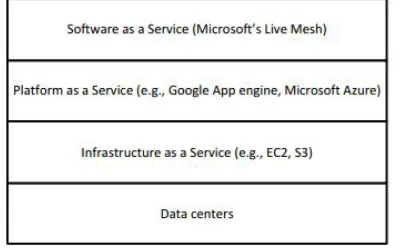
Cloud computing[1][2] is a large-scale distributed network system implemented based on a number of servers in data centers. In the upper layers of this paradigm, Infrastructure as a Service (IaaS), Platform as a Service (PaaS), and Software as a Service (SaaS) are stacked.
Figure 2. Layered architecture.
Data centers layer: This layer provides the hardware facility and infrastructure for clouds. In data center layer, a number of servers are linked with high-speed networks to provide services for customers.
Infrastructure as a Service (IaaS): IaaS is built on top of the data center layer. IaaS enables the provision of storage, hardware, servers and networking components. The client typically pays on a per-use basis. Thus, clients can save cost as the payment is only based on how much resource they really use.
Platform as a Service (PaaS): PaaS offers an advanced integrated environment for building, testing and deploying custom applications.
Software as a Service (SaaS): SaaS supports a software distribution with specific requirements. In this layer, the users can access an application and information remotely via the Internet and pay only for that they use.
IV. CHALLENGES IN CLOUD COMPUTING IN MOBILE ENVIRONMENT
Available Online at www.ijpret.com
276
Computing in which services and storage are provided over the Internet (or "cloud").Cloud computing is a general term for anything that involves delivering hosted services over the Internet. In the cloud paradigm, by putting the large data files on the remote servers, the clients can be relieved of the burden of storage and computation. As clients no longer possess their data locally, it is of critical importance for the clients to ensure that their data are being correctly stored and maintained[6] . More fundamental obstacles for mobile cloud computing emerge from the short battery lifetime of mobile devices, the limited and varying bandwidth on wireless links and the interaction latency between some user input and the update of the display. Although future of MCC is full of opportunities, but it has certain challenges as:
A.Communication Challenges: A Key Challenge for Cloud Computing is Network Availability and Intermittency. Because all Services will provided Via Internet[8]
B. Environment Challenges: The spaces in which mobile client and server that want to communicate are also an issue to be considered. This affects many other factors like delays and connectivity issues.
The following factors are essential to delivering a “good” cloud service [7]:
•Partitioning of application functions across cloud and device •Low network latency for faster responses
•High network bandwidth for faster data transfer between cloud and devices. •Adaptive monitoring of network conditions to optimize network and device costs.
V. ADVANTAGES OF CLOUD COMPUTING
One of the advantages of cloud computing is those both small and medium sized businesses can instantly obtain the benefits of the enormous infrastructure without having to implement and administer it directly[4][5].
•Reduced Cost: Cloud technology is paid incrementally, saving organizations money. •Increased Storage: Organizations can store more data than on private computer systems. •Highly Automated: No longer do IT personnel need to worry about keeping software up to date.
•Flexibility: Cloud computing offers much more flexibility than past computing methods. •More Mobility: Employees can access information wherever they are, rather than having to remain at their desks.
Available Online at www.ijpret.com
277
VI. CONCLUSION
Cloud architecture provides a new way to build applications on on-demand infrastructure. Without having any upfront investment, we were able to run a job massively distributed on multiple nodes in parallel and scale incrementally based on the demand (users, size of the input dataset). With no idle time, the application infrastructure was never underutilized. Mobile Cloud Computing (MCC) is one of mobile technology trends in the future since it combines the advantages of both mobile computing and cloud computing, thereby providing optimal services for mobile users. Whether you call it Cloud Computing or utility computing, the omnipresent power of high-speed internet connections and linkages to databases, applications and processing power . The challenges are discussed that may encounter in MMC Implementation.
VII. REFERENCE
1. Pieter Simoens, Filip De Turck member, IEEE , Bart Dhoedt member, IEEE , Piet Demeester Fellow, IEEE., “Remote display solutions for mobile cloud computing”, Digital Object Indentifier 10.1109/MC.2011.70 0018-9162/$26.00 2011 IEEE, Page No :- 1-6 .
2. Hoang T. Dinh, Chonho Lee, Dusit Niyato, and Ping Wang, “A Survey of Mobile Cloud Computing:
3. Architecture, Applications, and Approaches” , “Wireless Communications and Mobile Computing - Wiley” http://onlinelibrary.wiley.com/doi/10.1002/wcm.1203/abstract.
4. D. Sureshraj, Dr. V. Muralibhaskaran, Dr. D. Mahesh, “Intelligent Access Scheme Design for Mobile Cloud Computing” , International Journal of Emerging trends in Engineering and Development, ISSN 2249-6149 Issue1, Vol. 3(November-2011).
5. Amreen Khan and KamalKant Ahirwar, “MOBILE CLOUD COMPUTING AS A FUTURE OF MOBILE MULTIMEDIA DATABASE” International Journal of Computer Science and Communication Vol. 2, No. 1, January-June 2011, pp. 219-221.
6. Dejan Kovachev, Yiwei Cao and Ralf Klamma, “Mobile Cloud Computing: A Comparison of Application Models”,
Available Online at www.ijpret.com
278
8. Dr. Wendy A. Warr, Wendy Warr & Associates ([email protected], http://www.warr.com), November 2009 “Cloud Computing - Book”.
9. Ashish VijayJitendra Singh Yadav, Kamal Agrawal, Preeti Gupta, “Improvement and Performance of Mobile Environment using Cloud and Grid Computing”.
10.Wei Ren, Linchen Yu, Ren Gao, Feng Xiong, “Lightweight and Compromise Resilie nt Storage Outsourcing with Distributed Secure Accessibility in Mobile Cloud Computing” , T singhua Science And Technology ISSN ll 1007-0214ll 06/09 ll pp520-528 Volume 16, Number 5, October 2011.