Refereed papers
Current state of information technology
use in a US primary care practice-based
research network
James E Andrews PhD
Assistant Professor, School of Library and Information Science
Kevin A Pearce MD MPH
Associate Professor; Vice Chair, Academic Affairs, Department of Family Practice and Community Medicine
Carey Sydney MLS
Research Assistant, School of Library and Information Science
Carol Ireson PhD
Associate Professor, Center for Health Services Management and Research
Margaret Love PhD
Assistant Professor; Research Director, Department of Family Practice and Community Medicine University of Kentucky, USA
ABSTRACT
Objectives To examine the current levels of infor-mation technology (IT) use in a primary care practice-based research network (PBRN) in order to inform future development of its infrastructure.
Participants Every primary care practitioner who is a member of the Kentucky Ambulatory Network (KAN), as well as the office managers of each practice. Practitioners included family practitioners, general practitioners, nurse practitioners and physician assistants.
Methods A cross-sectional study using two survey instruments: one for office managers and one for practitioners. The office manager survey included questions related to the current state of IT within the practice, plans for enhancement and general IT issues from the perspective of managing a practice. The practitioner survey was designed to measure current IT use and attitudes of primary care practitioners.
Results Response rates for the surveys were 46% (n=68) for the office managers and 51% (n=116) for practitioners. All but one practice had internet access; however, 43% had only dial-up service. Only
21% of practitioners use an electronic medical record (EMR), with dollar cost being the barrier reported most frequently (58%). More than half of the office managers were either ‘somewhat interested’ (45%) or ‘very interested’ (17%) in a low-cost, standard-ised EMR that was, at the time, to be sponsored by the American Academy of Family Physicians. For practitioners, 71% were either ‘somewhat’ or ‘very’ interested in such a system. Responses to other IT issues are reported.
Conclusion While interest in enabling information technologies was high in KAN, adoption was variable, with use of several key technologies reported as low. The results suggest that research in this network that would be dependent on or enhanced by IT might be impeded and, generally, greater attention should be given to enhancing the IT infrastructure in primary care.
Introduction
Efforts to improve information technology (IT) supporting primary care are critical to enhancing health in the United States, because Americans rely so much on primary care providers for their health care.1–5This reliance is especially heavy in rural
com-munities.4,6 The defining characteristics of primary
care (first contact, comprehensiveness, accessibility, integration of services, sustained partnerships with patients over time, and orientation toward com-munities or populations served) result in very high complexity of practice content, and great diversity of practice settings.7–9Moreover, the complexity and
diversity of primary care lead to special challenges for effective use of health information technologies. Timely and accurate access to both patient-specific and knowledge-based information is critical to quality care, but major barriers to research and implementation of IT in primary care exist, and the US appears well behind informatics development in other nations.1,10,11
Primary care practice-based research networks (PBRNs; the UK equivalent are PCRNs, or Primary Care Research Networks) are collaborations of practising clinicians and expert researchers dedicated to developing practice-relevant research questions, designing and performing studies to answer these questions, and/or translating study results into everyday practice.12,13 As such, PBRNs offer a unique
‘laboratory’ for the investigation of primary care informatics problems in real-world practices serving a very broad array of patients in a variety of contexts. PBRNs also can provide an excellent vehicle for trans-lating advances in informatics into practice because the member practitioners tend to be opinion leaders among their colleagues, and their practices are good settings in which to test translation/dissemination strategies.
The Kentucky Ambulatory Network (KAN) is an emerging PBRN established in 2000. Its over-arching missions are to advance knowledge and to promote best practice at the primary care level through the study of common health problems in appropriate settings. In doing so, KAN seeks broadly to represent primary care practices in Kentucky, many of which are in rural communities (52% of Kentuckians live in rural areas). KAN is administered through the Department of Family Practice and Community Medicine at the University of Kentucky, in Lexington. Most of its member clin-icians are family practitioners located in central and eastern Kentucky, primarily in small private practices. KAN also includes a broad array of health services researchers and other academicians at the University of Kentucky and the University of Louisville.
Although not prerequisite, informatics can enhance the ability of a research network to conduct research and, to some extent, drives research methodology. Yet
prior to engaging in any level of informatics research it is necessary to examine the current state of IT in the practices that comprise the network. The purpose of this study was to explore IT use across KAN to offer a clearer picture to allow for more directed efforts to be pursued. Moreover, the results can be used in con-junction with other studies in the US to better inform policies needed to enhance the support of primary care informatics in the US (see Box 1).
Methods
We used a cross-sectional design that employed surveys of primary care practitioners (including phys-icians, nurse practitioners and physician assistants) and office managers to help determine their current technology status, and attitudes, knowledge and behaviours related to information technology use in the primary care setting. Practitioners from the university-based family practice offices were excluded from the study in order to achieve a sample of practices more representative of the primary care practising population in the state as a whole. That is, although KAN is a research network, most of its members are in smaller, non-academic practice settings, which is more representative of primary care practice in the state. Following a review of the literature, two survey instruments were developed. The first was designed for office managers of KAN-member practices; the second was for the primary care practitioners them-selves. Feedback on question wording and overall survey design was solicited from University of Kentucky Department of Family Practice faculty and staff, as well as other experts in survey design and research at the university. The final office manager survey was comprised of 28 questions (several of which have multiple parts) related to the current state of IT, includ-ing plans for future adoption. The final practitioner survey had 26 questions probing the practitioners’ current use of IT in their daily practice, their attitudes toward new technologies, plus their knowledge and use of various information resources, both online and print. The surveys are available online at: www.mc. uky.edu/kan/.The results presented here deal solely with the current state of use of IT in KAN practices; results from the questions related to information resource use are presented in a separate paper.14
response implied consent to participate, and assured participants that all individual responses would be kept confidential. Surveys were coded to track non-responders. A follow-up mailing to non-responders was done one month after the initial mailing. One of the co-investigators made phone calls to non-responders approximately one month after the second mailing as the final attempt to increase the response rate.
All statistical analyses were performed using SPSS v11.5, with a significance level of 0.05.
Results
Response rates
Of the 68 office manager surveys sent, 31 were completed and returned, giving a response rate of approximately 46%. Of the 116 practitioner surveys sent, 59 were returned: a response rate of approximately 51%, an adequate response rate.15From the surveys
returned, approximately three-quarters were from the initial mailing. The remainders were returned after a second mailing, with the exception of several that were sent after the follow-up call.
Demographics
Descriptive information relating to KAN practices showed that all respondents considered their practice to be ‘mostly office based’ (as opposed to either mostly or exclusively hospital based). The average number of physicians at each practice was 2.4 (ranging from 0–9); the average number of physician assistants was less than 1 (range: 0–2); the average number of nurse practitioners was nearly 1 (range: 0–5). The mean number of patient visits per year to each practice site was 17 180 (range: 550–100 000).
Approximately 60% of the practitioners responding were male, and 40% female. Thirty-five (30%) of all practitioner surveys sent were mailed to females, with 22 (63%) returned; 82 (71%) were sent to males, with 35 (43%) returned. Overall, 16 (62%) nurse
Box 1 Primary care in the United States
Primary care is usually the portal of entry through which individuals obtain medical services, and most Americans report having a primary care doctor.1,2Having a primary care doctor is associated
with better health outcomes than receiving care only from specialists, is a stronger predictor of good health outcomes than is insurance status, and improves the cost-effectiveness of medical care (especially in family practices).3–5
Along with family practitioners, general internists and general paediatricians constitute the main physician primary care workforce in the US. Of the total number (171 912) of professionally active physicians in primary care in 1996, 39% (66 421) were in general internal medicine, 21% in general paediatrics (36 300) and 40% in family/general practice (69 191).6
Physicians are not the only primary care providers in the US health system. Over the past quarter-century, there has been a significant development of non-physician clinicians (NPCs) in the United States, and in many cases, there has been a significant interest in their contribution to primary health care. It is estimated that as of 2001, there were around 7250 nurse practitioner (NP) graduates and 3400 physician assistants (PA). Approximately 95% of all NPs and 55% of all PAs are involved in primary care.7
1 Graham Center for Policy Studies in Family Practice and Primary Care. Policy Center One-Pager #2:Utilization Patterns and Usual Source of Care. December 1999.www.aafppolicy.org/library/
2 Green LA, Fryer GE Jr, Yawn BP, Lanier D and Dovey SM. The ecology of medical care revisited.New England Journal of Medicine2001;344:2021–5.
3 Leiyu S, Starfield B, Kennedy B and Kawachi I. Income inequality, primary care, and health indicators.Journal of Family Practice1999;48:275–84.
4 Leiyu S and Starfield B. Primary care, income inequality, and self-rated health in the United States: a mixed-level analysis. International Journal of Health Services2000;30:541–5.
5 Forrest C and Starfield B. The effect of first-contact care with primary care clinicians on ambulatory health care expenditures.Journal of Family Practice 1996;43:40–8.
6 American Medical Association. Physician Characteristics and Distribution in the US. Chicago, IL: American Medical Association, 1998.
practitioners or physician assistants sent their surveys back, whereas 41 (46%) of physicians did. Most of the nurses were female (four males and 22 females). Year of graduation from professional training was deter-mined for physicians. The median graduation year was 1994 (range: 1958–2001). The number of patients seen per week per practitioner ranged from 25–270, with a mean of 106. The average number of hours spent caring for patients per week was 43 (range: 8–80).
Information technology use and
attitudes in KAN
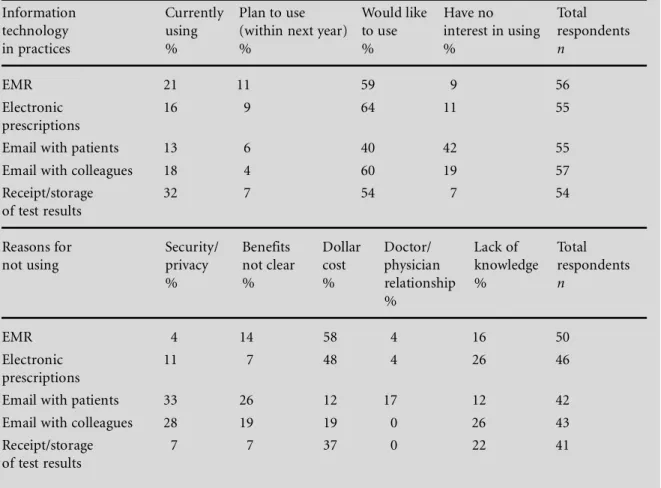
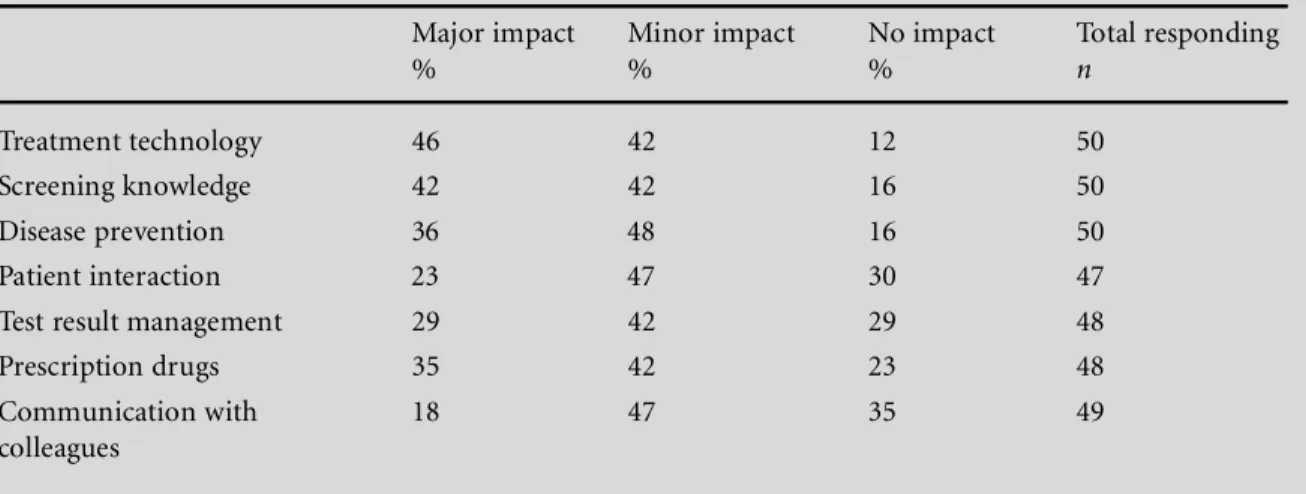
Table 1 shows the current use and attitudes towards particular IT applications, as well as reasons why these are not used. Table 2 shows how practitioners feel regarding the impact certain IT applications have had on their daily practice. A further description of the results is included in the subsequent sections.
Information technology infrastructure
Every practice reported having at least two desktop computers, with an average of about 13 per practice,
and one having 100. There were fewer laptops reported (average: 1.6; range 0–18), and still fewer handheld devices (mean 1; range: 0–6). A large majority of com-puters had as their operating systems either Microsoft Windows 2000 or XP; very few run any Macintosh operating systems.
Most practices (58%) reported that their existing information technology, including access to online resources, was adequate to support the goals of their organisation. Regarding plans to upgrade existing tech-nology, 32% stated they planned to within 12 months and 19% within the next two years, but nearly 36% did not have upgrade plans (13% planned to, but not within the next two years). Not surprisingly, a sig-nificant association was shown between feeling that IT capabilities were adequate within a practice and having no intention (or no intention within the next two years) of upgrading the IT (Pearson c2 [3] = 10.18;
P 0.005).
Approximately half of the practices stated they operated a local area network and half did not. Approximately 50% of the practices did not use any kind of integrated information system linking them with other organisations or practices; 10% use such a system for financial purposes, 13% for clinical, and 17% for both financial and clinical purposes.
Table 1 Practitioners’ current use and reasons for not using IT
Information Currently Plan to use Would like Have no Total technology using (within next year) to use interest in using respondents
in practices % % % % n
EMR 21 11 59 9 56
Electronic 16 9 64 11 55
prescriptions
Email with patients 13 6 40 42 55
Email with colleagues 18 4 60 19 57
Receipt/storage 32 7 54 7 54
of test results
Reasons for Security/ Benefits Dollar Doctor/ Lack of Total not using privacy not clear cost physician knowledge respondents
% % % relationship % n
%
EMR 4 14 58 4 16 50
Electronic 11 7 48 4 26 46
prescriptions
Email with patients 33 26 12 17 12 42
Email with colleagues 28 19 19 0 26 43
Receipt/storage 7 7 37 0 22 41
Administration and billing
Every practice noted that they used some kind of administrative database for billing or coding, 94% used one for scheduling, and 48% for laboratory test tracking or reporting. Far fewer used a database for quality assurance (23%), or external reporting of any kind (19%). Not surprisingly, nearly every practice reported using ICD-9, ICD-9CM or ICD-10 for coding. Many (77%) used CPT coding as well. To a large extent, the practitioners were primarily respon-sible for coding both billing data (63%) and patient data (80%).
Almost two-thirds (62%) of practitioners recorded their clinical work for billing purposes in paper form; 29% used a computer, 24% said it was generated auto-matically as part of clinical record taking processes, and about 11% used a personal digital assistant (PDA).
Use of mobile technology
Use of PDAs by practitioners was examined, with 48% of respondents stating they used a PDA as an integral part of their everyday practice, and 16% for mostly personal activities. However, 36% stated they did not use a PDA in their professional work. The top uses for PDAs in practice were: reference (e.g. drug information), 42%; medical calculators, 38%; and guidelines, 25%. The use of any kind of handheld device for recording clinical notes seemed low: 18% claimed they did this, and 6% said they would like to in the next year, 14% in the next two years, and 28% had no plans to record notes using a PDA. Nevertheless, 39% agreed and 37% strongly agreed that the use of handheld devices for electronic prescribing would substantially reduce medical errors and improve the quality of health care (7% disagreed, 3% strongly disagreed and 14% didn’t know).
Internet and email usage
The number of computers connected to the internet at each practice ranged from 0–100, with a mean of 8. Only one practice reported having no internet access and six (21%) only had one computer connected. Primarily, internet connections were via dial-up access (43%), with 20% having cable modem access and 23% using DSL; 14% reported ‘other’, noting a LAN or T1 connection.
Approximately 60% of practitioners had an email account, and 40% did not. When asked if they believed that the use of email to communicate with patients enhanced medical practice, 34% agreed and 7% strongly agreed, 24% disagreed and 9% strongly disagreed (27% said they did not know). Pearson Chi-square tests showed statistically significant relationships between practitioners’ beliefs that email with patients enhanced medical practice, and opinions that the fol-lowing patient/practitioner email activities are useful:
to ask questions when no visit is necessary (c2 [8] =
49.53;P 0.001)
to set up appointments (c2 [8] = 25.3;P 0.001) to renew prescriptions (c2 [8] = 36.76;P 0.001) to receive results of medical tests (c2 [8] = 24.79;
P 0.002).
Also, 52% of practitioners stated that patients often discussed with them information they received from the internet, 47% said this seldom occurred, and 2% said never. A majority (59%) of practitioners felt that patients who seek health information via the internet were more informed, 38% said they were about the same, and 3% said they seemed less well-informed. When asked how often (never, rarely, sometimes, fre-quently) they prescribed particular internet resources (either internet support groups or consumer health education information) to patients, practitioners answered in the following ways (see Table 3):
Table 2 IT impact on practice
Major impact Minor impact No impact Total responding
% % % n
Treatment technology 46 42 12 50
Screening knowledge 42 42 16 50
Disease prevention 36 48 16 50
Patient interaction 23 47 30 47
Test result management 29 42 29 48
Prescription drugs 35 42 23 48
Communication with 18 47 35 49
Electronic medical records
Both the office manager and practitioner surveys included a question asking about their interest in a recent proposal by the American Academy of Family Physicians (AAFP) to develop a low-cost, standardised electronic medical record (EMR).16 Of those office
managers responding to this question, 45% were somewhat interested, 17% very interested, and 24% were not interested (14% didn’t know). There was not a statistically significant correlation between the perception that IT is adequate in a practice and inter-est in an EMR.
Of the practitioners responding to this question, most replied that they either were somewhat (37%) or very (34%) interested in this, reconfirming a fairly solid interest in EMRs in the primary care community.
Discussion
While interest in potentially enabling IT was shown to be high in KAN, adoption appeared variable and may still be in flux, and the use of several key technologies was reported as low. For instance, we found near-universal use of IT for billing. Also, use of handheld devices, and the perception that they may reduce errors when used to support some functions may be on the rise. Internet access was nearly ubiquitous in our sample, but 43% still have only dial-up access. While interest in EMRs is high, adoption is still very low. Thus, generally speaking, despite calls at a national level regarding the importance of IT for improving quality and safety, penetration in primary care in Kentucky appears low. Practices and practitioners appear to be willing to adopt new technologies, but various practical barriers remain a concern.
For the KAN and similar research networks, this lack of a consistent IT infrastructure implies clear limits on the types of IT-dependent research activities in which the network can engage. For instance, given how few practices there are that operate an EMR,
studies utilising EMR-based data would be severely limited. On the other hand, since interest in EMRs was high in this PBRN, further assessments of barriers and motivations to EMR adoption are clearly needed. An earlier focus group meeting of KAN practitioners, during the 2002 Annual KAN Convocation, showed barriers to EMR adoption not unlike what is reported here. For instance, many revealed concerns not only about cost, but also maintenance, training and security. These, among other barriers, are common themes in the literature as well.2,3,17,18 Professional
society endorsement of one or more EMR products could be a step toward addressing some of these bar-riers (such as cost, stability, maintenance and need for standards), and the high levels of interest reported seem promising. An online survey conducted by the AAFP showed only 24% of practitioners reported using an EMR currently, and 82% would be interested in an AAFP-sponsored EMR.18
It is interesting to note, however, that the presence of technology is not sufficient to move practices toward the most efficacious use of IT for both the strategic and operational collection and management of clin-ical information. This was found in a study conducted by Thiru et alof a UK primary care research network, which used survey methods similar to ours.19 The
researchers there examined how practices in a research network are making progress toward ‘paperless’ practice. Their findings are interesting in that they suggest policy issues that the US is likely to encounter as national efforts to support IT in primary care con-tinue to emerge. For instance, in addition to noting that having various IT applications does not guarantee a move toward solely computer-based operations and data collection, the very definition of what it means to be a paperless practice is inconsistent across the network and between managers and clinicians.
Our study was limited in that it examined tech-nology use by a single PBRN in a particular region of the US. However, the KAN’s replication of the National Ambulatory Medical Care Survey (KAN NAMCS-Plus) shows its profile to be similar to national NAMCS data collected by the Centers for Disease Control in terms of patient demographics and types of cases
Table 3 Frequency of prescribing internet health resources to patients
Never Rarely Sometimes Frequently Total responding
% % % % n
Internet support groups 49 21 25 5 57
Consumer health 21 14 50 16 58
encountered.20 The response rate for the office
manager survey was lower than anticipated and the practitioner survey responses were adequate, particu-larly given the relatively long length of that survey. A comparison of responders and non-responders with the practitioner survey showed that they appeared to be similar in terms of types of practices and other demographic characteristics.
Although only a snapshot of the current state of use of IT in KAN, this study was a necessary step toward future research that will help the network better iden-tify and prioritise opportunities for future primary care research using, or focused on, IT. For instance, regarding the issues of EMR adoption, an obvious issue is that the purchase and implementation of these systems is based on individual practice decisions and outside the role of KAN. Researchers from KAN are developing qualitative studies to examine those prac-tices that have adopted an EMR. These will provide richer descriptions of such issues as vendor choice, processes for implementation, and how these organ-isations have dealt with the aforementioned barriers to EMR adoption. We have already set up a website accessible by KAN members where such informa-tion can be disseminated, and where individuals will be able to communicate their concerns and questions.
Other future directions of this effort in KAN will be focused on specific informatics needs assessments and innovative approaches to measuring the value of health information technologies in order to garner support for developing an informatics infrastructure suitable for KAN and to serve as a model for other networks. This sort of work is a national priority, as evidenced by major government funding initiatives from such agencies as the Agency for Healthcare Research and Quality (AHRQ; www.ahrq.gov) and the National Library of Medicine (NLM;www.nlm.nih.
gov).
ACKNOWLEDGEMENTS
Support for this project comes from the Agency for Healthcare Research and Quality grant number R21 HS13487-01. We would also like to acknowledge the supporting efforts of Mary Barron, Research Nurse for the Kentucky Ambulatory Network.
REFERENCES
1 Bates D, Ebell M, Gotlieb E, Zapp J and Mullins H. A proposal for electronic medical records in US primary care. Journal of the American Medical Informatics Association2003;10(1):1–10.
2 Bates D and Gawande A. Improving safety with infor-mation technology. New England Journal of Medicine
2003;348(25):2526–34.
3 Bodenheimer T and Grumbach K. Electronic technology: a spark to revitalize primary care?Journal of the American Medical Association2003;290(2):259–64.
4 Green LA, Fryer GE Jr, Yawn BP, Lanier D and Dovey SM. The ecology of medical care revisited. New England Journal of Medicine2001;344:2021–5.
5 Fryer GE, Green LA, Dovey SM and Phillips RI Jr. The United States relies on family physicians unlike any other specialty.American Family Physician2001;16:565–80. 6 Council on Graduate Education.Tenth Report.Physician
Distribution and Health Care Challenges in Rural and Inner-City Areas. Washington DC: US Dept of Health and Human Services, 1998.
7 Declaration of Alma-Ata. International Conference on Primary Health Care, Alma-Ata. USSR, 6–12 September, 1978.
8 Institute of Medicine: Donalson MS, Yordy KP, Lohr KN and Vanselow NA (eds).Primary Care: America’s health in a new era. Washington, DC: National Academy Press, 1996.
9 US Department of Health and Human Services. Ambu-latory care visits to physician offices, hospital outpatient departments and emergency departments: United States 1997.Vital and Health Statistics1999; 13(143).
10 Institute of Medicine.Crossing the Quality Chasm: a new health system for the 21st century. Washington, DC: National Academy Press, 2001.
11 Kohn L, Corrigan J and Donaldson ME.To Err Is Human: building a safer health system. Washington, DC: National Academy Press, 2000.
12 Nutting PA, Beasley JW and Werner JJ. Practice-based research networks answer primary care questions.Journal of the American Medical Association1999;281:686–8.
13 Agency for Healthcare Research and Quality. Primary Care Practice-Based Research Networks. Fact Sheet, June 2001. AHRQ Publication No. 01-P020. Rockville, MD: Agency for Healthcare Research and Quality, 2001.
www.ahrq.gov/research/pbrnfact.htm
14 Andrews JE, Pearce KP, Sydney C and Ireson C. Information needs of practitioners in a primary care practice-based research network (PBRN). Article sub-mitted to the Journal of the Medical Library Association. 15 Babbie E.The Practice of Social Research (9e). Stamford,
CT: Wadsworth, 2001.
16 Bush J. Open-source software: just what the doctor ordered.Family Practice Management2003;10(6):65–9.
17 Healthcare Information and Management Systems Society. 2002 HIMSS/AstraZeneca Clinician Survey. Survey; 4 November 2002.
18 American Academy of Family Physicians member survey of EHR use and interest. Leawood, Kan: AAFP, January 2003.www.aafp.org/x19997.xml
19 Thiru K, de Lusignan S and Shaw N. Paperless practices: a report from a research network.Informatics in Primary Care 2002;10:89–94.
20 Pearce KP, Love M, Barron M et al. How and why to study the practice content of a practice-based research network.Annals of Family Medicine2004: in press.
CONFLICTS OF INTEREST
ADDRESS FOR CORRESPONDENCE
James E Andrews PhD Assistant Professor University of Kentucky
School of Library and Information Science 502 King Library South
Lexington, KY 40506 USA
Tel: +1 859 257 8657 Email: [email protected]